Ezekiel 35:13

Hebrew (Westminster Leningrad Codex) Ezekiel 35:13 appears in the Hebrew Old Testament. The text above is from the Westminster Leningrad Codex. Each word links to its Strong’s number, a concise gloss, and parsing drawn from the Open Scriptures Hebrew Bible morphology. Click any word for its full Brown-Driver-Briggs (BDB) entry.
Download image
Cite this verse

Ezekiel 35:13 (World English Bible). Public Domain. Lemma interlinear Bible study tool, https://lemma.gebible.app/v/ezekiel/35/13.

Show BibTeX & RIS
BibTeX
RIS
English Translation
You have magnified yourselves against me with your mouth, and have multiplied your words against me: I have heard it.
World English Bible · Public Domain
Download a study sheet

One document with this verse’s original text, its word-by-word gloss line, the meaning frame, cross-references with their text, attributed commentary, and full source and license credits — printable, and it pastes into notes with its structure intact.

This verse Autodidact and up

Study sheet (.html) Plain text (.txt)

A passage Seminary Student

Up to 50 verses in one chapter. A passage sheet keeps up to 6 commentary sources and 12 cross-references per verse, in the order this page ranks them, and says so on the sheet whenever that leaves anything out. Ask for a single verse and you get the Autodidact verse sheet above.

Everything on this page stays free to read, with no account — the sheet is a download of what is already on screen, not access to it.

Want to remove ads? Support Godless Engineer
Compare translations 3

The same verse in 3 English versions, stacked beneath the original-language interlinear above. Click any original word for its lexicon entry.

Each is an independent rendering of the whole verse — the interlinear is not word-aligned to these translations.

Highlighted words mark where these versions differ — a whole-verse word diff, not a word-by-word alignment.

  • World English Bible Public Domain
    You have magnified yourselves against me with your mouth, and have multiplied your words against me: I have heard it.
  • King James Version Public Domain
    Thus with your mouth ye have boasted against me, and have multiplied your words against me: I have heard them.
  • unfoldingWord Literal Text CC BY-SA 4.0
    You exalted yourselves against me with what you said, and you multiplied the words you said against me; and I heard it all.

unfoldingWord Literal Text — © unfoldingWord, licensed CC BY-SA 4.0. Word-aligned USFM3 via Door43 (git.door43.org/unfoldingWord/en_ult).

Versions to compare (up to 4)

3 of 4 selected

Show all 18 translations

Every available English version of this verse, each an independent rendering of the whole verse.

  • World English Bible Public Domain
    You have magnified yourselves against me with your mouth, and have multiplied your words against me: I have heard it.
  • Berean Standard Bible Public Domain
    You boasted against Me with your mouth and multiplied your words against Me. I heard it Myself!
  • Majority Standard Bible Public Domain
    You boasted against Me with your mouth and multiplied your words against Me. I heard it Myself!
  • King James Version Public Domain
    Thus with your mouth ye have boasted against me, and have multiplied your words against me: I have heard them.
  • American Standard Version (1901) Public Domain
    And ye have magnified yourselves against me with your mouth, and have multiplied your words against me: I have heard it.
  • Revised Version (1885) Public Domain
    And ye have magnified yourselves against me with your mouth, and have multiplied your words against me: I have heard it.
  • Geneva Bible (1599) Public Domain
    Thus with your mouthes ye haue boasted against me, and haue multiplied your words against me: I haue heard them.
  • Douay-Rheims (1899) Public Domain
    And you rose up against me with your mouth, and have derogated from me by your words: I have heard them.
  • Young's Literal Translation Public Domain
    And ye magnify yourselves against Me with your mouth, And have made abundant against Me your words, I -- I have heard.
  • Literal Standard Version CC BY-SA 4.0
    And you magnify yourselves against Me with your mouth, || And have made your words abundant against Me; I have heard.
  • Unlocked Literal Bible CC BY-SA 4.0
    You exalted yourselves against me with what you said, and you multiplied the words you said against me; and I heard it all.
  • unfoldingWord Literal Text CC BY-SA 4.0
    You exalted yourselves against me with what you said, and you multiplied the words you said against me; and I heard it all.
  • Darby Bible Public Domain
    And ye have magnified yourselves against me with your mouth, and have multiplied your words against me: I have heard [them].
  • World Messianic Bible Public Domain
    You have magnified yourselves against me with your mouth, and have multiplied your words against me. I have heard it.”
  • Webster's Bible Public Domain
    Thus with your mouth ye have boasted against me, and have multiplied your words against me: I have heard them.
  • Free Bible Version CC BY-SA 4.0
    You made a lot of boasts attacking me—you had much to say against me. I heard it for myself!
  • Bible in Basic English Public Domain
    And you have made yourselves great against me with your mouths, increasing your words against me; and it has come to my ears.
  • JPS Tanakh (1917) Public Domain
    And ye have magnified yourselves against Me with your mouth, and have multiplied your words against Me; I have heard it.

Literal Standard Version (2020), Covenant Press — licensed CC BY-SA 4.0. Text via the HelloAO Bible API (eBible.org). Unlocked Literal Bible (unfoldingWord) — licensed CC BY-SA 4.0. Text via the HelloAO Bible API (eBible.org). unfoldingWord Literal Text — © unfoldingWord, licensed CC BY-SA 4.0. Word-aligned USFM3 via Door43 (git.door43.org/unfoldingWord/en_ult). Free Bible Version, Dr. Jonathan Gallagher — licensed CC BY-SA 4.0. Text via the HelloAO Bible API (eBible.org).

Word by word

More ways to search: Search by grammar → Find every occurrence → Compare this word →

Practice this passage: Drill this verse → Learn its vocabulary →

וְהַעְתַּרְתֶּ֥ם
ʻâthar
H6280
“and · to multiply”
Conjunction + Verb, Hiphil, Sequential Perfect, 2nd Person, Masculine, Plural
Part of Speech
Conjunction + Verb
Stem
Hiphil
Form
Sequential Perfect
Person
2nd Person
Gender
Masculine
Number
Plural
Full BDB Definition

Origin: a primitive root

TWOT: 1723

to be abundant - (Niphal) to be plentiful - (Hiphil) to multiply, become abundant
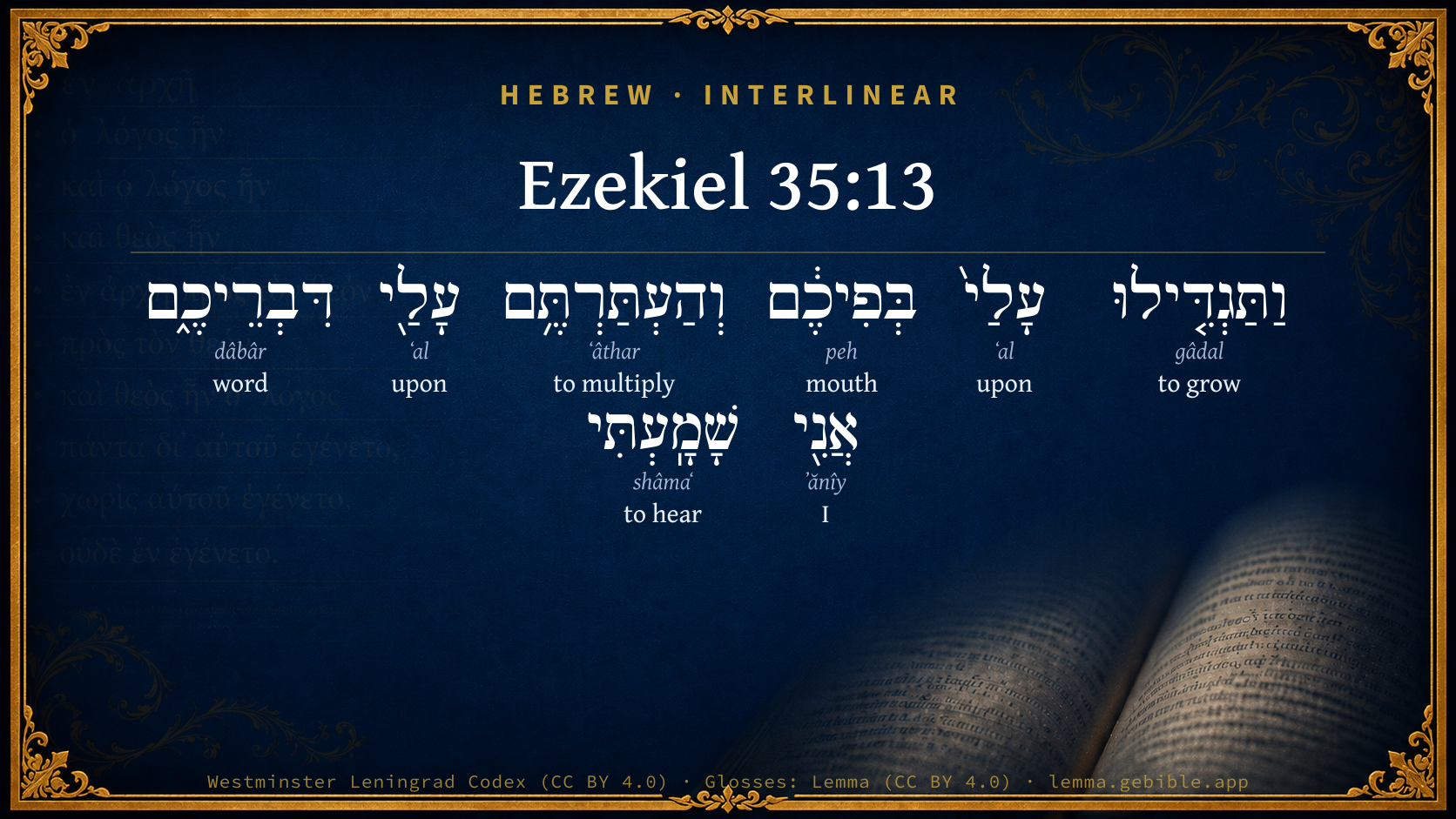
  1. וַתַּגְדִּ֤ילוּ gâdal H1431 “and · to grow” Conjunction + Verb, Hiphil, Sequential Imperfect, 2nd Person, Masculine, Plural
  2. עָלַי֙ ʻal H5921 “upon · me” Preposition + Suffix, Personal, 1st Person, Common, Singular
  3. בְּפִיכֶ֔ם peh H6310 “in/at · mouth · your” Preposition + Noun, Common, Masculine, Singular, Construct + Suffix, Personal, 2nd Person, Masculine, Plural
  4. עָלַ֖י ʻal H5921 “upon · me” Preposition + Suffix, Personal, 1st Person, Common, Singular
  5. דִּבְרֵיכֶ֑ם dâbâr H1697 “words · your” Noun, Common, Masculine, Plural, Construct + Suffix, Personal, 2nd Person, Masculine, Plural
  6. אֲנִ֖י ʼănîy H589 “I” Pronoun, Personal, 1st Person, Common, Singular
  7. שָׁמָֽעְתִּי shâmaʻ H8085 “to hear” Verb, Qal, Perfect, 1st Person, Common, Singular

About this verse

These counts appear in no published source. They are computed here, from the morphology-tagged text and Lemma’s own curated glosses. What Lemma adds →

8
words
7
distinct lemmas
Prophets
section

Notable vocabulary

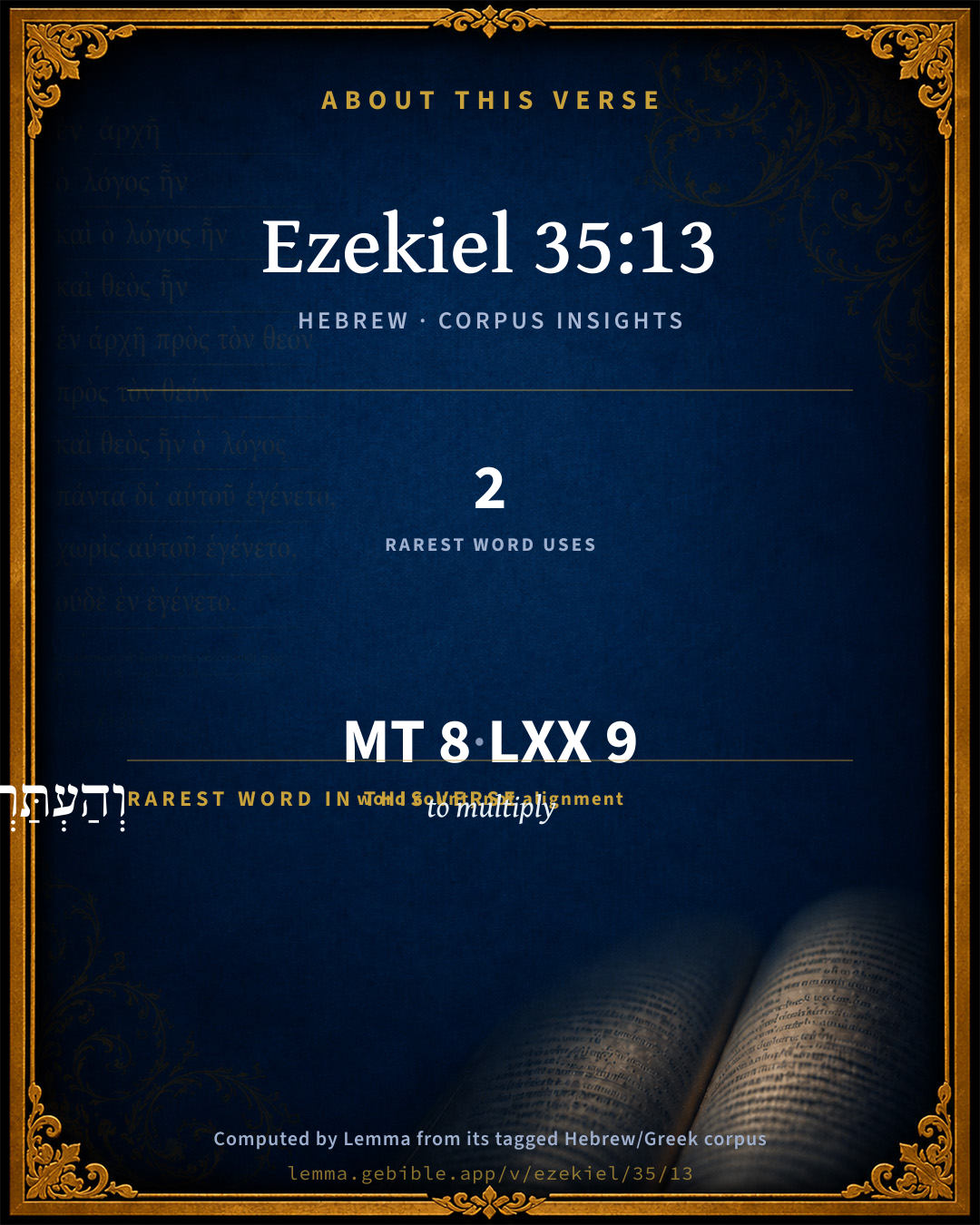
The rarest word here is וְהַעְתַּרְתֶּ֥ם to multiply H6280 — appearing just 2 times in the whole Hebrew Bible.

Shared distinctive vocabulary

וְהַעְתַּרְתֶּ֥ם to multiply H6280 occurs in 2 verses of the Hebrew Bible. Also found in:

Grammatical profile

  • 3 verbs
  • 2 nouns
  • 1 pronoun
  • 2 prepositions

Verb forms

  • וַתַּגְדִּ֤ילוּ Hiphil · Sequential Imperfect
  • וְהַעְתַּרְתֶּ֥ם Hiphil · Sequential Perfect
  • שָׁמָֽעְתִּי Qal · Perfect

Repetition

A word recurs within this verse — often emphatic in Hebrew:

  • עָלַי֙ upon H5921 ×2

Hebrew & Septuagint length

In English translation the verse runs 20 words from the Hebrew and 15 from the Septuagint (LXX English) — closely comparable.

A rough comparison of the two English renderings, which tokenize alike — not a word-level alignment.

Word counts can differ between the Hebrew and the Greek without any difference in meaning — e.g. the Hebrew direct-object marker אֵת has no separate Greek word, and Greek often adds the article ὁ.

In the original languages it is 8 Hebrew tokens and 9 Greek tokens — but the two are counted differently (Hebrew bundles its prefixes and suffixes into one token; the Greek is in lemma form), so that isn’t a like-for-like length.

Cross-references

22

Topical passages linked to Ezekiel 35:13 in the Treasury of Scripture Knowledge — connected by theme and wording, ordered by reader-vote popularity; previews shown in the World English Bible.

  • Daniel 11:36 The king shall do according to his will; and he shall exalt himself, and magnify himself above every god, and shall speak marvelous things against the God of gods; and he shall prosper until the indignation be accomplished; for that which is determined shall be done.
  • 1 Samuel 2:3 Talk no more so exceeding proudly; Don't let arrogance come out of your mouth; For Yahweh is a God of knowledge, By him actions are weighed.
  • Isaiah 36:20 Who are they among all the gods of these countries, that have delivered their country out of my hand, that Yahweh should deliver Jerusalem out of my hand?
  • Jeremiah 29:23 because they have worked folly in Israel, and have committed adultery with their neighbors' wives, and have spoken words in my name falsely, which I didn't command them; and I am he who knows, and am witness, says Yahweh.
  • Ezekiel 35:12 You shall know that I, Yahweh, have heard all your insults which you have spoken against the mountains of Israel, saying, They are laid desolate, they are given us to devour.
  • Numbers 14:27 How long [shall I bear] with this evil congregation, that murmur against me? I have heard the murmurings of the children of Israel, which they murmur against me.
  • 2 Kings 19:28 Because of your raging against me, and because your arrogance is come up into my ears, therefore will I put my hook in your nose, and my bridle in your lips, and I will turn you back by the way by which you came.
  • 2 Chronicles 32:15 Now therefore don't let Hezekiah deceive you, nor persuade you after this manner, neither believe you him; for no god of any nation or kingdom was able to deliver his people out of my hand, and out of the hand of my fathers: how much less shall your God deliver you out of my hand?
  • 2 Chronicles 32:19 They spoke of the God of Jerusalem, as of the gods of the peoples of the earth, which are the work of men's hands.
  • Job 34:37 For he adds rebellion to his sin. He claps his hands among us, And multiplies his words against God."
  • Job 35:16 Therefore Job opens his mouth with empty talk, And he multiplies words without knowledge."
  • Psalms 73:8–9 They scoff and speak with malice. In arrogance, they threaten oppression.
  • Ecclesiastes 10:14 A fool also multiplies words. Man doesn't know what will be; and that which will be after him, who can tell him?
  • Isaiah 10:13–19 For he has said, By the strength of my hand I have done it, and by my wisdom; for I have understanding: and I have removed the bounds of the peoples, and have robbed their treasures, and like a valiant man I have brought down those who sit [on thrones]:
  • Isaiah 37:10 Thus shall you speak to Hezekiah king of Judah, saying, Don't let your God in whom you trust deceive you, saying, Jerusalem shall not be given into the hand of the king of Assyria.
  • Isaiah 37:23 Whom have you defied and blasphemed? and against whom have you exalted your voice and lifted up your eyes on high? [even] against the Holy One of Israel.
  • Isaiah 37:29 Because of your raging against me, and because your arrogance is come up into my ears, therefore will I put my hook in your nose, and my bridle in your lips, and I will turn you back by the way by which you came.
  • Malachi 3:13 "Your words have been stout against me," says Yahweh. "Yet you say, 'What have we spoken against you?'
  • 2 Peter 2:18 For, uttering great swelling words of emptiness, they entice in the lusts of the flesh, by licentiousness, those who are indeed escaping from those who live in error;
  • Jude 1:15 to execute judgment on all, and to convict all the ungodly of all their works of ungodliness which they have done in an ungodly way, and of all the hard things which ungodly sinners have spoken against him."
  • Revelation 13:5–6 A mouth speaking great things and blasphemy was given to him. Authority to make war for forty-two months was given to him.
  • Exodus 16:12 "I have heard the murmurings of the children of Israel. Speak to them, saying, 'At evening you shall eat meat, and in the morning you shall be filled with bread: and you shall know that I am Yahweh your God.'"

Cross-references courtesy of OpenBible.info (CC BY 4.0).

Hebrew and Greek witnesses Masoretic Hebrew ↔ Greek Septuagint

The same verse in the two great witnesses to the Old Testament, shown verse-for-verse.

These are two independent witnesses, not word-aligned to each other, and the Septuagint is shown in lemma (dictionary) form.

Hebrew Ezekiel 35:13 Masoretic · Westminster Leningrad Codex

וַתַּגְדִּ֤ילוּ עָלַי֙ בְּפִיכֶ֔ם וְהַעְתַּרְתֶּ֥ם עָלַ֖י דִּבְרֵיכֶ֑ם אֲנִ֖י שָׁמָֽעְתִּי

You have magnified yourselves against me with your mouth, and have multiplied your words against me: I have heard it.

World English Bible · Public Domain

Greek LXX Ezekiel 35:13 Septuagint · lemma form

καί μεγαλορημονέω ἐπί ἐγώ ὁ στόμα σύ ἐγώ ἀκούω

and you have spoken swelling words against me with your mouth: I have heard them.

LXX2012 (modern English Septuagint) · Public Domain

On this verse, Haydock's Catholic Bible Commentary discusses the Septuagint’s reading. Read the note in Commentary ↓

Hebrew: Westminster Leningrad Codex (CC BY 4.0). Greek: Septuagint (public domain); English from LXX2012 (modern English Septuagint) (Public Domain). How the Septuagint differs from the Hebrew →

Targum (Aramaic paraphrase)

1

The Targum is the ancient Jewish Aramaic paraphrase of the Hebrew Scriptures — an interpretive translation, not the Hebrew text itself. Onkelos (literal) and Pseudo-Jonathan (expansive) render the Torah, and Jonathan the Prophets. Coverage is partial: where no permissively-licensed English translation exists for a verse, only the Aramaic is shown. This is verse-level text, not a word-by-word alignment to the Hebrew.

  1. Targum Jonathan Prophets (Joshua–Malachi)
    וְאִתְרַבְרַבְתּוּן עֲלַי בְּמִלֵי פּוּמְכוֹן וְאַסְגֵיתוּן עֲלַי פִּתְגָמֵיכוֹן קֳדָמַי שְׁמִיעַ:

    (no public-domain English translation for this verse)

    Targum Jonathan — Aramaic: “Mikraot Gedolot” (public domain). English: “Sefaria Community Translation” (CC0 1.0 (public-domain dedication)); “London "Chaldee Paraphrase," 1871” (public domain). Text via Sefaria.

Commentary

Notes on Ezekiel 35:13 from classic Christian and Jewish commentators (each source and its license shown beneath its notes). The classic Christian expositions comment on the surrounding passage and are grouped to its opening verse, so a note may address several verses; the Jewish commentaries on the Tanakh (Rashi and others) are per-verse, so they appear only where the commentator wrote on this verse.

Lemma curates 59 commentaries, every one of them public domain or Creative Commons licensed, each selected and text-cleaned for this edition rather than reprinted as found. About our sources →

Trapp's Complete Commentary

John Trapp

Eze 35:13 Thus with your mouth ye have boasted against me, and have multiplied your words against me: I have heard [them].

Ver. 13. Thus with your mouth ye have boasted.] Heb., Magnified, setting your mouths against heaven, your tongues also have walked through the earth. {Psa 73:9; see the notes there}

And have multiplied your words against me.] When it would have better become you to have multiplied your words before me in prayer and praises, as the Hebrew word ( עתר) here used, mostly signifieth.

John Trapp, A Commentary or Exposition upon All the Books of the Old and New Testament (1647–1656) — public domain. Text from a community e-Sword module.

Joseph Benson's Commentary

Eze 35:13-15. With your mouth ye have boasted against me — As if I were not able to make good my promises toward my people, or to assert my right in Judea. When the whole earth rejoiceth, I will make thee desolate — When I shall restore other countries, conquered by the king of Babylon, to their former prosperity, thou shalt still lie waste and desolate. The Edomites never recovered their country after the Nabatheans had expelled them out of it. Thou shalt be desolate, all Idumea — The expression is like that of Isaiah, whole Palestina, Isa 14:29; that is, all the several tribes and divisions of it. We learn from Psa 137:7, that the Edomites exulted greatly at the fall of Jerusalem, and gave all the encouragement they could to its destroyers. The punishments inflicted on them may teach us that God is displeased with and punishes those who have no pity on the miserable, and who take pleasure in doing evil to others.

Joseph Benson's Commentary on the Old and New Testaments (1811–1818) — public domain. Text from a community e-Sword module.

Tyndale Open Study Notes

Tyndale Open Resources

35:13-15 The Edomites mistakenly assumed that God’s judgment of his people and his abandonment of the Temple meant that his covenant with Israel was no longer in effect. The Edomites had boasted and elevated themselves against both Israel and the Lord. The God of Israel would not tolerate such boasting, for he is the sovereign Lord of all. His choice of Israel and his giving them the land would not be revoked.

Tyndale Open Study Notes — © Tyndale Open Resources, licensed CC BY-SA 4.0. Text via the HelloAO Bible API.

Adam Clarke's Commentary

Verse 13. Thus with your mouth ye have boasted ayainst me] Ye have said you would enter into those lands, and take them for your inheritance; though ye knew that God had promised them to the Israelites, and that you should never have them for your portion.

Adam Clarke's Commentary on the Bible (1810–1826) — public domain. Text from a community e-Sword/MySword module.

John Gill's Exposition

Thus with your mouth ye have boasted against me,.... Or, "magnified against me" (a); spoke great swelling words of vanity, or had a mouth opened to speak great things and blasphemy against God, as antichrist is said to do, Rev 13:5, what is spoken against the Lord's people is taken by him as spoken against himself:

and have multiplied your words against me; not in prayer, by deprecations or supplications, as the word (b) used sometimes signifies; but in reproaches and calumnies, vilifying expressions and hard speeches, against his people, in great numbers; which is all one as if they were directed against him:

I have heard them; these the Lord takes notice of, and will call to an account for, either here or hereafter; see Jde 1:15.

(a) "magnificastis contra me", Junius & Tremellius, Piscator, Polanus, Cocceius, Starckius. (b) ab "orare suppliciter".

John Gill's Exposition of the Whole Bible (1746–1763) — public domain (CC PDM 1.0). Text via the HelloAO Bible API.

Haydock's Catholic Bible Commentary

Derogated. Septuagint, "bawled;" or Hebrew, "multiplied your words against me," as if I could not protect my inheritance. (Haydock) --- You would pretend to judge me, and to fathom my designs.

George Leo Haydock (1774–1849), Haydock's Catholic Family Bible and Commentary, 1859 edition — public domain. Excludes Psalms (Douay-Rheims chapter numbering differs from Protestant) and Deuterocanonical books (Catholic canon only).

Matthew Poole's English Annotations

Though the very words be not reported, yet it is certain, from this passage, that they spake proudly against the God of Israel, boasting what they would do, will he nill be. And these blasphemous words or discourses were not once or twice, they multiplied them, it is probable, not much unlike the words of Sennacherib; but they shall smart for all this, and know it is for this, when God acts against them, who durst proudly speak against him. I have heard your words, you shall feel my sword.

Matthew Poole's English Annotations on the Holy Bible (1683–1685) — public domain. Text from a community e-Sword/MySword module.

The Pulpit Commentary

Boasting against God.

Edom had ignored the presence of God (ver. 10). Now she has gone further, and boasted against God. This is a sign either of heathenish darkness that does not know God, or of willful rebellion that proudly rises up against him, or of both.

I THE BOAST OF IGNORANCE. Men who forget God boast themselves:

1. In thought. Man looks very big when God is left out of sight. The hill is a grand sight to one who has not seen an Alp. The worship of humanity proceeds on the assumption of the non-existence of Divinity. If, indeed, there be no God, man may be the loftiest existence; in that case, he may stand on the very topmost pinnacle of being.

2. In practice. The same condition will be reflected in practical life when a man ignores the influence of God on his affairs. He feels himself the master of the situation. By science and art he can subdue nature. His powers and opportunities have given him a free hand among his fellow-men. Why, then, should he not dream great dreams and imagine himself to be a very monarch of life? The glorying of irreligion in a successful man seems to be perfectly natural, nay, inevitable.

II THE BOAST OF OPPOSITION. Edom beasts herself against God. In heathenish ignorance she supposes herself to be stronger than the God of Israel. At all events, she sets herself up in opposition to Jehovah. It is customary for contending powers, when going to war, to keep their courage up by boasting of their own strength and. despising that of their enemy. The same is seen in man"s great warfare against God.

1. In intelligence. People act as though they supposed they could outwit God. Though they do not draw out the thought into a clear argument when it would certainly break down in a great fallacy they tacitly assume that they are clever enough to elude the consequences of their sins. Other people may blunder into ruin, but they will steer their craft so deftly that, though it runs down the rapids, it will not go over the falls.

2. In will. The stubborn rebellion of man"s will asserts itself in opposition to the wise, holy, strong will of God. Men think in their strong-headed sin that they can force their way against the will of God. Because for the time being they have a free hand, they imagine that it will always be so. Now, it certainly does appear that man could assert his self-will in wildest opposition to God. The mistake is in judging of the future issue by present appearances.

III THE FATAL BOAST. Boasting against God cannot succeed. If there be a God, he must be supreme. He may be too magnanimous to hurl his rebellious creature to sudden destruction. He may even regard the sinful boasting with compassion on account of its helpless folly. But he certainly will not let it ultimately triumph. Boasting is not victory. Boasting does not create strength. It is only "with the mouth a mere matter of empty sound. But facts are not changed by words. All the oratory of boasting that was ever practiced will not dissolve one of the hard, stern realities of life. God is still God, though men ignore his presence and resist his will. Therefore to boast against God is fatal to the boaster. He is like one who dashes his head against a wall. He only destroys himself by his vain pretence. Our safety lies in humility, contrition, and submission to our God and Father.

The Pulpit Commentary (1880–1919), ed. H.D.M. Spence-Jones & Joseph S. Exell — public domain. Text from a community e-Sword module.

Rashi

Rabbi Shlomo Yitzchaki (Rashi)

and you have multiplied your words [Heb. וְהַעְתַּרְתֶּם,] you have increased. Similarly (above 8: 11): “and a thick (וַעֲתַר) cloud of incense,” an expression of increase.

Rashi on the Tanakh — English translations: “The Judaica Press complete Tanach with Rashi, translated by A. J. Rosenberg” (CC BY 4.0); “Pentateuch with Rashi's commentary by M. Rosenbaum and A.M. Silbermann, 1929-1934” (public domain); “The Metsudah Tanach series, Lakewood, N.J” (CC BY 4.0); and “The Book of Joshua, Metsudah Publications, 1997” (CC BY 4.0). Text via Sefaria.

Lesson kit

Teaching starters — assembled from the data on this page, not authored interpretation. Every prompt links to the verse data it draws on. Edit before teaching.

Ezekiel, in the Prophets, opens this verse with 8 words (7 distinct Hebrew lemmas). Its most distinctive word is ʻâthar (“to multiply”). A historical commentator’s framing appears above. Read the whole chapter for the surrounding context.

Discussion questions

  1. What does “to multiply” (ʻâthar) contribute to the verse as a whole?
  2. How does Proverbs 27:6, which shares the word «to multiply», read alongside this verse?
  3. What does the repetition of “upon” (2× in this one verse) do in this verse?
  4. These translations render this verse differently. What is at stake in choosing one wording over another?
  5. «וַתַּגְדִּ֤ילוּ» is a Hiphil Sequential Imperfect verb. How does that grammatical form shape the action described?
  6. Compare how Trapp's Complete Commentary and Joseph Benson's Commentary read this verse. Where do they agree or differ?

Things to notice

Reading settings

Reading text

Shown beneath each verse's original-language words.

Old Testament
Old Testament edition

Read the OT as the Masoretic Hebrew (MT) or the Greek Septuagint (LXX).

English shown for the Greek Septuagint (in the Hebrew ↔ Greek comparison).

Comparing translations? Open the Compare panel on any verse page to stack up to four side by side.