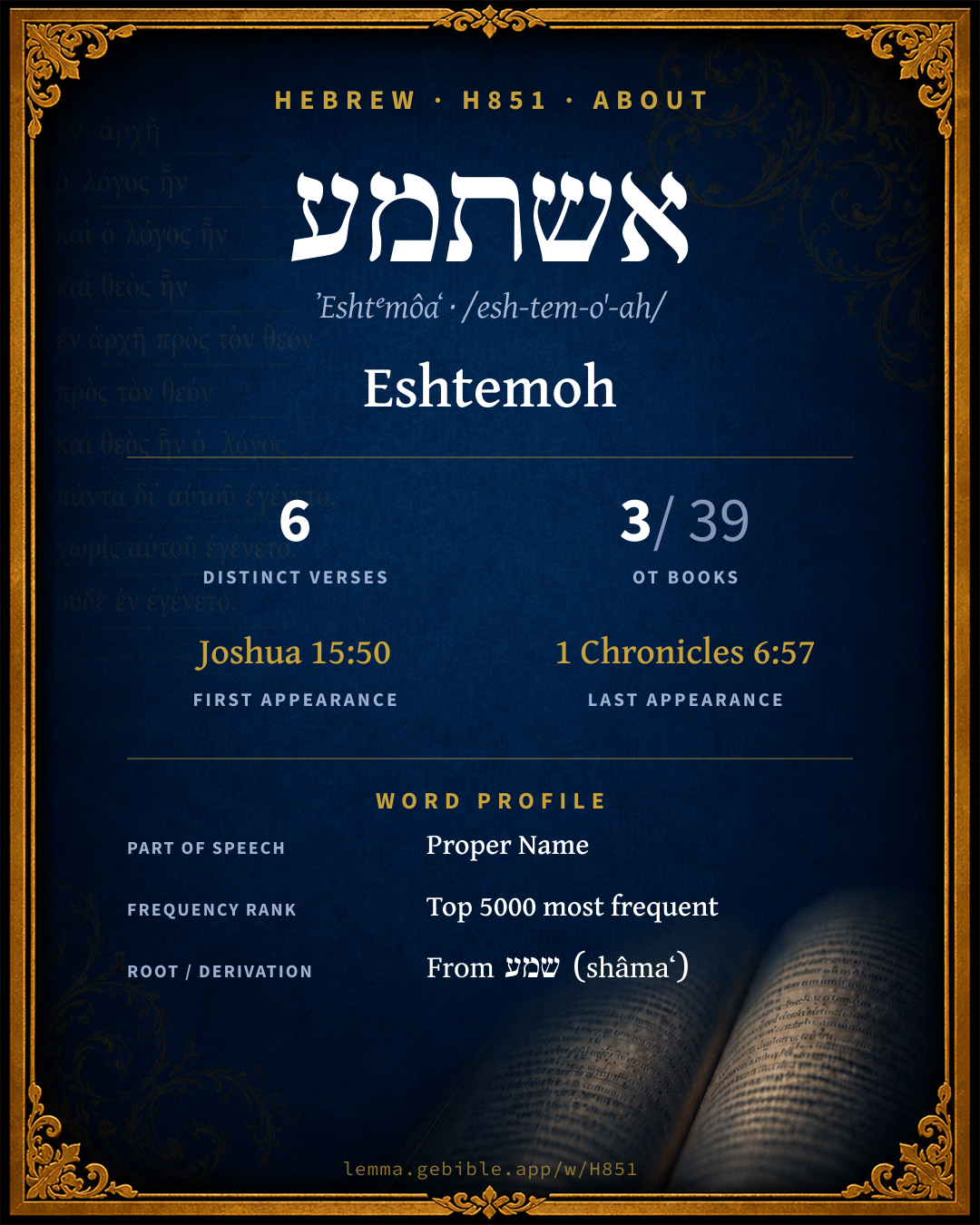
אֶשְׁתְּמוֹעַ
Eshtemoh
BDB lists 3 entries for ‘Eshtemoh’ fuller range ↓
Full lexicon entry — Brown-Driver-Briggs (BDB)
From Brown-Driver-Briggs (BDB)
Where this word appears
Grammar key — what these labels mean
Part of speech
- Noun
- A naming word — a person, place, thing, or idea.
Noun type
- Proper
- A name of a specific person, place, or people (e.g. Abraham, Zion, Israel).
Every verse where H851 appears — 6 distinct verses across 3 books. Click any verse to open its interlinear word-by-word view. Verse text shown in the World English Bible for context — . Each verse’s Hebrew form is shown with its reference; the English is not keyword-highlighted, since the data carries no word-level English alignment. Use “Compare translations” on any verse to read it across multiple English versions. This concordance covers the Hebrew Bible; Septuagint (Greek Old Testament) occurrences are not indexed here.
Joshua 2 verses
1 Samuel 1 verse
1 Chronicles 3 verses
- 1 Chronicles 4:17 אֶשְׁתְּמֹֽעַ n Proper The sons of Ezrah: Jether, and Mered, and Epher, and Jalon; and she bore Miriam, and Shammai, and Ishbah the father of Eshtemoa.
- 1 Chronicles 4:19 וְ/אֶשְׁתְּמֹ֖עַ conj + n Proper The sons of the wife of Hodiah, the sister of Naham, were the father of Keilah the Garmite, and Eshtemoa the Maacathite.
- 1 Chronicles 6:57 אֶשְׁתְּמֹ֖עַ n Proper To the sons of Aaron they gave the cities of refuge, Hebron; Libnah also with its suburbs, and Jattir, and Eshtemoa with its suburbs,
About this entry
At a glance — auto-summarized from this page’s data, not written by a person. Every figure links to its source below. This summary describes the numbers; it doesn’t interpret them.
אשתמע — transliterated ʼEshtᵉmôaʻ — is a Hebrew name carrying the sense “Eshtemoh.” Its uses cluster heavily in 1 Chronicles (50% of all occurrences). Spanning 6 verses in 3 books, it ranks among the uncommon words of the Hebrew Bible. Debuting at Joshua 15:50, it then recurs through the corpus. Each statement above links to its evidence; the full detail follows below.
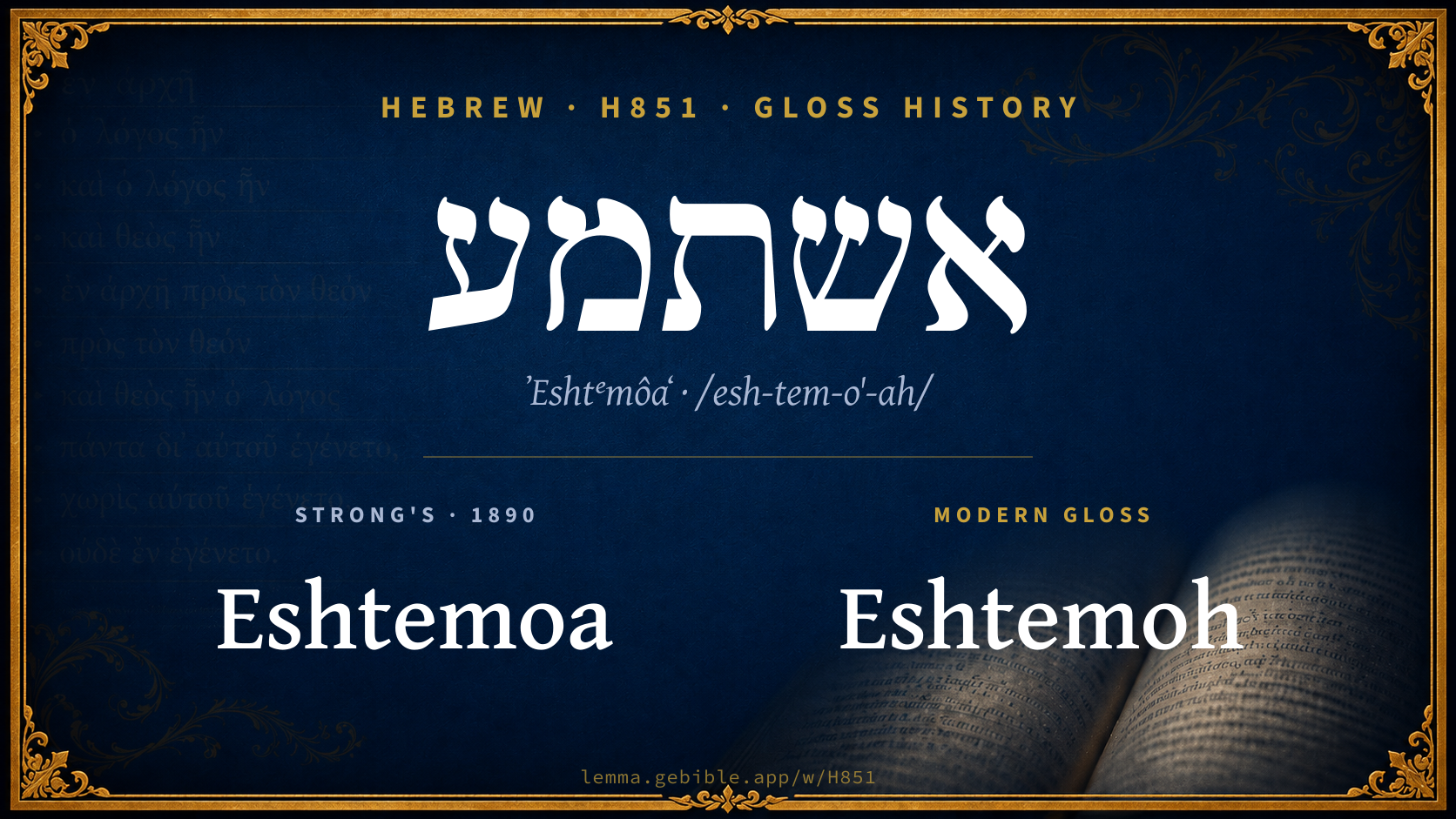
Gloss history
Strong's 1890 vs modern scholarship
About this word
Strong's H851 catalogs a Hebrew word from the Hebrew Old Testament.
These counts are not copied from any lexicon or concordance. They are computed here, from the morphology-tagged Hebrew Old Testament. What Lemma adds →
- 6
- distinct verses
- The word appears in 6 distinct verses.
- 3 / 39
- OT books
- The word appears in 3 of 39 Old Testament books.
- #3,040
- by frequency
- Top 5000 most frequent Hebrew words (rank 3,040 of 8,640 Hebrew words by occurrence).
View all 6 occurrences in the concordance →
Most concentrated in
- 1 Chronicles 3 verses 50%
- Joshua 2 verses 33%
- 1 Samuel 1 verse 17%
By section of the Old Testament
By traditional corpus
Conventional, traditional groupings — biblical authorship is debated, so this is a traditional corpus grouping, not an authorship claim. Each share is this word’s portion of its verses in that division of the Hebrew canon. Each figure is a share of the word’s 6 distinct verses.
- Prophets (Nevi'im) 3 verses · 50%
- Writings (Ketuvim) 3 verses · 50%
How translations render this word
Counts come from each version’s own published word-to-Strong’s tagging or interlinear alignment — an approximate guide to how each version renders this word, not a word-level alignment the data otherwise carries. Because each total is that version’s own tagged count, the per-version totals vary from one another and need not match the appearance or distinct-verse counts above. These counts may also differ from a printed concordance because Lemma counts each distinctly tagged rendering and does not collapse phrase taggings into a single head-word total. This is a fixed set of word-tagged versions (KJV, ASV, BSB, ULT) and does not change with the reading translation you choose elsewhere. Each version’s license is shown beside its name below (and on Sources).
- King James Version: Eshtemoa 4×
- American Standard Version: Eshtemoa 4×
- Berean Standard Bible: Eshtemoa 5×
- unfoldingWord Literal Text: Eshtemoa 4×
King James Version Public Domain
Renders H851 across 6 tagged occurrences — most commonly:
Plus 2 renderings that appear only once — usually multi-word phrases or single function words the recovered tagging swept in, not distinct renderings.
American Standard Version Public Domain
Renders H851 across 6 tagged occurrences — most commonly:
Plus 2 renderings that appear only once — usually multi-word phrases or single function words the recovered tagging swept in, not distinct renderings.
Berean Standard Bible Public Domain
Renders H851 across 6 tagged occurrences — most commonly:
Plus 1 rendering that appears only once — usually multi-word phrases or single function words the recovered tagging swept in, not distinct renderings.
unfoldingWord Literal Text CC BY-SA 4.0
Renders H851 across 6 tagged occurrences — most commonly:
Plus 2 renderings that appear only once — usually multi-word phrases or single function words the recovered tagging swept in, not distinct renderings.
Senses in BDB
The 3 senses BDB distinguishes for this word, in lexicon order (not ranked by frequency or importance). The full entry — with sub-senses — is in the Lexicon Entry tab.
- Eshtemoh = "I shall cause my own ruin: fire of astonishment: I shall soar aloft"
- a Levitical city in Judah
- a man of Judah
Word origin
אֶשְׁתְּמוֹעַ, אֶשְׁתְּמֹעַ, אֶשְׁתְּמֹה n.pr.loc. Levitical city in mountain-country of Judah, south of Hebron
— Brown-Driver-Briggs (Oxford 1906, public domain), digitized via Sefaria, supplemented by the OpenScriptures HebrewLexicon (CC BY 4.0). See Sources.
Derived from שמע (shâmaʻ) (H8085) — to hear.
Jastrow Dictionary
A second Hebrew/Aramaic lexicon for comparison, covering Aramaic and post-biblical (Talmudic, Targumic, Midrashic) usage that the biblical-Hebrew BDB does not. Matched by lemma rather than by Strong’s number, so a lemma may carry more than one Jastrow headword (shown separately below), and the entries cover usage well beyond the Bible.
שְׁמַע I
- Targ. Gen. XXVII, 5. Targ. Ex. XVIII, 1. Targ. Job IV, 16; a. v. fr.—Part. pass. שְׁמִיעַ; f. שְׁמִיעָא. Targ. Ps. XXIX, 3, sq. Targ. II Chr. VII, 12; a. fr.—Y. Ter. X, 47ᵇ bot. אנא מה דשַׁמְעִית ואינון מה דשַׁמְעוּן I report what I have heard, and they, what they have heard. Sabb. 46ᵇ הא שַׁמְעִינָן ליה לר"ש וכ׳ have we not heard what R. S. says &c.? Y. Sot. VII, beg. 21ᵇ, v. אֲלִנִיסְטִי; a. v. fr.—שמיע ל־ he has heard, he knows of. Erub. 9ᵇ ור"י מי לא ש׳ ליה הא but has R. J. not heard that (does he not know that Boraitha of R. Ḥiya)? ש׳ ליה ולא סבר (v. Rabb. D. S. a. l.) he knows of it, but does not accept it. Ib. 10ᵃ, a. fr. לא ש׳ לי הא שמעתתא this tradition is not known to me. Pes. 34ᵃ מידי ש׳ לך בהא do you know anything about this (hălakhah)?; a. v. fr.—Esp. שמע מ־ to understand from, to infer, prove. Ab. Zar. 72ᵇ, a. fr. ש׳ מינה וכ׳ (abbrev. ש"מ) deduce from this that &c. Ib. שַׁמְעַת מינה וכ׳ wilt thou conclude from this that &c.? Ib., a. fr. אלא מהא ליכא למִשְׁמַע מינה but (the conclusion is,) you can derive nothing from this.—Ib., a. fr. תא שמע (abbrev. ת"ש; v. אֲתָא) come and learn, i.e. derive it from the following. Sabb. 13ᵇ ת"ש … ש"מ ואלו תנן ש"מ I will prove it (from this Tosefta): ‘you must not …, and those are some of the halakhoth &c.’, which proves that the right version is ‘and those’: it stands proved. Y. M. Kat. III, 83ᵃ top נִישְׁמְעִינָהּ מן הדא let us prove it from this; a. v. fr.
- 1. to make music; to sing, v. Af.
- שַׁמְּעָא) to minister to, be an attendant of. Ber. 41ᵇ מאן … ונְשַׁמְּעִינָךְ would that we had iron feet, that we could always wait on thee! Meg. 28ᵇ ניחא לי דאֲשַׁמְּעֵיה למר (Ms. M. דאשתמש ליה למר, v. Rabb. D. S. a. l.) it gives me pleasure to be your servant; a. e.
- 1. to cause to hear, cause to be heard, announce, proclaim. Targ. Deut. IV, 36. Targ. Is. LII, 7. Targ. Ps. XXVI, 7; a. fr.—Esp. (interch. with Pa.) to make music, play; to be a musician. Targ. I Sam. XXIX, 5 (Ms. Pa.). Targ. I Chr. XV, 16. Ib. XVI, 42 מַשְׁמְעַיָּא ed. Lag. (ed. Rahmer משמעייאה, Var. מַשְׁמְעַיָּה; h. text מַשְׁמִיעִים) musicians. Targ. Ps. CL, 5 דמְשַׁמְּעִין לבדוחא Ms. (ed. Lag. דמשמעין בלחודיהון; ed. Wil. a. oth. דשמעין בלחודיהון, corr. acc.). Ib. דמַשְׁ׳ ביבבא (Ms. Pa.).
- 2. to give to understand; to teach, prove. Ber. 2ᵃ מילתא … קא מַשְׁמַע לן וכ׳ (the Tannai in using such an expression) wants to teach us something by the way: when do the priests eat &c.; והא קמשמע לן וכ׳ (abbrev. קמ"ל) and it is this he teaches us, that the sacrifice of atonement is not indispensable &c. Ib. 4ᵇ לאפוקי … קמ"ל דחובה in opposition to the opinion that the evening prayer is optional, he gives us to understand that it is obligatory. Sabb. 19ᵃ מהו דתימא … קמ"ל you may have thought (that the cases are different, because) this devolves upon him, and the other does not, therefore he teaches us (that they are the same). Ib. 108ᵃ מאי קמ"ל what does he teach us (is it not a matter of course)? Ber. 21ᵃ sq. דאי אַשְׁמְעִינָן וכ׳, v. צְרִיךְ; a. v. fr.—Part. pass. מַשְׁמֵע a) understood. Yeb. 102ᵇ מ׳ הכי ומ׳ הכי it may be understood thus (it may mean, ‘to take off’), and may be understood thus (it may mean, ‘to strengthen’); a. fr.—2) inferred, proved; evidence. Sabb. 84ᵇ מאי מ׳ how is this proved (from the verse quoted)? Erub. 65ᵃ מאי מ׳ וכ׳ what evidence is there &c.?, v. פּוּק. Ib. מַשְׁמְעֵי, v. infra; a. fr.—V. מַשְׁמָע.
- 1. to be heard, let one’s self be heard. Targ. Gen. XLV, 16. Targ. Job XXXVII, 4 Ms. (ed. ישמע). Targ. Ps. LXXVII, 19; a. fr.—Snh. 95ᵇ (prov.) אגב אורחך … א׳ on thy road let thy enemy hear from thee, i.e. take revenge when occasion offers. R. Hash. 27ᵃ תרתי … לא מִשְׁתַּמְּעֵי … משתמעי two different sounds produced simultaneously by the same person are not distinctly perceived, but if produced by two persons, they are. Erub. l. c. מכדי קראי מִשְׁתַּמְּעֵי בין למר וכ׳ Ms. M. (ed. משמעי, v. Rabb. D. S. a. l. note) since verses may be quoted in favor of the one as well as of the other, what is the practical difference between them?; a. fr.
- 2. to make one’s self subservient, obey; to surrender to the enemy, desert. Targ. II Kings XXV, 11 (h. text נפלו). Ib. VII, 4. Targ. Ps. XVIII, 45; II Sam. XXII, 45; a. fr. e.g. 2 Samuel 22:45
A Dictionary of the Targumim, the Talmud Babli and Yerushalmi, and the Midrashic Literature (Marcus Jastrow; London, Luzac, 1903) — Public Domain. Digitized via Sefaria. Digitized via Sefaria. Full attribution on Sources.
Forms in the corpus
The 5 distinct written forms H851 takes in the Hebrew Bible, most frequent first — each parse links to that state’s occurrences in the concordance. Hebrew forms include their vowel points and cantillation, so a single lemma takes many written forms.
| Form | Parsing | Example | Uses |
|---|---|---|---|
| אֶשְׁתְּמֹ֖עַ | Noun, Proper | 1 Chronicles 6:57 | 2 |
| אֶשְׁתְּמֹֽעַ | Noun, Proper | 1 Chronicles 4:17 | 1 |
| בְּ/אֶשְׁתְּמֹֽעַ | Noun, Proper | 1 Samuel 30:28 | 1 |
| וְ/אֶשְׁתְּמֹ֖ה | Noun, Proper | Joshua 15:50 | 1 |
| וְ/אֶשְׁתְּמֹ֖עַ | Noun, Proper | 1 Chronicles 4:19 | 1 |
Same root — word family
Other BDB entries built from the same root as H851, grouped by Strong’s listed origin. These share a root / origin per the lexicon — not necessarily a shared meaning. Each links to that word’s own entry.
Derives from
Shares the same root
- השמעות hashmâʻûwth H2045 report
- משמע mishmâʻ H4926 rumor
- שמע shᵉmaʻ H8086 to hear
- שמע shêmaʻ H8088 hearing
- שמע shômaʻ H8089 report
Proper names from this root
People and places named from this root — a name, not an additional meaning of the word.
- ישמעאל Yishmâʻêʼl H3458 Ishmael
- ישמעיה Yishmaʻyâh H3460 Ishmaiah
- שמואל Shᵉmûwʼêl H8050 Samuel
- שמע Shâmâʻ H8091 Shama
- שמעון Shimʻôwn H8095 Simeon
- שמעיה Shᵉmaʻyâh H8098 Shemaiah
Compare all same-root words → Showing 4 of 13 — not the complete family. 6 of the same-root words are proper names (people or places). They share a root, not necessarily a meaning.
Septuagint verse parallels
This word appears in 6 verses that also exist in the Greek Old Testament (Septuagint), out of the 6 Hebrew verses it occurs in. You can read those verses in Greek by switching the Old Testament edition to the Septuagint.
Read these verses in the Septuagint
This is a verse-level parallel only — the same verses exist in both the Hebrew and Greek Old Testaments. No word-level Hebrew↔Greek correspondence is claimed: the data carries no such alignment, so no Greek word is shown as this Hebrew word’s translation. Coverage is not total — the Septuagint omits the deuterocanon and renumbers the Psalms, so some Hebrew verses have no direct Greek parallel.