
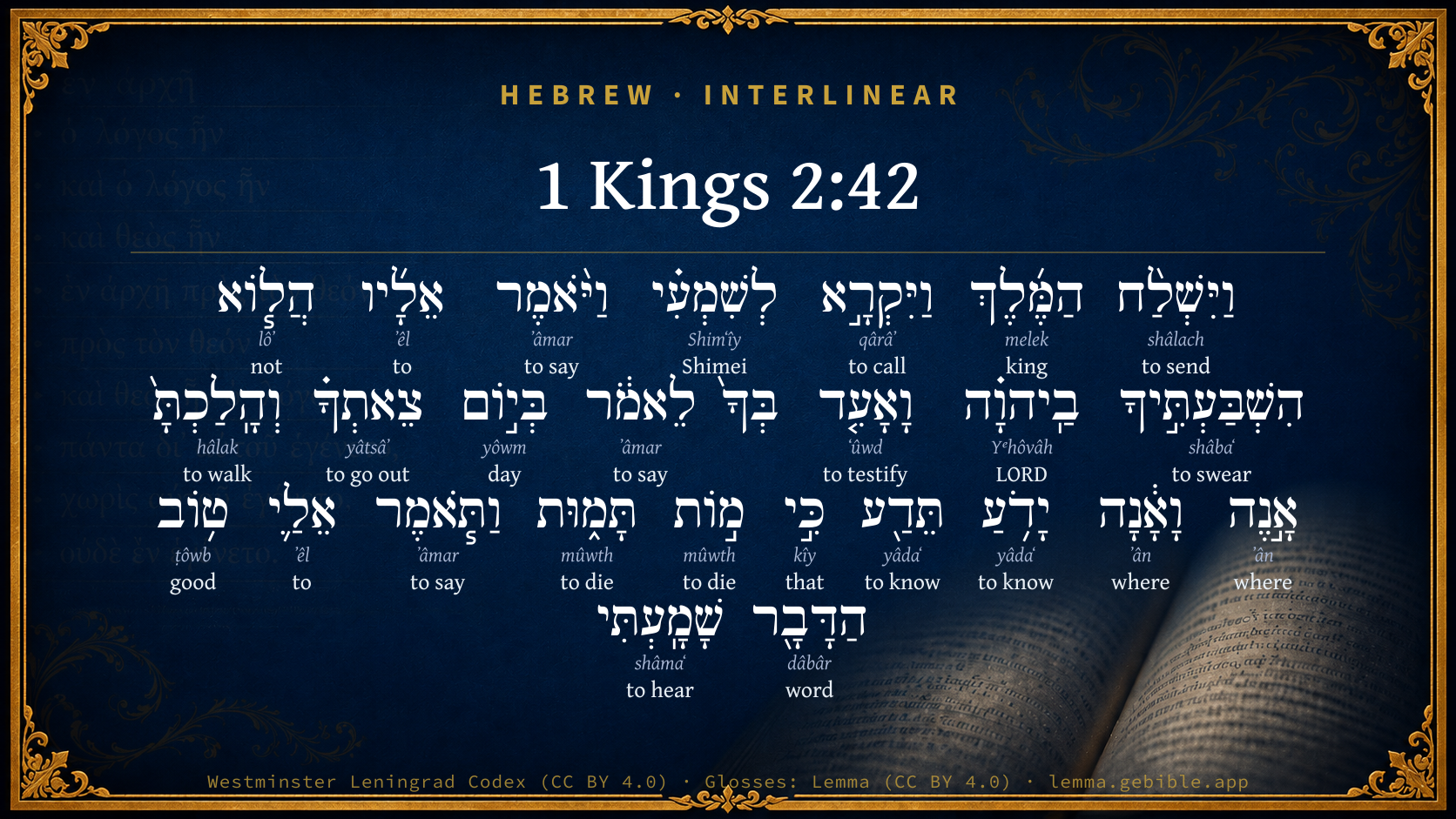
1 Kings 2:42

Hebrew (Westminster Leningrad Codex) 1 Kings 2:42 appears in the Hebrew Old Testament. The text above is from the Westminster Leningrad Codex. Each word links to its Strong’s number, a concise gloss, and parsing drawn from the Open Scriptures Hebrew Bible morphology. Click any word for its full Brown-Driver-Briggs (BDB) entry.
Download image
Cite this verse

1 Kings 2:42 (World English Bible). Public Domain. Lemma interlinear Bible study tool, https://lemma.gebible.app/v/1-kings/2/42.

Show BibTeX & RIS
BibTeX
RIS
English Translation
The king sent and called for Shimei, and said to him, Didn't I adjure you by Yahweh, and protest to you, saying, Know for certain, that on the day you go out, and walk abroad any where, you shall surely die? and you said to me, The saying that I have heard is good.
World English Bible · Public Domain
Download a study sheet

One document with this verse’s original text, its word-by-word gloss line, the meaning frame, cross-references with their text, attributed commentary, and full source and license credits — printable, and it pastes into notes with its structure intact.

This verse Autodidact and up

Study sheet (.html) Plain text (.txt)

A passage Seminary Student

Up to 50 verses in one chapter. A passage sheet keeps up to 6 commentary sources and 12 cross-references per verse, in the order this page ranks them, and says so on the sheet whenever that leaves anything out. Ask for a single verse and you get the Autodidact verse sheet above.

Everything on this page stays free to read, with no account — the sheet is a download of what is already on screen, not access to it.

Want to remove ads? Support Godless Engineer
Compare translations 3

The same verse in 3 English versions, stacked beneath the original-language interlinear above. Click any original word for its lexicon entry.

Each is an independent rendering of the whole verse — the interlinear is not word-aligned to these translations.

Highlighted words mark where these versions differ — a whole-verse word diff, not a word-by-word alignment.

  • World English Bible Public Domain
    The king sent and called for Shimei, and said to him, Didn't I adjure you by Yahweh, and protest to you, saying, Know for certain, that on the day you go out, and walk abroad any where, you shall surely die? and you said to me, The saying that I have heard is good.
  • King James Version Public Domain
    And the king sent and called for Shimei, and said unto him, Did I not make thee to swear by the LORD, and protested unto thee, saying, Know for a certain, on the day thou goest out, and walkest abroad any whither, that thou shalt surely die? and thou saidst unto me, The word that I have heard is good.
  • unfoldingWord Literal Text CC BY-SA 4.0
    And the king sent and called for Shimei, and he said to him, “Did I not make you swear by Yahweh and testify against you, saying, ‘On the day of your going out, and you go where or where, knowing, you shall know that dying, you shall die’? And you said to me, ‘The word I have heard is good.’

unfoldingWord Literal Text — © unfoldingWord, licensed CC BY-SA 4.0. Word-aligned USFM3 via Door43 (git.door43.org/unfoldingWord/en_ult).

Versions to compare (up to 4)

3 of 4 selected

Show all 18 translations

Every available English version of this verse, each an independent rendering of the whole verse.

  • World English Bible Public Domain
    The king sent and called for Shimei, and said to him, Didn't I adjure you by Yahweh, and protest to you, saying, Know for certain, that on the day you go out, and walk abroad any where, you shall surely die? and you said to me, The saying that I have heard is good.
  • Berean Standard Bible Public Domain
    the king summoned Shimei and said to him, “Did I not make you swear by the LORD and warn you, ‘On the day you leave and go elsewhere, know for sure that you will die’? And you told me, ‘The sentence is fair; I will comply.’
  • Majority Standard Bible Public Domain
    the king summoned Shimei and said to him, “Did I not make you swear by the LORD and warn you, ‘On the day you leave and go elsewhere, know for sure that you will die’? And you told me, ‘The sentence is fair; I will comply.’
  • King James Version Public Domain
    And the king sent and called for Shimei, and said unto him, Did I not make thee to swear by the LORD, and protested unto thee, saying, Know for a certain, on the day thou goest out, and walkest abroad any whither, that thou shalt surely die? and thou saidst unto me, The word that I have heard is good.
  • American Standard Version (1901) Public Domain
    And the king sent and called for Shimei, and said unto him, Did I not adjure thee by Jehovah, and protest unto thee, saying, Know for certain, that on the day thou goest out, and walkest abroad any whither, thou shalt surely die? and thou saidst unto me, The saying that I have heard is good.
  • Revised Version (1885) Public Domain
    And the king sent and called for Shimei, and said unto him, Did I not make thee to swear by the LORD, and protested unto thee, saying, Know for certain, that on the day thou goest out, and walkest abroad any whither, thou shalt surely die? and thou saidst unto me, The saying that I have heard is good.
  • Geneva Bible (1599) Public Domain
    And the King sent and called Shimei, and sayde vnto him, Did I not make thee to sweare by the Lord, and protested vnto thee, saying, That day that thou goest out, and walkest any whither, knowe assuredly that thou shalt dye the death? And thou saydest vnto mee, The thing is good, that I haue heard.
  • Douay-Rheims (1899) Public Domain
    And sending he called for him, and said to him: Did I not protest to thee by the Lord, and tell thee before: On what day soever thou shalt go out and walk abroad any whither, know that thou shalt die? And thou answeredst me: The word that I have heard is good.
  • Young's Literal Translation Public Domain
    and the king sendeth and calleth for Shimei, and saith unto him, `Have I not caused thee to swear by Jehovah -- and I testify against thee, saying, In the day of thy going out, and thou hast gone anywhere, thou dost certainly know that thou dost surely die; and thou sayest unto me, The word I have heard `is' good?
  • Literal Standard Version CC BY-SA 4.0
    and the king sends and calls for Shimei, and says to him, “Have I not caused you to swear by YHWH—and I testify against you, saying, In the day of your going out, and you have gone anywhere, you certainly know that you surely die; and you say to me, The word I have heard [is] good?
  • Unlocked Literal Bible CC BY-SA 4.0
    the king sent and called for Shimei and said to him, “Did I not make you swear by Yahweh and testify to you, saying, 'Know for certain that on the day you go out and go to any other place, you will surely die'? Then you said to me, 'What you say is good.'
  • unfoldingWord Literal Text CC BY-SA 4.0
    And the king sent and called for Shimei, and he said to him, “Did I not make you swear by Yahweh and testify against you, saying, ‘On the day of your going out, and you go where or where, knowing, you shall know that dying, you shall die’? And you said to me, ‘The word I have heard is good.’
  • Darby Bible Public Domain
    And the king sent and called for Shimei, and said to him, Did I not make thee swear by Jehovah, and protest to thee, saying, Know for certain, that on the day thou goest forth, and walkest abroad anywhere, thou shalt surely die? and thou saidst to me, The word that I have heard is good.
  • World Messianic Bible Public Domain
    The king sent and called for Shimei, and said to him, “Didn’t I adjure you by the LORD and warn you, saying, ‘Know for certain that on the day you go out and walk anywhere else, you shall surely die’? You said to me, ‘The saying that I have heard is good.’
  • Webster's Bible Public Domain
    And the king sent and called for Shimei, and said to him, Did I not make thee to swear by the LORD, and protest to thee, saying, Know for a certain, on the day thou goest out, and walkest any where abroad, that thou shalt surely die? and thou saidst to me, The word that I have heard is good.
  • Free Bible Version CC BY-SA 4.0
    The king summoned Shimei and asked him, “Didn't I vow to you by the Lord, didn't I warn you that the day you left and went somewhere else that you should know for certain that you would die? Didn't you reply to me, ‘What Your Majesty says is fair; I'll do as you ordered’?
  • Bible in Basic English Public Domain
    Then the king sent for Shimei, and said to him, Did I not make you take an oath by the Lord, protesting to you and saying, Be certain that on the day when you go out from here, wherever you go, death will overtake you? and you said to me, Very well!
  • JPS Tanakh (1917) Public Domain
    And the king sent and called for Shimei, and said unto him: 'Did I not make thee to swear by the LORD, and forewarned thee, saying: Know for certain, that on the day thou goest out, and walkest abroad any whither, thou shalt surely die? and thou saidst unto me: The saying is good; I have heard it.

Literal Standard Version (2020), Covenant Press — licensed CC BY-SA 4.0. Text via the HelloAO Bible API (eBible.org). Unlocked Literal Bible (unfoldingWord) — licensed CC BY-SA 4.0. Text via the HelloAO Bible API (eBible.org). unfoldingWord Literal Text — © unfoldingWord, licensed CC BY-SA 4.0. Word-aligned USFM3 via Door43 (git.door43.org/unfoldingWord/en_ult). Free Bible Version, Dr. Jonathan Gallagher — licensed CC BY-SA 4.0. Text via the HelloAO Bible API (eBible.org).

Word by word

More ways to search: Search by grammar → Find every occurrence → Compare this word →

Practice this passage: Drill this verse → Learn its vocabulary →

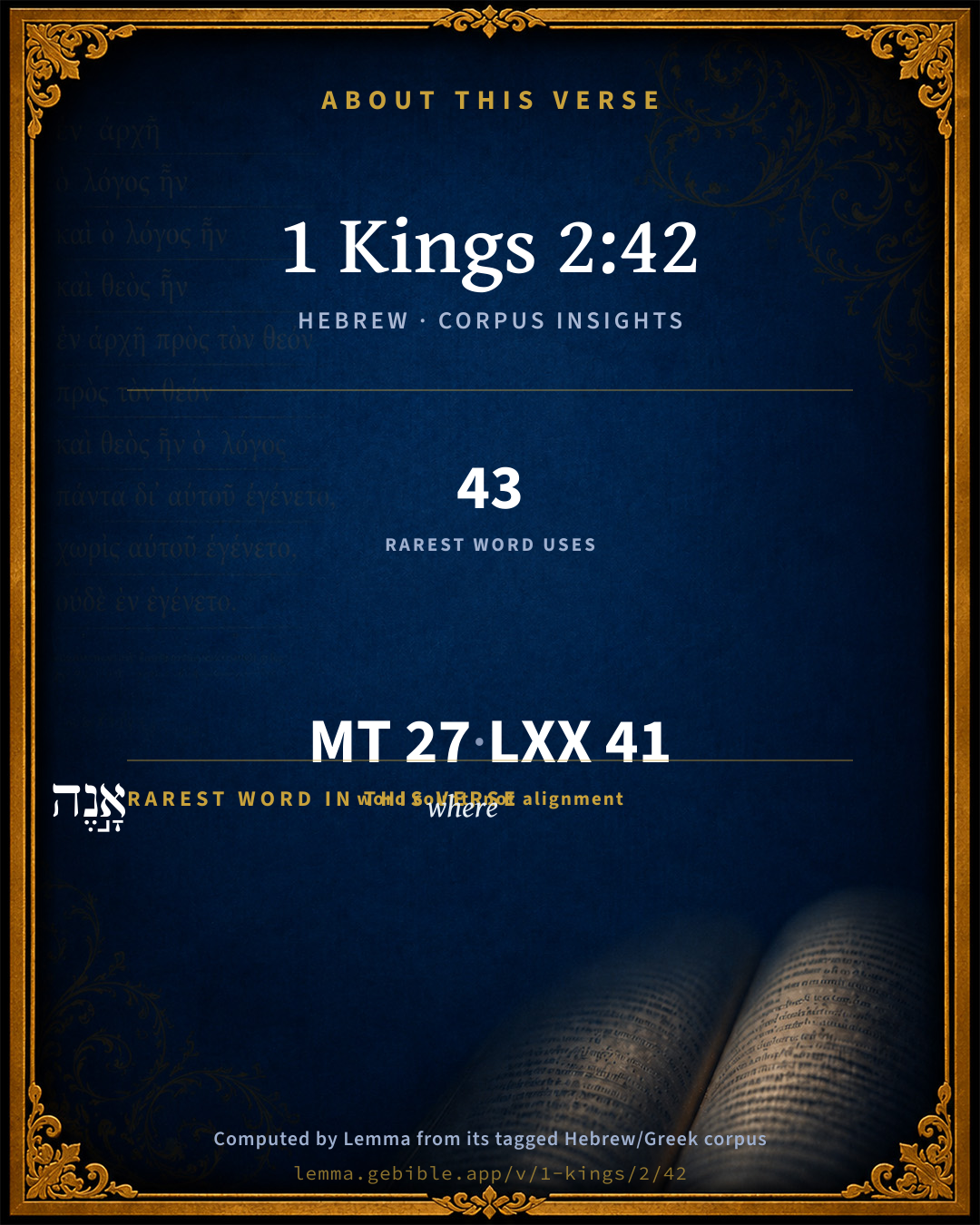
אָ֣נֶה
ʼân
H575
“where”
Adverb
Part of Speech
Adverb
Full BDB Definition

Origin: contracted from H370

TWOT: 75g

where?, whither? (of place) - when?, until when?, how long? (of time)
  1. וַיִּשְׁלַ֨ח shâlach H7971 “and · to send” Conjunction + Verb, Qal, Sequential Imperfect, 3rd Person, Masculine, Singular
  2. הַמֶּ֜לֶךְ melek H4428 “the · king” Particle, Definite Article + Noun, Common, Masculine, Singular, Absolute
  3. וַיִּקְרָ֣א qârâʼ H7121 “and · to call” Conjunction + Verb, Qal, Sequential Imperfect, 3rd Person, Masculine, Singular
  4. לְשִׁמְעִ֗י Shimʻîy H8096 “to/for · Shimei” Preposition + Noun, Proper
  5. וַיֹּ֨אמֶר ʼâmar H559 “and · to say” Conjunction + Verb, Qal, Sequential Imperfect, 3rd Person, Masculine, Singular
  6. אֵלָ֜יו ʼêl H413 “to · him” Preposition + Suffix, Personal, 3rd Person, Masculine, Singular
  7. הֲל֧וֹא lôʼ H3808 “not” Particle, Interrogative + Particle, Negative
  8. הִשְׁבַּעְתִּ֣יךָ shâbaʻ H7650 “to swear · you” Verb, Hiphil, Perfect, 1st Person, Common, Singular + Suffix, Personal, 2nd Person, Masculine, Singular
  9. בַֽיהוָ֗ה Yᵉhôvâh H3068 “in/at · LORD” Preposition + Noun, Proper
  10. וָאָעִ֤ד ʻûwd H5749 “and · to testify” Conjunction + Verb, Hiphil, Sequential Imperfect, 1st Person, Common, Singular
  11. לֵאמֹ֔ר ʼâmar H559 “to say” Preposition + Verb, Qal, Infinitive Construct
  12. בְּי֣וֹם yôwm H3117 “in/at · day of” Preposition + Noun, Common, Masculine, Singular, Construct
  13. צֵאתְךָ֗ yâtsâʼ H3318 “to go out · you” Verb, Qal, Infinitive Construct + Suffix, Personal, 2nd Person, Masculine, Singular
  14. וְהָֽלַכְתָּ֙ hâlak H1980 “and · to walk” Conjunction + Verb, Qal, Sequential Perfect, 2nd Person, Masculine, Singular
  15. וָאָ֔נָה ʼân H575 “and · where” Conjunction + Particle, Interrogative
  16. יָדֹ֥עַ yâdaʻ H3045 “to know” Verb, Qal, Infinitive Absolute
  17. תֵּדַ֖ע yâdaʻ H3045 “to know” Verb, Qal, Imperfect, 2nd Person, Masculine, Singular
  18. כִּ֣י kîy H3588 “that” Conjunction
  19. מ֣וֹת mûwth H4191 “to die” Verb, Qal, Infinitive Absolute
  20. תָּמ֑וּת mûwth H4191 “to die” Verb, Qal, Imperfect, 2nd Person, Masculine, Singular
  21. וַתֹּ֧אמֶר ʼâmar H559 “and · to say” Conjunction + Verb, Qal, Sequential Imperfect, 2nd Person, Masculine, Singular
  22. אֵלַ֛י ʼêl H413 “to · me” Preposition + Suffix, Personal, 1st Person, Common, Singular
  23. ט֥וֹב ṭôwb H2896 “good” Adjective, Adjective, Masculine, Singular, Absolute
  24. הַדָּבָ֖ר dâbâr H1697 “the · word” Particle, Definite Article + Noun, Common, Masculine, Singular, Absolute
  25. שָׁמָֽעְתִּי shâmaʻ H8085 “to hear” Verb, Qal, Perfect, 1st Person, Common, Singular

About this verse

These counts appear in no published source. They are computed here, from the morphology-tagged text and Lemma’s own curated glosses. What Lemma adds →

27
words
20
distinct lemmas
Historical
section

Shared distinctive vocabulary

אָ֣נֶה where H575 occurs in 33 verses of the Hebrew Bible. Also found in:

Grammatical profile

  • 14 verbs
  • 5 nouns
  • 1 adjective
  • 3 prepositions
  • 1 conjunction
  • 1 adverb
  • 2 particles

Verb forms

  • וַיִּשְׁלַ֨ח Qal · Sequential Imperfect
  • וַיִּקְרָ֣א Qal · Sequential Imperfect
  • וַיֹּ֨אמֶר Qal · Sequential Imperfect
  • הִשְׁבַּעְתִּ֣יךָ Hiphil · Perfect
  • וָאָעִ֤ד Hiphil · Sequential Imperfect
  • לֵאמֹ֔ר Qal · Infinitive Construct
  • צֵאתְךָ֗ Qal · Infinitive Construct
  • וְהָֽלַכְתָּ֙ Qal · Sequential Perfect
  • יָדֹ֥עַ Qal · Infinitive Absolute
  • תֵּדַ֖ע Qal · Imperfect
  • מ֣וֹת Qal · Infinitive Absolute
  • תָּמ֑וּת Qal · Imperfect
  • וַתֹּ֧אמֶר Qal · Sequential Imperfect
  • שָׁמָֽעְתִּי Qal · Perfect

Repetition

Words recur within this verse — often emphatic in Hebrew:

  • וַיֹּ֨אמֶר to say H559 ×3
  • אָ֣נֶה where H575 ×2
  • יָדֹ֥עַ to know H3045 ×2
  • מ֣וֹת to die H4191 ×2
  • אֵלָ֜יו to H413 ×2

Hebrew & Septuagint length

In the original languages it is 27 Hebrew tokens and 41 Greek tokens — but the two are counted differently (Hebrew bundles its prefixes and suffixes into one token; the Greek is in lemma form), so that isn’t a like-for-like length.

Cross-references

4

Topical passages linked to 1 Kings 2:42 in the Treasury of Scripture Knowledge — connected by theme and wording, ordered by reader-vote popularity; previews shown in the World English Bible.

  • 1 Kings 2:36–38 The king sent and called for Shimei, and said to him, Build yourself a house in Jerusalem, and dwell there, and don't go forth from there any where.
  • Psalms 15:4 In whose eyes a vile man is despised, But who honors those who fear Yahweh; He who keeps an oath even when it hurts, and doesn't change;
  • Luke 15:22 "But the father said to his servants, 'Bring out the best robe, and put it on him. Put a ring on his hand, and shoes on his feet.
  • Luke 19:22 "He said to him, 'Out of your own mouth will I judge you, you wicked servant! You knew that I am an exacting man, taking up that which I didn't lay down, and reaping that which I didn't sow.

Cross-references courtesy of OpenBible.info (CC BY 4.0).

Hebrew and Greek witnesses Masoretic Hebrew ↔ Greek Septuagint

The same verse in the two great witnesses to the Old Testament, shown verse-for-verse.

These are two independent witnesses, not word-aligned to each other, and the Septuagint is shown in lemma (dictionary) form.

Hebrew 1 Kings 2:42 Masoretic · Westminster Leningrad Codex

וַיִּשְׁלַ֨ח הַמֶּ֜לֶךְ וַיִּקְרָ֣א לְשִׁמְעִ֗י וַיֹּ֨אמֶר אֵלָ֜יו הֲל֧וֹא הִשְׁבַּעְתִּ֣יךָ בַֽיהוָ֗ה וָאָעִ֤ד בְּךָ֙ לֵאמֹ֔ר בְּי֣וֹם צֵאתְךָ֗ וְהָֽלַכְתָּ֙ אָ֣נֶה וָאָ֔נָה יָדֹ֥עַ תֵּדַ֖ע כִּ֣י מ֣וֹת תָּמ֑וּת וַתֹּ֧אמֶר אֵלַ֛י ט֥וֹב הַדָּבָ֖ר שָׁמָֽעְתִּי

The king sent and called for Shimei, and said to him, Didn't I adjure you by Yahweh, and protest to you, saying, Know for certain, that on the day you go out, and walk abroad any where, you shall surely die? and you said to me, The saying that I have heard is good.

World English Bible · Public Domain

Greek LXX 1 Kings 2:42 Septuagint · lemma form

καί ἀποστέλλω ὁ βασιλεύς καί καλέω ὁ σεμεϊ καί εἶπον πρός αὐτός οὐ ὁρκίζω σύ κατά ὁ κύριος καί ἐπιμαρτυρέω σύ λέγω ἐν ὅς ἄν ἡμέρα ἐκἔρχομαι ἐκ ἰερουσαλήμ καί πορεύομαι εἰς δεξιός ἤ εἰς ἀριστερός γιγνώσκω γιγνώσκω ὅτι θάνατος ἀποθνήσκω

No English rendering of this Greek verse — the small residue in the structurally divergent books.

On this verse, The Cambridge Bible for Schools and Colleges discusses the Septuagint’s reading. Read the note in Commentary ↓

Hebrew: Westminster Leningrad Codex (CC BY 4.0). Greek: Septuagint (public domain); English from a public-domain English Septuagint. How the Septuagint differs from the Hebrew →

Targum (Aramaic paraphrase)

1

The Targum is the ancient Jewish Aramaic paraphrase of the Hebrew Scriptures — an interpretive translation, not the Hebrew text itself. Onkelos (literal) and Pseudo-Jonathan (expansive) render the Torah, and Jonathan the Prophets. Coverage is partial: where no permissively-licensed English translation exists for a verse, only the Aramaic is shown. This is verse-level text, not a word-by-word alignment to the Hebrew.

  1. Targum Jonathan Prophets (Joshua–Malachi)
    וּשְׁלַח מַלְכָּא וּקְרָא לְשִׁמְעִי וַאֲמַר לֵיהּ הֲלָא קַיֵמִית עֲלָךְ בְּמֵימְרָא דַייָ וְאַסְהֵדִית בָּךְ לְמֵימָר בְּיוֹם מִפְקָךְ וּתְהָךְ לְכָא וּלְכָא מִידַע תִּידַע אֲרֵי מֵימַת תְּמוּת וַאֲמַרְתְּ לִי תַּקֵין פִּתְגָמָא שְׁמָעִית:

    (no public-domain English translation for this verse)

    Targum Jonathan — Aramaic: “Mikraot Gedolot” (public domain). English: “Sefaria Community Translation” (CC0 1.0 (public-domain dedication)); “London "Chaldee Paraphrase," 1871” (public domain). Text via Sefaria.

Commentary

Notes on 1 Kings 2:42 from classic Christian and Jewish commentators (each source and its license shown beneath its notes). The classic Christian expositions comment on the surrounding passage and are grouped to its opening verse, so a note may address several verses; the Jewish commentaries on the Tanakh (Rashi and others) are per-verse, so they appear only where the commentator wrote on this verse.

Lemma curates 59 commentaries, every one of them public domain or Creative Commons licensed, each selected and text-cleaned for this edition rather than reprinted as found. About our sources →

Trapp's Complete Commentary

John Trapp

1Ki 2:42 And the king sent and called for Shimei, and said unto him, Did I not make thee to swear by the LORD, and protested unto thee, saying, Know for a certain, on the day thou goest out, and walkest abroad any whither, that thou shalt surely die? and thou saidst unto me, The word [that] I have heard [is] good.

Ver. 42. Did not I make thee to swear.] Oρκος quasi ιρκος, oaths should bind to good abearance: but some can play with them as apes do with nuts, or monkeys with their collars, which they slip on and off again at pleasure.

John Trapp, A Commentary or Exposition upon All the Books of the Old and New Testament (1647–1656) — public domain. Text from a community e-Sword module.

The Cambridge Bible for Schools and Colleges

gen. ed. J. J. S. Perowne

42. Did I not make thee to swear by the Lord] There is no mention of an oath in the previous part of the narrative (1Ki_2:37), but the solemnity of the charge was probably so enforced. The LXX, making both portions of the story to correspond, inserts in 1Ki_2:37 ‘and the king made him to swear in that day.’

The word that I have heard] ‘The saying &c.’ as in 1Ki_2:38. The same Hebrew will thus have the same English.

The Cambridge Bible for Schools and Colleges (gen. ed. J. J. S. Perowne; Cambridge University Press, 1878–1918) — public domain. Text from a community e-Sword module.

John Gill's Exposition

Why then hast thou not kept the oath of the Lord,.... Which was made by him, and in his presence, and in which he was appealed to, and so by not keeping it was guilty of perjury:

and the commandment that I have charged thee with? and so guilty of disobedience to him as his sovereign; for which two reasons he ought to die.

John Gill's Exposition of the Whole Bible (1746–1763) — public domain (CC PDM 1.0). Text via the HelloAO Bible API.

Albert Barnes' Notes on the Bible

Did I not make thee to swear - The Septuagint add to 1Ki 2:37 a clause stating that Solomon “made Shimei swear” on the day when he commanded him to reside at Jerusalem.

Albert Barnes' Notes on the Bible (1834–1885) — public domain. Text from a community e-Sword/MySword module.

The Pulpit Commentary

And the king sent and called for Shimel, and said unto him, Did I not make thee swear by the Lord it thus comes out quite incidentally that Solomon had bound Shimei by an oath. The LXX: embodies this information as a direct statement in the text of ver. 37, kai wrkisen aujton oJ basileura ejkeinh, but it is obviously a gloss and protested unto thee, saying, Know for a certain, on the day that thou goest but and walkest abroad any whither, that thou shalt surely die? and thou saidst unto me, The word that I have heard is good. The LXX (Vat.) omits "And thou saidst," etc. This last sentence has been punctuated thus: "Good is the word. I have heard." Probably rva "which," is to be understood.

The Pulpit Commentary (1880–1919), ed. H.D.M. Spence-Jones & Joseph S. Exell — public domain. Text from a community e-Sword module.

Rashi

Rabbi Shlomo Yitzchaki (Rashi)

And forewarned you. An expression referring to a [legal] warning.

Rashi on the Tanakh — English translations: “The Judaica Press complete Tanach with Rashi, translated by A. J. Rosenberg” (CC BY 4.0); “Pentateuch with Rashi's commentary by M. Rosenbaum and A.M. Silbermann, 1929-1934” (public domain); “The Metsudah Tanach series, Lakewood, N.J” (CC BY 4.0); and “The Book of Joshua, Metsudah Publications, 1997” (CC BY 4.0). Text via Sefaria.

Lesson kit

Teaching starters — assembled from the data on this page, not authored interpretation. Every prompt links to the verse data it draws on. Edit before teaching.

1 Kings, in the Historical, opens this verse with 27 words (20 distinct Hebrew lemmas). Its most distinctive word is ʼân (“where”). A historical commentator’s framing appears above. Read the whole chapter for the surrounding context.

Discussion questions

  1. The word ʼân carries the sense “where.” How does it shape the verse?
  2. How does Genesis 16:8, which shares the word «where», read alongside this verse?
  3. What does the repetition of “to say” (3× in this one verse) do in this verse?
  4. The translations on this page render this verse differently — a whole-verse word diff, not a word-by-word alignment. What might account for the different wordings?
  5. «וַיִּשְׁלַ֨ח» is a Qal Sequential Imperfect verb. How does that grammatical form shape the action described?
  6. Compare how Trapp's Complete Commentary and The Cambridge Bible for Schools and Colleges read this verse. Where do they agree or differ?

Things to notice

Reading settings

Reading text

Shown beneath each verse's original-language words.

Old Testament
Old Testament edition

Read the OT as the Masoretic Hebrew (MT) or the Greek Septuagint (LXX).

English shown for the Greek Septuagint (in the Hebrew ↔ Greek comparison).

Comparing translations? Open the Compare panel on any verse page to stack up to four side by side.