1 Chronicles 5:8

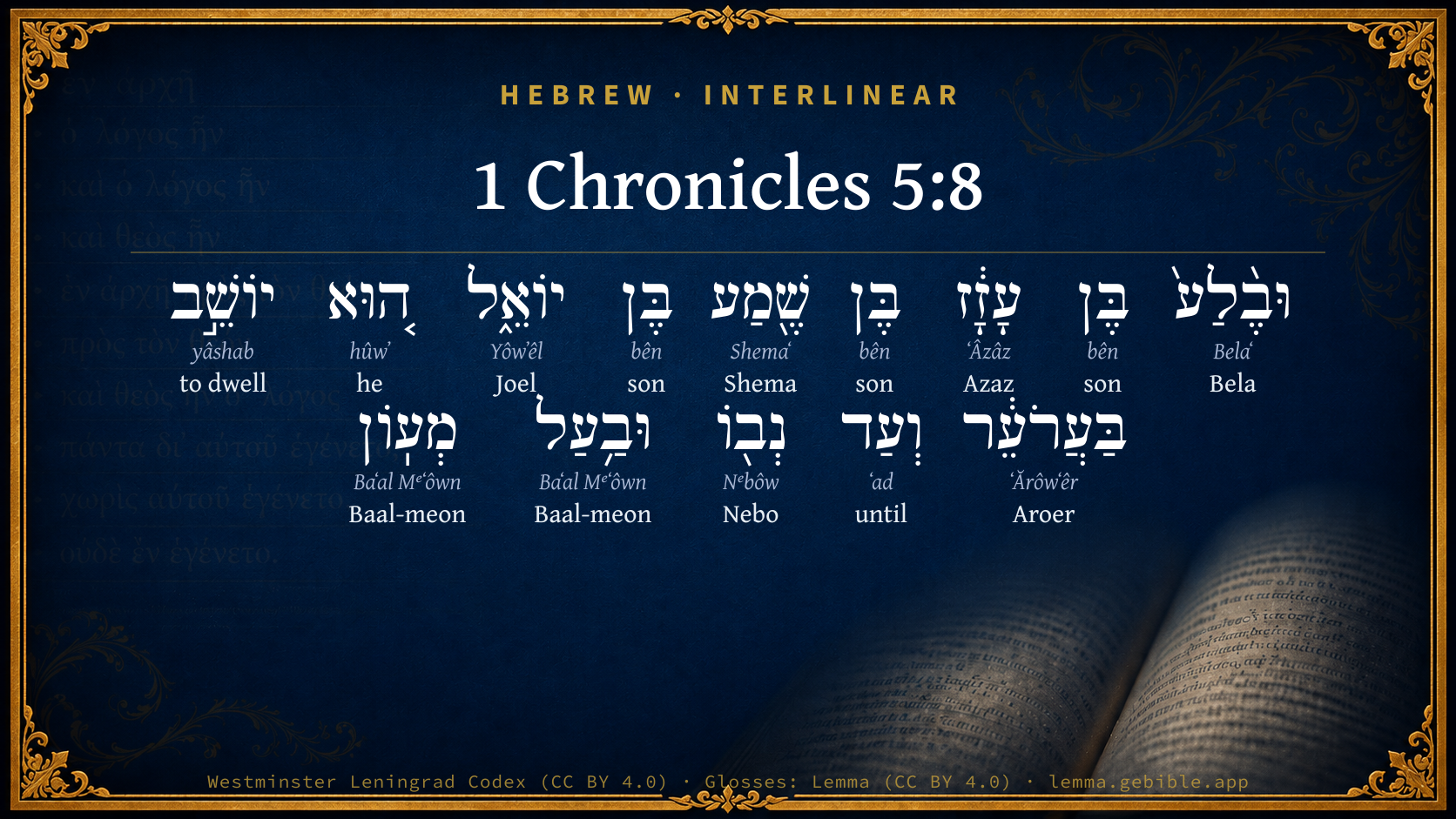
Hebrew (Westminster Leningrad Codex) 1 Chronicles 5:8 appears in the Hebrew Old Testament. The text above is from the Westminster Leningrad Codex. Each word links to its Strong’s number, a concise gloss, and parsing drawn from the Open Scriptures Hebrew Bible morphology. Click any word for its full Brown-Driver-Briggs (BDB) entry.
Download image
Cite this verse

1 Chronicles 5:8 (World English Bible). Public Domain. Lemma interlinear Bible study tool, https://lemma.gebible.app/v/1-chronicles/5/8.

Show BibTeX & RIS
BibTeX
RIS
English Translation
and Bela the son of Azaz, the son of Shema, the son of Joel, who lived in Aroer, even to Nebo and Baal Meon:
World English Bible · Public Domain
Highlights
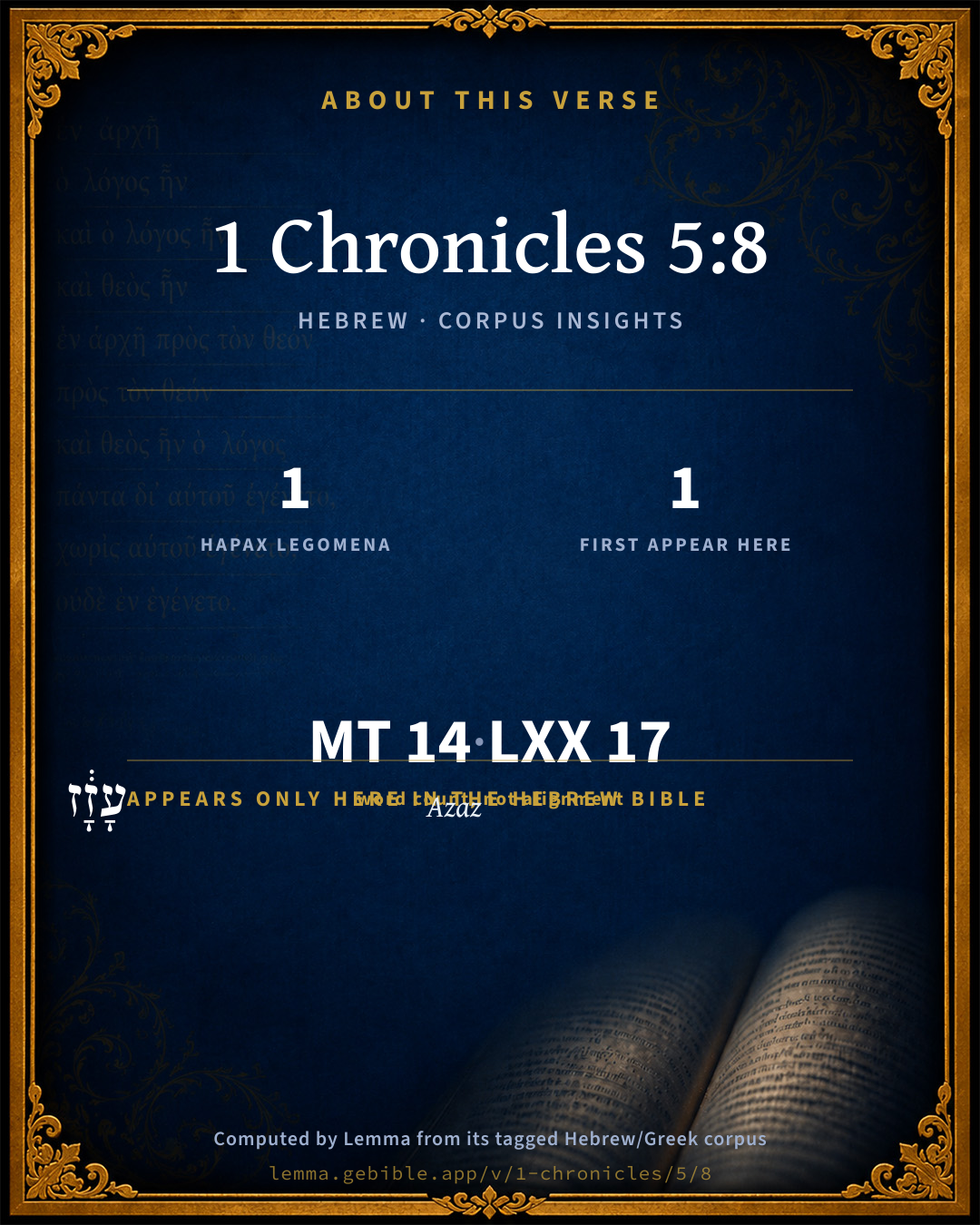
  • 1 hapax legomenon — only here in the Hebrew Bible
  • 1 first appearance in the Hebrew Bible
Full analysis ↓
Download a study sheet

One document with this verse’s original text, its word-by-word gloss line, the meaning frame, cross-references with their text, attributed commentary, and full source and license credits — printable, and it pastes into notes with its structure intact.

This verse Autodidact and up

Study sheet (.html) Plain text (.txt)

A passage Seminary Student

Up to 50 verses in one chapter. A passage sheet keeps up to 6 commentary sources and 12 cross-references per verse, in the order this page ranks them, and says so on the sheet whenever that leaves anything out. Ask for a single verse and you get the Autodidact verse sheet above.

Everything on this page stays free to read, with no account — the sheet is a download of what is already on screen, not access to it.

Want to remove ads? Support Godless Engineer
Compare translations 3

The same verse in 3 English versions, stacked beneath the original-language interlinear above. Click any original word for its lexicon entry.

Each is an independent rendering of the whole verse — the interlinear is not word-aligned to these translations.

Highlighted words mark where these versions differ — a whole-verse word diff, not a word-by-word alignment.

  • World English Bible Public Domain
    and Bela the son of Azaz, the son of Shema, the son of Joel, who lived in Aroer, even to Nebo and Baal Meon:
  • King James Version Public Domain
    And Bela the son of Azaz, the son of Shema, the son of Joel, who dwelt in Aroer, even unto Nebo and Baalmeon:
  • unfoldingWord Literal Text CC BY-SA 4.0
    and Bela, the son of Azaz, the son of Shema, the son of Joel. He was dwelling in Aroer and unto Nebo and Baal Meon,

unfoldingWord Literal Text — © unfoldingWord, licensed CC BY-SA 4.0. Word-aligned USFM3 via Door43 (git.door43.org/unfoldingWord/en_ult).

Versions to compare (up to 4)

3 of 4 selected

Show all 18 translations

Every available English version of this verse, each an independent rendering of the whole verse.

  • World English Bible Public Domain
    and Bela the son of Azaz, the son of Shema, the son of Joel, who lived in Aroer, even to Nebo and Baal Meon:
  • Berean Standard Bible Public Domain
    and Bela son of Azaz, the son of Shema, the son of Joel. They settled in Aroer and as far as Nebo and Baal-meon.
  • Majority Standard Bible Public Domain
    and Bela son of Azaz, the son of Shema, the son of Joel. They settled in Aroer and as far as Nebo and Baal-meon.
  • King James Version Public Domain
    And Bela the son of Azaz, the son of Shema, the son of Joel, who dwelt in Aroer, even unto Nebo and Baalmeon:
  • American Standard Version (1901) Public Domain
    and Bela the son of Azaz, the son of Shema, the son of Joel, who dwelt in Aroer, even unto Nebo and Baal-meon:
  • Revised Version (1885) Public Domain
    and Bela the son of Azaz, the son of Shema, the son of Joel, who dwelt in Aroer, even unto Nebo and Baal-meon:
  • Geneva Bible (1599) Public Domain
    And Bela the sonne of Azaz, the sonne of Shema, the sonne of Ioel, which dwelt in Aroer, euen vnto Nebo and Baal meon.
  • Douay-Rheims (1899) Public Domain
    And Bala the son of Azaz, the son of Samma, the son of Joel, dwelt in Aroer as far as Nebo, and Beelmeon.
  • Young's Literal Translation Public Domain
    and Bela son of Azaz, son of Shema, son of Joel -- he is dwelling in Aroer, even unto Nebo and Baal-Meon;
  • Literal Standard Version CC BY-SA 4.0
    and Bela son of Azaz, son of Shema, son of Joel—he is dwelling in Aroer, even to Nebo and Ba‘al-Meon;
  • Unlocked Literal Bible CC BY-SA 4.0
    Bela son of Azaz son of Shema son of Joel. They lived in Aroer, as far as Nebo and Baal Meon,
  • unfoldingWord Literal Text CC BY-SA 4.0
    and Bela, the son of Azaz, the son of Shema, the son of Joel. He was dwelling in Aroer and unto Nebo and Baal Meon,
  • Darby Bible Public Domain
    and Bela the son of Azaz, the son of Shema, the son of Joel, who dwelt in Aroer, as far as Nebo and Baal-meon;
  • World Messianic Bible Public Domain
    and Bela the son of Azaz, the son of Shema, the son of Joel, who lived in Aroer, even to Nebo and Baal Meon;
  • Webster's Bible Public Domain
    And Bela the son of Azaz, the son of Shema, the son of Joel, who dwelt in Aroer, even to Nebo, and Baal-meon:
  • Free Bible Version CC BY-SA 4.0
    and Bela of Azaz, son of Shema, son of Joel. They lived from Aroer to Nebo and Baal Meon.
  • Bible in Basic English Public Domain
    And Bela, the son of Azaz, the son of Shema, the son of Joel, who was living in Aroer, as far as Nebo and Baal-meon;
  • JPS Tanakh (1917) Public Domain
    and Bela the son of Azaz, the son of Shema, the son of Joel, who dwelt in Aroer, even unto Nebo and Baal-meon;

Literal Standard Version (2020), Covenant Press — licensed CC BY-SA 4.0. Text via the HelloAO Bible API (eBible.org). Unlocked Literal Bible (unfoldingWord) — licensed CC BY-SA 4.0. Text via the HelloAO Bible API (eBible.org). unfoldingWord Literal Text — © unfoldingWord, licensed CC BY-SA 4.0. Word-aligned USFM3 via Door43 (git.door43.org/unfoldingWord/en_ult). Free Bible Version, Dr. Jonathan Gallagher — licensed CC BY-SA 4.0. Text via the HelloAO Bible API (eBible.org).

Word by word

More ways to search: Search by grammar → Find every occurrence → Compare this word →

Practice this passage: Drill this verse → Learn its vocabulary →

About this verse

These counts appear in no published source. They are computed here, from the morphology-tagged text and Lemma’s own curated glosses. What Lemma adds →

14
words
11
distinct lemmas
Historical
section

Notable vocabulary

1 hapax legomenon — a word that appears only here in the entire Hebrew Bible:

  • עָזָ֔ז Azaz H5811

First appearance in Scripture

This word makes its first canonical appearance in the Hebrew Bible here:

  • עָזָ֔ז Azaz H5811

Shared distinctive vocabulary

שֶׁ֖מַע Shema H8087 occurs in 5 verses of the Hebrew Bible. Also found in:

Grammatical profile

  • 1 verb
  • 11 nouns
  • 1 pronoun
  • 1 preposition

Verb forms

  • יוֹשֵׁ֣ב Qal · Participle Active

Repetition

Words recur within this verse — often emphatic in Hebrew:

  • בֶּן son H1121 ×3
  • וּבַ֥עַל Baal-meon H1186 ×2

Hebrew & Septuagint length

In English translation the verse runs 24 words from the Hebrew and 24 from the Septuagint (LXX English) — the same length.

A rough comparison of the two English renderings, which tokenize alike — not a word-level alignment.

Word counts can differ between the Hebrew and the Greek without any difference in meaning — e.g. the Hebrew direct-object marker אֵת has no separate Greek word, and Greek often adds the article ὁ.

In the original languages it is 14 Hebrew tokens and 17 Greek tokens — but the two are counted differently (Hebrew bundles its prefixes and suffixes into one token; the Greek is in lemma form), so that isn’t a like-for-like length.

Cross-references

9

Topical passages linked to 1 Chronicles 5:8 in the Treasury of Scripture Knowledge — connected by theme and wording, ordered by reader-vote popularity; previews shown in the World English Bible.

  • Numbers 32:38 and Nebo, and Baal Meon, (their names being changed), and Sibmah: and they gave other names to the cities which they built.
  • Numbers 32:34 The children of Gad built Dibon, and Ataroth, and Aroer,
  • 1 Chronicles 5:4 The sons of Joel: Shemaiah his son, Gog his son, Shimei his son,
  • Deuteronomy 32:49 Go up into this mountain of Abarim, to Mount Nebo, which is in the land of Moab, that is over against Jericho; and see the land of Canaan, which I give to the children of Israel for a possession;
  • Deuteronomy 34:1 Moses went up from the plains of Moab to Mount Nebo, to the top of Pisgah, that is over against Jericho. Yahweh shown him all the land of Gilead, to Dan,
  • Joshua 13:17 Heshbon, and all its cities that are in the plain; Dibon, and Bamoth Baal, and Beth Baal Meon,
  • Isaiah 15:2 They are gone up to Bayith, and to Dibon, to the high places, to weep: Moab wails over Nebo, and over Medeba; on all their heads is baldness, every beard is cut off.
  • Isaiah 17:2 The cities of Aroer are forsaken; they shall be for flocks, which shall lie down, and none shall make them afraid.
  • Ezekiel 25:9 therefore, behold, I will open the side of Moab from the cities, from his cities which are on his frontiers, the glory of the country, Beth-jeshimoth, Baal Meon, and Kiriathaim,

Cross-references courtesy of OpenBible.info (CC BY 4.0).

Hebrew and Greek witnesses Masoretic Hebrew ↔ Greek Septuagint

The same verse in the two great witnesses to the Old Testament, shown verse-for-verse.

These are two independent witnesses, not word-aligned to each other, and the Septuagint is shown in lemma (dictionary) form.

Hebrew 1 Chronicles 5:8 Masoretic · Westminster Leningrad Codex

וּבֶ֨לַע֙ בֶּן עָזָ֔ז בֶּן שֶׁ֖מַע בֶּן יוֹאֵ֑ל ה֚וּא יוֹשֵׁ֣ב בַּעֲרֹעֵ֔ר וְעַד נְב֖וֹ וּבַ֥עַל מְעֽוֹן

and Bela the son of Azaz, the son of Shema, the son of Joel, who lived in Aroer, even to Nebo and Baal Meon:

World English Bible · Public Domain

Greek LXX 1 Chronicles 5:8 Septuagint · lemma form

καί βαλεκ υἱός οζουζ υἱός σαμα υἱός ιωηλ οὗτος καταοἰκέω ἐν αροηρ καί ἐπί ναβαυ καί βεελμαων

And Balec the son of Azuz, the son of Sama, the son of Joel: he lived in Aroer, and even to Naban, and Beelmasson.

LXX2012 (modern English Septuagint) · Public Domain

Hebrew: Westminster Leningrad Codex (CC BY 4.0). Greek: Septuagint (public domain); English from LXX2012 (modern English Septuagint) (Public Domain). How the Septuagint differs from the Hebrew →

Commentary

Notes on 1 Chronicles 5:8 from classic Christian and Jewish commentators (each source and its license shown beneath its notes). The classic Christian expositions comment on the surrounding passage and are grouped to its opening verse, so a note may address several verses; the Jewish commentaries on the Tanakh (Rashi and others) are per-verse, so they appear only where the commentator wrote on this verse.

Lemma curates 59 commentaries, every one of them public domain or Creative Commons licensed, each selected and text-cleaned for this edition rather than reprinted as found. About our sources →

Ellicott's Commentary for English Readers

(8) Bela.—His descent is traced, like that of Beerah. but through fewer names. This does not necessarily imply that Bela and Beerah were not contemporaries. Intermediate names are often omitted in genealogies. (See Jos_7:18 : “Achan son of Carmi son of Zabdi son of Zerah,” and 1Ch_5:24, “Achan son of Zerah,” and the different lengths of the pedigrees of Heman, Asaph, and Ethan in 1Ch_6:33-47.) It is not likely that the Joel of 1Ch_5:8 is the same as the Joel of 1Ch_5:4, in spite of the further coincidence of Shema-Shemiah.

Who dwelt.—He was dwelling, that is, he and his clan.

Aroer.—Now Arâ’ir, on the north bank of the Arnon (Jos_12:2).

Nebo, a place on the famous mount Nebo, in the region east of the Dead Sea (now Jebel Neba, Deu_34:1), over against Jericho (Num_32:38).

Baal-meon.—Or, Beth-bqal-meon, now Ma’in, about two miles south-east of Heshbon. Aroer gives the southern Nebo, and Baalmeon the northern, limits of the tribe. All three places are mentioned on the Stone of Mesha, kings of Moab (2Ki_3:4-27).

A Bible Commentary for English Readers, edited by Charles John Ellicott (1878–1897) — public domain. Text from a community e-Sword module.

Geneva Bible (1599)

Geneva Bible translators

These places were beyond Jordan toward the East in the land given to the Reubenites.

Geneva Bible (1599) marginal notes — public domain. Text via Bolls.life.

Adam Clarke's Commentary

Verse 8. Who dwelt in Aroer] This town was situated on the river Arnon; and Nebo was both a city and a mountain in the same country. They both lay on the other side of Jordan.

Adam Clarke's Commentary on the Bible (1810–1826) — public domain. Text from a community e-Sword/MySword module.

The Cambridge Bible for Schools and Colleges

gen. ed. J. J. S. Perowne

8. Aroer] now ‘Ar‘âir, a heap of ruins near the wâdy Mojib, i.e. the Arnon (Jos_12:2). It passed from Sihon king of the Amorites into the hands of the Reubenites at the Conquest (ib. Jos_13:16). See Bädeker, p. 191.

Nebo and Baal-meon] A line drawn due N. from Aroer (see last note), passes close first to Ma‘in (which may be Baal-meon) and then to Jebel Nebâ, which evidently preserves the name of Mount Nebo.

Baal-meon] called more correctly Beth-baal-meon Jos_13:17.

The Cambridge Bible for Schools and Colleges (gen. ed. J. J. S. Perowne; Cambridge University Press, 1878–1918) — public domain. Text from a community e-Sword module.

John Gill's Exposition

And eastward he inhabited,.... Either Bela, or the tribe of Reuben:

unto the entering in of the wilderness; the wilderness of Kedemoth, which was near to Sihon king of Heshbon, whose land the Reubenites inhabited, Deu 2:26.

from the river Euphrates; a learned man (r) thinks that this river Phrat was different from the Euphrates near Babylon, which was northward, since this was to the east or southeast:

because their cattle were multiplied in the land of Gilead; therefore their habitation was extended further, even to the river Euphrates, as in the days of David and Solomon, Sa2 8:3.

(r) Texelii Phoenix, l. 3. c. 7. p. 272.

John Gill's Exposition of the Whole Bible (1746–1763) — public domain (CC PDM 1.0). Text via the HelloAO Bible API.

Haydock's Catholic Bible Commentary

And. So Hebrew, &c., as f he was one of the princes. But the Vulgate seems to begin a new sentence, Porro, "now Bala." The possessions of this man must have been very extensive, from the Euphrates till (Haydock) Baal-meon, within nine miles of Hesebon, (Eusebius) almost (Calmet) as far as the Jordan. (Tirinus) --- Bala, or his descendants, extended their conquests as far as the Euphrates, which had been promised to Israel; and, under Saul, conquered the Agarites, who sprung from Agar. Syriac, &c., "the Arabs of Sacca," or the Scenites, "dwelling under tents," and inhabiting the Desert Arabia. The details of this war are probably given, ver. 19., &c. (Calmet)

George Leo Haydock (1774–1849), Haydock's Catholic Family Bible and Commentary, 1859 edition — public domain. Excludes Psalms (Douay-Rheims chapter numbering differs from Protestant) and Deuterocanonical books (Catholic canon only).

Matthew Poole's English Annotations

Who dwelt, to wit, the Reubenites, all these here before mentioned, as appears both by the following verses, which relate to the whole tribe; and by the agreement of this description of their inheritance with that, Jos 13:15,16.

Matthew Poole's English Annotations on the Holy Bible (1683–1685) — public domain. Text from a community e-Sword/MySword module.

Keil & Delitzsch

C. F. Keil & F. Delitzsch

And eastward he inhabited,.... Either Bela, or the tribe of Reuben:

unto the entering in of the wilderness; the wilderness of Kedemoth, which was near to Sihon king of Heshbon, whose land the Reubenites inhabited, Deu 2:26.

from the river Euphrates; a learned man (r) thinks that this river Phrat was different from the Euphrates near Babylon, which was northward, since this was to the east or southeast:

because their cattle were multiplied in the land of Gilead; therefore their habitation was extended further, even to the river Euphrates, as in the days of David and Solomon, Sa2 8:3.

(r) Texelii Phoenix, l. 3. c. 7. p. 272.

Keil & Delitzsch — Biblical Commentary on the Old Testament (1861–1891) — public domain (CC PDM 1.0). Text via the HelloAO Bible API. (Old Testament only.)

Rashi

Rabbi Shlomo Yitzchaki (Rashi)

and until Nebo and Baal Meon For in the ancient days, before they came into Israel’s hands, they were called Nebo and Baal Meon after their pagan deities, (lit. their abominations), for it was the custom of the heathens to call their pagan deities after their cities until that day. But when they came into Israel’s hands, they changed their names, as it is written (Num. 32:38): “Nebo and Baal Meon their names being changed,” i.e., Israel changed their names, but Sibmah, since it was not named for their pagan deities, they did not change its name. In Megillah (unknown) it is explained that Nebo and Baal Meon are names of pagan deities.

Rashi on the Tanakh — English translations: “The Judaica Press complete Tanach with Rashi, translated by A. J. Rosenberg” (CC BY 4.0); “Pentateuch with Rashi's commentary by M. Rosenbaum and A.M. Silbermann, 1929-1934” (public domain); “The Metsudah Tanach series, Lakewood, N.J” (CC BY 4.0); and “The Book of Joshua, Metsudah Publications, 1997” (CC BY 4.0). Text via Sefaria.

Lesson kit

Teaching starters — assembled from the data on this page, not authored interpretation. Every prompt links to the verse data it draws on. Edit before teaching.

1 Chronicles, in the Historical, opens this verse with 14 words (11 distinct Hebrew lemmas). Its most distinctive word is ʻÂzâz (“Azaz”). A historical commentator’s framing appears above. Read the whole chapter for the surrounding context.

Discussion questions

  1. The word ʻÂzâz carries the sense “Azaz.” How does it shape the verse?
  2. This verse holds 1 word here found nowhere else in the Hebrew Bible. What might the rare word draw attention to?
  3. The word “Azaz” first appears here in Scripture. What is being introduced at this debut?
  4. 1 Chronicles 2:43 shares the word «Shema» with this verse. How do the two illuminate each other?
  5. “son” occurs 3× in this one verse. What is the effect of the repetition?
  6. These translations render this verse differently. What is at stake in choosing one wording over another?
  7. The verb «יוֹשֵׁ֣ב» is Qal Participle Active. How does its form color the action?
  8. Reading how Ellicott's Commentary for English Readers and Geneva Bible (1599) read this verse, where do the two commentators agree and where do they part?

Things to notice

  • 1 word in this verse appears nowhere else in the Hebrew Bible.
  • 1 word makes its first canonical appearance in Scripture here.
  • This verse counts 14 Hebrew ↔ 17 Greek words.
  • These translations choose different wording for 8 words in this verse.
  • “son” occurs 3× in this single verse.

Reading settings

Reading text

Shown beneath each verse's original-language words.

Old Testament
Old Testament edition

Read the OT as the Masoretic Hebrew (MT) or the Greek Septuagint (LXX).

English shown for the Greek Septuagint (in the Hebrew ↔ Greek comparison).

Comparing translations? Open the Compare panel on any verse page to stack up to four side by side.