
Esther 1:18

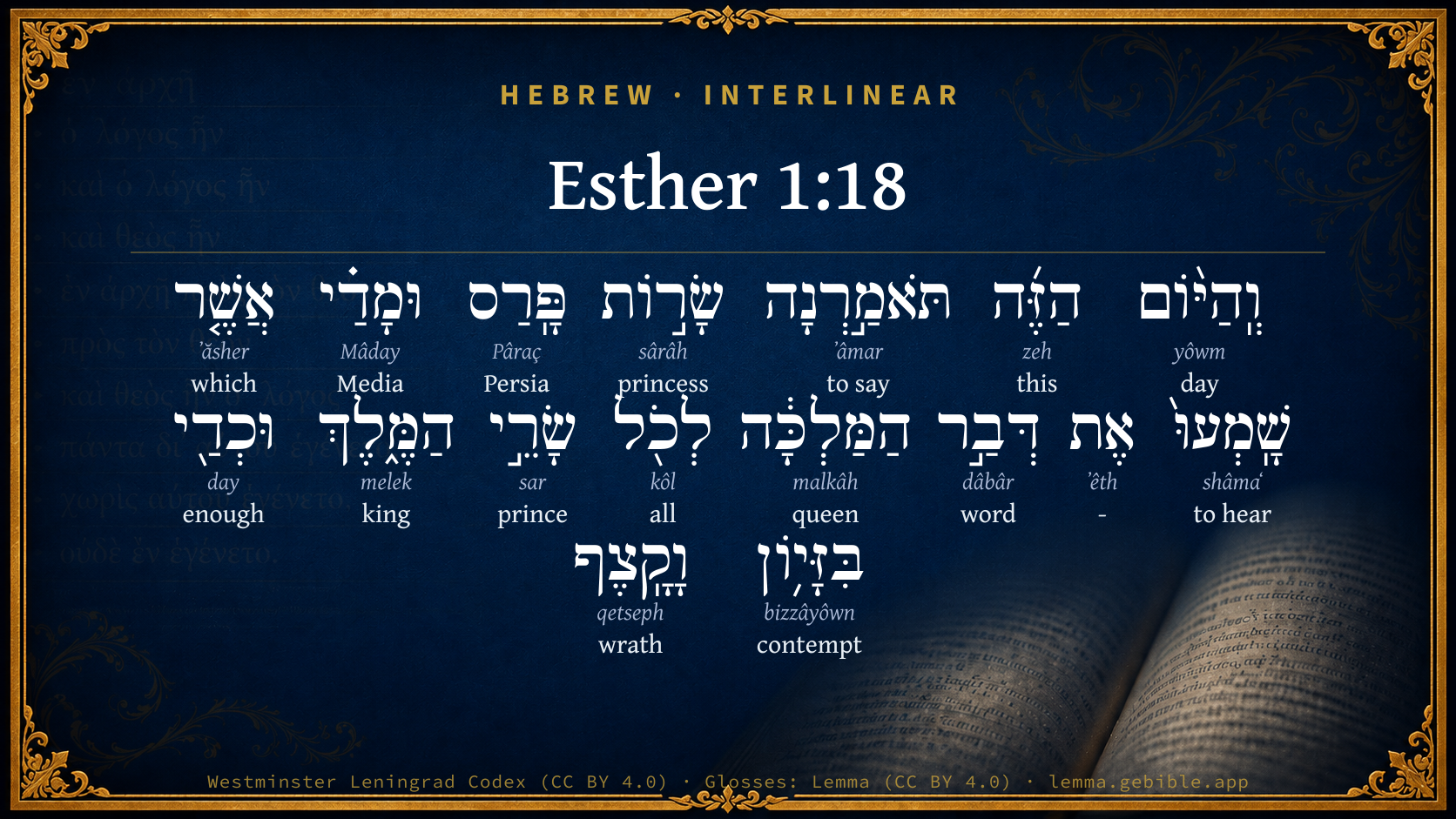
Hebrew (Westminster Leningrad Codex) Esther 1:18 appears in the Hebrew Old Testament. The text above is from the Westminster Leningrad Codex. Each word links to its Strong’s number, a concise gloss, and parsing drawn from the Open Scriptures Hebrew Bible morphology. Click any word for its full Brown-Driver-Briggs (BDB) entry.
Download image
Cite this verse

Esther 1:18 (World English Bible). Public Domain. Lemma interlinear Bible study tool, https://lemma.gebible.app/v/esther/1/18.

Show BibTeX & RIS
BibTeX
RIS
English Translation
This day will the princesses of Persia and Media who have heard of the deed of the queen say [the like] to all the king's princes. So [will there arise] much contempt and wrath.
World English Bible · Public Domain
Highlights
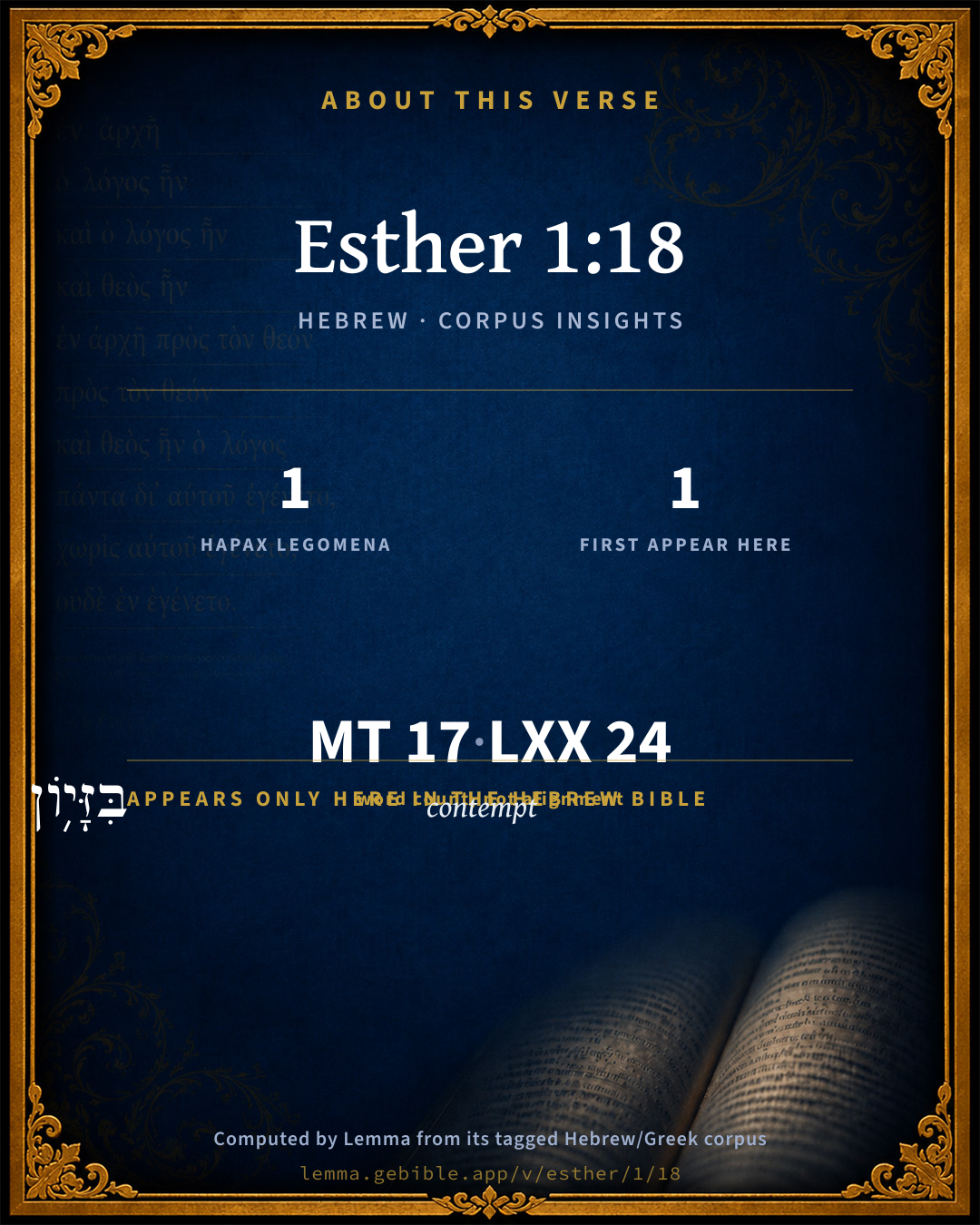
  • 1 hapax legomenon — only here in the Hebrew Bible
  • 1 first appearance in the Hebrew Bible
Full analysis ↓
Download a study sheet

One document with this verse’s original text, its word-by-word gloss line, the meaning frame, cross-references with their text, attributed commentary, and full source and license credits — printable, and it pastes into notes with its structure intact.

This verse Autodidact and up

Study sheet (.html) Plain text (.txt)

A passage Seminary Student

Up to 50 verses in one chapter. A passage sheet keeps up to 6 commentary sources and 12 cross-references per verse, in the order this page ranks them, and says so on the sheet whenever that leaves anything out. Ask for a single verse and you get the Autodidact verse sheet above.

Everything on this page stays free to read, with no account — the sheet is a download of what is already on screen, not access to it.

Want to remove ads? Support Godless Engineer
Compare translations 3

The same verse in 3 English versions, stacked beneath the original-language interlinear above. Click any original word for its lexicon entry.

Each is an independent rendering of the whole verse — the interlinear is not word-aligned to these translations.

Highlighted words mark where these versions differ — a whole-verse word diff, not a word-by-word alignment.

  • World English Bible Public Domain
    This day will the princesses of Persia and Media who have heard of the deed of the queen say [the like] to all the king's princes. So [will there arise] much contempt and wrath.
  • King James Version Public Domain
    Likewise shall the ladies of Persia and Media say this day unto all the king's princes, which have heard of the deed of the queen. Thus shall there arise too much contempt and wrath.
  • unfoldingWord Literal Text CC BY-SA 4.0
    Now this day, the noblewomen of Persia and Media who have heard the matter of the queen will speak to all the officials of the king. And there will be contempt and wrath enough!

unfoldingWord Literal Text — © unfoldingWord, licensed CC BY-SA 4.0. Word-aligned USFM3 via Door43 (git.door43.org/unfoldingWord/en_ult).

Versions to compare (up to 4)

3 of 4 selected

Show all 18 translations

Every available English version of this verse, each an independent rendering of the whole verse.

  • World English Bible Public Domain
    This day will the princesses of Persia and Media who have heard of the deed of the queen say [the like] to all the king's princes. So [will there arise] much contempt and wrath.
  • Berean Standard Bible Public Domain
    This very day the noble women of Persia and Media who have heard about the queen’s conduct will say the same thing to all the king’s officials, resulting in much contempt and wrath.
  • Majority Standard Bible Public Domain
    This very day the noble women of Persia and Media who have heard about the queen’s conduct will say the same thing to all the king’s officials, resulting in much contempt and wrath.
  • King James Version Public Domain
    Likewise shall the ladies of Persia and Media say this day unto all the king's princes, which have heard of the deed of the queen. Thus shall there arise too much contempt and wrath.
  • American Standard Version (1901) Public Domain
    And this day will the princesses of Persia and Media who have heard of the deed of the queen say `the like' unto all the king's princes. So `will there arise' much contempt and wrath.
  • Revised Version (1885) Public Domain
    And this day shall the princesses of Persia and Media which have heard of the deed of the queen say the like unto all the king’s princes, So shall there arise much contempt and wrath.
  • Geneva Bible (1599) Public Domain
    So shall the princesses of Persia and Media this day say vnto all the Kings Princes, when they heare of the acte of the Queene: thus shall there be much despitefulnesse and wrath.
  • Douay-Rheims (1899) Public Domain
    And by this example all the wives of the princes of the Persians and the Medes will slight the commandments of their husbands: wherefore the king's indignation is just.
  • Young's Literal Translation Public Domain
    yea, this day do princesses of Persia and Media, who have heard the word of the queen, say `so' to all heads of the king, even according to the sufficiency of contempt and wrath.
  • Literal Standard Version CC BY-SA 4.0
    indeed, this day princesses of Persia and Media, who have heard the word of the queen, say [so] to all heads of the king, even according to the sufficiency of contempt and wrath.
  • Unlocked Literal Bible CC BY-SA 4.0
    Before the end of this very day the noble women of Persia and Media who have heard of the matter of the queen will say the same thing to all the king's officials. There will be much contempt and anger.
  • unfoldingWord Literal Text CC BY-SA 4.0
    Now this day, the noblewomen of Persia and Media who have heard the matter of the queen will speak to all the officials of the king. And there will be contempt and wrath enough!
  • Darby Bible Public Domain
    And the princesses of Persia and Media who have heard of the queen's act, will say it this day to all the king's princes, and there will be contempt and anger enough.
  • World Messianic Bible Public Domain
    Today, the princesses of Persia and Media who have heard of the queen’s deed will tell all the king’s princes. This will cause much contempt and wrath.
  • Webster's Bible Public Domain
    Likewise will the ladies of Persia and Media say this day to all the king's princes, who have heard of the deed of the queen. Thus will there arise too much contempt and wrath.
  • Free Bible Version CC BY-SA 4.0
    By the end of the day, the wives of all the nobles throughout Persia and Media who have heard what the queen did will treat their noble husbands with angry contempt!
  • Bible in Basic English Public Domain
    And the wives of the captains of Persia and Media, hearing what the queen has done, will say the same to all the king's captains. So there will be much shame and wrath.
  • JPS Tanakh (1917) Public Domain
    And this day will the princesses of Persia and Media who have heard of the deed of the queen say the like unto all the king's princes. So will there arise enough contempt and wrath.

Literal Standard Version (2020), Covenant Press — licensed CC BY-SA 4.0. Text via the HelloAO Bible API (eBible.org). Unlocked Literal Bible (unfoldingWord) — licensed CC BY-SA 4.0. Text via the HelloAO Bible API (eBible.org). unfoldingWord Literal Text — © unfoldingWord, licensed CC BY-SA 4.0. Word-aligned USFM3 via Door43 (git.door43.org/unfoldingWord/en_ult). Free Bible Version, Dr. Jonathan Gallagher — licensed CC BY-SA 4.0. Text via the HelloAO Bible API (eBible.org).

Word by word

More ways to search: Search by grammar → Find every occurrence → Compare this word →

Practice this passage: Drill this verse → Learn its vocabulary →

בִּזָּי֥וֹן
bizzâyôwn
H963
“contempt”
Noun, Common, Masculine, Singular, Absolute
Part of Speech
Noun
Type
Common
Gender
Masculine
Number
Singular
State
Absolute
Full BDB Definition

Origin: from H959

TWOT: 224a

contempt
  1. וְֽהַיּ֨וֹם yôwm H3117 “and · the · day” Conjunction + Particle, Definite Article + Noun, Common, Masculine, Singular, Absolute
  2. הַזֶּ֜ה zeh H2088 “the · this” Particle, Definite Article + Pronoun, Demonstrative, Masculine, Singular
  3. תֹּאמַ֣רְנָה ʼâmar H559 “to say” Verb, Qal, Imperfect, 3rd Person, Feminine, Plural
  4. שָׂר֣וֹת sârâh H8282 “princesses of” Noun, Common, Feminine, Plural, Construct
  5. פָּֽרַס Pâraç H6539 “Persia” Noun, Proper
  6. וּמָדַ֗י Mâday H4074 “and · Media” Conjunction + Noun, Proper
  7. אֲשֶׁ֤ר ʼăsher H834 “which” Particle, Relative
  8. שָֽׁמְעוּ֙ shâmaʻ H8085 “to hear” Verb, Qal, Perfect, 3rd Person, Common, Plural
  9. אֶת ʼêth H853 “-” Particle, Direct Object
  10. דְּבַ֣ר dâbâr H1697 “word of” Noun, Common, Masculine, Singular, Construct
  11. הַמַּלְכָּ֔ה malkâh H4436 “the · queen” Particle, Definite Article + Noun, Common, Feminine, Singular, Absolute
  12. לְכֹ֖ל kôl H3605 “to/for · all of” Preposition + Noun, Common, Masculine, Singular, Construct
  13. שָׂרֵ֣י sar H8269 “princes of” Noun, Common, Masculine, Plural, Construct
  14. הַמֶּ֑לֶךְ melek H4428 “the · king” Particle, Definite Article + Noun, Common, Masculine, Singular, Absolute
  15. וּכְדַ֖י day H1767 “and · like/as · enough of” Conjunction + Preposition + Noun, Common, Masculine, Singular, Construct
  16. וָקָֽצֶף qetseph H7110 “and · wrath” Conjunction + Noun, Common, Masculine, Singular, Absolute

About this verse

These counts appear in no published source. They are computed here, from the morphology-tagged text and Lemma’s own curated glosses. What Lemma adds →

17
words
17
distinct lemmas
Historical
section

Notable vocabulary

1 hapax legomenon — a word that appears only here in the entire Hebrew Bible:

  • בִּזָּי֥וֹן contempt H963

First appearance in Scripture

This word makes its first canonical appearance in the Hebrew Bible here:

  • בִּזָּי֥וֹן contempt H963

Shared distinctive vocabulary

שָׂר֣וֹת princess H8282 occurs in 5 verses of the Hebrew Bible. Also found in:

Grammatical profile

  • 2 verbs
  • 12 nouns
  • 1 pronoun
  • 2 particles

Verb forms

  • תֹּאמַ֣רְנָה Qal · Imperfect
  • שָֽׁמְעוּ֙ Qal · Perfect

Hebrew & Septuagint length

In English translation the verse runs 34 words from the Hebrew and 32 from the Septuagint (LXX English) — closely comparable.

A rough comparison of the two English renderings, which tokenize alike — not a word-level alignment.

Word counts can differ between the Hebrew and the Greek without any difference in meaning — e.g. the Hebrew direct-object marker אֵת has no separate Greek word, and Greek often adds the article ὁ.

In the original languages it is 17 Hebrew tokens and 24 Greek tokens — but the two are counted differently (Hebrew bundles its prefixes and suffixes into one token; the Greek is in lemma form), so that isn’t a like-for-like length.

Cross-references

2

Topical passages linked to Esther 1:18 in the Treasury of Scripture Knowledge — connected by theme and wording, ordered by reader-vote popularity; previews shown in the World English Bible.

  • Judges 5:29 Her wise ladies answered her, Yes, she returned answer to herself,
  • 1 Kings 11:3 He had seven hundred wives, princesses, and three hundred concubines; and his wives turned away his heart.

Cross-references courtesy of OpenBible.info (CC BY 4.0).

Hebrew and Greek witnesses Masoretic Hebrew ↔ Greek Septuagint

The same verse in the two great witnesses to the Old Testament, shown verse-for-verse.

These are two independent witnesses, not word-aligned to each other, and the Septuagint is shown in lemma (dictionary) form.

Hebrew Esther 1:18 Masoretic · Westminster Leningrad Codex

וְֽהַיּ֨וֹם הַזֶּ֜ה תֹּאמַ֣רְנָה שָׂר֣וֹת פָּֽרַס וּמָדַ֗י אֲשֶׁ֤ר שָֽׁמְעוּ֙ אֶת דְּבַ֣ר הַמַּלְכָּ֔ה לְכֹ֖ל שָׂרֵ֣י הַמֶּ֑לֶךְ וּכְדַ֖י בִּזָּי֥וֹן וָקָֽצֶף

This day will the princesses of Persia and Media who have heard of the deed of the queen say [the like] to all the king's princes. So [will there arise] much contempt and wrath.

World English Bible · Public Domain

Greek LXX Esther 1:18 Septuagint · lemma form

οὕτως σήμερον ὁ τυραννίς ὁ λοιπός ὁ ἄρχων πέρσης καί μῆδοι ἀκούω ὁ ὁ βασιλεύς λέγω ὑπό αὐτός τολμάω ὁμοίως ἀτιμάζω ὁ ἀνήρ αὐτός

so this day shall the other ladies of the chiefs of the Persians and Medes, having heard what she said to the king, dare in the same way to dishonor their husbands.

LXX2012 (modern English Septuagint) · Public Domain

On this verse, Haydock's Catholic Bible Commentary discusses the Septuagint’s reading. Read the note in Commentary ↓

Hebrew: Westminster Leningrad Codex (CC BY 4.0). Greek: Septuagint (public domain); English from LXX2012 (modern English Septuagint) (Public Domain). How the Septuagint differs from the Hebrew →

Commentary

Notes on Esther 1:18 from classic Christian and Jewish commentators (each source and its license shown beneath its notes). The classic Christian expositions comment on the surrounding passage and are grouped to its opening verse, so a note may address several verses; the Jewish commentaries on the Tanakh (Rashi and others) are per-verse, so they appear only where the commentator wrote on this verse.

Lemma curates 59 commentaries, every one of them public domain or Creative Commons licensed, each selected and text-cleaned for this edition rather than reprinted as found. About our sources →

Trapp's Complete Commentary

John Trapp

Est 1:18 [Likewise] shall the ladies of Persia and Media say this day unto all the king’s princes, which have heard of the deed of the queen. Thus [shall there arise] too much contempt and wrath.

Ver. 18. Likewise shall the ladies of Persia and Media say] Say what? We will not do as our lords command us. Like enough all this; for their tongues were their own, and their wills no less. That free will (about which there is so much ado made) when men once lost, the women caught it up; and hence they are so wedded to their own will, saith one merrily. Quicquid volunt, valde volunt, what they will do they will do contra gentes, saith another. And for talking and telling their minds, the rabbis have a proverb, that ten kabs (measures) of speech descended into the world, and the women took away nine of them. These ladies of Persia and Media were feasting with the queen when the king sent for her, ubi quid factum est? garritur, potitatur, saltitatur, saith an interpreter, at which time they were chatting, and bibbing, and dancing, and (when their mirth was marred) they would not spare to speak their minds and ease their stomachs, whatever came of it. We read in our own chronicles of the Lady de Breuse, that by her railing and intemperate tongue she had so exasperated King John (whom she reviled as a tyrant and a murderer), that he would not be pacified by her strange present (four hundred cows, and one bull, all milk-white, except only the ears, which were red) sent unto the queen (Speed. 572).

Then shall there arise too much contempt and wrath] Contempt on the wives’ part, and wrath on the husbands’; wives shall slight their husbands, and they again shall fall foul upon their wives; so that coniugium marriage, shall become coniurgium; a dispute, and the house they dwell together in shall be no better than a fencing school, wherein the two sexes seem to have met together for nothing but to play their prizes, and to try masteries. This made Sulla say, I had been happy if I had never been married.

John Trapp, A Commentary or Exposition upon All the Books of the Old and New Testament (1647–1656) — public domain. Text from a community e-Sword module.

Joseph Benson's Commentary

Est 1:18. Thus shall there arise too much contempt and wrath — Contempt in the wives, and thereupon wrath in the husbands, and consequently strife in families, which may produce great and general mischiefs.

Joseph Benson's Commentary on the Old and New Testaments (1811–1818) — public domain. Text from a community e-Sword module.

Geneva Bible (1599)

Geneva Bible translators

Meaning, that they would take first occasion thereof to do the like, and that the rest of women would by continuance do the same.

Geneva Bible (1599) marginal notes — public domain. Text via Bolls.life.

Adam Clarke's Commentary

Verse 18. The ladies of Persia] שרות saroth, the princesses; but the meaning is very well expressed by our term ladies.

Adam Clarke's Commentary on the Bible (1810–1826) — public domain. Text from a community e-Sword/MySword module.

Ellicott's Commentary for English Readers

(18) Translate, and this day shall the princesses of Persia and Media, which heard the affair of the queen, say . . .

Contempt and wrath.—Presumably, contemptuous defiance on the part of the wives, and anger on the part of the husbands.

A Bible Commentary for English Readers, edited by Charles John Ellicott (1878–1897) — public domain. Text from a community e-Sword module.

The Cambridge Bible for Schools and Colleges

gen. ed. J. J. S. Perowne

18. Memucan points out that, inasmuch as the disobedience was public and notorious—for the princesses who were feasting with Vashti heard her answer—they will ‘say the like,’ i.e. will meet their husbands’ commands with equally insolent replies; or, better, as marg. of R.V., will ‘tell it,’ viz. spread the story far and wide.

much] lit., as in marg., enough, meaning, of course, more than enough; an example of the figure of speech called Litotes.

contempt and wrath] on the part of wives and husbands respectively.

The Cambridge Bible for Schools and Colleges (gen. ed. J. J. S. Perowne; Cambridge University Press, 1878–1918) — public domain. Text from a community e-Sword module.

John Gill's Exposition

Likewise shall the ladies of Persia and Media say this day unto the king's princes, which have heard of the deed of the queen,.... From henceforward they will give a like answer to their husbands, when they lay their commands upon them, as Vashti has to the king; they will tell them to their faces they will not obey their orders:

thus shall there arise too much contempt and wrath; there will be in wives a general contempt of their husbands, which will cause discord and strife, quarrels, wrath and anger; contempt on one part, wrath on the other, and contention between both.

John Gill's Exposition of the Whole Bible (1746–1763) — public domain (CC PDM 1.0). Text via the HelloAO Bible API.

Albert Barnes' Notes on the Bible

Translate it: “Likewise shall the princesses of Persia and Media, which have heard of the deed of the queen, say this day unto all the king’s princes.”

Albert Barnes' Notes on the Bible (1834–1885) — public domain. Text from a community e-Sword/MySword module.

Haydock's Catholic Bible Commentary

Wives. Greek turannides, "princesses, or female tyrants." --- Slight. Septuagint, "dare to slight their husbands. Wherefore if," &c. (Haydock) --- Just. Hebrew, "enough of contempt and indignation." This may be referred either to the king or to the women’s husbands. The example will prove a source of continual quarrels. (Calmet) --- Brentius approves the decision of this parasite; though St. Ambrose, &c., think that the queen was justified by the laws, which the king had no right to infringe, to gratify his drunken humour, ver. 10. Luther would also wrest this text in favour of adultery, p.ii. Devort. p. 177. (Worthington)

George Leo Haydock (1774–1849), Haydock's Catholic Family Bible and Commentary, 1859 edition — public domain. Excludes Psalms (Douay-Rheims chapter numbering differs from Protestant) and Deuterocanonical books (Catholic canon only).

Matthew Poole's English Annotations

Contempt in the wives, and thereupon wrath in the husbands; and consequently strife in families; which may produce great and general mischiefs.

Matthew Poole's English Annotations on the Holy Bible (1683–1685) — public domain. Text from a community e-Sword/MySword module.

Whedon's Commentary on the Bible

Daniel D. Whedon

18. Ladies — Princesses; those who were with their husbands at the court of Ahasuerus, or at Shushan, where they would at once (this day) hear of Vashti’s deed, that is, both her act and words, and be emboldened to say to their lords what Vashti had said to the king.

Contempt and wrath — Contempt on the part of wives for their husbands, and consequent wrath or anger (compare Est_1:12) on the part of the affronted husbands. This verse should be rendered thus: And this day will the princesses of Persia and Media, who have heard of the word of the queen, say (like words) to all the princes of the king, and (there will be) enough contempt and wrath.

Daniel D. Whedon (gen. ed.), Commentary on the Old and New Testaments (1874–1909) — public domain. Text from a community e-Sword module.

The Pulpit Commentary

The ladies. Rather, "the princesses." Translate the whole passage as follows: shall the princesses of Persia and Media, which have heard of the deed of the queen, say this day to all the king"s princes." Not only will the wives of the common people get hold of the story, and quote Vashti"s example as often as they wish to disobey their husbands, but our own wives too will disobey us on the same pretext, and will begin forthwith "this day." Too much contempt and wrath. Literally, "sufficient;" but the meaning is that given by our translators enough," "more than enough." Contempt on the part of the wives; wrath on the part of the husbands.

The Pulpit Commentary (1880–1919), ed. H.D.M. Spence-Jones & Joseph S. Exell — public domain. Text from a community e-Sword module.

John Wesley's Explanatory Notes

Contempt - Contempt in the wives, and thereupon wrath in the husbands; and consequently strife in families.

John Wesley, Explanatory Notes Upon the Whole Bible (1754–1765) — public domain. Text via the GEBible commentary corpus.

Rashi

Rabbi Shlomo Yitzchaki (Rashi)

the princesses of Persia and Media, etc. will say this word to all the princes; this is an ellipsis.

and much contempt and wrath And in this matter, there is much contempt and wrath.

Rashi on the Tanakh — English translations: “The Judaica Press complete Tanach with Rashi, translated by A. J. Rosenberg” (CC BY 4.0); “Pentateuch with Rashi's commentary by M. Rosenbaum and A.M. Silbermann, 1929-1934” (public domain); “The Metsudah Tanach series, Lakewood, N.J” (CC BY 4.0); and “The Book of Joshua, Metsudah Publications, 1997” (CC BY 4.0). Text via Sefaria.

Lesson kit

Teaching starters — assembled from the data on this page, not authored interpretation. Every prompt links to the verse data it draws on. Edit before teaching.

Esther, in the Historical, opens this verse with 17 words (17 distinct Hebrew lemmas). Its most distinctive word is bizzâyôwn (“contempt”). A historical commentator’s framing appears above. Read the whole chapter for the surrounding context.

Discussion questions

  1. How does “contempt” (bizzâyôwn) shape what this verse is saying?
  2. 1 word here appears nowhere else in the Hebrew Bible. Why might the author reach for such rare wording?
  3. This is the first place “contempt” appears in Scripture (first appears here). What does its debut here establish?
  4. How does Judges 5:29, which shares the word «princess», read alongside this verse?
  5. The translations on this page render this verse differently — a whole-verse word diff, not a word-by-word alignment. What might account for the different wordings?
  6. «תֹּאמַ֣רְנָה» is a Qal Imperfect verb. How does that grammatical form shape the action described?
  7. Compare how Trapp's Complete Commentary and Joseph Benson's Commentary read this verse. Where do they agree or differ?

Things to notice

Reading settings

Reading text

Shown beneath each verse's original-language words.

Old Testament
Old Testament edition

Read the OT as the Masoretic Hebrew (MT) or the Greek Septuagint (LXX).

English shown for the Greek Septuagint (in the Hebrew ↔ Greek comparison).

Comparing translations? Open the Compare panel on any verse page to stack up to four side by side.