
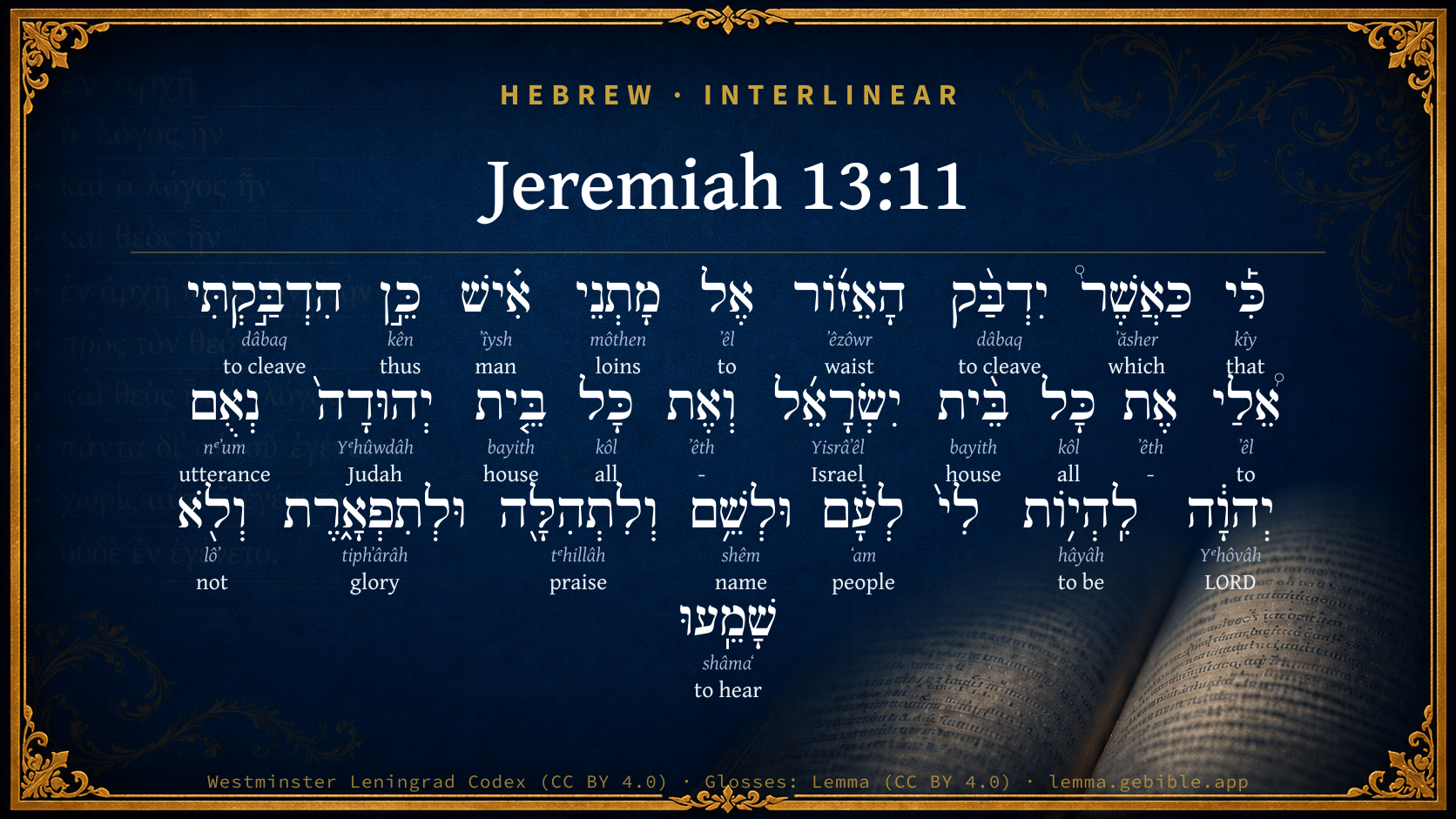
Jeremiah 13:11

Hebrew (Westminster Leningrad Codex) Jeremiah 13:11 appears in the Hebrew Old Testament. The text above is from the Westminster Leningrad Codex. Each word links to its Strong’s number, a concise gloss, and parsing drawn from the Open Scriptures Hebrew Bible morphology. Click any word for its full Brown-Driver-Briggs (BDB) entry.
Download image
Cite this verse

Jeremiah 13:11 (World English Bible). Public Domain. Lemma interlinear Bible study tool, https://lemma.gebible.app/v/jeremiah/13/11.

Show BibTeX & RIS
BibTeX
RIS
English Translation
For as the belt cleaves to the loins of a man, so have I caused to cleave to me the whole house of Israel and the whole house of Judah, says Yahweh; that they may be to me for a people, and for a name, and for a praise, and for a glory: but they would not hear.
World English Bible · Public Domain
Download a study sheet

One document with this verse’s original text, its word-by-word gloss line, the meaning frame, cross-references with their text, attributed commentary, and full source and license credits — printable, and it pastes into notes with its structure intact.

This verse Autodidact and up

Study sheet (.html) Plain text (.txt)

A passage Seminary Student

Up to 50 verses in one chapter. A passage sheet keeps up to 6 commentary sources and 12 cross-references per verse, in the order this page ranks them, and says so on the sheet whenever that leaves anything out. Ask for a single verse and you get the Autodidact verse sheet above.

Everything on this page stays free to read, with no account — the sheet is a download of what is already on screen, not access to it.

Want to remove ads? Support Godless Engineer
Compare translations 3

The same verse in 3 English versions, stacked beneath the original-language interlinear above. Click any original word for its lexicon entry.

Each is an independent rendering of the whole verse — the interlinear is not word-aligned to these translations.

Highlighted words mark where these versions differ — a whole-verse word diff, not a word-by-word alignment.

  • World English Bible Public Domain
    For as the belt cleaves to the loins of a man, so have I caused to cleave to me the whole house of Israel and the whole house of Judah, says Yahweh; that they may be to me for a people, and for a name, and for a praise, and for a glory: but they would not hear.
  • King James Version Public Domain
    For as the girdle cleaveth to the loins of a man, so have I caused to cleave unto me the whole house of Israel and the whole house of Judah, saith the LORD; that they might be unto me for a people, and for a name, and for a praise, and for a glory: but they would not hear.
  • unfoldingWord Literal Text CC BY-SA 4.0
    For as a loincloth clings to the loins of a man, so I have caused the whole house of Israel and the whole house of Judah to cling to me”—the declaration of Yahweh—“to be for me people, and for name, and for praise, and for glory. But they would not listen.

unfoldingWord Literal Text — © unfoldingWord, licensed CC BY-SA 4.0. Word-aligned USFM3 via Door43 (git.door43.org/unfoldingWord/en_ult).

Versions to compare (up to 4)

3 of 4 selected

Show all 18 translations

Every available English version of this verse, each an independent rendering of the whole verse.

  • World English Bible Public Domain
    For as the belt cleaves to the loins of a man, so have I caused to cleave to me the whole house of Israel and the whole house of Judah, says Yahweh; that they may be to me for a people, and for a name, and for a praise, and for a glory: but they would not hear.
  • Berean Standard Bible Public Domain
    For just as a loincloth clings to a man’s waist, so I have made the whole house of Israel and the whole house of Judah cling to Me, declares the LORD, so that they might be My people for My renown and praise and glory. But they did not listen.
  • Majority Standard Bible Public Domain
    For just as a loincloth clings to a man’s waist, so I have made the whole house of Israel and the whole house of Judah cling to Me, declares the LORD, so that they might be My people for My renown and praise and glory. But they did not listen.
  • King James Version Public Domain
    For as the girdle cleaveth to the loins of a man, so have I caused to cleave unto me the whole house of Israel and the whole house of Judah, saith the LORD; that they might be unto me for a people, and for a name, and for a praise, and for a glory: but they would not hear.
  • American Standard Version (1901) Public Domain
    For as the girdle cleaveth to the loins of a man, so have I caused to cleave unto me the whole house of Israel and the whole house of Judah, saith Jehovah; that they may be unto me for a people, and for a name, and for a praise, and for a glory: but they would not hear.
  • Revised Version (1885) Public Domain
    For as the girdle cleaveth to the loins of a man, so have I caused to cleave unto me the whole house of Israel and the whole house of Judah, saith the LORD; that they might be unto me for a people, and for a name, and for a praise, and for a glory: but they would not hear.
  • Geneva Bible (1599) Public Domain
    For as the girdle cleaueth to the loynes of a man, so haue I tied to me the whole house of Israel, and the whole house of Iudah, saith the Lord, that they might bee my people: that they might haue a name and prayse, and glory, but they would not heare.
  • Douay-Rheims (1899) Public Domain
    For as the girdle sticketh close to the loins of a man, so have I brought close to me all of the house of Israel, and all the house of Juda, saith the Lord: that they might be my people, and for a name, and for a praise, and for a glory: but they would not hear.
  • Young's Literal Translation Public Domain
    For, as the girdle cleaveth unto the loins of a man, So I caused to cleave unto Me The whole house of Israel, And the whole house of Judah, an affirmation of Jehovah, To be to Me for a people, and for a name, And for praise, and for beauty, And they have not hearkened.
  • Literal Standard Version CC BY-SA 4.0
    For as the girdle cleaves to the loins of a man, || So I caused to cleave to Me || The whole house of Israel, || And the whole house of Judah,” || A declaration of YHWH, || “To be to Me for a people, and for a name, || And for praise, and for beauty, || And they have not listened.
  • Unlocked Literal Bible CC BY-SA 4.0
    For just as an undergarment clings to someone's hips, so I have made all the house of Israel and all the house of Judah cling to me—this is Yahweh's declaration—to be my people, to bring me fame, praise, and honor. But they would not listen to me.
  • unfoldingWord Literal Text CC BY-SA 4.0
    For as a loincloth clings to the loins of a man, so I have caused the whole house of Israel and the whole house of Judah to cling to me”—the declaration of Yahweh—“to be for me people, and for name, and for praise, and for glory. But they would not listen.
  • Darby Bible Public Domain
    For as a girdle cleaveth to the loins of a man, so have I caused to cleave unto me the whole house of Israel and the whole house of Judah, saith Jehovah; that they might be unto me for a people, and for a name, and for a praise, and for a glory: but they would not hear.
  • World Messianic Bible Public Domain
    For as the belt clings to the waist of a man, so I have caused the whole house of Israel and the whole house of Judah to cling to me,’ says the LORD; ‘that they may be to me for a people, for a name, for praise, and for glory; but they would not hear.’
  • Webster's Bible Public Domain
    For as the girdle cleaveth to the loins of a man, so have I caused to cleave to me the whole house of Israel and the whole house of Judah, saith the LORD; that they might be to me for a people, and for a name, and for a praise, and for a glory: but they would not hear.
  • Free Bible Version CC BY-SA 4.0
    In the same way that a loincloth holds tightly to the body, so I made all the people of Israel and Judah hold tightly to me, declares the Lord. Then they could have been my people, representing me, giving me honor and praise. But they refused to listen.
  • Bible in Basic English Public Domain
    For as a band goes tightly round a man's body, so I made all the people of Israel and all the people of Judah tightly united to me; so that they might be a people for me and a name and a praise and a glory: but they would not give ear.
  • JPS Tanakh (1917) Public Domain
    For as the girdle cleaveth to the loins of a man, so have I caused to cleave unto Me the whole house of Israel and the whole house of Judah, saith the LORD, that they might be unto Me for a people, and for a name, and for a praise, and for a glory; but they would not hearken.

Literal Standard Version (2020), Covenant Press — licensed CC BY-SA 4.0. Text via the HelloAO Bible API (eBible.org). Unlocked Literal Bible (unfoldingWord) — licensed CC BY-SA 4.0. Text via the HelloAO Bible API (eBible.org). unfoldingWord Literal Text — © unfoldingWord, licensed CC BY-SA 4.0. Word-aligned USFM3 via Door43 (git.door43.org/unfoldingWord/en_ult). Free Bible Version, Dr. Jonathan Gallagher — licensed CC BY-SA 4.0. Text via the HelloAO Bible API (eBible.org).

Word by word

More ways to search: Search by grammar → Find every occurrence → Compare this word →

Practice this passage: Drill this verse → Learn its vocabulary →

הָאֵז֜וֹר
ʼêzôwr
H232
“the · waist”
Particle, Definite Article + Noun, Common, Masculine, Singular, Absolute
Part of Speech
Particle + Noun
Type
Common
Gender
Masculine
Number
Singular
State
Absolute
Full BDB Definition

Origin: from H246

TWOT: 59a

waist-cloth, the innermost piece of clothing - of God's power over kings (figuratively) - of faithfulness (metaphorically) - waistband
  1. כִּ֡י kîy H3588 “that” Conjunction
  2. כַּאֲשֶׁר֩ ʼăsher H834 “like/as · which” Preposition + Particle, Relative
  3. יִדְבַּ֨ק dâbaq H1692 “to cleave” Verb, Qal, Imperfect, 3rd Person, Masculine, Singular
  4. אֶל ʼêl H413 “to” Preposition
  5. מָתְנֵי môthen H4975 “loins of” Noun, Common, Masculine, Dual, Construct
  6. אִ֗ישׁ ʼîysh H376 “man” Noun, Common, Masculine, Singular, Absolute
  7. כֵּ֣ן kên H3651 “thus” Particle, Demonstrative
  8. הִדְבַּ֣קְתִּי dâbaq H1692 “to cleave” Verb, Hiphil, Perfect, 1st Person, Common, Singular
  9. אֵ֠לַי ʼêl H413 “to · me” Preposition + Suffix, Personal, 1st Person, Common, Singular
  10. אֶת ʼêth H853 “-” Particle, Direct Object
  11. כָּל kôl H3605 “all of” Noun, Common, Masculine, Singular, Construct
  12. בֵּ֨ית bayith H1004 “house of” Noun, Common, Masculine, Singular, Construct
  13. יִשְׂרָאֵ֜ל Yisrâʼêl H3478 “Israel” Noun, Proper
  14. וְאֶת ʼêth H853 “and · -” Conjunction + Particle, Direct Object
  15. כָּל kôl H3605 “all of” Noun, Common, Masculine, Singular, Construct
  16. בֵּ֤ית bayith H1004 “house of” Noun, Common, Masculine, Singular, Construct
  17. יְהוּדָה֙ Yᵉhûwdâh H3063 “Judah” Noun, Proper
  18. נְאֻם nᵉʼum H5002 “utterance of” Noun, Common, Masculine, Singular, Construct
  19. יְהוָ֔ה Yᵉhôvâh H3068 “LORD” Noun, Proper
  20. לִֽהְי֥וֹת hâyâh H1961 “to be” Preposition + Verb, Qal, Infinitive Construct
  21. לְעָ֔ם ʻam H5971 “to/for · people” Preposition + Noun, Common, Masculine, Singular, Absolute
  22. וּלְשֵׁ֥ם shêm H8034 “and · to/for · name” Conjunction + Preposition + Noun, Common, Masculine, Singular, Absolute
  23. וְלִתְהִלָּ֖ה tᵉhillâh H8416 “and · to/for · praise” Conjunction + Preposition + Noun, Common, Feminine, Singular, Absolute
  24. וּלְתִפְאָ֑רֶת tiphʼârâh H8597 “and · to/for · glory” Conjunction + Preposition + Noun, Common, Feminine, Singular, Absolute
  25. וְלֹ֖א lôʼ H3808 “and · not” Conjunction + Particle, Negative
  26. שָׁמֵֽעוּ shâmaʻ H8085 “to hear” Verb, Qal, Perfect, 3rd Person, Common, Plural

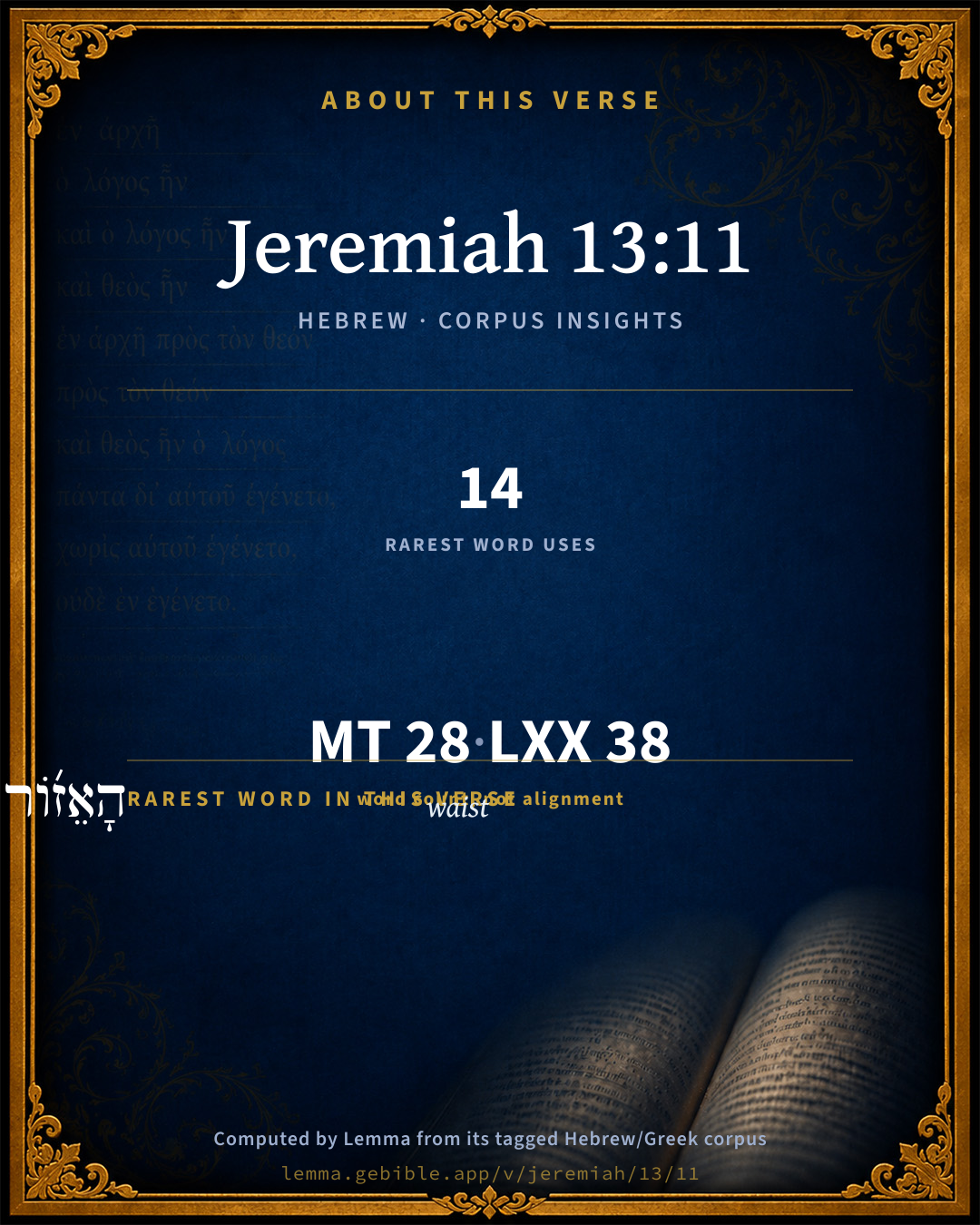
About this verse

These counts appear in no published source. They are computed here, from the morphology-tagged text and Lemma’s own curated glosses. What Lemma adds →

28
words
22
distinct lemmas
Prophets
section

Notable vocabulary

The rarest word here is הָאֵז֜וֹר waist H232 — appearing just 14 times in the whole Hebrew Bible.

Shared distinctive vocabulary

הָאֵז֜וֹר waist H232 occurs in 12 verses of the Hebrew Bible. Also found in:

Grammatical profile

  • 4 verbs
  • 15 nouns
  • 3 prepositions
  • 1 conjunction
  • 5 particles

Verb forms

  • יִדְבַּ֨ק Qal · Imperfect
  • הִדְבַּ֣קְתִּי Hiphil · Perfect
  • לִֽהְי֥וֹת Qal · Infinitive Construct
  • שָׁמֵֽעוּ Qal · Perfect

Repetition

Words recur within this verse — often emphatic in Hebrew:

  • יִדְבַּ֨ק to cleave H1692 ×2
  • כָּל all H3605 ×2
  • בֵּ֨ית house H1004 ×2
  • אֶל to H413 ×2

Hebrew & Septuagint length

In the original languages it is 28 Hebrew tokens and 38 Greek tokens — but the two are counted differently (Hebrew bundles its prefixes and suffixes into one token; the Greek is in lemma form), so that isn’t a like-for-like length.

Cross-references

16

Topical passages linked to Jeremiah 13:11 in the Treasury of Scripture Knowledge — connected by theme and wording, ordered by reader-vote popularity; previews shown in the World English Bible.

  • Exodus 19:5–6 Now therefore, if you will indeed obey my voice, and keep my covenant, then you shall be my own possession from among all peoples; for all the earth is mine;
  • Jeremiah 33:9 [This city] shall be to me for a name of joy, for a praise and for a glory, before all the nations of the earth, which shall hear all the good that I do to them, and shall fear and tremble for all the good and for all the peace that I procure to it.
  • Psalms 81:11 But my people didn't listen to my voice. Israel desired none of me.
  • Isaiah 43:21 the people which I formed for myself, that they might set forth my praise.
  • Deuteronomy 4:7 For what great nation is there, that has a god so near to them, as Yahweh our God is whenever we call on him?
  • Deuteronomy 26:18 and Yahweh has declared you this day to be a people for his own possession, as he has promised you, and that you should keep all his commandments;
  • Deuteronomy 32:10–15 He found him in a desert land, In the waste howling wilderness; He compassed him about, he cared for him, He kept him as the apple of his eye.
  • Psalms 135:4 For Yah has chosen Jacob for himself; Israel for his own possession.
  • Psalms 147:20 He has not done this for just any nation. They don't know his ordinances. Praise Yah!
  • Isaiah 62:12 They shall call them The holy people, The redeemed of Yahweh: and you shall be called Sought out, A city not forsaken.
  • Jeremiah 6:17 I set watchmen over you, [saying], Listen to the sound of the trumpet; but they said, We will not listen.
  • Jeremiah 7:26 yet they didn't listen to me, nor inclined their ear, but made their neck stiff: they did worse than their fathers.
  • Jeremiah 13:10 This evil people, who refuse to hear my words, who walk in the stubbornness of their heart, and are gone after other gods to serve them, and to worship them, shall even be as this belt, which is profitable for nothing.
  • Jeremiah 32:20 who performed signs and wonders in the land of Egypt, even to this day, both in Israel and among [other] men; and made you a name, as in this day;
  • John 5:37–40 The Father himself, who sent me, has testified about me. You have neither heard his voice at any time, nor seen his form.
  • 1 Peter 2:9 But you are a chosen race, a royal priesthood, a holy nation, a people for God's own possession, that you may show forth the excellencies of him who called you out of darkness into his marvelous light:

Cross-references courtesy of OpenBible.info (CC BY 4.0).

Hebrew and Greek witnesses Masoretic Hebrew ↔ Greek Septuagint

The same verse in the two great witnesses to the Old Testament, shown verse-for-verse.

These are two independent witnesses, not word-aligned to each other, and the Septuagint is shown in lemma (dictionary) form.

Hebrew Jeremiah 13:11 Masoretic · Westminster Leningrad Codex

כִּ֡י כַּאֲשֶׁר֩ יִדְבַּ֨ק הָאֵז֜וֹר אֶל מָתְנֵי אִ֗ישׁ כֵּ֣ן הִדְבַּ֣קְתִּי אֵ֠לַי אֶת כָּל בֵּ֨ית יִשְׂרָאֵ֜ל וְאֶת כָּל בֵּ֤ית יְהוּדָה֙ נְאֻם יְהוָ֔ה לִֽהְי֥וֹת לִי֙ לְעָ֔ם וּלְשֵׁ֥ם וְלִתְהִלָּ֖ה וּלְתִפְאָ֑רֶת וְלֹ֖א שָׁמֵֽעוּ

For as the belt cleaves to the loins of a man, so have I caused to cleave to me the whole house of Israel and the whole house of Judah, says Yahweh; that they may be to me for a people, and for a name, and for a praise, and for a glory: but they would not hear.

World English Bible · Public Domain

Greek LXX Structure differs

In the Septuagint, Jeremiah is about an eighth shorter than the Hebrew and arranges its material differently — the Oracles Against the Nations (Hebrew chapters 46–51) appear in the middle of the Greek book, after 25:13. Because the chapter and verse boundaries do not line up, a verse-for-verse comparison with the Hebrew is not shown.

A verse-for-verse comparison isn’t shown here because the chapters and verses don’t line up. Switch to the LXX edition with the MT / LXX toggle above to read the Greek directly.

Hebrew: Westminster Leningrad Codex (CC BY 4.0). Greek: Septuagint (public domain); English from a public-domain English Septuagint. How the Septuagint differs from the Hebrew →

Targum (Aramaic paraphrase)

1

The Targum is the ancient Jewish Aramaic paraphrase of the Hebrew Scriptures — an interpretive translation, not the Hebrew text itself. Onkelos (literal) and Pseudo-Jonathan (expansive) render the Torah, and Jonathan the Prophets. Coverage is partial: where no permissively-licensed English translation exists for a verse, only the Aramaic is shown. This is verse-level text, not a word-by-word alignment to the Hebrew.

  1. Targum Jonathan Prophets (Joshua–Malachi)
    אֲרֵי כְּמָא דְמִדְבַּק זַרְזָא בְּחַרְצָא דְגַבְרָא כֵּן קָרְבֵית לְפוּלְחָנִי יַת כָּל בֵּית יִשְׂרָאֵל וְיַת כָּל בֵּית יְהוּדָה אֲמַר יְיָ לְמֶהֱוֵי קֳדָמַי לְעַם וּלְשׁוּם וּלְחוּשְׁבְּחָא וְלִרְבוּ וְלָא קַבִּילוּ:

    (no public-domain English translation for this verse)

    Targum Jonathan — Aramaic: “Mikraot Gedolot” (public domain). English: “Sefaria Community Translation” (CC0 1.0 (public-domain dedication)); “London "Chaldee Paraphrase," 1871” (public domain). Text via Sefaria.

Commentary

Notes on Jeremiah 13:11 from classic Christian and Jewish commentators (each source and its license shown beneath its notes). The classic Christian expositions comment on the surrounding passage and are grouped to its opening verse, so a note may address several verses; the Jewish commentaries on the Tanakh (Rashi and others) are per-verse, so they appear only where the commentator wrote on this verse.

Lemma curates 59 commentaries, every one of them public domain or Creative Commons licensed, each selected and text-cleaned for this edition rather than reprinted as found. About our sources →

Trapp's Complete Commentary

John Trapp

Jer 13:11 For as the girdle cleaveth to the loins of a man, so have I caused to cleave unto me the whole house of Israel and the whole house of Judah, saith the LORD; that they might be unto me for a people, and for a name, and for a praise, and for a glory: but they would not hear.

Ver. 11. So have I caused to cleave unto me.] For nearness and dearness; the loins are the seat of strongest desires and affections.

And for a name and for a praise.] That I might be magnified and glorified in them, and for them also, among other nations.

John Trapp, A Commentary or Exposition upon All the Books of the Old and New Testament (1647–1656) — public domain. Text from a community e-Sword module.

Joseph Benson's Commentary

Jer 13:11. For as the girdle cleaveth to the loins of a man — Here God shows the prophet why he commanded him to put the girdle about his loins. So have I caused — Rather, had I caused; to cleave unto me the house of Israel — I had betrothed them to myself in righteousness, and entered into a marriage covenant with them, that they might cleave to me as a wife cleaveth to her husband. By the laws I gave them, the prophets I sent among them, and the favours which, in my providence, I showed them, I brought them near to myself, and allowed them access to me, and intercourse with me, above every other nation. That they might be unto me for a people — A peculiar people; that they might have the honour of being called by my name; and for a praise and a glory — That I might be glorified by their showing forth my power, goodness, and faithfulness, and all my other glorious perfections to the world, so that I might be honoured and praised through them.

Joseph Benson's Commentary on the Old and New Testaments (1811–1818) — public domain. Text from a community e-Sword module.

Jamieson, Fausset & Brown

Robert Jamieson, A. R. Fausset & David Brown

(Jer 33:9; Exo 19:5).

glory--an ornament to glory in.

Jamieson, Fausset & Brown — Commentary Critical and Explanatory on the Whole Bible (1871) — public domain (CC PDM 1.0). Text via the HelloAO Bible API.

John Calvin's Commentaries

He confirms what we noticed yesterday, — that the Jews entertained a foolish confidence, and promised themselves perpetual happiness, because God had chosen them as his people. This indeed would have been a perpetual glory to them, had they not violated their pledged faith; but their defection rendered void God’s covenant as far as they were concerned: for though God never suffered his faithfulness to fail, however false and perfidious they were, yet the adoption from which they had departed availed them nothing. But as they thought it an unalienable defense, the Prophet again repeats that they had been indeed adorned with singular gifts, but that, as they had not remained faithful, they would be deprived of them.

He indeed says, by way of concession, As a belt cleaves to the loins of man, so also have I joined to myself the house of Israel; for given to them is what they claimed. But at the same time, he reminds them that they only swelled with wind; for the less tolerable was their impiety, because they were so ungrateful to God. What, indeed, could have been more base or less excusable, than when those whom God had favored with so much honor rejected his bounty? Jeremiah then concedes to them what they proudly boasted of; but he retorts it on their own heads, and shews how they deserved a heavier judgment, as they had despised so many of God’s blessings.

We said yesterday that. the people is elsewhere compared to a crown and a diadem, as though God had declared that nothing was more precious to him than the children of Abraham. But the same thing is now expressed in other words, — that he had prepared them for himself as a girdle, that they might be his people This was indeed a great dignity; but what follows exceeds it, — that they might be to me a name, that is, that I might be celebrated by them; for it was his will to be called the God of Israel. What likeness there is between God and men! And yet, as though descending from his celestial glory, he united to himself the seed of Abraham, that he might also bind them to himself. The election of God was therefore like a bond of mutual union, so that he might not be separated from his people. Hence he says that they had been thus joined to him, that they might be for a name, and also for a praise and glory Though these words are nearly of the same meaning, yet no doubt they are put together for the sake of amplification. God, therefore, intended to exaggerate more fully the sin of the people, by saying that he had done so much for them, in order that he might be celebrated by them, and that his praise and his glory might dwell among them.

He at last adds, They have not heard Had God only commanded what he might have justly required, not to obey his authority would have been an inexcusable wickedness in the people; but as he had so freely offered himself and all other things to them, what a base and detestable ingratitude it was in them to reject blessings so many and so valuable? We hence see that the mouths of the Jews are here completely closed, so that they could not expostulate with God, and complain that he was too rigid, for they had in an extreme degree provoked his wrath, having not only rejected his yoke, but also refused his offered favors. It follows —

John Calvin's Commentaries (1540-1563) — public domain. Text from the Calvin Translation Society English edition (1840s-50s) via the Christian Classics Ethereal Library (ccel.org). Calvin's coverage is partial (roughly two-thirds of the Bible); uncommented books and verses are honest gaps, never fabricated. The 19th-century editor's footnotes and remarks are omitted so the notes are faithfully Calvin's own voice.

Ellicott's Commentary for English Readers

(11) The whole house of Israel.—The acted parable takes in not only, as in Jer_13:9, Judah, to whom the warning was specially addressed, but the other great division of the people. The sense of national unity is still strong in the prophet’s mind. Not Judah only, but the whole collective Israel had been as the girdle of Jehovah, consecrated to His service, designed to be, as the girdle was to man, a praise and glory (Deu_26:19).

A Bible Commentary for English Readers, edited by Charles John Ellicott (1878–1897) — public domain. Text from a community e-Sword module.

The Cambridge Bible for Schools and Colleges

gen. ed. J. J. S. Perowne

11. The aptitude of the symbol is pointed out. Probably, according to an indication given by the Syr. Hex.’s rendering, the words “the whole house of Israel and” are a gloss.

The Cambridge Bible for Schools and Colleges (gen. ed. J. J. S. Perowne; Cambridge University Press, 1878–1918) — public domain. Text from a community e-Sword module.

John Gill's Exposition

Therefore thou shalt speak unto them this word,.... The following parable:

thus saith the Lord God of Israel; what was to be said is prefaced with these words, to show that it was not a trifling matter, but of moment and importance, and not to be slighted and despised as it was:

every bottle shall be filled with wine; meaning every inhabitant of Judea and Jerusalem, comparable to bottles or earthen vessels, as the Jewish writers interpret it, for their being empty of all that is good, and for their frailty and brittleness being liable to be broke to pieces, and to utter ruin and destruction; these are threatened to be "filled with wine"; not literally taken, such as they loved; though there may be an allusion to their intemperance, and so this is a just retaliation for their sins; but figuratively, with the wine of divine wrath; and their being filled with it denotes the greatness of the calamities which should come upon them, and be around them on all sides:

and they shall say unto thee; upon hearing the above, and by way of reply to it:

do we not certainly know; or, "knowing do we not know" (u); can we be thought to be ignorant of this,

that every bottle shall be filled with wine? every child knows this; what else are bottles made for? is this the errand thou art sent on by the Lord? and is this all the knowledge and information that we are to have by thy prophesying? or what dost thou mean by telling us that which we and everybody know? what is designed by this? surely thou must have another meaning in it than what the words express.

(u) "an sciendo non scimus", Pagninus, Vatablus, Schmidt.

John Gill's Exposition of the Whole Bible (1746–1763) — public domain (CC PDM 1.0). Text via the HelloAO Bible API.

Albert Barnes' Notes on the Bible

The reason why the girdle was chosen as the symbol. Similarly, Israel was the people chosen and set apart that in and by them the Holy Spirit might work for the salvation of mankind.

Albert Barnes' Notes on the Bible (1834–1885) — public domain. Text from a community e-Sword/MySword module.

Haydock's Catholic Bible Commentary

Glory; that they might serve me for the edification of the world.

George Leo Haydock (1774–1849), Haydock's Catholic Family Bible and Commentary, 1859 edition — public domain. Excludes Psalms (Douay-Rheims chapter numbering differs from Protestant) and Deuterocanonical books (Catholic canon only).

Matthew Poole's English Annotations

Here God openeth to the prophet why he commanded him to put the girdle about his loins, viz. to show that he of his singular favour had used the Jews as a man useth girdle, which he fasteneth about his loins; and as a man weareth his girdle, made up of some costly materials, for an honour and praise to him, so God’s design in honouring this people, wearing them as a girdle, was, that they might bring him honour and glory, living to his praise, in the obedience of his commands, especially such commands as resisted to his worship.

But they would not hear; but they would not answer God’s designs, nor hearken to any counsels of that nature which he gave them, and therefore he resolved to pluck them from his loins, and to suffer them to rot and consume as that girdle was rotted: see Psa 81:8-16, which the author of the English Annotations saith well is an excellent comment on this text.

Matthew Poole's English Annotations on the Holy Bible (1683–1685) — public domain. Text from a community e-Sword/MySword module.

Whedon's Commentary on the Bible

Daniel D. Whedon

11. A people… a name… a praise… a glory — Observe again here, as in so many other places, the piling up of epithets, as if language must be taxed to the utmost to express what this people are to God. This mode of expressing emphasis illustrates the genius of the Hebrew language, and is specially characteristic of Jeremiah.

Daniel D. Whedon (gen. ed.), Commentary on the Old and New Testaments (1874–1909) — public domain. Text from a community e-Sword module.

Lesson kit

Teaching starters — assembled from the data on this page, not authored interpretation. Every prompt links to the verse data it draws on. Edit before teaching.

Jeremiah, in the Prophets, opens this verse with 28 words (22 distinct Hebrew lemmas). Its most distinctive word is ʼêzôwr (“waist”). A historical commentator’s framing appears above. Read the whole chapter for the surrounding context.

Discussion questions

  1. How does “waist” (ʼêzôwr) shape what this verse is saying?
  2. How does 2 Kings 1:8, which shares the word «waist», read alongside this verse?
  3. What does the repetition of “to cleave” (2× in this one verse) do in this verse?
  4. The translations on this page render this verse differently — a whole-verse word diff, not a word-by-word alignment. What might account for the different wordings?
  5. «יִדְבַּ֨ק» is a Qal Imperfect verb. How does that grammatical form shape the action described?
  6. Compare how Trapp's Complete Commentary and Joseph Benson's Commentary read this verse. Where do they agree or differ?

Things to notice

Reading settings

Reading text

Shown beneath each verse's original-language words.

Old Testament
Old Testament edition

Read the OT as the Masoretic Hebrew (MT) or the Greek Septuagint (LXX).

English shown for the Greek Septuagint (in the Hebrew ↔ Greek comparison).

Comparing translations? Open the Compare panel on any verse page to stack up to four side by side.