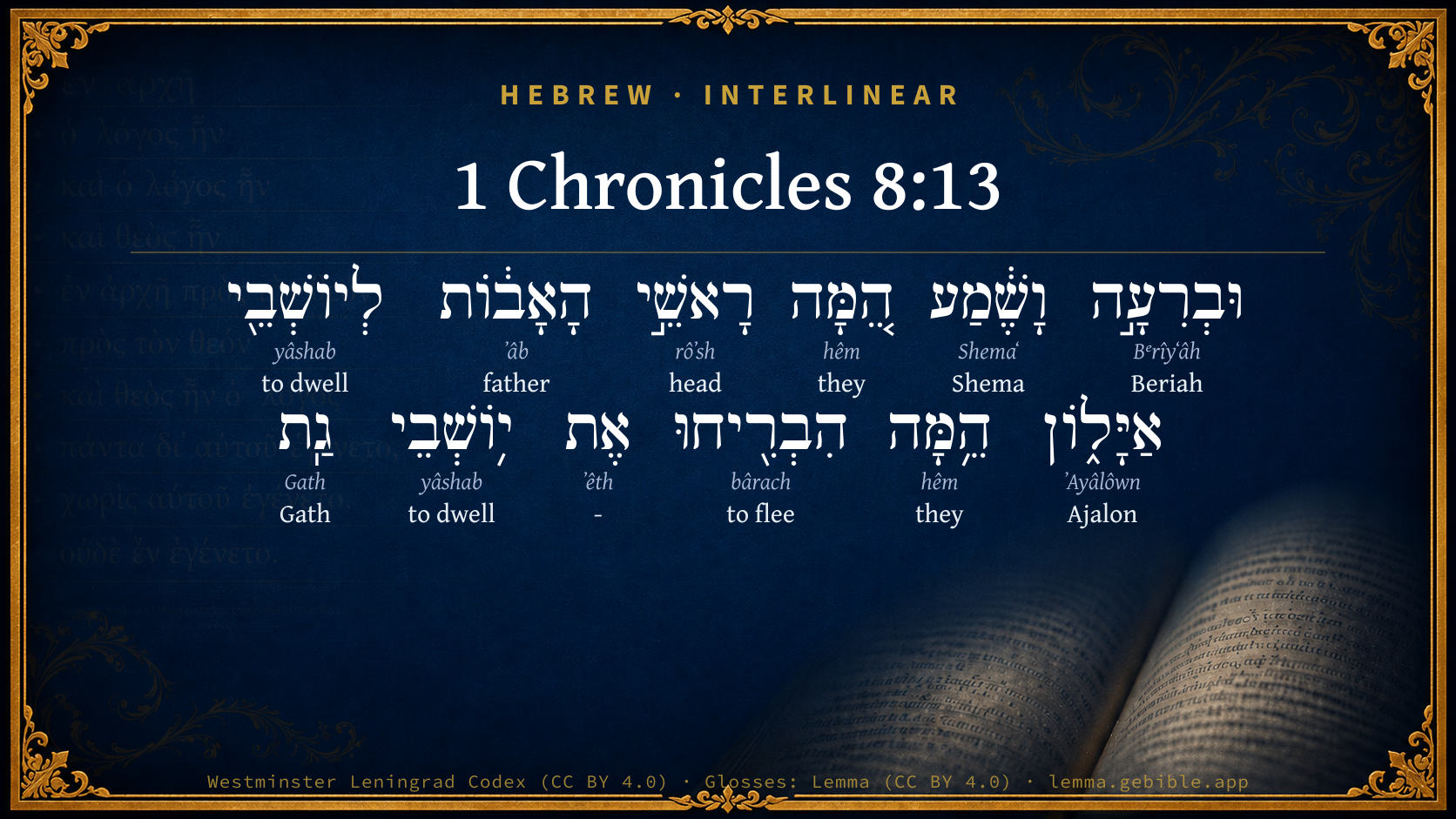
1 Chronicles 8:13

Hebrew (Westminster Leningrad Codex) 1 Chronicles 8:13 appears in the Hebrew Old Testament. The text above is from the Westminster Leningrad Codex. Each word links to its Strong’s number, a concise gloss, and parsing drawn from the Open Scriptures Hebrew Bible morphology. Click any word for its full Brown-Driver-Briggs (BDB) entry.
Download image
Cite this verse

1 Chronicles 8:13 (World English Bible). Public Domain. Lemma interlinear Bible study tool, https://lemma.gebible.app/v/1-chronicles/8/13.

Show BibTeX & RIS
BibTeX
RIS
English Translation
and Beriah, and Shema, who were heads of fathers' [houses] of the inhabitants of Aijalon, who put to flight the inhabitants of Gath;
World English Bible · Public Domain
Download a study sheet

One document with this verse’s original text, its word-by-word gloss line, the meaning frame, cross-references with their text, attributed commentary, and full source and license credits — printable, and it pastes into notes with its structure intact.

This verse Autodidact and up

Study sheet (.html) Plain text (.txt)

A passage Seminary Student

Up to 50 verses in one chapter. A passage sheet keeps up to 6 commentary sources and 12 cross-references per verse, in the order this page ranks them, and says so on the sheet whenever that leaves anything out. Ask for a single verse and you get the Autodidact verse sheet above.

Everything on this page stays free to read, with no account — the sheet is a download of what is already on screen, not access to it.

Want to remove ads? Support Godless Engineer
Compare translations 3

The same verse in 3 English versions, stacked beneath the original-language interlinear above. Click any original word for its lexicon entry.

Each is an independent rendering of the whole verse — the interlinear is not word-aligned to these translations.

Highlighted words mark where these versions differ — a whole-verse word diff, not a word-by-word alignment.

  • World English Bible Public Domain
    and Beriah, and Shema, who were heads of fathers' [houses] of the inhabitants of Aijalon, who put to flight the inhabitants of Gath;
  • King James Version Public Domain
    Beriah also, and Shema, who were heads of the fathers of the inhabitants of Aijalon, who drove away the inhabitants of Gath:
  • unfoldingWord Literal Text CC BY-SA 4.0
    and Beriah and Shema. They heads of the fathers to the dwellers of Aijalon; they, they made the dwellers of Gath flee.

unfoldingWord Literal Text — © unfoldingWord, licensed CC BY-SA 4.0. Word-aligned USFM3 via Door43 (git.door43.org/unfoldingWord/en_ult).

Versions to compare (up to 4)

3 of 4 selected

Show all 18 translations

Every available English version of this verse, each an independent rendering of the whole verse.

  • World English Bible Public Domain
    and Beriah, and Shema, who were heads of fathers' [houses] of the inhabitants of Aijalon, who put to flight the inhabitants of Gath;
  • Berean Standard Bible Public Domain
    and Beriah and Shema (who were the heads of families of the inhabitants of Aijalon and who drove out the inhabitants of Gath).
  • Majority Standard Bible Public Domain
    and Beriah and Shema (who were the heads of families living in Aijalon and who drove out the inhabitants of Gath).
  • King James Version Public Domain
    Beriah also, and Shema, who were heads of the fathers of the inhabitants of Aijalon, who drove away the inhabitants of Gath:
  • American Standard Version (1901) Public Domain
    and Beriah, and Shema, who were heads of fathers' `houses' of the inhabitants of Aijalon, who put to flight the inhabitants of Gath;
  • Revised Version (1885) Public Domain
    and Beriah, and Shema, who were heads of fathers’ houses of the inhabitants of Aijalon, who put to flight the inhabitants of Gath;
  • Geneva Bible (1599) Public Domain
    And Beriah and Shema (which were the chiefe fathers among the inhabitants of Aialon: they draue away the inhabitants of Gath)
  • Douay-Rheims (1899) Public Domain
    And Baria, and Sama were heads of their kindreds that dwelt in Aialon: these drove away the inhabitants of Geth.
  • Young's Literal Translation Public Domain
    and Beriah and Shema, (they `are' the heads of fathers to the inhabitants of Aijalon -- they caused to flee the inhabitants of Gath),
  • Literal Standard Version CC BY-SA 4.0
    and Beriah and Shema (they [are] the heads of fathers to the inhabitants of Aijalon—they caused the inhabitants of Gath to flee),
  • Unlocked Literal Bible CC BY-SA 4.0
    There were also Beriah and Shema. They were heads of the fathers' houses of those living in Aijalon, who drove out the inhabitants of Gath.
  • unfoldingWord Literal Text CC BY-SA 4.0
    and Beriah and Shema. They heads of the fathers to the dwellers of Aijalon; they, they made the dwellers of Gath flee.
  • Darby Bible Public Domain
    and Beriah, and Shema, who were chief fathers of the inhabitants of Ajalon; they drove away the inhabitants of Gath.
  • World Messianic Bible Public Domain
    and Beriah and Shema, who were heads of fathers’ households of the inhabitants of Aijalon, who put to flight the inhabitants of Gath;
  • Webster's Bible Public Domain
    Beriah also, and Shema, who were heads of the fathers of the inhabitants of Ajalon, who drove away the inhabitants of Gath:
  • Free Bible Version CC BY-SA 4.0
    and Beriah and Shema, who were family heads living in Aijalon and who drove away the people who lived in Gath.
  • Bible in Basic English Public Domain
    And Beriah and Shema, who were heads of the families of those who were living in Aijalon, who put to flight the people living in Gath;
  • JPS Tanakh (1917) Public Domain
    and Beriah, and Shema, who were heads of fathers' houses of the inhabitants of Aijalon, who put to flight the inhabitants of Gath.

Literal Standard Version (2020), Covenant Press — licensed CC BY-SA 4.0. Text via the HelloAO Bible API (eBible.org). Unlocked Literal Bible (unfoldingWord) — licensed CC BY-SA 4.0. Text via the HelloAO Bible API (eBible.org). unfoldingWord Literal Text — © unfoldingWord, licensed CC BY-SA 4.0. Word-aligned USFM3 via Door43 (git.door43.org/unfoldingWord/en_ult). Free Bible Version, Dr. Jonathan Gallagher — licensed CC BY-SA 4.0. Text via the HelloAO Bible API (eBible.org).

Word by word

More ways to search: Search by grammar → Find every occurrence → Compare this word →

Practice this passage: Drill this verse → Learn its vocabulary →

וָשֶׁ֔מַע
Shemaʻ
H8087
“and · Shema”
Conjunction + Noun, Proper
Part of Speech
Conjunction + Noun
Type
Proper
Full BDB Definition

Origin: for the same as H8088

TWOT: None

Shema = "hear" - a Reubenite, son of Joel, father of Azaz, and grandfather of Bela - a Judaite, son of Hebron and father of Raham - a Benjamite, son of Elpaal who along with his brother Beriah were heads of their fathers houses in Aijalon and who drove out the inhabitants of Gath. Probably the same as 'Shimhi' - an Israelite who stood on the right hand of Ezra as he read the Law to the people
  1. וּבְרִעָ֣ה Bᵉrîyʻâh H1283 “and · Beriah” Conjunction + Noun, Proper
  2. הֵ֚מָּה hêm H1992 “they” Pronoun, Personal, 3rd Person, Masculine, Plural
  3. רָאשֵׁ֣י rôʼsh H7218 “heads of” Noun, Common, Masculine, Plural, Construct
  4. הָאָב֔וֹת ʼâb H1 “the · fathers” Particle, Definite Article + Noun, Common, Masculine, Plural, Absolute
  5. לְיוֹשְׁבֵ֖י yâshab H3427 “to/for · dwelling” Preposition + Verb, Qal, Participle Active, Masculine, Plural, Construct
  6. אַיָּל֑וֹן ʼAyâlôwn H357 “Ajalon” Noun, Proper
  7. הֵ֥מָּה hêm H1992 “they” Pronoun, Personal, 3rd Person, Masculine, Plural
  8. הִבְרִ֖יחוּ bârach H1272 “to flee” Verb, Hiphil, Perfect, 3rd Person, Common, Plural
  9. אֶת ʼêth H853 “-” Particle, Direct Object
  10. י֥וֹשְׁבֵי yâshab H3427 “dwelling” Verb, Qal, Participle Active, Masculine, Plural, Construct
  11. גַֽת Gath H1661 “Gath” Noun, Proper

About this verse

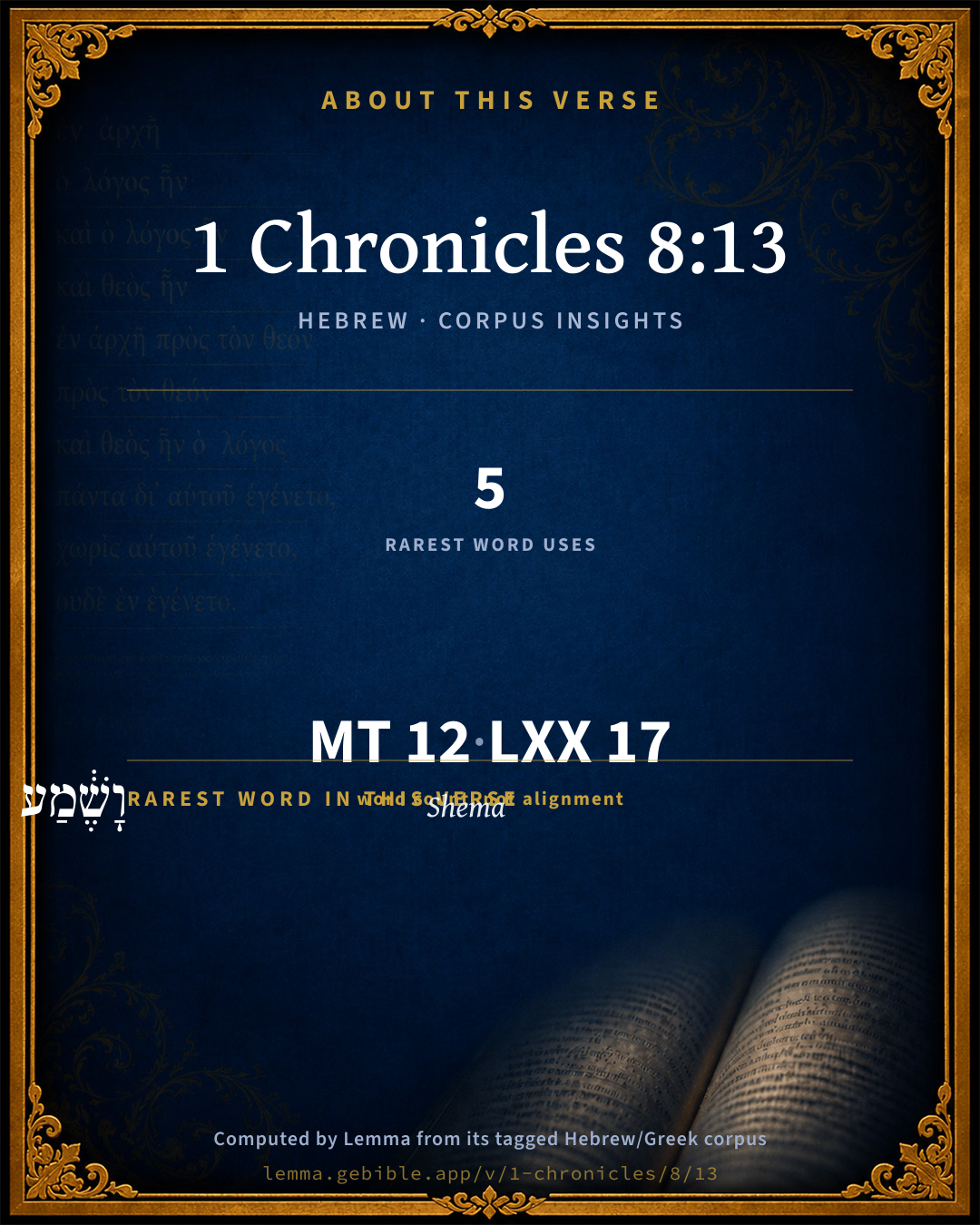
These counts appear in no published source. They are computed here, from the morphology-tagged text and Lemma’s own curated glosses. What Lemma adds →

12
words
10
distinct lemmas
Historical
section

Notable vocabulary

The rarest word here is וָשֶׁ֔מַע Shema H8087 — appearing just 5 times in the whole Hebrew Bible.

Shared distinctive vocabulary

וָשֶׁ֔מַע Shema H8087 occurs in 5 verses of the Hebrew Bible. Also found in:

Grammatical profile

  • 3 verbs
  • 6 nouns
  • 2 pronouns
  • 1 particle

Verb forms

  • לְיוֹשְׁבֵ֖י Qal · Participle Active
  • הִבְרִ֖יחוּ Hiphil · Perfect
  • י֥וֹשְׁבֵי Qal · Participle Active

Repetition

Words recur within this verse — often emphatic in Hebrew:

  • לְיוֹשְׁבֵ֖י to dwell H3427 ×2
  • הֵ֚מָּה they H1992 ×2

Hebrew & Septuagint length

In English translation the verse runs 23 words from the Hebrew and 22 from the Septuagint (LXX English) — closely comparable.

A rough comparison of the two English renderings, which tokenize alike — not a word-level alignment.

Word counts can differ between the Hebrew and the Greek without any difference in meaning — e.g. the Hebrew direct-object marker אֵת has no separate Greek word, and Greek often adds the article ὁ.

In the original languages it is 12 Hebrew tokens and 17 Greek tokens — but the two are counted differently (Hebrew bundles its prefixes and suffixes into one token; the Greek is in lemma form), so that isn’t a like-for-like length.

Cross-references

5

Topical passages linked to 1 Chronicles 8:13 in the Treasury of Scripture Knowledge — connected by theme and wording, ordered by reader-vote popularity; previews shown in the World English Bible.

  • Joshua 10:12 Then spoke Joshua to Yahweh in the day when Yahweh delivered up the Amorites before the children of Israel; and he said in the sight of Israel, Sun, stand you still on Gibeon; You, Moon, in the valley of Aijalon.
  • Joshua 19:42 and Shaalabbin, and Aijalon, and Ithlah,
  • 1 Chronicles 2:49–50 She bore also Shaaph the father of Madmannah, Sheva the father of Machbena, and the father of Gibea; and the daughter of Caleb was Achsah.
  • 1 Chronicles 2:52 Shobal the father of Kiriath Jearim had sons: Haroeh, half of the Menuhoth.
  • 1 Chronicles 4:4 and Penuel the father of Gedor, and Ezer the father of Hushah. These are the sons of Hur, the firstborn of Ephrathah, the father of Bethlehem.

Cross-references courtesy of OpenBible.info (CC BY 4.0).

Hebrew and Greek witnesses Masoretic Hebrew ↔ Greek Septuagint

The same verse in the two great witnesses to the Old Testament, shown verse-for-verse.

These are two independent witnesses, not word-aligned to each other, and the Septuagint is shown in lemma (dictionary) form.

Hebrew 1 Chronicles 8:13 Masoretic · Westminster Leningrad Codex

וּבְרִעָ֣ה וָשֶׁ֔מַע הֵ֚מָּה רָאשֵׁ֣י הָאָב֔וֹת לְיוֹשְׁבֵ֖י אַיָּל֑וֹן הֵ֥מָּה הִבְרִ֖יחוּ אֶת י֥וֹשְׁבֵי גַֽת

and Beriah, and Shema, who were heads of fathers' [houses] of the inhabitants of Aijalon, who put to flight the inhabitants of Gath;

World English Bible · Public Domain

Greek LXX 1 Chronicles 8:13 Septuagint · lemma form

καί βεριγα καί σαμα οὗτος ἄρχων ὁ πατριά ὁ καταοἰκέω αιλαμ καί οὗτος ἐκδιώκω ὁ καταοἰκέω γεθ

and Beria, and Sama; these were heads of families among the dwellers in Elam, and they drove out the inhabitants of Geth.

LXX2012 (modern English Septuagint) · Public Domain

Hebrew: Westminster Leningrad Codex (CC BY 4.0). Greek: Septuagint (public domain); English from LXX2012 (modern English Septuagint) (Public Domain). How the Septuagint differs from the Hebrew →

Commentary

Notes on 1 Chronicles 8:13 from classic Christian and Jewish commentators (each source and its license shown beneath its notes). The classic Christian expositions comment on the surrounding passage and are grouped to its opening verse, so a note may address several verses; the Jewish commentaries on the Tanakh (Rashi and others) are per-verse, so they appear only where the commentator wrote on this verse.

Lemma curates 59 commentaries, every one of them public domain or Creative Commons licensed, each selected and text-cleaned for this edition rather than reprinted as found. About our sources →

Ellicott's Commentary for English Readers

(13) Beriah also, and Shema.—After these two names the Masoretic punctuators have put a stop. Thus 1Ch_8:12-13 give five sons of Elpaal. Or 1Ch_8:13 may be disconnected from 1Ch_8:12, and Beriah and Shema regarded as beginning a new series of Benjamite clans.

Who were heads of the fathers. . . .—Rather, “THEY were heads of the clans of the inhabitants of Aijalon; THEY put to flight the inhabitants of Gath.” The pronoun is emphatic in both cases. The clans of Beriah and Shema, who were settled at Ajalon (Yalo), near Gibeon, appear to have expelled a Gittite population from Ajalon, and dwelt in their stead. At all events, there is evident allusion to some famous exploit, in which the two Benjamite houses were more fortunate than the Ephraimites Ezer and Elead (1Ch_7:21). We must not identify this Benjamite Beriah with the Ephraimite Beriah of 1Ch_7:23. There was also an Asherite clan of Beriah (1Ch_7:30).

A Bible Commentary for English Readers, edited by Charles John Ellicott (1878–1897) — public domain. Text from a community e-Sword module.

John Gill's Exposition

And Jakim,.... With all the rest in these verses, namely:

Zichri, Zabdi, Elienai, Zilthai, Eliel, Adaiah, Beraiah, and Shimrath, were the sons of Shimhi, the same with Shema brother of Beriah, and son of Elpaal, Ch1 8:13.

John Gill's Exposition of the Whole Bible (1746–1763) — public domain (CC PDM 1.0). Text via the HelloAO Bible API.

Trapp's Complete Commentary

John Trapp

1Ch 8:13 Beriah also, and Shema, who [were] heads of the fathers of the inhabitants of Aijalon, who drove away the inhabitants of Gath:

Ver. 13. Who drove away the inhabitants of Gath.] See 1Ch 7:21.

John Trapp, A Commentary or Exposition upon All the Books of the Old and New Testament (1647–1656) — public domain. Text from a community e-Sword module.

Keil & Delitzsch

C. F. Keil & F. Delitzsch

And Jakim,.... With all the rest in these verses, namely:

Zichri, Zabdi, Elienai, Zilthai, Eliel, Adaiah, Beraiah, and Shimrath, were the sons of Shimhi, the same with Shema brother of Beriah, and son of Elpaal, Ch1 8:13.

Keil & Delitzsch — Biblical Commentary on the Old Testament (1861–1891) — public domain (CC PDM 1.0). Text via the HelloAO Bible API. (Old Testament only.)

The Cambridge Bible for Schools and Colleges

gen. ed. J. J. S. Perowne

13. of the fathers] R.V. of fathers’ houses, as in 1Ch_8:10.

drove away] R.V. put to flight. Probably an allusion to some fight the memory of which was kept alive in local song. Cp. 1Ch_7:21-22.

Aijalon] Jos_10:12; 1Sa_14:31.

The Cambridge Bible for Schools and Colleges (gen. ed. J. J. S. Perowne; Cambridge University Press, 1878–1918) — public domain. Text from a community e-Sword module.

Haydock's Catholic Bible Commentary

And Sama. They are supposed to have been sons of Elphaal. (Calmet) --- Aialon belonged to Dan, Josue xix. 42. But it was near Benjamin, (Menochius) and was probably occupied by people chiefly of that tribe. (Haydock) --- Geth. We know not at what period.

George Leo Haydock (1774–1849), Haydock's Catholic Family Bible and Commentary, 1859 edition — public domain. Excludes Psalms (Douay-Rheims chapter numbering differs from Protestant) and Deuterocanonical books (Catholic canon only).

Matthew Poole's English Annotations

Aijalon; a place formerly belonging to the tribe of Dan, Jos 19:42; but after the return from Babylon possessed by the Benjamites, because both Dan and the rest of the ten tribes were yet for the generality of them in captivity, and but few of them returned.

Who drove away the inhabitants of Gath; either,

1. At that time when they made such a slaughter among Ephraim’s children, 1Ch 7:21, and were possibly pursuing their victory till they were driven back by these Benjamites, who came to the succour of their brethren. Or,

2. Now when they were returned from the captivity, and found the men of Gath possessed of Aijalon. Or,

3. At some other time not mentioned in Scripture.

Matthew Poole's English Annotations on the Holy Bible (1683–1685) — public domain. Text from a community e-Sword/MySword module.

The Pulpit Commentary

Aijalon. A similar kind of history belongs to this place. It was assigned to Dan. (Jos_19:40-48) Unsubdued by them, (Jud 1:34-36) the Ephraimites possessed it awhile, (1Ch_6:47-49) until it came to be more like the common property or care of Benjamin and Judah, situated as it was on their boundary line (1Sa_14:31; 2Ch_11:10 2Ch_28:18)

The Pulpit Commentary (1880–1919), ed. H.D.M. Spence-Jones & Joseph S. Exell — public domain. Text from a community e-Sword module.

Lesson kit

Teaching starters — assembled from the data on this page, not authored interpretation. Every prompt links to the verse data it draws on. Edit before teaching.

1 Chronicles, in the Historical, opens this verse with 12 words (10 distinct Hebrew lemmas). Its most distinctive word is Shemaʻ (“Shema”). A historical commentator’s framing appears above. Read the whole chapter for the surrounding context.

Discussion questions

  1. How does “Shema” (Shemaʻ) shape what this verse is saying?
  2. How does 1 Chronicles 2:43, which shares the word «Shema», read alongside this verse?
  3. What does the repetition of “to dwell” (2× in this one verse) do in this verse?
  4. These translations render this verse differently. What is at stake in choosing one wording over another?
  5. «לְיוֹשְׁבֵ֖י» is a Qal Participle Active verb. How does that grammatical form shape the action described?
  6. Compare how Ellicott's Commentary for English Readers and John Gill's Exposition read this verse. Where do they agree or differ?

Things to notice

Reading settings

Reading text

Shown beneath each verse's original-language words.

Old Testament
Old Testament edition

Read the OT as the Masoretic Hebrew (MT) or the Greek Septuagint (LXX).

English shown for the Greek Septuagint (in the Hebrew ↔ Greek comparison).

Comparing translations? Open the Compare panel on any verse page to stack up to four side by side.