
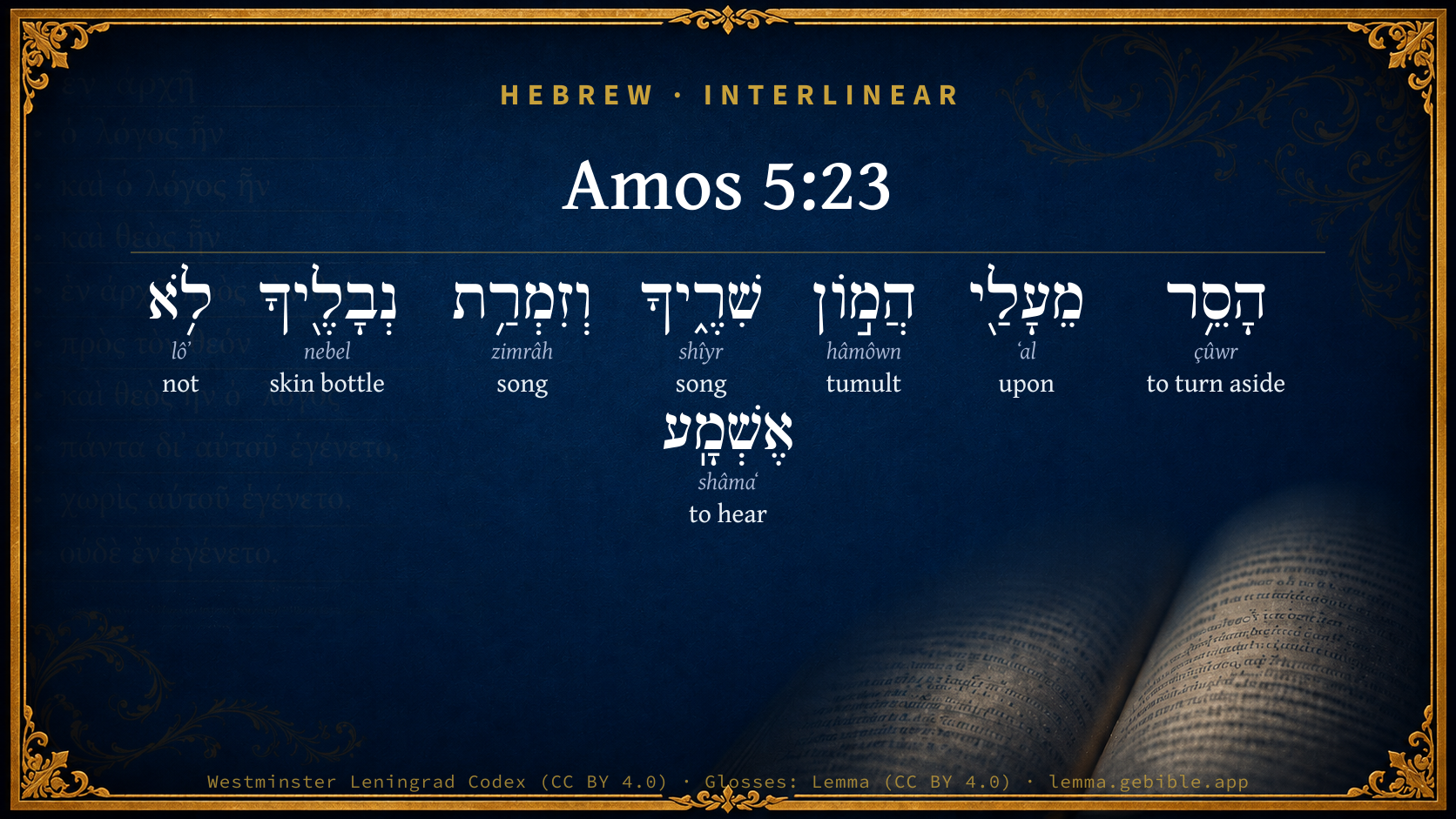
Amos 5:23

Hebrew (Westminster Leningrad Codex) Amos 5:23 appears in the Hebrew Old Testament. The text above is from the Westminster Leningrad Codex. Each word links to its Strong’s number, a concise gloss, and parsing drawn from the Open Scriptures Hebrew Bible morphology. Click any word for its full Brown-Driver-Briggs (BDB) entry.
Download image
Cite this verse

Amos 5:23 (World English Bible). Public Domain. Lemma interlinear Bible study tool, https://lemma.gebible.app/v/amos/5/23.

Show BibTeX & RIS
BibTeX
RIS
English Translation
Take away from me the noise of your songs! I will not listen to the music of your harps.
World English Bible · Public Domain
Download a study sheet

One document with this verse’s original text, its word-by-word gloss line, the meaning frame, cross-references with their text, attributed commentary, and full source and license credits — printable, and it pastes into notes with its structure intact.

This verse Autodidact and up

Study sheet (.html) Plain text (.txt)

A passage Seminary Student

Up to 50 verses in one chapter. A passage sheet keeps up to 6 commentary sources and 12 cross-references per verse, in the order this page ranks them, and says so on the sheet whenever that leaves anything out. Ask for a single verse and you get the Autodidact verse sheet above.

Everything on this page stays free to read, with no account — the sheet is a download of what is already on screen, not access to it.

Want to remove ads? Support Godless Engineer
Compare translations 3

The same verse in 3 English versions, stacked beneath the original-language interlinear above. Click any original word for its lexicon entry.

Each is an independent rendering of the whole verse — the interlinear is not word-aligned to these translations.

Highlighted words mark where these versions differ — a whole-verse word diff, not a word-by-word alignment.

  • World English Bible Public Domain
    Take away from me the noise of your songs! I will not listen to the music of your harps.
  • King James Version Public Domain
    Take thou away from me the noise of thy songs; for I will not hear the melody of thy viols.
  • unfoldingWord Literal Text CC BY-SA 4.0
    Remove from me the noise of your songs; I will not listen to the sound of your harps.

unfoldingWord Literal Text — © unfoldingWord, licensed CC BY-SA 4.0. Word-aligned USFM3 via Door43 (git.door43.org/unfoldingWord/en_ult).

Versions to compare (up to 4)

3 of 4 selected

Show all 18 translations

Every available English version of this verse, each an independent rendering of the whole verse.

  • World English Bible Public Domain
    Take away from me the noise of your songs! I will not listen to the music of your harps.
  • Berean Standard Bible Public Domain
    Take away from Me the noise of your songs! I will not listen to the music of your harps.
  • Majority Standard Bible Public Domain
    Take away from Me the noise of your songs! I will not listen to the music of your harps.
  • King James Version Public Domain
    Take thou away from me the noise of thy songs; for I will not hear the melody of thy viols.
  • American Standard Version (1901) Public Domain
    Take thou away from me the noise of thy songs; for I will not hear the melody of thy viols.
  • Revised Version (1885) Public Domain
    Take thou away from me the noise of thy songs; for I will not hear the melody of thy viols.
  • Geneva Bible (1599) Public Domain
    Take thou away from me the multitude of thy songs (for I wil not heare the melodie of thy violes)
  • Douay-Rheims (1899) Public Domain
    Take away from me the tumult of thy songs: and I will not hear the canticles of thy harp.
  • Young's Literal Translation Public Domain
    Turn aside from Me the noise of thy songs, Yea, the praise of thy psaltery I hear not.
  • Literal Standard Version CC BY-SA 4.0
    Turn the noise of your songs aside from Me, || Indeed, I do not hear the praise of your stringed instruments.
  • Unlocked Literal Bible CC BY-SA 4.0
    Remove from me the noise of your songs; I will not listen to the sound of your harps.
  • unfoldingWord Literal Text CC BY-SA 4.0
    Remove from me the noise of your songs; I will not listen to the sound of your harps.
  • Darby Bible Public Domain
    Take away from me the noise of thy songs, and I will not hear the melody of thy lutes;
  • World Messianic Bible Public Domain
    Take away from me the noise of your songs! I will not listen to the music of your harps.
  • Webster's Bible Public Domain
    Take thou away from me the noise of thy songs; for I will not hear the melody of thy viols.
  • Free Bible Version CC BY-SA 4.0
    Stop your noisy worship songs. I will not listen to the melody of your harps.
  • Bible in Basic English Public Domain
    Take away from me the noise of your songs; my ears are shut to the melody of your instruments.
  • JPS Tanakh (1917) Public Domain
    Take thou away from Me the noise of thy songs; and let Me not hear the melody of thy psalteries.

Literal Standard Version (2020), Covenant Press — licensed CC BY-SA 4.0. Text via the HelloAO Bible API (eBible.org). Unlocked Literal Bible (unfoldingWord) — licensed CC BY-SA 4.0. Text via the HelloAO Bible API (eBible.org). unfoldingWord Literal Text — © unfoldingWord, licensed CC BY-SA 4.0. Word-aligned USFM3 via Door43 (git.door43.org/unfoldingWord/en_ult). Free Bible Version, Dr. Jonathan Gallagher — licensed CC BY-SA 4.0. Text via the HelloAO Bible API (eBible.org).

Word by word

More ways to search: Search by grammar → Find every occurrence → Compare this word →

Practice this passage: Drill this verse → Learn its vocabulary →

About this verse

These counts appear in no published source. They are computed here, from the morphology-tagged text and Lemma’s own curated glosses. What Lemma adds →

8
words
8
distinct lemmas
Prophets
section

Notable vocabulary

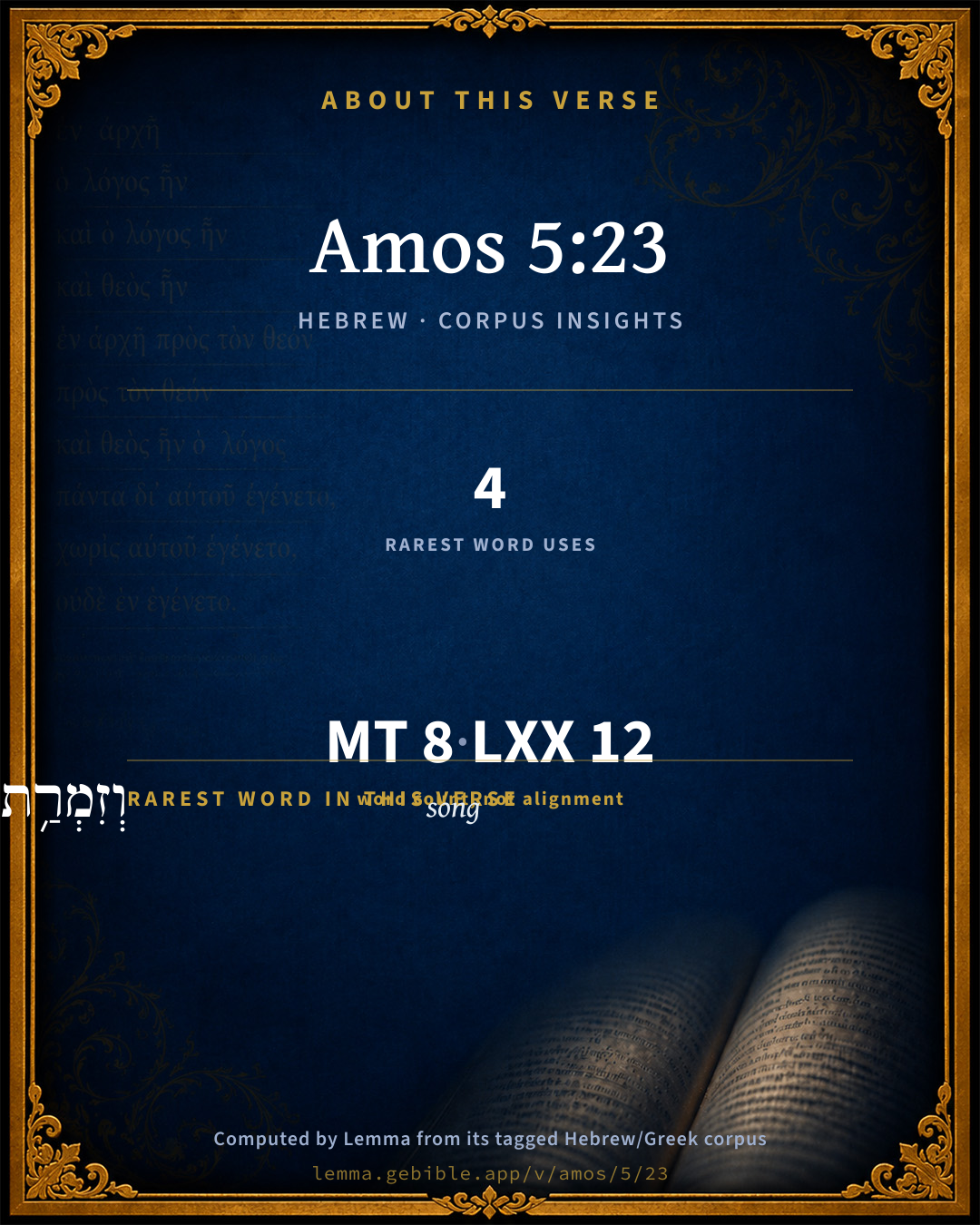
The rarest word here is וְזִמְרַ֥ת song H2172 — appearing just 4 times in the whole Hebrew Bible.

Shared distinctive vocabulary

וְזִמְרַ֥ת song H2172 occurs in 4 verses of the Hebrew Bible. Also found in:

Grammatical profile

  • 2 verbs
  • 4 nouns
  • 1 preposition
  • 1 particle

Verb forms

  • הָסֵ֥ר Hiphil · Imperative
  • אֶשְׁמָֽע Qal · Imperfect

Hebrew & Septuagint length

In English translation the verse runs 19 words from the Hebrew and 18 from the Septuagint (LXX English) — closely comparable.

A rough comparison of the two English renderings, which tokenize alike — not a word-level alignment.

Word counts can differ between the Hebrew and the Greek without any difference in meaning — e.g. the Hebrew direct-object marker אֵת has no separate Greek word, and Greek often adds the article ὁ.

In the original languages it is 8 Hebrew tokens and 12 Greek tokens — but the two are counted differently (Hebrew bundles its prefixes and suffixes into one token; the Greek is in lemma form), so that isn’t a like-for-like length.

Cross-references

3

Topical passages linked to Amos 5:23 in the Treasury of Scripture Knowledge — connected by theme and wording, ordered by reader-vote popularity; previews shown in the World English Bible.

  • Amos 6:5 Who strum on the strings of a harp; Who invent for themselves instruments of music, like David;
  • Amos 8:3 The songs of the temple will be wailings in that day," says the Lord Yahweh. "The dead bodies will be many. In every place they will throw them out with silence.
  • Amos 8:10 I will turn your feasts into mourning, And all your songs into lamentation; And I will make you wear sackcloth on all your bodies, And baldness on every head. I will make it like the mourning for an only son, And the end of it like a bitter day.

Cross-references courtesy of OpenBible.info (CC BY 4.0).

Hebrew and Greek witnesses Masoretic Hebrew ↔ Greek Septuagint

The same verse in the two great witnesses to the Old Testament, shown verse-for-verse.

These are two independent witnesses, not word-aligned to each other, and the Septuagint is shown in lemma (dictionary) form.

Hebrew Amos 5:23 Masoretic · Westminster Leningrad Codex

הָסֵ֥ר מֵעָלַ֖י הֲמ֣וֹן שִׁרֶ֑יךָ וְזִמְרַ֥ת נְבָלֶ֖יךָ לֹ֥א אֶשְׁמָֽע

Take away from me the noise of your songs! I will not listen to the music of your harps.

World English Bible · Public Domain

Greek LXX Amos 5:23 Septuagint · lemma form

μεταἵστημι ἀπό ἐγώ ἦχος ᾠδή σύ καί ψαλμός ὄργανον σύ οὐ ἀκούω

Remove from me the sound of your songs, and I will not hear the music of your instruments.

LXX2012 (modern English Septuagint) · Public Domain

On this verse, The Cambridge Bible for Schools and Colleges discusses the Septuagint’s reading. Read the note in Commentary ↓

Hebrew: Westminster Leningrad Codex (CC BY 4.0). Greek: Septuagint (public domain); English from LXX2012 (modern English Septuagint) (Public Domain). How the Septuagint differs from the Hebrew →

Targum (Aramaic paraphrase)

1

The Targum is the ancient Jewish Aramaic paraphrase of the Hebrew Scriptures — an interpretive translation, not the Hebrew text itself. Onkelos (literal) and Pseudo-Jonathan (expansive) render the Torah, and Jonathan the Prophets. Coverage is partial: where no permissively-licensed English translation exists for a verse, only the Aramaic is shown. This is verse-level text, not a word-by-word alignment to the Hebrew.

  1. Targum Jonathan Prophets (Joshua–Malachi)
    אַעְדֵי מִן קֳדָמַי אִתְרְגוּשַׁת זִמְרָךְ וְנִגוּן כִּנָרָךְ לָא אֶשְׁמָע:

    (no public-domain English translation for this verse)

    Targum Jonathan — Aramaic: “Mikraot Gedolot” (public domain). English: “Sefaria Community Translation” (CC0 1.0 (public-domain dedication)); “London "Chaldee Paraphrase," 1871” (public domain). Text via Sefaria.

Commentary

Notes on Amos 5:23 from classic Christian and Jewish commentators (each source and its license shown beneath its notes). The classic Christian expositions comment on the surrounding passage and are grouped to its opening verse, so a note may address several verses; the Jewish commentaries on the Tanakh (Rashi and others) are per-verse, so they appear only where the commentator wrote on this verse.

Lemma curates 59 commentaries, every one of them public domain or Creative Commons licensed, each selected and text-cleaned for this edition rather than reprinted as found. About our sources →

The Cambridge Bible for Schools and Colleges

gen. ed. J. J. S. Perowne

23. The songs and music accompanying the worship (cf. Amo_8:10; Isa_30:29 a) are rejected by Jehovah likewise. Of what nature these were in pre-exilic times, we do not precisely know: the descriptions in the Chronicles reflect the usage of a much later age, when the Temple music was more highly organized. The distinctly liturgical Psalms are also all probably post-exilic.

from me] lit. from upon me: the praises of sinful Israel are represented as a burden to Jehovah, from which He would gladly be freed. Cf. Isa_1:14 (of various sacred seasons), “They are a cumbrance upon me.”

viols] most probably harps, but possibly lutes. See the Additional Note, p. 234.

Additional Note on Chap. Amo_5:23 (nçbhel)

The Hebrew word nçbhel is rendered viol in A.V., R.V., of Amo_5:23; Amo_6:5, Isa_14:11, and in A.V. of Isa_5:12 (R.V. lute), elsewhere in both versions psaltery (2Sa_6:5; 1Ki_10:12, &c.); in the P.B.V. of the Psalms, lute (Psa_33:2; Psa_57:9 (= Psa_108:3), Psa_81:2, Psa_92:4, Psa_144:9, Psa_150:3)[225], once (Psa_71:20) vaguely music. Although there is no excuse for the same Heb. word being thus rendered differently in one and the same version, it is true that the exact instrument meant is uncertain. The LXX. usually represent nçbhel by νάβλα, or (Psalms generally, Isa_5:12, Neh_12:27) ψαλτήριον, here and Amo_6:5 by the general term ὄργανα. The νάβλα was known to the Greeks as a Sidonian instrument (Athen. iv. p. 175); and we learn from Ovid (Ars Am. 3. 327) that it was played duplici palma. It is often in the O.T. coupled with the kinnôr; according to Josephus (Ant. 8. 3. 8) the difference between the κινύρα (= kinnôr) and the νάβλα was that the former had ten strings and was played with the plectrum, the latter had twelve notes, and was played with the hand. These are substantially all the data which we possess for determining what instrument the nçbhel was. Kinnôr in A.V., R.V., is always represented by harp: and if this rendering be correct, nçbhel might well be the lyre. There is, however, force in the remark[226] that the kinnôr is mentioned much more frequently than the nçbhel, and seems to have been in more common use; the nçbhel was used at the feasts of the wealthy (Amo_6:5; Isa_5:12; Isa_14:11), or in religious ceremonies; it was therefore probably a more elaborate and expensive instrument. This consideration would point to kinnôr being the lyre, and nçbhel the harp. The large and heavy stationary harp of modern times must not, however, be thought of: the nçbhel could be played while the performer was walking (1Sa_10:5; 2Sa_6:5); and the ancients had small portable harps, of triangular shape (called accordingly by the Greeks τρίγωνα), which could be so used[227]. The word nçbhel, however, also means in Hebrew a wine-skin (1Sa_1:24), and an earthen jar (Isa_30:14); hence if the name of the musical instrument be etymologically the same word, it would seem rather to have denoted one possessing a bulging body or resonance-box: so that, after all, it is possible that some kind of lute or guitar may be the instrument mentioned[228].

[225] All these names of instruments occur frequently in old English writers, though they are now practically obsolete. The viol (Norm. viele, Prov. viula, Span, vihuela, viola, Dan. fiddel, A.-S. fidele,—from Low Lat. vitula, vidula), was a bowed instrument, in use from the 15th to the 18th centuries, an early form of the modern violin. The lute (Fr. luth, Ital. liuto, Port. alaude, from the Arab. ’al‘ûd, with the a of the article elided, ‘the wood,’ applied, κατʼ ἐξοχήν, to a particular instrument of wood, Lane, Arab. Lex., p. 2190), resembled a guitar, having a long neck with a bulging body, or resonance-box. It was played with a plectrum: among the Arabs it has been for long a popular instrument: see representations in Lane, Mod. Egyptians, chap. 18 (ed. 5, 2:67, 68), or Stainer, Music of the Bible, Figs. 18, 21. The psaltery may be described generally as a small lyre (see further D.B.1, and Grove’s Dict. of Music, s.v. Psaltery)

[226] Riehm, Handwörterbuch des Bibl. Alt. p. 1030 (ed. 2, p. 1044); Nowack, Hebr. Arch. i. 274.

[227] See representations of such portable harps in Stainer, Music of the Bible, Figs. 1–8: also (from Assyria) Engel, Music of the most Ancient Nations, pp. 29–31, and frontispiece; DB2 s.v. Harp: Rawlinson, Anc. Monarchies, Bk. ii. ch. vii. (ed. 4) p. 529 f., 542 (a procession of musicians—the same as Engel’s frontispiece): and from Egypt, Engel, p. 181 ff. (trigons, p. 195); Wilkinson-Birch, i. 465,469–470, 474 (trigons: larger harps resting on the ground, pp. 436–442, 462, 464).

[228] For representations of ancient guitars, see Rawlinson, l.c. p. 534; Wilkinson-Birch, pp. 481–483; Stainer, p. 28; Engel, pp. 204–208.

For various forms of lyre see Stainer, Figs. 9–17: Engel, pp. 38–40, 196–8; Rawlinson, l.c. pp. 531–533, 540; Wilkinson-Birch, pp. 476–478, and Plate XII., No. 16, opposite p. 480 (an interesting picture, from a tomb at Beni-hassan, representing the arrival of some Semites in Egypt): and on Jewish coins, Madden, Coins of the Jews, pp. 205, 235, 236, 241, 243 (with 3, 5, or 6 strings); Nowack, p. 274; Stainer, p. 62.

An ancient Assyrian portable harp (from Engel’s Music of the most Ancient Nations, 1870, p. 29).

The nçbhel is mentioned as an instrument used for secular music in Amo_6:5, Isa_5:12; Isa_14:11, perhaps also 1Ki_10:12; and in connexion with religious ceremonies, 1Sa_10:5 (as maintaining, with other instruments, the excitement of a troop of ‘prophets’), 2Sa_6:5, Amo_5:23; and often in the later parts of the O.T., as in the Psalms quoted above, and in the Chronicles, viz. 1Ch_13:8; 1Ch_15:16; 1Ch_15:20; 1Ch_15:28; 1Ch_16:5; 1Ch_25:1; 1Ch_25:6, 2Ch_5:12; 2Ch_9:11; 2Ch_20:28; 2Ch_29:25, Neh_12:27, generally in conjunction with the kinnôr.

The Cambridge Bible for Schools and Colleges (gen. ed. J. J. S. Perowne; Cambridge University Press, 1878–1918) — public domain. Text from a community e-Sword module.

Trapp's Complete Commentary

John Trapp

Amo 5:23 Take thou away from me the noise of thy songs; for I will not hear the melody of thy viols.

Ver. 23. Take thou away from me the noise of thy songs] No more pleasing to me than the grunting of a hog or the braying of an ass, because hateless, heartless; for as every sound is not music, so neither is every musical sound melodious to God. The voice which is made in the mouth is nothing so sweet to our ears as that which comes from the depth of the breast. "Sing with grace in your hearts," is the best tune to all the psalms; which are therefore called "spiritual songs," Col 3:16, both because they are indited by the Spirit, and are to be sung with the spirit, 1Co 14:15, and because they being so sung, do make us more spiritual in the use of them; while we sing David’s Psalms with David’s heart.

For I will not hear the melody of thy viols] Or of thine organ, harp, cittern, lute, bag pipe, for so some render it, with respect to the etymology of the word Nebel. The Greek rendereth it, Of the psalteries. What need we trouble ourselves much about those things whereof we can neither have proof nor profit, at least not profit enough to pay for the pains? God will not hear either their voice or instrument music, because the heart was wanting.

“ Non vex sed votum, non musica chordula, sed cor. ”

The deeper and hollower the belly of the lute or viol is the pleasanter is the sound; the fleeter, the more grating and harsh in our ears. Think the same of God, and see how exceeding offensive to all his senses, yea, to his very soul, hypocrisy is, Isa 1:11-13.

John Trapp, A Commentary or Exposition upon All the Books of the Old and New Testament (1647–1656) — public domain. Text from a community e-Sword module.

Jamieson, Fausset & Brown

Robert Jamieson, A. R. Fausset & David Brown

Take . . . away from me--literally, "Take away, from upon Me"; the idea being that of a burden pressing upon the bearer. So Isa 1:14, "They are a trouble unto Me (literally, 'a burden upon Me'): I am weary to bear them."

the noise of thy songs--The hymns and instrumental music on sacred occasions are to Me nothing but a disagreeable noise.

I will not hear--Isaiah substitutes "prayers" (Isa 1:15) for the "songs" and "melody" here; but, like Amos, closes with "I will not hear."

Jamieson, Fausset & Brown — Commentary Critical and Explanatory on the Whole Bible (1871) — public domain (CC PDM 1.0). Text via the HelloAO Bible API.

Adam Clarke's Commentary

Verse 23. The noise of thy songs - the melody of thy viols.] They had both vocal and instrumental music in those sacrificial festivals; and God hated the noise of the one and shut his ears against the melody of the other. In the first there was nothing but noise, because their hearts were not right with God; and in the latter there could be nothing but (זמרת zimrath) cutting and scraping, because there was no heart-no religious sense in the thing, and nearly as little in them that used it. See on Am 6:5.

Adam Clarke's Commentary on the Bible (1810–1826) — public domain. Text from a community e-Sword/MySword module.

John Calvin's Commentaries

It follows, Take away from me the multitude of thy songs By speaking of multitude, he aims at hypocrites, who toil much in their devices without measure or end, as we see done at this day by those under the Papacy; for they accumulate endless forms of worship, and greatly weary themselves, morning and evening; in short, they spend days and nights in performing their ceremonies, and every one devises some new thing, and all these they heap together. Inasmuch, then, as men, when they have begun to turn aside from the pure word of God, continually invent various kinds of trifles, the Prophet here touches indirectly on this foolish laboriousness (stultan sedulitatem — foolish sedulity) when he says, Take away from me the multitude of thy songs. He might have simply said, “Thy songs please me not;” but he mentions their multitude, because hypocrites, as I have said, fix no limits to their outward ceremonies: and a vast heap especially follows, when once they take to themselves the liberty of devising this or that form of worship. Hence God testifies here, that they spend labor in vain, for he rejects what he does not command, and whatever is not rightly offered to him.

And the harmony of lyres, or of musical instruments. But נבל, nabel, was an instrument, which, as to its kind, is unknown to us now. Take away, then, from me the harmony of lyres; for the verb, take away, may refer to both clauses; though some join them to the last the verb “lo לא אשמע, la ashimo, I will not hear. The difference really is very little: but their view is the most probable, who join together the two clauses, ‘Take away from me the multitude of thy songs and the harmony of lyres;’ with which thou thinkest me to be delighted. They afterwards take לא אשמע “I will not hear,” by itself. But I contend not about such minute things: it is enough to know the design of the Prophet. It now follows —

John Calvin's Commentaries (1540-1563) — public domain. Text from the Calvin Translation Society English edition (1840s-50s) via the Christian Classics Ethereal Library (ccel.org). Calvin's coverage is partial (roughly two-thirds of the Bible); uncommented books and verses are honest gaps, never fabricated. The 19th-century editor's footnotes and remarks are omitted so the notes are faithfully Calvin's own voice.

Ellicott's Commentary for English Readers

(23) Songs.—The very sound of their tumultuous songs was a burden to Jehovah. As Christ cleansed the Temple, so would He dispel all this hypocritical and perilous confusion of ideas.

A Bible Commentary for English Readers, edited by Charles John Ellicott (1878–1897) — public domain. Text from a community e-Sword module.

John Gill's Exposition

Take thou away from me the noise of thy songs,.... The ten tribes, very probably, imitated the, temple music at Jerusalem, both vocal and instrumental, and had their songs and hymns of praise, which they sung to certain tunes; but the music of these is called a noise, being very disagreeable to the Lord, as coming from such carnal and wicked persons; and therefore he desires it might cease, be took away, and he be no more troubled with it:

for I will not hear the melody of thy viols: which may be put for all instruments of music used by them, as violins, harps, psalteries, &c. the sound of which, how melodious soever, the, Lord would turn a deaf ear unto, and not regard.

John Gill's Exposition of the Whole Bible (1746–1763) — public domain (CC PDM 1.0). Text via the HelloAO Bible API.

Albert Barnes' Notes on the Bible

Take thou away from Me - Literally, “from upon Me,” that is, from being a burden to Me, a weight on Me. So God says by Isaiah, “your new moons and your appointed feasts My soul hateth; they are a burden upon Me; I am weary to bear them” Isa 1:14. Their “songs” and hymns were but a confused, tumultuous, “noise,” since they had not the harmony of love.

For - (And) the melody of thy viols I will not hear - Yet the “nebel,” probably a sort of harp, was almost exclusively consecrated to the service of God, and the Psalms were God’s own writing. Doubtless they sounded harmoniously in their own ears; but it reached no further. Their melody, like much Church-music, was for itself, and ended in itself. : “Let Christian chanters learn hence, not to set the whole devotion of Psalmody in a good voice, subtlety of modulation and rapid intonation, etc., quavering like birds, to tickle the ears of the curious, take them off to themselves and away from prayer, lest they hear from God, ‘I will not hear the melody of thy viols.’ Let them learn that of the Apostle, ‘I will sing with the Spirit, and I will sing with the understanding also’ 1Co 14:15.” Augustine, in Psa 30:1-12; Enarr. iv. (p. 203. Oxford Translation) L.: “If the Psalm prays, pray; if it sorrows, sorrow; if it is glad, rejoice; if full of hope, hope; if of fear, fear. For whatever is therein written, is our mirror.”

Augustine in Ps. 119 (n. 9. T. v. p. 470. Old Testament) L.: “How many are loud in voice, dumb in heart! How many lips are silent, but their love is loud! For the ears of God are to the heart of man. As the ears of the body are to the mouth of man, so the heart of man is to the ears of God. Many are heard with closed lips, and many who cry aloud are not heard.” Dionysius: “God says, ‘I will not hear,” as He says, ‘praise is not seemly in the mouth of a sinner’ (Ecclesiaticus 15:9), and, ‘to the ungodly saith God, what hast thou to do, to declare My statutes?’ Psa 50:16, and, ‘he that turneth away his ear from hearing the law, even his prayer shall be abomination’ Pro 28:9. It is not meant hereby that the wicked ought wholly to abstain from the praise of God and from prayers, but that they should be diligent to amend, and know that through such imperfect services they cannot be saved.” The prophet urges upon them the terribleness of the Day of Judgment, that they might feel and flee its terribleness, before it comes. He impresses on them the fruitlessness of their prayers, that, amending, they might so pray, that God would hear them.

Albert Barnes' Notes on the Bible (1834–1885) — public domain. Text from a community e-Sword/MySword module.

Haydock's Catholic Bible Commentary

Harp. Praise ill becomes the sinner, Ecclesiasticus xv. 9., and Psalm xlix. 17.

George Leo Haydock (1774–1849), Haydock's Catholic Family Bible and Commentary, 1859 edition — public domain. Excludes Psalms (Douay-Rheims chapter numbering differs from Protestant) and Deuterocanonical books (Catholic canon only).

Matthew Poole's English Annotations

The noise of thy songs; by way of contempt and loathing, God calls their songs noise; how harmonious, delightful, and ravishing soever they might be to their ears, they were not pleasing unto God.

Songs, used in their sacrifices, and their solemn feasts; herein they imitated temple-worship, but all was unpleasing to the Lord.

I will not hear: this is not to be taken absolutely, for God heard the noise; but it is taken in a qualified sense, he did not hear with delight and acceptance.

The melody, the pleasing harmony, the sweet concert,

of thy viols; this one kind of musical instrument put for all the rest: in a word, your hypocrisy, idolatry, and injustice spoil all your services, and make God weary of you and them.

Matthew Poole's English Annotations on the Holy Bible (1683–1685) — public domain. Text from a community e-Sword/MySword module.

The Pulpit Commentary

The noise of thy songs. Their psalms and hymns of praise were mere noise in God"s ear, and wearied him (Isa_1:14 Isa_24:8; Eze_26:13) Viols; (Amo_6:5) ojrganwn (Septuagint). The nebel, usually translated "psaltery," was a kind of harp. Josephus ("Ant.," 7:12. 3) describes it as having twelve strings, played by the fingers. Music,both instrumental and vocal, was used in the temple worship. (see 1Ch_16:42 1Ch_23:5, 1Ch_23:25)

The Pulpit Commentary (1880–1919), ed. H.D.M. Spence-Jones & Joseph S. Exell — public domain. Text from a community e-Sword module.

John Wesley's Explanatory Notes

Thy songs - Used in their sacrifices, and solemn feasts; herein they imitated the temple-worship, but all was unpleasing to the Lord. Will not hear - Not with delight and acceptance. Thy viols - This one kind of musical instrument is put for all the rest.

John Wesley, Explanatory Notes Upon the Whole Bible (1754–1765) — public domain. Text via the GEBible commentary corpus.

unfoldingWord translationNotes

Door43 World Missions Community

Remove from me the noise of your songs

This speaks of the noise of songs as if it could be put somewhere else. It represents stopping singing. AT: "Stop singing your noisy songs" (See: Metaphor)

noise

unpleasant sounds

let justice flow like water, and righteousness like a constantly flowing stream

This represents causing there to be much justice and righteous. AT: "let there be so much justice that it is like flowing water, and let there be so much righteousness that it is like a constantly flowing stream" or "let justice abound like a flood, and let righteousness abound like a stream that never stops" (See: Simile)

translationWords

harp

just

righteous

unfoldingWord translationNotes — © Distant Shores Media and the Door43 World Missions Community, licensed CC BY-SA 4.0. Source: git.door43.org/Door43/en_tn.

Rashi

Rabbi Shlomo Yitzchaki (Rashi)

Take away from Me the din of your songs—that the Levites sing on the platform, since you are robbers and perverters of justice.

Rashi on the Tanakh — English translations: “The Judaica Press complete Tanach with Rashi, translated by A. J. Rosenberg” (CC BY 4.0); “Pentateuch with Rashi's commentary by M. Rosenbaum and A.M. Silbermann, 1929-1934” (public domain); “The Metsudah Tanach series, Lakewood, N.J” (CC BY 4.0); and “The Book of Joshua, Metsudah Publications, 1997” (CC BY 4.0). Text via Sefaria.

Lesson kit

Teaching starters — assembled from the data on this page, not authored interpretation. Every prompt links to the verse data it draws on. Edit before teaching.

Amos, in the Prophets, opens this verse with 8 words (8 distinct Hebrew lemmas). Its most distinctive word is zimrâh (“song”). A historical commentator’s framing appears above. Read the whole chapter for the surrounding context.

Discussion questions

  1. How does “song” (zimrâh) shape what this verse is saying?
  2. Psalms 81:2 shares the word «song» with this verse. How do the two illuminate each other?
  3. These translations render this verse differently. What is at stake in choosing one wording over another?
  4. The verb «הָסֵ֥ר» is Hiphil Imperative. How does its form color the action?
  5. Reading how The Cambridge Bible for Schools and Colleges and Trapp's Complete Commentary read this verse, where do the two commentators agree and where do they part?

Things to notice

Reading settings

Reading text

Shown beneath each verse's original-language words.

Old Testament
Old Testament edition

Read the OT as the Masoretic Hebrew (MT) or the Greek Septuagint (LXX).

English shown for the Greek Septuagint (in the Hebrew ↔ Greek comparison).

Comparing translations? Open the Compare panel on any verse page to stack up to four side by side.