1 Kings 8:49

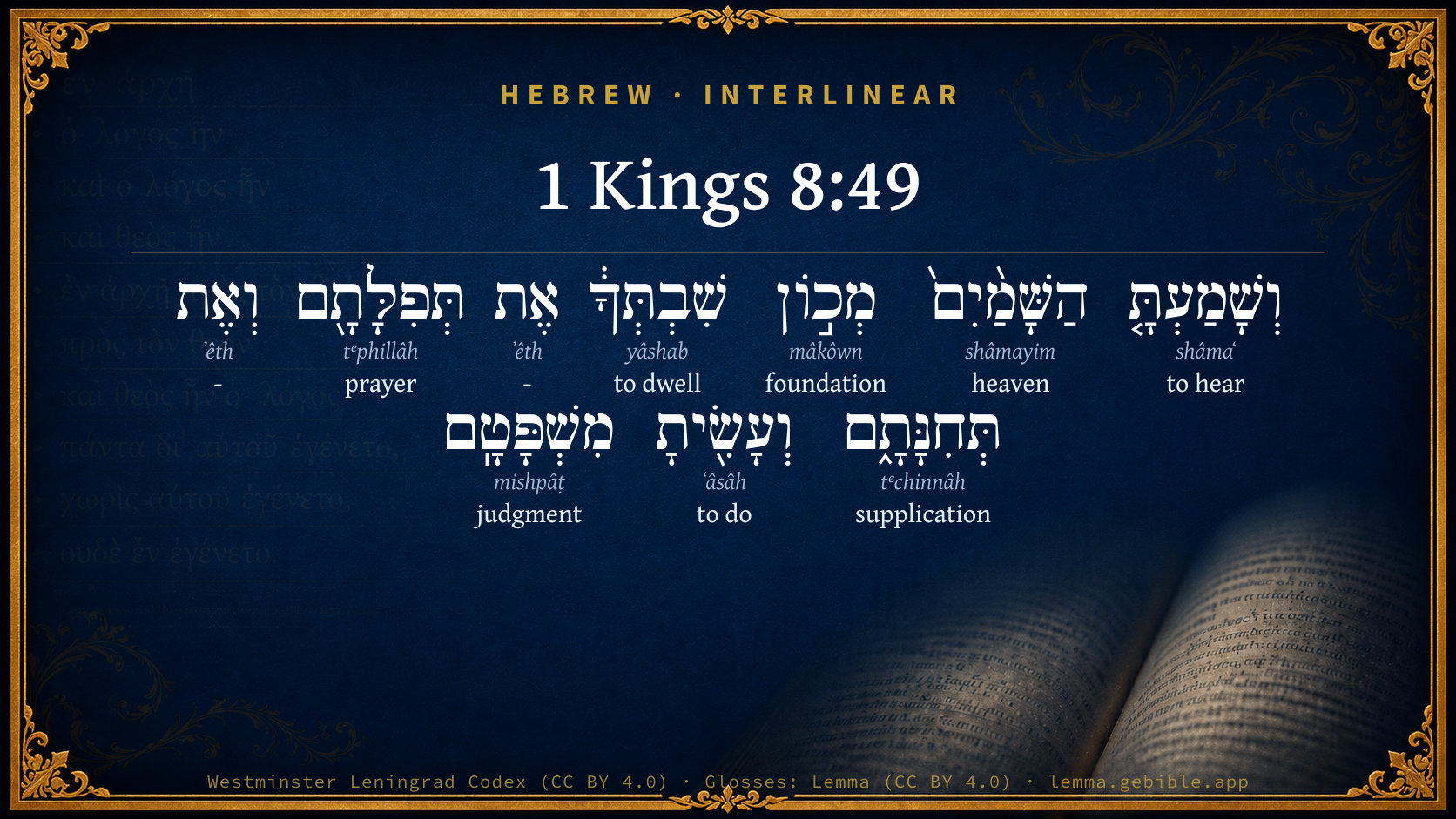
Hebrew (Westminster Leningrad Codex) 1 Kings 8:49 appears in the Hebrew Old Testament. The text above is from the Westminster Leningrad Codex. Each word links to its Strong’s number, a concise gloss, and parsing drawn from the Open Scriptures Hebrew Bible morphology. Click any word for its full Brown-Driver-Briggs (BDB) entry.
Download image
Cite this verse

1 Kings 8:49 (World English Bible). Public Domain. Lemma interlinear Bible study tool, https://lemma.gebible.app/v/1-kings/8/49.

Show BibTeX & RIS
BibTeX
RIS
English Translation
then hear you their prayer and their supplication in heaven, your dwelling-place, and maintain their cause;
World English Bible · Public Domain
Download a study sheet

One document with this verse’s original text, its word-by-word gloss line, the meaning frame, cross-references with their text, attributed commentary, and full source and license credits — printable, and it pastes into notes with its structure intact.

This verse Autodidact and up

Study sheet (.html) Plain text (.txt)

A passage Seminary Student

Up to 50 verses in one chapter. A passage sheet keeps up to 6 commentary sources and 12 cross-references per verse, in the order this page ranks them, and says so on the sheet whenever that leaves anything out. Ask for a single verse and you get the Autodidact verse sheet above.

Everything on this page stays free to read, with no account — the sheet is a download of what is already on screen, not access to it.

Want to remove ads? Support Godless Engineer
Compare translations 3

The same verse in 3 English versions, stacked beneath the original-language interlinear above. Click any original word for its lexicon entry.

Each is an independent rendering of the whole verse — the interlinear is not word-aligned to these translations.

Highlighted words mark where these versions differ — a whole-verse word diff, not a word-by-word alignment.

  • World English Bible Public Domain
    then hear you their prayer and their supplication in heaven, your dwelling-place, and maintain their cause;
  • King James Version Public Domain
    Then hear thou their prayer and their supplication in heaven thy dwelling place, and maintain their cause,
  • unfoldingWord Literal Text CC BY-SA 4.0
    then may you hear the heavens, the place of your dwelling, their prayer and their supplication, and may you do their justice.

unfoldingWord Literal Text — © unfoldingWord, licensed CC BY-SA 4.0. Word-aligned USFM3 via Door43 (git.door43.org/unfoldingWord/en_ult).

Versions to compare (up to 4)

3 of 4 selected

Show all 18 translations

Every available English version of this verse, each an independent rendering of the whole verse.

  • World English Bible Public Domain
    then hear you their prayer and their supplication in heaven, your dwelling-place, and maintain their cause;
  • Berean Standard Bible Public Domain
    then may You hear from heaven, Your dwelling place, their prayer and petition, and may You uphold their cause.
  • Majority Standard Bible Public Domain
    then may You hear from heaven, Your dwelling place, their prayer and petition, and may You uphold their cause.
  • King James Version Public Domain
    Then hear thou their prayer and their supplication in heaven thy dwelling place, and maintain their cause,
  • American Standard Version (1901) Public Domain
    then hear thou their prayer and their supplication in heaven thy dwelling-place, and maintain their cause;
  • Revised Version (1885) Public Domain
    then hear thou their prayer and their supplication in heaven thy dwelling place, and maintain their cause;
  • Geneva Bible (1599) Public Domain
    Then heare thou their prayer and their supplication in heauen thy dwelling place, and iudge their cause,
  • Douay-Rheims (1899) Public Domain
    Then hear thou in heaven, in the firmament of thy throne, their prayers, and their supplications, and do judgment for them:
  • Young's Literal Translation Public Domain
    `Then Thou hast heard in the heavens, the settled place of Thy dwelling, their prayer and their supplication, and hast maintained their cause,
  • Literal Standard Version CC BY-SA 4.0
    then You have heard in the heavens, the settled place of Your dwelling, their prayer and their supplication, and have maintained their cause,
  • Unlocked Literal Bible CC BY-SA 4.0
    Then from heaven, the place where you live, listen to their prayer and their request for help, and you will make matters right for them.
  • unfoldingWord Literal Text CC BY-SA 4.0
    then may you hear the heavens, the place of your dwelling, their prayer and their supplication, and may you do their justice.
  • Darby Bible Public Domain
    then hear thou in the heavens, the settled place of thy dwelling, their prayer and their supplication, and maintain their right;
  • World Messianic Bible Public Domain
    then hear their prayer and their supplication in heaven, your dwelling place, and maintain their cause;
  • Webster's Bible Public Domain
    Then hear thou their prayer and their supplication in heaven thy dwelling-place, and maintain their cause,
  • Free Bible Version CC BY-SA 4.0
    then hear from heaven, the place where you live, respond and support their cause.
  • Bible in Basic English Public Domain
    Then give ear to their prayer and to their cry in heaven your living-place, and see right done to them;
  • JPS Tanakh (1917) Public Domain
    then hear Thou their prayer and their supplication in heaven Thy dwelling-place, and maintain their cause;

Literal Standard Version (2020), Covenant Press — licensed CC BY-SA 4.0. Text via the HelloAO Bible API (eBible.org). Unlocked Literal Bible (unfoldingWord) — licensed CC BY-SA 4.0. Text via the HelloAO Bible API (eBible.org). unfoldingWord Literal Text — © unfoldingWord, licensed CC BY-SA 4.0. Word-aligned USFM3 via Door43 (git.door43.org/unfoldingWord/en_ult). Free Bible Version, Dr. Jonathan Gallagher — licensed CC BY-SA 4.0. Text via the HelloAO Bible API (eBible.org).

Word by word

More ways to search: Search by grammar → Find every occurrence → Compare this word →

Practice this passage: Drill this verse → Learn its vocabulary →

מְכ֣וֹן
mâkôwn
H4349
“foundation of”
Noun, Common, Masculine, Singular, Construct
Part of Speech
Noun
Type
Common
Gender
Masculine
Number
Singular
State
Construct
Full BDB Definition

Origin: from H3559

TWOT: 964c

fixed or established place, foundation - fixed place - foundation
  1. וְשָׁמַעְתָּ֤ shâmaʻ H8085 “and · to hear” Conjunction + Verb, Qal, Sequential Perfect, 2nd Person, Masculine, Singular
  2. הַשָּׁמַ֨יִם֙ shâmayim H8064 “the · heaven(s)” Particle, Definite Article + Noun, Common, Masculine, Plural, Absolute
  3. שִׁבְתְּךָ֔ yâshab H3427 “to dwell · you” Verb, Qal, Infinitive Construct + Suffix, Personal, 2nd Person, Masculine, Singular
  4. אֶת ʼêth H853 “-” Particle, Direct Object
  5. תְּפִלָּתָ֖ם tᵉphillâh H8605 “prayer · their” Noun, Common, Feminine, Singular, Construct + Suffix, Personal, 3rd Person, Masculine, Plural
  6. וְאֶת ʼêth H853 “and · -” Conjunction + Particle, Direct Object
  7. תְּחִנָּתָ֑ם tᵉchinnâh H8467 “supplication · their” Noun, Common, Feminine, Singular, Construct + Suffix, Personal, 3rd Person, Masculine, Plural
  8. וְעָשִׂ֖יתָ ʻâsâh H6213 “and · to do” Conjunction + Verb, Qal, Sequential Perfect, 2nd Person, Masculine, Singular
  9. מִשְׁפָּטָֽם mishpâṭ H4941 “judgment · their” Noun, Common, Masculine, Singular, Construct + Suffix, Personal, 3rd Person, Masculine, Plural

About this verse

These counts appear in no published source. They are computed here, from the morphology-tagged text and Lemma’s own curated glosses. What Lemma adds →

10
words
9
distinct lemmas
Historical
section

Notable vocabulary

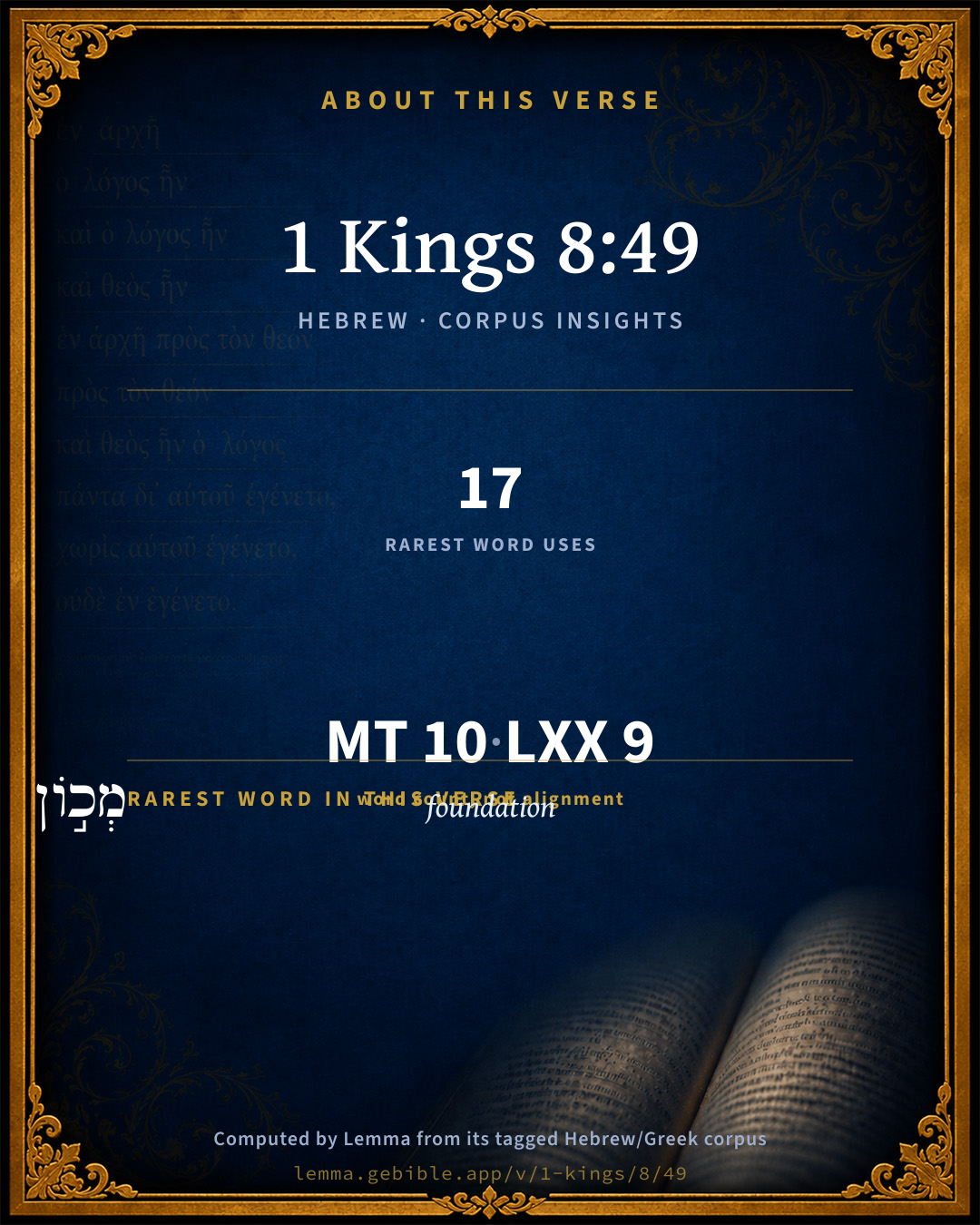
The rarest word here is מְכ֣וֹן foundation H4349 — appearing just 17 times in the whole Hebrew Bible.

Shared distinctive vocabulary

מְכ֣וֹן foundation H4349 occurs in 17 verses of the Hebrew Bible. Also found in:

Grammatical profile

  • 3 verbs
  • 5 nouns
  • 2 particles

Verb forms

  • וְשָׁמַעְתָּ֤ Qal · Sequential Perfect
  • שִׁבְתְּךָ֔ Qal · Infinitive Construct
  • וְעָשִׂ֖יתָ Qal · Sequential Perfect

Hebrew & Septuagint length

In English translation the verse runs 16 words from the Hebrew and 9 from the Septuagint (LXX English) — the Septuagint runs noticeably shorter here. See the side-by-side →

A rough comparison of the two English renderings, which tokenize alike — not a word-level alignment.

Word counts can differ between the Hebrew and the Greek without any difference in meaning — e.g. the Hebrew direct-object marker אֵת has no separate Greek word, and Greek often adds the article ὁ.

In the original languages it is 10 Hebrew tokens and 9 Greek tokens — but the two are counted differently (Hebrew bundles its prefixes and suffixes into one token; the Greek is in lemma form), so that isn’t a like-for-like length.

Cross-references

3

Topical passages linked to 1 Kings 8:49 in the Treasury of Scripture Knowledge — connected by theme and wording, ordered by reader-vote popularity; previews shown in the World English Bible.

  • 1 Kings 8:45 then hear in heaven their prayer and their supplication, and maintain their cause.
  • 2 Kings 19:19 Now therefore, Yahweh our God, save you us, I beg you, out of his hand, that all the kingdoms of the earth may know that you Yahweh are God alone.
  • Zechariah 1:15–16 I am very angry with the nations that are at ease; for I was but a little displeased, but they added to the calamity."

Cross-references courtesy of OpenBible.info (CC BY 4.0).

Hebrew and Greek witnesses Masoretic Hebrew ↔ Greek Septuagint

The same verse in the two great witnesses to the Old Testament, shown verse-for-verse.

Here the Septuagint runs noticeably shorter than the Hebrew — LXX2012 (modern English Septuagint) 9 words vs World English Bible 16. A rough length comparison of the two English translations, not a word-level alignment — read both below.

These are two independent witnesses, not word-aligned to each other, and the Septuagint is shown in lemma (dictionary) form.

Hebrew 1 Kings 8:49 Masoretic · Westminster Leningrad Codex

וְשָׁמַעְתָּ֤ הַשָּׁמַ֨יִם֙ מְכ֣וֹן שִׁבְתְּךָ֔ אֶת תְּפִלָּתָ֖ם וְאֶת תְּחִנָּתָ֑ם וְעָשִׂ֖יתָ מִשְׁפָּטָֽם

then hear you their prayer and their supplication in heaven, your dwelling-place, and maintain their cause;

World English Bible · Public Domain

Greek LXX 1 Kings 8:49 Septuagint · lemma form

καί εἰςἀκούω ἐκ ὁ οὐρανός ἐκ ἕτοιμος κατοικητήριον σύ

then shall you hear from heaven your established dwelling-place,

LXX2012 (modern English Septuagint) · Public Domain

Hebrew: Westminster Leningrad Codex (CC BY 4.0). Greek: Septuagint (public domain); English from LXX2012 (modern English Septuagint) (Public Domain). How the Septuagint differs from the Hebrew →

Targum (Aramaic paraphrase)

1

The Targum is the ancient Jewish Aramaic paraphrase of the Hebrew Scriptures — an interpretive translation, not the Hebrew text itself. Onkelos (literal) and Pseudo-Jonathan (expansive) render the Torah, and Jonathan the Prophets. Coverage is partial: where no permissively-licensed English translation exists for a verse, only the Aramaic is shown. This is verse-level text, not a word-by-word alignment to the Hebrew.

  1. Targum Jonathan Prophets (Joshua–Malachi)
    וּתְקַבֵּל מִן שְׁמַיָא מֵאֲתַר בֵּית שְׁכִנְתָּךְ יַת צְלוֹתְהוֹן וְיַת בָעוּתְהוֹן וְתִתְפְּרַע עוֹלְבַּנְהוֹן:

    (no public-domain English translation for this verse)

    Targum Jonathan — Aramaic: “Mikraot Gedolot” (public domain). English: “Sefaria Community Translation” (CC0 1.0 (public-domain dedication)); “London "Chaldee Paraphrase," 1871” (public domain). Text via Sefaria.

Commentary

Notes on 1 Kings 8:49 from classic Christian and Jewish commentators (each source and its license shown beneath its notes). The classic Christian expositions comment on the surrounding passage and are grouped to its opening verse, so a note may address several verses; the Jewish commentaries on the Tanakh (Rashi and others) are per-verse, so they appear only where the commentator wrote on this verse.

Lemma curates 59 commentaries, every one of them public domain or Creative Commons licensed, each selected and text-cleaned for this edition rather than reprinted as found. About our sources →

Trapp's Complete Commentary

John Trapp

1Ki 8:49 Then hear thou their prayer and their supplication in heaven thy dwelling place, and maintain their cause,

Ver. 49. And maintain their cause.] Or, Right. Vindicate them out of the hands of their oppressors, who cannot do, but they must overdo. {Zec 1:15}

John Trapp, A Commentary or Exposition upon All the Books of the Old and New Testament (1647–1656) — public domain. Text from a community e-Sword module.

Geneva Bible (1599)

Geneva Bible translators

Or, avenge their wrong.

Geneva Bible (1599) marginal notes — public domain. Text via Bolls.life.

The Cambridge Bible for Schools and Colleges

gen. ed. J. J. S. Perowne

49. and maintain their cause] The words are the same as in 1Ki_8:45, but the idea is a little different. There the ‘cause’ was a righteous war undertaken at God’s direction; here the phrase implies that God shall do His people right by delivering them from their oppressors. For though God may use the heathen as His instruments He does not always approve of the conduct they exhibit. On this cf. Isa_10:5-16. The literal meaning of the Hebrew is ‘do them right’ or ‘work out their right.’

The Cambridge Bible for Schools and Colleges (gen. ed. J. J. S. Perowne; Cambridge University Press, 1878–1918) — public domain. Text from a community e-Sword module.

John Gill's Exposition

Then hear thou their prayers, and their supplication, in heaven thy dwellingplace,.... For their deliverance out of captivity: and maintain their cause; plead it, and do them justice, avenge their injuries, and deliver them.

Then hear thou their prayers, and their supplication, in heaven thy dwellingplace,.... For their deliverance out of captivity: and maintain their cause; plead it, and do them justice, avenge their injuries, and deliver them.

1 Kings 8:50

kg1 8:50

kg1 8:50

kg1 8:50And forgive thy people that have sinned against thee, and all their transgressions wherein they have transgressed against thee,.... By returning them to their own land; by which it would appear that the Lord had forgiven their trespasses, as well as by what follows:

and give them compassion before them who carried them captive, that they may have compassion on them; for it is in the power of God to work upon the affections of men, and dispose their minds to use his people well, and to pity them under their distresses, as the Chaldeans did the Jews in Babylon, Psa 106:46.

John Gill's Exposition of the Whole Bible (1746–1763) — public domain (CC PDM 1.0). Text via the HelloAO Bible API.

Matthew Poole's English Annotations

Heb. their right, against their invaders and oppressors. For they had forfeited all their rights to God only, but not to their enemies; whom though God used as scourges to chastise his people’s sins, yet they had no pretence of right to their land, nor any regard to it; but only minded the satisfaction of their own lusts and interests. See Isa 10:5,6; 47:6; Zec 1:15.

Matthew Poole's English Annotations on the Holy Bible (1683–1685) — public domain. Text from a community e-Sword/MySword module.

The Pulpit Commentary

Then hear thou their prayer and their supplication in heaven thy dwelling place, and maintain their cause. Heb. do their judgments, as in ver. 45.

HOMILIES BY A. ROWLAND Ver. 49.

Occasions for Prayer.

In the prayer of dedication Solomon suggests occasions on which it would be natural for men to turn to their God. The Divine Presence is constant, but our realization of it is not. Many require the shock of some unexpected or lamentable occurrence to rouse them to prayer. This effect, however, will only be seen in those who have, underlying their forgetfulness and sensuousness, an abiding (though sometimes inoperative) belief in God. This Israel for the most part had. Hence Solomon"s belief that in their future times of distress and difficulty they would turn to Him who dwelt between the cherubims. Analyze the prayer, and see the following occasions suggested as those in which supplication would be natural.

I WHEN MEN MAKE VOWS AND PROMISES. Compare ver. 31 with the ordinances of Moses. (Exo_22:7-9) The oath was taken in the presence of God, because the thought of Him as the Searcher of hearts would induce serious consideration and careful exactitude, and because He was tacitly invited by His providence to confirm or to punish the spoken word. Show how the principle, right in itself, became abused and vitiated, so that Christ condemned the practices of His day. (Mat_5:33-37) Learn from the ancient practice

(1) that our utterances should be made as by men conscious of the nearness of the God of truth. Apply this to the immoralities of some business transactions, to the prevalence of slander in society, etc.

(2) That our resolutions should be formed in a spirit of prayer. How vain the pledge and promise of amendment, unless there be added to the human resolve the help of God"s providence in circumstances, and the grace of His Spirit in the heart! Give examples of each.

II WHEN MEN ARE INJURED OR DEFEATED BY THEIR ADVERSARIES. "When thy people Israel be smitten down before the enemy" (ver. 33). National defeat in war should lead to self examination on the part of those smitten. Too often the investigation is applied only to material resources: incompetent officials are dismissed, weakened regiments are strengthened, new alliances are formed, etc. The mischief may lie deeper. Sometimes God is calling the people not to redeem national honour, but to seek national righteousness. The teaching of the verse may be applied figuratively to defeats suffered by Christian controversialists or by philanthropic workers, etc. Every check in onward progress is a summons to thought and prayer. "In the day of adversity consider." Illustrate by examples in Scripture, e.g., by the defeat of Israel at Ai, and its issues.

III WHEN MEN ARE TREMBLING UNDER NATURAL CALAMITIES. Reference is made in ver. 35 to the withholding of rain; in ver. 37 to "famine, pestilence, blasting, mildew, locust, and caterpillar." Such troubles were sent in vain to bring the Egyptians to repentance. Compare those plagues with Elijah"s message to Ahab, and with the threats of other prophets. Such statements as Deu_11:17 enshrine an abiding truth. In the long run the violation of God"s laws do bring disasters of the very kind specified here. If the law of industry be violated, the harvests fail; if the law of mutual dependence be ignored by nations, commerce is crippled, and impoverishment comes; if the laws against self indulgence, pride, ambition, etc., be defied, the spendthrift has the result in poverty, the proud nation in the miseries of war, etc. Even the disasters which are accounted "natural phenomena," then, should lead the wise hearted to prayer, the sinful to penitence; and God will hear in heaven His dwelling place, and answer and forgive. Show how, during the ministry of our Lord, the cripples, the blind, the diseased came to Him. Their misery made them feel their need of what He alone could give, and many of them became conscious of their spiritual wants from considering first the want that was physical. As they were thus led, so the Church has been which in the Old Testament was oppressed most by the earthly wants, and in the New by the spiritual. Those in the far country learn, by beginning to "be in want," that God is calling them to arise and return to Him.

IV WHEN MEN ARE CONSCIOUS OF THEIR SIN. All through this prayer reference is made to sin and to the consequent necessity for pardon (vers. 38, 46-50). Point out the climax in ver. 47:

(1) "We have sinned have not kept in the ways of God sin in its negative aspect;

(2) "have done perversely acts of perversity;

(3) "have committed wickedness the overwhelming passion which drives into corruption. The necessity of humble confession as an integral part of prayer from the lips of fallen man can readily be shown from Scripture. Examples of conscience of sin impelling to prayer seen in David, (Ps 51) the publican. (Luk_18:18) "If we confess our sins, He is faithful and just to forgive us our sins, and to cleanse us from all unrighteousness". (1Jn_1:9)

V WHEN MEN ARE GOING FORTH TO CONFLICT IN GOD"S NAME. "If thy people shall go out to battle against their enemy whithersoever thou shalt send them," etc. (ver. 44). We must not forget that Israel was a theocracy. David, for example, spoke of his foes as being God"s foes. So had it been with Moses, Joshua, etc. The consciousness of that gives almost superhuman power. "Man, being linked with Omnipotency, is a kind of omnipotent creature," says Bacon. Even when the belief that one is on God"s side is false, the belief itself is an inspiration. Examples from history of such belief well or ill founded Joan of Are, the Puritans, etc. In actual war no nation can fairly put up this prayer unless the cause of war is that of which we can say, "whithersoever thou shalt send." No mistake need exist in reference to foes whom Christ came to destRomans The promise, "Lo! I am with you," was the inspiration of the apostles as they confronted false philosophies, crass ignorance, brutal customs, degrading superstitions. Hence, if they were going forth to battle with such evils, the prayers of the Church went up on their behalf. Men were set apart for their Christian mission by prayer (give examples), and in their work they often turned to their intercessors, saying, "Brethren, pray for us!" Feeling our insufficiency to overcome the adversaries of the gospel, let us, like the apostles, "continue in prayer and supplication" till we are "endued with power from on high. A.R.

The Pulpit Commentary (1880–1919), ed. H.D.M. Spence-Jones & Joseph S. Exell — public domain. Text from a community e-Sword module.

John Wesley's Explanatory Notes

Their course - Hebrew. their right, against their invaders and oppressors. For they had forfeited all their rights to God only, but not to their enemies; whom tho' God used as scourges to chastise his peoples sins, yet they had no pretense of right to their land.

John Wesley, Explanatory Notes Upon the Whole Bible (1754–1765) — public domain. Text via the GEBible commentary corpus.

unfoldingWord translationNotes

Door43 World Missions Community

their prayer and their request

The two words "prayer" and "request" mean basically the same thing. Together they emphasize that the people were sincere as they made their request to Yahweh. See how you translated similar words in 1 Kings 8:28. (See: Doublet)

Forgive your people who have sinned against you, and all their transgressions that they have committed against you

Solomon twice requests Yahweh to forgive the people. This emphasizes the earnestness of his request. (See: Parallelism)

translationWords

pray

heaven

forgive

transgress

command

compassion

unfoldingWord translationNotes — © Distant Shores Media and the Door43 World Missions Community, licensed CC BY-SA 4.0. Source: git.door43.org/Door43/en_tn.

Lesson kit

Teaching starters — assembled from the data on this page, not authored interpretation. Every prompt links to the verse data it draws on. Edit before teaching.

1 Kings, in the Historical, opens this verse with 10 words (9 distinct Hebrew lemmas). Its most distinctive word is mâkôwn (“foundation”). The Greek Septuagint runs shorter here. A historical commentator’s framing appears above. Read the whole chapter for the surrounding context.

Discussion questions

  1. How does “foundation” (mâkôwn) shape what this verse is saying?
  2. Exodus 15:17 shares the word «foundation» with this verse. How do the two illuminate each other?
  3. Compared with the Hebrew, the Septuagint runs shorter here. What questions does that raise?
  4. These translations render this verse differently. What is at stake in choosing one wording over another?
  5. The verb «וְשָׁמַעְתָּ֤» is Qal Sequential Perfect. How does its form color the action?
  6. Reading how Trapp's Complete Commentary and Geneva Bible (1599) read this verse, where do the two commentators agree and where do they part?

Things to notice

Reading settings

Reading text

Shown beneath each verse's original-language words.

Old Testament
Old Testament edition

Read the OT as the Masoretic Hebrew (MT) or the Greek Septuagint (LXX).

English shown for the Greek Septuagint (in the Hebrew ↔ Greek comparison).

Comparing translations? Open the Compare panel on any verse page to stack up to four side by side.