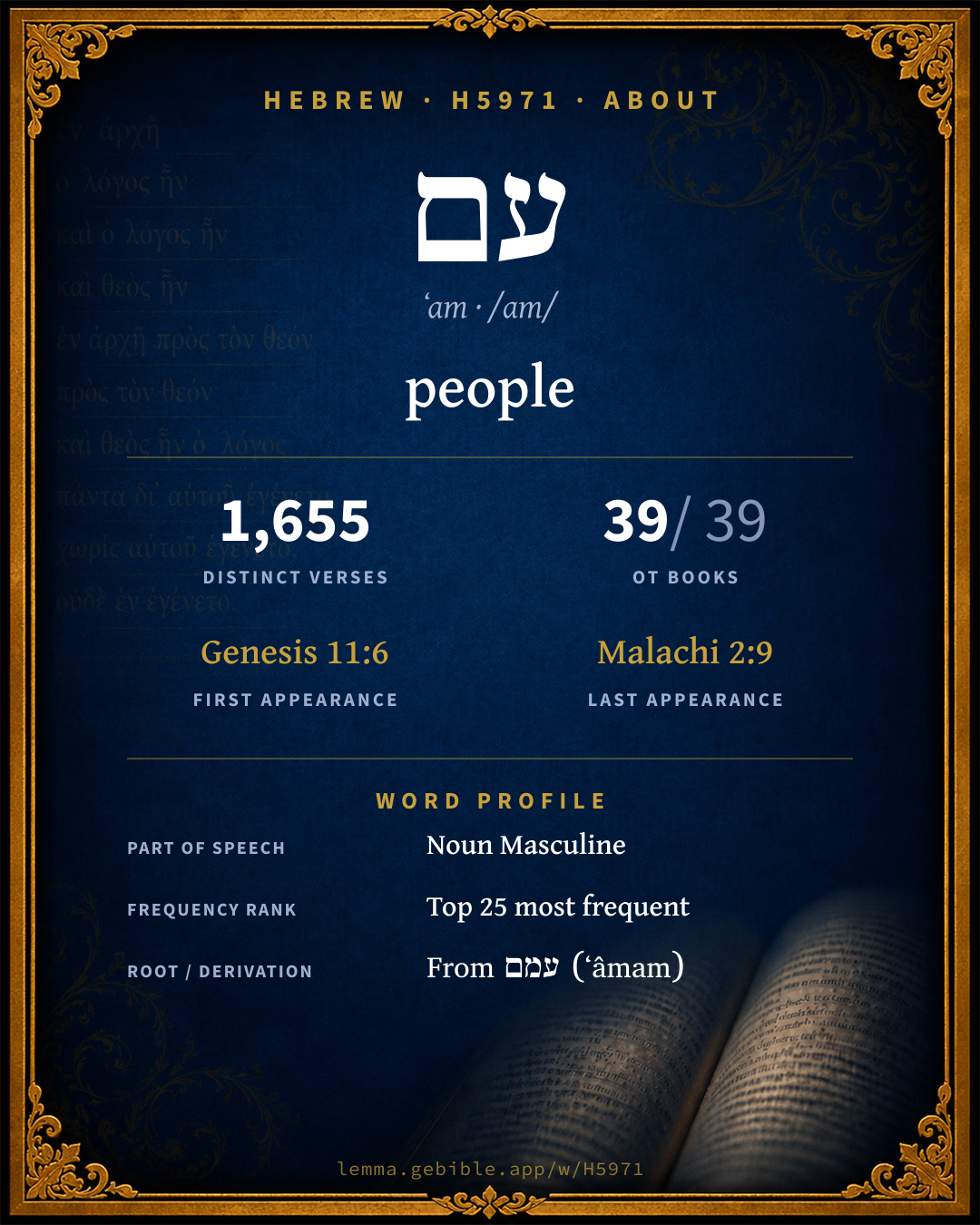
עַם
people
‘people’ is one of 2 main senses fuller range ↓
Full lexicon entry — Brown-Driver-Briggs (BDB)
From Brown-Driver-Briggs (BDB)
Where this word appears
See every Absolute-state word in the Hebrew Bible →
Grammar key — what these labels mean
Part of speech
- Noun
- A naming word — a person, place, thing, or idea.
Noun type
- Common
- A common noun — a general class of person, place, or thing (“king,” “city,” “water”), not a specific name.
- Proper
- A name of a specific person, place, or people (e.g. Abraham, Zion, Israel).
State
- Absolute
- The independent form of a noun, not bound to a following word.
- Construct
- A noun bound to a following noun in a possessive / “of” relationship (the construct chain).
Gender
- Masculine
- Grammatically masculine.
Number
- Singular
- One.
- Plural
- More than one (in Hebrew, generally three or more).
58 verses where H5971 appears in the Absolute state in the Book of Psalms. Filtered view — show all forms. Click any verse to open its interlinear word-by-word view. Verse text shown in the World English Bible for context — . Each verse’s Hebrew form is shown with its reference; the English is not keyword-highlighted, since the data carries no word-level English alignment. Use “Compare translations” on any verse to read it across multiple English versions. This concordance covers the Hebrew Bible; Septuagint (Greek Old Testament) occurrences are not indexed here.
Psalms
- Psalms 3:6 עָ֑ם n c ms I will not be afraid of tens of thousands of people Who have set themselves against me on every side.
- Psalms 7:8 עַ֫מִּ֥ים n c mp Yahweh administers judgment to the peoples. Judge me, Yahweh, according to my righteousness, And to my integrity that is in me.
- Psalms 9:11 בָ֝/עַמִּ֗ים prep det + n c mp Sing praises to Yahweh, who dwells in Zion, And declare among the people what he has done.
- Psalms 18:27 עַם n c ms For you will save the afflicted people, But the haughty eyes you will bring down.
- Psalms 18:43 עָ֥ם עַ֖ם n c ms n c ms You have delivered me from the strivings of the people. You have made me the head of the nations. A people whom I have not known shall serve me.
- Psalms 18:47 עַמִּ֣ים n c mp Even the God who executes vengeance for me, And subdues peoples under me.
- Psalms 22:6 עָֽם n c ms But I am a worm, and no man; A reproach of men, and despised by the people.
- Psalms 22:31 לְ/עַ֥ם prep + n c ms They shall come and shall declare his righteousness to a people that shall be born, For he has done it.
- Psalms 33:10 עַמִּֽים n c mp Yahweh brings the counsel of the nations to nothing. He makes the thoughts of the peoples to be of no effect.
- Psalms 33:12 הָ/עָ֓ם ptcl def.art + n c ms Blessed is the nation whose God is Yahweh, The people whom he has chosen for his own inheritance.
- Psalms 35:18 בְּ/עַ֖ם prep + n c ms I will give you thanks in the great assembly. I will praise you among many people.
- Psalms 45:5 עַ֭מִּים n c mp Your arrows are sharp. The nations fall under you, with arrows in the heart of the king's enemies.
- Psalms 45:12 עָֽם n c ms The daughter of Tyre comes with a gift. The rich among the people entreat your favor.
- Psalms 45:17 עַמִּ֥ים n c mp I will make your name to be remembered in all generations. Therefore the peoples shall give you thanks forever and ever.
- Psalms 47:1 הָ֭/עַמִּים ptcl def.art + n c mp Oh clap your hands, all you nations. Shout to God with the voice of triumph!
- Psalms 47:3 עַמִּ֣ים n c mp He subdues nations under us, And peoples under our feet.
- Psalms 47:9 עַמִּ֨ים עַם֮ n c mp n c ms cs The princes of the peoples are gathered together, The people of the God of Abraham. For the shields of the earth belong to God. He is greatly exalted!
- Psalms 49:1 הָֽ/עַמִּ֑ים ptcl def.art + n c mp Hear this, all you peoples. Listen, all you inhabitants of the world,
- Psalms 56:7 עַמִּ֤ים n c mp Shall they escape by iniquity? In anger cast down the peoples, God.
- Psalms 57:9 בָ/עַמִּ֥ים prep det + n c mp I will give thanks to you, Lord, among the peoples. I will sing praises to you among the nations.
- Psalms 62:8 עָ֗ם n c ms Trust in him at all times, you people. Pour out your heart before him. God is a refuge for us. Selah.
- Psalms 66:8 עַמִּ֥ים n c mp Praise our God, you peoples! Make the sound of his praise heard,
- Psalms 67:3 עַמִּ֥ים עַמִּ֥ים n c mp n c mp Let the peoples praise you, God. Let all the peoples praise you.
- Psalms 67:4 עַמִּ֣ים n c mp Oh let the nations be glad and sing for joy, For you will judge the peoples with equity, And govern the nations on earth. Selah.
- Psalms 67:5 עַמִּ֥ים עַמִּ֥ים n c mp n c mp Let the peoples praise you, God. Let all the peoples praise you.
- Psalms 68:30 עַמִּ֗ים עַ֝מִּ֗ים n c mp n c mp Rebuke the wild animal of the reeds, The multitude of the bulls, with the calves of the peoples. Being humbled, may it bring bars of silver. Scatter the nations that delight in war.
- Psalms 68:35 לָ/עָ֗ם prep det + n c ms You are awesome, God, in your sanctuaries. The God of Israel gives strength and power to his people. Praise be to God!
- Psalms 72:3 לָ/עָ֑ם prep det + n c ms The mountains shall bring prosperity to the people. The hills bring the fruit of righteousness.
- Psalms 72:4 עָ֗ם n c ms He will judge the poor of the people. He will save the children of the needy, And will break the oppressor in pieces.
- Psalms 74:14 לְ/עָ֣ם prep + n c ms You broke the heads of Leviathan in pieces. You gave him as food to people and desert creatures.
- Psalms 74:18 וְ/עַ֥ם conj + n c ms Remember this, that the enemy has mocked you, Yahweh. Foolish people have blasphemed your name.
- Psalms 77:14 בָ/עַמִּ֣ים prep det + n c mp You are the God who does wonders. You have made your strength known among the peoples.
- Psalms 87:6 עַמִּ֑ים n c mp Yahweh will count, when he writes up the peoples, "This one was born there." Selah.
- Psalms 89:15 הָ֭/עָם ptcl def.art + n c ms Blessed are the people who learn to acclaim you. They walk in the light of your presence, Yahweh.
- Psalms 89:19 מֵ/עָֽם prep + n c ms Then you spoke in vision to your saints, And said, "I have bestowed strength on the warrior. I have exalted a young man from the people.
- Psalms 89:50 עַמִּֽים n c mp Remember, Lord, the reproach of your servants, How I bear in my heart the taunts of all the mighty peoples,
- Psalms 94:8 בָּ/עָ֑ם prep det + n c ms Consider, you senseless among the people; You fools, when will you be wise?
- Psalms 95:10 עַ֤ם n c ms Forty long years I was grieved with that generation, And said, "It is a people that errs in their heart. They have not known my ways."
- Psalms 96:3 הָֽ֝/עַמִּ֗ים ptcl def.art + n c mp Declare his glory among the nations, His marvelous works among all the peoples.
- Psalms 96:5 הָ/עַמִּ֣ים ptcl def.art + n c mp For all the gods of the peoples are idols, But Yahweh made the heavens.
- Psalms 96:7 עַמִּ֑ים n c mp Ascribe to Yahweh, you families of nations, Ascribe to Yahweh glory and strength.
- Psalms 96:10 עַ֝מִּ֗ים n c mp Say among the nations, "Yahweh reigns." The world is also established. It can't be moved. He will judge the peoples with equity.
- Psalms 96:13 וְ֝/עַמִּ֗ים conj + n c mp Before Yahweh; for he comes, For he comes to judge the earth. He will judge the world with righteousness, The peoples with his truth.
- Psalms 97:6 הָ/עַמִּ֣ים ptcl def.art + n c mp The heavens declare his righteousness. All the peoples have seen his glory.
- Psalms 98:9 וְ֝/עַמִּ֗ים conj + n c mp Let them sing before Yahweh, For he comes to judge the earth. He will judge the world with righteousness, And the peoples with equity.
- Psalms 99:1 עַמִּ֑ים n c mp Yahweh reigns! Let the peoples tremble. He sits enthroned among the cherubim. Let the earth be moved.
- Psalms 99:2 הָֽ/עַמִּֽים ptcl def.art + n c mp Yahweh is great in Zion. He is high above all the peoples.
- Psalms 102:18 וְ/עַ֥ם conj + n c ms This will be written for the generation to come. A people which will be created will praise Yah.
- Psalms 102:22 עַמִּ֣ים n c mp When the peoples are gathered together, The kingdoms, to serve Yahweh.
- Psalms 105:1 בָ֝/עַמִּ֗ים prep det + n c mp Give thanks to Yahweh! Call on his name! Make his doings known among the peoples.
- Psalms 105:13 עַ֥ם n c ms They went about from nation to nation, From one kingdom to another people.
- Psalms 105:20 עַ֝מִּ֗ים n c mp The king sent and freed him; Even the ruler of peoples, and let him go free.
- Psalms 106:34 הָֽ/עַמִּ֑ים ptcl def.art + n c mp They didn't destroy the peoples, As Yahweh commanded them,
- Psalms 106:48 הָ/עָ֥ם ptcl def.art + n c ms Blessed be Yahweh, the God of Israel, From everlasting even to everlasting! Let all the people say, "Amen." Praise Yah!
- Psalms 107:32 עָ֑ם n c ms Let them exalt him also in the assembly of the people, And praise him in the seat of the elders.
- Psalms 108:3 בָ/עַמִּ֥ים prep det + n c mp I will give thanks to you, Yahweh, among the nations. I will sing praises to you among the peoples.
- Psalms 114:1 מֵ/עַ֥ם prep + n c ms When Israel went forth out of Egypt, The house of Jacob from a people of foreign language;
- Psalms 144:15 הָ֭/עָם הָ֝/עָ֗ם ptcl def.art + n c ms ptcl def.art + n c ms Happy are the people who are in such a situation. Happy are the people whose God is Yahweh.
About this entry
At a glance — auto-summarized from this page’s data, not written by a person. Every figure links to its source below. This summary describes the numbers; it doesn’t interpret them.
עם — transliterated ʻam — is a Hebrew noun carrying the sense “people.” Its earliest occurrence is Genesis 11:6. It appears 1,655 verses across 39 books of the Hebrew Bible, among its most common vocabulary. The lexicon spreads it across several senses; see its full sense range. It shares a root with עמם, עם and עמה. Each statement above links to its evidence; the full detail follows below.
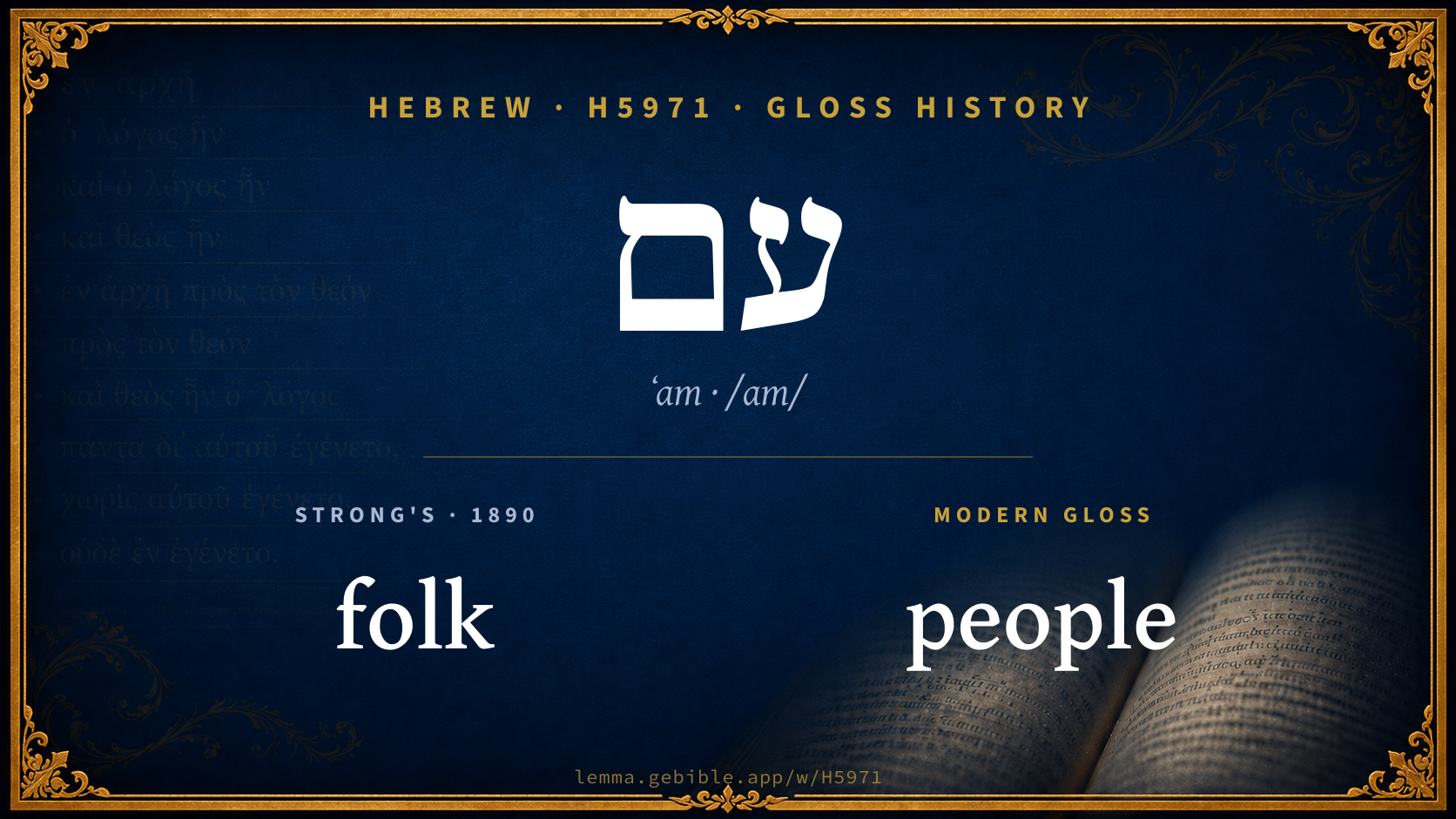
Gloss history
Strong's 1890 vs modern scholarship
About this word
Strong's H5971 catalogs a Hebrew word from the Hebrew Old Testament.
These counts are not copied from any lexicon or concordance. They are computed here, from the morphology-tagged Hebrew Old Testament. What Lemma adds →
- 1,655
- distinct verses
- The word appears in 1,655 distinct verses.
- 39 / 39
- OT books
- The word appears in 39 of 39 Old Testament books.
- #24
- by frequency
- Top 25 most frequent Hebrew words (rank 24 of 8,640 Hebrew words by occurrence).
View all 1,655 occurrences in the concordance →
By section of the Old Testament
By traditional corpus
Conventional, traditional groupings — biblical authorship is debated, so this is a traditional corpus grouping, not an authorship claim. Each share is this word’s portion of its verses in that division of the Hebrew canon. Each figure is a share of the word’s 1,655 distinct verses.
- Prophets (Nevi'im) 874 verses · 53%
- Torah (Pentateuch) 393 verses · 24%
- Writings (Ketuvim) 388 verses · 23%
How translations render this word
Counts come from each version’s own published word-to-Strong’s tagging or interlinear alignment — an approximate guide to how each version renders this word, not a word-level alignment the data otherwise carries. Because each total is that version’s own tagged count, the per-version totals vary from one another and need not match the appearance or distinct-verse counts above. These counts may also differ from a printed concordance because Lemma counts each distinctly tagged rendering and does not collapse phrase taggings into a single head-word total. This is a fixed set of word-tagged versions (KJV, ASV, BSB, ULT) and does not change with the reading translation you choose elsewhere. Each version’s license is shown beside its name below (and on Sources).
BDB lists this Strong’s number as 3 distinct words (homographs). Each count above pools all of them and is not split by sense — see the Senses section below. A low-frequency rendering may belong to a different one of those words, not the primary meaning.
- King James Version†: People 1,181×, All the people 214×, Among the people 24×
- American Standard Version†: People 987×, All the people 192×, Peoples 95×
- Berean Standard Bible†: People 1,246×, Peoples 103×, Troops 83×
- unfoldingWord Literal Text†: People 1,394×, Peoples 144×, People of 83×
King James Version Public Domain
Renders H5971 across 1,857† tagged occurrences — most commonly:
Plus other, less common renderings. Plus 216 renderings that appear only once — usually multi-word phrases or single function words the recovered tagging swept in, not distinct renderings. Not rendered by a distinct English word in 5 further occurrences.
American Standard Version Public Domain
Renders H5971 across 1,857† tagged occurrences — most commonly:
Plus other, less common renderings. Plus 273 renderings that appear only once — usually multi-word phrases or single function words the recovered tagging swept in, not distinct renderings.
Berean Standard Bible Public Domain
Renders H5971 across 1,748† tagged occurrences — most commonly:
Plus other, less common renderings. Plus 86 renderings that appear only once — usually multi-word phrases or single function words the recovered tagging swept in, not distinct renderings. Not rendered by a distinct English word in 116 further occurrences.
unfoldingWord Literal Text CC BY-SA 4.0
Renders H5971 across 1,856† tagged occurrences — most commonly:
Plus other, less common renderings. Plus 58 renderings that appear only once — usually multi-word phrases or single function words the recovered tagging swept in, not distinct renderings.
18 senses and sub-senses in the full BDB
What do BDB’s symbols mean?
BDB uses these scholarly abbreviations:
| Symbol | Meaning |
|---|---|
| 𝔊 | the Septuagint (the ancient Greek translation, LXX) |
| 𝔙 | the Vulgate (the Latin translation) |
| 𝔖 | the Syriac version (the Peshitta) |
| 𝔗 | the Targum (the Aramaic translation) |
| ψ | the Psalms |
| √ | root (the underlying root or stem) |
| ‖ | parallel passage (a synonymous or contrasted parallel) |
| † | the dagger: every passage where the word occurs is cited |
The 18 senses and sub-senses the full Brown-Driver-Briggs lexicon distinguishes for this word, in lexicon order (not ranked by frequency), with BDB’s own verbatim wording and sub-sense lettering. Shown in Hebrew script with BDB’s own scholarly abbreviations. The condensed entry is in the Lexicon Entry tab. See also the Forms in the corpus table below.
עם I
- 1. a people, nation (sometimes ‖ גּוֹי), n. coll. (sg. Ex 21:8 Jos 17:14, 15, 17; 2 S 17:29 + often, or pl. Ex 20:15; 24:2; Je 5:31 + often, or both in same clause Ex 1:20; 2 S 13:24): עַם אֶחָד = all mankind Gn 11:6 (J); peoples in gen. 27:29 (J; ‖ לְאֻמִּים), Ex 19:5 (E), Dt 2:25; 4:6 + often Dt, Ne 13:24 + often; קְהַל עַמִּים Gn 28:3 (P) an assembly (multitude) of peoples, 48:4 (P), Ez 23:24; 32:3 (+ דַבִּים); one’s own people Je 46:16 ψ 45:11; Ru 1:10, 15, 16(×2) + (on עַמִּי נָדִיב Ct 6:12 v. especially Bu); particular peoples, Egypt Gn 41:40 (E), Ex 1:22 (E), Ne 9:10 +; עַם־אֲרָם Am 1:5; עַם־כְּמוֹשׁ (i.e. Moab) Nu 21:29 (JE), Je 48:46; but especially Isr. Ex 1:20 (E) + often; עַם־בְּנֵי יִשׂ׳ v 9 (J); called ע׳ יהוה Nu 11:29 (E), 1 S 2:24 +, and (by י׳) עַמִּי Ex 3:7; 5:1 (J) + often (all periods); קְהַל עַם־הָאֱלֹהִים Ju 20:2, עַם־הַקָּהָל Lv 16:33 (P), קְהַל עָם ψ 107:32; especially הָעָם הַזֶּה (often in contempt or disgust) Nu 11:1, 12, 13 +; fig. of ants Pr 30:25, the shaphan v 26, locusts Jo 2:2, cf. לְעַם לְצִיִּים ψ 74:14 (where read לְעַם צִיִּים Hup-Now).—On Ju 1:16 v. עֲמָלֵקִי. e.g. Exodus 21:8
- 2. = smaller units, e.g.
- a. inhab. of a city Gn 19:4 (J), 1 S 9:12, 13; Je 29:16, 25; 2 Ch 31:4 + (Je 8:5 del. יְרוּשׁ׳ 𝔊 Gie Co Rothst). e.g. Genesis 19:4
- b. inhab. of a locality Je 37:12 [appar. not = tribe, Dt 33:3 read עַמּוֹ 𝔊 Di Dr, Ho 10:14; Ju 5:8, 14 read בְּעָרֶיךָ We Now; v. sub d]. e.g. Jeremiah 37:12
- c. retainers, followers Gn 14:16; 32:8; 33:15; 35:6; Ju 3:18; 8:5; 2 S 15:17; Je 41:13, 14 +. e.g. Genesis 14:16
- d. people bearing arms 1 S 11:11; 1 K 20:10 +; ע׳ כָּבֵד Nu 20:20 (JE), i.e. a powerful force; עַם הַצָּבָא Nu 31:32 (P), ע׳ הַמִּלְחָמָה Jos 8:1, 3, 11; 10:7; 11:7 (all JE); so prob. Ju 5:8 a (fighting) band; perhaps also v 14 (read sg.? v. GFM Bu). e.g. 1 Samuel 11:11
- 3. = common people Je 21:7; 22:4, Lv 4:27 (opp. ruler v 22), Ne 5:1 (opp. יְהוּדִים), 7:5 (opp. rulers). e.g. Jeremiah 21:7
- 4. people in gen., persons Gn 50:20 (E), so appar. כָּל־הָעָם אֲשֵׁר וגו׳ Ex 33:16 (J), Nu 11:34 (J), Jos 5:5(×2) (D), Ju 9:36 (as sg.), v 37 (as pl.), Je 36:9; persons labouring 1 K 9:23; superior persons Jb 12:2 (iron.); עַם עוֹלָם Ez 26:20 people of long ago (now in Sheʾôl). e.g. Genesis 50:20
- 5. phrases are:
- a. (עַמָּהּ, עַמִּי, עַמְּךָ) כְּנֵי עַמּוֹ members of one’s people, compatriots, fellow-countrymen, etc. Nu 22:5 (E), Gn 23:11 (P) Lv 19:18 (H), Ju 14:16, 17; Ez 33:2, 12 +. e.g. Numbers 22:5
- b. בְּנֵי הָעָם = common people (v. 3) 2 K 23:6; Je 26:23 +; people in gen. שַׁעַר בְּנֵי הָעָם Je 17:19 i.e. public gate 2 Ch 35:5, 12. e.g. 2 Kings 23:6
- c. עַם הָאָרֶץ the people at large, as a body 2 K 11:14, 18, 19, 20; 15:5; 16:15; 21:24(×2) +, Je 37:2; 44:21 Lv 20:2 (H), Gn 23:7, 12, 13 (P); common people Je 34:19, cf. דַּלַּת ע׳ הא׳ 2 K 24:14; disting. from prince Ez 45:22; 46:3, 9, from priests Hg 2:4 Zc 7:5; = Canaanites Nu 14:9 (JE), cf. עַמֵּי הָאָרֶץ 1 Ch 5:25; mixed post-exil. population Ezr 4:4. e.g. 2 Kings 11:14
- d. עַמֵּי הָאָרֶץ usually peoples of the earth Jos 4:24 (D), 2 Ch 32:19 +; of heathen peoples about and in Pal. after exile Ezr 10:2, 11; traders Ne 10:31; עַמֵּי הָאֲרָצוֹת 9:30; 10:29; 2 Ch 32:13. e.g. Joshua 4:24
- e. מִשְׁפְּחוֹת עַמִּים ψ 96:7 = 1 Ch 16:28 (cf. ψ 22:23). e.g. Psalms 96:7
- f. בַּת־עַמִּי = people personif. Is 22:4; Je 4:11 + 7 times Je + 6:14 (van d. H.; om. בַּת Baer Gi), La 2:11; 3:48; 4:3, 6, 10; בְּתוּלַת בַּת־עַמִּי Je 14:17. e.g. Isaiah 22:4
- g. designations of Isr. are: עַם־קָדוֹשׁ Dt 7:6 + 3 times, ע׳ קְדוֹשִׁים Dn 8:24, ע׳ (ה)קֹדֶשׁ Is 62:12; 63:18; Dn 12:7; ע׳ סְגֻלָּה Dt 7:6; 14:2; 26:18. e.g. Deuteronomy 7:6
- h. of foreign (non-Isr.) peoples: ע׳ נָכְרִי Ex 21:8 (E), ע׳ אַחֵר Dt 28:32, and especially from language, ע׳ עִמְקֵי שָׂפָה Ez 3:5 cf. v 6, כִּלְשׁוֹן עַם וָעָם Ne 13:24 cf. Est 1:22(×2); 3:12, ע׳ לֹעֵג ψ 114:1. e.g. Exodus 21:8
- i. עַם עֶבְרָתִי Is 10:6, ע׳ חֶרְמִי 34:11, ע׳־מִבְחָרָיו Dn 11:15, עַמֵּי תּוֹעֵבוֹת הָאֵלָּה Ezr 9:14; לֹא עַם בִּינוֹת Is 27:11.—For עַם־עוֹלָם Is 44:7 read (אֹתִיּוֹת) מֵעוֹלָם (מִי הִשְׁמִי)עַ Oort Du Kit CheHpt cf. PerlesAnal. 40, 64. e.g. Isaiah 10:6
עם II [m.] kinsman* kinsman, later development of i. עַם RSK 58
Senses from the full Brown-Driver-Briggs lexicon (Brown, Driver, Briggs; Oxford 1906 — public domain), digitized via Sefaria, supplemented by the OpenScriptures HebrewLexicon (CC BY 4.0). Full attribution on Sources.
Word origin
II. n.m. Gn 11:6 (v. infr.) people (NH id., plebeian, common man; 𝔗 עַמָּא people, pl. peoples, tribes, etc.; Syriac ܥܰܡܳܐ; Arabic عَمٌّ v. supr.; orig. meaning prob. those united, connected, related, cf. WeGGN 1893, 480);—abs. עַם Gn 11:6 +, עַם Ju 9:36 +, הָעָם Jos 8:11 +; cstr. עַם Nu 21:29 +; sf. עַמִּי Ex 3:7 +, עַמְּךָ 22:27 +, etc.; pl. עַמִּים Is 2:3 +, עֲמָמִים (cf. Biblical Aramaic) Ne 9:22; cstr. עַמֵּי 1 K 8:43 +, עַמְמֵי Ne 9:24; pl. c. sf. v. ii. עַם;—(Thes cites foll. as f. וְחָטָאת עַמֶּ֑ךָ Ex 5:16 [but corrupt and unintellig.; read perhaps וְחַטָאתָ לְע׳, so 𝔊 𝔖 Di]; Ju 18:7 [but ישֶׁבֶת must agree with lost word city, or the like, v. GFM]; Je 8:5 [but read שׁוֹבַב for שׁוֹבְבָה Gie]);—
III. n.[m.] kinsman* kinsman, later development of i. עַם RSK 58; 2nd ed. 72. (on father’s side) (Arabic عَمٌّ paternal uncle, etc. v. I. עמם; cf. perhaps TelAm. ammu, kinsmen (?); on Nab. עם ancestor cf. Lzb151, 499; v. also especially NesEg 187, ZAW xvi (1896), 322 f. Krenkelib. viii (1888), 280–84);—sf. עַמִּי in בֶּן־עַמִּי (q.v.), and n.pr. sqq.; elsewhere pl. sf. עַמֶּיךָ Nu 27:13; 31:2 (Lv 19:16 read עַמְּךָ 𝔊 Sam), + (poss.) עֲמָמֶיךָ Ju 5:14; עַמָּיו Gn 25:8 + 15 times, עַמֶּיהָ 17:14 + 3 times; read עַמַּי (for MT עַמִּי, 1עַם; cf. Krenkell.c. 281) Gn 49:29 and perhaps Ju 14:3 (cf. Lv 21:14); according to Buhl Kit also 2 K 4:13;—father’s kinsmen: וַיֵּאָסֵף אֶל־עַמָּיו Gn 25:8 (of joining kinsmen in Sheʾôl), so v 17; 35:29; 49:33; Nu 20:24; Dt 32:50, cf. Gn 49:29 (v. supr.), Nu 27:13; 31:2; Dt 32:50 (all P); וְנִכְרְתָה הַנֶּפֶשׁ מֵעַמֶּיהָ Gn 17:14 (severed from living kinsmen), so Lv 7:20, 21, 25, 27; 19:8; 23:29; Nu 9:13, מִקֶּרֶב עַמֶּיהָ Ex 31:14, cf. 30:33, 38; Lv 17:9 (all PH); מֵעַמָּיו יִקַּח אִשָּׁה 21:14 (H), and perhaps Ju 14:3 (sim. 1עַם: [ם—ָ, הּ—ָ] מִקֶּרֶב עַמּוֹ Lv 17:4, 10; 18:29 +); other combin. Ju 5:14 (si vera l., read perhaps בְּעַמֶּ֑ךָ, v. 1.עַם 2 d), Lv 21:1, 4, 15 (H), Ez 18:18 and (perhaps) 2 K 4:13.—בֶּן־עַמִּי (v. p. 122 b) perhaps = son of my kinsman; on n.pr. c. עַם v. GrayProp. N. 41 ff..
— Brown-Driver-Briggs (Oxford 1906, public domain), digitized via Sefaria, supplemented by the OpenScriptures HebrewLexicon (CC BY 4.0). See Sources.
Derived from עמם (ʻâmam) (H6004) — to darken.
Jastrow Dictionary
A second Hebrew/Aramaic lexicon for comparison, covering Aramaic and post-biblical (Talmudic, Targumic, Midrashic) usage that the biblical-Hebrew BDB does not. Matched by lemma rather than by Strong’s number, so a lemma may carry more than one Jastrow headword (shown separately below), and the entries cover usage well beyond the Bible.
עִם
- v. עַם) junction; (prep.) with, near. Sabb. I, 8 עם השמש with the sun, i.e. as long as the sun shines, before sunset. Ib. II, 7 עם חשיכה, v. חֲשֵׁיכָה. Ber. 7ᵃ ותתנהג עם בניך וכ׳ and deal with thy children mercifully. Snh. 23ᵃ מי חותם עִמָּהֶן who is to sign as witness with them; a. fr.
עִם ²
- Targ. O. Gen. XXV, 11. Targ. Ps. LIV, 2 עִימָּנָא Ms. (ed. גַּבָּן). Targ. Job XXXII, 6 עִימְּכוֹן Ms. (ed. יַתְכוֹן); a. fr.
עַם
- עמם to press, crowd, join) gathering, crowd, people. Snh. 94ᵇ, v. עָיֵף. Men. 53ᵇ יבא זח … לעם זו let ‘this one’ (Moses) come and receive ‘this’ (the Law) … for ‘this people’ (Israel); a. fr.—עם הארץ, v. אֶרֶץ.—Pl. עַמִּים gentiles. Sabb. 14ᵇ, a. fr. על ארץ הע׳ concerning (importations from) heathen countries. Y. Shebi. VI, 36ᵇ bot.; a. fr.—V. עֲמָם.
עַם ²
- Targ. Gen. XII, 2. Targ. Ez. XLV, 16. Targ. Cant. VI, 5; a. v. fr.—Erub. 14ᵇ, a. e. מאי ע׳ דבר, v. דְּבַר. Y. Kil. V, 29ᵈ bot. כל ע׳; Y. Yeb. XIII, beg. 13ᵇ כל עַמָּה, a. fr., v. כּוֹל. Sot. IX, 15 ע׳ דארעא = עם הארץ, ignorant people; a. fr.—Pl., v. עֲמַם II.
A Dictionary of the Targumim, the Talmud Babli and Yerushalmi, and the Midrashic Literature (Marcus Jastrow; London, Luzac, 1903) — Public Domain. Digitized via Sefaria. Digitized via Sefaria. Full attribution on Sources.
Forms in the corpus
The 348 distinct written forms H5971 takes in the Hebrew Bible, most frequent first — each parse links to that state’s occurrences in the concordance. Hebrew forms include their vowel points and cantillation, so a single lemma takes many written forms.
The 60 most common forms are shown; 288 rarer forms follow in the full concordance.
Same root — word family
Other BDB entries built from the same root as H5971, grouped by Strong’s listed origin. These share a root / origin per the lexicon — not necessarily a shared meaning. Each links to that word’s own entry.
Derives from
Shares the same root
Derived from this word
Proper names from this root
People and places named from this root — a name, not an additional meaning of the word.
- עמון ʻAmmôwn H5983 Ammon
- עמיאל ʻAmmîyʼêl H5988 Ammiel
- עמיהוד ʻAmmîyhûwd H5989 Ammihud
- עמיזבד ʻAmmîyzâbâd H5990 Ammizabad
- עמיחור ʻAmmîychûwr H5991 Ammihur
- עמינדב ʻAmmîynâdâb H5992 Amminadab
- עמי נדיב ʻAmmîy Nâdîyb H5993 Amminadib
- עמישדי ʻAmmîyshadday H5996 Ammishaddai
- עמעד ʻAmʻâd H6008 Amad
- עמרם ʻAmrâm H6019 Amram
Compare all same-root words → Showing 4 of 15 — not the complete family. 10 of the same-root words are proper names (people or places). They share a root, not necessarily a meaning.
Septuagint verse parallels
This word appears in 1,549 verses that also exist in the Greek Old Testament (Septuagint), out of the 1,655 Hebrew verses it occurs in. You can read those verses in Greek by switching the Old Testament edition to the Septuagint.
Read these verses in the Septuagint
- Genesis 11:6
- Exodus 1:9
- Leviticus 4:3
- Numbers 5:21
- Deuteronomy 1:28
- Joshua 1:2
- Judges 1:16
- Ruth 1:6
- 1 Samuel 2:13
- 2 Samuel 1:4
- 1 Kings 1:39
- 2 Kings 3:7
This is a verse-level parallel only — the same verses exist in both the Hebrew and Greek Old Testaments. No word-level Hebrew↔Greek correspondence is claimed: the data carries no such alignment, so no Greek word is shown as this Hebrew word’s translation. Coverage is not total — the Septuagint omits the deuterocanon and renumbers the Psalms, so some Hebrew verses have no direct Greek parallel.