
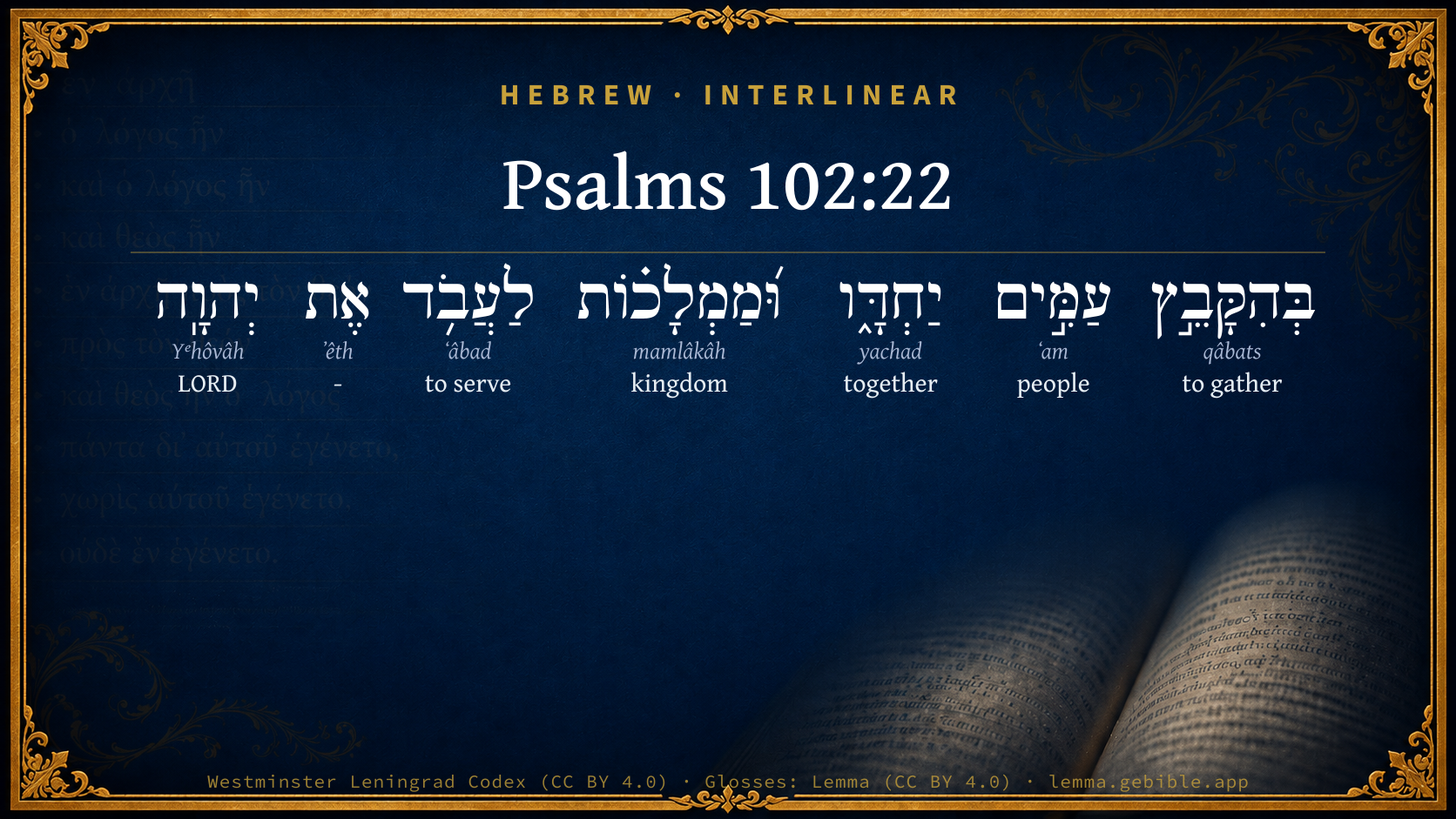
Psalms 102:22

Hebrew (Westminster Leningrad Codex) Psalms 102:22 appears in the Hebrew Old Testament. The text above is from the Westminster Leningrad Codex. Each word links to its Strong’s number, a concise gloss, and parsing drawn from the Open Scriptures Hebrew Bible morphology. Click any word for its full Brown-Driver-Briggs (BDB) entry.
Download image
Cite this verse

Psalms 102:22 (World English Bible). Public Domain. Lemma interlinear Bible study tool, https://lemma.gebible.app/v/psalms/102/22.

Show BibTeX & RIS
BibTeX
RIS
English Translation
When the peoples are gathered together, The kingdoms, to serve Yahweh.
World English Bible · Public Domain
Download a study sheet

One document with this verse’s original text, its word-by-word gloss line, the meaning frame, cross-references with their text, attributed commentary, and full source and license credits — printable, and it pastes into notes with its structure intact.

This verse Autodidact and up

Study sheet (.html) Plain text (.txt)

A passage Seminary Student

Up to 50 verses in one chapter. A passage sheet keeps up to 6 commentary sources and 12 cross-references per verse, in the order this page ranks them, and says so on the sheet whenever that leaves anything out. Ask for a single verse and you get the Autodidact verse sheet above.

Everything on this page stays free to read, with no account — the sheet is a download of what is already on screen, not access to it.

Want to remove ads? Support Godless Engineer
Compare translations 3

The same verse in 3 English versions, stacked beneath the original-language interlinear above. Click any original word for its lexicon entry.

Each is an independent rendering of the whole verse — the interlinear is not word-aligned to these translations.

Highlighted words mark where these versions differ — a whole-verse word diff, not a word-by-word alignment.

  • World English Bible Public Domain
    When the peoples are gathered together, The kingdoms, to serve Yahweh.
  • King James Version Public Domain
    When the people are gathered together, and the kingdoms, to serve the LORD.
  • unfoldingWord Literal Text CC BY-SA 4.0
    when peoples and kingdoms gather together to serve Yahweh.

unfoldingWord Literal Text — © unfoldingWord, licensed CC BY-SA 4.0. Word-aligned USFM3 via Door43 (git.door43.org/unfoldingWord/en_ult).

Versions to compare (up to 4)

3 of 4 selected

Show all 18 translations

Every available English version of this verse, each an independent rendering of the whole verse.

  • World English Bible Public Domain
    When the peoples are gathered together, The kingdoms, to serve Yahweh.
  • Berean Standard Bible Public Domain
    when peoples and kingdoms assemble to serve the LORD.
  • Majority Standard Bible Public Domain
    when peoples and kingdoms assemble to serve the LORD.
  • King James Version Public Domain
    When the people are gathered together, and the kingdoms, to serve the LORD.
  • American Standard Version (1901) Public Domain
    When the peoples are gathered together, And the kingdoms, to serve Jehovah.
  • Revised Version (1885) Public Domain
    When the peoples are gathered together, and the kingdoms, to serve the LORD.
  • Geneva Bible (1599) Public Domain
    When the people shalbe gathered together, and the kingdomes to serue the Lord.
  • Douay-Rheims (1899) Public Domain
    That they may declare the name of the Lord in Sion: and his praise in Jerusalem;
  • Young's Literal Translation Public Domain
    In the peoples being gathered together, And the kingdoms -- to serve Jehovah.
  • Literal Standard Version CC BY-SA 4.0
    In the peoples being gathered together, || And the kingdoms—to serve YHWH.
  • Unlocked Literal Bible CC BY-SA 4.0
    when the peoples and kingdoms gather together to serve Yahweh.
  • unfoldingWord Literal Text CC BY-SA 4.0
    when peoples and kingdoms gather together to serve Yahweh.
  • Darby Bible Public Domain
    When the peoples shall be gathered together, and the kingdoms, to serve Jehovah.
  • World Messianic Bible Public Domain
    when the peoples are gathered together, the kingdoms, to serve the LORD.
  • Webster's Bible Public Domain
    \\102:21\\To declare the name of the LORD in Zion, and his praise in Jerusalem;
  • Free Bible Version CC BY-SA 4.0
    when the people of many kingdoms gather together to worship the Lord.
  • Bible in Basic English Public Domain
    When the peoples are come together, and the kingdoms, to give worship to the Lord.
  • JPS Tanakh (1917) Public Domain
    (102-23) When the peoples are gathered together, and the kingdoms, to serve the LORD.

Literal Standard Version (2020), Covenant Press — licensed CC BY-SA 4.0. Text via the HelloAO Bible API (eBible.org). Unlocked Literal Bible (unfoldingWord) — licensed CC BY-SA 4.0. Text via the HelloAO Bible API (eBible.org). unfoldingWord Literal Text — © unfoldingWord, licensed CC BY-SA 4.0. Word-aligned USFM3 via Door43 (git.door43.org/unfoldingWord/en_ult). Free Bible Version, Dr. Jonathan Gallagher — licensed CC BY-SA 4.0. Text via the HelloAO Bible API (eBible.org).

Word by word

More ways to search: Search by grammar → Find every occurrence → Compare this word →

Practice this passage: Drill this verse → Learn its vocabulary →

About this verse

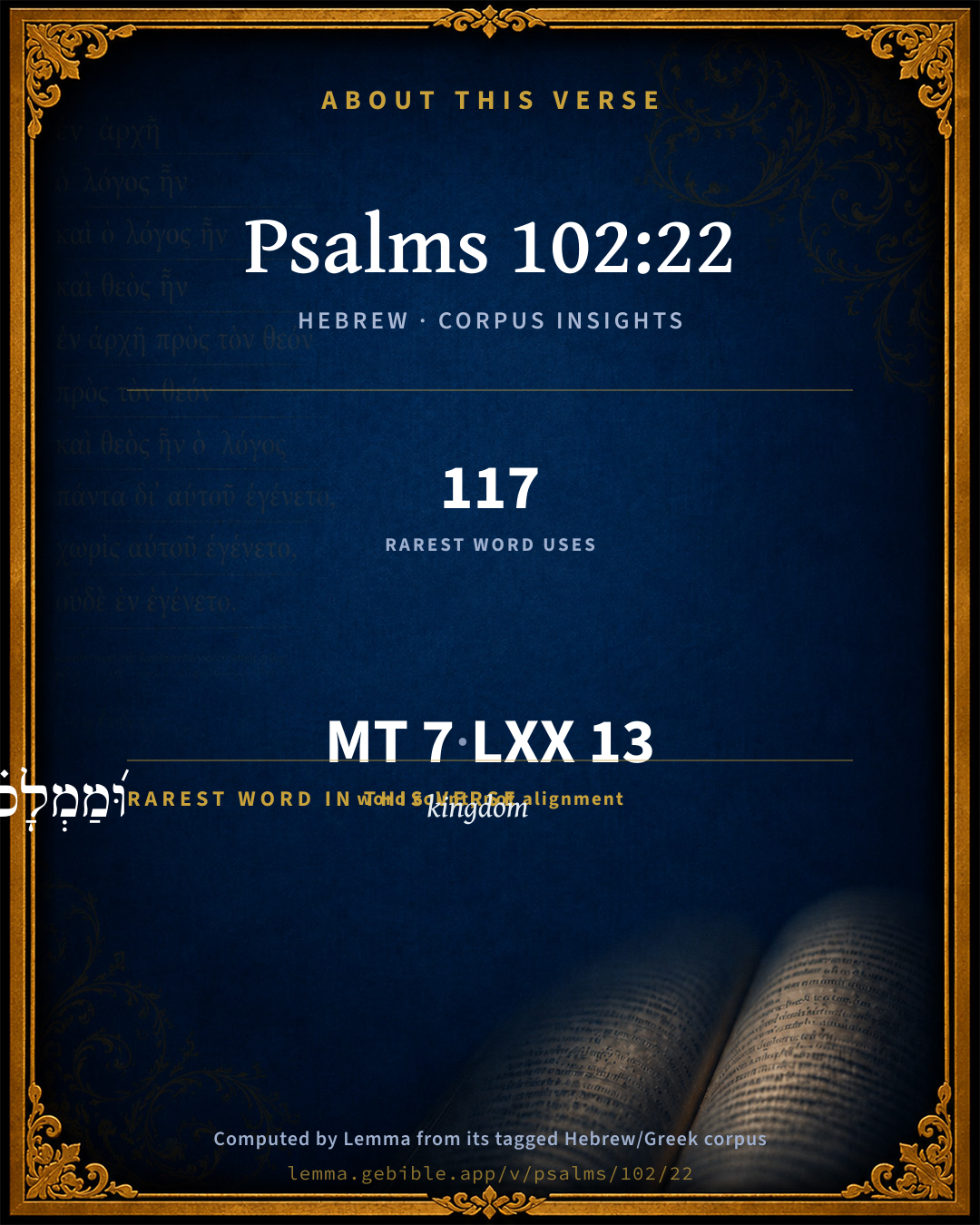
These counts appear in no published source. They are computed here, from the morphology-tagged text and Lemma’s own curated glosses. What Lemma adds →

7
words
7
distinct lemmas
Wisdom
section

Grammatical profile

  • 2 verbs
  • 3 nouns
  • 1 adverb
  • 1 particle

Verb forms

  • בְּהִקָּבֵ֣ץ Niphal · Infinitive Construct
  • לַעֲבֹ֥ד Qal · Infinitive Construct

Hebrew & Septuagint length

In English translation the verse runs 11 words from the Hebrew and 13 from the Septuagint (LXX English) — closely comparable.

A rough comparison of the two English renderings, which tokenize alike — not a word-level alignment.

Word counts can differ between the Hebrew and the Greek without any difference in meaning — e.g. the Hebrew direct-object marker אֵת has no separate Greek word, and Greek often adds the article ὁ.

In the original languages it is 7 Hebrew tokens and 13 Greek tokens — but the two are counted differently (Hebrew bundles its prefixes and suffixes into one token; the Greek is in lemma form), so that isn’t a like-for-like length.

Cross-references

9

Topical passages linked to Psalms 102:22 in the Treasury of Scripture Knowledge — connected by theme and wording, ordered by reader-vote popularity; previews shown in the World English Bible.

  • Zechariah 8:20–23 Thus says Yahweh of Hosts: "Many peoples, and the inhabitants of many cities will yet come;
  • Psalms 72:8–11 He shall have dominion also from sea to sea, From the River to the ends of the earth.
  • Isaiah 49:22–23 Thus says the Lord Yahweh, Behold, I will lift up my hand to the nations, and set up my ensign to the peoples; and they shall bring your sons in their bosom, and your daughters shall be carried on their shoulders.
  • Matthew 24:14 This Gospel of the Kingdom will be preached in the whole world for a testimony to all the nations, and then the end will come.
  • Genesis 49:10 The scepter will not depart from Judah, Nor the ruler's staff from between his feet, Until he comes to whom it belongs. To him will the obedience of the peoples be.
  • Psalms 22:27 All the ends of the earth shall remember and turn to Yahweh. All the relatives of the nations shall worship before you.
  • Isaiah 60:3–22 Nations shall come to your light, and kings to the brightness of your rising.
  • Hosea 1:9–11 He said, "Call his name Lo-Ammi; for you are not my people, and I will not be yours.
  • Romans 15:19 in the power of signs and wonders, in the power of God's Spirit; so that from Jerusalem, and around as far as to Illyricum, I have fully preached the Gospel of Christ;

Cross-references courtesy of OpenBible.info (CC BY 4.0).

Hebrew and Greek witnesses Masoretic Hebrew ↔ Greek Septuagint

The same verse in the two great witnesses to the Old Testament, shown verse-for-verse.

You’re reading Greek Psalm 101 (Hebrew Psalm 102). The Septuagint counts the superscription, so verse numbers can differ from the Hebrew — chapter-level alignment, not verse-by-verse. Numbering follows Rahlfs.

These are two independent witnesses, not word-aligned to each other, and the Septuagint is shown in lemma (dictionary) form.

Hebrew Psalms 102:22 Masoretic · Westminster Leningrad Codex

בְּהִקָּבֵ֣ץ עַמִּ֣ים יַחְדָּ֑ו וּ֝מַמְלָכ֗וֹת לַעֲבֹ֥ד אֶת יְהוָֽה

When the peoples are gathered together, The kingdoms, to serve Yahweh.

World English Bible · Public Domain

Greek LXX Greek Psalm 101:22 Septuagint · lemma form

ὁ ἀναἀγγέλλω ἐν σιων ὁ ὄνομα κύριος καί ὁ αἴνεσις αὐτός ἐν ἰερουσαλήμ

when the people are gathered together, and the kings, to serve the Lord.

LXX2012 (modern English Septuagint) · Public Domain

On this verse, Albert Barnes' Notes on the Bible discusses the Septuagint’s reading. Read the note in Commentary ↓

Hebrew: Westminster Leningrad Codex (CC BY 4.0). Greek: Septuagint (public domain); English from LXX2012 (modern English Septuagint) (Public Domain). How the Septuagint differs from the Hebrew →

Commentary

Notes on Psalms 102:22 from classic Christian and Jewish commentators (each source and its license shown beneath its notes). The classic Christian expositions comment on the surrounding passage and are grouped to its opening verse, so a note may address several verses; the Jewish commentaries on the Tanakh (Rashi and others) are per-verse, so they appear only where the commentator wrote on this verse.

Lemma curates 59 commentaries, every one of them public domain or Creative Commons licensed, each selected and text-cleaned for this edition rather than reprinted as found. About our sources →

Trapp's Complete Commentary

John Trapp

Psa 102:22 When the people are gathered together, and the kingdoms, to serve the LORD.

Ver. 22. When the people are gathered together] sc. To the Lord Christ; for to "Shiloh shall be the gathering of the people," Gen 49:10.

And the kingdoms to serve the Lord] As they did under Constantine the Great, Valentinian, Theodosius, which three emperors called themselves vasallos Christi (as Socrates reporteth), the vassals of Christ: and the like may be said of other Christian kings and princes since, who have yielded professed subjection to the gospel, and cast their crowns at Christ’s feet.

John Trapp, A Commentary or Exposition upon All the Books of the Old and New Testament (1647–1656) — public domain. Text from a community e-Sword module.

J. A. Alexander on Psalms

Joseph Addison Alexander

23. (Psa 102:22) In the gathering of peoples together, and kingdoms to serve Jehovah. This verse is necessary to complete and qualify the sense of that before it. God has looked down from heaven to deliver his people and receive their praise, not in their secluded, insulated state, but in their glorious reunion with the converted nations. The first verb is a passive infinitive in Hebrew, in their being gathered. The preposition in relates both to the time and to the act of convocation. To serve Jehovah, not only as a King, but as a God, to be both his subject and his worshipper. Compare Psa 2:11.

Joseph Addison Alexander, The Psalms Translated and Explained (1850) — public domain. Text from a community e-Sword module.

Tyndale Open Study Notes

Tyndale Open Resources

102:22 The multitudes—both Jews and Gentiles—will join in the worship of the Lord (see 96:7, 9; 106:48; Isa 2:2-4; 43:10-13; 57:15; 60:3-7).

Tyndale Open Study Notes — © Tyndale Open Resources, licensed CC BY-SA 4.0. Text via the HelloAO Bible API.

Geneva Bible (1599)

Geneva Bible translators

He showeth that God’s Name is never more praised, than when religion flourisheth and the church increaseth: which thing is chiefly accomplished under the kingdom of Christ.

Geneva Bible (1599) marginal notes — public domain. Text via Bolls.life.

Adam Clarke's Commentary

Verse 22. When the people are gathered together] When all the Gentiles are enlightened, and the kings of the earth brought to pay homage to the King of kings.

Adam Clarke's Commentary on the Bible (1810–1826) — public domain. Text from a community e-Sword/MySword module.

The Cambridge Bible for Schools and Colleges

gen. ed. J. J. S. Perowne

22. the people] R.V. the peoples. Israel does not return alone: its restoration will be the signal for that gathering of the nations to worship Jehovah in Zion, which ancient prophecy had foretold (Isa_2:2 ff. = Mic_4:1 ff.), and which recent prophecy had uncompromisingly reaffirmed in the teeth of appearances (Isa_60:3 ff.). Cp. Psa_22:27.

But did not the event, it may be asked, fall far short of the anticipations of prophet and Psalmist? They looked for a triumphant return of Israel and a visible manifestation of Jehovah’s glory, to be followed immediately by the submission of the nations. As a matter of fact the return was an insignificant event, and no startling results immediately followed it. The answer is twofold. The spiritual significance of the Return for the history of the world could not be exaggerated; and prophecy constantly combines in one view the nearer and the remoter future, depicting the eventual result, without indicating the steps by which it is to be reached.

The Cambridge Bible for Schools and Colleges (gen. ed. J. J. S. Perowne; Cambridge University Press, 1878–1918) — public domain. Text from a community e-Sword module.

John Gill's Exposition

He weakened my strength in the way,.... The psalmist here returns to his complaint of his afflictions, weakness, and frailty, which ended Psa 102:11, after which some hints are given of the latter day glory, which though he despaired of seeing, by reason of his frailty and mortality, yet comforts himself with the eternity and immutability of Christ, and that there would be a succession of the church, a seed of true believers, who would see and enjoy it: as for himself, he says that God (for he is that "He", and not the enemy, as some) had "weakened" his "strength in the way", by afflictions, as the word (e) signifies; which weakens the strength and vigour of the mind, and discourages and dispirits it, and enfeebles the body: many are the afflictions which the people of God meet with in the course of their life, in their way to heaven, which have such an effect upon them; through many tribulations they pass to enter the kingdom, as the Israelites in their way to Canaan, and Christ to glory: some think the psalmist represents the Jews in their return from the Babylonish captivity, meeting with difficulties and discouragements in the way; rather the church of God, in the expectation of the Messiah, who, because his coming was delayed, grew feeble in their faith and hope, had weak hands and feeble knees, which needed strengthening by fresh promises: though it may be, best of all, the people of God, waiting for latter day glory, enfeebled by the persecutions of antichrist, or grown weak in the exercises of their grace, faith, hope, and love; which will be their case before these glorious times, and now is, see Rev 3:2,

he shortened my days; which he thought he should live, and expected he would; and which, according to the course of nature, and the common term of man's life, he might, in all human appearance, have lived; otherwise, with respect to the decree of God, which has fixed the bounds of man's days, they cannot be shorter or longer than they are, Job 14:5.

(e) "afflixit", Pagninus, Montanus, Tigurine version, Musculus, Piscator, Gejerus, Schmidt; so Ainsworth.

John Gill's Exposition of the Whole Bible (1746–1763) — public domain (CC PDM 1.0). Text via the HelloAO Bible API.

Albert Barnes' Notes on the Bible

When the people are gathered together - When they shall be brought from their dispersion in distant lands; when they shall assemble again in the city of their fathers, and when public worship shall be celebrated there as in former ages.

And the kingdoms, to serve the Lord - The Septuagint and the Latin Vulgate render this, “kings.” The reference must be to the time when those of other lands - kings and their people - would be converted to the true religion; when the Gentiles as well as the Jews, then one undistinguished people, would be brought to the knowledge of the true God, and would unite in his worship. See the notes at Isa. 60. All of all lands, will yet praise the Lord “as if” they were one great congregation, assembled in one place. Thus, though separate, they will with united feeling recount the mercy and goodness of God to his people in past times.

Albert Barnes' Notes on the Bible (1834–1885) — public domain. Text from a community e-Sword/MySword module.

Matthew Poole's English Annotations

When the Gentiles shall gather themselves to the Jews, and join with them in the praise and worship of the true God, and of the Messias. This verse seems to be added to intimate, that although the psalmist in this Psalm respects the deliverance of the Jews out of Babylon, yet he had a further design and a principal respect unto that greater and more general deliverance of his church and people by the Messias.

Matthew Poole's English Annotations on the Holy Bible (1683–1685) — public domain. Text from a community e-Sword/MySword module.

The Treasury of David

Charles H. Spurgeon

Ver. 22. When the people are gathered together, and the kingdoms, to serve the Lord. The great work of restoring ruined Zion is to be spoken of in those golden ages when the heathen nations shall be converted unto God; even those glorious times will not be able to despise that grand event, which, like the passage of Israel through the Red Sea, will never be eclipsed and never cease to awaken the enthusiasm of the cliosen people. Happy will the day be when all nations shall unite in the sole worship of Jehovah, then shall the histories of the olden times be read with adoring wonder, and the hand of the Lord shall be seen as having ever rested upon the sacramental host of his elect: then shall shouts of exulting praise ascend to heaven in honour of him who loosed the captives, delivered the condemned, raised up the desolations of ages, and made out of stones and rubbish a temple for his worship.

Psalms 102:23*

Charles H. Spurgeon's The Treasury of David (1869–1885) — public domain. Psalms only. Text from a community e-Sword/MySword module.

Whedon's Commentary on the Bible

Daniel D. Whedon

22. When the people are gathered—An anticipation, not unfrequent, of the submission of the nations to Jehovah, as in Psa_22:27; Psa_72:11, and in the later prophecies of Isaiah; but realized fully only in gospel times.

Daniel D. Whedon (gen. ed.), Commentary on the Old and New Testaments (1874–1909) — public domain. Text from a community e-Sword module.

The Pulpit Commentary

When the people (rather, the peoples) are gathered together, and the kingdoms, to serve the Lord. (comp. Psa_22:27 Psa_68:29-32 Isa_49:6, Isa_49:7, Isa_49:18, etc)

The Pulpit Commentary (1880–1919), ed. H.D.M. Spence-Jones & Joseph S. Exell — public domain. Text from a community e-Sword module.

John Wesley's Explanatory Notes

When - When the Gentiles shall gather themselves to the Jews, and join with them in the worship of the true God.

John Wesley, Explanatory Notes Upon the Whole Bible (1754–1765) — public domain. Text via the GEBible commentary corpus.

Lesson kit

Teaching starters — assembled from the data on this page, not authored interpretation. Every prompt links to the verse data it draws on. Edit before teaching.

Psalms, in the Wisdom, opens this verse with 7 words (7 distinct Hebrew lemmas). Its most distinctive word is mamlâkâh (“kingdom”). A historical commentator’s framing appears above. Read the whole chapter for the surrounding context.

Discussion questions

  1. The word mamlâkâh carries the sense “kingdom.” How does it shape the verse?
  2. How does Zechariah 8:20–23, which shares this passage’s theme, read alongside this verse?
  3. These translations render this verse differently. What is at stake in choosing one wording over another?
  4. «בְּהִקָּבֵ֣ץ» is a Niphal Infinitive Construct verb. How does that grammatical form shape the action described?
  5. Compare how Trapp's Complete Commentary and J. A. Alexander on Psalms read this verse. Where do they agree or differ?

Things to notice

Reading settings

Reading text

Shown beneath each verse's original-language words.

Old Testament
Old Testament edition

Read the OT as the Masoretic Hebrew (MT) or the Greek Septuagint (LXX).

English shown for the Greek Septuagint (in the Hebrew ↔ Greek comparison).

Comparing translations? Open the Compare panel on any verse page to stack up to four side by side.