Psalms 95:10

Hebrew (Westminster Leningrad Codex) Psalms 95:10 appears in the Hebrew Old Testament. The text above is from the Westminster Leningrad Codex. Each word links to its Strong’s number, a concise gloss, and parsing drawn from the Open Scriptures Hebrew Bible morphology. Click any word for its full Brown-Driver-Briggs (BDB) entry.
Download image
Cite this verse

Psalms 95:10 (World English Bible). Public Domain. Lemma interlinear Bible study tool, https://lemma.gebible.app/v/psalms/95/10.

Show BibTeX & RIS
BibTeX
RIS
English Translation
Forty long years I was grieved with that generation, And said, "It is a people that errs in their heart. They have not known my ways."
World English Bible · Public Domain
Highlights
  • 1 first appearance in the Hebrew Bible
Full analysis ↓
Download a study sheet

One document with this verse’s original text, its word-by-word gloss line, the meaning frame, cross-references with their text, attributed commentary, and full source and license credits — printable, and it pastes into notes with its structure intact.

This verse Autodidact and up

Study sheet (.html) Plain text (.txt)

A passage Seminary Student

Up to 50 verses in one chapter. A passage sheet keeps up to 6 commentary sources and 12 cross-references per verse, in the order this page ranks them, and says so on the sheet whenever that leaves anything out. Ask for a single verse and you get the Autodidact verse sheet above.

Everything on this page stays free to read, with no account — the sheet is a download of what is already on screen, not access to it.

Want to remove ads? Support Godless Engineer
Compare translations 3

The same verse in 3 English versions, stacked beneath the original-language interlinear above. Click any original word for its lexicon entry.

Each is an independent rendering of the whole verse — the interlinear is not word-aligned to these translations.

Highlighted words mark where these versions differ — a whole-verse word diff, not a word-by-word alignment.

  • World English Bible Public Domain
    Forty long years I was grieved with that generation, And said, "It is a people that errs in their heart. They have not known my ways."
  • King James Version Public Domain
    Forty years long was I grieved with this generation, and said, It is a people that do err in their heart, and they have not known my ways:
  • unfoldingWord Literal Text CC BY-SA 4.0
    For 40 years I was angry with the generation and said, ‘They are a people wandering of heart and they, they have not known my ways.’

unfoldingWord Literal Text — © unfoldingWord, licensed CC BY-SA 4.0. Word-aligned USFM3 via Door43 (git.door43.org/unfoldingWord/en_ult).

Versions to compare (up to 4)

3 of 4 selected

Show all 18 translations

Every available English version of this verse, each an independent rendering of the whole verse.

  • World English Bible Public Domain
    Forty long years I was grieved with that generation, And said, "It is a people that errs in their heart. They have not known my ways."
  • Berean Standard Bible Public Domain
    For forty years I was angry with that generation, and I said, “They are a people whose hearts go astray, and they have not known My ways.”
  • Majority Standard Bible Public Domain
    For forty years I was angry with that generation, and I said, “They are a people whose hearts go astray, and they have not known My ways.”
  • King James Version Public Domain
    Forty years long was I grieved with this generation, and said, It is a people that do err in their heart, and they have not known my ways:
  • American Standard Version (1901) Public Domain
    Forty years long was I grieved with `that' generation, And said, It is a people that do err in their heart, And they have not known my ways:
  • Revised Version (1885) Public Domain
    Forty years long was I grieved with that generation, and said, It is a people that do err in their heart, and they have not known my ways:
  • Geneva Bible (1599) Public Domain
    Fourtie yeeres haue I contended with this generation, and said, They are a people that erre in heart, for they haue not knowen my wayes.
  • Douay-Rheims (1899) Public Domain
    Forty years long was I offended with that generation, and I said: These always err in heart.
  • Young's Literal Translation Public Domain
    Forty years I am weary of the generation, And I say, `A people erring in heart -- they! And they have not known My ways:'
  • Literal Standard Version CC BY-SA 4.0
    Forty years I am weary of the generation, || And I say, “A people erring in heart—they! And they have not known My ways”:
  • Unlocked Literal Bible CC BY-SA 4.0
    For forty years I was angry with that generation and said, 'This is a people whose hearts wander astray; they have not known my ways.'
  • unfoldingWord Literal Text CC BY-SA 4.0
    For 40 years I was angry with the generation and said, ‘They are a people wandering of heart and they, they have not known my ways.’
  • Darby Bible Public Domain
    Forty years was I grieved with the generation, and said, It is a people that do err in their heart, and they have not known my ways;
  • World Messianic Bible Public Domain
    Forty long years I was grieved with that generation, and said, “They are a people who err in their heart. They have not known my ways.”
  • Webster's Bible Public Domain
    Forty years long was I grieved with this generation, and said, It is a people that do err in their heart, and they have not known my ways:
  • Free Bible Version CC BY-SA 4.0
    For forty years I was disgusted with that generation, and I said, ‘They are people who are unfaithful to me in their minds, and they refuse to accept my ways.’
  • Bible in Basic English Public Domain
    For forty years I was angry with this generation, and said, They are a people whose hearts are turned away from me, for they have no knowledge of my ways;
  • JPS Tanakh (1917) Public Domain
    For forty years was I wearied with that generation, and said: It is a people that do err in their heart, and they have not known My ways;

Literal Standard Version (2020), Covenant Press — licensed CC BY-SA 4.0. Text via the HelloAO Bible API (eBible.org). Unlocked Literal Bible (unfoldingWord) — licensed CC BY-SA 4.0. Text via the HelloAO Bible API (eBible.org). unfoldingWord Literal Text — © unfoldingWord, licensed CC BY-SA 4.0. Word-aligned USFM3 via Door43 (git.door43.org/unfoldingWord/en_ult). Free Bible Version, Dr. Jonathan Gallagher — licensed CC BY-SA 4.0. Text via the HelloAO Bible API (eBible.org).

Word by word

More ways to search: Search by grammar → Find every occurrence → Compare this word →

Practice this passage: Drill this verse → Learn its vocabulary →

אָ֘ק֤וּט
qûwṭ
H6962
“to loathe”
Verb, Qal, Imperfect, 1st Person, Common, Singular
Part of Speech
Verb
Stem
Qal
Form
Imperfect
Person
1st Person
Gender
Common
Number
Singular
Full BDB Definition

Origin: a primitive root

TWOT: 1996

to loathe, be grieved, feel a loathing - (Qal) to feel a loathing - (Niphal) - to feel loathing against self - to detest - (Hithpolel) to loathe oneself
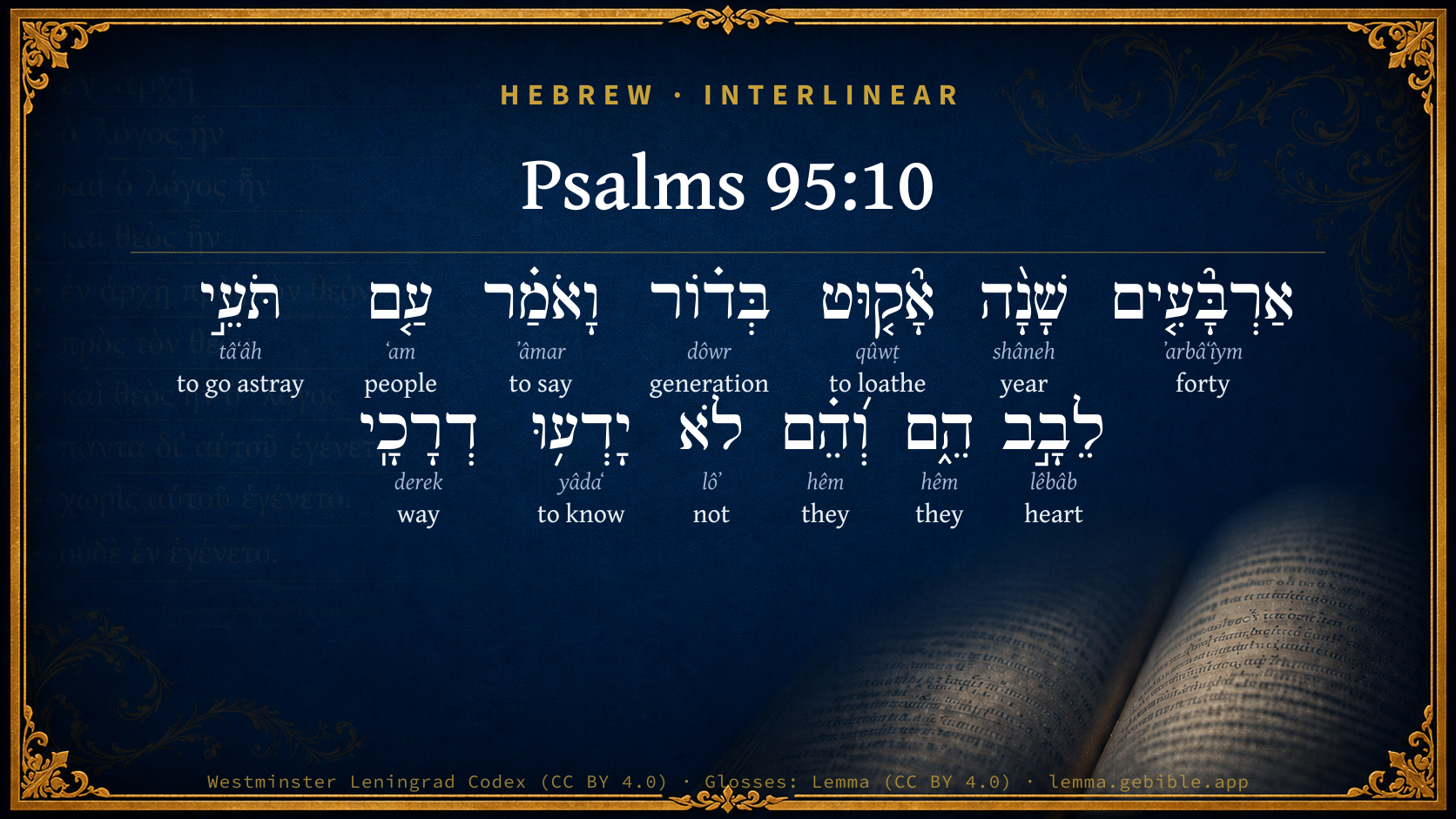
  1. אַרְבָּ֘עִ֤ים ʼarbâʻîym H705 “forty” Adjective, Cardinal number, Both, Plural, Absolute
  2. שָׁנָ֨ה shâneh H8141 “year” Noun, Common, Feminine, Singular, Absolute
  3. בְּד֗וֹר dôwr H1755 “in/at · generation” Preposition + Noun, Common, Masculine, Singular, Absolute
  4. וָאֹמַ֗ר ʼâmar H559 “and · to say” Conjunction + Verb, Qal, Sequential Imperfect, 1st Person, Common, Singular
  5. עַ֤ם ʻam H5971 “people” Noun, Common, Masculine, Singular, Absolute
  6. תֹּעֵ֣י tâʻâh H8582 “going astray” Verb, Qal, Participle Active, Masculine, Plural, Construct
  7. לֵבָ֣ב lêbâb H3824 “heart” Noun, Common, Masculine, Singular, Absolute
  8. הֵ֑ם hêm H1992 “they” Pronoun, Personal, 3rd Person, Masculine, Plural
  9. וְ֝הֵ֗ם hêm H1992 “and · they” Conjunction + Pronoun, Personal, 3rd Person, Masculine, Plural
  10. לֹא lôʼ H3808 “not” Particle, Negative
  11. יָדְע֥וּ yâdaʻ H3045 “to know” Verb, Qal, Perfect, 3rd Person, Common, Plural
  12. דְרָכָֽי derek H1870 “ways · my” Noun, Common, Both, Plural, Construct + Suffix, Personal, 1st Person, Common, Singular

About this verse

These counts appear in no published source. They are computed here, from the morphology-tagged text and Lemma’s own curated glosses. What Lemma adds →

13
words
12
distinct lemmas
Wisdom
section

Notable vocabulary

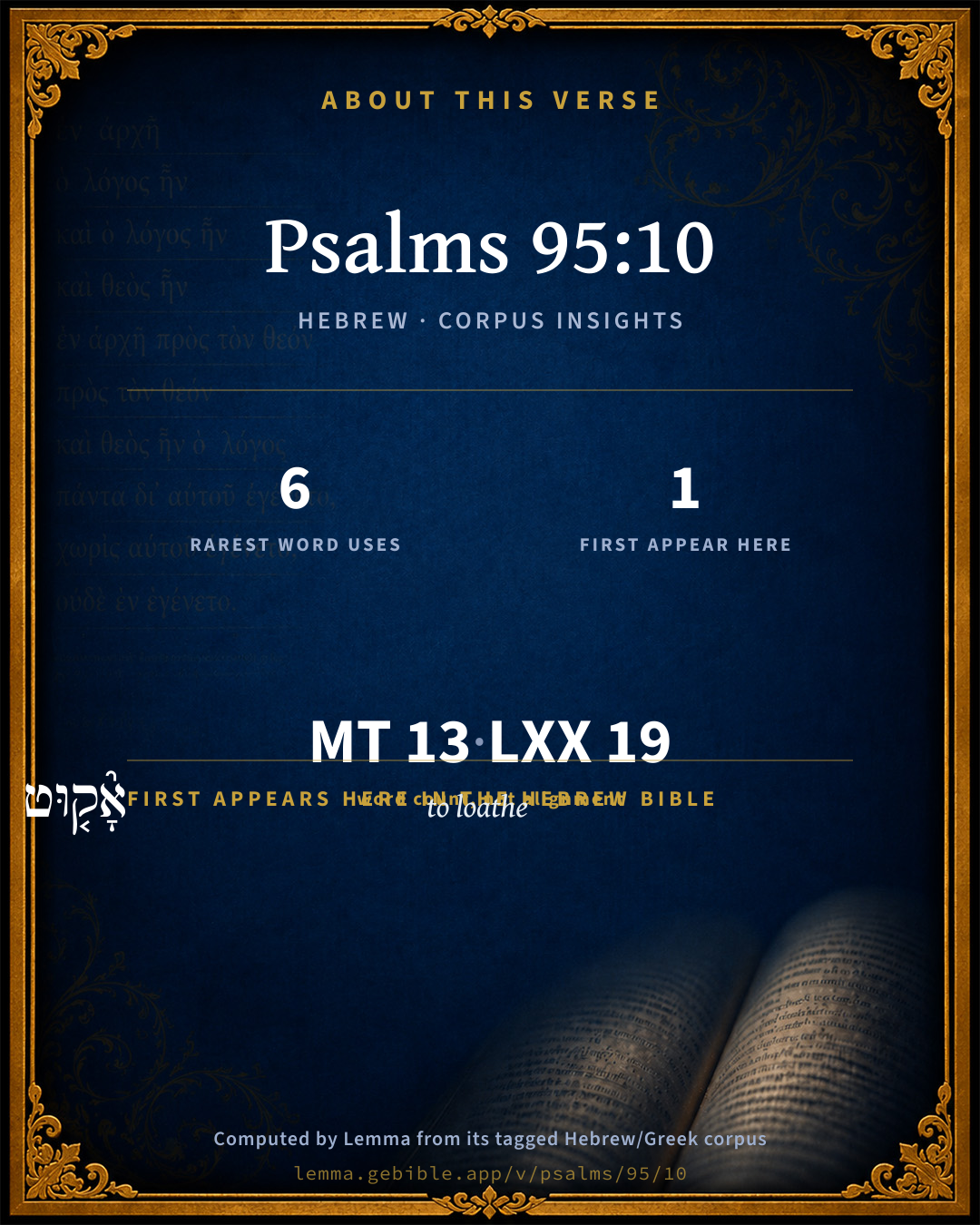
The rarest word here is אָ֘ק֤וּט to loathe H6962 — appearing just 6 times in the whole Hebrew Bible.

First appearance in Scripture

This word makes its first canonical appearance in the Hebrew Bible here:

  • אָ֘ק֤וּט to loathe H6962

Shared distinctive vocabulary

אָ֘ק֤וּט to loathe H6962 occurs in 6 verses of the Hebrew Bible. Also found in:

Grammatical profile

  • 4 verbs
  • 5 nouns
  • 1 adjective
  • 2 pronouns
  • 1 particle

Verb forms

  • אָ֘ק֤וּט Qal · Imperfect
  • וָאֹמַ֗ר Qal · Sequential Imperfect
  • תֹּעֵ֣י Qal · Participle Active
  • יָדְע֥וּ Qal · Perfect

Repetition

A word recurs within this verse — often emphatic in Hebrew:

  • הֵ֑ם they H1992 ×2

Hebrew & Septuagint length

In English translation the verse runs 26 words from the Hebrew and 24 from the Septuagint (LXX English) — closely comparable.

A rough comparison of the two English renderings, which tokenize alike — not a word-level alignment.

Word counts can differ between the Hebrew and the Greek without any difference in meaning — e.g. the Hebrew direct-object marker אֵת has no separate Greek word, and Greek often adds the article ὁ.

In the original languages it is 13 Hebrew tokens and 19 Greek tokens — but the two are counted differently (Hebrew bundles its prefixes and suffixes into one token; the Greek is in lemma form), so that isn’t a like-for-like length.

Cross-references

16

Topical passages linked to Psalms 95:10 in the Treasury of Scripture Knowledge — connected by theme and wording, ordered by reader-vote popularity; previews shown in the World English Bible.

  • Hebrews 3:17 With whom was he displeased forty years? Wasn't it with those who sinned, whose bodies fell in the wilderness?
  • Proverbs 1:22–29 "How long, you simple ones, will you love simplicity? How long will mockers delight themselves in mockery, And fools hate knowledge?
  • Hebrews 3:9–10 Where your fathers tested me by proving me, And saw my works for forty years.
  • Isaiah 63:17 O Yahweh, why do you make us to err from your ways, and harden our heart from your fear? Return for your servants' sake, the tribes of your inheritance.
  • Acts 13:18 For a period of about forty years he put up with them in the wilderness.
  • Numbers 32:13 Yahweh's anger was kindled against Israel, and he made them wander back and forth in the wilderness forty years, until all the generation, who had done evil in the sight of Yahweh, was consumed.
  • Deuteronomy 2:14–16 The days in which we came from Kadesh-barnea, until we were come over the brook Zered, were thirty-eight years; until all the generation of the men of war were consumed from the midst of the camp, as Yahweh swore to them.
  • Proverbs 1:7 The fear of Yahweh is the beginning of knowledge; But the foolish despise wisdom and instruction.
  • Jeremiah 9:6 Your habitation is in the midst of deceit; through deceit they refuse to know me, says Yahweh.
  • Acts 7:36 This man led them out, having worked wonders and signs in Egypt, in the Red Sea, and in the wilderness for forty years.
  • Genesis 6:6 Yahweh was sorry that he had made man on the earth, and it grieved him in his heart.
  • Numbers 14:33–34 Your children shall be wanderers in the wilderness forty years, and shall bear your prostitution, until your dead bodies be consumed in the wilderness.
  • Deuteronomy 1:3 It happened in the fortieth year, in the eleventh month, on the first day of the month, that Moses spoke to the children of Israel, according to all that Yahweh had given him in commandment to them;
  • Romans 1:28 Even as they refused to have God in their knowledge, God gave them up to a reprobate mind, to do those things which are not fitting;
  • Ephesians 4:30 Don't grieve the Holy Spirit of God, in whom you were sealed for the day of redemption.
  • John 3:19–21 This is the judgment, that the light has come into the world, and men loved the darkness rather than the light; for their works were evil.

Cross-references courtesy of OpenBible.info (CC BY 4.0).

Hebrew and Greek witnesses Masoretic Hebrew ↔ Greek Septuagint

The same verse in the two great witnesses to the Old Testament, shown verse-for-verse.

You’re reading Greek Psalm 94 (Hebrew Psalm 95). The Septuagint counts the superscription, so verse numbers can differ from the Hebrew — chapter-level alignment, not verse-by-verse. Numbering follows Rahlfs.

These are two independent witnesses, not word-aligned to each other, and the Septuagint is shown in lemma (dictionary) form.

Hebrew Psalms 95:10 Masoretic · Westminster Leningrad Codex

אַרְבָּ֘עִ֤ים שָׁנָ֨ה אָ֘ק֤וּט בְּד֗וֹר וָאֹמַ֗ר עַ֤ם תֹּעֵ֣י לֵבָ֣ב הֵ֑ם וְ֝הֵ֗ם לֹא יָדְע֥וּ דְרָכָֽי

Forty long years I was grieved with that generation, And said, "It is a people that errs in their heart. They have not known my ways."

World English Bible · Public Domain

Greek LXX Greek Psalm 94:10 Septuagint · lemma form

τεσσαράκοντα ἔτος προςὀχθίζω ὁ γενεά ἐκεῖνος καί εἶπον ἀεί πλανάω ὁ καρδία καί αὐτός οὐ γιγνώσκω ὁ ὁδός ἐγώ

Forty years was I grieved with this generation, and said, They do always err in their heart, and they have not known my ways.

LXX2012 (modern English Septuagint) · Public Domain

On this verse, John Calvin's Commentaries discusses the Septuagint’s reading. Read the note in Commentary ↓

Hebrew: Westminster Leningrad Codex (CC BY 4.0). Greek: Septuagint (public domain); English from LXX2012 (modern English Septuagint) (Public Domain). How the Septuagint differs from the Hebrew →

Commentary

Notes on Psalms 95:10 from classic Christian and Jewish commentators (each source and its license shown beneath its notes). The classic Christian expositions comment on the surrounding passage and are grouped to its opening verse, so a note may address several verses; the Jewish commentaries on the Tanakh (Rashi and others) are per-verse, so they appear only where the commentator wrote on this verse.

Lemma curates 59 commentaries, every one of them public domain or Creative Commons licensed, each selected and text-cleaned for this edition rather than reprinted as found. About our sources →

Trapp's Complete Commentary

John Trapp

Psa 95:10 Forty years long was I grieved with [this] generation, and said, It [is] a people that do err in their heart, and they have not known my ways:

Ver. 10. Was I grieved] Litigavi, vel cum taedio pertuli.

That do err in their hearts] Wandering, though not so wide as to miss of hell.

They have not known] viz. Practically and savingly.

John Trapp, A Commentary or Exposition upon All the Books of the Old and New Testament (1647–1656) — public domain. Text from a community e-Sword module.

The Biblical Illustrator

Joseph S. Exell

Psa_95:10-11

Forty years long was I grieved with this generation.

Israels provocation against God, and the punishment inflicted on them

I. The conduct of israel. Their conduct was marked by ignorance and error. They have not known My ways, and they do err in their hearts.

1. Ignorance is not always criminal. Some things we cannot know, through the limited nature of out faculties; other things God does not choose for us to know (Deu_29:29); and others it is not our interest to know. God will never impute blame for unavoidable ignorance.

2. When the most important subjects are presented to us, and the most favourable means offered for knowing them, then ignorance is highly criminal. This was Israels case. Does not our conduct too nearly resemble theirs?

3. Error was another of their crimes. Ignorance produces error (Mat_22:29). Errors are of two sorts,--of judgment, and of heart. Errors of judgment may consist with rectitude of heart; the heart may be right with God, where erroneous opinions warp the judgment. But errors of heart are the most deadly and destructive that exist upon earth; when the affections are perverted and the heart wanders from God. This was Israels error (Isa_5:20; Isa_29:13). And this error in heart gave birth to error in the life (Isa_28:7).

II. The effect produced by this conduct. Forty years long was I grieved with this generation, etc.

1. God takes cognizance of human conduct. He sees all our actions, whether in the broad daylight, or amidst impenetrable darkness, for the darkness and the light are both alike to Him: and He sees them as they are.

2. The ignorant and erroneous conduct of men is highly offensive to God. His is the grief of a Father whose bowels yearn over the miseries of a child (Jer_31:20; Hos_11:8).

3. God exercises long patience with His creatures (Act_13:18).

III. The punishment which this conduct merited. Unto whom I sware in My wrath, etc.

1. Whatever forbearance God may exercise towards His creatures, yet a continuance of crime must ultimately produce the infliction of punishment.

2. Israels punishment was a deprivation of rest; They should not enter into My rest. This threatening primarily referred to the exclusion of Israel from the land of Canaan (Num_14:22-23). This was a land of rest, compared with the toils and perils of the wilderness (Exo_33:14). But Canaan was typically representative of heaven (Heb_4:11). They shall not enter into it--they have no preparation for it, and no promise of possession.

3. The awfully affecting language in which the threatening is expressed leads us to reflect on the terrible doom of its subject; I sware in My wrath. Illustrated by Num_14:28-29; Num_14:35.

IV. Inferences.

1. Learn what ideas we ought to entertain of sin.

2. That ignorance and error which some deem perfectly innocent expose men to the wrath of God.

3. That sin in the professing people of God is attended with peculiar aggravations.

4. That the doom of impenitent sinners is certain and irreparable. (Sketches of Four Hundred Sermons.)

The Biblical Illustrator, edited by Joseph S. Exell (c. 1880s–1900s) — public domain. Text from a community e-Sword module.

Joseph Benson's Commentary

Psa 95:10. Forty years long, &c. — Nor did they cease their discontented murmurings and distrust of me; but persisted in their stubborn infidelity and disobedience for the space of forty years; was I grieved with this generation — Or rather, with that generation, which then lived, who were your ancestors; and said, It is a people that do err in their heart — They not only sin through infirmity, and the violence and surprise of temptation, but their hearts are insincere and inconstant, and given to backsliding, and therefore there is no hope of their amendment. And they have not known — Or, they do not know, namely, with a practical and useful knowledge; they do not rightly understand, nor duly consider, nor seriously lay to heart, my ways — That is, either, 1st, My laws, or statutes, which are frequently called God’s ways; or, rather, 2d, My works, as it is explained Psa 95:9, which also are often so called. They do not know nor consider those great things which I wrought for them and among them.

Joseph Benson's Commentary on the Old and New Testaments (1811–1818) — public domain. Text from a community e-Sword module.

J. A. Alexander on Psalms

Joseph Addison Alexander

10. (Psa 95:10) Forty years I am vexed with a (wicked) generation, and say, A people of wanderers in heart (are) they, and they do not know my ways. The first verb strictly means to be sick of, or disgusted with, a thing or person. The future form expresses more distinctly the idea of protracted trial and annoyance. A generation, or contemporary race, as distinguished from mere individuals. This expression is the more appropriate because the threatening was fulfilled, with scarcely an exception, in the whole genera tion that came out of Egypt. The qualifying epithet supplied in the translation is derived from Deu 1:35 (compare Deu 2:14). I say or said, i.e. I had occasion or good cause to say, I could have said with truth, or I was compelled to say. The next clause contains an allusion to their two-fold wandering or error. They were not only wanderers in body but in heart, i. e. they erred from the path of duty, truth, and safety. This allusion seems to be continued in the last clause. They were not more bewildered in the mazes of the trackless waste, than ignorant of God's ways, i.e. of the meaning and design of his providential dealings with them. Compare Deu 29:3.

Joseph Addison Alexander, The Psalms Translated and Explained (1850) — public domain. Text from a community e-Sword module.

Geneva Bible (1599)

Geneva Bible translators

They were without judgment and reason.

Geneva Bible (1599) marginal notes — public domain. Text via Bolls.life.

Adam Clarke's Commentary

Verse 10. Forty years long] They did nothing but murmur, disbelieve, and rebel, from the time they began their journey at the Red Sea till they passed over Jordan, a period of forty years. During all this time God was grieved by that generation; yet he seldom showed forth that judgment which they most righteously had deserved.

It is a people that do err in their heart] Or, according to the Chaldee, These are a people whose idols are in their hearts. At any rate they had not GOD there.

They have not known my ways] The verb ידע yada, to know, is used here, as in many other parts of Scripture, to express approbation. They knew God's ways well enough; but they did not like them; and would not walk in them. "These wretched men," says the old Psalter, "were gifnen to the lufe of this lyfe: knewe noght my ways of mekenes, and charite: for thi in my wreth I sware to thaim; that es, I sett stabely that if that sall entre in till my rest;" that is, they shall not enter into my rest.

This ungrateful people did not approve of God's ways - they did not enter into his designs - they did not conform to his commands - they paid no attention to his miracles - and did not acknowledge the benefits which they received from his hands; therefore God determined that they should not enter into the rest which he had promised to them on condition that, if they were obedient, they should inherit the promised land. So none of those who came out of Egypt, except Joshua and Caleb, entered into Canaan; all the rest died in the wilderness, wherein, because of their disobedience, God caused them to wander forty years.

It is well known that the land of Canaan was a type of heaven, where, after all his toils, the good and faithful servant is to enter into the joy of his Lord. And as those Israelites in the wilderness were not permitted to enter into the land of Canaan because of their unbelief, their distrust of God's providence, and consequent disobedience, St. Paul hence takes occasion to exhort the Jews, Heb 4:2-11, to accept readily the terms offered to them by the Gospel. He shows that the words of the present Psalm are applicable to the state of Christianity; and intimates to them that, if they persisted in obstinate refusal of those gracious offers, they likewise would fall according to the same example of unbelief. - Dodd.

ANALYSIS OF THE NINETY-FIFTH PSALM

This Psalm contains two parts: -

I. An exhortation to praise God, to adore, worship, kneel, Ps 95:1-2; Ps 95:6.

II. Reasons to persuade to it.

1. God's mercies, Ps 95:3-5; Ps 95:7.

2. His judgments in punishing his own people Israel for neglect of this duty.

I. The psalmist begins this Psalm with an earnest invitation, including himself; saying, -

1. "O come, let us;" come along with me. Though a king, he thought not himself exempted.

2. And the assembly being come together, he acquaints them what they came for: -

1. "To sing to the Lord." 1. Heartily, joyfully: "Let us make a joyful noise;" make a jubilee of it. 2. Openly, and with a loud voice: "Let us make a joyful noise with Psalms." 3. Reverently, as being in his eye, "his presence." 4. Gratefully: "Let us come before his presence with thanksgiving."

2. "To worship, to bow down, to kneel," Ps 95:6. Adoration, humble adoration; outward worship - that of the body, as well as inward - that of the soul, is his due; and that for these reasons: -

II. 1. Because he is "the Rock of our salvation;" whether temporal or spiritual. So long as we rely on him as a Rock, we are safe from the tyranny of men, from the wrath of God, from the power of the devil, death, and hell.

2. Because he is "a great God, and a great King above all gods," JEHOVAH, a God whose name is I am, an incommunicable name to any other; for his essence is from himself, and immutable; all others derivative and mutable; and the great JEHOVAH, great in power, majesty, and glory; for he "is above all gods."

3. The whole orb of the earth is under his power and dominion: "In his hands are all the corners of the earth; the strength of the hills is his also." The globe in all its extensions is subject to him.

4. And no wonder, for he is the Creator of both, which is another argument: "The sea is his, and he made it; and his hands formed the dry land."

5. "He is our Maker," the Creator and Lord of men also.

6. Our Lord God in particular, for he hath called us to be his inheritance: "For we are the people of his pasture, and the sheep of his hand."

In which duty, if we fail, he proposeth what is to be expected by the example of the Israelites.

I. God gave them a day, and he gives it to you; it is the hodie, to-day, of your life.

2. In this day he speaks, he utters his voice: outwardly he speaks by his word; inwardly, by his Spirit.

3. This you are bound to hear, to obey.

4. And it is your own fault if you hear it not, for you may hear it if you will; to that purpose he hath given you a day: "To-day if you will hear his voice."

5. Suppose you hear it not; the cause is, the hardness of your hearts: and take heed of it; "harden not your hearts."

For then it will be with you as it was with the Israelites.

I. "As in the day of temptation in the wilderness," at Meribah and Massah.

2. "When your fathers," the Israelites that then lived, "tempted me and proved me." They asked whether God was among them or not? They questioned my power, whether I was able to give them bread and water, and flesh?

3. And they found that I was able to do it: "They saw my works;" for I brought them water out of the rock, and gave them bread from heaven, and flesh also.

Their stubbornness was of long continuance, and often repeated, for it lasted forty years: "Forty years was I grieved with this generation;" which drew God to pass this censure and verdict upon them: -

1. His censure was, that they were an obstinate perverse people, "a people that do always err in their hearts;" that were led by their own desires, which caused them to err; the way of God they would not go in; they knew it not, that is, they liked it not.

2. This verdict upon them: "Unto whom I sware in my wrath, that they should not enter into my rest;" i.e., literally, into the land of Canaan that I promised them. The oath is extant, Nu 14:28-29. "As I live, saith the Lord, your carcasses shall fall in the wilderness;" and in the wilderness they did fall, every one except Caleb and Joshua, a fearful example against stubbornness and disobedience. Let him that readeth understand.

Adam Clarke's Commentary on the Bible (1810–1826) — public domain. Text from a community e-Sword/MySword module.

John Calvin's Commentaries

10. Forty years I strove with this generation The Psalmist brings it forward as an aggravation of their perverse obstinacy, that God strove with them for so long a time without effect. Occasionally it will happen that there is a violent manifestation of perversity which soon subsides; but God complains that he had constant grounds of contention with his people, throughout the whole forty years. And this proves to us the incurable waywardness of that people. The word generation is used with the same view. The word דור, dor, signifies an age, or the allotted term of human life; and it is here applied to the men of an age, as if the Psalmist had said, that the Israelites whom God had delivered were incorrigible, during the whole period of their lives. The verb אקוט, akut, which I have rendered I strove, is, by some, translated contemned, and in the Septuagint it reads, προσωχθισα, I was incensed, or enraged; but Hebrew interpreters retain the genuine meaning, That God strove with them in a continual course of contention. This was a remarkable proof of their extreme obstinacy; and God is introduced in the verse as formally pronouncing judgment upon them, to intimate, that after having shown their ungodliness in so many different ways, there could be no doubt regarding their infatuation. Erring in heart, is an expression intended not to extenuate their conduct, but to stamp it with folly and madness, as if he had said, that he had to do with beasts, rather than men endued with sense and intelligence. The reason is subjoined, that they would not attend to the many works of God brought under their eyes, and more than all, to his word; for the Hebrew term דרך, derech, which I have rendered ways, comprehends his law and repeated admonitions, as well as his miracles done before them. It argued amazing infatuation that when God had condescended to dwell in such a familiar manner amongst them, and had made such illustrious displays of himself, both in word and works, they should have shut their eyes and overlooked all that had been done. This is the reason why the Psalmist, considering that they wandered in error under so much light as they enjoyed, speaks of their stupidity as amounting to madness.

John Calvin's Commentaries (1540-1563) — public domain. Text from the Calvin Translation Society English edition (1840s-50s) via the Christian Classics Ethereal Library (ccel.org). Calvin's coverage is partial (roughly two-thirds of the Bible); uncommented books and verses are honest gaps, never fabricated. The 19th-century editor's footnotes and remarks are omitted so the notes are faithfully Calvin's own voice.

Ellicott's Commentary for English Readers

(10) See Notes, Heb_3:17, New Testament Commentary.

I grieved.—Better, I loathed.

A people that do err.—Literally, a people of wanderers in heart. They are morally astray through ignorance of God’s paths.

A Bible Commentary for English Readers, edited by Charles John Ellicott (1878–1897) — public domain. Text from a community e-Sword module.

The Cambridge Bible for Schools and Colleges

gen. ed. J. J. S. Perowne

10. was I grieved] The Heb. is stronger; did I loathe (Eze_6:9).

this generation] “This” is not in the Heb., which seems to mean, with a (whole) generation. But it is better to read with LXX and Jer., with that generation.

And I said, They are a people whose heart goeth astray,

And they know not my ways.

Wandering from the right way (Psa_58:3; Isa_29:24; Isa_53:6); incapable of understanding the leadings of God’s Providence (Psa_81:13).

The Cambridge Bible for Schools and Colleges (gen. ed. J. J. S. Perowne; Cambridge University Press, 1878–1918) — public domain. Text from a community e-Sword module.

John Gill's Exposition

Forty years long was I grieved with this generation,.... The generation of the wilderness, as the Jews commonly call them; and which was a stubborn and a rebellious one, whose heart and spirit were not right with God, Psa 78:8, wherefore, speaking after the manner of men, God was grieved with them, as he was with the old world, Gen 6:6, or he was "weary" of them, and "loathed" them as the word (l) sometimes signifies; wherefore, after the affair of the spies, to which Aben Ezra thinks this had reference, they did not hear from the mouth of the Lord, there was no prophecy sent them by the hand of Moses, as the same writer observes; nor any history or account of them, from that time till they came to the border of Canaan; so greatly was their conduct and behaviour resented: and it was much such a term of time that was between the beginning of the ministry of John the Baptist and of Christ, and the destruction of Jerusalem; during which time the Jews tempted Christ, tried his patience, saw his works, and grieved his Spirit, which brought at last ruin upon them:

and said, it is a people that do err in their heart; he was not only inwardly grieved with them, but, speaking after the same human manner, he gave his grief vent, he spoke and gave this just character of them. The apostle adds "alway", Heb 3:10 and so does the Arabic version here, and which is implied in the words "do err"; they not only had erred, but they continued to do so; and their errors were not merely through weakness, ignorance, and mistake, but were voluntary, and with their whole hearts; they sprung from their hearts, which were desperately wicked; they erred willingly and wilfully; and this the Lord, the searcher of hearts, knew and took notice of:

and they have not known my ways; they had his law, his statutes, and his judgments, and so must know the ways he prescribed them to walk in; but they did not practically observe them: or his ways of providence; which they did not take that notice of as they ought to have done; they did not consider them as they should, nor improve them in the manner as became them; they were not thankful for their mercies as they ought; nor did the goodness of God lead them to repentance.

(l) "fastidio habui", Montanus, Junius & Tremellius, Gejerus, so Cocceius, Michaelis.

John Gill's Exposition of the Whole Bible (1746–1763) — public domain (CC PDM 1.0). Text via the HelloAO Bible API.

Albert Barnes' Notes on the Bible

Forty years long - All the time that they were in the wilderness. During this long period their conduct was such as to try my patience and forbearance.

Was I grieved - The word used here - קוט qûṭ - means properly to loathe, to nauseate, to be disgusted with. It is translated “loathe” in Eze 6:9; Eze 20:43; Eze 36:31; and grieved in Psa 119:158; Psa 139:21. It is here expressive of the strong abhorrence which God had of their conduct. Compare Rev 3:16.

With this generation - With the entire generation that came out of Egypt. They were all cut off in the wilderness, except Caleb and Joshua.

And said, It is a people - It is a characteristic of the entire people, that they are disposed to wander from God.

That do err in their heart - In the Epistle to the Hebrews Heb 3:10 where this is quoted, it is, “They do always err in their heart.” The sense is substantially the same. See the notes at that place.

And they have not known my ways - See the notes at Heb 3:10.

Albert Barnes' Notes on the Bible (1834–1885) — public domain. Text from a community e-Sword/MySword module.

Matthew Poole's English Annotations

With this generation; or rather, with that generation which then lived, who were your ancestors.

Do err in their heart; they do not only sin through infirmity, and the violence and surprisal of temptations, but their hearts are insincere and inconstant, and given to backsliding, and therefore there is no hopes of their amendment. Compare Psa 78:8.

They have not known; or, they do not know, to wit, with a practical and useful knowledge, as that word commonly notes in Scripture. They did not rightly understand, nor duly consider, nor seriously lay to heart; they remain ignorant after all my teachings and discoveries of myself to them.

My ways; either,

1. My laws or statutes, which are frequently called God’s ways. Or rather,

2. My works, as it is expressed, Psa 95:9, which also are commonly so called. They did not know nor consider and remember those great things which I had wrought for them and among them.

Matthew Poole's English Annotations on the Holy Bible (1683–1685) — public domain. Text from a community e-Sword/MySword module.

The Treasury of David

Charles H. Spurgeon

Ver. 10. Forty years long was I grieved with this generation. The impression upon the divine mind is most vivid; he sees them before him now, and calls them "this generation." He does not leave his prophets to upbraid the sin, but himself utters the complaint and declares that he was grieved, nauseated, and disgusted. It is no small thing which can grieve our long suffering God to the extent which the Hebrew word here indicates, and if we reflect a moment we shall see the abundant provocation given; for no one who values his veracity can endure to be suspected, mistrusted, and belied, when there is no ground for it, but on the contrary the most overwhelming reason for confidence. To such base treatment was the tender Shepherd of Israel exposed, not for a day or a month, but for forty years at a stretch, and that not by here and there an unbeliever, but by a whole nation, in which only two men were found so thoroughly believing as to be exempted from the doom which at last was pronounced upon all the rest. Which shall we most wonder at, the cruel insolence of man, or the tender patience of the Lord? Which shall leave the deepest impression on our minds, the sin or the punishment? unbelief, or the barring of the gates of Jehovah's rest against the unbelievers?

And said, It is a people that do err in their heart, and they have not known my ways. Their heart was obstinately and constantly at fault; it was not their head which erred, but their very heart was perverse: love, which appealed to their affections, could not convert them. The heart is the main spring of the man, and if it be not in order, the entire nature is thrown out of gear. If sin were only skin deep, it might be a slight matter; but since it has defiled the soul, the case is bad indeed. Taught as they were by Jehovah himself in lessons illustrated by miracles, which came to them daily in the manual from heaven, and the water from the flinty rock, they ought to have learned something, and it was a foul shame that they remained obstinately ignorant, and would not know the ways of God. Wanderers in body, they were also wanderers in heart, and the plain providential goodness of their God remained to their blinded minds as great a maze as those twisting paths by which he led them through the wilderness. Are we better than they? Are we not quite as apt to misinterpret the dealings of the Lord? Have we suffered and enjoyed so many things in vain? With many it is even so. Forty years of providential wisdom, yea, and even a longer period of experience, have failed to teach them serenity of assurance, and firmness of reliance. There is ground for much searching of heart concerning this. Many treat unbelief as a minor fault, they even regard it rather as an infirmity than a crime, but the Lord thinketh not so. Faith is Jehovah's due, especially from those who claim to be the people of his pasture, and yet more emphatically from those whose long life has been crowded with evidences of his goodness: unbelief insults one of the dearest attributes of Deity, it does so needlessly and without the slightest ground and in defiance of all sufficient arguments, weighty with the eloquence of love. Let us in reading this psalm examine ourselves, and lay these things to heart.

Ver. 10. O the desperate presumption of man, that he should offend his Maker forty years! O the patience and longsuffering of his Maker, that he should allow him forty years to offend in! Sin begins in the heart, by its desires wandering and going astray after forbidden objects; whence follows inattention to the ways of God, to his dispensations, and our own duty. Lust in the heart, like vapour in the stomach, soon affects the head, and clouds the understanding. George Horne.

Ver. 10. Forty Years. It is curious to know that the ancient Jews believed that "the days of the Messiah were to be forty years." Thus Tanchuma, F. 79, 4. "Quamdiu durant anni Messiae? R. Akiba dixit, 40 annos, quemadmodum Israelitae per tot annos in deserto fuerunt." It is remarkable, that in forty years after the ascension, the whole Jewish nation were cut off equally as they who fell in the wilderness. John Brown, in "An Exposition of the Epistle to the Hebrews." 1862.

Ver. 10. Was I grieved. The word is a strong wold, expressive of loathing and disgust. J.J.S. Perowne.

Ver. 10. This generation. The word rwd, dor, signifies an age, or the allotted term of human life; and it is here applied to the men of an age, as if the psalmist had said, that the Israelites whom God had delivered were incorrigible, during the whole period of their lives. John Calvin.

Ver. 10. It is a people that do err in their heart. We may observe here, that he does not simply say, This people errs. What mortal is there that does not err? Or where is there a multitude of mortals, exposed to no errors? But he adds, "In their heart." Every error therefore is not blamed here, but the error of their heart is fastened upon. It is to be noted, therefore, that there is a twofold kind of error:

1. One is of the intellect, by which we go astray through ignorance. In this kind of erring Paul erred when he persecuted the Church of Christ; the Sadducees erred, not knowing the Scriptures, Mt 22:29; and to this day many in the Church go astray, endowed with zeal for God, but destitute of a true knowledge of Him.

2. The other kind of erring is of the heart and affections, by which men go astray, not through ignorance, but through corruption and perversity of heart. This error of heart is a mind averse to God, and alienated from the will and way of God, which is elsewhere thus described in the case of this very people: "And their heart was not right with Him." Musculus.

Ver. 10. It is a people that do err in their heart. In err in heart may mean either to err in judgment, or in disposition, intention: for the Hebrew bbl, and after it the Greek kardia, means either animus, judicium, or, mens, cogitatio, desiderium. I understand kardia here, as used according to the Hebrew idiom (in which it is often pleonastic, at least it seems so to us,)so that the phrase imports simply, They always err, i.e. they are continually departing from the right way. Moses Stuart.

Ver. 10. Err in their heart. He had called them sheep, and now he notes their wandering propensity, and their incapacity for being led; for the footsteps of their Shepherd they did not know, much less follow. C.H.S.

Ver. 10. They have not known my ways; that is, they have not regarded my ways, have not allowed of them, or loved them; for otherwise they were not ignorant of them; they heard his words, and saw his works. David Dickson.

Ver. 10. They have not known my ways. This ungrateful people did not approve of God's waysthey did not enter into his designs they did not conform to his commandsthey paid no attention to his miraclesand did not acknowledge the benefits which they received from his hands. Adam Clarke.

Ver. 10. A people that do err in their heart, & c. These words are not to be found in Nu 14:1-45; but the inspired Psalmist expresses the sense of what Jehovah said on that occasion. "They do always err in their heart", (Heb 3:10). They are radically and habitually evil. They have not known my ways. God's "ways" may mean either his dispensations or his precepts. The Israelites did not rightly understand the former, and they obstinately refused to acquire a practical knowledgethe only truly valuable species of knowledgeof the latter. The reference is probably to God's mode of dealing: Ro 11:33 De 4:32, 8:2, 29:2-4. Such a people deserved severe punishment, and they received it. So I sware in my wrath, They shall not enter into my rest. The original words in the Hebrew are, "If they shall enter into my rest." This elliptical mode of expressing oaths is common in the Old Testament: De 1:35 1Sa 3:14 Ps 89:35 Isa 62:8. This awful oath is recorded in Nu 14:21-29: "But as truly as I live, all the earth shall be filled with the glory of the Lord. Because all those men which have seen my glory, and my miracles, which I did in Egypt, and in the wilderness, and have tempted me now these ten times, and have not hearkened to my voice; surely they shall not see the land which I sware unto their fathers, neither shall any of them that provoked me see it: but my servant Caleb, because he had another spirit with him, and hath followed me fully, him will I bring into the land whereinto he went; and his seed shall possess it. (Now the Amalekites and the Canaanites dwelt in the valley.) Tomorrow turn you, and get you into the wilderness by the way of the Red Sea. And the Lord spoke unto Moses and unto Aaron, saying, How long shall I bear with this evil congregation, which murmur against me? I have heard the murmurings of the children of Israel which they murmur against me. Say unto them, As truly as I live, saith the LORD, as ye have spoken in mine ears, so will I do to you: your carcases shall fall in this wilderness; and all that were numbered of you, according to your whole number, from twenty years old and upward, which have murmured against me." The words of the oath seem here borrowed from the account in De 1:35. There are many threatenings of God which have a tacit condition implied in them; but when God interposes his oath, the sentence is irreversible.

The curse was not causeless, and it did come. We have an account of its actual fulfilment, Nu 26:64-65. The "rest" from which they were excluded was the land of Canaan. Their lives were spent in wandering. It is termed "God's rest", as there he was to finish his work of bringing Israel into the land promised to their fathers, and fix the symbol of his presence in the midst of them, dwelling in that land in which his people were to rest from their wanderings, and to dwell in safety under his protection. It is His rest, as of His preparing, De 12:9. It is His restrest like His, rest along with Him. We are by no means warranted to conclude that all who died in the wilderness came short of everlasting happiness. It is to be feared many of them, most of them, did; but the curse denounced on them went only to their exclusion from the earthly Canaan. John Brown.

Ver. 10-11. And said. Mark the gradation, first grief or disgust with those who erred made him say; then anger felt more heavily against those who did not believe made him swear. The people had been called sheep in Ps 95:7, to sheep the highest good is rest, but into this rest they were never to come, for they had not known or delighted in the ways in which the good Shepherd desired to lead them. John Albert Bengel.

Ver. 10. The error and the ignorance which are fatal.

Psalms 95:11*

Ver. 10-11. The kindling, increasing, and full force of divine anger, and its dreadful results.

Charles H. Spurgeon's The Treasury of David (1869–1885) — public domain. Psalms only. Text from a community e-Sword/MySword module.

Whedon's Commentary on the Bible

Daniel D. Whedon

10. Forty years long was I grieved—That is, disgusted, made to loathe, as the word imports. This not only illustrates the long suffering of God, but the incurable malignity of their sin. After all their bitter experience and rejection at Kadesh, the remaining thirty-eight years of wandering in the desert offered nothing pleasing to God, and effected no radical change in their manners. Nothing is recorded of those years of wandering except the names of their principal encampments. See on Psa_90:9.

Generation—To be understood qualitatively and not quantitatively; of the nature or kind of people, rather than the simple, aggregate body of those who perished in the wilderness. See note on Psa_22:30.

Err in their heart—The evil lay deep in the moral nature, as at enmity with God.

“Err,” here, means confused, wandering; descriptive of one who has lost his way, and who fails in all his efforts to regain it. This was because of the state of their heart, which made them inapt to learn God’s ways.

Daniel D. Whedon (gen. ed.), Commentary on the Old and New Testaments (1874–1909) — public domain. Text from a community e-Sword module.

The Pulpit Commentary

Forty years long was I grieved with this generation; rather, with that generation the generation that tempted God in the wilderness (see the Revised Version). And said, It is a people that do err in their heart; literally, a people of wanderers in heart are these; i.e. "not only are they a people whose feet wander, (Psa_107:4) but their hearts also have wandered and gone astray from my paths." And they have not known my ways. "My ways the ways of my commandments are unknown to them, untrodden by them."

The Pulpit Commentary (1880–1919), ed. H.D.M. Spence-Jones & Joseph S. Exell — public domain. Text from a community e-Sword module.

John Wesley's Explanatory Notes

Do err - Their hearts are insincere and bent to backsliding. Not known - After all my teaching and discoveries of myself to them; they did not know, nor consider, those great things which I had wrought for them.

John Wesley, Explanatory Notes Upon the Whole Bible (1754–1765) — public domain. Text via the GEBible commentary corpus.

unfoldingWord translationNotes

Door43 World Missions Community

General Information:

Yahweh continues speaking directly to his people.

forty years

"40 years" (See: Numbers)

that generation

"all of those people" or "that entire generation of people"

wander astray

God speaks of the people as if they were sheep, which will go wherever they want to and not stay near their shepherd. AT: "move away from me" or "go their own way" (See: Metaphor)

they have not known my ways

Yahweh's commands are spoken of as if they were paths on which the people should walk. The people not obeying Yahweh's commands is spoken of as if they did not know these paths. AT: "they have not obeyed my commands" (See: Metaphor)

my resting place

"the place where I would have allowed them to rest"

translationWords

anger

generation

people group

heart

astray

know

vow

rest

unfoldingWord translationNotes — © Distant Shores Media and the Door43 World Missions Community, licensed CC BY-SA 4.0. Source: git.door43.org/Door43/en_tn.

Rashi

Rabbi Shlomo Yitzchaki (Rashi)

Forty years I quarreled with them and contended with them. [אקוט is] an expression of (Job 10: 1): “My soul quarrels (נקטה) with my life.” I strove with them for forty years to kill them in the desert, because I said, “They are of erring heart.”

Rashi on the Tanakh — English translations: “The Judaica Press complete Tanach with Rashi, translated by A. J. Rosenberg” (CC BY 4.0); “Pentateuch with Rashi's commentary by M. Rosenbaum and A.M. Silbermann, 1929-1934” (public domain); “The Metsudah Tanach series, Lakewood, N.J” (CC BY 4.0); and “The Book of Joshua, Metsudah Publications, 1997” (CC BY 4.0). Text via Sefaria.

Lesson kit

Teaching starters — assembled from the data on this page, not authored interpretation. Every prompt links to the verse data it draws on. Edit before teaching.

Psalms, in the Wisdom, opens this verse with 13 words (12 distinct Hebrew lemmas). Its most distinctive word is qûwṭ (“to loathe”). A historical commentator’s framing appears above. Read the whole chapter for the surrounding context.

Discussion questions

  1. What does “to loathe” (qûwṭ) contribute to the verse as a whole?
  2. This is the first place “to loathe” appears in Scripture (first appears here). What does its debut here establish?
  3. How does Psalms 119:158, which shares the word «to loathe», read alongside this verse?
  4. What does the repetition of “they” (2× in this one verse) do in this verse?
  5. These translations render this verse differently. What is at stake in choosing one wording over another?
  6. «אָ֘ק֤וּט» is a Qal Imperfect verb. How does that grammatical form shape the action described?
  7. Compare how Trapp's Complete Commentary and The Biblical Illustrator read this verse. Where do they agree or differ?

Things to notice

Reading settings

Reading text

Shown beneath each verse's original-language words.

Old Testament
Old Testament edition

Read the OT as the Masoretic Hebrew (MT) or the Greek Septuagint (LXX).

English shown for the Greek Septuagint (in the Hebrew ↔ Greek comparison).

Comparing translations? Open the Compare panel on any verse page to stack up to four side by side.