Psalms 106:48

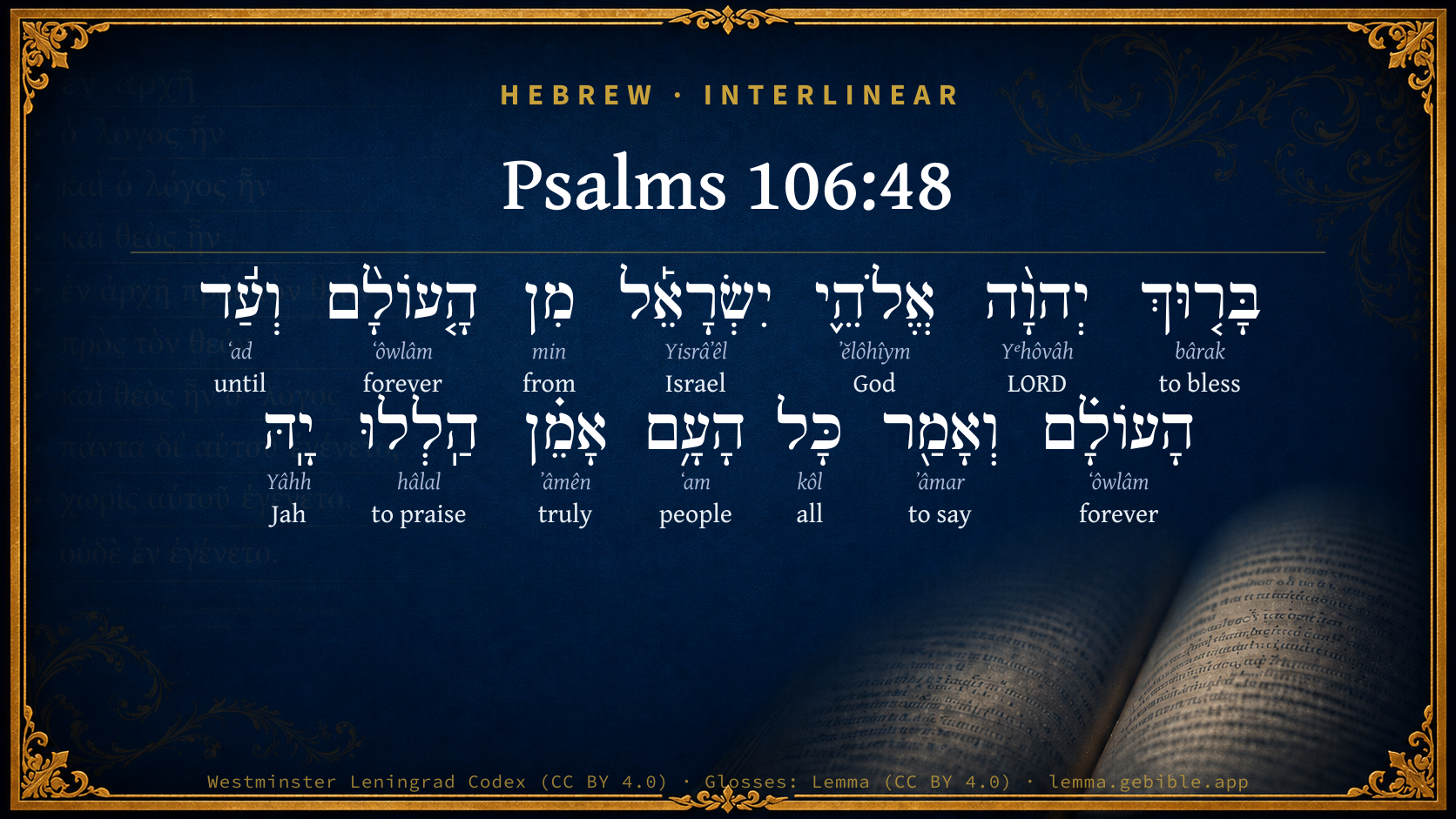
Hebrew (Westminster Leningrad Codex) Psalms 106:48 appears in the Hebrew Old Testament. The text above is from the Westminster Leningrad Codex. Each word links to its Strong’s number, a concise gloss, and parsing drawn from the Open Scriptures Hebrew Bible morphology. Click any word for its full Brown-Driver-Briggs (BDB) entry.
Download image
Cite this verse

Psalms 106:48 (World English Bible). Public Domain. Lemma interlinear Bible study tool, https://lemma.gebible.app/v/psalms/106/48.

Show BibTeX & RIS
BibTeX
RIS
English Translation
Blessed be Yahweh, the God of Israel, From everlasting even to everlasting! Let all the people say, "Amen." Praise Yah!
World English Bible · Public Domain
Download a study sheet

One document with this verse’s original text, its word-by-word gloss line, the meaning frame, cross-references with their text, attributed commentary, and full source and license credits — printable, and it pastes into notes with its structure intact.

This verse Autodidact and up

Study sheet (.html) Plain text (.txt)

A passage Seminary Student

Up to 50 verses in one chapter. A passage sheet keeps up to 6 commentary sources and 12 cross-references per verse, in the order this page ranks them, and says so on the sheet whenever that leaves anything out. Ask for a single verse and you get the Autodidact verse sheet above.

Everything on this page stays free to read, with no account — the sheet is a download of what is already on screen, not access to it.

Want to remove ads? Support Godless Engineer
Compare translations 3

The same verse in 3 English versions, stacked beneath the original-language interlinear above. Click any original word for its lexicon entry.

Each is an independent rendering of the whole verse — the interlinear is not word-aligned to these translations.

Highlighted words mark where these versions differ — a whole-verse word diff, not a word-by-word alignment.

  • World English Bible Public Domain
    Blessed be Yahweh, the God of Israel, From everlasting even to everlasting! Let all the people say, "Amen." Praise Yah!
  • King James Version Public Domain
    Blessed be the LORD God of Israel from everlasting to everlasting: and let all the people say, Amen. Praise ye the LORD.
  • unfoldingWord Literal Text CC BY-SA 4.0
    May Yahweh, the God of Israel, be blessed from everlasting and to everlasting, and all the people say, “Amen. Hallelu Yah!”

unfoldingWord Literal Text — © unfoldingWord, licensed CC BY-SA 4.0. Word-aligned USFM3 via Door43 (git.door43.org/unfoldingWord/en_ult).

Versions to compare (up to 4)

3 of 4 selected

Show all 18 translations

Every available English version of this verse, each an independent rendering of the whole verse.

  • World English Bible Public Domain
    Blessed be Yahweh, the God of Israel, From everlasting even to everlasting! Let all the people say, "Amen." Praise Yah!
  • Berean Standard Bible Public Domain
    Blessed be the LORD, the God of Israel, from everlasting to everlasting. Let all the people say, “Amen!” Hallelujah!
  • Majority Standard Bible Public Domain
    Blessed be the LORD, the God of Israel, from everlasting to everlasting. Let all the people say, “Amen!” Hallelujah!
  • King James Version Public Domain
    Blessed be the LORD God of Israel from everlasting to everlasting: and let all the people say, Amen. Praise ye the LORD.
  • American Standard Version (1901) Public Domain
    Blessed be Jehovah, the God of Israel, From everlasting even to everlasting. And let all the people say, Amen. Praise ye Jehovah.
  • Revised Version (1885) Public Domain
    Blessed be the LORD, the God or Israel, from everlasting even to everlasting. And let all the people say, Amen. Praise ye the LORD.
  • Geneva Bible (1599) Public Domain
    Blessed be the Lord God of Israel for euer and euer, and let all the people say, So be it. Praise yee the Lord.
  • Douay-Rheims (1899) Public Domain
    Blessed be the Lord the God of Israel, from everlasting to everlasting: and let all the people say: So be it, so be it.
  • Young's Literal Translation Public Domain
    Blessed `is' Jehovah, God of Israel, From the age even unto the age. And all the people said, `Amen, praise Jah!'
  • Literal Standard Version CC BY-SA 4.0
    Blessed [is] YHWH, God of Israel, || From age until age. And all the people said, “Amen, praise YAH!”
  • Unlocked Literal Bible CC BY-SA 4.0
    May Yahweh, the God of Israel, be praised from everlasting to everlasting. All the people said, “Amen.” Praise Yahweh.
  • unfoldingWord Literal Text CC BY-SA 4.0
    May Yahweh, the God of Israel, be blessed from everlasting and to everlasting, and all the people say, “Amen. Hallelu Yah!”
  • Darby Bible Public Domain
    Blessed be Jehovah the God of Israel, from eternity and to eternity! And let all the people say, Amen! Hallelujah!
  • World Messianic Bible Public Domain
    Blessed be the LORD, the God of Israel, from everlasting even to everlasting! Let all the people say, “Amen.” Praise the LORD!
  • Webster's Bible Public Domain
    Blessed be the LORD God of Israel from everlasting to everlasting: and let all the people say, Amen. Praise ye the LORD.
  • Free Bible Version CC BY-SA 4.0
    How wonderful is the Lord, the God of Israel, who lives forever and ever! Let all the people say “Amen”! Praise the Lord!
  • Bible in Basic English Public Domain
    Praise be to the Lord God of Israel for ever and for ever; and let all the people say, So be it. Give praise to the Lord.
  • JPS Tanakh (1917) Public Domain
    Blessed be the LORD, the God of Israel, from everlasting even to everlasting, and let all the people say: 'Amen.' Hallelujah.

Literal Standard Version (2020), Covenant Press — licensed CC BY-SA 4.0. Text via the HelloAO Bible API (eBible.org). Unlocked Literal Bible (unfoldingWord) — licensed CC BY-SA 4.0. Text via the HelloAO Bible API (eBible.org). unfoldingWord Literal Text — © unfoldingWord, licensed CC BY-SA 4.0. Word-aligned USFM3 via Door43 (git.door43.org/unfoldingWord/en_ult). Free Bible Version, Dr. Jonathan Gallagher — licensed CC BY-SA 4.0. Text via the HelloAO Bible API (eBible.org).

Word by word

More ways to search: Search by grammar → Find every occurrence → Compare this word →

Practice this passage: Drill this verse → Learn its vocabulary →

אָמֵ֗ן
ʼâmên
H543
“truly”
Adverb
Part of Speech
Adverb
Full BDB Definition

Origin: from H539

TWOT: 116b

verily, truly, amen, so be it
  1. בָּר֤וּךְ bârak H1288 “blessed” Verb, Qal, Participle Passive, Masculine, Singular, Absolute
  2. יְהוָ֨ה Yᵉhôvâh H3068 “LORD” Noun, Proper
  3. אֱלֹהֵ֪י ʼĕlôhîym H430 “God(s) of” Noun, Common, Masculine, Plural, Construct
  4. יִשְׂרָאֵ֡ל Yisrâʼêl H3478 “Israel” Noun, Proper
  5. מִן min H4480 “from” Preposition
  6. הָ֤עוֹלָ֨ם ʻôwlâm H5769 “the · forever” Particle, Definite Article + Noun, Common, Masculine, Singular, Absolute
  7. וְעַ֬ד ʻad H5704 “and · until” Conjunction + Preposition
  8. הָעוֹלָ֗ם ʻôwlâm H5769 “the · forever” Particle, Definite Article + Noun, Common, Masculine, Singular, Absolute
  9. וְאָמַ֖ר ʼâmar H559 “and · to say” Conjunction + Verb, Qal, Sequential Perfect, 3rd Person, Masculine, Singular
  10. כָּל kôl H3605 “all of” Noun, Common, Masculine, Singular, Construct
  11. הָעָ֥ם ʻam H5971 “the · people” Particle, Definite Article + Noun, Common, Masculine, Singular, Absolute
  12. הַֽלְלוּ hâlal H1984 “praise” Verb, Piel, Imperative, 2nd Person, Masculine, Plural
  13. יָֽהּ Yâhh H3050 “Jah” Noun, Proper

About this verse

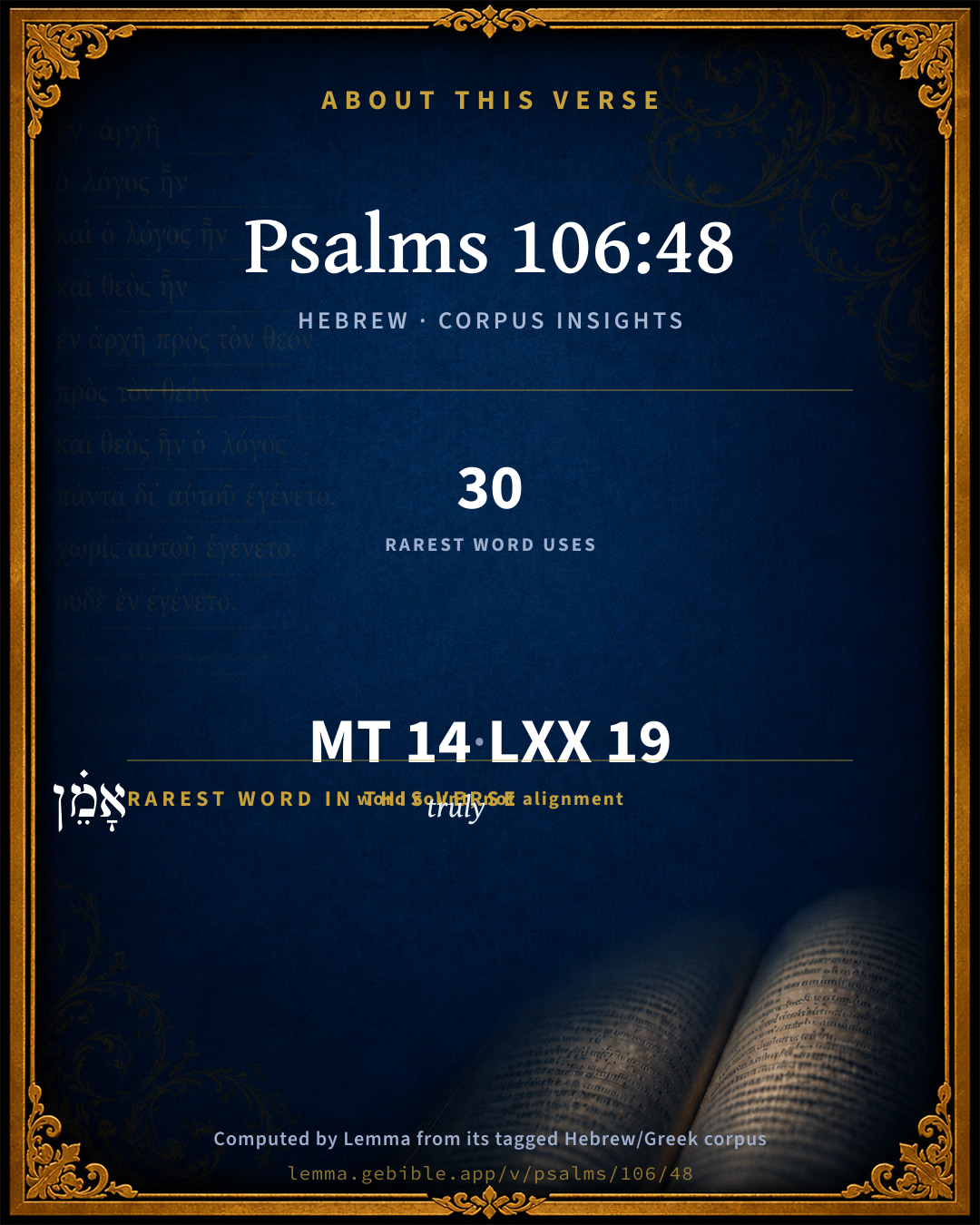
These counts appear in no published source. They are computed here, from the morphology-tagged text and Lemma’s own curated glosses. What Lemma adds →

14
words
13
distinct lemmas
Wisdom
section

Shared distinctive vocabulary

אָמֵ֗ן truly H543 occurs in 24 verses of the Hebrew Bible. Also found in:

Grammatical profile

  • 3 verbs
  • 8 nouns
  • 2 prepositions
  • 1 adverb

Verb forms

  • בָּר֤וּךְ Qal · Participle Passive
  • וְאָמַ֖ר Qal · Sequential Perfect
  • הַֽלְלוּ Piel · Imperative

Repetition

A word recurs within this verse — often emphatic in Hebrew:

  • הָ֤עוֹלָ֨ם forever H5769 ×2

Hebrew & Septuagint length

In English translation the verse runs 20 words from the Hebrew and 20 from the Septuagint (LXX English) — the same length.

A rough comparison of the two English renderings, which tokenize alike — not a word-level alignment.

Word counts can differ between the Hebrew and the Greek without any difference in meaning — e.g. the Hebrew direct-object marker אֵת has no separate Greek word, and Greek often adds the article ὁ.

In the original languages it is 14 Hebrew tokens and 19 Greek tokens — but the two are counted differently (Hebrew bundles its prefixes and suffixes into one token; the Greek is in lemma form), so that isn’t a like-for-like length.

Cross-references

6

Topical passages linked to Psalms 106:48 in the Treasury of Scripture Knowledge — connected by theme and wording, ordered by reader-vote popularity; previews shown in the World English Bible.

  • Psalms 41:13 Blessed be Yahweh, the God of Israel, From everlasting and to everlasting! Amen and amen.
  • Psalms 89:52 Blessed be Yahweh forevermore. Amen, and Amen.
  • 1 Chronicles 29:10 Therefore David blessed Yahweh before all the assembly; and David said, You are blessed, Yahweh, the God of Israel our father, forever and ever.
  • Psalms 72:18–19 Praise be to Yahweh God, the God of Israel, Who alone does marvelous deeds.
  • Psalms 105:45–106:1 That they might keep his statutes, And observe his laws. Praise Yah!
  • 1 Corinthians 14:16 Otherwise if you bless with the spirit, how will he who fills the place of the unlearned say the "Amen" at your giving of thanks, seeing he doesn't know what you say?

Cross-references courtesy of OpenBible.info (CC BY 4.0).

Hebrew and Greek witnesses Masoretic Hebrew ↔ Greek Septuagint

The same verse in the two great witnesses to the Old Testament, shown verse-for-verse.

You’re reading Greek Psalm 105 (Hebrew Psalm 106). The Septuagint counts the superscription, so verse numbers can differ from the Hebrew — chapter-level alignment, not verse-by-verse. Numbering follows Rahlfs.

These are two independent witnesses, not word-aligned to each other, and the Septuagint is shown in lemma (dictionary) form.

Hebrew Psalms 106:48 Masoretic · Westminster Leningrad Codex

בָּר֤וּךְ יְהוָ֨ה אֱלֹהֵ֪י יִשְׂרָאֵ֡ל מִן הָ֤עוֹלָ֨ם וְעַ֬ד הָעוֹלָ֗ם וְאָמַ֖ר כָּל הָעָ֥ם אָמֵ֗ן הַֽלְלוּ יָֽהּ

Blessed be Yahweh, the God of Israel, From everlasting even to everlasting! Let all the people say, "Amen." Praise Yah!

World English Bible · Public Domain

Greek LXX Greek Psalm 105:48 Septuagint · lemma form

εὐλογητός κύριος ὁ θεός ἰσραήλ ἀπό ὁ αἰών καί ἕως ὁ αἰών καί εἶπον πᾶς ὁ λαός γίγνομαι γίγνομαι

Blessed be the Lord God of Israel from everlasting and to everlasting; and all the people shall say, Amen, Amen.

LXX2012 (modern English Septuagint) · Public Domain

Hebrew: Westminster Leningrad Codex (CC BY 4.0). Greek: Septuagint (public domain); English from LXX2012 (modern English Septuagint) (Public Domain). How the Septuagint differs from the Hebrew →

Commentary

Notes on Psalms 106:48 from classic Christian and Jewish commentators (each source and its license shown beneath its notes). The classic Christian expositions comment on the surrounding passage and are grouped to its opening verse, so a note may address several verses; the Jewish commentaries on the Tanakh (Rashi and others) are per-verse, so they appear only where the commentator wrote on this verse.

Lemma curates 59 commentaries, every one of them public domain or Creative Commons licensed, each selected and text-cleaned for this edition rather than reprinted as found. About our sources →

Trapp's Complete Commentary

John Trapp

Psa 106:48 Blessed [be] the LORD God of Israel from everlasting to everlasting: and let all the people say, Amen. Praise ye the LORD.

Ver. 48. Blessed be the Lord] viz. For our return out of captivity, which we foresee, believe, and give thanks for beforehand.

Praise ye the Lord] Thus they speak one to another, by way of excitation, υμνησατε μετα μελους το ον, so Justin Martyr rendereth it.

John Trapp, A Commentary or Exposition upon All the Books of the Old and New Testament (1647–1656) — public domain. Text from a community e-Sword module.

The Biblical Illustrator

Joseph S. Exell

Psa_106:48

Let all the people say, Amen.

Amen

The word Amen has a history full of instruction and interest. Its original meaning had reference to the material. It signified firm, durable, lasting. I will build him a sure house. His waters shall be sure. In course of time, like other words, Amen came to have a higher, even a social meaning. As what is firm and secure is able to bear and carry other things, it at length described carrying. A nursing father: Naomi took the child and became nurse. Next it was promoted to the honour of an intellectual office, and signified trustiness or skill. He removeth away the speech of the trusty. Then it was raised to the dignity of an ethical use. As what is truthful and upright is firm, it came to mean trust and faith. Who hath said Amen to our report? Finally it acquired an ecclesiastical import, and is now commonly employed in the well-known sense of, Truly; so be it; so let it be!

I. To Gods commands, Let all the people say, Amen.

1. The Divine commands are wholly right. Were we able to see absolute rectitude, looking at it as upon an elaborate architectural plan, we should find, on comparing it with the edifice of Gods laws, that the latter is a wonderful and minute reflex on the former. What an inspiring thought!

2. The Divine commands are wholly beneficial. In keeping of them is great reward.

II. To Gods providence, let all the people say, Amen.

1. To do otherwise is thoughtless. In the Divine government there is a balance of power. A law of compensation is at work. Weal and woe are more evenly distributed than is commonly imagined. No person, class, or condition has a monopoly of either the blissful or the baleful. One thing is set over against another. A good man in a sea of troubles is in a condition infinitely preferable to that of a bad man nursed in the lap of luxury, housed magnificently, and faring sumptuously every day.

2. To do otherwise is useless. Where is the profit of rebelling against Gods sovereign dealing? It is vain to oppose the inevitable. Nay, it is worse than useless; it is injurious. It increases, instead of alleviating, our misery. An oak that had been rooted up by the winds was borne down the stream of a river, on the banks of which many reeds were growing. The oak wondered to see that things so slight and frail had stood the storm, when so great and strong a tree as itself had been rooted up. Cease to wonder, said the reed, you were overthrown by fighting against the storm, while we are saved by yielding and bending to the slightest breath that blows. Yes; it is eminently advantageous to say, Amen to the darkest dispensations of Providence.

3. To do otherwise is forgetful. It ignores the oft-repeated doctrine that out of our trials God perfects our good. When we murmur at sorrow, we cease to remember that it is through much tribulation that all kingdoms worth occupying are entered.

III. To Gods gospel, let all the people say, Amen. The good news of free and full pardon through the sacrifice of Christ and in answer to prayer--be that kept intact. We must take it just as it is. Nothing must be added, nothing removed. It is neither too large nor too small, and woe to us if we attempt to alter it. (T. R. Stevenson.)

Hearty Amens

St. Jerome tells us that it was the custom, in his time, to close every prayer with such a unanimous consent, that the Amens of the people rang and echoed in the church, and sounded like the dash of a mighty cataract, or a clap of thunder. There are several kinds of Amens.

I. The amen of habit. People have uttered it from their infancy, all unconscious how much was really contained in that single word. No feeling nor earnestness has accompanied the vocal sound. So far as receiving any benefit from such empty mummery, you might as well expect it from swinging the pendulum of a clock, or by winding up the machinery of an automaton.

II. The amen of hope. Melanchthon, once going forth upon some important service for his Heavenly Master, and having many doubts and fears as to his success, was cheered by a company of poor women and children, whom he found praying together for the prosperity of the Church. And so, the Amen of hope is breathed forth by the trusting soul, as it hears the Saviours promise, Behold, I come quickly (Rev_3:11).

III. The amen of faith. When the devout Christian who has poured forth his soul in prayer, says, Amen, it is not the mere utterance of earnest desire, but of undoubting faith in Him who is always more ready to hear than we to pray. The same gracious Father whose promises we plead in prayer, is able, also, to perform. Faith clasps its arms around the Cross of Jesus, and looks, with undoubting confidence, for an answer of peace. (J. N. Norton.)

.

Psa_107:1-43

The Biblical Illustrator, edited by Joseph S. Exell (c. 1880s–1900s) — public domain. Text from a community e-Sword module.

Keil & Delitzsch

C. F. Keil & F. Delitzsch

The closing doxology of the Fourth Book. The chronicler has ואמרוּ before Psa 106:47 (which with him differs only very slightly), an indispensable rivet, so to speak, in the fitting together of Psa 106:1 (Psa 107:1) and Psa 106:47. The means this historian, who joins passages together like mosaic-work, calls to his aid are palpable enough. He has also taken over. Psa 106:48 by transforming and let all the people say Amen, Hallelujah! in accordance with his style (cf. Ch1 25:3; Ch2 5:13, and frequently, Ezr 3:11), into an historical clause: ויּאמרוּ כל־העם אמן והלּל ליהוה. Hitzig, by regarding the echoes of the Psalms in the chronicler as the originals of the corresponding Psalms in the Psalter, and consequently Ch1 16:36 as the original of the Beracha placed after our Psalm, reverses the true relation; vid., with reference to this point, Riehm in the Theolog. Literat. Blatt, 1866, No. 30, and Kצhler in the Luther. Zeitschrift, 1867, S. 297ff. The priority of Ps 106 is clear from the fact that Psa 106:1 gives a liturgical key-note that was in use even in Jeremiah's time (Psa 33:11), and that Psa 106:47 reverts to the tephilla-style of the introit, Psa 106:4. And the priority of Psa 106:48 as a concluding formula of the Fourth Book is clear from the fact that is has been fashioned, like that of the Second Book (Psa 72:18.), under the influence of the foregoing Psalm. The Hallelujah is an echo of the Hallelujah-Psalm, just as there the Jahve Elohim is an echo of the Elohim-Psalm. And "let all the people say Amen" is the same closing thought as in Psa 106:6 of Ps, which is made into the closing doxology of the whole Psalter. Ἀμὴν ἀλληλούΐα together (Rev 19:4) is a laudatory confirmation.

Keil & Delitzsch — Biblical Commentary on the Old Testament (1861–1891) — public domain (CC PDM 1.0). Text via the HelloAO Bible API. (Old Testament only.)

J. A. Alexander on Psalms

Joseph Addison Alexander

48. (Psa 106:48) Blessed (be) Jehovah, God of Israel, from eternity even to eternity. All the people say Amen. Halleluj ah! Some interpreters regard the psalm as closing with the preceding verse, and the one before us as a doxo- logy added to mark the conclusion of the Fourth Book. But here, as in Psa 72:19, it is far more probable that this doxology was the occasion of the psalm's being reckoned as the last of a Book, notwithstanding its intimate connection with the one that follows. This probability is strengthened, in the case before us, by the addition of the words, and all the people say Amen, which would be unmeaning, unless the doxology formed part of the psalm itself. The additional words are borrowed from Deu 27:15-26. The parallel passage (1Ch 16:36) has, And all the people said Amen and give praise (or gave praise) to Jehovah, which last words are represented, in the verse before us, by the Hallelujah (Praise ye Jah!)

Joseph Addison Alexander, The Psalms Translated and Explained (1850) — public domain. Text from a community e-Sword module.

Tyndale Open Study Notes

Tyndale Open Resources

106:48 This doxology concludes Book Four (cp. 41:13; 89:52). • from everlasting to everlasting! The reference to God’s eternal nature links to the opening of Book Four (90:1-2). • Let all the people say, “Amen!”: The Hebrew word ’amen means “It is true.” The godly accept the Lord’s will in exile and his promise to be their God.

Tyndale Open Study Notes — © Tyndale Open Resources, licensed CC BY-SA 4.0. Text via the HelloAO Bible API.

Adam Clarke's Commentary

Verse 48. Blessed be the Lord God of Israel] Here both gratitude and confidence are expressed; gratitude for what God had already wrought, and confidence that he would finish the great work of their restoration.

From everlasting to everlasting] מן האולם ועד האולם min haolam vead haolam, "from the hidden term to the hidden term," from the beginning of time to the end of time, from eternity and on to eternity. [Anglo-Saxon], Anglo-Saxon. Fra worlde and into worlde, old Psalter; which it paraphrases thus: Fra with outen beginning, withouten endyng.

And let all the people say, Amen.] Let the people join in the prayer and in the thanksgiving, that God may hear and answer. Anglo-Saxon: [A.S.] "And, quoth all folk, be it, be it." Hallelujah - Praise ye Jehovah! Let his name be eternally magnified! Amen.

This is the end of the fourth book of the Psalms.

ANALYSIS OF THE ONE HUNDRED AND SIXTH PSALM

The intention of the prophet in this Psalm is to express God's long-suffering in bearing with rebellious sinners, and yet in pardoning them upon the confession of their sins, and turning to him; both which he exemplifies by a long narration of Israel's rebellions, repentance, and turning to God, and God's dealing with them, which gave him just occasion to praise God, and to pray for his Church and people.

I. An exhortation to praise God, with the reasons in general, Ps 106:1; and who are fit to perform this duty, Ps 106:2-3.

II. A petition and prayer directed to God in his own person for the whole Church, and the end of it, Ps 106:4-5.

III. A confession of sin, particularly of the Israelites', together with God's patience with them, and their repentance, Ps 106:6-46.

IV. His prayer that God would collect his Church out of all nations, that they might meet and praise him, Ps 106:47-48.

I. "Praise Ye the Lord, O give thanks unto the Lord." To this the prophet invites, for two reasons: -

1. "Because he is good." He is beforehand with us, and prevents men with many benefits.

2. "Because his mercy endures for ever." It is everlasting, and far exceeds our sins and miseries; for after men have offended him, and deserve no mercy, yet he receives the penitent offenders. But who is sufficient for these things? Who is fit to praise him, and set forth his mercies? "Who can utter the mighty acts of the Lord?" That is, the infinite benefits exhibited to his people. Or, Who can show forth all his praise in preserving, pardoning, and propagating his Church?

They alone are happy men "who keep judgment, and do righteousness at all times."

1. They are happy in prosperity and adversity, they dwell in the house of God, under his protection.

2. "They keep his judgments." Follow in their lives the strict rules of the Divine law, by which they judge all their actions, and so keep faith and a good conscience.

3. "They do righteousness at all times." They approve that which is right, true, and just; condemn, hate, and punish what is unjust: such are fit to praise God with their tongues, because they praise him in their lives.

II. After the prophet had invited men to praise God, and showed who were fit to do it, he begins his petition, which he proposes in his own person for the whole Church.

1. "Remember me." Me; but not me alone, rather thy whole Church. By what we suffer, thou hast seemed to forget thy covenant and promise; but now call it to mind again.

2. Which I expect, not for any desert of mine, but merely from thy good will: "Remember me with the favour," c.

3. "O visit me" but not in wrath, for such a visitation there is; but in mercy and grace.

4. "With thy salvation." Save me at this time from my sins, and from my present calamities.

And to this end I desire thy favour, thy salvation.

1. "That I may see the good of thy chosen." Be a partaker of and in their happiness.

2. "That I may rejoice in the gladness of thy nation." Partake of it.

3. "That I may glory with thine inheritance." Glorify thee with them.

But observe here the three eminent titles given to God's Church: -

1. They are a "chosen" people; which is a glorious and gracious title, and intimates favour.

2. They are his "nation," his peculiar people.

3. They are his "inheritance."

III. In the following part of the Psalm, Ps 106:7-46, he makes use of a new argument to move God to mercy. He represents not the present condition the people of God are in, not their captivity, miseries, and afflictions, but ingenuously confesses how they had offended God, and how justly they suffered.

1. "We have sinned with our fathers." Trodden in their steps, and filled up the measure of their sins.

2. "We have committed iniquity." Not only from infirmity, but choice.

3. "We have done wickedly." The intent and purpose in it was evil. And by these three steps he exaggerates the sin; the act, the frequency, the intent; as every true confessionist to God ought never to extenuate, but to aggravate the offence against himself.

And because he had mentioned their fathers at large, now he instances their rebellions: "Our fathers understood not thy wonders in Egypt;" that is, they laid them not to heart.

1. "They remembered not the multitude of thy mercies," c. When they saw Pharaoh's army on one side, and the sea on the other, they grew heartless, diffident, and murmured.

2. This was their sin at that time but God was then merciful to them: "Nevertheless he saved them."

For which he assigns two reasons: -

1. "For his name's sake." To advance his glory and honour.

2. "That he might make his mighty power to be known." Pharaoh and the Egyptians might have taken notice of it by the plagues he had already brought upon them.

In the following verses, by a distribution, he shows the manner of their deliverance.

1. By God's rebuke, and drying up of the sea: "He rebuked the Red Sea also," c.

2. By the unheard-of way: "He led them through the depths as through the wilderness" there was no more water there to offend them than in the sands of Arabia.

3. By the consequence of it: "And he saved them by the hand of him," c.

4. "And the waters covered their enemies," c.

The effect was, for the present,

1. It extorted from them a confession that God was true in his promises: "Then believed they his words."

2. It excited them to praise him: "They sang his praise," Ex 15:1-21. But these very men who were forced to confess his power and sing his praises for the overthrow of Pharaoh in the Red Sea, were scarcely departed from those banks, when they, for want of a little bread and water, grew as impatient and distrustful as they were before.

1. They made haste to forget: "They soon forgot" which aggravates their sin.

2. They forgot his omnipotence, his providence.

3. "They waited not for his council." With patience they expected not the end, why God in his wisdom suffered them now to wait, which was, to prove their faith, hope, and love.

4. And what they did at this time they did also at others: "For they lusted exceedingly in the wilderness."

Now God yielded to these desires of the people: "He gave them bread, flesh, and water."

1. And he gave them their request, Ex 16:12.

2. "But he sent leanness into their souls." Which certainly has reference to the quails in Nu 11:20, Nu 11:33, where the people ate, and died of plague.

Another rebellion the prophet now touches, which was, when they rose up against the king and the priest.

1. "They envied also Moses in the camp;" objecting that he had usurped a power over them, and taken it upon his own head.

2. "And Aaron, the saint of the Lord." He whom God had chosen, anointed, and sanctified to the priest's office.

The punishment follows, Nu 16:32; Nu 16:35; Nu 16:41; Nu 16:49.

1. "The earth opened, and swallowed up Dathan, and covered the congregation of Abiram."

2. "And a fire was kindled in their company the flame burned up the wicked." That is, the two hundred and fifty men that presumed to offer incense; and presently after the fourteen thousand seven hundred that murmured, and objected to Moses and Aaron that they had killed the people of the Lord.

Still the prophet goes on in his story of Israel's stubbornness and rebellion; and comes to their grand sin, their idolatry in erecting the golden calf, Ex 32:4.

1. "They made a calf in Horeb," c., contrary to God's command.

2. "Thus they changed their glory." That is, the true God, who was indeed their glory, "into the similitude of an ox," a brute beast, "that eateth grass," a base creature, which much aggravates their sin.

3. But the prophet aggravates their stupidity and folly: "They forgat God," c.

In the following verse are expressed God's just anger and mercy, -

1. His anger against their sins: "Therefore he saith," &c. Pronounced his will to destroy them.

2. His mercy, in that he spared them at the intercession of Moses: "Had not Moses his chosen stood before him in the breach." The breach and division which this sin had made between God and his people, like that in the wall of a besieged town, in which some valiant captain stands, and opposes himself against the assault of the enemy so did Moses.

For his object was the same, it was "to turn away his wrath lest he should destroy" and the end was answered - it was turned away.

Farther yet, he calls to mind a new rebellion, which fell out upon the report of the spies sent to search the land, Nu 13:26, c., Nu 14:1-10.

1. "They despised the pleasant land," and wished to return into Egypt, Nu 14:1-5.

2. "They believed not his word" for they said, "Hath the Lord brought us," c.

3. "But murmured in their tents, and hearkened not," c., Nu 14:27. "Therefore he lifted up his hand against them," &c. As their sin, so their punishment, is extant Nu 14:29: "Your carcasses shall fall in the wilderness ye shall not come into the land."

This punishment fell upon the murmurers themselves; but if their children should be guilty of the like rebellion, they should not escape, for they too should be overthrown; which is fully brought to pass.

The prophet joins to that of the golden calf another piece of idolatry in the wilderness, to which there was joined fornication also, by the counsel of Balaam and the policy of Balak. This caused them to eat and sacrifice to their god, Nu 25:1-3, which the prophet next insists upon, -

1. "They joined themselves to Baal-peor," because the idol was set up upon that mountain.

2. "And ate the offerings of the dead." They left the sacrifice of the living God, and ate those meats which were offered to dead idols.

Upon which there followed God's wrath and their own punishment: -

1. God was angry: "For they provoked him to wrath."

"And the plague brake in upon them" like mighty waters, or as an army into a city at a breach; for there died of it twenty-four thousand, Nu 25:9.

In the former idolatry God's anger was averted by the intercession of Moses; in this, by the execution of judgment by Phinehas; for -

1. "There stood up Phinehas; " moved, no question, with a zeal for God's honour.

2. "And he executed judgment upon Zimri and Cozbi;" for which (let men conceive as they please - I see nothing to the contrary) he had his commission from Moses, or rather God; Nu 25:4-5.

3. The event was, the plague was stayed; the execution of offenders pacifies the anger of God.

Which zeal of his was well rewarded: "This was accounted to him for righteousness," c. This act was an act of righteousness, and an ample reward he had for it for God established the dignity of the high priesthood in Phinehas and his posterity, as long as the Jewish commonwealth continued.

The prophet comes to another remarkable sin of the Jews, Nu 20:3; Nu 20:13, where the people chid Moses for want of water: -

1. "They angered him also at the waters of strife," when they contradicted Moses.

2. "So that it went ill with Moses for their sakes;" for, being disturbed with choler, "he spake unadvisedly with his lips," - "Hear now, ye rebels," c. and he smote the rock. By their murmuring they so provoked his spirit to bitterness, that he who at other times was cheerful, and ready to obey God's commands, now acted with reluctance.

Hitherto the prophet has set down several rebellions of the Jews during their abode in the wilderness; and now he shows how they behaved themselves after they came into the land of Canaan. Better, a man would think, they should be after God had fulfilled his word to them; but an Ethiopian cannot change his skin, nor they their manners; disobedient, stubborn, and rebellious they remained.

1. God had expressly commanded that the nations of Canaan should be destroyed, De 7:1-3: "But they did not destroy the nations," c.

2. "But they mingled among the heathen:" in leagues and marriages, Jdg 2:2; Jdg 3:5-6.

3. "And learned their works:" many superstitious and evil customs.

But, beyond all, they learned to be idolaters; forsook God for the devil.

1. "They served their idols, which was a snare unto them," for that they became their slaves, Jdg 2:14-15, c.

2. "Yea, they sacrificed their sons," c., to Moloch.

3. With inhuman sin, they "shed innocent blood" the blood of innocent children, c.

The consequences of which are double. First, A double pollution. Secondly, A heavy punishment.

1. A pollution of the land: "The land was defiled with blood."

2. A pollution of their own souls: "Thus were they defiled with their own works."

The judgment, or punishment, now follows and a signification whence it proceeded it came not by chance, but by God's order and anger.

1. "Therefore was the wrath of the Lord kindled," c. For their idolatry, murder, whoredom so that he was not only angry, but his anger was kindled to a flame.

2. Insomuch "that he abhorred his own inheritance."

And the punishment he inflicted on them was very just, -

1. "He gave them into the hand," that is, the power, "of the heathen." God had given the heathen into their hands to destroy them; which, because they did not, but learned their works, therefore God gave them into the hands of the heathen.

2. He made them their lords; and hard masters they were, as plainly appears from the Book of Judges, and 1 Samuel.

And little they; for the prophet in the next verse adds,

1. "Their enemies oppressed them:" tyrants, oppressors they were. Read the Book of Judges, c.

2. "They were brought into subjection," c., under the Philistines, Moabites, Ammonites, &c.

In which condition God did not forget them, for "many times did he deliver them" not once only, but often, as by Gideon, Jephthah, Deborah, Samson, and others. But, O the ingratitude of a sinful nation! instead of serving God, "they provoked him with their counsel," that is, by following the dictates of their own hearts.

And so were very justly brought into the same case they were before for "they were brought low for their iniquity."

And now the prophet adds, which indeed he infers through the whole Psalm, the wonderful and immutable good will of God to them. Though he forgave and delivered them upon their repentance, and they in a short time provoked him again; yet he received them to grace, even after their relapses. And the causes that moved him to this were external and internal.

The cause that outwardly and occasionally moved him to it was their affliction and cry: "He regarded their affliction " c.

But the cause that inwardly swayed him was his word passed to them, and his mercy.

1. His word and his promise were passed to "Abraham, to be their God" and he would not break it. "And he remembered for them his covenant."

2. His tender affection that he bare them; this caused him to repent, and grieve that they should be in misery. "He repented," c.

3. And the effect which all these causes had was beneficial to them even in their bondage and captivity for even their very enemies' hearts were often turned to do them good, as is evident in Jeremiah, David, Daniel, Ezra, Zerubbabel, Mordecai, and indeed the whole nation under the Babylonian, Philistian, Egyptian, and Persian kings, which the prophet sets down, Ps 106:46: "He made them also to be pitied of all those that carried them captives." According to the saying of the wise man: "When a man's ways please God, he will make his very enemies to be at peace with him," Pr 16:7.

4. And this sense makes the way plainer to what follows, the petition and the doxology; for if God showed himself merciful in the time of his anger, and made it apparent even to the very view of their enemies, encouragement they might have, -

1. To pray: "Save us, O Lord our God, and gather us from among the heathen," c.

2. Then to give thanks: 1. "Blessed be the Lord God of Israel from everlasting to everlasting. 2. And for it let the people do their duty that is, the solemn and necessary forms: "Let all the people say, Amen. Hallelujah."

Adam Clarke's Commentary on the Bible (1810–1826) — public domain. Text from a community e-Sword/MySword module.

John Calvin's Commentaries

48. Blessed be Jehovah, the God of Israel The prophet here regulates the prayers and desires of the people in such a way, as that, amid their grievous oppression, the dejected captives may not cease to render thanks to God; and this is a matter which must be carefully attended to, because, when borne down by adversity, there is scarcely one among a hundred, who, with composure of spirit, draws near to God; but, on the contrary, he betrays the pride of his heart by the careless and insipid manner in which he prays, or in pouring out complaints about his afflicted condition. But the only way in which we can expect God to lend a favorable ear to the voice of our supplications is, in the spirit of meekness to submit to his corrections, and patiently to bear the cross which he is pleased to lay upon us. It is with great propriety then, that the prophet exhorts the afflicted captives to bless God, even when he was chastising them with considerable severity. It is to the same purpose that it is added, let the people say, Amen; as if he were commanding them all to consent to the praises of God, though both privately and publicly they were overwhelmed in a sea of troubles.

John Calvin's Commentaries (1540-1563) — public domain. Text from the Calvin Translation Society English edition (1840s-50s) via the Christian Classics Ethereal Library (ccel.org). Calvin's coverage is partial (roughly two-thirds of the Bible); uncommented books and verses are honest gaps, never fabricated. The 19th-century editor's footnotes and remarks are omitted so the notes are faithfully Calvin's own voice.

Ellicott's Commentary for English Readers

(48) Blessed . . .—The doxology, which is only slightly altered from that at the end of the second book, is quoted as part of the psalm in 1Ch_16:36—an indication that by that time this book was complete, if not the whole collection.

A Bible Commentary for English Readers, edited by Charles John Ellicott (1878–1897) — public domain. Text from a community e-Sword module.

The Cambridge Bible for Schools and Colleges

gen. ed. J. J. S. Perowne

48. Blessed be Jehovah, the God of Israel,

From eternity even to eternity.

And all the people shall say, Amen,

Hallelujah.

The liturgical direction “and all the people shall say, Amen, Hallelujah” seems to imply that the doxology here is not a mere mark of the end of the Fourth Book, but was actually sung at the close of the Psalm. This was the usage in the time of the Chronicler, for in 1 Chronicles 16 he prefixes the words, “and say ye,” to Psa_106:35-36 (= Psa_106:47-48 here), and turns the direction into a statement, “and all the people said, Amen, and praised Jehovah.” This doxology then, as Robertson Smith points out (OTJC.2, p. 196), differs in character from the doxologies at the close of the first three books. It is a part of the Psalm and not an addition by the collector of the Psalter. For the use of similar doxologies cp. 1Ch_29:10; Neh_9:5. It came however to be regarded as marking the end of a fourth book, although Psalms 106, 107 are closely connected together, and the division of the fourth and fifth books does not correspond to any difference of source or character, as is the case in the other books. Cp. Introd. p. liv.

The Cambridge Bible for Schools and Colleges (gen. ed. J. J. S. Perowne; Cambridge University Press, 1878–1918) — public domain. Text from a community e-Sword module.

Albert Barnes' Notes on the Bible

Blessed be the Lord God of Israel from everlasting to everlasting - Forever. As he has been adored in the past - even from the beginning of the creation - so let him be adored and praised in all periods to come - forever and forever. See the notes at Psa 41:13.

And let all the people say, Amen - In Psa 41:13, this is, “Amen and amen.” The idea is, Let all the people join in this; let them all express and declare their assent to this: let them all say, “Be it so.” The word “Amen” is a word expressing assent - meaning verily, truly, certainly.

Praise ye the Lord - Hebrew, “Hallelu-jah.” See Psa 104:35.

Albert Barnes' Notes on the Bible (1834–1885) — public domain. Text from a community e-Sword/MySword module.

The Treasury of David

Charles H. Spurgeon

Ver. 48. Amen. Martin Luther said once of the Lord's Prayer that "it was the greatest martyr on earth because it was used so frequently without thought and feeling, without reverence and faith." This quaint remark, as true as it is sad, applies perhaps with still greater force to the word "Amen."

Familiar to us from our infancy is the sound of this word, which has found a home wherever the natives have learnt to adore Israel's God and Saviour. It has been adopted, and without translation retained, in all languages in which the gospel of Jesus the Son of David is preached. The literal signification, "So be it", is known to all; yet few consider the deep meaning, the great solemnity, and the abundant consolation treasured up in this word, which has formed for centuries the conclusion of the prayers and praises of God's people. A word which is frequently used without due thoughtfulness, and unaccompanied with the feeling which it is intended to call forth, loses its power from this very familiarity, and though constantly on our lips, lies bedridden in the dormitory of our soul. But it is a great word this word "Amen"; and Luther has truly said, "As your Amen is, so has been your prayer."

It is a word of venerable history in Israel and in the church. The word dates as far back as the law of Moses. When a solemn oath was pronounced by the priest, the response of the person who was adjured consisted simply of the word "Amen." In like manner the people responded "Amen" when, from the heights of Ebal and Gerizim, the blessings and the curses of the divine law were pronounced. Again, at the great festival which David made when the ark of God was brought from Obed Edom, the psalm of praise which Asaph and his brethren sang concluded with the words, "Blessed be the Lord. God of Israel for ever and ever. And all the people said, Amen" (1Ch 16:36). Thus we find in the Psalms, not merely that David concludes his psalm of praise with the word Amen, but he says, And let all the people say, Amen. Adolph Saphir, in "The Lord's Prayer", 1870.

Ver. 48.

1. God is to be praised as the "God of Israel."

(a) Of typical Israel.

(b) Of the true Israel.

2. He is to be praised as the God of Israel under all circumstances: for his judgments as well as for his mercies.

3. At all times: "From everlasting to everlasting."

4. By all people: "Let all the people say, Amen."

5. As the beginning and end of every song: "Praise ye the Lord."

G.R.

Ver. 48. Let all the people say, Amen. The exhortation to universal praise. All men are indebted to the Lord, all have sinned, all hear the gospel, all his people are saved. Unanimity in praise is pleasant, and promotes unity in other matters.

Charles H. Spurgeon's The Treasury of David (1869–1885) — public domain. Psalms only. Text from a community e-Sword/MySword module.

Whedon's Commentary on the Bible

Daniel D. Whedon

48. This verse, also, was borrowed from the same source as the preceding, with modifications to suit it to less triumphant times. The let all the people say, Amen, here, stands for “and all the people said, Amen,” in the Chronicles.

BOOK V.—Psalms 107-150.

Daniel D. Whedon (gen. ed.), Commentary on the Old and New Testaments (1874–1909) — public domain. Text from a community e-Sword module.

The Pulpit Commentary

Blessed be the Lord God of Israel from everlasting to everlasting. This verse is not so much a part of the particular psalm, as a mark that here another Book of the Psalms has reached its conclusion. (comp. Psa_41:13 Psa_72:19 Psa_89:52) The form has, however, been modified so as to make it run on smoothly with the verse immediately preceding. And let all the people say. In their praises and thanks to God (see ver. 47). Amen. Praise ye the Lord. The other terminal psalms end with "Amen and Amen;" here alone do we have "Amen. Praise ye the Lord." the intention being evidently that the last words of the psalm should be an echo of the first (see ver. 1).

The Pulpit Commentary (1880–1919), ed. H.D.M. Spence-Jones & Joseph S. Exell — public domain. Text from a community e-Sword module.

Rashi

Rabbi Shlomo Yitzchaki (Rashi)

from world to world From this world to the world to come.

Rashi on the Tanakh — English translations: “The Judaica Press complete Tanach with Rashi, translated by A. J. Rosenberg” (CC BY 4.0); “Pentateuch with Rashi's commentary by M. Rosenbaum and A.M. Silbermann, 1929-1934” (public domain); “The Metsudah Tanach series, Lakewood, N.J” (CC BY 4.0); and “The Book of Joshua, Metsudah Publications, 1997” (CC BY 4.0). Text via Sefaria.

Lesson kit

Teaching starters — assembled from the data on this page, not authored interpretation. Every prompt links to the verse data it draws on. Edit before teaching.

Psalms, in the Wisdom, opens this verse with 14 words (13 distinct Hebrew lemmas). Its most distinctive word is ʼâmên (“truly”). A historical commentator’s framing appears above. Read the whole chapter for the surrounding context.

Discussion questions

  1. What does “truly” (ʼâmên) contribute to the verse as a whole?
  2. How does Numbers 5:22, which shares the word «truly», read alongside this verse?
  3. What does the repetition of “forever” (2× in this one verse) do in this verse?
  4. The translations on this page render this verse differently — a whole-verse word diff, not a word-by-word alignment. What might account for the different wordings?
  5. «בָּר֤וּךְ» is a Qal Participle Passive verb. How does that grammatical form shape the action described?
  6. Compare how Trapp's Complete Commentary and The Biblical Illustrator read this verse. Where do they agree or differ?

Things to notice

Reading settings

Reading text

Shown beneath each verse's original-language words.

Old Testament
Old Testament edition

Read the OT as the Masoretic Hebrew (MT) or the Greek Septuagint (LXX).

English shown for the Greek Septuagint (in the Hebrew ↔ Greek comparison).

Comparing translations? Open the Compare panel on any verse page to stack up to four side by side.