
Psalms 22:6

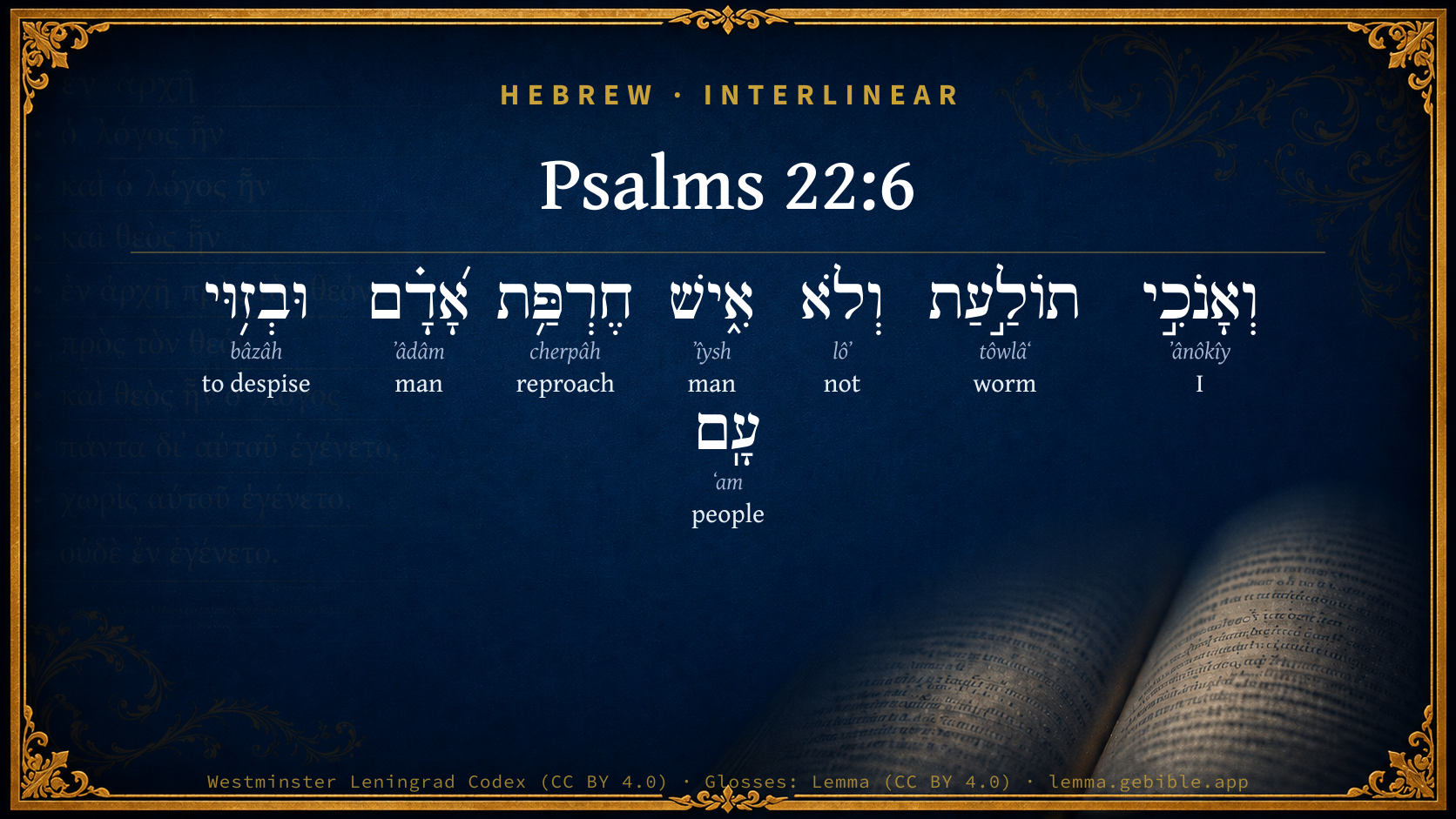
Hebrew (Westminster Leningrad Codex) Psalms 22:6 appears in the Hebrew Old Testament. The text above is from the Westminster Leningrad Codex. Each word links to its Strong’s number, a concise gloss, and parsing drawn from the Open Scriptures Hebrew Bible morphology. Click any word for its full Brown-Driver-Briggs (BDB) entry.
Download image
Cite this verse

Psalms 22:6 (World English Bible). Public Domain. Lemma interlinear Bible study tool, https://lemma.gebible.app/v/psalms/22/6.

Show BibTeX & RIS
BibTeX
RIS
English Translation
But I am a worm, and no man; A reproach of men, and despised by the people.
World English Bible · Public Domain
Download a study sheet

One document with this verse’s original text, its word-by-word gloss line, the meaning frame, cross-references with their text, attributed commentary, and full source and license credits — printable, and it pastes into notes with its structure intact.

This verse Autodidact and up

Study sheet (.html) Plain text (.txt)

A passage Seminary Student

Up to 50 verses in one chapter. A passage sheet keeps up to 6 commentary sources and 12 cross-references per verse, in the order this page ranks them, and says so on the sheet whenever that leaves anything out. Ask for a single verse and you get the Autodidact verse sheet above.

Everything on this page stays free to read, with no account — the sheet is a download of what is already on screen, not access to it.

Want to remove ads? Support Godless Engineer
Compare translations 3

The same verse in 3 English versions, stacked beneath the original-language interlinear above. Click any original word for its lexicon entry.

Each is an independent rendering of the whole verse — the interlinear is not word-aligned to these translations.

Highlighted words mark where these versions differ — a whole-verse word diff, not a word-by-word alignment.

  • World English Bible Public Domain
    But I am a worm, and no man; A reproach of men, and despised by the people.
  • King James Version Public Domain
    But I am a worm, and no man; a reproach of men, and despised of the people.
  • unfoldingWord Literal Text CC BY-SA 4.0
    But I am a worm and not a man, a reproach of mankind and despised by the people.

unfoldingWord Literal Text — © unfoldingWord, licensed CC BY-SA 4.0. Word-aligned USFM3 via Door43 (git.door43.org/unfoldingWord/en_ult).

Versions to compare (up to 4)

3 of 4 selected

Show all 18 translations

Every available English version of this verse, each an independent rendering of the whole verse.

  • World English Bible Public Domain
    But I am a worm, and no man; A reproach of men, and despised by the people.
  • Berean Standard Bible Public Domain
    But I am a worm and not a man, scorned by men and despised by the people.
  • Majority Standard Bible Public Domain
    But I am a worm and not a man, scorned by men and despised by the people.
  • King James Version Public Domain
    But I am a worm, and no man; a reproach of men, and despised of the people.
  • American Standard Version (1901) Public Domain
    But I am a worm, and no man; A reproach of men, and despised of the people.
  • Revised Version (1885) Public Domain
    But I am a worm, and no man; a reproach of men, and despised of the people.
  • Geneva Bible (1599) Public Domain
    But I am a worme, and not a man: a shame of men, and the contempt of the people.
  • Douay-Rheims (1899) Public Domain
    They cried to thee, and they were saved: they trusted in thee, and were not confounded.
  • Young's Literal Translation Public Domain
    And I `am' a worm, and no man, A reproach of man, and despised of the people.
  • Literal Standard Version CC BY-SA 4.0
    And I [am] a worm, and no man, || A reproach of man, and despised of the people.
  • Unlocked Literal Bible CC BY-SA 4.0
    But I am a worm and not a man, a disgrace to humanity and despised by the people.
  • unfoldingWord Literal Text CC BY-SA 4.0
    But I am a worm and not a man, a reproach of mankind and despised by the people.
  • Darby Bible Public Domain
    But I am a worm, and no man; a reproach of men, and the despised of the people.
  • World Messianic Bible Public Domain
    But I am a worm, and no man; a reproach of men, and despised by the people.
  • Webster's Bible Public Domain
    \\22:5\\They cried to thee, and were delivered: they trusted in thee, and were not confounded.
  • Free Bible Version CC BY-SA 4.0
    But I'm a worm, not a man, scorned and despised by everyone.
  • Bible in Basic English Public Domain
    But I am a worm and not a man; cursed by men, and looked down on by the people.
  • JPS Tanakh (1917) Public Domain
    (22-7) But I am a worm, and no man; a reproach of men, and despised of the people.

Literal Standard Version (2020), Covenant Press — licensed CC BY-SA 4.0. Text via the HelloAO Bible API (eBible.org). Unlocked Literal Bible (unfoldingWord) — licensed CC BY-SA 4.0. Text via the HelloAO Bible API (eBible.org). unfoldingWord Literal Text — © unfoldingWord, licensed CC BY-SA 4.0. Word-aligned USFM3 via Door43 (git.door43.org/unfoldingWord/en_ult). Free Bible Version, Dr. Jonathan Gallagher — licensed CC BY-SA 4.0. Text via the HelloAO Bible API (eBible.org).

Word by word

More ways to search: Search by grammar → Find every occurrence → Compare this word →

Practice this passage: Drill this verse → Learn its vocabulary →

About this verse

These counts appear in no published source. They are computed here, from the morphology-tagged text and Lemma’s own curated glosses. What Lemma adds →

8
words
8
distinct lemmas
Wisdom
section

Shared distinctive vocabulary

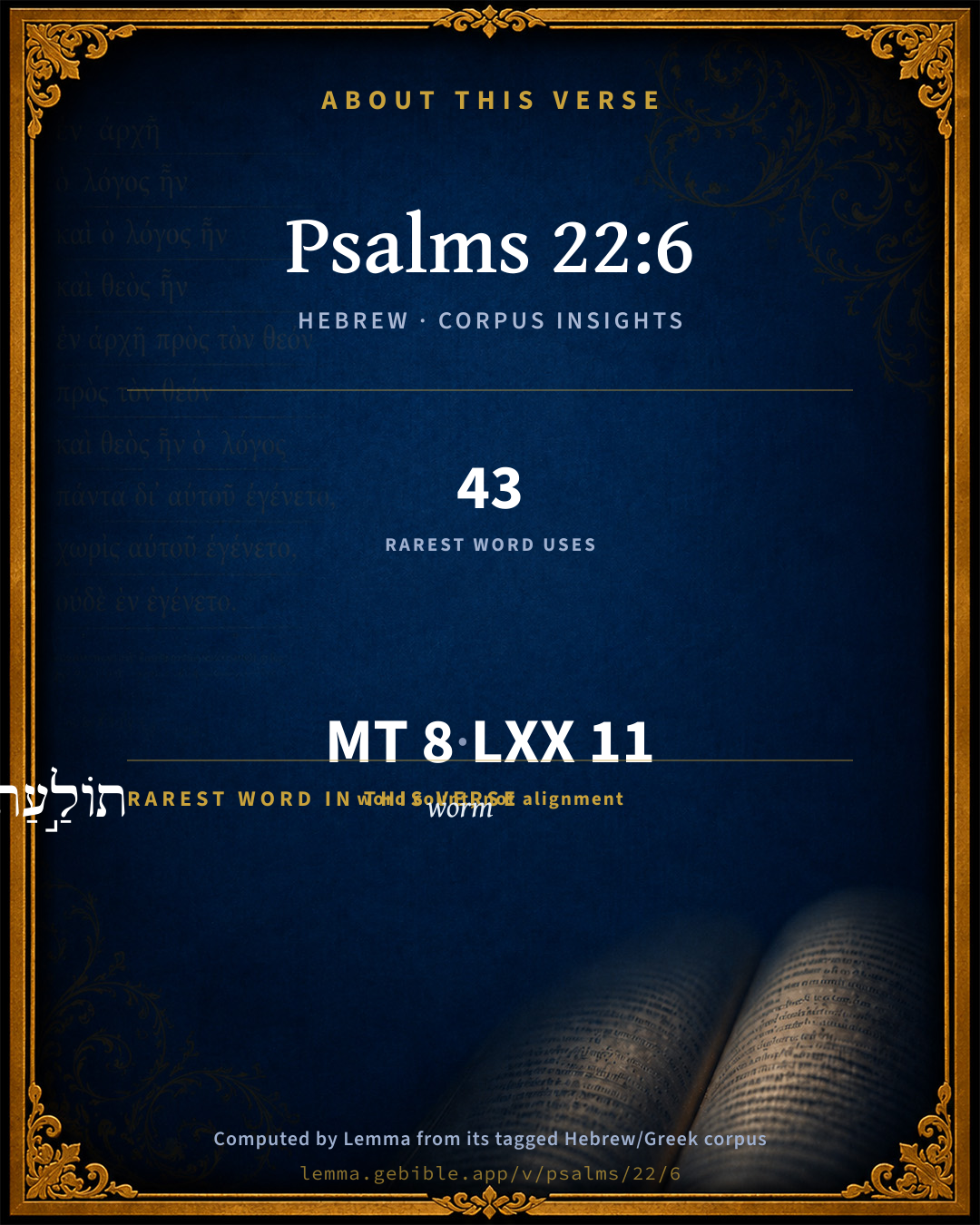
תוֹלַ֣עַת worm H8438 occurs in 43 verses of the Hebrew Bible. Also found in:

Grammatical profile

  • 1 verb
  • 5 nouns
  • 1 pronoun
  • 1 particle

Verb forms

  • וּבְז֥וּי Qal · Participle Passive

Hebrew & Septuagint length

In English translation the verse runs 17 words from the Hebrew and 18 from the Septuagint (LXX English) — closely comparable.

A rough comparison of the two English renderings, which tokenize alike — not a word-level alignment.

Word counts can differ between the Hebrew and the Greek without any difference in meaning — e.g. the Hebrew direct-object marker אֵת has no separate Greek word, and Greek often adds the article ὁ.

In the original languages it is 8 Hebrew tokens and 11 Greek tokens — but the two are counted differently (Hebrew bundles its prefixes and suffixes into one token; the Greek is in lemma form), so that isn’t a like-for-like length.

Cross-references

19

Topical passages linked to Psalms 22:6 in the Treasury of Scripture Knowledge — connected by theme and wording, ordered by reader-vote popularity; previews shown in the World English Bible.

  • Isaiah 53:3 He was despised, and rejected by men; a man of suffering, and acquainted with disease: and as one from whom men hide their face he was despised; and we didn't respect him.
  • Job 25:6 How much less man, who is a worm! The son of man, who is a worm!"
  • Isaiah 41:14 Don't be afraid, you worm Jacob, and you men of Israel; I will help you, says Yahweh, and your Redeemer is the Holy One of Israel.
  • Isaiah 49:7 Thus says Yahweh, the Redeemer of Israel, [and] his Holy One, to him whom man despises, to him whom the nation abhors, to a servant of rulers: Kings shall see and arise; princes, and they shall worship; because of Yahweh who is faithful, [even] the Holy One of Israel, who has chosen you.
  • Psalms 69:7–12 Because for your sake, I have borne reproach. Shame has covered my face.
  • Psalms 69:19–20 You know my reproach, my shame, and my dishonor. My adversaries are all before you.
  • Psalms 31:11 Because of all my adversaries I have become utterly contemptible to my neighbors, A fear to my acquaintances. Those who saw me on the street fled from me.
  • Matthew 11:19 The Son of Man came eating and drinking, and they say, 'Behold, a gluttonous man and a drunkard, a friend of tax collectors and sinners!' But wisdom is justified by her children."
  • Matthew 27:20–23 Now the chief priests and the elders persuaded the multitudes to ask for Barabbas, and destroy Jesus.
  • Lamentations 3:30 Let him give his cheek to him who strikes him; let him be filled full with reproach.
  • Hebrews 13:12 Therefore Jesus also, that he might sanctify the people through his own blood, suffered outside of the gate.
  • Revelation 15:3 They sang the song of Moses, the servant of God, and the song of the Lamb, saying, "Great and marvelous are your works, Lord God, the Almighty; Righteous and true are your ways, you King of the nations.
  • Psalms 88:8 You have taken my friends from me. You have made me an abomination to them. I am confined, and I can't escape.
  • Matthew 12:24 But when the Pharisees heard it, they said, "This man does not cast out demons, except by Beelzebul, the prince of the demons."
  • John 7:15 The Jews therefore marveled, saying, "How does this man know letters, having never been educated?"
  • John 7:47–49 The Pharisees therefore answered them, "You aren't also led astray, are you?
  • John 8:48 Then the Jews answered him, "Don't we say well that you are a Samaritan, and have a demon?"
  • Psalms 31:1 In you, Yahweh, I take refuge. Let me never be disappointed: Deliver me in your righteousness.
  • John 7:20 The multitude answered, "You have a demon! Who seeks to kill you?"

Cross-references courtesy of OpenBible.info (CC BY 4.0).

Hebrew and Greek witnesses Masoretic Hebrew ↔ Greek Septuagint

The same verse in the two great witnesses to the Old Testament, shown verse-for-verse.

You’re reading Greek Psalm 21 (Hebrew Psalm 22). The Septuagint counts the superscription, so verse numbers can differ from the Hebrew — chapter-level alignment, not verse-by-verse. Numbering follows Rahlfs.

These are two independent witnesses, not word-aligned to each other, and the Septuagint is shown in lemma (dictionary) form.

Hebrew Psalms 22:6 Masoretic · Westminster Leningrad Codex

וְאָנֹכִ֣י תוֹלַ֣עַת וְלֹא אִ֑ישׁ חֶרְפַּ֥ת אָ֝דָ֗ם וּבְז֥וּי עָֽם

But I am a worm, and no man; A reproach of men, and despised by the people.

World English Bible · Public Domain

Greek LXX Greek Psalm 21:6 Septuagint · lemma form

πρός σύ κράζω καί σώζω ἐπί σύ ἐλπίζω καί οὐ κατααἰσχύνω

But I am a worm, and not a man; a reproach of men, and scorn of the people.

LXX2012 (modern English Septuagint) · Public Domain

On this verse, Keil & Delitzsch discusses the Septuagint’s reading. Read the note in Commentary ↓

Hebrew: Westminster Leningrad Codex (CC BY 4.0). Greek: Septuagint (public domain); English from LXX2012 (modern English Septuagint) (Public Domain). How the Septuagint differs from the Hebrew →

Commentary

Notes on Psalms 22:6 from classic Christian and Jewish commentators (each source and its license shown beneath its notes). The classic Christian expositions comment on the surrounding passage and are grouped to its opening verse, so a note may address several verses; the Jewish commentaries on the Tanakh (Rashi and others) are per-verse, so they appear only where the commentator wrote on this verse.

Lemma curates 59 commentaries, every one of them public domain or Creative Commons licensed, each selected and text-cleaned for this edition rather than reprinted as found. About our sources →

John Gill's Exposition

But I am a worm, and no man,.... Christ calls himself a worm, not because of his original, for he was not of the earth earthy, but was the Lord from heaven; nor because of his human nature, man being a worm, and the Son of Man such, Job 25:6; and because of his meanness and low estate in that nature, in his humiliation; nor to express his humility, and the mean thoughts he had of himself, as David, his type, calls himself a dead dog, and a flea, Sa1 24:14; but on account of the opinion that men of the world had of him; so Jacob is called "a worm", Isa 41:14; not only because mean in his own eyes, but contemptible in the eyes of others. The Jews esteemed Christ as a worm, and treated him as such; he was loathsome to them and hated by them; everyone trampled upon him and trod him under foot as men do worms; such a phrase is used of him in Heb 10:29; there is an agreement in some things between the worm and Christ in his state of humiliation; as in its uncomeliness and disagreeable appearance; so in Christ the Jews could discern no form nor comeliness wherefore he should be desired; and in its weakness, the worm being an impotent, unarmed, and defenceless creatures, hence the Chaldee paraphrase renders it here "a weak worm"; and though Christ is the mighty God, and is also the Son of Man whom God made strong for himself, yet mere was a weakness in his human nature and he was crucified through it, Co2 13:4; and it has been observed by some, that the word here used signifies the scarlet worm, or the worm that is in the grain or berry with which scarlet is dyed; and like, is scarlet worm did our Lord look, when by way of mockery be was clothed with a scarlet robe; and especially when he appeared in his dyed garments, and was red in his apparel, as one that treadeth in the wine fat; when his body was covered with blood when he hung upon the cross, which was shed to make crimson and scarlet sins as white as wool. When Christ says he was "no man", his meaning is, not that he was not truly and really man, for he assumed a true body and a reasonable soul; he partook of the same flesh and blood with his children, and was in all things made like unto his brethren, excepting sin; but that he was a man of no figure, he bore no office, and had no title of honour; he was not a Rabbi, nor a member of the Jewish sanhedrim; he had no share of government, either in the civil or ecclesiastic state; he was a carpenter's son, and a carpenter; nor was he treated as a man, but in the most inhuman manner; he was despised and rejected of men, he was called a madman, and said to have a devil;

a reproach of men; he was reproached by men, as if he had been the worst of men; the reproaches of God and of his people all fell on him, insomuch that his heart was broken with them; see Psa 69:7; and it was reckoned a reproach to men to be seen in his company, or to be thought to belong to him, and be a disciple of his; hence some, who believed he was the Messiah, yet would not confess him, because they loved the praise of men more than the praise of God, Joh 12:42;

and despised of the people; rejected with contempt as the Messiah, refused with scorn as the stone of Israel, disallowed of men, and set at nought by them; by "the people" are meant the people of the Jews, his own people and nation; which contempt of him they signified both by gestures and words, as in the following verses.

(When the female of the scarlet worm species was ready to give birth to her young, she would attach her body to the trunk of a tree, fixing herself so firmly and permanently that she would never leave again. The eggs deposited beneath her body were thus protected until the larvae were hatched and able to enter their own life cycle. As the mother died, the crimson fluid stained her body and the surrounding wood. From the dead bodies of such female scarlet worms, the commercial scarlet dyes of antiquity were extracted. (x) What a picture this gives of Christ, dying on the tree, shedding his precious blood that he might "bring many sons unto glory" (Heb 2:10)! He died for us, that we might live through him! Psa 22:6 describes such a worm and gives us this picture of Christ. (cf. Isa 1:18) Editor.)

(x) Dr. Henry Morris, "Biblical Basis for Modern Science", p. 73. Baker Book House, 1985.

John Gill's Exposition of the Whole Bible (1746–1763) — public domain (CC PDM 1.0). Text via the HelloAO Bible API.

Trapp's Complete Commentary

John Trapp

Psa 22:6 But I [am] a worm, and no man; a reproach of men, and despised of the people.

Ver. 6. But I am a worm, and no man] David, saith a learned man, in the Arabic tongue signifieth a worm; to which he may here seem to allude. I am a worm, saith he; I am dust and ashes, saith Abraham; less than the least of thy lovingkindnesses, saith Jacob; Nos autem quid sumus? saith Moses. Thus the saints express themselves in a low language, as so many broken men. Contrarily the wicked speak big words, bubbles of words, as Peter hath it, ampullantur; as Pharaoh, who said, "Who is the Lord?" Nebuchadnezzar, "Who is that God that can deliver you?" Dan 3:15; "Who is Lord over us?" &c., Psa 12:4. Our Lord Christ, of whom the greatest part of this psalm must be understood, emptied and humbled himself to the utmost, Php 2:7-8, that we might be exalted; this Sun of righteousness went ten degrees back in the dial of his Father, that he might come unto us with health in his wings, &c.

A reproach of men] Reiectamentum hominis, et nullificamen populi, as Tertullian phraseth it. So was Christ, Isa 53:1-12; so were his apostles, 1Co 4:13; we are made the sweepings of the world, the offscourings of all things, the very dung cart into which every man casteth his filth to be carried through the dung port. Why, then, should we think much to be slighted?

John Trapp, A Commentary or Exposition upon All the Books of the Old and New Testament (1647–1656) — public domain. Text from a community e-Sword module.

Joseph Benson's Commentary

Psa 22:6. But I am a worm, and no man — Neglected and despised, as a mean reptile; a reproach of men, and despised of the people — Not only of the great men, but also of the common people. This does not so truly agree to David (who, though he was hated and persecuted by Saul and his courtiers, was honoured and beloved by the body of the people) as to Christ: see Isa 53:2-3. “Christ may be said to have been a worm. with respect to the mean and poor condition in which he lived; but especially to that kind of death which he suffered; for he was stripped of his clothes, and fixed upon the cross, naked as a worm of the earth.” — Dodd. See Php 2:7; Mat 27:39-43.

Joseph Benson's Commentary on the Old and New Testaments (1811–1818) — public domain. Text from a community e-Sword module.

J. A. Alexander on Psalms

Joseph Addison Alexander

7. (Psa 22:6). And I (am) a worm, and not a man; a reproach of men, and despised of the people. The pronoun expressed at the beginning is emphatic. I, as contrasted with my fathers. Our idiom would here require an adversative particle, but I, the use of which is much less frequent in Hebrew. See above, on Psa 2:6. The insignificance and meanness of mankind in general are elsewhere denoted by the figure of a worm (Job 25:6). But even in comparison with these, the sufferer is a worm, i.e. an object of contemptuous pity, because apparently forsaken of God, and reduced to a desperate extremity. (Compare Isa 41:14, and 1Sa 24:15.) A reproach of mankind, despised by them, and disgraceful to them.—The people, not a single person or a few, but the community at large.

Joseph Addison Alexander, The Psalms Translated and Explained (1850) — public domain. Text from a community e-Sword module.

Tyndale Open Study Notes

Tyndale Open Resources

22:6-8 Both the Lord and people reject the psalmist. He vividly describes his anguish (22:1-2); he lives like a lowly animal.

Tyndale Open Study Notes — © Tyndale Open Resources, licensed CC BY-SA 4.0. Text via the HelloAO Bible API.

Geneva Bible (1599)

Geneva Bible translators

And seeming most miserable of all creatures, which was meant of Christ. And herein appeareth the unspeakable love of God toward man, that he would thus abase his Son for our sakes.

Geneva Bible (1599) marginal notes — public domain. Text via Bolls.life.

Jamieson, Fausset & Brown

Robert Jamieson, A. R. Fausset & David Brown

He who was despised and rejected of His own people, as a disgrace to the nation, might well use these words of deep abasement, which express not His real, but esteemed, value.

Jamieson, Fausset & Brown — Commentary Critical and Explanatory on the Whole Bible (1871) — public domain (CC PDM 1.0). Text via the HelloAO Bible API.

Adam Clarke's Commentary

Verse 6. But I am a worm, and no man] I can see no sense in which our Lord could use these terms. David might well use them to express his vileness and worthlessness. The old Psalter gives this a remarkable turn: I am a worme, that es, I am borne of the mayden with outen manseede; and nout man anely, bot god als so: and nevir the latter, I am reprove of men. In spitting, buffetyng, and punging with the thornes and outkasting of folk; for thai chesed Barraban the thefe, and nought me.

Adam Clarke's Commentary on the Bible (1810–1826) — public domain. Text from a community e-Sword/MySword module.

John Calvin's Commentaries

6. But I am a worm, and not a man. David does not murmur against God as if God had dealt hardly with him; but in bewailing his condition, he says, in order the more effectually to induce God to show him mercy, that he is not accounted so much as a man. This, it is true, seems at first sight to have a tendency to discourage the mind, or rather to destroy faith; but it will appear more clearly from the sequel, that so far from this being the case, David declares how miserable his condition is, that by this means he may encourage himself in the hope of obtaining relief. He therefore argues that it could not be but that God would at length stretch forth his hand to save him; to save him, I say, who was so severely afflicted, and on the brink of despair. If God has had compassion on all who have ever been afflicted, although afflicted only in a moderate degree, how could he forsake his servant when plunged in the lowest abyss of all calamities? Whenever, therefore, we are overwhelmed under a great weight of afflictions, we ought rather to take from this an argument to encourage us to hope for deliverance, than suffer ourselves to fall into despair. If God so severely exercised his most eminent servant David, and abased him so far that he had not a place even among the most despised of men, let us not take it ill, if, after his example, we are brought low. We ought, however, principally to call to our remembrance the Son of God, in whose person we know this also was fulfilled, as Isaiah had predicted,

“He is despised and rejected of men; a man of sorrows, and acquainted with grief and we hid as it were our faces from him; he was despised, and we esteemed him not.” (Isaiah 53:3)

By these words of the prophet we are furnished with a sufficient refutation of the frivolous subtlety of those who have philosophised upon the word worm, as if David here pointed out some singular mystery in the generation of Christ; whereas his meaning simply is, that he had been abased beneath all men, and, as it were, cut off from the number of living beings. The fact that the Son of God suffered himself to be reduced to such ignominy, yea, descended even to hell, is so far from obscuring, in any respect, his celestial glory, that it is rather a bright mirror from which is reflected his unparalleled grace towards us.

John Calvin's Commentaries (1540-1563) — public domain. Text from the Calvin Translation Society English edition (1840s-50s) via the Christian Classics Ethereal Library (ccel.org). Calvin's coverage is partial (roughly two-thirds of the Bible); uncommented books and verses are honest gaps, never fabricated. The 19th-century editor's footnotes and remarks are omitted so the notes are faithfully Calvin's own voice.

Ellicott's Commentary for English Readers

(6) Worm.—An indication of extreme degradation and helplessness. (Comp. Isa_41:14.)

A Bible Commentary for English Readers, edited by Charles John Ellicott (1878–1897) — public domain. Text from a community e-Sword module.

The Cambridge Bible for Schools and Colleges

gen. ed. J. J. S. Perowne

6. a worm] Trampled under foot, despised, defenceless. Almost every word of this verse finds a parallel in the second part of Isaiah. Jehovah’s servant Israel is there called a worm (Isa_41:14); and the ideal representative of Israel is one whom men despise (Isa_49:7, Isa_53:3); from whom they shrink with horror as scarcely human (Isa_52:14, Isa_53:2-3). Comp. too Psa_51:7.

the people] Or, people, generally; those with whom he is brought in contact.

6, 7. The contrast of his own lot.

The Cambridge Bible for Schools and Colleges (gen. ed. J. J. S. Perowne; Cambridge University Press, 1878–1918) — public domain. Text from a community e-Sword module.

Albert Barnes' Notes on the Bible

But I am a worm, and no man - In contrast with the fathers who trusted in thee. They prayed, and were heard; they confided in God, and were treated as men. I am left and forsaken, as if I were not worth regarding; as if I were a grovelling worm beneath the notice of the great God. In other words, I am treated as if I were the most insignificant, the most despicable, of all objects - alike unworthy the attention of God or man. By the one my prayers are unheard; by the other I am cast out and despised. Compare Job 25:6. As applicable to the Redeemer, this means that he was forsaken alike by God and men, as if he had no claims to the treatment due to a “man.”

A reproach of men - Reproached by men. Compare Isa 53:3, and the notes at that verse.

Despised of the people - That is, of the people who witnessed his sufferings. It is not necessary to say how completely this had a fulfillment in the sufferings of the Saviour.

Albert Barnes' Notes on the Bible (1834–1885) — public domain. Text from a community e-Sword/MySword module.

Matthew Poole's English Annotations

Our fathers were honoured by thee and by others, because of thy appearance for their defence and deliverance; but I am treated like a worm, i.e. neglected and despised, both by thee, who dost not afford me help, and by the men of my age and nation, as it follows. For the phrase, see Job 25:6; Isa 41:14.

Despised of the people; not only of the great men, but also of the common people; which doth not so truly agree to David (who, though he was hated and persecuted by Saul and his courtiers, was honoured and beloved by the body of the people) as to Christ: compare Isa 53:2,3.

Matthew Poole's English Annotations on the Holy Bible (1683–1685) — public domain. Text from a community e-Sword/MySword module.

The Treasury of David

Charles H. Spurgeon

Ver. 6. But I am a worm, and no man. This verse is a miracle in language. How could the Lord of glory be brought to such abasement as to be not only lower than the angels, but even lower than men. What a contrast between "I AM" and "I am a worm"! yet such a double nature was found in the person of our Lord Jesus when bleeding upon the tree. He felt himself to be comparable to a helpless, powerless, down trodden worm, passive while crushed, and unnoticed and despised by those who trod upon him. He selects the weakest of creatures, which is all flesh; and becomes, when trodden upon, writhing, quivering flesh, utterly devoid of any might except strength to suffer. This was a true likeness of himself when his body and soul had become a mass of miserythe very essence of agonyin the dying pangs of crucifixion. Man by nature is but a worm; but our Lord puts himself even beneath man, on account of the scorn that was heaped upon him and the weakness which he felt, and therefore he adds, "and no man." The privileges and blessings which belonged to the fathers he could not obtain while deserted by God, and common acts of humanity were not allowed him, for he was rejected of men; he was outlawed from the society of earth, and shut out from the smile of heaven. How utterly did the Saviour empty himself of all glory, and become of no reputation for our sakes!

A reproach of men their common butt and jest; a byword and a proverb unto them: the sport of the rabble, and the scorn of the rulers. Oh the caustic power of reproach, to those who endure it with patience, yet smart under it most painfully!

And despised of the people. The vox populi was against him. The very people who would once have crowned him then contemned him, and they who were benefited by his cures sneered at him in his woes. Sin is worthy of all reproach and contempt, and for this reason Jesus, the Sin bearer, was given up to be thus unworthily and shamefully entreated.

Ver. 6. But I am a worm, and no man. A fisherman, when he casts his angle into the river, doth not throw the hook in bare, naked and uncovered, for then he knows the fish will never bite, and therefore he hides the hook within a worm, or some other bait, and so, the fish, biting at the worm, is caught by the hook. Thus Christ, speaking of himself, saith, "Ego vermis et non homo." He, coming to perform the great work of our redemption, did cover and hide his Godhead within the worm of his human nature. The grand water serpent, Leviathan, the devil, thinking to swallow the worm of his humanity, was caught upon the hook of his divinity. This hook stuck in his jaws, and tore him very sore. By thinking to destroy Christ, he destroyed his own kingdom, and lost his own power for ever. Lancelot Andrewes.

Ver. 6. I am a worm. Christ calls himself "a worm"... on account of the opinion that men of the world had of him... the Jews esteemed Christ as a worm, and treated him as such; he was loathsome to them and hated by them; every one trampled upon him, and trod him under foot as men do worms... The Chaldee paraphrase renders it here a weak worm; and though Christ is the mighty God, and is also the Son of man, whom God made strong for himself; yet there was a weakness in his human nature, and he was crucified through it, 2Co 13:4: and it has been observed by some, that the word (telwt) there used signifies the scarlet worm, or the worm that is in the grain or berry with which scarlet is dyed: and like this scarlet worm did our Lord look, when by way of mockery he was clothed with a scarlet robe; and especially when he appeared in his dyed garments, and was red in his apparel, as one that treadeth in the wine fat; when his body was covered with blood when he hung upon the cross, which was shed to make crimson and scarlet sins as white as snow. John Gill.

Ver. 6. I am a worm. An humble soul is emptied of all swelling thoughts of himself. Bernard calls humility a self annihilation. Job 22:29. "Thou wilt save the humble; "in the Hebrew it is, "Him that is of low eyes." An humble man has lower thoughts of himself than others can have of him; David, though a king, yet looked upon himself as "a worm:" "I am a worm, and no man." Bradford, a martyr, yet subscribes himself "a sinner." Job 10:15. "If I be righteous, yet will I not lift up my head:" like the violet a sweet flower, but hangs down the head. Thomas Watson.

Ver. 6. A worm. So trodden under foot, trampled on, maltreated, buffeted and spit upon, mocked and tormented, as to seem more like a worm than a man. Behold what great contempt hath the Lord of Majesty endured, that his confusion may be our glory; his punishment our heavenly bliss! Without ceasing impress this spectacle, O Christian, on thy soul! Dionysius, quoted by Isaac Williams.

Ver. 6. I am a worm. Among the Hindus, when a man complains and abhors himself, he asks; "What am I! a worm! a worm!" "Ah, the proud man!" he regarded me as a worm, well should I like to say to him, "We are all worms." "Worm, crawl out of my presence." Joseph Roberts.

Ver. 6-18. Full of striking sentences upon our Lord's suffering.

Psalms 22:7*

Ver. 6-18. Full of striking sentences upon our Lord's suffering.

Psalms 22:8*

Ver. 6-18. Full of striking sentences upon our Lord's suffering.

Psalms 22:9*

Ver. 6-18. Full of striking sentences upon our Lord's suffering.

Psalms 22:10*

Ver. 6-18. Full of striking sentences upon our Lord's suffering.

Psalms 22:11*

The crucified Son of David continues to pour out his complaint and prayer. We need much grace that while reading we may have fellowship with his sufferings. May the blessed Spirit conduct us into a most clear and affecting sight of our Redeemer's woes.

Ver. 6-18. Full of striking sentences upon our Lord's suffering.

Ver. 6-18. Full of striking sentences upon our Lord's suffering.

Psalms 22:13*

Ver. 6-18. Full of striking sentences upon our Lord's suffering.

Psalms 22:14*

Ver. 6-18. Full of striking sentences upon our Lord's suffering.

Psalms 22:15*

Ver. 6-18. Full of striking sentences upon our Lord's suffering.

Psalms 22:16*

Ver. 6-18. Full of striking sentences upon our Lord's suffering.

Psalms 22:17*

Ver. 6-18. Full of striking sentences upon our Lord's suffering.

Psalms 22:18*

Ver. 6-18. Full of striking sentences upon our Lord's suffering.

Psalms 22:19*

Charles H. Spurgeon's The Treasury of David (1869–1885) — public domain. Psalms only. Text from a community e-Sword/MySword module.

Whedon's Commentary on the Bible

Daniel D. Whedon

6. But I am a worm, and no man—The contrast is with the “fathers.” They trusted and were helped, “but I, ah! a worm and not a man.” Nothing can exceed these verses in plaintive tenderness, in humility, and in childlike clinging to God. The word תולעת, (tholaath,) rendered “worm,” is here used proverbially for lowness, vileness, insignificance; and it is literally the name of the scarlet worm, (coccus ilicis,) an insignificant insect which fed on plants, chiefly the holm oak. It was extensively used for scarlet dye.

A reproach of men… despised—Comp. Isa_53:3; Mat_27:21-31

Daniel D. Whedon (gen. ed.), Commentary on the Old and New Testaments (1874–1909) — public domain. Text from a community e-Sword module.

The Pulpit Commentary

But I am a worm, and no man. (comp. Job_25:6 Isa_41:14) The worm is a symbol of extreme weakness and helplessness it is naturally despised, derided, trodden upon. A reproach of men, and despised of the people. (Comp. Isa_49:7 Isa_53:3; and for the fulfilment, see Mat_27:39) How deeply Christ was "despised of the people" appeared most evidently when they expressed their desire that, instead of him, a murderer should be granted to them. (Act_3:14)

The Pulpit Commentary (1880–1919), ed. H.D.M. Spence-Jones & Joseph S. Exell — public domain. Text from a community e-Sword module.

John Wesley's Explanatory Notes

A worm - Neglected and despised. People - Not only of the great men, but also of the common people. Which doth not so truly agree to David as to Christ.

John Wesley, Explanatory Notes Upon the Whole Bible (1754–1765) — public domain. Text via the GEBible commentary corpus.

Keil & Delitzsch

C. F. Keil & F. Delitzsch

(Heb.: 22:7-9)The sufferer complains of the greatness of his reproach, in order to move Jahve, who is Himself involved therein, to send him speedy succour. Notwithstanding his cry for help, he is in the deepest affliction without rescue. Every word of Psa 22:7 is echoed in the second part of the Book of Isaiah. There, as here, Israel is called a worm, Isa 41:14; there all these traits of suffering are found in the picture of the Servant of God, Isa 49:7; Isa 53:3, cf. Isa 50:6, and especially Isa 52:14 "so marred was His appearance, that He no longer looked like a man." תּולעת is more particularly the kermes, or cochineal (vermiculus, whence color vermiculi, vermeil, vermiglio); but the point of comparison in the present instance is not the blood-red appearance, but the suffering so utterly defenceless and even ignominious. עם is gen. subj., like גּוי, Isa 49:7. Jerome well renders the ἐξουθένωμα λαοῦ of the lxx by abjectio (Tertullian: nullificamen) plebis, not populi. The ἐξεμυκτήρισάν με, by which the lxx translates ילעיגו לי, is used by Luke, Luk 23:35, cf. Luk 16:14, in the history of the Passion; fulfilment and prediction so exactly coincide, that no more adequate expressions can be found in writing the gospel history than those presented by prophecy. In הפטיר בּשׂפה, what appears in other instances as the object of the action (to open the mouth wide, diducere labia), is regarded as the means of its execution; so that the verbal notion being rendered complete has its object in itself: to make an opening with the mouth, cf. פּער בּפה, Job 16:10, נתן בּקול Psa 68:34; Ges. 138, 1, rem. 3. The shaking of the head is, as in Psa 109:25, cf. Psa 44:15; Psa 64:9, a gesture of surprise and astonishment at something unexpected and strange, not a προσνεύειν approving the injury of another, although נוּע, נוּד, נוּט, νεύ-ω, nu-t-o, nic-to, neigen, nicken, all form one family of roots. In Psa 22:9 the words of the mockers follow without לאמר. גּל is not the 3 praet. (lxx, cf. Mat 27:43) like אור, בּושׁ; it is not only in Piel (Jer 11:20; Jer 20:12, where גּלּיתי = גּלּלתּי, Ew. 121, a) that it is transitive, but even in Kal; nor is it inf. absol. in the sense of the imperative (Hitz., Bttch.), although this infinitive form is found, but always only as an inf. intens. (Num 23:25; Rut 2:16, cf. Isa 24:19); but, in accordance with the parallels Psa 37:5 (where it is written גּול), Pro 16:3, cf. Psa 55:23; Pe1 5:7, it is imperat.: roll, viz., thy doing and thy suffering to Jahve, i.e., commit it to Him. The mockers call out this גּל to the sufferer, and the rest they say of him with malicious looks askance. כּי in the mouth of the foes is not confirmatory as in Psa 18:20, but a conditional ἐάν (in case, provided that).

Keil & Delitzsch — Biblical Commentary on the Old Testament (1861–1891) — public domain (CC PDM 1.0). Text via the HelloAO Bible API. (Old Testament only.)

unfoldingWord translationNotes

Door43 World Missions Community

I am a worm and not a man

The writer speaks of himself as if he were a worm. This emphasizes that he feels worthless or that the people treat him as if he were worthless. AT: "But it is like I am a worm and not a man" (See: Metaphor)

disgrace to humanity and despised by the people

Both of these phrase mean basically the same thing. The phrase "despised by the people" can be stated in active form. AT: "everyone thinks I am worthless and the people hate me" (See: Parallelism and Active or Passive)

taunt me; they mock me; they shake their heads at me

These three phrases share similar meanings and emphasize how much people disrespect him. (See: Parallelism)

they shake their heads at me

This describes an action used to mock someone. (See: Symbolic Action)

He trusts in Yahweh ... delights in him

The people are saying this to mock the writer. They do not really believe Yahweh will rescue him. (See: Irony)

Let him rescue him

"Let Yahweh rescue him"

for he delights in him

Possible meanings are 1) "for Yahweh delights in him" or 2) "for he delights in Yahweh"

translationWords

disgrace

mock

trust

Yahweh

delight

unfoldingWord translationNotes — © Distant Shores Media and the Door43 World Missions Community, licensed CC BY-SA 4.0. Source: git.door43.org/Door43/en_tn.

Radak

Rabbi David Kimhi (Radak)

They cried unto Thee, and escaped: – not to other gods. Therefore

In Thee they trusted, and were not ashamed: – They shall not be put to shame by reason of their ruin.

Radak on the Tanakh — English translations: “Sefaria Community Translation” (CC0 1.0 (public-domain dedication)); “Eliyahu Munk, HaChut Hameshulash” (CC BY 4.0); “Rabbi Mike Feuer, Jerusalem Anthology” (CC BY 4.0); and “R. David Kimhi on the first book of Psalms, Translated by R.G. Finch, London, 1919” (public domain). Text via Sefaria.

Lesson kit

Teaching starters — assembled from the data on this page, not authored interpretation. Every prompt links to the verse data it draws on. Edit before teaching.

Psalms, in the Wisdom, opens this verse with 8 words (8 distinct Hebrew lemmas). Its most distinctive word is tôwlâʻ (“worm”). A historical commentator’s framing appears above. Read the whole chapter for the surrounding context.

Discussion questions

  1. What does “worm” (tôwlâʻ) contribute to the verse as a whole?
  2. Exodus 16:20 shares the word «worm» with this verse. How do the two illuminate each other?
  3. These translations render this verse differently; the difference is in the English rendering, not the original. What questions does that raise?
  4. The verb «וּבְז֥וּי» is Qal Participle Passive. How does its form color the action?
  5. Reading how John Gill's Exposition and Trapp's Complete Commentary read this verse, where do the two commentators agree and where do they part?

Things to notice

Reading settings

Reading text

Shown beneath each verse's original-language words.

Old Testament
Old Testament edition

Read the OT as the Masoretic Hebrew (MT) or the Greek Septuagint (LXX).

English shown for the Greek Septuagint (in the Hebrew ↔ Greek comparison).

Comparing translations? Open the Compare panel on any verse page to stack up to four side by side.