
Psalms 45:12

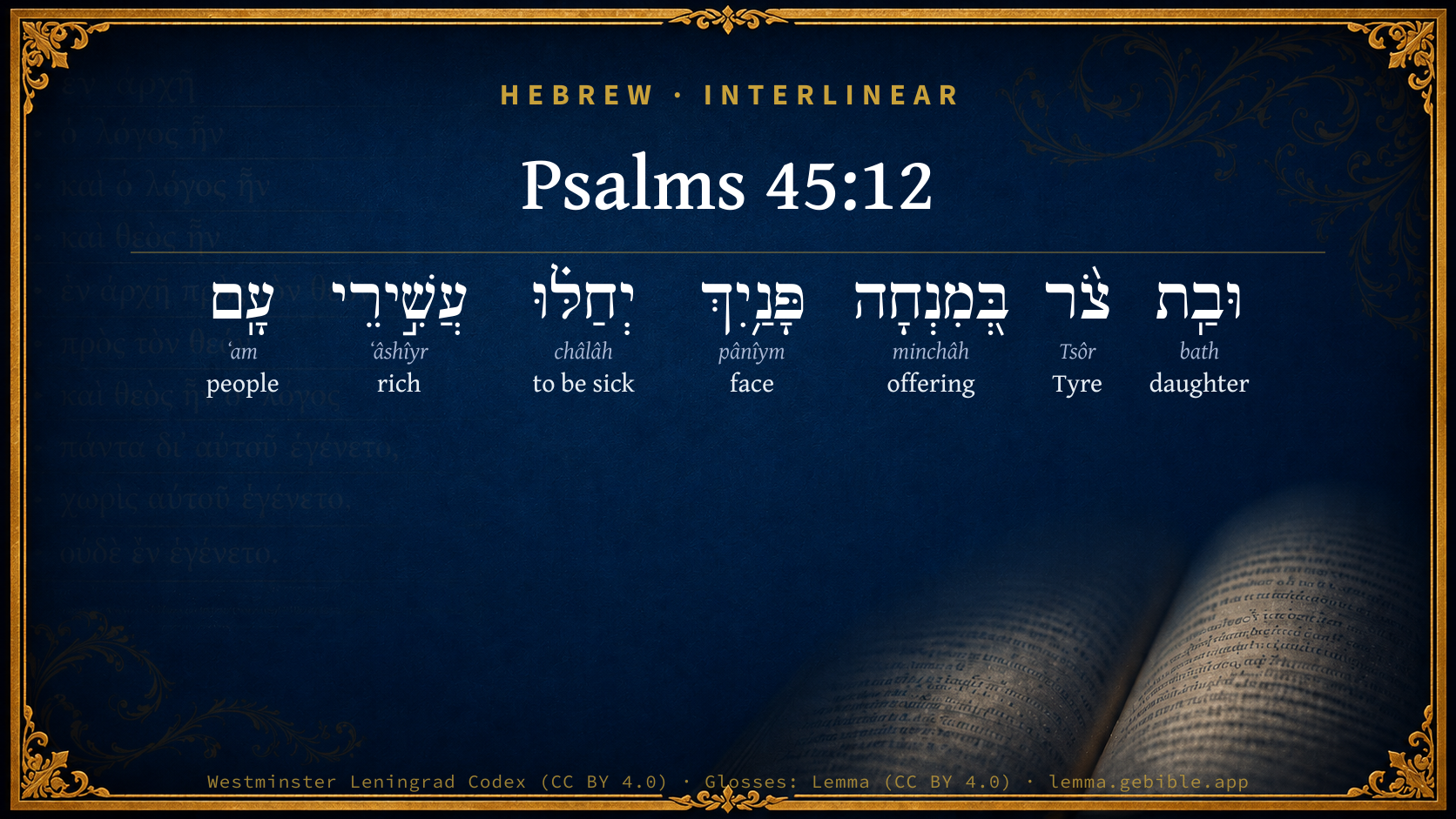
Hebrew (Westminster Leningrad Codex) Psalms 45:12 appears in the Hebrew Old Testament. The text above is from the Westminster Leningrad Codex. Each word links to its Strong’s number, a concise gloss, and parsing drawn from the Open Scriptures Hebrew Bible morphology. Click any word for its full Brown-Driver-Briggs (BDB) entry.
Download image
Cite this verse

Psalms 45:12 (World English Bible). Public Domain. Lemma interlinear Bible study tool, https://lemma.gebible.app/v/psalms/45/12.

Show BibTeX & RIS
BibTeX
RIS
English Translation
The daughter of Tyre comes with a gift. The rich among the people entreat your favor.
World English Bible · Public Domain
Download a study sheet

One document with this verse’s original text, its word-by-word gloss line, the meaning frame, cross-references with their text, attributed commentary, and full source and license credits — printable, and it pastes into notes with its structure intact.

This verse Autodidact and up

Study sheet (.html) Plain text (.txt)

A passage Seminary Student

Up to 50 verses in one chapter. A passage sheet keeps up to 6 commentary sources and 12 cross-references per verse, in the order this page ranks them, and says so on the sheet whenever that leaves anything out. Ask for a single verse and you get the Autodidact verse sheet above.

Everything on this page stays free to read, with no account — the sheet is a download of what is already on screen, not access to it.

Want to remove ads? Support Godless Engineer
Compare translations 3

The same verse in 3 English versions, stacked beneath the original-language interlinear above. Click any original word for its lexicon entry.

Each is an independent rendering of the whole verse — the interlinear is not word-aligned to these translations.

Highlighted words mark where these versions differ — a whole-verse word diff, not a word-by-word alignment.

  • World English Bible Public Domain
    The daughter of Tyre comes with a gift. The rich among the people entreat your favor.
  • King James Version Public Domain
    And the daughter of Tyre shall be there with a gift; even the rich among the people shall intreat thy favour.
  • unfoldingWord Literal Text CC BY-SA 4.0
    The daughter of Tyre with a gift; the rich of the people will entreat your face.

unfoldingWord Literal Text — © unfoldingWord, licensed CC BY-SA 4.0. Word-aligned USFM3 via Door43 (git.door43.org/unfoldingWord/en_ult).

Versions to compare (up to 4)

3 of 4 selected

Show all 18 translations

Every available English version of this verse, each an independent rendering of the whole verse.

  • World English Bible Public Domain
    The daughter of Tyre comes with a gift. The rich among the people entreat your favor.
  • Berean Standard Bible Public Domain
    The Daughter of Tyre will come with a gift; men of wealth will seek your favor.
  • Majority Standard Bible Public Domain
    The Daughter of Tyre will come with a gift; men of wealth will seek your favor.
  • King James Version Public Domain
    And the daughter of Tyre shall be there with a gift; even the rich among the people shall intreat thy favour.
  • American Standard Version (1901) Public Domain
    And the daughter of Tyre `shall be there' with a gift; The rich among the people shall entreat thy favor.
  • Revised Version (1885) Public Domain
    And the daughter of Tyre shall be there with a gift; even the rich among the people shall entreat thy favour.
  • Geneva Bible (1599) Public Domain
    And the daughter of Tyrus with the rich of the people shall doe homage before thy face with presents.
  • Douay-Rheims (1899) Public Domain
    And the king shall greatly desire thy beauty; for he is the Lord thy God, and him they shall adore.
  • Young's Literal Translation Public Domain
    And the daughter of Tyre with a present, The rich of the people do appease thy face.
  • Literal Standard Version CC BY-SA 4.0
    And the daughter of Tyre with a present, || The rich of the people appease your face.
  • Unlocked Literal Bible CC BY-SA 4.0
    The daughter of Tyre will be there with a gift; the rich among the people will beg for your favor.
  • unfoldingWord Literal Text CC BY-SA 4.0
    The daughter of Tyre with a gift; the rich of the people will entreat your face.
  • Darby Bible Public Domain
    And the daughter of Tyre with a gift, the rich ones among the people, shall court thy favour.
  • World Messianic Bible Public Domain
    The daughter of Tyre comes with a gift. The rich among the people entreat your favor.
  • Webster's Bible Public Domain
    \\45:11\\So shall the king greatly desire thy beauty: for he is thy lord; and worship thou him.
  • Free Bible Version CC BY-SA 4.0
    The people of Tyre will come with gifts; rich people will look for your favor.
  • Bible in Basic English Public Domain
    And the daughters of Tyre will be there with an offering; those who have wealth among the people will be looking for your approval.
  • JPS Tanakh (1917) Public Domain
    (45-13) And, O daughter of Tyre, the richest of the people shall entreat thy favour with a gift.'

Literal Standard Version (2020), Covenant Press — licensed CC BY-SA 4.0. Text via the HelloAO Bible API (eBible.org). Unlocked Literal Bible (unfoldingWord) — licensed CC BY-SA 4.0. Text via the HelloAO Bible API (eBible.org). unfoldingWord Literal Text — © unfoldingWord, licensed CC BY-SA 4.0. Word-aligned USFM3 via Door43 (git.door43.org/unfoldingWord/en_ult). Free Bible Version, Dr. Jonathan Gallagher — licensed CC BY-SA 4.0. Text via the HelloAO Bible API (eBible.org).

Word by word

More ways to search: Search by grammar → Find every occurrence → Compare this word →

Practice this passage: Drill this verse → Learn its vocabulary →

About this verse

These counts appear in no published source. They are computed here, from the morphology-tagged text and Lemma’s own curated glosses. What Lemma adds →

7
words
7
distinct lemmas
Wisdom
section

Notable vocabulary

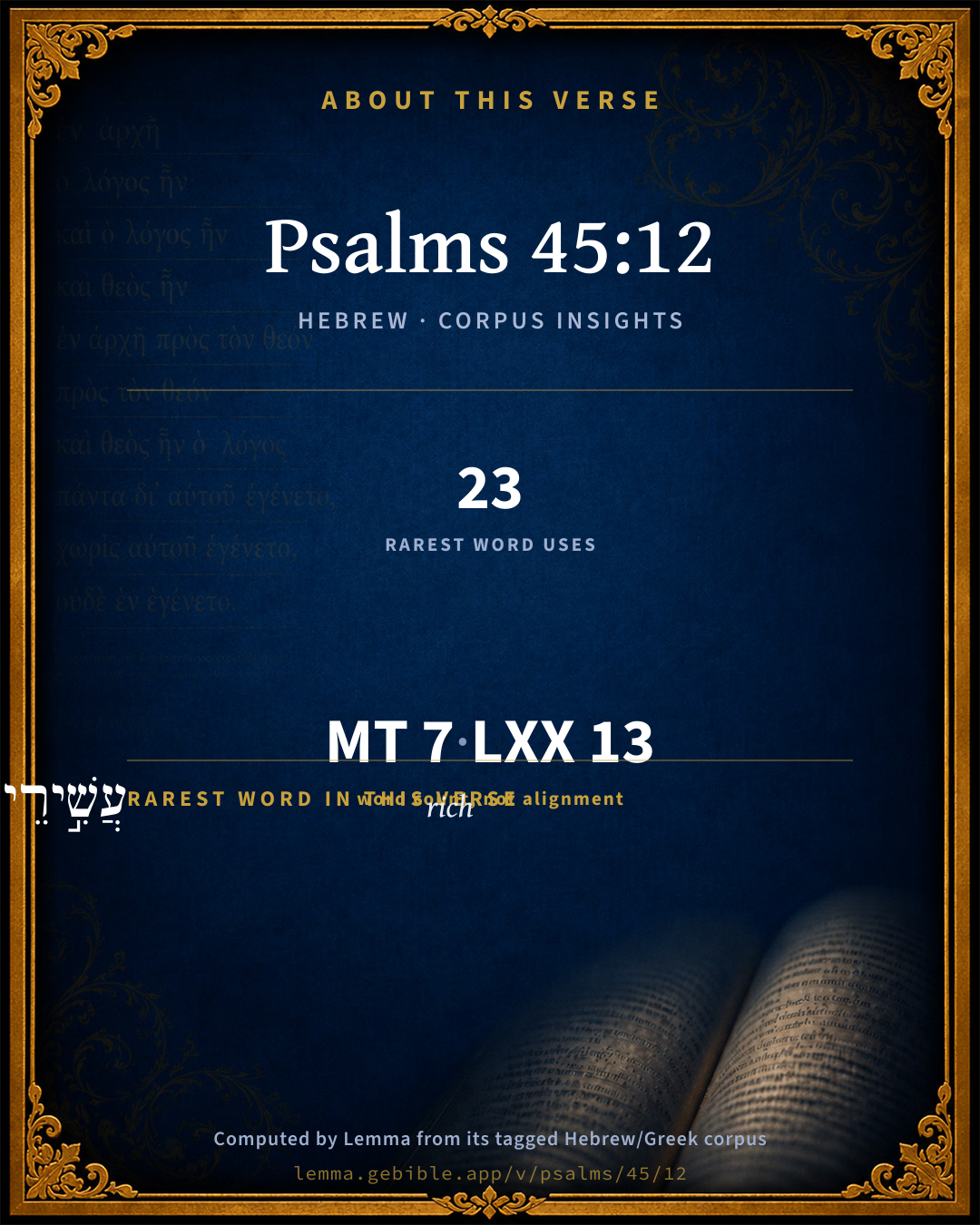
The rarest word here is עֲשִׁ֣ירֵי rich H6223 — appearing just 23 times in the whole Hebrew Bible.

Shared distinctive vocabulary

עֲשִׁ֣ירֵי rich H6223 occurs in 23 verses of the Hebrew Bible. Also found in:

Grammatical profile

  • 1 verb
  • 5 nouns
  • 1 adjective

Verb forms

  • יְחַלּ֗וּ Piel · Imperfect

Hebrew & Septuagint length

In English translation the verse runs 16 words from the Hebrew and 22 from the Septuagint (LXX English) — closely comparable.

A rough comparison of the two English renderings, which tokenize alike — not a word-level alignment.

Word counts can differ between the Hebrew and the Greek without any difference in meaning — e.g. the Hebrew direct-object marker אֵת has no separate Greek word, and Greek often adds the article ὁ.

In the original languages it is 7 Hebrew tokens and 13 Greek tokens — but the two are counted differently (Hebrew bundles its prefixes and suffixes into one token; the Greek is in lemma form), so that isn’t a like-for-like length.

Cross-references

10

Topical passages linked to Psalms 45:12 in the Treasury of Scripture Knowledge — connected by theme and wording, ordered by reader-vote popularity; previews shown in the World English Bible.

  • Psalms 22:29 All the rich ones of the earth shall eat and worship. All those who go down to the dust shall bow before him, Even he who can't keep his soul alive.
  • Isaiah 60:3 Nations shall come to your light, and kings to the brightness of your rising.
  • Isaiah 49:23 Kings shall be your nursing fathers, and their queens your nursing mothers: they shall bow down to you with their faces to the earth, and lick the dust of your feet; and you shall know that I am Yahweh; and those who wait for me shall not be disappointed.
  • Psalms 72:10 The kings of Tarshish and of the isles will bring tribute. The kings of Sheba and Seba shall offer gifts.
  • Isaiah 23:17–18 It shall happen after the end of seventy years, that Yahweh will visit Tyre, and she shall return to her hire, and shall play the prostitute with all the kingdoms of the world on the surface of the earth.
  • Isaiah 60:10–11 Foreigners shall build up your walls, and their kings shall minister to you: for in my wrath I struck you, but in my favor have I had mercy on you.
  • Matthew 2:11 They came into the house and saw the young child with Mary, his mother, and they fell down and worshiped him. Opening their treasures, they offered to him gifts: gold, frankincense, and myrrh.
  • Psalms 68:29 Because of your temple at Jerusalem, Kings shall bring presents to you.
  • Isaiah 60:6–7 The multitude of camels shall cover you, the dromedaries of Midian and Ephah; all they from Sheba shall come; they shall bring gold and frankincense, and shall proclaim the praises of Yahweh.
  • Acts 21:3–6 When we had come in sight of Cyprus, leaving it on the left hand, we sailed to Syria, and landed at Tyre, for there the ship was to unload her cargo.

Cross-references courtesy of OpenBible.info (CC BY 4.0).

Hebrew and Greek witnesses Masoretic Hebrew ↔ Greek Septuagint

The same verse in the two great witnesses to the Old Testament, shown verse-for-verse.

You’re reading Greek Psalm 44 (Hebrew Psalm 45). The Septuagint counts the superscription, so verse numbers can differ from the Hebrew — chapter-level alignment, not verse-by-verse. Numbering follows Rahlfs.

These are two independent witnesses, not word-aligned to each other, and the Septuagint is shown in lemma (dictionary) form.

Hebrew Psalms 45:12 Masoretic · Westminster Leningrad Codex

וּבַֽת צֹ֨ר בְּ֭מִנְחָה פָּנַ֥יִךְ יְחַלּ֗וּ עֲשִׁ֣ירֵי עָֽם

The daughter of Tyre comes with a gift. The rich among the people entreat your favor.

World English Bible · Public Domain

Greek LXX Greek Psalm 44:12 Septuagint · lemma form

ὅτι ἐπιθυμέω ὁ βασιλεύς ὁ κάλλος σύ ὅτι αὐτός εἰμί ὁ κύριος σύ

And the daughter of Tyre shall adore him with gifts; the rich of the people of the land shall supplicate your favor.

LXX2012 (modern English Septuagint) · Public Domain

On this verse, The Cambridge Bible for Schools and Colleges discusses the Septuagint’s reading. Read the note in Commentary ↓

Hebrew: Westminster Leningrad Codex (CC BY 4.0). Greek: Septuagint (public domain); English from LXX2012 (modern English Septuagint) (Public Domain). How the Septuagint differs from the Hebrew →

Commentary

Notes on Psalms 45:12 from classic Christian and Jewish commentators (each source and its license shown beneath its notes). The classic Christian expositions comment on the surrounding passage and are grouped to its opening verse, so a note may address several verses; the Jewish commentaries on the Tanakh (Rashi and others) are per-verse, so they appear only where the commentator wrote on this verse.

Lemma curates 59 commentaries, every one of them public domain or Creative Commons licensed, each selected and text-cleaned for this edition rather than reprinted as found. About our sources →

Trapp's Complete Commentary

John Trapp

Psa 45:12 And the daughter of Tyre [shall be there] with a gift; [even] the rich among the people shall intreat thy favour.

Ver. 12. And the daughter of Tyre shall be there with a gift] Isa 23:18. The Tyrians, that wealthy people, when once converted (think the same of other nations) shall leave hoarding and heaping; and find another manner of merchandise and employment of their substance, viz. to feed and clothe God’s saints, and maintain his ministers.

John Trapp, A Commentary or Exposition upon All the Books of the Old and New Testament (1647–1656) — public domain. Text from a community e-Sword module.

The Biblical Illustrator

Joseph S. Exell

Psa_45:12

The daughter of Tyre shall be there with a gift,

Gentile sinners coming into the Church and presenting themselves a free-will offering to the Lord upon the Gospel altar

I.

Some things implied in the words.

1. That whatever be the outward lot and condition of a person or people, before the Lord is pleased to visit them with a dispensation of the Gospel, their case is truly melancholy, and affecting. When it is said, the daughter of Tyre shall be there with a gift, it supposes that her then present state was a state of distance from God and the ordinary means of gracious intercourse with Him.

2. That it is by the special providence of God that persons or nations are brought into the fellowship of the Gospel.

3. That it is a very great privilege to have a place in Gods house. Those who are within the Church enjoy all the ordinary means of salvation.

II. The gift which persons present to the Lord in the day of their effectual calling.

1. Men give themselves to the Lord in the day of their regeneration and effectual vocation. This is the principal gift, and that without which nothing which they can present to Him can possibly be accepted. What is it for persons to give themselves unto the Lord? We answer--

(1) It is to give up the soul in all its powers and faculties to the Lord, to be employed in His service.

(2) They likewise give up their bodies to the Lord. The eye to behold His works, and look into His Word, so as to affect the heart. The ear to hear and listen to His voice; the hand to work with an eye to His glory; the feet to run His errands; and the tongue to speak to, and for, God, and confess Him before the world.

(3) All that the man is, and hath, is contained in this gift.

III. Speak of persons presenting that gift unto the Lord.

1. Mention some things imported in a person or people, their giving themselves to the Lord.

(1) This exercise of a person or people, their giving themselves to the Lord, imports their discerning, and taking up the ground and warrant that they have to do so, and that is, the Lords giving and making over Himself to them in the word of grace and promise as their God in Christ.

(2) A person or people, their giving themselves to the Lord, imports an humble and hearty acknowledgment that they have formerly been under the power and dominion of other lords and lovers (Isa_36:13).

(3) It imports a real persuasion of His having an undoubted right to them and their services.

(4) It has in it the persons withdrawing his allegiance from his former lords and lovers; his revoking and calling back the gift which he lind made of himself and his service to Satan, the god of this world.

(5),It imports a cordial embracing and receiving a God in Christ as their God and portion, Their taking the God and Father of our Lord Jesus Christ as their God and Father, according to His promise (Jer_3:19).

(6) It imports an unshaken purpose and resolution, through grace, to keep by the Lord and cleave to Him for better and worse.

2. Inquire for what ends and purposes persons give themselves to the Lord in the day of their effectual calling.

(1) Sinners give themselves to the Lord in the day of their effectual calling, their hearts being touched by grace, in compliance with the end and design of the glorious Gospel, which is to bring sinners that are ready to perish in the far country of a natural state home to God, as their God and Father in Christ.

(2) With an eye to their own safety.

(3) That they may be henceforth employed in His service (Act_9:6; Psa_116:16).

(4) To be led and guided through an ensnaring world by the good skill of His hand.

(5) That He may keep them by His almighty power, through faith unto salvation (1Pe_1:5).

IV. Illustrate the truth of the doctrine,

1. Though there were none who set themselves in greater opposition to the Lord Jesus and the grace of God manifested in Him than the Jews, yet three thousand of them were added to the Church in one day (Act_2:37-42).

2. The success which the Gospel has already had among the Gentile nations.

V. Use.

1. For trial and examination.

(1) If you have really given yourselves to the Lord, you have accepted of God in Christ for Himself, and that without making any conditions about peace and prosperity and freedom from trouble in this world; but you gave yourself to Him without any reserve.

(2) If you have really given yourselves to the Lord, it was with much affection you did so (Jer_2:2). If you have given yourselves to the Lord, it was in a marriage-covenant.

(3) If you have given yourselves to the Lord, you cannot fail to admire His love and condescension to you in His giving Himself to you, in the word of grace and promise, and determining you to give yourselves to Him.

(4) If you have given yourselves to the Lord, you will be frequently recognizing that deed; yea, it will be habitually in your minds, and often upon the imagination of the thoughts of your hearts.

(5) If you have given yourselves to the Lord, you have a high esteem and valuation of Himself, and of everything that stands connected with Him.

2. For consolation to all who have been determined to give themselves to the Lord. They are in a state of happy condition; they have made the Most High their habitation; and therefore no real evil can befall them, neither any plague come near their dwelling.

3. For exhortation.

(1) As for you, then, who have been determined, by grace, to give yourselves to the Lord, we exhort you to bless the great and glorious name of the Lord your God, that He hath been graciously pleased so to shine into your hearts as to give you the saving knowledge of Himself, and bowed your rebellious wills unto a cordial yielding of yourselves unto the Lord, and so hath caused you to enter into His sanctuary which He hath sanctified for ever. We exhort you to be ever mindful whose you are, and to whom you have devoted yourselves and your services. When Satan, the world and the remaining corruptions of your flesh would seek to entice and draw you aside from the service of God, be exhorted to tell them that you have opened your mouths to the Lord, and that you cannot, and, through grace, will not, go back. We exhort you who have really given yourselves to the Lord to use your best endeavours to excite and influence others to go and do likewise. (T. Bennet.)

The Biblical Illustrator, edited by Joseph S. Exell (c. 1880s–1900s) — public domain. Text from a community e-Sword module.

Joseph Benson's Commentary

Psa 45:12. The daughter of Tyre shall be there — That is, the people of Tyre; as the daughter of Zion or Jerusalem, is put for their inhabitants: he mentions the Tyrians, because they, among others, and before many others, were to be converted to Christ, Mat 11:21; Mar 3:8; Mar 7:24; Act 21:3-5; but they are here put for all the Gentiles, whom that city fitly represented as being the mart of the nations, as she is called Isa 23:3. With a gift — To testify their homage, which was done by gifts or presents; and to procure thine and thy Lord’s favour. Even the rich — Of other nations.

Joseph Benson's Commentary on the Old and New Testaments (1811–1818) — public domain. Text from a community e-Sword module.

J. A. Alexander on Psalms

Joseph Addison Alexander

13. (Psa 45:12). And the daughter of Tyre with a gift thy face shall soften—the rich of the people. In the Hebrew idiom the daughter of Tyre, or the daughter (i.e. the virgin) Tyre denotes the city, or the population of the city, personified as a woman. See above, on Psa 9:15 (14). It has been proposed, indeed, to take this as a vocative (and O daughter of Tyre, the rich of the people shall, etc.) addressed to Jezebel, in honour of whose marriage with Ahab (1Ki 16:31) the psalm is then supposed to have been written. But besides the harsh construction of the first words, and the constant usage of the phrase and others like it in the sense explained above, it is inconceivable that a poem in celebration of the marriage between a wicked king of Israel and a heathen princess could have been composed by the sons of Korah for permanent religious use in the kingdom of Judah. And yet this is the only hypothesis, except the Messianic one, on which the reference to Tyre can be explained. In the time of Solomon, the Tyrians were the most commercial nation in the world, and the one with which the Israelites had most commercial intercourse. It was natural, herefore, to use Tyre as a type for the wealth and commerce of the world, and the same mode of representation is employed by later writers. (See especially Isa 23:18.) Thus understood, the promise that the daughter of Tyre should seek, by means of gifts, to conciliate the favour of the queen, is a prediction that the richest of the nations should seek union and communion with the chosen people. See below, Ps. xlvii. 10 (9), 10, Psa 87:4, in the last of which places Tyre is particularly mentioned. See also Isa 60:6, Hag 2:7-8, Zec 9:10. That the daughter of Tyre is here an ideal person, comprehending many individuals, is clear from the plural verb with which it is construed, and from the epexegetical clause, the rich (i.e. the richest) of the people, whether this be understood to mean the richest of that people, or the richest of the nations. In either case it is an apposition with daughter of Tyre, and in some way explanatory of it. "The daughter of Tyre, that richest of the nations (or the daughter of Tyre, even the richest of that nation), shall entreat thy favour." This last idea is conveyed by a highly idiomatic phrase, meaning, as some suppose, to stroke or soothe the face, and then, by a natural transition, to conciliate, to flatter. Others obtain nearly the same sense by making it mean to weaken, soften, or subdue the face, i. e. the opposition which the face expresses.

Joseph Addison Alexander, The Psalms Translated and Explained (1850) — public domain. Text from a community e-Sword module.

Tyndale Open Study Notes

Tyndale Open Resources

45:12 The princess of Tyre: Israel traded with Tyre, a powerful city-state. The noblest woman of the city bears a wedding gift to her counterpart, the new queen, who represents an honored kingdom.

Tyndale Open Study Notes — © Tyndale Open Resources, licensed CC BY-SA 4.0. Text via the HelloAO Bible API.

Geneva Bible (1599)

Geneva Bible translators

He signifieth that divers of them that be rich shall be benefactors to the Church, albeit they give not perfect obedience to the Gospel.

Or, Zor.

Geneva Bible (1599) marginal notes — public domain. Text via Bolls.life.

Jamieson, Fausset & Brown

Robert Jamieson, A. R. Fausset & David Brown

daughter of Tyre-- (Psa 9:14); denotes the people. Tyre, celebrated for its great wealth, is selected to represent the richest nations, an idea confirmed by the next clause. These gifts are brought as means to conciliate the royal parties, representing the admitted subjection of the offerers. This well sets forth the exalted position of the Church and her head, whose moral qualities receive the homage of the world. The contribution of material wealth to sustain the institutions of the Church may be included (compare "riches of the Gentiles," Psa 72:10; Isa 60:5-10).

Jamieson, Fausset & Brown — Commentary Critical and Explanatory on the Whole Bible (1871) — public domain (CC PDM 1.0). Text via the HelloAO Bible API.

Adam Clarke's Commentary

Verse 12. The daughter of Tyre shall be there with a gift] The Tyrians shall pay tribute to thy spouse, and assist him in all his grand and magnificent operations.

As, at this time, Tyre was the greatest maritime and commercial city in the world, it may be here taken as representing those places which lay on the coasts of the sea, and carried on much traffic such as parts of Syria, Egypt, Asia Minor, Greece, Italy, France, the British Isles, &c., which first received the Gospel of Christ and were the instruments of sending it to all the other nations of the earth.

Rich among the people] The most powerful and opulent empires, kingdoms, and states, shall embrace Christianity, and entreat the favour of its Author.

Adam Clarke's Commentary on the Bible (1810–1826) — public domain. Text from a community e-Sword/MySword module.

John Calvin's Commentaries

12 And the daughter of Tyre with a gift. This also is a part of the recompense which the prophet promises to the queen in order to mitigate or rather to extinguish entirely, the longing desire she might still feel after her former condition. He says: that the Tyrians will come humbly to pay her reverence, bringing presents with them. Tyre, we know, was formerly a city of great renown, and, therefore, he accounts it a very high honor that men will come from a city so distinguished and opulent to greet her and to testify their submission to her. It is not necessary for us to examine every word minutely, in order to apply to the Church every thing here said concerning the wife of Solomon; but in our own day we realize some happy fruits of this prophecy when God has so ordered it, that some of the great men of this world, although they themselves refuse to submit to the authority of Christ, act with kindness towards the Church, maintaining and defending her.

John Calvin's Commentaries (1540-1563) — public domain. Text from the Calvin Translation Society English edition (1840s-50s) via the Christian Classics Ethereal Library (ccel.org). Calvin's coverage is partial (roughly two-thirds of the Bible); uncommented books and verses are honest gaps, never fabricated. The 19th-century editor's footnotes and remarks are omitted so the notes are faithfully Calvin's own voice.

Ellicott's Commentary for English Readers

(12) And the daughter of Tyre—i.e., Tyre itself and the Tyrians. (See Note Psa_9:14.) Render,

The Tyrians with a gift entreat thy favour,

The rich ones of the people.

The objection that Tyre was never subject to Israel is not conclusive, since the gifts may be complimentary presents, such as Hiram sent to Solomon, not tribute. (See next Note.)

Entreat thy favour.—Literally, stroke thy face (comp. Job_11:19, Pro_19:6); or since the root-idea is one of polishing or making bright, we may render “makes thy face bright or joyful,” i.e., with pleasure at the splendid gifts.

A Bible Commentary for English Readers, edited by Charles John Ellicott (1878–1897) — public domain. Text from a community e-Sword module.

The Cambridge Bible for Schools and Colleges

gen. ed. J. J. S. Perowne

12. The words shall be there are not in the Heb., and it has been proposed to render, And, O daughter of Tyre, with a gift shall the rich of the people intreat thy favour, making the bride a Tyrian princess. But apart from other objections, the daughter of Tyre should mean, according to the analogy of the similar phrases, daughter of Zion, daughter of Babylon, not an individual Tyrian woman, but the city and people of Tyre personified as a woman: and the A.V. no doubt gives the sense correctly, though some verb has probably been lost. The express mention of the wealthy merchant city of Tyre as the representative of the neighbouring nations which would send their greetings to the new queen is most naturally accounted for if the Psalm refers to Solomon, who was in close alliance with Tyre.

even the rich &c.] Render, Yea, the richest of people: i.e. as the LXX paraphrases, the people of the earth; or perhaps, of the land: wealthy nobles of the country as well as foreigners.

The Cambridge Bible for Schools and Colleges (gen. ed. J. J. S. Perowne; Cambridge University Press, 1878–1918) — public domain. Text from a community e-Sword module.

John Gill's Exposition

And the daughter of Tyre shall be there with a gift,.... That is, among the honourable women in the king's court and palace: it is a prophecy of the conversion of the Tyrians, and their admission into a Gospel church, state, which had its accomplishment in the times of Christ and his apostles, Mar 7:24; compare with this Psa 87:4; and though Tyre is only mentioned, it being, as Kimchi on this place observes, near to the land of Judea; yet all other Gentiles are meant, to whom the Gospel should come to the conversion of them, and thereby become members of churches; where they are "with a gift", of themselves to the churches; see Co2 8:5; joining themselves to them, to walk with them, and serve the Lord with one consent; and with the gift or offering of praise and thanksgiving, for the grace and blessings of it bestowed upon them; and with a free donation out of their substance, to support a Gospel church state, its ministers, and the interest, of religion; see Isa 23:18; the allusion may be to Exo 23:15;

even the rich among the people shall entreat thy favour; either such as are rich, in a literal sense, both among the inhabitants of Tyre, who were a very wealthy people, Isa 23:8; and among other Gentiles, especially in the latter day, when kings shall be the church's nursing fathers, and bow down to her, Isa 49:23; or such who are so in a spiritual sense, enriched by Christ with all spiritual blessings, and who are particularly rich in faith, and heirs of a kingdom; these shall "entreat the favour" of the queen the church; not pray unto her, or worship her in a religious way; for God is only the object of such worship; but do those things by which they would show that they valued her friendship, and would gain her good will; as also acknowledge any former injury done her by them, and entreat her forgiveness; and particularly desire to have communion with her, and share in her prayers.

John Gill's Exposition of the Whole Bible (1746–1763) — public domain (CC PDM 1.0). Text via the HelloAO Bible API.

Albert Barnes' Notes on the Bible

And the daughter of Tyre shall be there with a gift - On the situation of Tyre, and its ancient splendor, see the notes at Mat 11:21; the introduction to Isa. 23; and the notes at that chapter. In the time of the psalmist it was probably the most wealthy and luxurious commercial town then existing; and it is referred to here as meaning that persons of highest rank, and of the greatest riches, and those who were surrounded most by affluence and luxury, would come to honor the king. Even the daughter of the magnificent prince of Tyre would deem it an honor to be present with a gift becoming her exalted station, and properly representing the wealth of a king of so much magnificence. This is the imagery. As applied to the Messiah, it is a description of the honor which would be shown to “him” by those of highest rank and largest wealth. Compare Isa 60:5-7, note; Isa 60:9, note; Isa 60:11, note; Isa 60:13 note.

Even the rich among the people - Rich men scattered among the people. Compare the notes at Psa 22:29.

Shall entreat thy favor - Margin, as in Hebrew, “thy face.” Shall desire thy smile; the light of thy countenance; thy friendship. The word rendered “entreat” - חלה châlâh - means properly to be rubbed; then, to be polished; and then, in the form used here (Piel) to rub, or stroke the face of anyone; to soothe or caress; to flatter, to court; and the idea is literally that of one who caresses or soothes, or seeks to conciliate. The sense here is, “the richest of the nations shall make court to thee with gifts.” Gesenius, Lexicon. Ultimately, this will be true in regard to the Messiah. Compare as above, Isa. 60. The wealth of the world will yet be laid at his feet, and, placed at his disposal. The effect of true conversion is always to make people willing to consecrate to the Saviour all that they possess.

Albert Barnes' Notes on the Bible (1834–1885) — public domain. Text from a community e-Sword/MySword module.

Matthew Poole's English Annotations

The daughter of Tyre, i.e. the people or citizens of Tyre; as the daughter of Zion, or Jerusalem, or Babel, &c., are put for their inhabitants, 2Ki 19:21; Psa 137:8; Zec 9:9. He mentioneth the Tyrians, partly because they did give presents to Solomon, 1Ki 5:1, &c., to whom here is a continued allusion through the whole Psalm; and partly because they among others, and before many others, were to be converted to Christ, as they were. See Mat 11:21,22; Mr 3:8; 7:24; Act 21:3-5. But they are here put synecdochically for all the Gentiles, whom that city fitly represents, as being the mart of the nations, as she is called, Isa 23:3. And being a very rich and proud, and therefore a self-conceited and a stiffnecked people, their merchants being princes, Isa 23:8 they may in a particular manner represent all those great and proud princes and stubborn people of the Gentile world, which should be subdued to Christ by the preaching of the gospel.

With a gift; partly to testify their homage, which was done by gifts or presents, as appears from 1Sa 10:27; 2Sa 8:2, &c.; and partly to procure thine, and consequently thy husband’s, favour, as it here follows.

The rich among the people of other nations.

Matthew Poole's English Annotations on the Holy Bible (1683–1685) — public domain. Text from a community e-Sword/MySword module.

The Treasury of David

Charles H. Spurgeon

Ver. 12. And the daughter of Tyre shall be there with a gift. When the church abounds in holiness, she shall know no lack of homage from the surrounding people. Her glory shall then impress and attract the heathen around, till they also unite in doing honour to her Lord. The power of missions abroad lies at home: a holy church will be a powerful church. Nor shall there be lack of treasure in her coffers when grace is in her heart; the free gifts of a willing people shall enable the workers for God to carry on their sacred enterprise without stint. Commerce shall send in its revenue to endow, not with forced levies and imperial taxes, but with willing gifts the church of the Great King. Even the rich among the people shall intreat thy favour. Not by pandering to their follies, but by testifying against their sins, shall the wealthy be one to the faith of Jesus. They shall come not to favour the church but to beg for her favour. She shall not be the hireling of the great, but as a queen shall she dispense her favours to the suppliant throng of the rich among the people. We go about to beg for Christ like beggars for alms, and many who should know better will make compromises and become reticent of unpopular truth to please the great ones of the earth; not so will the true bride of Christ degrade herself, when her sanctification is more deep and more visible; then will the hearts of men grow liberal, and offerings from afar, abundant and continual, shall be presented at the throne of the Pacific Prince.

Ver. 12. And the daughter of Tyre shall be there with a gift. The daughters of Tyre are the daughters of the Gentiles, the part standing for the whole. Tyre, a city bordering on this country where the prophecy was delivered, typified the nations that were to believe in Christ. Thence came that Canaanitish woman, who was at first called a dog; for that ye may know that she was from thence, the gospel speaks thus Mt 15:21-28, "Jesus departed into the coasts of Tyre and Sidon. And, behold, a woman of Canaan came out of the same coasts, "with all the rest that is related there. She who at first, at the house of her "father, "and among her "own people, "was but a dog, who by coming to, and crying after that "King, "was made beautiful by believing in him, what did she obtain to hear? "O woman, great is thy faith." The King has greatly desired thy beauty. Augustine.

Ver. 12. With a gift. Those who sold their property, came with presents to entreat the face of this "queen, "and "laid what they brought at the apostle's feet." Warm then was love in the church. Augustine.

Ver. 12. The rich. They are, indeed, rich in grace, whose graces are not hindered by riches, whose souls prosper when their bodies prosper, as the apostle John speaks in his third Epistle; or, who, as it is prophesied in the verse, being full of worldly blessings, are yet hungry and eager in their pursuit after Christ. The daughter of Tyre shall be there with a gift; even the rich among the people shall intreat thy favour, saith the psalmist; that is, either the favour of Christ himself, or the favour of the church, by reason of that spiritual excellence and inward glory which she hath received from Christ. Now, to see the rich bring their gifts, and, which is the thing chiefly aimed at here, giving up themselves to Christ, this is a rare sight, and a remarkable work of grace. Joseph Caryl.

None.

Psalms 45:13*

Charles H. Spurgeon's The Treasury of David (1869–1885) — public domain. Psalms only. Text from a community e-Sword/MySword module.

Whedon's Commentary on the Bible

Daniel D. Whedon

12. The daughter of Tyre—A figurative expression for the people of Tyre, as the frequent phrase “daughter of Zion” is a poetic form for the inhabitants and worshippers in Zion. There is nothing improbable in the supposition that Tyre and other nations should represent themselves with valuable gifts at Solomon’s nuptials with the daughter of the powerful king of Egypt, or on the memorable occasion of the formal occupancy of her new palace. But prophetically we know this honour is to be conferred on Christ and his Church. Psa_72:10-11; Isa_49:23

Daniel D. Whedon (gen. ed.), Commentary on the Old and New Testaments (1874–1909) — public domain. Text from a community e-Sword module.

The Pulpit Commentary

And the daughter of Tyro shall be there with a gift. Heathen nations shall be attracted to Christ and his Church, shall bring their offerings, and make submission, and humbly sue for favour. Tyro is taken as a type of heathen states and cities generally. (comp. Isa_49:18-23 Isa_56:6-8 Isa_60:3-14) Even the rich among the people shall intreat thy favour. (On the wealth of Tyre, see Isa_23:2-8 Eze_26:12, 16 27:3-33 28:13, etc.)

The Pulpit Commentary (1880–1919), ed. H.D.M. Spence-Jones & Joseph S. Exell — public domain. Text from a community e-Sword module.

John Wesley's Explanatory Notes

The daughter - The people of Tyre; as the daughter of Zion or Jerusalem, are put for their inhabitants: he mentions the Tyrians; because they among others, and before many others, were to be converted to Christ, but they are here put for all the Gentiles, whom that city fitly represents, as being the mart of the nations. A gift - To testify their homage. The rich - Of other nations.

John Wesley, Explanatory Notes Upon the Whole Bible (1754–1765) — public domain. Text via the GEBible commentary corpus.

unfoldingWord translationNotes

Door43 World Missions Community

General Information:

The writer continues to speak to the queen.

The daughter of Tyre

The writer speaks of the people who live in Tyre as if they are Tyre's children. AT: "The people of Tyre" (See: Metaphor)

The royal daughter

This is a reference to the woman whom the king will marry. AT: "The king's bride" (See: Assumed Knowledge and Implicit Information)

all glorious

"very beautiful." This refers to the woman's appearance.

her clothing is worked with gold

Her clothing is decorated or embroidered with gold. This can be stated in active form. AT: "she wears clothing that someone has embroidered with golden thread" (See: Active or Passive)

translationWords

Tyre

gift

beg

favor

royal

palace

glory

gold

unfoldingWord translationNotes — © Distant Shores Media and the Door43 World Missions Community, licensed CC BY-SA 4.0. Source: git.door43.org/Door43/en_tn.

Rashi

Rabbi Shlomo Yitzchaki (Rashi)

And the King shall desire your beauty And if you do this, the King, the Holy One, blessed be He, will desire the beauty of your deeds.

Rashi on the Tanakh — English translations: “The Judaica Press complete Tanach with Rashi, translated by A. J. Rosenberg” (CC BY 4.0); “Pentateuch with Rashi's commentary by M. Rosenbaum and A.M. Silbermann, 1929-1934” (public domain); “The Metsudah Tanach series, Lakewood, N.J” (CC BY 4.0); and “The Book of Joshua, Metsudah Publications, 1997” (CC BY 4.0). Text via Sefaria.

Lesson kit

Teaching starters — assembled from the data on this page, not authored interpretation. Every prompt links to the verse data it draws on. Edit before teaching.

Psalms, in the Wisdom, opens this verse with 7 words (7 distinct Hebrew lemmas). Its most distinctive word is ʻâshîyr (“rich”). A historical commentator’s framing appears above. Read the whole chapter for the surrounding context.

Discussion questions

  1. The word ʻâshîyr carries the sense “rich.” How does it shape the verse?
  2. Exodus 30:15 shares the word «rich» with this verse. How do the two illuminate each other?
  3. These translations render this verse differently; the difference is in the English rendering, not the original. What questions does that raise?
  4. The verb «יְחַלּ֗וּ» is Piel Imperfect. How does its form color the action?
  5. Reading how Trapp's Complete Commentary and The Biblical Illustrator read this verse, where do the two commentators agree and where do they part?

Things to notice

Reading settings

Reading text

Shown beneath each verse's original-language words.

Old Testament
Old Testament edition

Read the OT as the Masoretic Hebrew (MT) or the Greek Septuagint (LXX).

English shown for the Greek Septuagint (in the Hebrew ↔ Greek comparison).

Comparing translations? Open the Compare panel on any verse page to stack up to four side by side.