
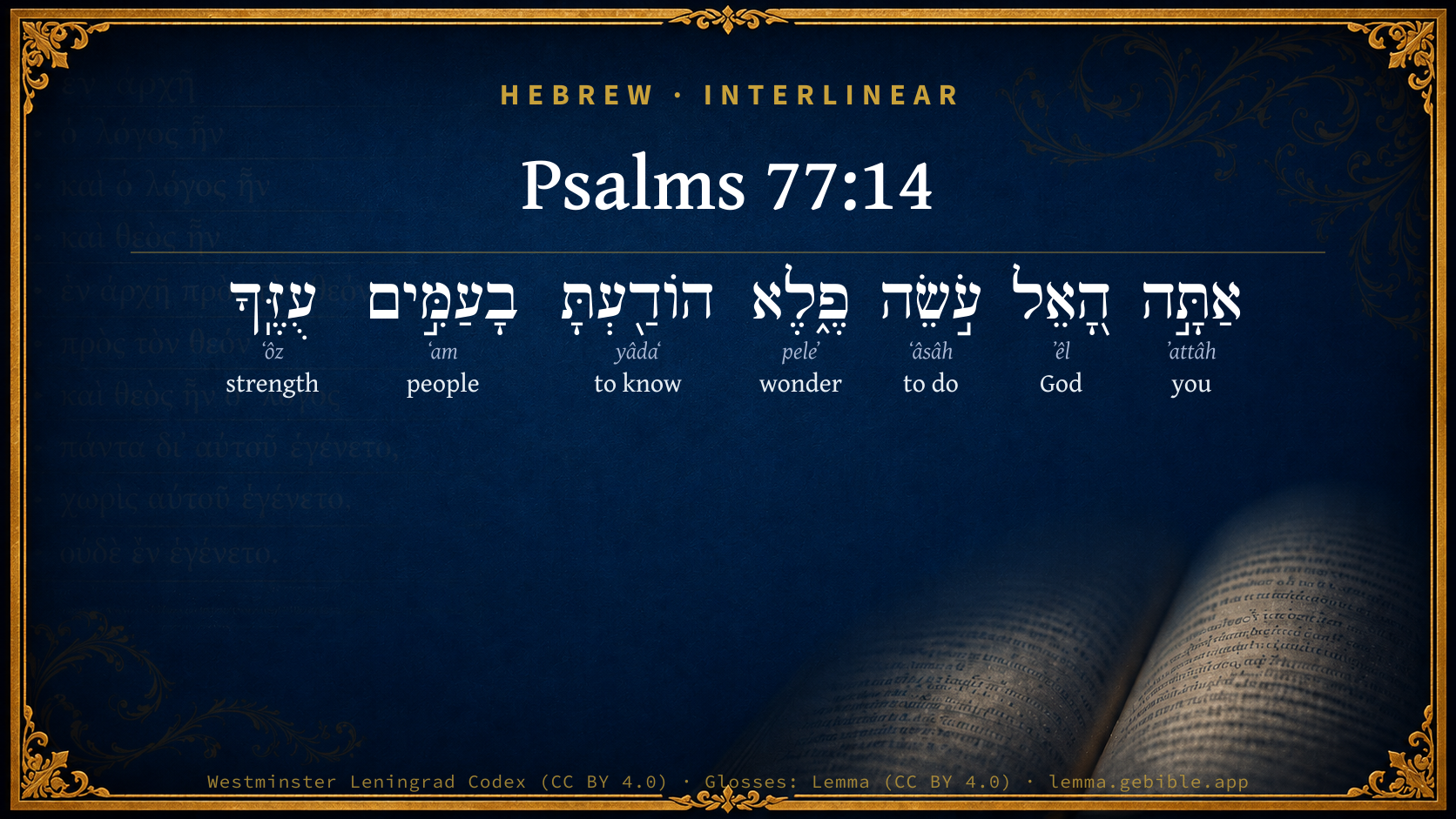
Psalms 77:14

Hebrew (Westminster Leningrad Codex) Psalms 77:14 appears in the Hebrew Old Testament. The text above is from the Westminster Leningrad Codex. Each word links to its Strong’s number, a concise gloss, and parsing drawn from the Open Scriptures Hebrew Bible morphology. Click any word for its full Brown-Driver-Briggs (BDB) entry.
Download image
Cite this verse

Psalms 77:14 (World English Bible). Public Domain. Lemma interlinear Bible study tool, https://lemma.gebible.app/v/psalms/77/14.

Show BibTeX & RIS
BibTeX
RIS
English Translation
You are the God who does wonders. You have made your strength known among the peoples.
World English Bible · Public Domain
Download a study sheet

One document with this verse’s original text, its word-by-word gloss line, the meaning frame, cross-references with their text, attributed commentary, and full source and license credits — printable, and it pastes into notes with its structure intact.

This verse Autodidact and up

Study sheet (.html) Plain text (.txt)

A passage Seminary Student

Up to 50 verses in one chapter. A passage sheet keeps up to 6 commentary sources and 12 cross-references per verse, in the order this page ranks them, and says so on the sheet whenever that leaves anything out. Ask for a single verse and you get the Autodidact verse sheet above.

Everything on this page stays free to read, with no account — the sheet is a download of what is already on screen, not access to it.

Want to remove ads? Support Godless Engineer
Compare translations 3

The same verse in 3 English versions, stacked beneath the original-language interlinear above. Click any original word for its lexicon entry.

Each is an independent rendering of the whole verse — the interlinear is not word-aligned to these translations.

Highlighted words mark where these versions differ — a whole-verse word diff, not a word-by-word alignment.

  • World English Bible Public Domain
    You are the God who does wonders. You have made your strength known among the peoples.
  • King James Version Public Domain
    Thou art the God that doest wonders: thou hast declared thy strength among the people.
  • unfoldingWord Literal Text CC BY-SA 4.0
    You are the God who does wonders; you have revealed your strength among the peoples.

unfoldingWord Literal Text — © unfoldingWord, licensed CC BY-SA 4.0. Word-aligned USFM3 via Door43 (git.door43.org/unfoldingWord/en_ult).

Versions to compare (up to 4)

3 of 4 selected

Show all 18 translations

Every available English version of this verse, each an independent rendering of the whole verse.

  • World English Bible Public Domain
    You are the God who does wonders. You have made your strength known among the peoples.
  • Berean Standard Bible Public Domain
    You are the God who works wonders; You display Your strength among the peoples.
  • Majority Standard Bible Public Domain
    You are the God who works wonders; You display Your strength among the peoples.
  • King James Version Public Domain
    Thou art the God that doest wonders: thou hast declared thy strength among the people.
  • American Standard Version (1901) Public Domain
    Thou art the God that doest wonders: Thou hast made known thy strength among the peoples.
  • Revised Version (1885) Public Domain
    Thou art the God that doest wonders: thou hast made known thy strength among the peoples.
  • Geneva Bible (1599) Public Domain
    Thou art ye God that doest wonders: thou hast declared thy power among the people.
  • Douay-Rheims (1899) Public Domain
    Thy way, O God, is in the holy place: who is the great God like our God?
  • Young's Literal Translation Public Domain
    Thou `art' the God doing wonders. Thou hast made known among the peoples Thy strength,
  • Literal Standard Version CC BY-SA 4.0
    You [are] the God doing wonders. You have made Your strength known among the peoples,
  • Unlocked Literal Bible CC BY-SA 4.0
    You are the God who does wonders; you have revealed your strength among the peoples.
  • unfoldingWord Literal Text CC BY-SA 4.0
    You are the God who does wonders; you have revealed your strength among the peoples.
  • Darby Bible Public Domain
    Thou art the ùGod that doest wonders; thou hast declared thy strength among the peoples.
  • World Messianic Bible Public Domain
    You are the God who does wonders. You have made your strength known among the peoples.
  • Webster's Bible Public Domain
    \\77:13\\Thy way, O God, is in the sanctuary: who is so great a God as our God!
  • Free Bible Version CC BY-SA 4.0
    You are the God who does wonderful things! You have revealed your power to the nations.
  • Bible in Basic English Public Domain
    You are the God who does works of power: you have made your strength clear to the nations.
  • JPS Tanakh (1917) Public Domain
    (77-15) Thou art the God that doest wonders; Thou hast made known Thy strength among the peoples.

Literal Standard Version (2020), Covenant Press — licensed CC BY-SA 4.0. Text via the HelloAO Bible API (eBible.org). Unlocked Literal Bible (unfoldingWord) — licensed CC BY-SA 4.0. Text via the HelloAO Bible API (eBible.org). unfoldingWord Literal Text — © unfoldingWord, licensed CC BY-SA 4.0. Word-aligned USFM3 via Door43 (git.door43.org/unfoldingWord/en_ult). Free Bible Version, Dr. Jonathan Gallagher — licensed CC BY-SA 4.0. Text via the HelloAO Bible API (eBible.org).

Word by word

More ways to search: Search by grammar → Find every occurrence → Compare this word →

Practice this passage: Drill this verse → Learn its vocabulary →

About this verse

These counts appear in no published source. They are computed here, from the morphology-tagged text and Lemma’s own curated glosses. What Lemma adds →

7
words
7
distinct lemmas
Wisdom
section

Notable vocabulary

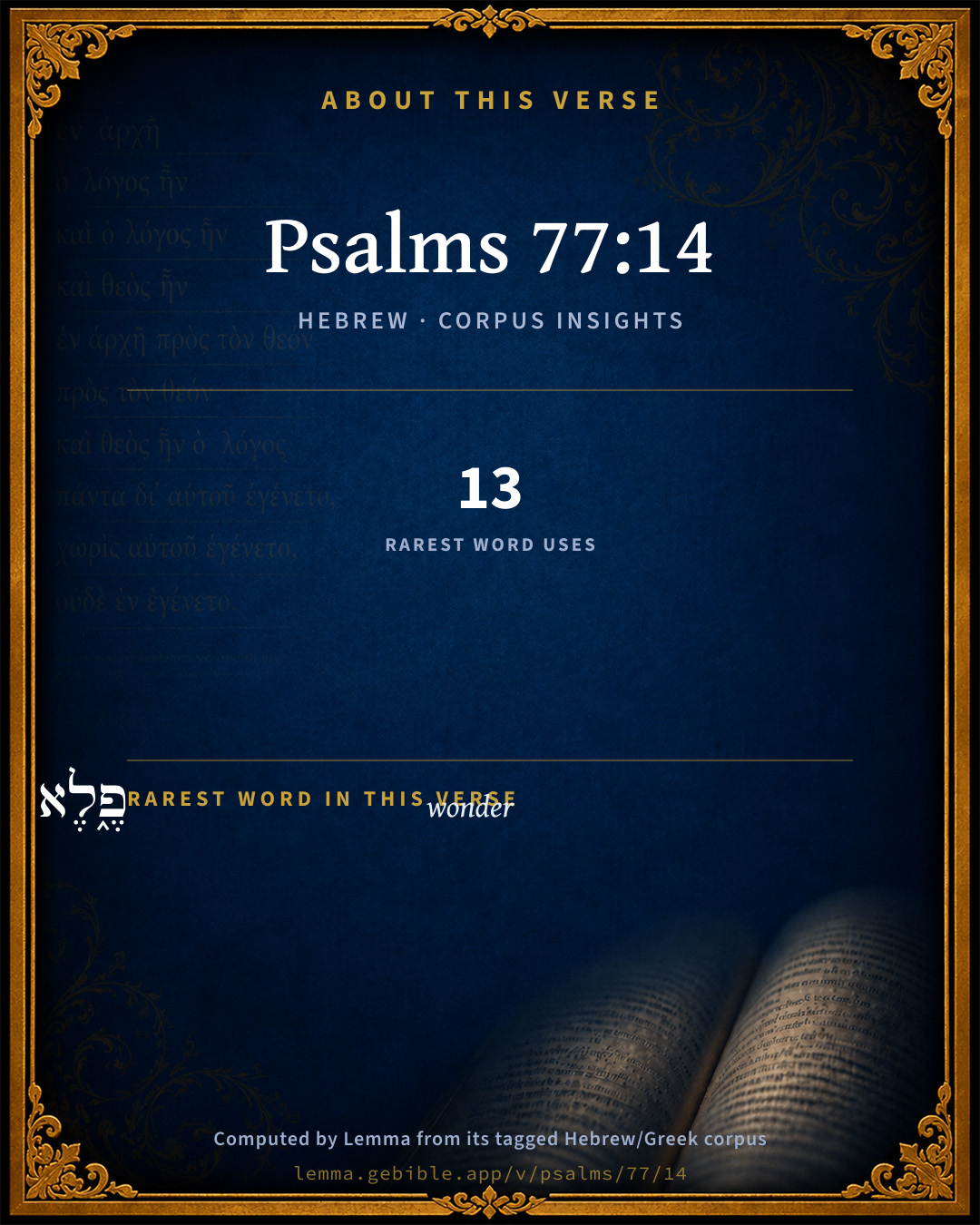
The rarest word here is פֶ֑לֶא wonder H6382 — appearing just 13 times in the whole Hebrew Bible.

Shared distinctive vocabulary

פֶ֑לֶא wonder H6382 occurs in 13 verses of the Hebrew Bible. Also found in:

Grammatical profile

  • 2 verbs
  • 4 nouns
  • 1 pronoun

Verb forms

  • עֹ֣שֵׂה Qal · Participle Active
  • הוֹדַ֖עְתָּ Hiphil · Perfect

Hebrew & Septuagint length

In English translation the verse runs 16 words from the Hebrew and 16 from the Septuagint (LXX English) — the same length.

A rough comparison of the two English renderings, which tokenize alike — not a word-level alignment.

Word counts can differ between the Hebrew and the Greek without any difference in meaning — e.g. the Hebrew direct-object marker אֵת has no separate Greek word, and Greek often adds the article ὁ.

Cross-references

14

Topical passages linked to Psalms 77:14 in the Treasury of Scripture Knowledge — connected by theme and wording, ordered by reader-vote popularity; previews shown in the World English Bible.

  • Daniel 6:27 He delivers and rescues, and he works signs and wonders in heaven and in earth, who has delivered Daniel from the power of the lions.
  • Psalms 136:4 To him who alone does great wonders; For his loving kindness endures forever:
  • Exodus 15:11 Who is like you, Yahweh, among the gods? Who is like you, glorious in holiness, Fearful in praises, doing wonders?
  • Exodus 13:14 It shall be, when your son asks you in time to come, saying, 'What is this?' that you shall tell him, 'By strength of hand Yahweh brought us out from Egypt, from the house of bondage;
  • Psalms 72:18 Praise be to Yahweh God, the God of Israel, Who alone does marvelous deeds.
  • Isaiah 51:9 Awake, awake, put on strength, arm of Yahweh; awake, as in the days of old, the generations of ancient times. Isn't it you who did cut Rahab in pieces, who pierced the monster?
  • Joshua 9:9–10 They said to him, From a very far country your servants are come because of the name of Yahweh your God: for we have heard the fame of him, and all that he did in Egypt,
  • Exodus 15:6 Your right hand, Yahweh, is glorious in power, Your right hand, Yahweh, dashes the enemy in pieces.
  • Revelation 15:3 They sang the song of Moses, the servant of God, and the song of the Lamb, saying, "Great and marvelous are your works, Lord God, the Almighty; Righteous and true are your ways, you King of the nations.
  • Psalms 86:10 For you are great, and do wondrous things. You are God alone.
  • Psalms 105:5 Remember his marvelous works that he has done; His wonders, and the judgments of his mouth,
  • Psalms 106:8 Nevertheless he saved them for his name's sake, That he might make his mighty power known.
  • Isaiah 52:10 Yahweh has made bare his holy arm in the eyes of all the nations; and all the ends of the earth have seen the salvation of our God.
  • Daniel 3:29 Therefore I make a decree, that every people, nation, and language, which speak anything evil against the God of Shadrach, Meshach, and Abednego, shall be cut in pieces, and their houses shall be made a dunghill; because there is no other god who is able to deliver after this sort.

Cross-references courtesy of OpenBible.info (CC BY 4.0).

Hebrew and Greek witnesses Masoretic Hebrew ↔ Greek Septuagint

The same verse in the two great witnesses to the Old Testament, shown verse-for-verse.

You’re reading Greek Psalm 76 (Hebrew Psalm 77). The Septuagint counts the superscription, so verse numbers can differ from the Hebrew — chapter-level alignment, not verse-by-verse. Numbering follows Rahlfs.

These are two independent witnesses, not word-aligned to each other, and the Septuagint is shown in lemma (dictionary) form.

Hebrew Psalms 77:14 Masoretic · Westminster Leningrad Codex

אַתָּ֣ה הָ֭אֵל עֹ֣שֵׂה פֶ֑לֶא הוֹדַ֖עְתָּ בָעַמִּ֣ים עֻזֶּֽךָ

You are the God who does wonders. You have made your strength known among the peoples.

World English Bible · Public Domain

Greek LXX Greek Psalm 76:14 Septuagint · lemma form

ὁ θεός ἐν ὁ ἅγιος ὁ ὁδός σύ τίς θεός μέγας ὡς ὁ θεός ἐγώ

You are the God that do wonders; you have made known your power among the nations.

LXX2012 (modern English Septuagint) · Public Domain

Hebrew: Westminster Leningrad Codex (CC BY 4.0). Greek: Septuagint (public domain); English from LXX2012 (modern English Septuagint) (Public Domain). How the Septuagint differs from the Hebrew →

Commentary

Notes on Psalms 77:14 from classic Christian and Jewish commentators (each source and its license shown beneath its notes). The classic Christian expositions comment on the surrounding passage and are grouped to its opening verse, so a note may address several verses; the Jewish commentaries on the Tanakh (Rashi and others) are per-verse, so they appear only where the commentator wrote on this verse.

Lemma curates 59 commentaries, every one of them public domain or Creative Commons licensed, each selected and text-cleaned for this edition rather than reprinted as found. About our sources →

Trapp's Complete Commentary

John Trapp

Psa 77:14 Thou [art] the God that doest wonders: thou hast declared thy strength among the people.

Ver. 14. Thou art the God that doest wonders] In the daily defence and government of thy Church. Thou art the great Thaumaturgus, or wonder worker.

Thou hast declared thy strength among the people] As among the Egyptians, Canaanites, Philistines, &c. Vere magnus est Dens Christianorum, said one Calocerius, a heathen.

John Trapp, A Commentary or Exposition upon All the Books of the Old and New Testament (1647–1656) — public domain. Text from a community e-Sword module.

Joseph Benson's Commentary

Psa 77:14-15. Thou hast declared thy strength among the people — By the mighty acts of it here following. Thou hast redeemed thy people — Namely, out of Egypt, after a long and hard bondage; which he here mentions to strengthen his faith in the present trouble. The sons of Jacob and Joseph — The people of the Jews are very properly styled the sons of Joseph, as well as of Jacob. For as Jacob was, under God, the author of their being, so was Joseph the preserver of it. The Chaldee paraphrast appears to have understood the words thus, rendering them, The sons which Jacob begat and Joseph nourished. Joseph was indeed a kind of second father, and they might well be called his sons; without whose care, humanly speaking, there had been no such redemption, nor people to be redeemed.

Joseph Benson's Commentary on the Old and New Testaments (1811–1818) — public domain. Text from a community e-Sword module.

J. A. Alexander on Psalms

Joseph Addison Alexander

15. (Psa 77:14). Thou (art) the Almighty doing wonders; thou hast made known in the nations thy strength. Thou art the true Almighty as distinguished from all counterfeits. Doing, i.e. habitually, characteristically, doing wonders. The next word has the singular form but a collective meaning, as in Psa 77:11 above. In the nations, not only to them, but among them, in the midst of them, and in their own experience. The display of God's omnipotence had not been confined to his own people, but extended to surrounding nations, This is particularly mentioned in the history of the exodus from Egypt. See Exo 9:16; Exo 15:14.

Joseph Addison Alexander, The Psalms Translated and Explained (1850) — public domain. Text from a community e-Sword module.

Adam Clarke's Commentary

Verse 14. Thou - doest wonders] Every act of God, whether in nature or grace, in creation or providence, is wondrous; surpasses all power but his own; and can be comprehended only by his own wisdom. To the general observer, his strength is most apparent; to the investigator of nature, his wisdom; and to the genuine Christian, his mercy and love.

Adam Clarke's Commentary on the Bible (1810–1826) — public domain. Text from a community e-Sword/MySword module.

John Calvin's Commentaries

14. Thou art the God that doest wonders. The Psalmist confirms the preceding sentence, proving the greatness of God from the wonderful character of his works. He does not speak of the hidden and mysterious essence of God which fills heaven and earth, but of the manifestations of his power, wisdom, goodness, and righteousness, which are clearly exhibited, although they are too vast for our limited understandings to comprehend. Literally, the words are, Thou art the God that doest a Wonder; but the singular number is here evidently put for the plural, an instance of which we have seen before. From this we learn that the glory of God is so near us, and that he has so openly and clearly unfolded himself, that we cannot justly pretend any excuse for ignorance. He, indeed, works so wonderfully, that even the heathen nations are inexcusable for their blindness. For this reason it is added, Thou hast made known thy strength among the peoples. This has an immediate reference to the deliverance of the Church; but, at the same time, it shows that the glory of God, which he had clearly and mightily displayed among the nations, could not be despised without the guilt of grievous impiety having been incurred.

John Calvin's Commentaries (1540-1563) — public domain. Text from the Calvin Translation Society English edition (1840s-50s) via the Christian Classics Ethereal Library (ccel.org). Calvin's coverage is partial (roughly two-thirds of the Bible); uncommented books and verses are honest gaps, never fabricated. The 19th-century editor's footnotes and remarks are omitted so the notes are faithfully Calvin's own voice.

The Cambridge Bible for Schools and Colleges

gen. ed. J. J. S. Perowne

14. Thou art the God &c.] The true El, the living, Almighty God (Psa_5:4; Psa_42:2). The epithet that doest wonders is borrowed from Exo_15:11. Cp. Isa_25:1.

thou hast declared &c.] Render, Thou didst make known thy strength among the peoples. Cp. Exo_15:13-14; Exo_9:16.

The Cambridge Bible for Schools and Colleges (gen. ed. J. J. S. Perowne; Cambridge University Press, 1878–1918) — public domain. Text from a community e-Sword module.

John Gill's Exposition

Thou art the God that doest wonders,.... In nature, providence, and grace; it seems chiefly to regard what was done for the Israelites in Egypt, and in the wilderness, see Psa 78:12,

thou hast declared thy strength among the people; the nations of the world, who heard what the Lord did for Israel by his mighty power, and with an outstretched arm, as follows.

John Gill's Exposition of the Whole Bible (1746–1763) — public domain (CC PDM 1.0). Text via the HelloAO Bible API.

Albert Barnes' Notes on the Bible

Thou art the God that doest wonders - It is, it must be, the characteristic of God, the true God, to do wonderful things; things which are suited to produce amazement, and which we can little hope to be able to understand. Our judgment of God, therefore, should not be hasty and rash, but calm and deliberate.

Thou hast declared thy strength among the people - Thou hast manifested thy greatness in thy dealings with the people. The word “people” here refers not especially to the Hebrew people, but to the nations - the people of the world at large. On a wide scale, and among all nations, God had done that which was suited to excite wonder, and which people were little qualified as yet to comprehend. No one can judge aright of what another has done unless he can take in the whole subject, and see it as he does who performs the act - unless he understands all the causes, the motives, the results near and remote - unless he sees the necessity of the act - unless he sees what would have been the consequences if it had not been done, for in that which is unknown to us, and which lies beyond the range of our vision, there may be full and sufficient reasons for what has been done, and an explanation may be found there which would remove all the difficulty.

Albert Barnes' Notes on the Bible (1834–1885) — public domain. Text from a community e-Sword/MySword module.

Matthew Poole's English Annotations

By the mighty effects of it here following.

Matthew Poole's English Annotations on the Holy Bible (1683–1685) — public domain. Text from a community e-Sword/MySword module.

The Treasury of David

Charles H. Spurgeon

Ver. 14. Thou art the God that doest wonders. Thou alone art Almighty. The false gods are surrounded with the pretence of wonders, but you really work them. It is thy peculiar prerogative to work marvels; it is no new or strange thing with thee, it is according to thy wont and use. Herein is renewed reason for holy confidence. It would be a great wonder if we did not trust the wonder working God.

Thou hast declared thy strength among the people. Not only Israel, but Egypt, Bashan, Edom, Philistia, and all the nations have seen Jehovah's power. It was no secret in the olden time and to this day it is published abroad. God's providence and grace are both full of displays of his power; he is in the latter peculiarly conspicuous as "mighty to save." Who will not be strong in faith when there is so strong an arm to lean upon? Shall our trust be doubtful when his power is beyond all question? My soul see to it that these considerations banish thy mistrusts.

Whole Psalm. See Psalms on "Ps 77:1" for further information.

Ver. 14. The God that doest wonders. If he said, Thou art the God that hast done wonders, it would be plain that he spake only of those ancient miracles which were wrought in former days: but now that he saith, Thou art the God that doest wonders, he evidently refers to those wonderful works, which he is doing now, and shall not cease to do even to the end of the world. Gerhohus.

Ver. 14. Thaumaturgeis, or the Great Wonder worker.

Psalms 77:15*

Charles H. Spurgeon's The Treasury of David (1869–1885) — public domain. Psalms only. Text from a community e-Sword/MySword module.

The Pulpit Commentary

Thou art the God that doest wonders. The gods of the heathen could do nothing. They were weakness, vanity, nothingness. Jehovah alone was powerful. tie could work, and could "work wonders." This clause prepares the way for the magnificent description of the deliverance of Israel at the Red Sea, which occupies vers. 16-19. Thou hast declared thy strength among the people; rather, among the peoples i.e. in the sight of many heathen nations. (comp. Exo_15:14-16)

The Pulpit Commentary (1880–1919), ed. H.D.M. Spence-Jones & Joseph S. Exell — public domain. Text from a community e-Sword module.

Rashi

Rabbi Shlomo Yitzchaki (Rashi)

Your way is in sanctity Your manner is to sanctify Your name in the world, to execute justice upon the wicked.

Rashi on the Tanakh — English translations: “The Judaica Press complete Tanach with Rashi, translated by A. J. Rosenberg” (CC BY 4.0); “Pentateuch with Rashi's commentary by M. Rosenbaum and A.M. Silbermann, 1929-1934” (public domain); “The Metsudah Tanach series, Lakewood, N.J” (CC BY 4.0); and “The Book of Joshua, Metsudah Publications, 1997” (CC BY 4.0). Text via Sefaria.

Lesson kit

Teaching starters — assembled from the data on this page, not authored interpretation. Every prompt links to the verse data it draws on. Edit before teaching.

Psalms, in the Wisdom, opens this verse with 7 words (7 distinct Hebrew lemmas). Its most distinctive word is peleʼ (“wonder”). A historical commentator’s framing appears above. Read the whole chapter for the surrounding context.

Discussion questions

  1. How does “wonder” (peleʼ) shape what this verse is saying?
  2. How does Exodus 15:11, which shares the word «wonder», read alongside this verse?
  3. These translations render this verse differently. What is at stake in choosing one wording over another?
  4. «עֹ֣שֵׂה» is a Qal Participle Active verb. How does that grammatical form shape the action described?
  5. Compare how Trapp's Complete Commentary and Joseph Benson's Commentary read this verse. Where do they agree or differ?

Things to notice

Reading settings

Reading text

Shown beneath each verse's original-language words.

Old Testament
Old Testament edition

Read the OT as the Masoretic Hebrew (MT) or the Greek Septuagint (LXX).

English shown for the Greek Septuagint (in the Hebrew ↔ Greek comparison).

Comparing translations? Open the Compare panel on any verse page to stack up to four side by side.