
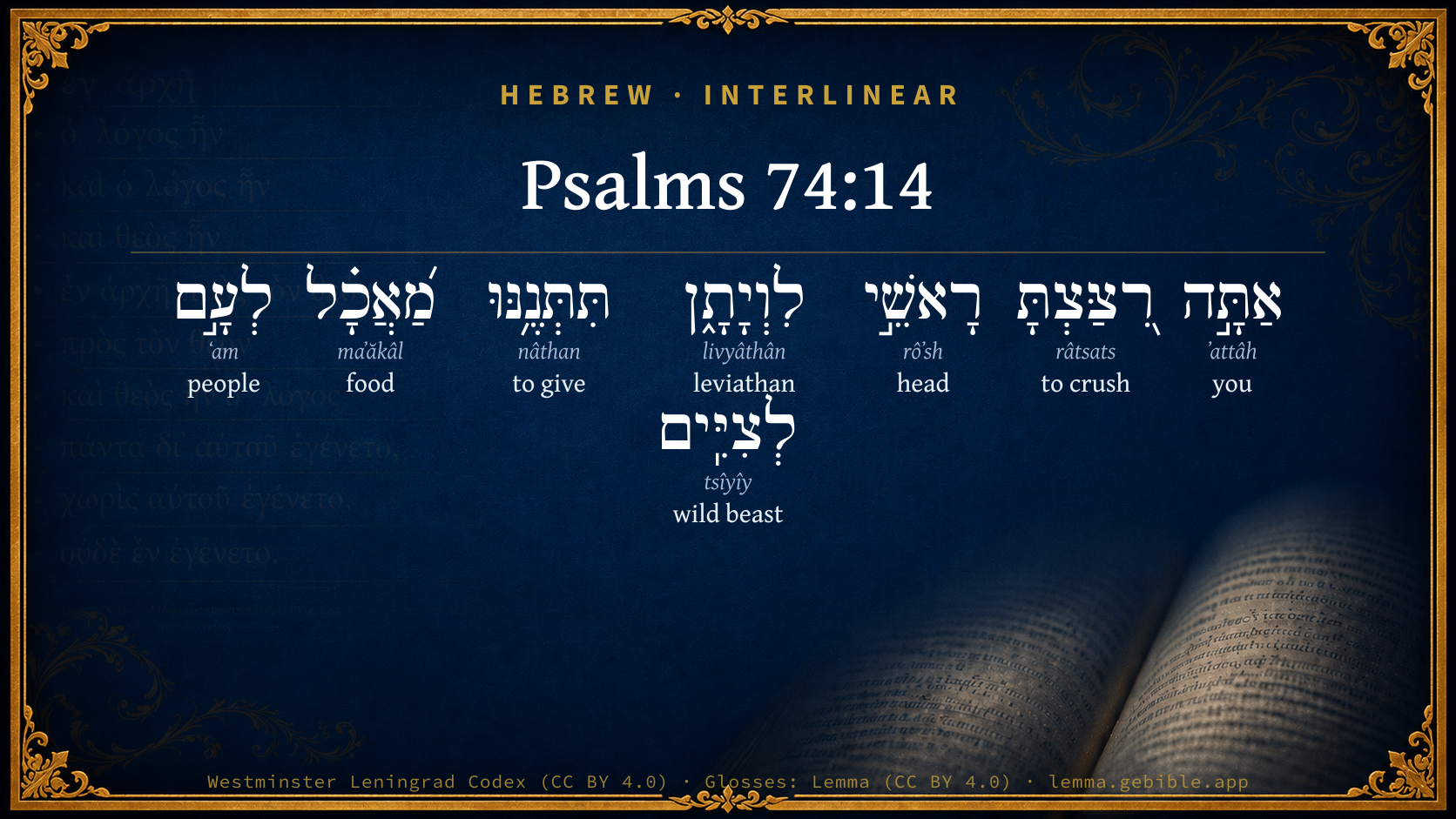
Psalms 74:14

Hebrew (Westminster Leningrad Codex) Psalms 74:14 appears in the Hebrew Old Testament. The text above is from the Westminster Leningrad Codex. Each word links to its Strong’s number, a concise gloss, and parsing drawn from the Open Scriptures Hebrew Bible morphology. Click any word for its full Brown-Driver-Briggs (BDB) entry.
Download image
Cite this verse

Psalms 74:14 (World English Bible). Public Domain. Lemma interlinear Bible study tool, https://lemma.gebible.app/v/psalms/74/14.

Show BibTeX & RIS
BibTeX
RIS
English Translation
You broke the heads of Leviathan in pieces. You gave him as food to people and desert creatures.
World English Bible · Public Domain
Download a study sheet

One document with this verse’s original text, its word-by-word gloss line, the meaning frame, cross-references with their text, attributed commentary, and full source and license credits — printable, and it pastes into notes with its structure intact.

This verse Autodidact and up

Study sheet (.html) Plain text (.txt)

A passage Seminary Student

Up to 50 verses in one chapter. A passage sheet keeps up to 6 commentary sources and 12 cross-references per verse, in the order this page ranks them, and says so on the sheet whenever that leaves anything out. Ask for a single verse and you get the Autodidact verse sheet above.

Everything on this page stays free to read, with no account — the sheet is a download of what is already on screen, not access to it.

Want to remove ads? Support Godless Engineer
Compare translations 3

The same verse in 3 English versions, stacked beneath the original-language interlinear above. Click any original word for its lexicon entry.

Each is an independent rendering of the whole verse — the interlinear is not word-aligned to these translations.

Highlighted words mark where these versions differ — a whole-verse word diff, not a word-by-word alignment.

  • World English Bible Public Domain
    You broke the heads of Leviathan in pieces. You gave him as food to people and desert creatures.
  • King James Version Public Domain
    Thou brakest the heads of leviathan in pieces, and gavest him to be meat to the people inhabiting the wilderness.
  • unfoldingWord Literal Text CC BY-SA 4.0
    You, you crushed the heads of Leviathan; you gave him food to a people, to the desert-dwellers.

unfoldingWord Literal Text — © unfoldingWord, licensed CC BY-SA 4.0. Word-aligned USFM3 via Door43 (git.door43.org/unfoldingWord/en_ult).

Versions to compare (up to 4)

3 of 4 selected

Show all 18 translations

Every available English version of this verse, each an independent rendering of the whole verse.

  • World English Bible Public Domain
    You broke the heads of Leviathan in pieces. You gave him as food to people and desert creatures.
  • Berean Standard Bible Public Domain
    You crushed the heads of Leviathan; You fed him to the creatures of the desert.
  • Majority Standard Bible Public Domain
    You crushed the heads of Leviathan; You fed him to the creatures of the desert.
  • King James Version Public Domain
    Thou brakest the heads of leviathan in pieces, and gavest him to be meat to the people inhabiting the wilderness.
  • American Standard Version (1901) Public Domain
    Thou brakest the heads of leviathan in pieces; Thou gavest him to be food to the people inhabiting the wilderness.
  • Revised Version (1885) Public Domain
    Thou brakest the heads of leviathan in pieces, thou gavest him to be meat to the people inhabiting the wilderness.
  • Geneva Bible (1599) Public Domain
    Thou brakest the head of Liuiathan in pieces, and gauest him to be meate for the people in wildernesse.
  • Douay-Rheims (1899) Public Domain
    Thou hast broken the heads of the dragon: thou hast given him to be meat for the people of the Ethiopians.
  • Young's Literal Translation Public Domain
    Thou hast broken the heads of leviathan, Thou makest him food, For the people of the dry places.
  • Literal Standard Version CC BY-SA 4.0
    You have broken the heads of leviathan, || You make him food for the people of desert-dwellers.
  • Unlocked Literal Bible CC BY-SA 4.0
    You crushed the heads of leviathan; you fed him to those living in the wilderness.
  • unfoldingWord Literal Text CC BY-SA 4.0
    You, you crushed the heads of Leviathan; you gave him food to a people, to the desert-dwellers.
  • Darby Bible Public Domain
    *Thou* didst break in pieces the heads of leviathan, thou gavest him to be meat to those that people the desert.
  • World Messianic Bible Public Domain
    You broke the heads of Leviathan in pieces. You gave him as food to people and desert creatures.
  • Webster's Bible Public Domain
    Thou didst break the head of leviathan in pieces, and didst give him to be food to the people inhabiting the wilderness.
  • Free Bible Version CC BY-SA 4.0
    You were the one who crushed the heads of Leviathan, and you gave its body to the desert animals to eat.
  • Bible in Basic English Public Domain
    The heads of the great snake were crushed by you; you gave them as food to the fishes of the sea.
  • JPS Tanakh (1917) Public Domain
    Thou didst crush the heads of leviathan, Thou gavest him to be food to the folk inhabiting the wilderness.

Literal Standard Version (2020), Covenant Press — licensed CC BY-SA 4.0. Text via the HelloAO Bible API (eBible.org). Unlocked Literal Bible (unfoldingWord) — licensed CC BY-SA 4.0. Text via the HelloAO Bible API (eBible.org). unfoldingWord Literal Text — © unfoldingWord, licensed CC BY-SA 4.0. Word-aligned USFM3 via Door43 (git.door43.org/unfoldingWord/en_ult). Free Bible Version, Dr. Jonathan Gallagher — licensed CC BY-SA 4.0. Text via the HelloAO Bible API (eBible.org).

Word by word

More ways to search: Search by grammar → Find every occurrence → Compare this word →

Practice this passage: Drill this verse → Learn its vocabulary →

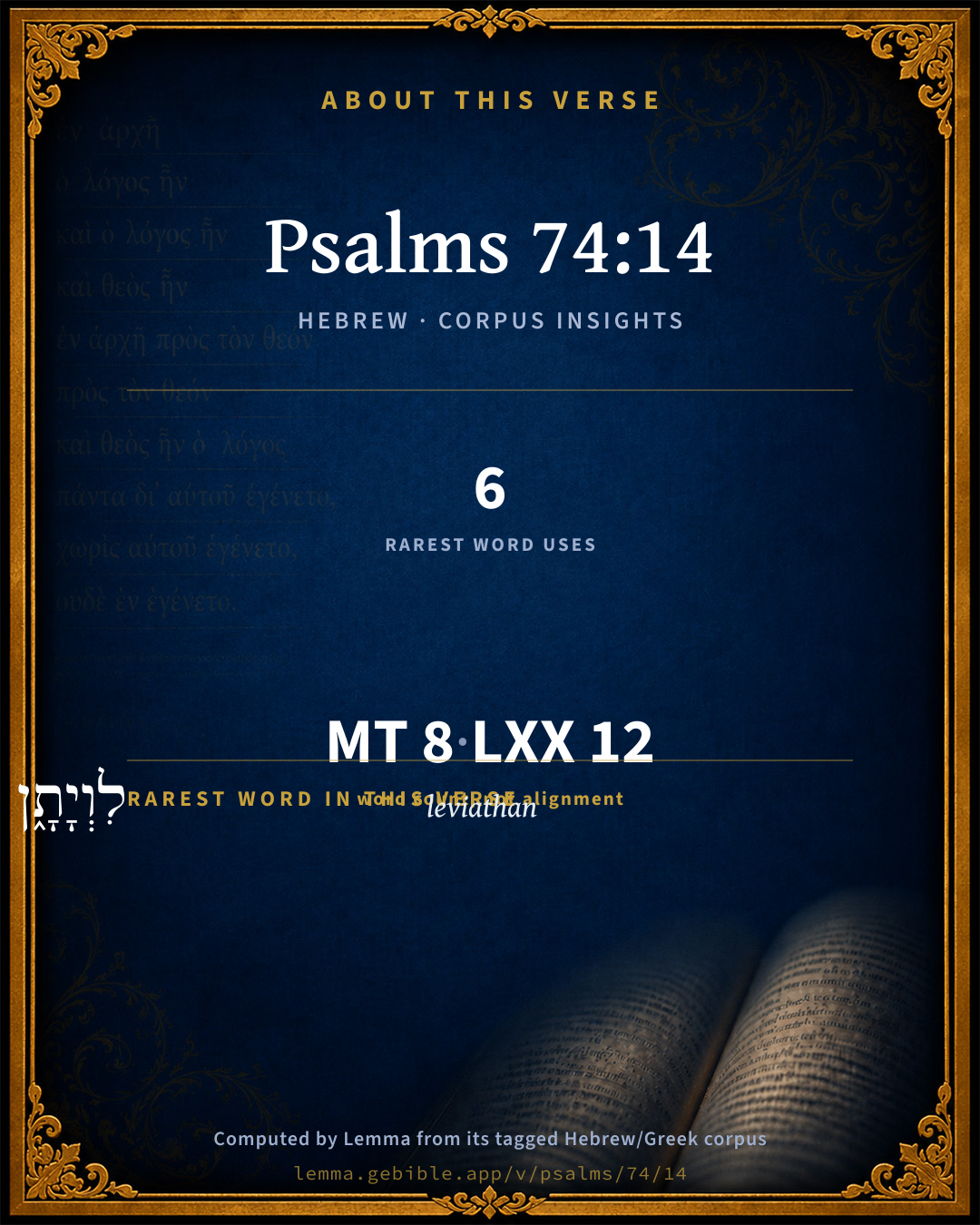
About this verse

These counts appear in no published source. They are computed here, from the morphology-tagged text and Lemma’s own curated glosses. What Lemma adds →

8
words
8
distinct lemmas
Wisdom
section

Notable vocabulary

The rarest word here is לִוְיָתָ֑ן leviathan H3882 — appearing just 6 times in the whole Hebrew Bible.

Shared distinctive vocabulary

לִוְיָתָ֑ן leviathan H3882 occurs in 5 verses of the Hebrew Bible. Also found in:

Grammatical profile

  • 2 verbs
  • 5 nouns
  • 1 pronoun

Verb forms

  • רִ֭צַּצְתָּ Piel · Perfect
  • תִּתְּנֶ֥נּוּ Qal · Imperfect

Hebrew & Septuagint length

In English translation the verse runs 18 words from the Hebrew and 20 from the Septuagint (LXX English) — closely comparable.

A rough comparison of the two English renderings, which tokenize alike — not a word-level alignment.

Word counts can differ between the Hebrew and the Greek without any difference in meaning — e.g. the Hebrew direct-object marker אֵת has no separate Greek word, and Greek often adds the article ὁ.

In the original languages it is 8 Hebrew tokens and 12 Greek tokens — but the two are counted differently (Hebrew bundles its prefixes and suffixes into one token; the Greek is in lemma form), so that isn’t a like-for-like length.

Cross-references

9

Topical passages linked to Psalms 74:14 in the Treasury of Scripture Knowledge — connected by theme and wording, ordered by reader-vote popularity; previews shown in the World English Bible.

  • Isaiah 27:1 In that day Yahweh with his hard and great and strong sword will punish leviathan the swift serpent, and leviathan the crooked serpent; and he will kill the monster that is in the sea.
  • Psalms 72:9 Those who dwell in the wilderness shall bow before him. His enemies shall lick the dust.
  • Job 41:1–34 "Can you draw out Leviathan with a fishhook? Or press down his tongue with a cord?
  • Psalms 104:25–26 There is the sea, great and wide, In which are innumerable living things, Both small and large animals.
  • Numbers 14:9 Only don't rebel against Yahweh, neither fear the people of the land; for they are bread for us: their defense is removed from over them, and Yahweh is with us: don't fear them.
  • Job 3:8 Let them curse it who curse the day, Who are ready to rouse up leviathan.
  • Exodus 12:35–36 The children of Israel did according to the word of Moses; and they asked of the Egyptians jewels of silver, and jewels of gold, and clothing.
  • Exodus 14:30 Thus Yahweh saved Israel that day out of the hand of the Egyptians; and Israel saw the Egyptians dead on the seashore.
  • Revelation 20:2 He seized the dragon, the old serpent, which is the devil and Satan, who deceives the whole inhabited earth, and bound him for a thousand years,

Cross-references courtesy of OpenBible.info (CC BY 4.0).

Hebrew and Greek witnesses Masoretic Hebrew ↔ Greek Septuagint

The same verse in the two great witnesses to the Old Testament, shown verse-for-verse.

You’re reading Greek Psalm 73 (Hebrew Psalm 74). The Septuagint counts the superscription, so verse numbers can differ from the Hebrew — chapter-level alignment, not verse-by-verse. Numbering follows Rahlfs.

These are two independent witnesses, not word-aligned to each other, and the Septuagint is shown in lemma (dictionary) form.

Hebrew Psalms 74:14 Masoretic · Westminster Leningrad Codex

אַתָּ֣ה רִ֭צַּצְתָּ רָאשֵׁ֣י לִוְיָתָ֑ן תִּתְּנֶ֥נּוּ מַ֝אֲכָ֗ל לְעָ֣ם לְצִיִּֽים

You broke the heads of Leviathan in pieces. You gave him as food to people and desert creatures.

World English Bible · Public Domain

Greek LXX Greek Psalm 73:14 Septuagint · lemma form

σύ συνθλάω ὁ κεφαλή ὁ δράκων δίδωμι αὐτός βρῶμα λαός ὁ αἰθίοψ

You did break to pieces the heads of the dragon; you did give him for meat to the Ethiopian nations.

LXX2012 (modern English Septuagint) · Public Domain

On this verse, Adam Clarke's Commentary discusses the Septuagint’s reading. Read the note in Commentary ↓

Hebrew: Westminster Leningrad Codex (CC BY 4.0). Greek: Septuagint (public domain); English from LXX2012 (modern English Septuagint) (Public Domain). How the Septuagint differs from the Hebrew →

Commentary

Notes on Psalms 74:14 from classic Christian and Jewish commentators (each source and its license shown beneath its notes). The classic Christian expositions comment on the surrounding passage and are grouped to its opening verse, so a note may address several verses; the Jewish commentaries on the Tanakh (Rashi and others) are per-verse, so they appear only where the commentator wrote on this verse.

Lemma curates 59 commentaries, every one of them public domain or Creative Commons licensed, each selected and text-cleaned for this edition rather than reprinted as found. About our sources →

Trapp's Complete Commentary

John Trapp

Psa 74:14 Thou brakest the heads of leviathan in pieces, [and] gavest him [to be] meat to the people inhabiting the wilderness.

Ver. 14. Thou brakest the heads of leviathan] i.e. Of Pharaoh himself. See Isa 26:1 Eze 29:3. Egypt is situated between two seas; and a great part of it overflowed by the river Nile. Pharaoh, therefore, is fitly compared to the master fish, and his captains to crocodiles.

And gavest him to be meat to the people inhabiting the wilderness] i.e. To the birds and wild beasts, who fed upon the dead carcases of the Egyptians cast upon the shore; the Israelites having first taken the spoil of them, whereby they were provided of many necessaries for their voyage toward Canaan.

John Trapp, A Commentary or Exposition upon All the Books of the Old and New Testament (1647–1656) — public domain. Text from a community e-Sword module.

The Biblical Illustrator

Joseph S. Exell

Psa_74:14

Thou brakest the heads Of leviathan in pieces, and gavest him to be meat to the people inhabiting the wilderness.

Leviathan

We cannot certainly tell what animal is meant by leviathan, but whatever be intended, it is here used to represent Pharaoh with all his policy and power. Who were the people inhabiting the wilderness?

I. The birds and beasts of the desert. The carcases of the Egyptians became their prey.

II. The Jews themselves. For literally, Pharaoh and his hosts became meat for them by the spoils they took from them. And morally, because they gained from the event food for their faith, gratitude, and hope.

III. Christians to-day. For they are such a people: the world is a wilderness to them, not their rest. And for them many leviathans have been destroyed. Satans power: the curse and condemnation of our natural state. And the remembrance will feed our humility, gratitude and trust. And there have been providential interpositions also. Take note of these things. (W. Jay.)

The Biblical Illustrator, edited by Joseph S. Exell (c. 1880s–1900s) — public domain. Text from a community e-Sword module.

J. A. Alexander on Psalms

Joseph Addison Alexander

Psa 74:14. (It is) thou (that) hast crushed the heads of Leviathan, (that) wilt give him (as) food to the people, to the wild men, or the dwellers in the desert. See above, on Psa 72:9. Leviathan, according to its etymology, denotes a coiled or crooked serpent, but like dragon in ver. 13, is used as a generic term for huge aquatic animals. Having no plural form, it is here used in a collective sense, as appears from the expression heads, unless we understand this as denoting a many-headed monster, to which, however, there is no analogy in Scripture. In the last clause, people seems to mean men in general, and is then rendered definite by the use of the specific erm which follows. By the people of the desert some understand the savage beasts, by whom the Egyptians were devoured after the overthrow of Pharaoh; others, with more probability, the wild men living on the shores of the Red Sea, and subsisting on its fish, and hence called by the Greeks the Ichthyophagi. The transition from the past tense to the future seems to represent the scene as actually passing, or the act as one that may be frequently repeated. "It is thou that hast done all this, and wilt do it again."

Joseph Addison Alexander, The Psalms Translated and Explained (1850) — public domain. Text from a community e-Sword module.

Tyndale Open Study Notes

Tyndale Open Resources

74:14 Leviathan: See 104:26; Job 3:8; 41:1, 12, 22, 31; Isa 27:1. Here, the creature’s multiple heads suggest a mythical monster.

Tyndale Open Study Notes — © Tyndale Open Resources, licensed CC BY-SA 4.0. Text via the HelloAO Bible API.

Geneva Bible (1599)

Geneva Bible translators

His destruction did rejoice them as meat refresheth the body.

Which was a great monster of the sea, or whale, meaning, Pharaoh.

Geneva Bible (1599) marginal notes — public domain. Text via Bolls.life.

Adam Clarke's Commentary

Verse 14. The heads of leviathan] Leviathan might be intended here as a personification of the Egyptian government; and its heads, Pharaoh and his chief captains.

To the people inhabiting the wilderness.] Probably meaning the birds and beasts of prey. These were the people of the wilderness, which fed on the dead bodies of the Egyptians, which the tides had cast ashore. The Vulgate, Septuagint, AEthiopic, and Arabic read, "Thou hast given him for meat to the Ethiopians," or Abyssinians.

Adam Clarke's Commentary on the Bible (1810–1826) — public domain. Text from a community e-Sword/MySword module.

Ellicott's Commentary for English Readers

(14) Leviathan.—See last note.

And gavest him . . .—The crocodile was eaten by the people of Elephantine (Herod. ii. 69), but there is no allusion here to that custom, nor to the Ichthyophagi mentioned by Agatharchides, nor to the Æthiopians (as in the LXX.). It is the Egyptian corpses thrown up by the Red Sea that are to be devoured (comp. Eze_29:3-5) by the “wild beasts,” called here “people,” as the ants and conies are (Pro_30:25-26).

A Bible Commentary for English Readers, edited by Charles John Ellicott (1878–1897) — public domain. Text from a community e-Sword module.

The Cambridge Bible for Schools and Colleges

gen. ed. J. J. S. Perowne

14. Thou brakest &c. Thou didst crush … thou didst give him &c. The dead bodies of the Egyptians were cast up on the shore (Exo_14:30) to be devoured by the wild beasts of the desert. Cp. Eze_29:3-5. For ‘people’ applied to animals cp. Pro_30:25-26.

The Cambridge Bible for Schools and Colleges (gen. ed. J. J. S. Perowne; Cambridge University Press, 1878–1918) — public domain. Text from a community e-Sword module.

John Gill's Exposition

Thou didst cleave the fountain and the flood,.... That is, the rocks at Horeb and at Kadesh, from whence water flowed as out of a fountain, and became a flood, whereby the people of Israel were supplied with water in the wilderness, and also their beasts; and from this instance it may be concluded that God will not leave his people, nor suffer them to want, but will supply all their need while they are in the wilderness, and will open fountains and rivers for them, Isa 41:17 he himself is a fountain of living water; Christ is the fountain of gardens, and the Spirit and his grace a well of living water springing up unto everlasting life:

thou driedst up mighty rivers; the river of Jordan, called "mighty", as Kimchi says, because by its strength it overflowed all its banks and "rivers", and because other rivers flowed into it; this was dried up, or way was made through it, as on dry land, for the people of Israel to pass into Canaan, Jos 3:14, the Targum is,

"thou hast dried up the fords and brooks of Hermon, and the fords of Jabbok and Jordan;''

see Num 21:14, and the Lord, that did this, is able to dry up, and will dry up, the river Euphrates, as is foretold, Rev 16:12, that is, destroy the Turkish empire, and make way for the spread of the Gospel in the eastern parts of the world; to which reference is had in Isa 11:15.

John Gill's Exposition of the Whole Bible (1746–1763) — public domain (CC PDM 1.0). Text via the HelloAO Bible API.

Albert Barnes' Notes on the Bible

Thou brakest the heads of leviathan in pieces - On the meaning of the word “leviathan,” see the notes at Job 41:1. The word is used here as descriptive of sea monsters.

And gavest him to be meat - Gavest him for “food.”

To the people inhabiting the wilderness - That is, the sea monsters were killed, and, being thrown on shore, were gathered for food. The “inhabitants of the wilderness” or the desert, may refer either to the wild and savage tribes of men that lived on the shores of the sea, and that subsisted mainly on fish, or it may refer to the wild animals of the desert that consumed such sea monsters as they were cast up on the shore. There is no allusion to the Israelites considered as passing through the desert, as if they had fed on these sea monsters. The essential idea is, that these monsters were put to death, or were so removed but of the way as to offer no obstruction to the passage of the Israelites through the sea. It was as if they had been killed. The image is entirely poetic, and there is no necessity for supposing that such a thing literally occurred.

Albert Barnes' Notes on the Bible (1834–1885) — public domain. Text from a community e-Sword/MySword module.

Matthew Poole's English Annotations

The heads, i.e. the head; called heads, partly for the greatness of this beast, as that great monster is called beasts, Job 40:20, for the same reason; and partly for the several heads or princes who were and acted under his influence.

Leviathan; Pharaoh.

To the people inhabiting the wilderness, Heb. to the people in or of the desert; either,

1. To the Israelites then in the wilderness, to whom the destruction of Pharaoh and his host was meat, i.e. matter of great support and refreshment. Or,

2. To those savage people to whom they were meat, because they lived upon fishes, and might eat those very fishes which had devoured Pharaoh’s host in the bottom of the sea. Or rather,

3. To those ravenous birds and beasts of the desert, which after their manner fed and feasted themselves upon the carcasses of the Egyptians, who were cast upon the sea-shore, Exo 14:30, which were properly and immediately meat unto them. And when words can be taken properly, we ought to prefer that before the metaphorical sense, as is agreed by interpreters. And this was a very suitable punishment for this proud and insolent people, that they who were so haughty, that they would not own nor submit to the Lord himself, Exo 5:2, should be devoured by these contemptible creatures, which was a great reproach, 1Sa 17:44,46, and oft threatened by God as a grievous curse, as Deu 28:26; Jer 7:33; 16:4, &c. Neither let any think it strange that the name of

people is given to these creatures, for it is given to conies, grasshoppers, pismires, &c., both in Scripture, as Pro 30:25,26; Joe 1:6, and in Homer, and other ancient profane writers. Nay, here is an elegancy in the expression; for these creatures are significantly called the people of the wilderness, because they are the only people that inhabited it, this being a wilderness wherein was no man, as is said, Job 38:26.

Matthew Poole's English Annotations on the Holy Bible (1683–1685) — public domain. Text from a community e-Sword/MySword module.

The Treasury of David

Charles H. Spurgeon

Ver. 14. Thou brakest the heads of leviathan in pieces. It is the Lord who has done it all. The mighty dragon of Egypt was utterly slain, and his proud heads broken in pieces. Our Lord Jesus is the true Hercules, dragons with a hundred heads are crushed beneath his foot: the infernal hydra he utterly vanquishes.

And gavest him to be meat to the people inhabiting the wilderness. Not only did the wild beasts feed upon the carcasses of the Egyptians, but the dwellers along the shores stripped the bodies and enriched themselves with the spoil. Israel, too, grew rich with the relics of her drowned adversaries. How often do great afflictions work our lasting good. Leviathan, who would have devoured us, is himself devoured, and out of the monster we gather sweetness. Let us not give way to fear; hydra headed evils shall be slain, and monstrous difficulties shall be overcome, and all things shall work our lasting good.

Ver. 14. Thou brakest the heads of leviathan, etc. It is spoken of Pharaoh's army which God destroyed in the Red Sea; that is, the destruction of the Egyptians was a pledge of the accomplishment of God's promise to cast the Canaanite out of the promised land, and to give them possession of it. Many hardships they were to pass through in the wilderness, but God gave them this mercy as food, not to their bodies, but food to their faith, while they were in the wilderness: therefore, those former great and glorious promises were accomplished. So that former mercies are food that God gives unto the faith of his people to feed upon, till he hath perfectly accomplished whatever he hath promised unto his church. William Strong.

Ver. 14. Leviathan. The Arabic Lexicographers (quoted by Bochart) affirm that Pharao, in the Egyptian language, signified a crocodile. Parkhurst remarks that in Schenchzer's Physica Sacra may be seen a medal with Julius Caesar's head on one side, and on the reverse a crocodile with this inscription: AGYPTO CAPTA, Egypt taken. M. Mariette has discovered at Karnak a monumental stele of Thothmes on which the king says of himself,

"Fierce as the huge crocodile, I made them see the glory of

my God;

Terrible Lord of the waters, none dare even approach him."

Ver. 14. Leviathan is a name given not only to the crocodile, but to the whale and other large fishes. The Zum, or people inhabiting the wilderness, are supposed, by many sensible writers, to be the Ichthyophagy, or fish eaters, who occupied, according to ancient authors, a part of the coast of the Red Sea. The psalmist is here speaking of Israel's passage through its waters; and it is a singular fact that Diodorus, who lived about two thousand years ago, mentions a tradition, prevalent amongst these very persons, to the effect that in the time of their remote forefathers an extraordinary reflux took place, the channel of the gulf becoming dry, and the green bottom appearing, whilst the whole body of waters rolled away in an opposite direction. There can be little doubt that this strange people would have used for food, and various purposes, such great fish as might have been cast ashore on the termination of the miracle. Most writers give this text a figurative meaning, but that is no reason why it may not be also literally understood; for such a mode of speaking is common in the Bible. But whether we understand it one way or the other, we have the testimony of heathens to its propriety and force. If, by the term Leviathan, we believe Egypt to be intended, and by its heads those petty states into which that country was divided, the traditions of India, and the East, inform us that such designations were well understood, and therefore beautifully applicable. Anon., in "Biblical and Theological Gleanings"; by William O'Neill. 1854.

Ver. 14. Meat to the people inhabiting the wilderness. May not the exact meaning be that even as the sea monsters washed upon the shore furnished food for the inhabitants of the Red Sea, even so the symbolic dragon power of Egypt when destroyed at the Red Sea, became food for Israel's faith, and even furnished provision for their wilderness journey by the spoil which was cast up by the tide. C. H. S.

Ver. 14. God's defeat of our enemies, and the benefit accruing to ourselves.

Psalms 74:15*

Charles H. Spurgeon's The Treasury of David (1869–1885) — public domain. Psalms only. Text from a community e-Sword/MySword module.

Whedon's Commentary on the Bible

Daniel D. Whedon

14. Leviathan—A different word in the original from “dragons” in preceding verse, but of similar import. In Isa_27:1, it is described as a serpent, crooked and tortuous, but crocodiles often present that form. So Job_26:13. These names are not given according to scientific classification, but generally signify saurian monsters of any kind, and are here used interchangeably. In Psa_104:26, it evidently means a mammal of the Mediterranean, the whale, which formerly inhabited that sea.

Gavest him to be meat to the people inhabiting the wilderness— The Egyptians proper held the crocodile sacred, and worshipped it as a god, hence they never ate its flesh. But others, like the inhabitants of the city of Elephantine, in Upper Egypt, of whom Herodotus speaks, (book ii, sec. 69,) freely ate it. But we may take “people” in the figurative sense of Pro_30:25, “The ants are a people not strong,” and apply the term to the wild beasts of the desert. The crushing the head of the crocodile and throwing out the carcass as common food for desert men or beasts, was the contempt which Jehovah inflicted upon its worshippers.

Daniel D. Whedon (gen. ed.), Commentary on the Old and New Testaments (1874–1909) — public domain. Text from a community e-Sword module.

The Pulpit Commentary

Thou brakest the heads of leviathan in pieces. Here the metaphor is only slightly varied, leviathan, "the crocodile," being substituted for tannim, "the dragon," or "sea monster," as the representative of the might of Egypt. And gavest him to be meat to the people inhabiting the wilderness. The corpses of the Egyptians thrown up upon the Red Sea shores (Exo_14:30) are certainly the "meat" intended. Whether the "people of dwellers in the wilderness" are cannibal tribes, or jackals and hyenas, is perhaps doubtful.

The Pulpit Commentary (1880–1919), ed. H.D.M. Spence-Jones & Joseph S. Exell — public domain. Text from a community e-Sword module.

John Wesley's Explanatory Notes

Leviathan - Pharaoh. The people - To the ravenous birds and beasts of the desert. These creatures are significantly called the people of the wilderness, because they are the only people that inhabit it.

John Wesley, Explanatory Notes Upon the Whole Bible (1754–1765) — public domain. Text via the GEBible commentary corpus.

unfoldingWord translationNotes

Door43 World Missions Community

General Information:

Asaph continues to speak of what God did long ago. He is probably speaking of when God brought Israel out of Egypt and drowned Pharaoh's army in the Sea of Reeds. If possible, these words should be translated literally.

leviathan

Leviathan is a sea monster. It represents a cruel enemy. (See: Metaphor)

You broke open springs and streams

Yahweh causing springs and streams to flow out of the ground as if he broke open the ground so that they could flow. AT: "You caused springs and streams to flow out of the ground" (See: Metaphor)

translationWords

desert

unfoldingWord translationNotes — © Distant Shores Media and the Door43 World Missions Community, licensed CC BY-SA 4.0. Source: git.door43.org/Door43/en_tn.

Rashi

Rabbi Shlomo Yitzchaki (Rashi)

the heads of Leviathan Pharaoh is called [by] this [name], as it is said (Isa. 27:1): “the Lord will visit with His hard...sword on leviathan, etc.”

You give it as food to the people in companies You gave his money to the people of Israel to consume. in companies Heb. לציים. To the companies and hosts that You took out.

ציים are companies, as (Num. 24:24): “And companies from the Kittites,” which is translated as וסיען, and companies.

Rashi on the Tanakh — English translations: “The Judaica Press complete Tanach with Rashi, translated by A. J. Rosenberg” (CC BY 4.0); “Pentateuch with Rashi's commentary by M. Rosenbaum and A.M. Silbermann, 1929-1934” (public domain); “The Metsudah Tanach series, Lakewood, N.J” (CC BY 4.0); and “The Book of Joshua, Metsudah Publications, 1997” (CC BY 4.0). Text via Sefaria.

Lesson kit

Teaching starters — assembled from the data on this page, not authored interpretation. Every prompt links to the verse data it draws on. Edit before teaching.

Psalms, in the Wisdom, opens this verse with 8 words (8 distinct Hebrew lemmas). Its most distinctive word is livyâthân (“leviathan”). A historical commentator’s framing appears above. Read the whole chapter for the surrounding context.

Discussion questions

  1. The word livyâthân carries the sense “leviathan.” How does it shape the verse?
  2. Job 3:8 shares the word «leviathan» with this verse. How do the two illuminate each other?
  3. These translations render this verse differently. What is at stake in choosing one wording over another?
  4. The verb «רִ֭צַּצְתָּ» is Piel Perfect. How does its form color the action?
  5. Reading how Trapp's Complete Commentary and The Biblical Illustrator read this verse, where do the two commentators agree and where do they part?

Things to notice

Reading settings

Reading text

Shown beneath each verse's original-language words.

Old Testament
Old Testament edition

Read the OT as the Masoretic Hebrew (MT) or the Greek Septuagint (LXX).

English shown for the Greek Septuagint (in the Hebrew ↔ Greek comparison).

Comparing translations? Open the Compare panel on any verse page to stack up to four side by side.