
Psalms 68:30

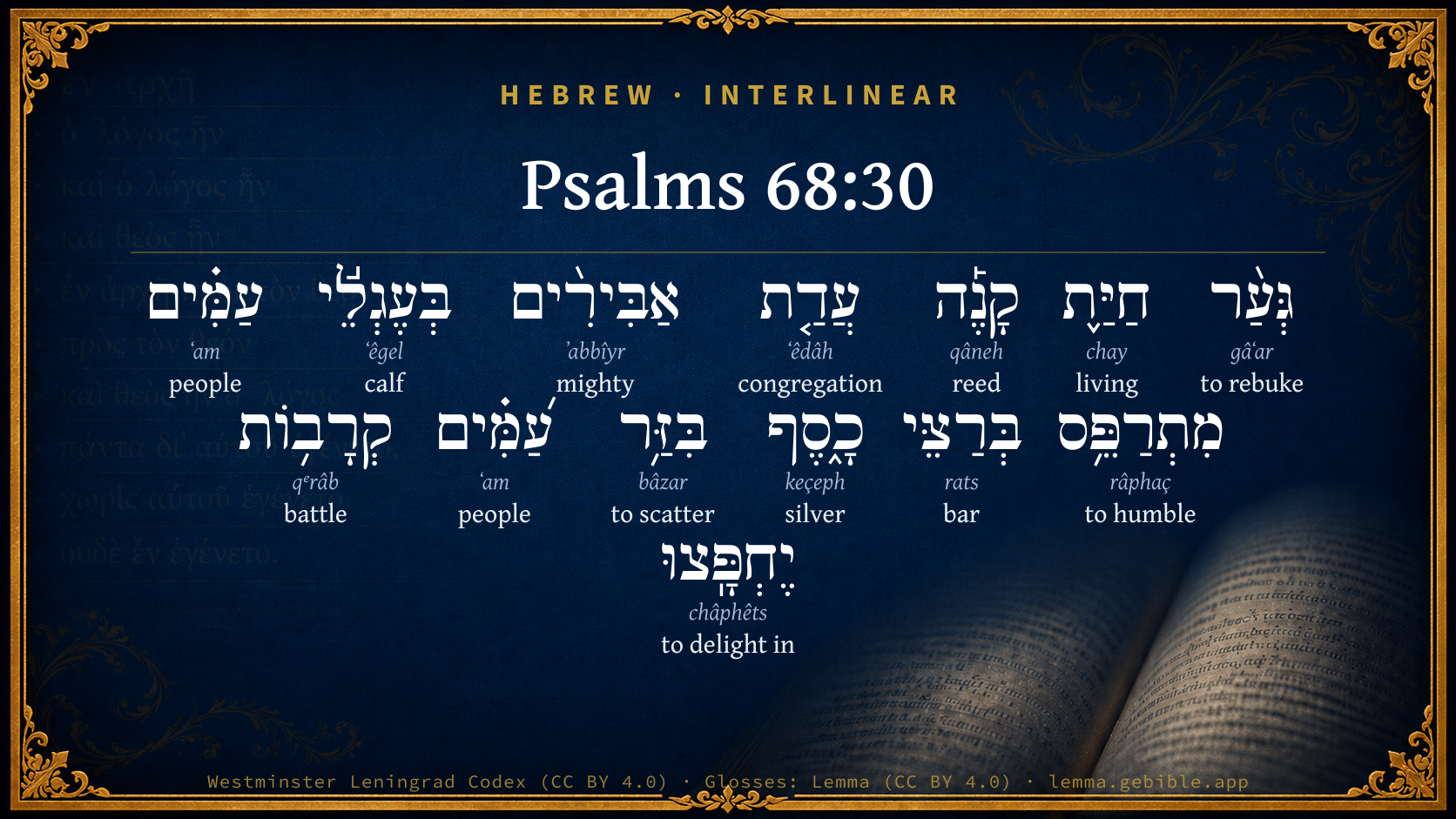
Hebrew (Westminster Leningrad Codex) Psalms 68:30 appears in the Hebrew Old Testament. The text above is from the Westminster Leningrad Codex. Each word links to its Strong’s number, a concise gloss, and parsing drawn from the Open Scriptures Hebrew Bible morphology. Click any word for its full Brown-Driver-Briggs (BDB) entry.
Download image
Cite this verse

Psalms 68:30 (World English Bible). Public Domain. Lemma interlinear Bible study tool, https://lemma.gebible.app/v/psalms/68/30.

Show BibTeX & RIS
BibTeX
RIS
English Translation
Rebuke the wild animal of the reeds, The multitude of the bulls, with the calves of the peoples. Being humbled, may it bring bars of silver. Scatter the nations that delight in war.
World English Bible · Public Domain
Highlights
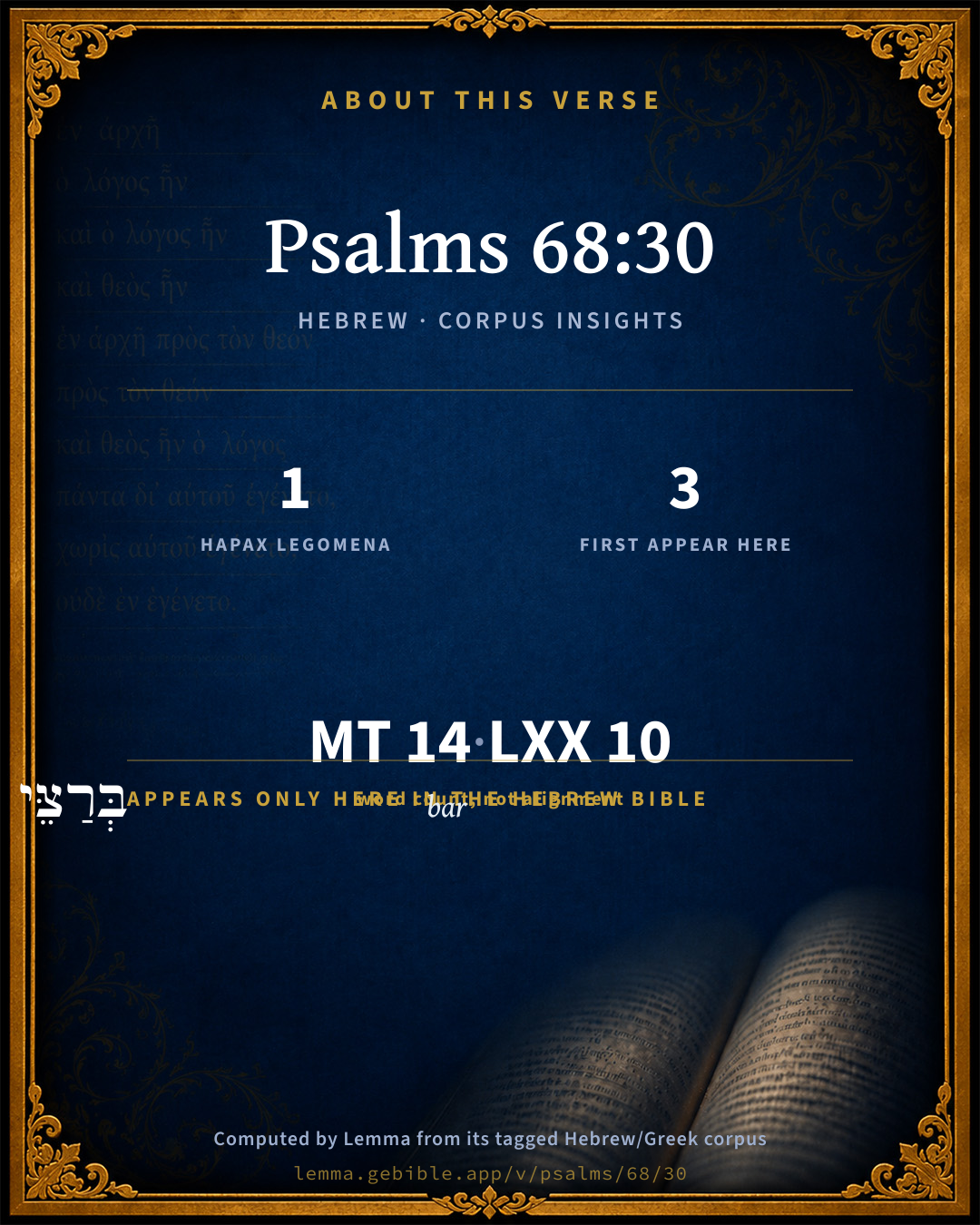
  • 1 hapax legomenon — only here in the Hebrew Bible
  • 3 first appearances in the Hebrew Bible
Full analysis ↓
Download a study sheet

One document with this verse’s original text, its word-by-word gloss line, the meaning frame, cross-references with their text, attributed commentary, and full source and license credits — printable, and it pastes into notes with its structure intact.

This verse Autodidact and up

Study sheet (.html) Plain text (.txt)

A passage Seminary Student

Up to 50 verses in one chapter. A passage sheet keeps up to 6 commentary sources and 12 cross-references per verse, in the order this page ranks them, and says so on the sheet whenever that leaves anything out. Ask for a single verse and you get the Autodidact verse sheet above.

Everything on this page stays free to read, with no account — the sheet is a download of what is already on screen, not access to it.

Want to remove ads? Support Godless Engineer
Compare translations 3

The same verse in 3 English versions, stacked beneath the original-language interlinear above. Click any original word for its lexicon entry.

Each is an independent rendering of the whole verse — the interlinear is not word-aligned to these translations.

Highlighted words mark where these versions differ — a whole-verse word diff, not a word-by-word alignment.

  • World English Bible Public Domain
    Rebuke the wild animal of the reeds, The multitude of the bulls, with the calves of the peoples. Being humbled, may it bring bars of silver. Scatter the nations that delight in war.
  • King James Version Public Domain
    Rebuke the company of spearmen, the multitude of the bulls, with the calves of the people, till every one submit himself with pieces of silver: scatter thou the people that delight in war.
  • unfoldingWord Literal Text CC BY-SA 4.0
    Rebuke the beast of the reed, the assembly of the mighty with the calves of the peoples, humbling himself with pieces of silver. He scatters the peoples delight in battles.

unfoldingWord Literal Text — © unfoldingWord, licensed CC BY-SA 4.0. Word-aligned USFM3 via Door43 (git.door43.org/unfoldingWord/en_ult).

Versions to compare (up to 4)

3 of 4 selected

Show all 18 translations

Every available English version of this verse, each an independent rendering of the whole verse.

  • World English Bible Public Domain
    Rebuke the wild animal of the reeds, The multitude of the bulls, with the calves of the peoples. Being humbled, may it bring bars of silver. Scatter the nations that delight in war.
  • Berean Standard Bible Public Domain
    Rebuke the beast in the reeds, the herd of bulls among the calves of the nations, until it submits, bringing bars of silver. Scatter the nations who delight in war.
  • Majority Standard Bible Public Domain
    Rebuke the beast in the reeds, the herd of bulls among the calves of the nations, until it submits, bringing bars of silver. Scatter the nations who delight in war.
  • King James Version Public Domain
    Rebuke the company of spearmen, the multitude of the bulls, with the calves of the people, till every one submit himself with pieces of silver: scatter thou the people that delight in war.
  • American Standard Version (1901) Public Domain
    Rebuke the wild beast of the reeds, The multitude of the bulls, with the calves of the peoples, Trampling under foot the pieces of silver: He hath scattered the peoples that delight in war.
  • Revised Version (1885) Public Domain
    Rebuke the wild beast of the reeds, the multitude of the bulls, with the calves of the peoples, trampling under foot the pieces of silver; he hath scattered the peoples that delight in war.
  • Geneva Bible (1599) Public Domain
    Destroy the company of the spearemen, and multitude of the mightie bulles with the calues of the people, that tread vnder feete pieces of siluer: scatter the people that delite in warre.
  • Douay-Rheims (1899) Public Domain
    From thy temple in Jerusalem, kings shall offer presents to thee.
  • Young's Literal Translation Public Domain
    Rebuke a beast of the reeds, a company of bulls, With calves of the peoples, Each humbling himself with pieces of silver, Scatter Thou peoples delighting in conflicts.
  • Literal Standard Version CC BY-SA 4.0
    Rebuke a beast of the reeds, a herd of bulls, || With calves of the peoples, || Each humbling himself with pieces of silver, || You scatter peoples delighting in conflicts.
  • Unlocked Literal Bible CC BY-SA 4.0
    Shout in battle against the wild beasts in the reeds, against the peoples, that multitude of bulls and calves. Humiliate them and make them bring you gifts; scatter the peoples who love to wage war.
  • unfoldingWord Literal Text CC BY-SA 4.0
    Rebuke the beast of the reed, the assembly of the mighty with the calves of the peoples, humbling himself with pieces of silver. He scatters the peoples delight in battles.
  • Darby Bible Public Domain
    Rebuke the beast of the reeds, the assembly of the strong, with the calves of the peoples: [every one] submitteth himself with pieces of silver. Scatter the peoples that delight in war.
  • World Messianic Bible Public Domain
    Rebuke the wild animal of the reeds, the multitude of the bulls with the calves of the peoples. Trample under foot the bars of silver. Scatter the nations who delight in war.
  • Webster's Bible Public Domain
    \\68:29\\Because of thy temple at Jerusalem shall kings bring presents to thee.
  • Free Bible Version CC BY-SA 4.0
    Condemn the beasts of the reeds, the bulls and calves! May they be humbled and bring bars of silver in tribute! Scatter the war-loving nations!
  • Bible in Basic English Public Domain
    Say sharp words to the beast among the water-plants, the band of strong ones, with the lords of the peoples, put an end to the people whose delight is in war.
  • JPS Tanakh (1917) Public Domain
    (68-31) Rebuke the wild beast of the reeds, the multitude of the bulls, with the calves of the peoples, every one submitting himself with pieces of silver; He hath scattered the peoples that delight in war!

Literal Standard Version (2020), Covenant Press — licensed CC BY-SA 4.0. Text via the HelloAO Bible API (eBible.org). Unlocked Literal Bible (unfoldingWord) — licensed CC BY-SA 4.0. Text via the HelloAO Bible API (eBible.org). unfoldingWord Literal Text — © unfoldingWord, licensed CC BY-SA 4.0. Word-aligned USFM3 via Door43 (git.door43.org/unfoldingWord/en_ult). Free Bible Version, Dr. Jonathan Gallagher — licensed CC BY-SA 4.0. Text via the HelloAO Bible API (eBible.org).

Word by word

More ways to search: Search by grammar → Find every occurrence → Compare this word →

Practice this passage: Drill this verse → Learn its vocabulary →

בְּרַצֵּי
rats
H7518
“in/at · bars of”
Preposition + Noun, Common, Masculine, Plural, Construct
Part of Speech
Preposition + Noun
Type
Common
Gender
Masculine
Number
Plural
State
Construct
Full BDB Definition

Origin: contracted from H7533

TWOT: 2212a

piece, bar - meaning dubious
  1. גְּעַ֨ר gâʻar H1605 “rebuke” Verb, Qal, Imperative, 2nd Person, Masculine, Singular
  2. חַיַּ֪ת chay H2416 “living of” Noun, Common, Feminine, Singular, Construct
  3. קָנֶ֡ה qâneh H7070 “reed” Noun, Common, Masculine, Singular, Absolute
  4. עֲדַ֤ת ʻêdâh H5712 “congregation of” Noun, Common, Feminine, Singular, Construct
  5. אַבִּירִ֨ים ʼabbîyr H47 “mighty” Adjective, Adjective, Masculine, Plural, Absolute
  6. בְּעֶגְלֵ֬י ʻêgel H5695 “in/at · calves of” Preposition + Noun, Common, Masculine, Plural, Construct
  7. עַמִּ֗ים ʻam H5971 “peoples” Noun, Common, Masculine, Plural, Absolute
  8. מִתְרַפֵּ֥ס râphaç H7511 “humbling” Verb, Hithpael, Participle Active, Masculine, Singular, Absolute
  9. כָ֑סֶף keçeph H3701 “silver” Noun, Common, Masculine, Singular, Absolute
  10. בִּזַּ֥ר bâzar H967 “to scatter” Verb, Piel, Perfect, 3rd Person, Masculine, Singular
  11. עַ֝מִּ֗ים ʻam H5971 “peoples” Noun, Common, Masculine, Plural, Absolute
  12. קְרָב֥וֹת qᵉrâb H7128 “battles” Noun, Common, Masculine, Plural, Absolute
  13. יֶחְפָּֽצוּ châphêts H2654 “to delight in” Verb, Qal, Imperfect, 3rd Person, Masculine, Plural

About this verse

These counts appear in no published source. They are computed here, from the morphology-tagged text and Lemma’s own curated glosses. What Lemma adds →

14
words
13
distinct lemmas
Wisdom
section

Notable vocabulary

1 hapax legomenon — a word that appears only here in the entire Hebrew Bible:

  • בְּרַצֵּי bar H7518

First appearance in Scripture

These words make their first canonical appearance in the Hebrew Bible here:

  • מִתְרַפֵּ֥ס to humble H7511
  • בְּרַצֵּי bar H7518
  • בִּזַּ֥ר to scatter H967

Shared distinctive vocabulary

מִתְרַפֵּ֥ס to humble H7511 occurs in 2 verses of the Hebrew Bible. Also found in:

Grammatical profile

  • 4 verbs
  • 9 nouns
  • 1 adjective

Verb forms

  • גְּעַ֨ר Qal · Imperative
  • מִתְרַפֵּ֥ס Hithpael · Participle Active
  • בִּזַּ֥ר Piel · Perfect
  • יֶחְפָּֽצוּ Qal · Imperfect

Repetition

A word recurs within this verse — often emphatic in Hebrew:

  • עַמִּ֗ים people H5971 ×2

Hebrew & Septuagint length

In English translation the verse runs 33 words from the Hebrew and 42 from the Septuagint (LXX English) — closely comparable.

A rough comparison of the two English renderings, which tokenize alike — not a word-level alignment.

Word counts can differ between the Hebrew and the Greek without any difference in meaning — e.g. the Hebrew direct-object marker אֵת has no separate Greek word, and Greek often adds the article ὁ.

In the original languages it is 14 Hebrew tokens and 10 Greek tokens — but the two are counted differently (Hebrew bundles its prefixes and suffixes into one token; the Greek is in lemma form), so that isn’t a like-for-like length.

Cross-references

17

Topical passages linked to Psalms 68:30 in the Treasury of Scripture Knowledge — connected by theme and wording, ordered by reader-vote popularity; previews shown in the World English Bible.

  • Psalms 22:12–13 Many bulls have surrounded me. Strong bulls of Bashan have encircled me.
  • Psalms 89:10 You have broken Rahab in pieces, like one of the slain. You have scattered your enemies with your mighty arm.
  • Romans 7:22 For I delight in God's law after the inward man,
  • 2 Samuel 8:1–18 After this it happened that David struck the Philistines, and subdued them: and David took the bridle of the mother city out of the hand of the Philistines.
  • 2 Samuel 10:1–19 It happened after this, that the king of the children of Ammon died, and Hanun his son reigned in his place.
  • 2 Chronicles 14:1–15 So Abijah slept with his fathers, and they buried him in the city of David; and Asa his son reigned in his place. In his days the land was quiet ten years.
  • 2 Chronicles 20:1–37 It happened after this, that the children of Moab, and the children of Ammon, and with them some of the Ammonites, came against Jehoshaphat to battle.
  • Job 40:21 He lies under the lotus trees, In the covert of the reed, and the marsh.
  • Psalms 2:12 Kiss the son, lest he be angry, and you perish in the way, For his wrath will soon be kindled. Blessed are all those who take refuge in him.
  • Psalms 18:44 As soon as they hear of me they shall obey me. The foreigners shall submit themselves to me.
  • Psalms 120:7 I am for peace, But when I speak, they are for war.
  • Isaiah 34:7 The wild-oxen shall come down with them, and the bulls with the bulls: and their land shall be drunken with blood, and their dust made fat with fatness.
  • Isaiah 37:1–38 It happened, when king Hezekiah heard it, that he tore his clothes, and covered himself with sackcloth, and went into the house of Yahweh.
  • Jeremiah 50:11 Because you are glad, because you rejoice, O you who plunder my heritage, because you are wanton as a heifer that treads out [the grain], and neigh as strong horses;
  • Ezekiel 29:3 speak, and say, Thus says the Lord Yahweh: Behold, I am against you, Pharaoh king of Egypt, the great monster that lies in the midst of his rivers, that has said, My river is my own, and I have made it for myself.
  • James 4:1 Where do wars and fightings among you come from? Don't they come from your pleasures that war in your members?
  • Jeremiah 51:32–33 and the passages are seized, and the reeds they have burned with fire, and the men of war are frightened.

Cross-references courtesy of OpenBible.info (CC BY 4.0).

Hebrew and Greek witnesses Masoretic Hebrew ↔ Greek Septuagint

The same verse in the two great witnesses to the Old Testament, shown verse-for-verse.

You’re reading Greek Psalm 67 (Hebrew Psalm 68). The Septuagint counts the superscription, so verse numbers can differ from the Hebrew — chapter-level alignment, not verse-by-verse. Numbering follows Rahlfs.

These are two independent witnesses, not word-aligned to each other, and the Septuagint is shown in lemma (dictionary) form.

Hebrew Psalms 68:30 Masoretic · Westminster Leningrad Codex

גְּעַ֨ר חַיַּ֪ת קָנֶ֡ה עֲדַ֤ת אַבִּירִ֨ים בְּעֶגְלֵ֬י עַמִּ֗ים מִתְרַפֵּ֥ס בְּרַצֵּי כָ֑סֶף בִּזַּ֥ר עַ֝מִּ֗ים קְרָב֥וֹת יֶחְפָּֽצוּ

Rebuke the wild animal of the reeds, The multitude of the bulls, with the calves of the peoples. Being humbled, may it bring bars of silver. Scatter the nations that delight in war.

World English Bible · Public Domain

Greek LXX Greek Psalm 67:30 Septuagint · lemma form

ἀπό ὁ ναός σύ ἐπί ἰερουσαλήμ σύ φέρω βασιλεύς δῶρον

Rebuke the wild beasts of the reed: let the crowd of bulls with the heifers of the nations be rebuked, so that they who have been proved with silver may not be shut out: scatter you the nations that wish for wars.

LXX2012 (modern English Septuagint) · Public Domain

On this verse, Joseph Benson's Commentary discusses the Septuagint’s reading. Read the note in Commentary ↓

Hebrew: Westminster Leningrad Codex (CC BY 4.0). Greek: Septuagint (public domain); English from LXX2012 (modern English Septuagint) (Public Domain). How the Septuagint differs from the Hebrew →

Commentary

Notes on Psalms 68:30 from classic Christian and Jewish commentators (each source and its license shown beneath its notes). The classic Christian expositions comment on the surrounding passage and are grouped to its opening verse, so a note may address several verses; the Jewish commentaries on the Tanakh (Rashi and others) are per-verse, so they appear only where the commentator wrote on this verse.

Lemma curates 59 commentaries, every one of them public domain or Creative Commons licensed, each selected and text-cleaned for this edition rather than reprinted as found. About our sources →

Trapp's Complete Commentary

John Trapp

Psa 68:30 Rebuke the company of spearmen, the multitude of the bulls, with the calves of the people, [till every one] submit himself with pieces of silver: scatter thou the people [that] delight in war.

Ver. 30. Rebuke the company of spearmen] Or, lancemen; Heb. the beast of the reeds; that is, say some, voluptuous persons that wallow in wealth, plenty, and pleasure, Job 40:21, Sicut Pontifices, Cardinales, Episcopi et horum satellites. as Popes, cardinals, bishops and their underlings. Behemoth lieth in the fens, which Gul. Parisiensis applieth to the devil in sensual hearts; reeds grow not but in fat and moist places: but they do better who render it the rout, or crew, of the cane; that is, men that bear reeds or canes, whereof spears, arrows, and lances were wont to be made; these men, or rather beasts, cruel, savage, and bloody, rebuke, that is, repress.

The multitude of the bulls] The commanders and chieftains.

With the calves of the people] The common soldiers.

With pieces of silver] With a homage penny, as they call it.

That delight in war] That make a sport of it, as Joab, 2Sa 2:14; as Pyrrhus, king of Epirotes, who made a recreation of warfare. So did not David, though, necessitated thereunto for the glory of God, he was a man of war from his youth. If we princes, said our Henry VII, should delight in war, or take every occasion that is offered, the world should never be quiet, but wearied with continual wars.

John Trapp, A Commentary or Exposition upon All the Books of the Old and New Testament (1647–1656) — public domain. Text from a community e-Sword module.

The Biblical Illustrator

Joseph S. Exell

Psa_68:30

Scatter Thou the people that delight in war.

A prayer for peace

God sometimes does that in which He has no delight. Surely Thou wilt slay the wicked, O God. But God saith, As I live, I have no pleasure in . . . wicked. And yet He slays them. God can look at your state of ruin, and say, as the God of truth, I have no pleasure in the death of him that dieth. Now, we may not delight in that in which God does not delight. God has sanctioned and ordained war. The Bible is full of proof of this. But that does not justify war on our part, unless He commands it, as at times He does. He does not delight in it. This is clear from the miseries which follow from it, and from the promise that in the Kingdom of God war shall be no more. Still, now and here He uses it; but that does not involve our right, whenever we think we have just cause, to declare war. God uses pestilence. Shall man therefore breed and propagate it? Some engage in war who do not delight in it, whilst some who delight in it take care to keep aloof from the field of battle. Men who think war to be right under special circumstances are far from delighting in it. David was one such, for he prays, Scatter them . . . delight in war. Who are the characters delighting in war?

1. Quarrelsome men, fond of the strife and conflict of war, and of the excitement which that strife and conflict brings.

2. Restless men, weary, strange to say, of the very quietness and repose of peace.

3. Officious men, delighting to meddle with strife belonging not to them, and ready to forward their opinions by war.

4. Ambitious men, who see a path to honour and to fame--a path to their own honour and fame, or to the honour and reputation of some of their kindred--by means of war.

5. Covetous men, who hope to get gain by war.

6. Mistaken patriots, who aim at the extension of empire and increase of national honour by war.

7. Cruel men, who, setting no value upon life, delight to shed blood in war.

8. Envious men, who aim to desolate every land fairer than their own by the ravages of war.

9. Proud and revengeful men, ever ready to take offence, and who see no means of settling differences except by war.

10. Thoughtless men, infected by sympathy with the delight of others in war.

11. All who do not look upon mankind as the children of one Father in heaven, and adopt the law of love as their rule. Intelligence and benevolence (religious intelligence and Christian benevolence--light from the God who is light, and love from the God who is love) will check delight in war; and godliness and Christianity, when perfected and consummated in the human heart, in our homes, and in the high places of authority in the country, most inevitably root up all pleasure in war. Nations cannot make war except by a combination of men. In a despotic govern-meat, if one ruler delight in war, this suffices to produce it; but where the power is distributed combination is necessary. And our text is a prayer against those who delight in war. It amounts to a petition against all war, that it may cease for ever. Many are the reasons why we should deprecate it. In order to produce a thorough soldier you must, to a considerable extent, blunt and destroy the ordinary susceptibilities of human nature. Now, just look for a moment at this--just think of taking away from a man that which makes the man nearest to God, and most like God. Then look at the actual struggle--how horrible! and reflect upon all that is involved in it. For those in whose land the war rages: what untold misery is theirs. Think of the arrest of all that is useful and benevolent and religious in a country, and remember that in every case of war bitter animosity remains, and is transmitted hereafter to future generations. Observe further, that the issues of war, if they decide the might, can never, taken alone, determine the right. So that there is no lawful ground upon which we can delight in war; but on every ground we are bound, as Christians, to pray, Scatter Thou the people that have pleasure in war. Of course we know that sceptics deride the so-called power of prayer--let none of us be of their number. Struggle against the contagion of contempt for what is religious: it is easily caught, and may lie dormant within you, to show itself only when you really need to pray. But why should we pray this prayer?

I. Because God alone can prevent war. Men used to say that civilization would bring peace. But it has not done so. It is one of our false gods which our true God casts down by showing us how powerless it is to prevent this great evil of war. Nor will international intercourse prevent it. Only the love of God and of one another. Now, God represents Himself as able to do this. He disappointeth the devices of the crafty, so that their hands cannot perform their enterprises. He taketh the wise in their own craftiness, and the counsel of the froward is carried headlong. And there are many more such words. Guided by these testimonies, oh, pray this prayer, day by day, without ceasing, until peace be restored, and peace reign over the wide earth. Cry to the Lord God of Hosts, Scatter Thou the people that delight in war. But is there nothing else to be done--to be done, I mean, with this object? Submit yourselves to the Prince of Peace, for the ejection of the war spirit from the heart. And seek to love all men for the sake of God and our Saviour. (Samuel Martin.)

War to be deprecated

1. Because it has a tendency to corrupt the dispositions and morals of a people.

2. Because it oppresses a people, and renders them more unable to bear the burdens which they are obliged to sustain.

3. Because it occasions great grief and lamentation to a people.

4. Because it spreads ruin and destruction wherever it is.

5. Because it disturbs and interrupts the worship of God.

6. Because it is diametrically opposed to the mild genius of our holy religion. (John Ralston, M. A.)

The Biblical Illustrator, edited by Joseph S. Exell (c. 1880s–1900s) — public domain. Text from a community e-Sword module.

Joseph Benson's Commentary

Psa 68:30. Rebuke, &c. — Chastise those that will not bring presents unto thee till they see their error and submit themselves. It is a prophetical prayer against the enemies of the Israelitish Church. The company of spearmen — The reading in the margin, The beasts of the reeds; or, as קנה חית, chajath kaneh, is still more literally rendered, the beast, or wild beast of the reed, seems preferable here to this which our translators have placed in the text. For although the word הית, rendered congregation, Psa 68:10, may signify a company, (see the note there,) it does not appear that there is any sufficient authority for translating קנה, spearmen, the word properly signifying a reed. The LXX. render the clause, επιτιμησον τοις θηριοις του καλαμου, rebuke the beasts of the reed. “By the wild beast (or beasts) of the reeds,” says Dr. Horne, after Poole, Chandler, Lowth, and several other learned men, “is to be understood the Egyptian power, described by its emblem, the crocodile, or river-horse, creatures living among the reeds of the Nile.” In consistency with this interpretation, by the calves of the people, or of the nations, as he translates it, he understands the objects of worship among the Egyptians, their Apis, Osiris, &c., around which the congregation of the mighty (Hebrew, עדת אבירים, gnadath abbirim, rendered in our text, the multitude of the bulls) assembled to worship. There is, however, one considerable objection to this interpretation. As David was not now attacked by the Egyptians, nor about to make war upon them, it does not seem likely that he should so particularly advert to them, or pray so pointedly against them, on this occasion. Some enemy, however, of great power, and fierce as a wild beast, was, no doubt, intended. Bishop Patrick, who refers us to 2Sa 8:3, evidently thought that Hadadezer, king of Zobah, and the Syrians were meant. His paraphrase on the clause is, “Destroy that fierce prince, who, like a wild beast out of the forest, comes against us, with a great number of captains as furious as bulls, and of soldiers as insolent as young heifers.” Till every one submit himself — Hebrew, מתרפס, mithrappes, literally, casts himself down, or offers himself to be trod upon. The same word bears the same sense Pro 6:3. With pieces of silver — Bringing pieces of silver by way of tribute, or in token of subjection. This sense of the clause seems to connect best with the context, although, it must be acknowledged, the original text is very obscure, and is capable of several different interpretations, as learned men have shown: see Chandler, Lowth, Dodd, and Horne. Which interpretations it would require more room to state than can be spared in this work. Scatter — Hebrew, בזר, bizzar, he hath scattered; that is, according to the prophetic style, He will certainly scatter; the people that delight in war — That without any necessity or provocation, and merely out of love of mischief and spoil, make war upon others, and particularly upon us. The sense of the verse upon the whole is, Now that thou hast given thy people rest, and settled the ark in its place, O Lord, rebuke all our malicious and bloody enemies, and give us assured peace, that we may worship thee without disturbance. Thus “the Christian Church,” says Dr. Horne, “through faith in the power of her Lord, risen from the dead, and ascended into heaven, prays for the confusion of her implacable enemies, who delight in opposing the kingdom of Messiah.”

Joseph Benson's Commentary on the Old and New Testaments (1811–1818) — public domain. Text from a community e-Sword module.

J. A. Alexander on Psalms

Joseph Addison Alexander

31. (Psa 68:30). Rebuke thou the beasts of the reeds, the crowd of strong (bulls) with the calves of the nations, crouching with pieces of silver; he has scattered nations (that) in wars delight. What he confidently anticipates is prayed for in the first clause, and in the last described as already realized, both common modes of indirect prediction. The word for beasts is that translated flock in Psa 68:10 above; but here both senses seem to be suggested, as they may be by the use of the plural in English. The beast of the reeds has been variously explained to be the lion (Jer 49:19; Jer 50:44, Zec 11:3), the crocodile (Eze 29:3; Eze 32:2), and the hippopotamus, the Hebrew name of which is plural in its form (Behemoth) and therefore analogous to the collective term here used. This animal is also represented elsewhere as lying in the covert of the reed (Job 40:21). Either the crocodile or hippopotamus would necessarily suggest the idea of Egypt, here referred to as the most powerful of heathen states, and therefore a fit emblem of the heathen world. The adjective strong is a poetical description of wild bulls, as in Psa 22:12. These may represent the leaders of the nations, and the calves their subjects. The participle crouching is a singular in Hebrew, prostrating himself, the many being suddenly transformed into an ideal individual. See above, on Ps. x, 10. With pieces of silver, silver coins, offered as tribute to their conquerors. See above, on Psa 68:18, and compare Isa 60:9. In the close of the verse he sees the warlike enemies of Israel already scattered by the hand of God.

Joseph Addison Alexander, The Psalms Translated and Explained (1850) — public domain. Text from a community e-Sword module.

Tyndale Open Study Notes

Tyndale Open Resources

68:30 Hostile and rebellious people delight in warfare and insurrection (see 2:1-3).

Tyndale Open Study Notes — © Tyndale Open Resources, licensed CC BY-SA 4.0. Text via the HelloAO Bible API.

Geneva Bible (1599)

Geneva Bible translators

He desireth that the pride of the mighty may be destroyed, which accustomed to garnish their shoes with silver, and therefore for their glittering pomp thought themselves above all men.

Geneva Bible (1599) marginal notes — public domain. Text via Bolls.life.

Jamieson, Fausset & Brown

Robert Jamieson, A. R. Fausset & David Brown

The strongest nations are represented by the strongest beasts (compare Margin).

Jamieson, Fausset & Brown — Commentary Critical and Explanatory on the Whole Bible (1871) — public domain (CC PDM 1.0). Text via the HelloAO Bible API.

Adam Clarke's Commentary

Verse 30. Rebuke the company of spearmen] חית קנה chaiyath kaneh, the wild beast of the reed-the crocodile or hippopotamus, the emblem of Pharaoh and the Egyptians; thus all the Versions. Our translators have mistaken the meaning; but they have put the true sense in the margin.

Adam Clarke's Commentary on the Bible (1810–1826) — public domain. Text from a community e-Sword/MySword module.

John Calvin's Commentaries

30. Destroy the company of spearmen Some read rebuke, but I approve of the distinction which has been noticed by those who are most skilled in the Hebrew language, that while the verb גער, gear, has this meaning when the letter ב beth, is interposed, it signifies without it to destroy. The word, חית, chayath, which I have rendered company, has been translated beast, but no such sense can apply to it here. David evidently prays in this passage that God would deliver his chosen people by destroying their cruel and bloody enemies. In calling these the company of the reed or cane, he does not mean to say that they are weak, but alludes to the kind of armor which they wore, and which were lances or spears. The reed grows in some countries to a tree, or at least has all the consistency of wood, and the people are in the habit of making darts from it. In the East missile weapons are commonly used in war. He compares them for their fierceness to bulls, so I have rendered the word אבירים, abbirim; for though it may be translated strong or stout persons — the congregation of the strong — it occasionally bears the other meaning; and as David adds, calves of the people, it would seem evident that he uses a figure to represent the rage and fury of the enemy, and perhaps their strength, which the Israelites were wholly unequal to combat except with Divine assistance. It is not so easy to discover the meaning of the next clause in the verse, treading upon pieces of silver The Hebrew verb רפס, raphas, signifies to tread, or literally, (for it, is here in the hithpael conjugations) causing themselves to tread; and some consider that the allusion is to the arrogance and vain-glorious boasting of the enemy. Others attach exactly the opposite sense to the words, holding that they denote submission, and that the enemy would bring pieces of silver in token of subjection. But how could we suppose that David would pray for the destruction of enemies who were already subdued, and paying tribute in the character of suppliants? To this it has been said in reply, that enemies may retain their animosity in all its force within their own breasts, ready to vent itself in rebellion upon the first opportunity, although when deprived of arms they cannot display it openly, and that this is especially true of the enemies of the Church, whose antipathies are virulent, ever breaking forth afresh so soon as an occasion offers. But I see no necessity for doing violence to the words of the Psalmist, and would take them in their plain acceptation, as meaning that the enemy in their pride trampled upon pieces of silver. The reference may be to attachments of silver upon their sandals, as the Eastern nations were always proverbial for their luxury. What immediately follows by no means favors the sense we have formerly adverted to, scatter the people who delight in war, where he hints that they sought groundless occasions for quarrel and tumult, and gratuitously attacked such as were disposed for peace. When we find David, after all the victories he had gained, still commending himself and his people to the protection of God, it should teach us to abandon the hope of ever seeing the Church placed in a state of perfect tranquillity in this world, exposed, as it is, to a succession of enemies raised up by the malice of Satan, and designed by God for the trial and exercise of our patience. In comparing their enemies to the beasts here mentioned, and taking notice that they delighted in war, it was no doubt his intention to influence the minds of the people of God to the contrary dispositions of clemency and mercy, as being that frame of spirit in the exercise of which they might expect to receive the Divine assistance. The more violently their enemies raged, and the more lawless their attempts might prove, they had only the more reason to expect the interposition of God, who humbles the proud and the mighty ones of this world. Such being the character of God, let us learn from this prayer of David to resort to him with confidence when the objects at any time of unmerited persecution, and to believe that he is able to deliver us at once from all our enemies.

John Calvin's Commentaries (1540-1563) — public domain. Text from the Calvin Translation Society English edition (1840s-50s) via the Christian Classics Ethereal Library (ccel.org). Calvin's coverage is partial (roughly two-thirds of the Bible); uncommented books and verses are honest gaps, never fabricated. The 19th-century editor's footnotes and remarks are omitted so the notes are faithfully Calvin's own voice.

Ellicott's Commentary for English Readers

(30) Rebuke . . .—See margin, which (if we change beasts to beast) gives the right rendering. So LXX. and Vulgate. The beast of the reed is undoubtedly symbolical of Egypt, whether it be the crocodile or the hippopotamus.

Bulls . . . calves.—These are possibly emblems respectively of the strong and the weak—the princes and the common people. (Comp., for a somewhat similar description of the Egyptians, Psa_76:5-6.) But a slight emendation suggested by Grätz gives the herd of bulls despisers of the people, a reading quite in keeping with the ordinary use of this figure. (See Psa_22:12; Jer_1:11.) The figure in connection with the bull-worship of Egypt is especially significant.

Till every one submit.—This clause still waits for a satisfactory explanation. The Authorised Version is intelligible, but grammatically indefensible. The LXX. are undoubtedly right in taking the verb as a contracted infinitive preceded by a negative particle (comp. Gen_27:1), and not as a participle. The meaning submit or humble (Pro_6:3) is only with violence deduced from the original meaning of the verb, which (see Dan_7:7) means to stamp like a furious animal. One cognate is used (Eze_34:18) of a herd of bulls fouling the pasture with their feet, and another means to tread. The form of the verb here used might mean to set oneself in quick motion, which is the sense adopted by the LXX. in Pro_6:3. Hence we get rebuke . . . from marching for pieces of silver, the meaning being that a rebuke is administered not only to Egypt, but also to those Jews who took the pay of Egypt as mercenaries, and oppressed the rest of the community, a sense in keeping with the next clause.

Scatter.—The verb, as pointed, means hath scattered, but the LXX. support the alteration to the imperative which the context demands.

A Bible Commentary for English Readers, edited by Charles John Ellicott (1878–1897) — public domain. Text from a community e-Sword module.

The Cambridge Bible for Schools and Colleges

gen. ed. J. J. S. Perowne

30. the company of spearmen] Better as R.V., the wild beast of the reeds, i.e. the crocodile, or rather, the hippopotamus, which is described in Job_40:21 as lying “in the covert of the reed.” It is a symbolical designation of Egypt, which is mentioned either as the typical enemy of Israel, or with reference to circumstances of the time.

the multitude of Me bulls, with the calves of the people] R.V. peoples. The kings or leaders of heathen nations, followed by their peoples as the calves of the herd follow the bulls. Cp. Jer_46:20-21, R.V. ‘Bulls’ suggests the idea of proud defiance; ‘calves’ that of comfortable security.

till every one submit himself with pieces of silver] Lit. as R.V. marg., Every one submitting himself &c. Their proud spirits are subdued by the irresistible divine ‘rebuke’ (Psa_76:6; Isa_17:13); they prostrate themselves in the dust before the Lord of the world, and offer tribute of their wealth. Cp. Isa_60:9. This gives a fair sense, but the construction is difficult. The difficulty is avoided by the rendering of R.V., which makes the participle refer to God: Trampling under foot the pieces of silver, i.e. spurning the tribute which they bring Thee. The true meaning is however quite uncertain, and the text is very possibly corrupt. The Ancient Versions vary greatly, some of them pointing to varieties of reading. Of the host of modern emendations, one may be mentioned which only requires alteration of the vowel points: ‘Trampling under foot them that delight in silver’; but it can hardly be pronounced satisfactory.

scatter thou &c.] The Massoretic Text reads: He bath scattered the peoples: a ‘prophetic perfect,’ realising the triumph of God over all opposition as already complete. But it suits the context better to read the imperative with LXX and Jer., scatter thou. The difference is one of vocalisation only.

The Cambridge Bible for Schools and Colleges (gen. ed. J. J. S. Perowne; Cambridge University Press, 1878–1918) — public domain. Text from a community e-Sword module.

John Gill's Exposition

Rebuke the company of spearmen,.... Or, "of the reed" (d); that is, men that use and fight with spears, like to reeds, as Kimchi and Ben Melech interpret it. Aben Ezra says, that spears are so called in the Kedarene or Arabian language; and the Arabians use a sort of reed for a spear, as Mr. Castel out of Avicenna observes (e), and Pliny (f) says they are used spears: or rather the words should be rendered, "rebuke", restrain, destroy "the wild beast", or "beasts of the reed" (g); as the Syriac, Septuagint, and Vulgate Latin versions, and others, render it: the allusion is to such kind of creatures as lions in the thickets of Jordan; See Gill on Jer 49:19; and the behemoth, that lies under the covert of reeds, Job 40:21; or as the crocodile in the river Nile, and other rivers of Egypt, which abounded with flags and reeds, in which such creatures lay; see Isa 19:6; perhaps the hippopotamus, or river horse, is referred to; so may design an insidious, cruel, and tyrannical prince; such an one as Pharaoh king of Egypt, Isa 27:1; a type of antichrist, and who seems to be here meant; for as Rome, for its wickedness, cruelty, and idolatry, is spiritually called Egypt, Rev 11:8; so the Romish antichrist is the beast ascending out of the bottomless pit; and is an insidious creature, lies in wait to deceive, puts on the mask and visor of Christianity; has two horns, like a lamb in his ecclesiastic capacity; lies covered with the reeds of the traditions, inventions, and the doctrines of men; and teaches men to trust in the staff of a broken reed, in their own merits, and the merits of others. Jarchi interprets it of Esau, who is like to a wild boar that dwells among the reeds; and the Talmud (h) interprets it of a beast that dwells among reeds, and the gloss explains it of the nation of Amalek; the Turks, according to some, are meant;

the multitude of bulls; the secular powers of the beast of Rome; the antichristian states, their kings and princes, comparable to these creatures for their great strength, power, and authority, and for their fierceness and furiousness in persecuting the people of God: these are horned creatures, the ten horns of the beast, in his civil and secular capacity, with which he pushes at the saints, casts them down, and tramples upon them; see Psa 22:13; compared with Rev 19:18;

with the calves of the people; or the people, comparable to calves for their weakness, folly, and stupidity; these are the common people under the government and influence of the kings and princes of the earth; the people, multitudes, nations, and tongues, over whom the antichristian harlot sits, rules, and reigns: this phrase shows that the whole is to be taken, not in a literal, but figurative, sense;

till everyone submit himself with pieces of silver; that is, rebuke them by thy word, or by thy providences, until they become sensible of their sins, repent of them, and submit themselves to Christ; and bring with them their wealth and substance, and lay it at his feet for the use of his interest, as a testification of their subjection to him: but as this is not to be expected from the persons before described, at least not from everyone of them, the words require another sense, and are to be considered as a continued description of the persons to be rebuked, and may be rendered, even everyone "that treads with pieces of silver" (k); that walks proudly and haughtily, being decorated with gold and silver on their garments; so the Romish antichrist is said to be decked, his popes, cardinals, and bishops, with gold and precious stones, Rev 17:4; or "everyone that humbles himself for pieces of silver" (l), as the word is rendered in Pro 6:3; that lies down to be trampled upon for the sake of temporal advantage; and so it describes the parasites and flatterers of the man of sin, who crouch unto him, take his mark in their hands or foreheads, that they may be allowed to buy and sell; all these, it is desired, God would rebuke, not in love, but with flames of fire, as he will sooner or later; for when the kings of the earth are become Christians, as in Psa 68:29, God will put it into their hearts to hate the whore, and burn her flesh with fire;

scatter thou the people that delight in war; as antichrist, and the antichristian states, do: they take delight in making war with the saints, and in slaying of them, to whom power has been given so to do; with whose blood they have been made drunk, and have took as much pleasure in the shedding of it as a drunken man does in indulging himself to excess in liquor; but these in God's own time shall be scattered, when Christ the Lamb shall fight against them with the sword of his mouth, and shall utterly destroy them; see Rev 13:7.

(d) "congregationem calami", Pagninus. (e) Lexic. Polyglott. col. 3376. (f) Nat. Hist. l. 16. c. 36. (g) "Feram cannae", Montanus; "bestiam arundineti", Cocceius; "feram vel bestiam arundinis", Gejerus, Michaelis. (h) T. Bab. Pesachim, fol. 118. 2. (k) "gloriantem se", Montanus, Vatablus; "calcantem", Rivet. (l) "Ob fragmina argenti", Gejerus.

John Gill's Exposition of the Whole Bible (1746–1763) — public domain (CC PDM 1.0). Text via the HelloAO Bible API.

Albert Barnes' Notes on the Bible

Rebuke the company of spearmen - Margin, “the beasts of the reeds.” This is in the form of a prayer - “Rebuke;” but the idea is, that this “would” occur; and the meaning of the whole verse, though there is much difficulty in interpreting the particular expressions, is, that the most formidable enemies of the people of God, represented here by wild beasts, would be subdued, and would be made to show their submission by bringing presents - by “pieces of silver,” or, with tribute. Thus the idea corresponds with that in the previous verse, that “kings would bring presents.” The rendering in the margin here expresses the meaning of the Hebrew. It “might” perhaps be possible to make out from the Hebrew the sense in our common translation, but it is not the “obvious” meaning, and would not accord so well with the scope of the passage. On the word rendered “company,” which primarily means an animal, see the notes at Psa 68:10.

It is applied to an army as being formidable, or terrible, “like” a wild beast. The word rendered “spearmen” - קנה qâneh - means “a reed” or “cane;” “calamus.” Compare the notes at Isa 42:3; notes at Isa 36:6. This phrase, “the beast of the reeds,” would properly denote a wild beast, as living among the reeds or canes that sprang up on the banks of a river, and having his home there. It would thus, perhaps, most naturally suggest the crocodile, but it might also be applicable to a lion or other wild beast that had its dwelling in the jungles or bushes on the banks of a river. Compare Jer 49:19; Jer 50:44. The comparison here would, therefore, denote any powerful and fierce monarch or people that might be compared with such a fierce beast. There is no particular allusion to Egypt, as being the abode of the crocodile, but the reference is more general, and the language would imply that fierce and savage people - kings who might be compared with wild beasts that had their homes in the deep and inaccessible thickets - would come bending with the tribute money, with pieces of silver, in token of their subjection to God.

The multitude of the bulls - Fierce and warlike kings, who might be compared with bulls. See the notes at Psa 22:12.

With the calves of the people - That is, the nations that might be compared with the calves of such wild herds - fierce, savage, powerful. Their leaders might be compared with the bulls; the people - the multitudes - were like the wild and lawless herd of young ones that accompanied them. The general idea is, that the most wild and savage nations would come and acknowledge their subjection to God, and would express that subjection by an appropriate offering.

Till every one submit himself with pieces of silver - The word here rendered “submit” means properly to tread with the feet, to trample upon; and then, in the form used here, to let oneself be trampled under feet, to prostrate oneself; to humble oneself. Here it means that they would come and submissively offer silver as a tribute. That is, they would acknowledge the authority of God, and become subject to him.

Scatter thou the people that delight in war - Margin, “He scattereth.” The margin expresses the sense most accurately. The reference is to God. The psalmist sees the work already accomplished. In anticipation of the victory of God over his foes, he sees them already discomfited and put to flight. The mighty hosts which had been arrayed against the people of God are dissipated and driven asunder; or, in other words, a complete victory is obtained. The people that “delighted in war” were those that had a pleasure in arraying themselves against the people of God - the enemies that had sought their overthrow.

Albert Barnes' Notes on the Bible (1834–1885) — public domain. Text from a community e-Sword/MySword module.

Matthew Poole's English Annotations

Rebuke, to wit, really; humble and chastise those that will not bring presents to thee, as the kings did, Psa 68:29, till they see their error and submit themselves, as it here follows.

The company; so this word signifies here above, Psa 68:11; 2Sa 23:11; Psa 74:19. Or, the beast, or wild beast, as this word is elsewhere used, i.e. the beasts; the singular being put for the plural: so the sense is the same.

Spear-men, Heb. of the reed, i.e. that use spears or arrows; which may be called reeds, either because in length and form they resemble reeds, or because anciently they were made of reeds. And this sense seems favoured by the last words of this verse, in which he explains this and the other metaphors of warriors. Or the reed may be taken properly; and by the beast of the reed he may understand the king of Egypt, who then was a very potent and a most idolatrous king, and a great and old enemy to the true religion, and to the people of Israel, whom therefore he desires God to rebuke and humble, that he may acknowledge the true God, which is foretold that he shall do, Psa 68:31. As for this enigmatical designation of this king, that is agreeable enough both to the usage of the prophets in such cases, and to the rules of prudence; and upon the same account the prophet Jeremiah, threatening destruction against Babylon, calls it enigmatically Sheshach, Jer 25:26; 51:41, and St. Paul calls Nero the lion, 2Ti 4:17. But then this one king, being eminent in his kind, is by a usual synecdoche put for all of them which were enemies to God’s people.

Bulls; by which he doubtless understands men of war, as the following words expound it; the great, and potent, and fierce, and furious adversaries of God, and of his church, as this word is used, Psa 22:12; Isa 34:7. And consequently

the calves must be their people or soldiers depending upon them, and joining with them in these acts of hostility against thine Israel.

Submit himself with pieces of silver: this he adds as a limitation of his request; Rebuke them, O Lord, not to utter destruction, but only till they be humbled and submit themselves, and in token thereof bring pieces of silver for presents, as was foretold, Psa 68:29. For submit himself, it is in the Hebrew cast himself down, or offer himself to be trod upon. But because this supplement may seem too large, and not necessary, the words are and may be rendered otherwise, that tread upon, or walk proudly in or with, fragments or pieces of silver, wherewith eminent captains used to adorn themselves and their very horses. And so this belongs to the bulls and calves, whose pride, and wealth, and power is described in this manner. Scatter thou, Heb. he hath scattered, i.e. he will certainly scatter, according to the prophetical style. So this may contain an answer, or his assurance of an answer, to his prayer: I prayed, Rebuke the company, &c., and God hath heard my prayer, and I doubt not will rebuke or scatter them.

That delight in war; that without any necessity or provocation, and merely out of a love to mischief and spoil, make war upon others, and upon us particularly. Now that thou hast given thy people rest, and settled the ark in its place, O Lord, rebuke all our malicious and bloody enemies, and give us assured peace, that we may worship the Lord without disturbance. And withal David may seem to utter this for his own vindication. It is true, O Lord, I have been a man of war, and therefore have lost the honour of building the temple, and am now forced to lodge the ark in a mean tabernacle, which I have erected for it; but this thou knowest, that I have not undertaken any of my wars out of wantonness, or ambition, or love to war and mischief, but only by constraint and necessity, for the just defence of myself and of thy people; and therefore do not lay my wars to my charge.

Matthew Poole's English Annotations on the Holy Bible (1683–1685) — public domain. Text from a community e-Sword/MySword module.

The Treasury of David

Charles H. Spurgeon

Ver. 30. Rebuke the company of spearmen; or, the beasts of the reeds, as the margin more correctly renders it. Speak to Egypt, let its growing power and jealousy be kept in order, by a word from thee. Israel remembers her old enemy, already plotting the mischief, which would break out under Jeroboam, and begs for a rebuking word from her Omnipotent Friend. Antichrist also, that great red dragon, needs the effectual word of the Lord to rebuke its insolence.

The multitude of the bulls, the stronger foes; the proud, headstrong, rampant, fat, and roaring bulls, which sought to gore the chosen nation, --these also need the Lord's rebuke, and they shall have it too. All Egypt's sacred bulls could not avail against a "thus saith Jehovah." Popish bulls, and imperial edicts have dashed against the Lord's church, but they have not prevailed against her, and they never shall.

With the calves of the people. The poorer and baser sort are equally set on mischief, but the divine voice can control them; multitudes are as nothing to the Lord when he goes forth in power; whether bulls or calves, they are but cattle for the shambles when Omnipotence displays itself. The gospel, like the ark, has nothing to fear from great or small; it is a stone upon which every one that stumbleth shall be broken.

Till every one submit himself with pieces of silver. The Lord is asked to subdue the enemies of Israel, till they rendered tribute in silver ingots. Blessed is that rebuke, which does not break but bend; for subjection to the Lord of hosts is liberty, and tribute to him enriches him that pays it. The taxation of sin is infinitely more exacting than the tribute of religion. The little finger of lust is heavier than the loins of the law. Pieces of silver given to God are replaced with pieces of gold.

Scatter thou the people that delight in war. So that, notwithstanding the strong expression of Ps 68:23, God's people were peace men, and only desired the crushing of oppressive nations, that war might not occur again. Let the battles of peace be as fierce as they will; heap coals of fire on the heads of enemies, and slay their enmity thereby. That "they who take the sword should perish by the sword, "is a just regulation for the establishment of quiet in the earth. What peace can there be, while blood thirsty tyrants and their myrmidons are so many? Devoutly may we offer this prayer, and with equal devotion, we may bless God that it is sure to be answered, for "he breaketh the bow and cutteth the spear in sunder, he burneth the chariot in the fire."

Ver. 30. Rebuke the wild beasts of the reeds. This is our marginal version, which is the proper one. Most modern critics consider that the lion is here intended, which frequently makes its den among reeds or brush wood. Innumerable lions wander about among the reeds and copses, on the borders of the rivers of Mesopotamia. The river Jordan was infested with them (Jer 4:7 49:19). Hence, the wild beasts of the reed may signify the Syrian kings, who often contended with David. Benjamin Boothroyd.

Ver. 30. The idolatrous king of Egypt is here enigmatically represented as dwelling, like the crocodile, among the reeds of the Nile; and with him are introduced the bulls and calves, who were the gods of the people of Egypt, before whom they were ever dancing in their superstitious revels. "Quell these insults upon thy majesty, nor put down only the superstition of Egypt, but all their pomp of war also, that the Gentiles may be converted unto thee, and the idols be utterly abolished." Edward Garrard Marsh.

Ver. 30. When the enemies of God rise up against his church, it is time for the church to fall down to God, to implore his aid against those enemies. Holy prayers are more powerful than profane swords. Thomas Wall, in "A Comment on the Times." 1657.

Ver. 30. These words contain, first, a declaration of God's enemies; secondly, an imprecation against those enemies. The enemies are marshalled into four ranks.

1. A company of spearmen, or (as some translations read it) the beast of the reeds.

2. The multitude of the bulls.

3. The calves of the people.

4. The men that delight in war.

The imprecation is also twofold; the first more gentle; it is but rebuke the spearmen; and that with limitation too--till they submit themselves with pieces of silver. For they that will not, but delight in war, more severely deal with such: Scatter them; Scatter the men that delight in war.... The church of God never wanted enemies, never will. "There is no peace to the wicked, "saith God: there shall be no peace to the godly, say the wicked. The wicked shall have no peace which God can give; the godly shall have no peace which the wicked can take away. Thomas Wall.

Ver. 30.

1. Scrupulosity.

2. Envy.

3. Ignorance.

4. Ambition or pride.

Upon which these four beasts in the text do act their enmity against the church; scrupulosity sets forth unto us the beast of the reeds; envy, the bulls; ignorance, the calves; and pride, the men that delight in war. Thomas Wall.

This instance of spiritualising may act rather as a beacon than as an example. The author was an able divine, but in this sermon gives more play to his imagination than his common sense.

Ver. 30-31.

I. Hindrances to the progress of divine truth.

1. Idolatry. Worship of the crocodile--beasts of the reeds, (LXX) --of bulls and calves, as in Egypt.

2. Covetousness.

3. War. II. The means for their removal. Prayer and the divine rebuke. Scatter thou, etc. III. The consequences of this removal; Ps 68:31.

Psalms 68:31*

Ver. 30-31. See Psalms on "Ps 68:31" for further information.

Psalms 68:32*

Charles H. Spurgeon's The Treasury of David (1869–1885) — public domain. Psalms only. Text from a community e-Sword/MySword module.

Whedon's Commentary on the Bible

Daniel D. Whedon

30. Rebuke the company of spearmen—Literally, Rebuke the wild beast of the reed, or cane-brake. This is commonly supposed to be an Egyptian phrase, the beast of the reed denoting the crocodile, and symbolizing the Egyptian tyrant. But it is more in harmony with both the connexion from Psa_68:11, and the historic age of the psalm, to suppose the imagery to be purely Hebrew. The banks of the Jordan, especially north, in the valley of Huleh, (Waters of Merom,) abounded in thick cane-brakes, where the wild beasts from Lebanon found a covert, and the lion lurked for his prey. The lion or wild beast of the cane-brake, symbolizes a northern enemy, probably Syria.

The multitude of the bulls—Literally, (preserving the figure,) The herd of the strong ones; but wild bulls are intended, which also frequented Huleh, Hermon, and Bashan. See on Psa_22:12; Psa_50:13; Isa_34:7; Jer_50:11, where the same word is translated “bulls,” a fit emblem of powerful and pitiless kings who make war for conquest and plunder.

Calves of the people—Either an emblem of “wild mercenary troops of all kinds of people,” (Furst,) or of young, wanton, and untamed princes, from whose power this deprecatory prayer pleads deliverance. See the figure, Jer_31:18; Hos_4:16; Psa_29:6. Scatter thou the people, etc.—Better, Thou hast scattered, or put to flight. The verb is in the past tense, not imperative; the deed is done, God has already given the victory. This is exegetical of the preceding imagery, and comprehends all; a large advance from “rebuke,” in the first member of the verse.

Daniel D. Whedon (gen. ed.), Commentary on the Old and New Testaments (1874–1909) — public domain. Text from a community e-Sword module.

The Pulpit Commentary

Rebuke the company of spear men; rather, the wild beast of the reeds; i.e. the crocodile or the hippopotamus, either of which may well symbolize the empire of Egypt, the mightiest of the heathen powers in David"s time. The multitude of the bulls represents other heathen powers, Assyria perhaps especially, which had the human-headed and winged bull for its principal emblem. With the calves of the people; rather, of peoples an obscure phrase, perhaps meaning inferior powers. Till every one submit himself with pieces of silver; literally, (each) submitting himself to thee with pieces of silver. This is given as the result of the rebukes. When the various earth powers have been "rebuked" or chastised by God, then they will submit to bring gifts, or pay tribute, to Israel (comp. ver. 18). Scatter thou the people that delight in war. This is exegetical of the first clause rebuke these various world powers that delight in war by "scattering" them, or putting them to flight before their enemies.

The Pulpit Commentary (1880–1919), ed. H.D.M. Spence-Jones & Joseph S. Exell — public domain. Text from a community e-Sword module.

John Wesley's Explanatory Notes

Rebuke - Chastise those that will not bring presents to thee. The bulls - The fierce and furious adversaries of God, and of his church; the calves, are people or soldiers depending upon them. Delight - That merely out of a love to mischief and spoil, make war upon others, and upon us particularly.

John Wesley, Explanatory Notes Upon the Whole Bible (1754–1765) — public domain. Text via the GEBible commentary corpus.

unfoldingWord translationNotes

Door43 World Missions Community

the wild beasts in the reeds

Many scholars believe these wild beasts are a metaphor that refers to the people of Egypt. This can be made explicit. AT: "the people of Egypt who are like wild beasts in the reeds" (See: Metaphor and Assumed Knowledge and Implicit Information)

the peoples, that multitude of bulls and calves

The peoples of other nations are spoken of as if they were a large group of cattle. AT: "the powerful nations, who are like herds of bulls" (See: Metaphor)

scatter

to disperse or to cause something to spread quickly in different direction

Princes will come out of Egypt

It is implied that these princes come from Egypt in order to offer gifts to God in Jerusalem. AT: "Then the leaders of Egypt will bring gifts to you" (See: Assumed Knowledge and Implicit Information)

Cush

This refers to the people of Cush. AT: "The Cushites" (See: Metonymy)

reach out with her hands to God

This is a symbolic action that represents worship to God. AT: "lift up her hands to praise God" (See: Symbolic Action)

translationWords

beast

reed

people group

cow

humiliate

love

prince

Egypt

Ethiopia

unfoldingWord translationNotes — © Distant Shores Media and the Door43 World Missions Community, licensed CC BY-SA 4.0. Source: git.door43.org/Door43/en_tn.

Rashi

Rabbi Shlomo Yitzchaki (Rashi)

From Your Temple, which is over Jerusalem, etc. And since the kings will see the glory of Your temple, which is over Jerusalem, they will bring You a gift and a tribute.

Rashi on the Tanakh — English translations: “The Judaica Press complete Tanach with Rashi, translated by A. J. Rosenberg” (CC BY 4.0); “Pentateuch with Rashi's commentary by M. Rosenbaum and A.M. Silbermann, 1929-1934” (public domain); “The Metsudah Tanach series, Lakewood, N.J” (CC BY 4.0); and “The Book of Joshua, Metsudah Publications, 1997” (CC BY 4.0). Text via Sefaria.

Lesson kit

Teaching starters — assembled from the data on this page, not authored interpretation. Every prompt links to the verse data it draws on. Edit before teaching.

Psalms, in the Wisdom, opens this verse with 14 words (13 distinct Hebrew lemmas). Its most distinctive word is rats (“bar”). A historical commentator’s framing appears above. Read the whole chapter for the surrounding context.

Discussion questions

  1. How does “bar” (rats) shape what this verse is saying?
  2. 1 word here appears nowhere else in the Hebrew Bible. Why might the author reach for such rare wording?
  3. 3 words make their first appearance in Scripture here. What does this debut establish?
  4. How does Proverbs 6:3, which shares the word «to humble», read alongside this verse?
  5. What does the repetition of “people” (2× in this one verse) do in this verse?
  6. The translations on this page render this verse differently — a whole-verse word diff, not a word-by-word alignment. What might account for the different wordings?
  7. «גְּעַ֨ר» is a Qal Imperative verb. How does that grammatical form shape the action described?
  8. Compare how Trapp's Complete Commentary and The Biblical Illustrator read this verse. Where do they agree or differ?

Things to notice

  • 1 word in this verse appears nowhere else in the Hebrew Bible.
  • 3 words make their first canonical appearance in Scripture here.
  • This verse counts 14 Hebrew ↔ 10 Greek words.
  • These translations choose different wording for 30 words in this verse.
  • “people” occurs 2× in this single verse.

Reading settings

Reading text

Shown beneath each verse's original-language words.

Old Testament
Old Testament edition

Read the OT as the Masoretic Hebrew (MT) or the Greek Septuagint (LXX).

English shown for the Greek Septuagint (in the Hebrew ↔ Greek comparison).

Comparing translations? Open the Compare panel on any verse page to stack up to four side by side.