
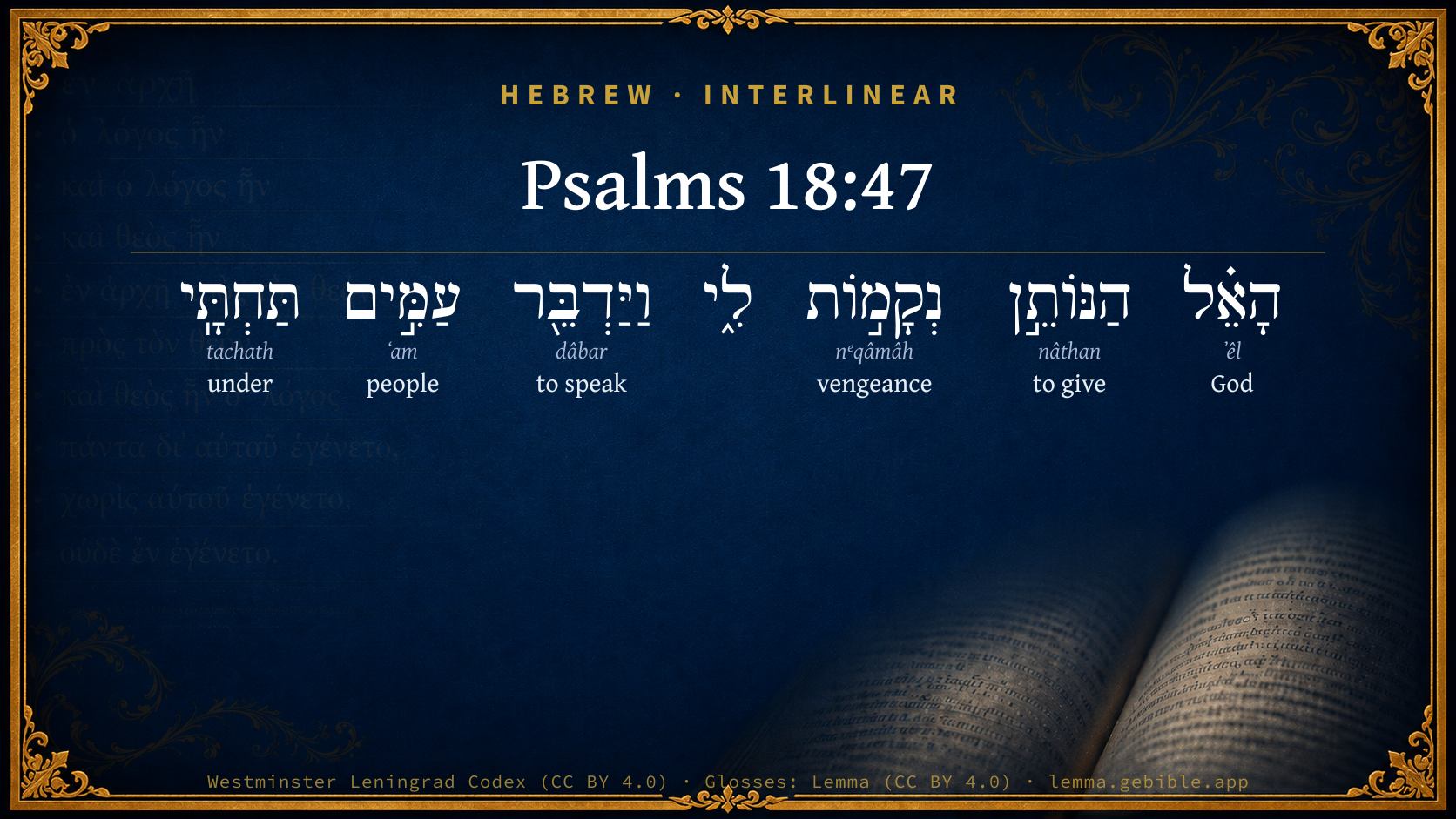
Psalms 18:47

Hebrew (Westminster Leningrad Codex) Psalms 18:47 appears in the Hebrew Old Testament. The text above is from the Westminster Leningrad Codex. Each word links to its Strong’s number, a concise gloss, and parsing drawn from the Open Scriptures Hebrew Bible morphology. Click any word for its full Brown-Driver-Briggs (BDB) entry.
Download image
Cite this verse

Psalms 18:47 (World English Bible). Public Domain. Lemma interlinear Bible study tool, https://lemma.gebible.app/v/psalms/18/47.

Show BibTeX & RIS
BibTeX
RIS
English Translation
Even the God who executes vengeance for me, And subdues peoples under me.
World English Bible · Public Domain
Download a study sheet

One document with this verse’s original text, its word-by-word gloss line, the meaning frame, cross-references with their text, attributed commentary, and full source and license credits — printable, and it pastes into notes with its structure intact.

This verse Autodidact and up

Study sheet (.html) Plain text (.txt)

A passage Seminary Student

Up to 50 verses in one chapter. A passage sheet keeps up to 6 commentary sources and 12 cross-references per verse, in the order this page ranks them, and says so on the sheet whenever that leaves anything out. Ask for a single verse and you get the Autodidact verse sheet above.

Everything on this page stays free to read, with no account — the sheet is a download of what is already on screen, not access to it.

Want to remove ads? Support Godless Engineer
Compare translations 3

The same verse in 3 English versions, stacked beneath the original-language interlinear above. Click any original word for its lexicon entry.

Each is an independent rendering of the whole verse — the interlinear is not word-aligned to these translations.

Highlighted words mark where these versions differ — a whole-verse word diff, not a word-by-word alignment.

  • World English Bible Public Domain
    Even the God who executes vengeance for me, And subdues peoples under me.
  • King James Version Public Domain
    It is God that avengeth me, and subdueth the people under me.
  • unfoldingWord Literal Text CC BY-SA 4.0
    the God giving vengeance to me, and he subdues peoples under me,

unfoldingWord Literal Text — © unfoldingWord, licensed CC BY-SA 4.0. Word-aligned USFM3 via Door43 (git.door43.org/unfoldingWord/en_ult).

Versions to compare (up to 4)

3 of 4 selected

Show all 18 translations

Every available English version of this verse, each an independent rendering of the whole verse.

  • World English Bible Public Domain
    Even the God who executes vengeance for me, And subdues peoples under me.
  • Berean Standard Bible Public Domain
    the God who avenges me and subdues nations beneath me,
  • Majority Standard Bible Public Domain
    the God who avenges me and subdues nations beneath me,
  • King James Version Public Domain
    It is God that avengeth me, and subdueth the people under me.
  • American Standard Version (1901) Public Domain
    Even the God that executeth vengeance for me, And subdueth peoples under me.
  • Revised Version (1885) Public Domain
    Even the God that executeth vengeance for me, and subdueth peoples under me.
  • Geneva Bible (1599) Public Domain
    It is God that giueth me power to auenge me, and subdueth the people vnder me.
  • Douay-Rheims (1899) Public Domain
    The Lord liveth, and blessed be my God, and let the God of my salvation be exalted:
  • Young's Literal Translation Public Domain
    God -- who is giving vengeance to me, And He subdueth peoples under me,
  • Literal Standard Version CC BY-SA 4.0
    God—who is giving vengeance to me, || And He subdues peoples under me,
  • Unlocked Literal Bible CC BY-SA 4.0
    He is the God who executes vengeance for me, who subdues the nations under me.
  • unfoldingWord Literal Text CC BY-SA 4.0
    the God giving vengeance to me, and he subdues peoples under me,
  • Darby Bible Public Domain
    The ùGod who hath avenged me, and hath subjected the peoples to me;
  • World Messianic Bible Public Domain
    even the God who executes vengeance for me, and subdues peoples under me.
  • Webster's Bible Public Domain
    \\18:46\\The LORD liveth; and blessed be my rock; and let the God of my salvation be exalted.
  • Free Bible Version CC BY-SA 4.0
    God avenges me, he subdues peoples under me,
  • Bible in Basic English Public Domain
    It is God who sends punishment on my haters, and puts peoples under my rule.
  • JPS Tanakh (1917) Public Domain
    (18-48) Even the God that executeth vengeance for me, and subdueth peoples under me.

Literal Standard Version (2020), Covenant Press — licensed CC BY-SA 4.0. Text via the HelloAO Bible API (eBible.org). Unlocked Literal Bible (unfoldingWord) — licensed CC BY-SA 4.0. Text via the HelloAO Bible API (eBible.org). unfoldingWord Literal Text — © unfoldingWord, licensed CC BY-SA 4.0. Word-aligned USFM3 via Door43 (git.door43.org/unfoldingWord/en_ult). Free Bible Version, Dr. Jonathan Gallagher — licensed CC BY-SA 4.0. Text via the HelloAO Bible API (eBible.org).

Word by word

More ways to search: Search by grammar → Find every occurrence → Compare this word →

Practice this passage: Drill this verse → Learn its vocabulary →

About this verse

These counts appear in no published source. They are computed here, from the morphology-tagged text and Lemma’s own curated glosses. What Lemma adds →

7
words
6
distinct lemmas
Wisdom
section

Shared distinctive vocabulary

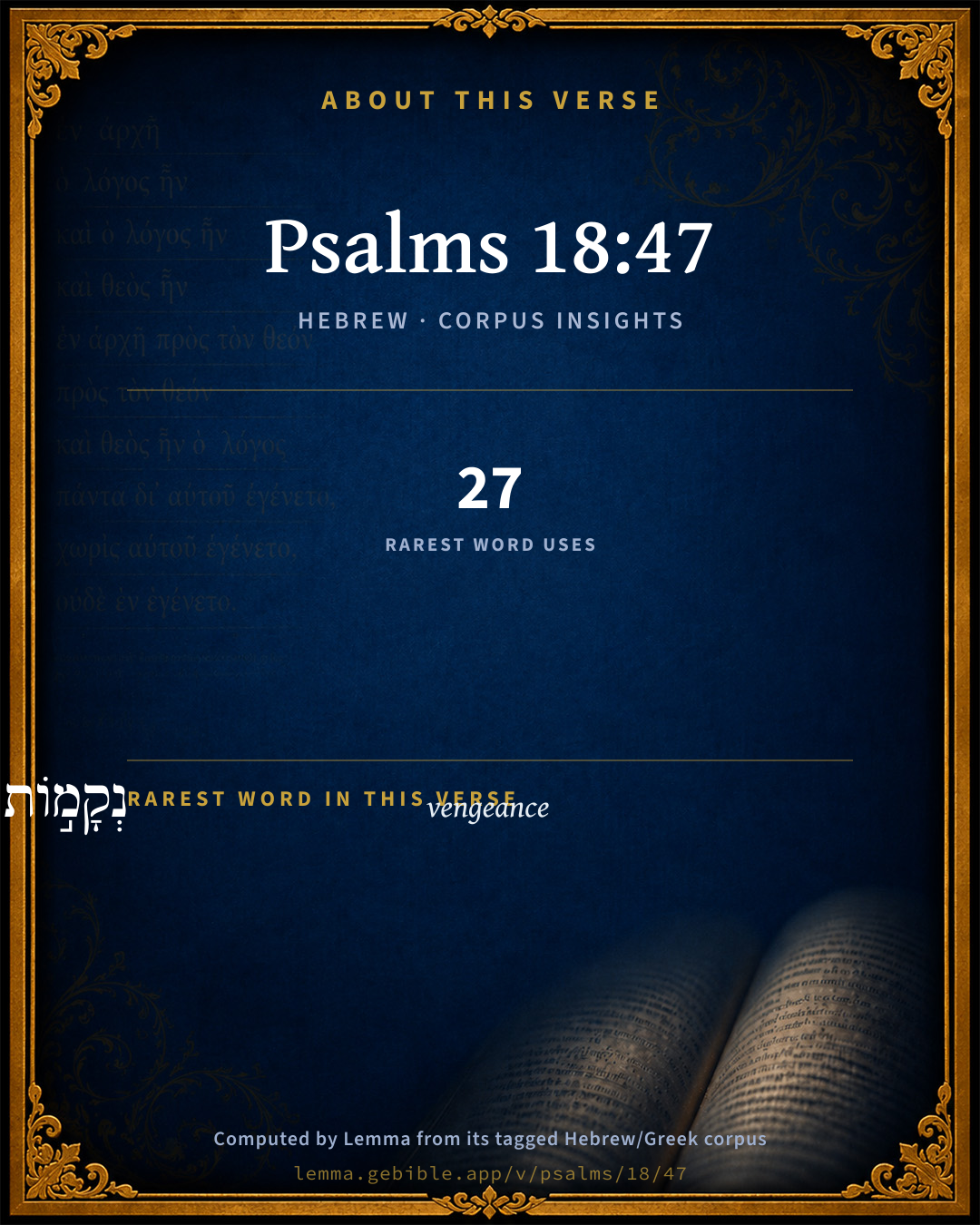
נְקָמ֣וֹת vengeance H5360 occurs in 22 verses of the Hebrew Bible. Also found in:

Grammatical profile

  • 2 verbs
  • 3 nouns
  • 2 prepositions

Verb forms

  • הַנּוֹתֵ֣ן Qal · Participle Active
  • וַיַּדְבֵּ֖ר Hiphil · Sequential Imperfect

Hebrew & Septuagint length

In English translation the verse runs 13 words from the Hebrew and 13 from the Septuagint (LXX English) — the same length.

A rough comparison of the two English renderings, which tokenize alike — not a word-level alignment.

Word counts can differ between the Hebrew and the Greek without any difference in meaning — e.g. the Hebrew direct-object marker אֵת has no separate Greek word, and Greek often adds the article ὁ.

Cross-references

6

Topical passages linked to Psalms 18:47 in the Treasury of Scripture Knowledge — connected by theme and wording, ordered by reader-vote popularity; previews shown in the World English Bible.

  • Psalms 47:3 He subdues nations under us, And peoples under our feet.
  • Romans 12:19 Don't seek revenge yourselves, beloved, but give place to God's wrath. For it is written, "Vengeance belongs to me; I will repay, says the Lord."
  • 2 Samuel 22:48 Even the God who executes vengeance for me, Who brings down peoples under me,
  • Psalms 144:2 My loving kindness, my fortress, My high tower, my deliverer, My shield, and he in whom I take refuge; Who subdues my people under me.
  • Nahum 1:2 Yahweh is a jealous God and avenges. Yahweh avenges and is full of wrath. Yahweh takes vengeance on his adversaries, and he maintains wrath against his enemies.
  • Deuteronomy 32:35 Vengeance is mine, and recompense, At the time when their foot shall slide: For the day of their calamity is at hand, The things that are to come on them shall make haste.

Cross-references courtesy of OpenBible.info (CC BY 4.0).

Hebrew and Greek witnesses Masoretic Hebrew ↔ Greek Septuagint

The same verse in the two great witnesses to the Old Testament, shown verse-for-verse.

You’re reading Greek Psalm 17 (Hebrew Psalm 18). The Septuagint counts the superscription, so verse numbers can differ from the Hebrew — chapter-level alignment, not verse-by-verse. Numbering follows Rahlfs.

These are two independent witnesses, not word-aligned to each other, and the Septuagint is shown in lemma (dictionary) form.

Hebrew Psalms 18:47 Masoretic · Westminster Leningrad Codex

הָאֵ֗ל הַנּוֹתֵ֣ן נְקָמ֣וֹת לִ֑י וַיַּדְבֵּ֖ר עַמִּ֣ים תַּחְתָּֽי

Even the God who executes vengeance for me, And subdues peoples under me.

World English Bible · Public Domain

Greek LXX Greek Psalm 17:47 Septuagint · lemma form

ζάω κύριος καί εὐλογητός ὁ θεός ἐγώ καί ὑψόω ὁ θεός ὁ σωτηρία ἐγώ

It is God that avenges me, and has subdued the nations under me;

LXX2012 (modern English Septuagint) · Public Domain

Hebrew: Westminster Leningrad Codex (CC BY 4.0). Greek: Septuagint (public domain); English from LXX2012 (modern English Septuagint) (Public Domain). How the Septuagint differs from the Hebrew →

Commentary

Notes on Psalms 18:47 from classic Christian and Jewish commentators (each source and its license shown beneath its notes). The classic Christian expositions comment on the surrounding passage and are grouped to its opening verse, so a note may address several verses; the Jewish commentaries on the Tanakh (Rashi and others) are per-verse, so they appear only where the commentator wrote on this verse.

Lemma curates 59 commentaries, every one of them public domain or Creative Commons licensed, each selected and text-cleaned for this edition rather than reprinted as found. About our sources →

Trapp's Complete Commentary

John Trapp

Psa 18:47 [It is] God that avengeth me, and subdueth the people under me.

Ver. 47. It is God that avengeth me] Heb. that giveth vengeances for me; whence also he is called the God of vengeances, Psa 94:1, and the God of recompenses, Jer 51:56.

And subdueth the people under me] It is the great work of God to persuade the hearts of so many millions to obey one man.

John Trapp, A Commentary or Exposition upon All the Books of the Old and New Testament (1647–1656) — public domain. Text from a community e-Sword module.

Joseph Benson's Commentary

Psa 18:47-50. It is God that avengeth me — That executeth vengeance, both by me, against his malicious enemies, and for me, against Saul, on whom I would not avenge myself. Thou liftest me up above those, &c. — Above their malice and power. Thou hast delivered me from the violent man — From Saul, whose name, for honour’s sake, he forbears to mention. Therefore I will give thanks to thee among the heathen — In the great congregations, consisting of the Israelites of all the tribes, of whom the word גוים, goim, nations, here rendered heathen, is used, Jos 3:17; Jos 4:1; Eze 2:3, and elsewhere. Or, he means that he would give thanks to Jehovah, in the presence of those Gentiles who resorted to Jerusalem in great numbers, and before others of them who were either subject to him, or confederate with him, as he should have occasion of speaking or writing to any of them. It is probable, however, that David was here transported beyond himself, and spoke this with a special reference to Christ, who was to be his seed, of whom he was an eminent type, and by whom, what he here mentions, was most eminently done. Accordingly these words are applied to him, and to his calling of the Gentiles, Rom 15:9. Great deliverance giveth he to his king — The king whom he himself hath chosen and constituted. Literally the words, מגדל ישׁעוהmean, He magnifies the salvations of his king, which are said to be magnified, because “they are great and wonderful in themselves, and because they add a dignity and lustre to the king on whom they are bestowed; there being nothing that can tend more to advance the honour, and heighten the reverence, due to a prince than his being highly distinguished by the divine protection and care, and delivered thereby out of numerous dangers which threatened his prosperity and life.” —

Chandler. And showeth mercy to his anointed, to David and his seed — To all his posterity, and especially to the Messiah, in whom only the words, for evermore, are properly accomplished, it being only true of his kingdom, that it shall have no end.

Joseph Benson's Commentary on the Old and New Testaments (1811–1818) — public domain. Text from a community e-Sword module.

J. A. Alexander on Psalms

Joseph Addison Alexander

48. (Psa 18:47). The Mighty (God) who gives revenges to me and has subdued nations under me. The construction is the same as in Psa 18:31; Psa 18:33 (30, 32) above. This verse contains a further description of the God of his salvation, and at the same time justifies the affirmations of the preceding verse, What the Psalmist here rejoices in is not vengeance wreaked upon his personal enemies, but punishment inflicted on the enemies of God through himself as a mere instrument. Not to rejoice in this would have proved him unworthy of his high vocation. With the last clause compare Psa 47:4 (3), Psa 144:2.

Joseph Addison Alexander, The Psalms Translated and Explained (1850) — public domain. Text from a community e-Sword module.

Tyndale Open Study Notes

Tyndale Open Resources

18:47 God vindicates his servant and so fulfills his mission (Ps 2; see 47:3; 144:2).

Tyndale Open Study Notes — © Tyndale Open Resources, licensed CC BY-SA 4.0. Text via the HelloAO Bible API.

Jamieson, Fausset & Brown

Robert Jamieson, A. R. Fausset & David Brown

avengeth me--His cause is espoused by God as His own.

Jamieson, Fausset & Brown — Commentary Critical and Explanatory on the Whole Bible (1871) — public domain (CC PDM 1.0). Text via the HelloAO Bible API.

Adam Clarke's Commentary

Verse 47. God that avengeth me] The way that I took was after his own heart; therefore he sustained me in it, and did me justice over my enemies.

Subdueth the people under me.] He keeps down the spirits of the disaffected, and weakens their hands. They are subdued, and they continue under me; and this is the Lord's doing.

Adam Clarke's Commentary on the Bible (1810–1826) — public domain. Text from a community e-Sword/MySword module.

John Calvin's Commentaries

47. The God who giveth me vengeance. The Psalmist again attributes to God the victories which he had obtained. As he could never have expected to obtain them unless he had been confident that he would receive the aid of God, so now he acknowledges God to be the sole author of them. That he may not seem carelessly to bestow upon him, as it were, in passing, only a small sprinkling of the praise of his victories, he repeats, in express terms, that he had nothing but what God had given him. In the first place, he acknowledges that power was given him from above, to enable him to inflict on his enemies the punishment which they deserved. It may seem at first sight strange that God should arm his own people to execute vengeance; but as I have previously shown you, we ought always to remember David’s vocation. He was not a private person, but being endued with royal power and authority, the judgment which he executed was enjoined upon him by God. If a man, upon receiving injury, breaks forth to avenge himself, he usurps the office of God; and, therefore, it is rash and impious for private individuals to retaliate the injuries which have been inflicted upon them. With respect to kings and magistrates, God, who declares that vengeance belongeth to him, in arming them with the sword, constitutes them the ministers and executioners of his vengeance. David, therefore, has put the word vengeance for the just punishments which it was lawful for him to inflict by the commandment of God, provided he was led under the influence of a zeal duly regulated by the Holy Spirit, and not under the influence of the impetuosity of the flesh. Unless this moderation is exemplified in performing the duties of their calling, it is in vain for kings to boast that God has committed to them the charge of taking vengeance; seeing it is not less unwarrantable for a man to abuse, according to his own fancy and the lust of the flesh, the sword which he is allowed to use, than to seize it without the command of God. The Church militant, which is under the standard of Christ, has no permission to execute vengeance, except against those who obstinately refuse to be reclaimed. We are commanded to endeavor to overcome our enemies by doing them good, and to pray for their salvation. It becomes us, therefore, at the same time, to desire that they may be brought to repentance, and to a right state of mind, until it appear beyond all doubt that they are irrecoverably and hopelessly depraved. In the meantime, in regard to vengeance, it must be left to God, that we may not be carried headlong to execute it before the time. David next concludes, from the perils and distresses in which he had been involved, that if he had not been preserved by the hand of God, he could not in any other way have escaped in safety: My deliverer from my enemies; yea, thou hast lifted me up from those who had risen up against me. The sense in which we are to understand the lifting up of which he speaks is, that he was wonderfully raised up above the power and malice of his enemies that he might not sink under their violence, and that they might not be victorious over him.

John Calvin's Commentaries (1540-1563) — public domain. Text from the Calvin Translation Society English edition (1840s-50s) via the Christian Classics Ethereal Library (ccel.org). Calvin's coverage is partial (roughly two-thirds of the Bible); uncommented books and verses are honest gaps, never fabricated. The 19th-century editor's footnotes and remarks are omitted so the notes are faithfully Calvin's own voice.

The Cambridge Bible for Schools and Colleges

gen. ed. J. J. S. Perowne

47. Render:

Even the God that executed vengeance for me,

And subdued peoples under me.

Vengeance is the prerogative of God (Psa_94:1); it is His vindication of the righteousness and integrity of His servants. Such a thanksgiving as this does not shew a spirit of vindictiveness in David, but is a recognition that God had ‘pleaded his cause,’ and maintained the right. God had avenged him for the cruel injustice of Saul (1Sa_24:12); for the contemptuous insults of Nabal (1Sa_25:39); for the factious opposition of those who refused to acknowledge him as king in spite of his Divine call (2Sa_4:8).

The second line of the verse refers, like Psa_18:43, to success in overcoming internal as well as external opposition to his rule. Cp. Psa_144:2. It is not, however, the boast of a triumphant despot, but the thanksgiving of a ruler who recognised the vital importance of union for the prosperity of Israel, and knew that the task of reconciling the discordant elements in the nation was beyond his own unaided powers.

For subdueth 2 Sam. has ‘bringeth down.’

The Cambridge Bible for Schools and Colleges (gen. ed. J. J. S. Perowne; Cambridge University Press, 1878–1918) — public domain. Text from a community e-Sword module.

John Gill's Exposition

He delivereth me from mine enemies,.... From Saul and his men, from Ishbosheth and Abner, from Absalom, and the conspirators with him; so all believers are delivered out of the hands of their enemies by Christ, as that they can serve the Lord without fear; and so Christ himself is delivered from all his enemies, being raised from the dead, and set at the right hand of God, where he must reign till all enemies are put under his feet;

yea, thou liftest me up above those that rise up against me; David was lifted up from a low and mean estate, and placed on the throne of Israel, above all those that rose up against him, and sought to destroy him; and the saints are set upon their high places in Christ, where they are out of the reach of their enemies to do them any harm; and Christ, he is highly exalted at the right hand of God, above all principality and power, might and dominion, and every name that is named in this world;

thou hast delivered me from the violent man; either from Saul, from whom David was delivered; or from Satan the enemy, the son of wickedness, who shall no more exact upon and afflict the Messiah, Psa 89:21. The Chaldee paraphrase says, from Gog; as the saints will be delivered from antichrist, the man of sin, and son of perdition, who will be destroyed with the breath of Christ's mouth.

John Gill's Exposition of the Whole Bible (1746–1763) — public domain (CC PDM 1.0). Text via the HelloAO Bible API.

Albert Barnes' Notes on the Bible

It is God that avengeth me - Margin, giveth avengements for me. The marginal reading is a literal translation of the Hebrew. The meaning is, that God had punished the enemies of the author of the psalm for all the wrongs which they had done to him. Compare Rom 12:19.

And subdueth the people under me - Margin, destroyeth. The idea is that he had subdued the nations so that they became obedient to him. The primary notion of the word used here - from דבר dâbar - is to set in a row; to range in order; to connect; to lead; to guide; - then, to reduce to order; to subdue. This God had done in respect to the nations. Instead of being rebellious and tumultuous, God had reduced them to obedience, and had thus set him over a kingdom where all were subject to order and to law.

Albert Barnes' Notes on the Bible (1834–1885) — public domain. Text from a community e-Sword/MySword module.

Matthew Poole's English Annotations

That avengeth me; that executed vengeance both by me against malicious enemies, and for me against Saul, of whom I would not avenge myself.

Matthew Poole's English Annotations on the Holy Bible (1683–1685) — public domain. Text from a community e-Sword/MySword module.

Whedon's Commentary on the Bible

Daniel D. Whedon

47. Avengeth—Executeth justice for me.

Daniel D. Whedon (gen. ed.), Commentary on the Old and New Testaments (1874–1909) — public domain. Text from a community e-Sword module.

The Pulpit Commentary

It is God that avengeth me; rather, even the God avengeth me (comp. vers. 3, 6, 14, 17, etc.). And subdueth the people under me; rather, the peoples; i.e. the nations (comp. vers. 37-42).

The Pulpit Commentary (1880–1919), ed. H.D.M. Spence-Jones & Joseph S. Exell — public domain. Text from a community e-Sword module.

Rashi

Rabbi Shlomo Yitzchaki (Rashi)

The Lord lives He Who does all this for me.

Rashi on the Tanakh — English translations: “The Judaica Press complete Tanach with Rashi, translated by A. J. Rosenberg” (CC BY 4.0); “Pentateuch with Rashi's commentary by M. Rosenbaum and A.M. Silbermann, 1929-1934” (public domain); “The Metsudah Tanach series, Lakewood, N.J” (CC BY 4.0); and “The Book of Joshua, Metsudah Publications, 1997” (CC BY 4.0). Text via Sefaria.

Lesson kit

Teaching starters — assembled from the data on this page, not authored interpretation. Every prompt links to the verse data it draws on. Edit before teaching.

Psalms, in the Wisdom, opens this verse with 7 words (6 distinct Hebrew lemmas). Its most distinctive word is nᵉqâmâh (“vengeance”). A historical commentator’s framing appears above. Read the whole chapter for the surrounding context.

Discussion questions

  1. How does “vengeance” (nᵉqâmâh) shape what this verse is saying?
  2. Numbers 31:2 shares the word «vengeance» with this verse. How do the two illuminate each other?
  3. The translations on this page render this verse differently — a whole-verse word diff, not a word-by-word alignment. What might account for the different wordings?
  4. The verb «הַנּוֹתֵ֣ן» is Qal Participle Active. How does its form color the action?
  5. Reading how Trapp's Complete Commentary and Joseph Benson's Commentary read this verse, where do the two commentators agree and where do they part?

Things to notice

Reading settings

Reading text

Shown beneath each verse's original-language words.

Old Testament
Old Testament edition

Read the OT as the Masoretic Hebrew (MT) or the Greek Septuagint (LXX).

English shown for the Greek Septuagint (in the Hebrew ↔ Greek comparison).

Comparing translations? Open the Compare panel on any verse page to stack up to four side by side.