
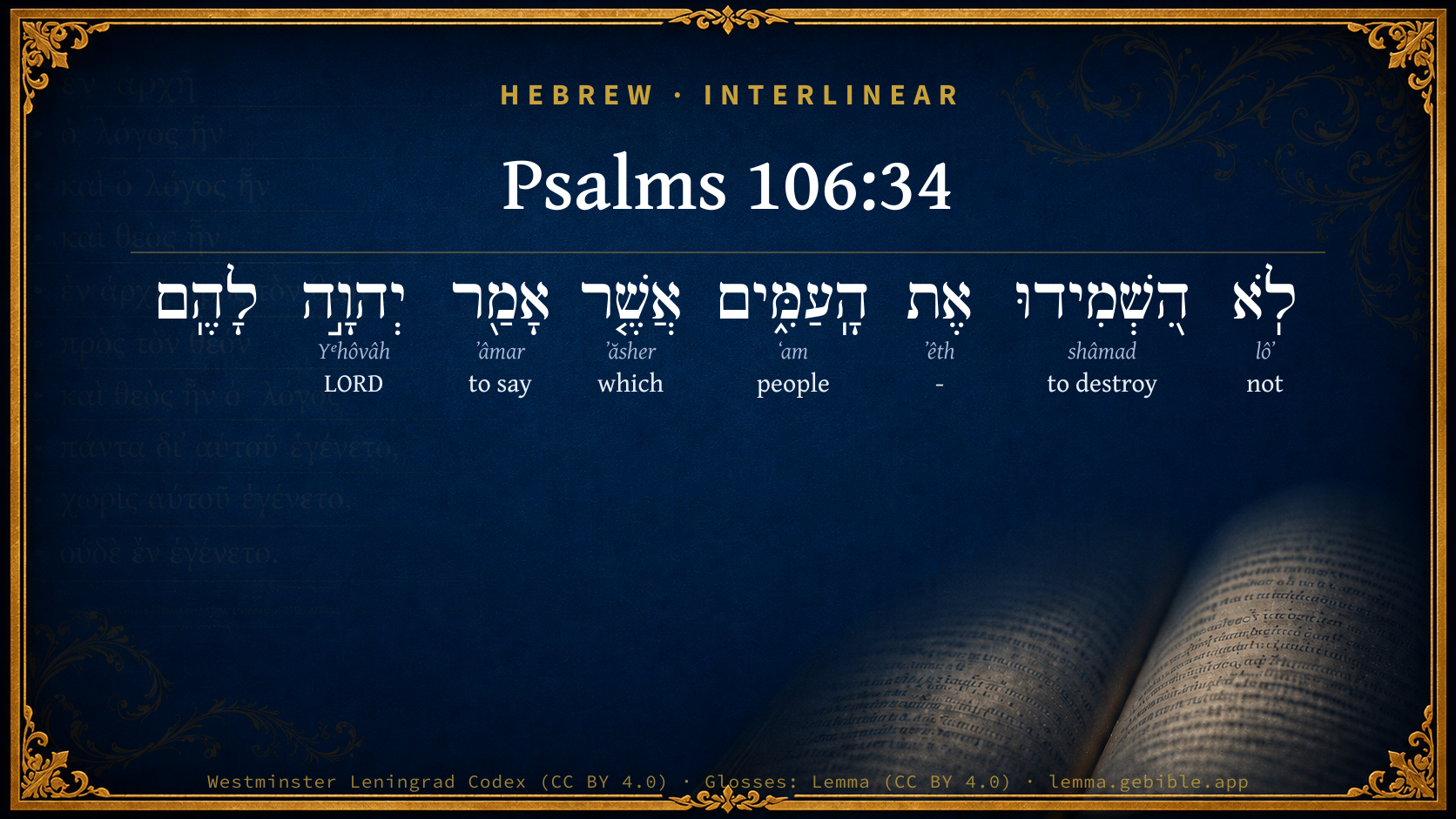
Psalms 106:34

Hebrew (Westminster Leningrad Codex) Psalms 106:34 appears in the Hebrew Old Testament. The text above is from the Westminster Leningrad Codex. Each word links to its Strong’s number, a concise gloss, and parsing drawn from the Open Scriptures Hebrew Bible morphology. Click any word for its full Brown-Driver-Briggs (BDB) entry.
Download image
Cite this verse

Psalms 106:34 (World English Bible). Public Domain. Lemma interlinear Bible study tool, https://lemma.gebible.app/v/psalms/106/34.

Show BibTeX & RIS
BibTeX
RIS
English Translation
They didn't destroy the peoples, As Yahweh commanded them,
World English Bible · Public Domain
Download a study sheet

One document with this verse’s original text, its word-by-word gloss line, the meaning frame, cross-references with their text, attributed commentary, and full source and license credits — printable, and it pastes into notes with its structure intact.

This verse Autodidact and up

Study sheet (.html) Plain text (.txt)

A passage Seminary Student

Up to 50 verses in one chapter. A passage sheet keeps up to 6 commentary sources and 12 cross-references per verse, in the order this page ranks them, and says so on the sheet whenever that leaves anything out. Ask for a single verse and you get the Autodidact verse sheet above.

Everything on this page stays free to read, with no account — the sheet is a download of what is already on screen, not access to it.

Want to remove ads? Support Godless Engineer
Compare translations 3

The same verse in 3 English versions, stacked beneath the original-language interlinear above. Click any original word for its lexicon entry.

Each is an independent rendering of the whole verse — the interlinear is not word-aligned to these translations.

Highlighted words mark where these versions differ — a whole-verse word diff, not a word-by-word alignment.

  • World English Bible Public Domain
    They didn't destroy the peoples, As Yahweh commanded them,
  • King James Version Public Domain
    They did not destroy the nations, concerning whom the LORD commanded them:
  • unfoldingWord Literal Text CC BY-SA 4.0
    They did not destroy the peoples, which Yahweh had said to them,

unfoldingWord Literal Text — © unfoldingWord, licensed CC BY-SA 4.0. Word-aligned USFM3 via Door43 (git.door43.org/unfoldingWord/en_ult).

Versions to compare (up to 4)

3 of 4 selected

Show all 18 translations

Every available English version of this verse, each an independent rendering of the whole verse.

  • World English Bible Public Domain
    They didn't destroy the peoples, As Yahweh commanded them,
  • Berean Standard Bible Public Domain
    They did not destroy the peoples as the LORD had commanded them,
  • Majority Standard Bible Public Domain
    They did not destroy the peoples as the LORD had commanded them,
  • King James Version Public Domain
    They did not destroy the nations, concerning whom the LORD commanded them:
  • American Standard Version (1901) Public Domain
    They did not destroy the peoples, As Jehovah commanded them,
  • Revised Version (1885) Public Domain
    They did not destroy the peoples, as the LORD commanded them;
  • Geneva Bible (1599) Public Domain
    Neither destroied they the people, as the Lord had commanded them,
  • Douay-Rheims (1899) Public Domain
    They did not destroy the nations of which the Lord spoke unto them.
  • Young's Literal Translation Public Domain
    They have not destroyed the peoples, As Jehovah had said to them,
  • Literal Standard Version CC BY-SA 4.0
    They have not destroyed the peoples, || As YHWH had commanded to them,
  • Unlocked Literal Bible CC BY-SA 4.0
    They did not destroy the nations as Yahweh had commanded them,
  • unfoldingWord Literal Text CC BY-SA 4.0
    They did not destroy the peoples, which Yahweh had said to them,
  • Darby Bible Public Domain
    They did not destroy the peoples, as Jehovah commanded them;
  • World Messianic Bible Public Domain
    They didn’t destroy the peoples, as the LORD commanded them,
  • Webster's Bible Public Domain
    They did not destroy the nations, concerning whom the LORD commanded them:
  • Free Bible Version CC BY-SA 4.0
    They did not destroy the heathen peoples as the Lord had told them to do,
  • Bible in Basic English Public Domain
    They did not put an end to the peoples, as the Lord had said;
  • JPS Tanakh (1917) Public Domain
    They did not destroy the peoples, as the LORD commanded them;

Literal Standard Version (2020), Covenant Press — licensed CC BY-SA 4.0. Text via the HelloAO Bible API (eBible.org). Unlocked Literal Bible (unfoldingWord) — licensed CC BY-SA 4.0. Text via the HelloAO Bible API (eBible.org). unfoldingWord Literal Text — © unfoldingWord, licensed CC BY-SA 4.0. Word-aligned USFM3 via Door43 (git.door43.org/unfoldingWord/en_ult). Free Bible Version, Dr. Jonathan Gallagher — licensed CC BY-SA 4.0. Text via the HelloAO Bible API (eBible.org).

Word by word

More ways to search: Search by grammar → Find every occurrence → Compare this word →

Practice this passage: Drill this verse → Learn its vocabulary →

הִ֭שְׁמִידוּ
shâmad
H8045
“to destroy”
Verb, Hiphil, Perfect, 3rd Person, Common, Plural
Part of Speech
Verb
Stem
Hiphil
Form
Perfect
Person
3rd Person
Gender
Common
Number
Plural
Full BDB Definition

Origin: a primitive root

TWOT: 2406

to destroy, exterminate, be destroyed, be exterminated - (Niphal) - to be annihilated, be exterminated - to be destroyed, be devastated - (Hiphil) - to annihilate, exterminate - to destroy
  1. לֹֽא lôʼ H3808 “not” Particle, Negative
  2. אֶת ʼêth H853 “-” Particle, Direct Object
  3. הָֽעַמִּ֑ים ʻam H5971 “the · peoples” Particle, Definite Article + Noun, Common, Masculine, Plural, Absolute
  4. אֲשֶׁ֤ר ʼăsher H834 “which” Particle, Relative
  5. אָמַ֖ר ʼâmar H559 “to say” Verb, Qal, Perfect, 3rd Person, Masculine, Singular
  6. יְהוָ֣ה Yᵉhôvâh H3068 “LORD” Noun, Proper

About this verse

These counts appear in no published source. They are computed here, from the morphology-tagged text and Lemma’s own curated glosses. What Lemma adds →

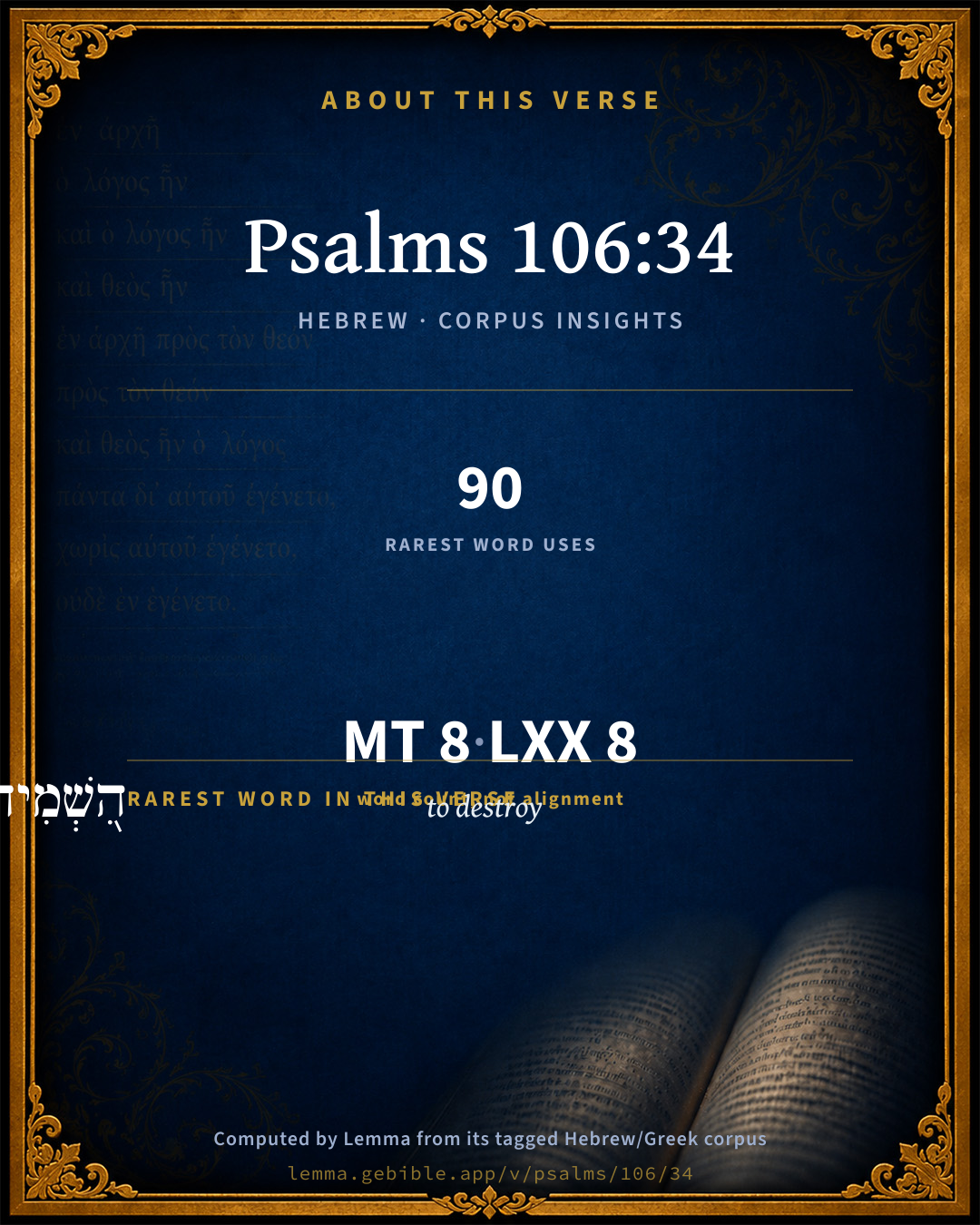
8
words
7
distinct lemmas
Wisdom
section

Grammatical profile

  • 2 verbs
  • 2 nouns
  • 1 preposition
  • 3 particles

Verb forms

  • הִ֭שְׁמִידוּ Hiphil · Perfect
  • אָמַ֖ר Qal · Perfect

Hebrew & Septuagint length

In English translation the verse runs 9 words from the Hebrew and 12 from the Septuagint (LXX English) — closely comparable.

A rough comparison of the two English renderings, which tokenize alike — not a word-level alignment.

Word counts can differ between the Hebrew and the Greek without any difference in meaning — e.g. the Hebrew direct-object marker אֵת has no separate Greek word, and Greek often adds the article ὁ.

In the original languages it is 8 Hebrew tokens and 8 Greek tokens — but the two are counted differently (Hebrew bundles its prefixes and suffixes into one token; the Greek is in lemma form), so that isn’t a like-for-like length.

Cross-references

16

Topical passages linked to Psalms 106:34 in the Treasury of Scripture Knowledge — connected by theme and wording, ordered by reader-vote popularity; previews shown in the World English Bible.

  • Deuteronomy 7:2 and when Yahweh your God shall deliver them up before you, and you shall strike them; then you shall utterly destroy them: you shall make no covenant with them, nor show mercy to them;
  • Deuteronomy 7:16 You shall consume all the peoples who Yahweh your God shall deliver to you; your eye shall not pity them: neither shall you serve their gods; for that will be a snare to you.
  • Judges 1:21 The children of Benjamin did not drive out the Jebusites who inhabited Jerusalem; but the Jebusites dwell with the children of Benjamin in Jerusalem to this day.
  • Joshua 23:12–13 Else if you do at all go back, and cleave to the remnant of these nations, even these who remain among you, and make marriages with them, and go in to them, and they to you;
  • Numbers 33:55–56 But if you will not drive out the inhabitants of the land from before you, then shall those who you let remain of them be as pricks in your eyes, and as thorns in your sides, and they shall vex you in the land in which you dwell.
  • 1 Samuel 15:22–23 Samuel said, Has Yahweh as great delight in burnt offerings and sacrifices, as in obeying the voice of Yahweh? Behold, to obey is better than sacrifice, and to listen than the fat of rams.
  • Matthew 17:19–20 Then the disciples came to Jesus privately, and said, "Why weren't we able to cast it out?"
  • Numbers 33:52 then you shall drive out all the inhabitants of the land from before you, and destroy all their figured [stones], and destroy all their molten images, and demolish all their high places:
  • Deuteronomy 7:23–24 But Yahweh your God will deliver them up before you, and will confuse them with a great confusion, until they be destroyed.
  • Deuteronomy 20:16–17 But of the cities of these peoples, that Yahweh your God gives you for an inheritance, you shall save alive nothing that breathes;
  • Joshua 15:63 As for the Jebusites, the inhabitants of Jerusalem, the children of Judah couldn't drive them out: but the Jebusites dwell with the children of Judah at Jerusalem to this day.
  • Joshua 16:10 They didn't drive out the Canaanites who lived in Gezer: but the Canaanites dwell in the midst of Ephraim to this day, and are become servants to do forced labor.
  • Joshua 17:12–16 Yet the children of Manasseh couldn't drive out [the inhabitants of] those cities; but the Canaanites would dwell in that land.
  • Judges 1:19 Yahweh was with Judah; and drove out [the inhabitants of] the hill-country; for he could not drive out the inhabitants of the valley, because they had chariots of iron.
  • Judges 1:27–36 Manasseh did not drive out [the inhabitants of] Beth-shean and its towns, nor [of] Taanach and its towns, nor the inhabitants of Dor and its towns, nor the inhabitants of Ibleam and its towns, nor the inhabitants of Megiddo and its towns; but the Canaanites would dwell in that land.
  • 1 Samuel 15:3 Now go and strike Amalek, and utterly destroy all that they have, and don't spare them; but kill both man and woman, infant and suckling, ox and sheep, camel and donkey.

Cross-references courtesy of OpenBible.info (CC BY 4.0).

Hebrew and Greek witnesses Masoretic Hebrew ↔ Greek Septuagint

The same verse in the two great witnesses to the Old Testament, shown verse-for-verse.

You’re reading Greek Psalm 105 (Hebrew Psalm 106). The Septuagint counts the superscription, so verse numbers can differ from the Hebrew — chapter-level alignment, not verse-by-verse. Numbering follows Rahlfs.

These are two independent witnesses, not word-aligned to each other, and the Septuagint is shown in lemma (dictionary) form.

Hebrew Psalms 106:34 Masoretic · Westminster Leningrad Codex

לֹֽא הִ֭שְׁמִידוּ אֶת הָֽעַמִּ֑ים אֲשֶׁ֤ר אָמַ֖ר יְהוָ֣ה לָהֶֽם

They didn't destroy the peoples, As Yahweh commanded them,

World English Bible · Public Domain

Greek LXX Greek Psalm 105:34 Septuagint · lemma form

οὐ ἐκὀλεθρεύω ὁ ἔθνος ὅς εἶπον κύριος αὐτός

They destroyed not the nations which the Lord told them to destroy;

LXX2012 (modern English Septuagint) · Public Domain

Hebrew: Westminster Leningrad Codex (CC BY 4.0). Greek: Septuagint (public domain); English from LXX2012 (modern English Septuagint) (Public Domain). How the Septuagint differs from the Hebrew →

Commentary

Notes on Psalms 106:34 from classic Christian and Jewish commentators (each source and its license shown beneath its notes). The classic Christian expositions comment on the surrounding passage and are grouped to its opening verse, so a note may address several verses; the Jewish commentaries on the Tanakh (Rashi and others) are per-verse, so they appear only where the commentator wrote on this verse.

Lemma curates 59 commentaries, every one of them public domain or Creative Commons licensed, each selected and text-cleaned for this edition rather than reprinted as found. About our sources →

Matthew Henry's Commentary

Here, I. The narrative concludes with an account of Israel's conduct in Canaan, which was of a piece with that in the wilderness, and God's dealings with them, wherein, as all along, both justice and mercy appeared.

1. They were very provoking to God. The miracles and mercies which settled them in Canaan made no more deep and durable impressions upon them than those which fetched them out of Egypt; for by the time they were just settled in Canaan they corrupted themselves, and forsook God. Observe,

(1.) The steps of their apostasy. [1.] They spared the nations which God had doomed to destruction (Psa 106:34); when they had got the good land God had promised them they had no zeal against the wicked inhabitants whom the Lord commanded them to extirpate, pretending pity; but so merciful is God that no man needs to be in any case more compassionate than he. [2.] When they spared them they promised themselves that, notwithstanding this, they would not join in any dangerous affinity with them. But the way of sin is down-hill; omissions make way for commissions; when they neglect to destroy the heathen the next news we hear is, They were mingled among the heathen, made leagues with them and contracted an intimacy with them, so that they learned their works, Psa 106:35. That which is rotten will sooner corrupt that which is sound than be cured or made sound by it. [3.] When they mingled with them, and learned some of their works that seemed innocent diversions and entertainments, yet they thought they would never join with them in their worship; but by degrees they learned that too (Psa 106:36): They served their idols in the same manner, and with the same rites, that they served them; and they became a snare to them. That sin drew on many more, and brought the judgments of God upon them, which they themselves could not but be sensible of and yet knew not how to recover themselves. [4.] When they joined with them in some of their idolatrous services, which they thought had least harm in them, they little thought that ever they should be guilty of that barbarous and inhuman piece of idolatry the sacrificing of their living children to their dead gods; but they came to that at last (Psa 106:37, Psa 106:38), in which Satan triumphed over his worshippers, and regaled himself in blood and slaughter: They sacrificed their sons and daughters, pieces of themselves, to devils, and added murder, the most unnatural murder, to their idolatry; one cannot think of it without horror. They shed innocent blood, the most innocent, for it was infant-blood, nay, it was the blood of their sons and their daughters. See the power of the spirit that works in the children of disobedience, and see his malice. The beginning of idolatry and superstition, like that of strife, is as the letting forth of water, and there is no villany which those that venture upon it can be sure they shall stop short of, for God justly gives them up to a reprobate mind, Rom 1:28.

(2.) Their sin was, in part, their own punishment; for by it, [1.] They wronged their country: The land was polluted with blood, Psa 106:38. That pleasant land, that holy land, was rendered uncomfortable to themselves, and unfit to receive those kind tokens of God's favour and presence in it which were designed to be its honour. [2.] They wronged their consciences (Psa 106:39): They went a whoring with their own inventions, and so debauched their own minds, and were defiled with their own works, and rendered odious in the eyes of the holy God, and perhaps of their own consciences.

2. God brought his judgments upon them; and what else could be expected? For his name is Jealous, and he is a jealous God. (1.) He fell out with them for it, Psa 106:40. He was angry with them: The wrath of God, that consuming fire, was kindled against his people; for from them he took it as more insulting and ungrateful than from the heathen that never knew him. Nay, he was sick of them: He abhorred his own inheritance, which once he had taken pleasure in; yet the change was not in him, but in them. This is the worst thing in sin, that it makes us loathsome to God; and the nearer any are to God in profession the more loathsome are they if they rebel against him, like a dunghill at our door. (2.) Their enemies then fell upon them, and, their defence having departed, made an easy prey of them (Psa 106:41, Psa 106:42): He gave them into the hands of the heathen. Observe here how the punishment answered to the sin: They mingled with the heathen and learned their works; from them they willingly took the infection of sin, and therefore God justly made use of them as the instruments of their correction. Sinners often see themselves ruined by those by whom they have suffered themselves to be debauched. Satan, who is a tempter, will be a tormentor. The heathen hated them. Apostates lose all the love on God's side, and get none on Satan's; and when those that hated them ruled over them, and they were brought into subjection under them, no marvel that they oppressed them and ruled them with rigour; and thus God made them know the difference between his service and the service of the kings of the countries, Ch2 12:8. (3.) When God granted them some relief, yet they went on in their sins, and their troubles also were continued, Psa 106:43. This refers to the days of the Judges, when God often raised up deliverers and wrought deliverances for them, and yet they relapsed to idolatry and provoked God with their counsel, their idolatrous inventions, to deliver them up to some other oppressor, so that at last they were brought very low for their iniquity. Those that by sin disparage themselves, and will not by repentance humble themselves, are justly debased, and humbled, and brought low, by the judgments of God. (4.) At length they cried unto God, and God returned in favour to them, Psa 106:44-46. They were chastened for their sins, but not destroyed, cast down, but not cast off. God appeared for them, [1.] As a God of mercy, who looked upon their grievances, regarded their affliction, beheld when distress was upon them (so some), who looked over their complaints, for he heard their cry with tender compassion (Exo 3:7) and overlooked their provocations; for though he had said, and had reason to say it, that he would destroy them, yet he repented, according to the multitude of his mercies, and reversed the sentence. Though he is not a man that he should repent, so as to change his mind, yet he is a gracious God, who pities us, and changes his way. [2.] As a God of truth, who remembered for them his covenant, and made good every word that he had spoken; and therefore, bad as they were, he would not break with them, because he would not break his own promise. [3.] As a God of power, who has all hearts in his hand, and turns them which way soever he pleases. He made them to be pitied even of those that carried them captives, and hated them, and ruled them with rigour. He not only restrained the remainder of their enemies' wrath, that it should not utterly consume them, but he infused compassion even into their stony hearts, and made them relent, which was more than any art of man could have done with the utmost force of rhetoric. Note, God can change lions into lambs, and, when a man's ways please the Lord, will make even his enemies to pity him and be at peace with him. When God pities men shall. Tranquillus Deus tranquillat omnia - A God at peace with us makes every thing at peace.

II. The psalm concludes with prayer and praise. 1. Prayer for the completing of his people's deliverance. Even when the Lord brought back the captivity of his people still there was occasion to pray, Lord, turn again our captivity (Psa 126:1, Psa 126:4); so here (Psa 106:47), Save us, O Lord our God! and gather us from among the heathen. We may suppose that many who were forced into foreign countries, in the times of the Judges (as Naomi was, Rut 1:1), had not returned in the beginning of David's reign, Saul's time being discouraging, and therefore it was seasonable to pray, Lord, gather the dispersed Israelites from among the heathen, to give thanks to thy holy name, not only that they may have cause to give thanks and hearts to give thanks, that they may have opportunity to do it in the courts of the Lord's house, from which they were now banished, and so may triumph in thy praise, over those that had in scorn challenged them to sing the Lord's song in a strange land. 2. Praise for the beginning and progress of it (Psa 106:48): Blessed be the Lord God of Israel from everlasting to everlasting. He is a blessed God from eternity, and will be so to eternity, and so let him be praised by all his worshippers. Let the priests say this, and then let all the people say, Amen, Hallelujah, in token of their cheerful concurrence in all these prayers, praises, and confessions. According to this rubric, or directory, we find that when this psalm (or at least the closing verses of it) was sung all the people said Amen, and praised the Lord by saying, Hallelujah. By these two comprehensive words it is very proper, in religious assemblies, to testify their joining with their ministers in the prayers and praises which, as their mouth, they offer up to God, according to his will, saying Amen to the prayers and Hallelujah to the praises.

Matthew Henry's Commentary on the Whole Bible (1708–1710) — public domain (CC PDM 1.0). Text via the HelloAO Bible API.

Trapp's Complete Commentary

John Trapp

Psa 106:34 They did not destroy the nations, concerning whom the LORD commanded them:

Ver. 34. They did not destroy the nations] For which neglect of theirs pity would be pleaded. But there is a cruel mercy, saith one; there is a pious cruelty, saith another. Cursed is he that doeth the Lord’s work deceitfully, and cursed is he that restraineth his sword from blood when God biddeth him strike. Saul and Ahab felt the dint of this curse, and so did these Israelites, for sparing the Canaanites, whether out of pusillanimity or foolish pity.

John Trapp, A Commentary or Exposition upon All the Books of the Old and New Testament (1647–1656) — public domain. Text from a community e-Sword module.

The Treasury of David

Charles H. Spurgeon

Ver. 34. They did not destroy the nations, concerning whom the LORD commanded them. They were commissioned to act as executioners upon races condemned for their unnatural crimes, and through sloth, cowardice, or Sinful complacency they sheathed the sword too soon, very much to their own danger and disquietude. It is a great evil with professors that they are not zealous for the total destruction of all sin within and without. We make alliances of peace where we ought to proclaim war to the knife; we plead our constitutional temperament, our previous habits, the necessity of our circumstances, or some other evil excuse as an apology for being content with a very partial sanctification, if indeed it be sanctification at all. We are slow also to rebuke sin in others, and are ready to spare respectable sins, which like Agag walk with mincing steps. The measure of our destruction of sin is not to be our inclination, or the habit of others, but the Lord's command. We have no warrant for dealing leniently with any sin, be it what it may.

Ver. 34-38. The miracles and mercies which settled them in Canaan made no more deep and durable impressions upon them than those that fetched them out of Egypt; for by that time they were well warm in Canaan, they corrupted themselves, and forsook God. Observe the steps of their apostasy.

1. They spared the nations which God had doomed to destruction (Ps 106:34). When they had got the good land God had promised them, they had no zeal against the wicked inhabitants, whom the Lord commanded them to extirpate, pretending pity; but so merciful is God, that no man needs to be in any case more compassionate than he.

2. When they spared them, they promised themselves, that for all this, they would not join in any dangerous affinity with them; but the way of sin is down hill; omissions make way for commissions; when they neglect to destroy the heathen, the next news we hear is, they were mingled among the heathen, made leagues with them, and contracted an intimacy with them, so that they learned their works (Ps 106:35). That which is rotten will sooner corrupt that which is sound, than be cured or made sound by it.

3. When they mingled with them, and learned some of their works that seemed innocent diversions and entertainments, yet they thought they would never join with them in their worship; but by degrees they learned that too (Ps 106:36). They served their idols in the same manner, and with the same rites that they served them; and they became a snare unto them, that sin drew on many more, and brought the judgments of God upon them, which they themselves could not but be sensible of, and yet knew not how to recover themselves.

4. When they joined with them in some of their idolatrous services, which they thought had least harm in them, they little thought that ever they should be guilty of that barbarous and inhuman piece of idolatry, the sacrificing of their living children to their dead gods: but they came to that at last (Ps 106:37-38) in which Satan triumphed over his worshippers, and regaled himself in blood and slaughter. They sacrificed their sons and daughters, pieces of themselves to devils; and added murder, the most unnatural murder, to their idolatry; one cannot think of it without horror; they "shed innocent blood", the most innocent, for it was infant blood, nay, it was the "blood of their sons and their daughters." See the power of the spirit that works in the children of disobedience, and see his malice. The beginning of idolatry and superstition, like that of strife, is as the letting forth of water, and there is no villainy which they that venture upon it can be sure they shall stop short of, for God justly "gives them up to a reprobate mind" (Ro 1:28). Matthew Henry.

Ver. 34-42.

1. What Israel did not do. They began well, but did not complete the conquest of their foes: Ps 106:34.

2. What they did do: Ps 106:35-39.

(a) They became friendly with them.

(b) They adopted their habits: "learned their works."

(c) They embraced their religion: "served their idols."

(d) They imitated their cruelties; Ps 106:37-38.

(e) They did worse than the heathen (Ps 106:39),

they added wicked inventions of their own.

3. What God did to them: Ps 106:40-42. He gave them into the hands of their enemies, and suffered them to be severely oppressed by them. We must either conquer all our foes or be conquered by them. Bring your shield from the battle or be brought home upon it.

G.R.

Psalms 106:35*

Charles H. Spurgeon's The Treasury of David (1869–1885) — public domain. Psalms only. Text from a community e-Sword/MySword module.

Joseph Benson's Commentary

Psa 106:34-39. They did not destroy the nations, concerning whom — Concerning whose destruction, the Lord commanded them — For when the iniquity of the Canaanites was full, it was God’s will to extirpate their race, and Israel was commissioned to execute upon them the vengeance determined. But were mingled among the heathen — In their habitations and negotiations, as also in marriages. And they served their idols — Which idols were an occasion of their falling both into further and greater sins, as it follows, Psa 106:37-38, and into utter ruin. They sacrificed their sons and daughters — Of which heathenish practice, see the notes on Lev 18:21. Unto devils — By which expression he informs them that they did not worship God as they pretended, but devils in their idols; and that those spirits that were supposed by the heathen idolaters to inhabit their images, and which they worshipped in them, were not good spirits, as they imagined, but evil spirits or devils. And shed innocent blood — The blood of their children, who, though depraved before God, yet were innocent as to them, from any crime deserving such barbarous usage from them. Thus were they defiled with their own works — And rendered abominable in the sight of a holy God; and went a whoring with their own inventions — Committed spiritual whoredom, by worshipping those idols which were but human inventions, and that in such an unnatural and bloody manner as they had devised.

Joseph Benson's Commentary on the Old and New Testaments (1811–1818) — public domain. Text from a community e-Sword module.

Keil & Delitzsch

C. F. Keil & F. Delitzsch

The sins in Canaan: the failing to exterminate the idolatrous peoples and sharing in their idolatry. In Psa 106:34 the poet appeals to the command, frequently enjoined upon them from Exo 23:32. onwards, to extirpate the inhabitants of Canaan. Since they did not execute this command (vid., Jdg 1:1), that which it was intended to prevent came to pass: the heathen became to them a snare (mowqeesh), Exo 23:33; Exo 34:12; Deu 7:16. They intermarried with them, and fell into the Canaanitish custom in which the abominations of heathenism culminate, viz., the human sacrifice, which Jahve abhorreth (Deu 12:31), and only the demons (שׁדים, Deu 32:17) delight in. Thus then the land was defiled by blood-guiltiness (חנף, Num 35:33, cf. Isa 24:5; Isa 26:21), and they themselves became unclean (Eze 20:43) by the whoredom of idolatry. In Psa 106:40-43 the poet (as in Neh 9:26.) sketches the alternation of apostasy, captivity, redemption, and relapse which followed upon the possession of Canaan, and more especially that which characterized the period of the judges. God's "counsel" was to make Israel free and glorious, but they leaned upon themselves, following their own intentions (בּעצתם); wherefore they perished in their sins. The poet uses מכך (to sink down, fall away) instead of the נמק (to moulder, rot) of the primary passage, Lev 26:39, retained in Eze 24:23; Eze 33:10, which is no blunder (Hitzig), but a deliberate change.

Keil & Delitzsch — Biblical Commentary on the Old Testament (1861–1891) — public domain (CC PDM 1.0). Text via the HelloAO Bible API. (Old Testament only.)

J. A. Alexander on Psalms

Joseph Addison Alexander

34. (Psa 106:34) They did not destroy the nations which the Lord said to them. The confession now passes from the sins of the wilderness to those of Canaan. The neglect to destroy the Canaanites completely was not only a direct violation of God's precept, but the source of nearly all the public evils that ensued. There is no need of giving to the last verb a rare and dubious sense (commanded). The meaning of the clause is, which Jehovah said to them (must be destroyed).

Joseph Addison Alexander, The Psalms Translated and Explained (1850) — public domain. Text from a community e-Sword module.

Tyndale Open Study Notes

Tyndale Open Resources

106:34 Israel continued to disobey the word of the Lord while living in the Promised Land. Rather than destroying the nations, Israel accepted them and their ways (see Judg 2:1-3, 11-15; 3:5-6).

Tyndale Open Study Notes — © Tyndale Open Resources, licensed CC BY-SA 4.0. Text via the HelloAO Bible API.

John Calvin's Commentaries

34. They did not destroy the nations It appears to me that those persons are mistaken who think that the prophet is here simply giving a relation of the punishment which was inflicted upon the Jews, as if he were imputing to them the entire blame of not exterminating the nations, in consequence of their not deserving the honor of obtaining any more victories over them. But he rather prefers another charge against them, that they had been remiss in driving out the heathen, or more probably that they had not obeyed the Divine command to root them out of the land. Now that the cup of the iniquity of the Amorites was full, it was the purpose of God that they should be exterminated, lest their society might prove injurious to the holy people. For God, having chosen that land for a habitation to himself, intended that it should be holy and purified from all defilement. In refusing, therefore, to execute the vengeance enjoined upon them, the people showed their willingness to associate with the uncircumcised inhabitants of Canaan. In manifesting such indifference about God’s command respecting the driving out these nations, they gave just cause for his anger waxing hot against them. Behold, saith he, I have commanded all these nations to be cut off by the sword; and now, because ye have not obeyed my voice,

“they shall be pricks in your eyes, and thorns in your sides, and shall vex you in the land wherein ye dwell,” Numbers 33:55

The not destroying all these nations, but permitting some of them to remain, might appear to be an act of mercy; but in thus acting, the people were guilty of neglecting to execute God’s righteous vengeance upon them, and of leaving the land liable to be polluted with their abominations. From these things it ought to be noticed, that there are two extremes in which men are apt to indulge, either in being unnecessarily over rigorous, or in defeating the ends of justice by too great lenity. We must, therefore, adhere strictly to God’s command, if we would desire to shun both extremes. For if the Israelites are condemned for sparing some of these nations wholly, what are we to think of those judges who, from a timid and apathetic attention to the responsible duties of their office, exercise too much lenity to a few persons, thus weakening the restraints of the inlets to vice, to the great detriment of the public weal?

John Calvin's Commentaries (1540-1563) — public domain. Text from the Calvin Translation Society English edition (1840s-50s) via the Christian Classics Ethereal Library (ccel.org). Calvin's coverage is partial (roughly two-thirds of the Bible); uncommented books and verses are honest gaps, never fabricated. The 19th-century editor's footnotes and remarks are omitted so the notes are faithfully Calvin's own voice.

Ellicott's Commentary for English Readers

(34-39) The national sin after the settlement in Canaan.

A Bible Commentary for English Readers, edited by Charles John Ellicott (1878–1897) — public domain. Text from a community e-Sword module.

The Cambridge Bible for Schools and Colleges

gen. ed. J. J. S. Perowne

34. They did not destroy the peoples,

As Jehovah had commanded them.

For the command so often repeated see Exo_23:32-33; Exo_34:12 ff.; Deu_7:2 ff.: and for the neglect of it, Jdg_1:21; Jdg_1:27; Jdg_1:29 ff., Jdg_2:1 ff.

34–39. The continued disobedience of Israel even after the Entry into Canaan. Neglecting the command to exterminate the Canaanites they became infected by their abominations.

The Cambridge Bible for Schools and Colleges (gen. ed. J. J. S. Perowne; Cambridge University Press, 1878–1918) — public domain. Text from a community e-Sword module.

John Gill's Exposition

They did not destroy the nations,.... Here begins an account of their sins and provocations, after they were settled in the land of Canaan. They did not destroy the inhabitants of the land, of the seven nations; whose land was given to them as an inheritance, and of which the Canaanites were dispossessed for their sins, and to be destroyed.

Concerning whom the Lord commanded them; that they should destroy them; the command is in Deu 7:1. God's commands are to be obeyed; they are neither to be added to, nor diminished from; his commands are transgressed and violated by sins of omission or commission; the Israelites might plead mercy, but this was no excuse to an express command: the same sin Saul was afterwards guilty of, with respect to one of these nations, Sa1 15:2. Those spiritual Canaanites, the sinful deeds of the body, are to be mortified, and not indulged and spared, Col 3:5.

John Gill's Exposition of the Whole Bible (1746–1763) — public domain (CC PDM 1.0). Text via the HelloAO Bible API.

Albert Barnes' Notes on the Bible

They did not destroy the nations - The Canaanites, Hivites, Jebusites, etc.; the nations that inhabited the land of Canaan.

Concerning whom the Lord commanded them - The command on this subject was positive; and it was to destroy them, to spare none of them. Num 33:52; Deu 7:5, Deu 7:16.

Albert Barnes' Notes on the Bible (1834–1885) — public domain. Text from a community e-Sword/MySword module.

Matthew Poole's English Annotations

Concerning whom, i.e. concerning whose destruction or rather, which thing to wit, to destroy those Canaanitish nations; for in the Hebrew there is nothing but asher, which signifies only either whom or which.

Matthew Poole's English Annotations on the Holy Bible (1683–1685) — public domain. Text from a community e-Sword/MySword module.

Whedon's Commentary on the Bible

Daniel D. Whedon

34. They did not destroy the nations—This was the seventh great sin of the nation, according to the enumeration of the psalm. The command was given as stated Exo_23:32-33, and reiterated in Jos_23:12-13. But early after their settlement in Canaan their faith failed, the wars abated, and many powerful hostile cities and tribes remained. See Jdg_2:3. These were thorns and snares to Israel in all future time.

Daniel D. Whedon (gen. ed.), Commentary on the Old and New Testaments (1874–1909) — public domain. Text from a community e-Sword module.

The Pulpit Commentary

They did not destroy the nations, concerning whom the Lord commanded them. This is reckoned as another sin. Israel, once comfortably settled in Palestine, with sufficient room for its numbers, did not carry out the Divine command to "destroy," or "cast out," the Canaanitish nations, but was content to share the land with them. "The children of Benjamin did not drive out the Jebusites who inhabited Jerusalem"; (Jud_1:21) "neither did Manasseh drive out the inhabitants of Bethshean and her towns, nor Taanach and her towns; nor the inhabitants of Dor and her towns"; (Jud 1:27) "neither did Ephraim drive out the Canaanites that dwelt in Gezer"; (Jud 1:29) nor "Zebulon the inhabitants of Kitten, nor the inhabitants of Nahalol"; (Jud 1:30) "neither did Asher drive out the inhabitants of Accho"; (Jud 1:31) nor "Naphtali the inhabitants of Beth-shemesh and Bethanath"; (Jud 1:33) nor Dan the Amorites, who "would dwell in Mount Heros in Aijalon, and in Shaalbim". (Jud 1:35) It was not compassion that restrained them, but love of ease, idleness, one of the seven deadly sins; and the results were those described in the next verse.

The Pulpit Commentary (1880–1919), ed. H.D.M. Spence-Jones & Joseph S. Exell — public domain. Text from a community e-Sword module.

Rashi

Rabbi Shlomo Yitzchaki (Rashi)

They did not destroy in the days of Joshua.

the peoples whom the Lord had told them (Deut. 20:16): “You shall not allow a soul to remain alive”; (Exod. 23:33), “They shall not remain as residents in your land,” but they allowed them to dwell in their midst, paying tribute.

Rashi on the Tanakh — English translations: “The Judaica Press complete Tanach with Rashi, translated by A. J. Rosenberg” (CC BY 4.0); “Pentateuch with Rashi's commentary by M. Rosenbaum and A.M. Silbermann, 1929-1934” (public domain); “The Metsudah Tanach series, Lakewood, N.J” (CC BY 4.0); and “The Book of Joshua, Metsudah Publications, 1997” (CC BY 4.0). Text via Sefaria.

Lesson kit

Teaching starters — assembled from the data on this page, not authored interpretation. Every prompt links to the verse data it draws on. Edit before teaching.

Psalms, in the Wisdom, opens this verse with 8 words (7 distinct Hebrew lemmas). Its most distinctive word is shâmad (“to destroy”). A historical commentator’s framing appears above. Read the whole chapter for the surrounding context.

Discussion questions

  1. The word shâmad carries the sense “to destroy.” How does it shape the verse?
  2. Deuteronomy 7:2 shares this passage’s theme. How do the two illuminate each other?
  3. The translations on this page render this verse differently — a whole-verse word diff, not a word-by-word alignment. What might account for the different wordings?
  4. The verb «הִ֭שְׁמִידוּ» is Hiphil Perfect. How does its form color the action?
  5. Reading how Matthew Henry's Commentary and Trapp's Complete Commentary read this verse, where do the two commentators agree and where do they part?

Things to notice

Reading settings

Reading text

Shown beneath each verse's original-language words.

Old Testament
Old Testament edition

Read the OT as the Masoretic Hebrew (MT) or the Greek Septuagint (LXX).

English shown for the Greek Septuagint (in the Hebrew ↔ Greek comparison).

Comparing translations? Open the Compare panel on any verse page to stack up to four side by side.