
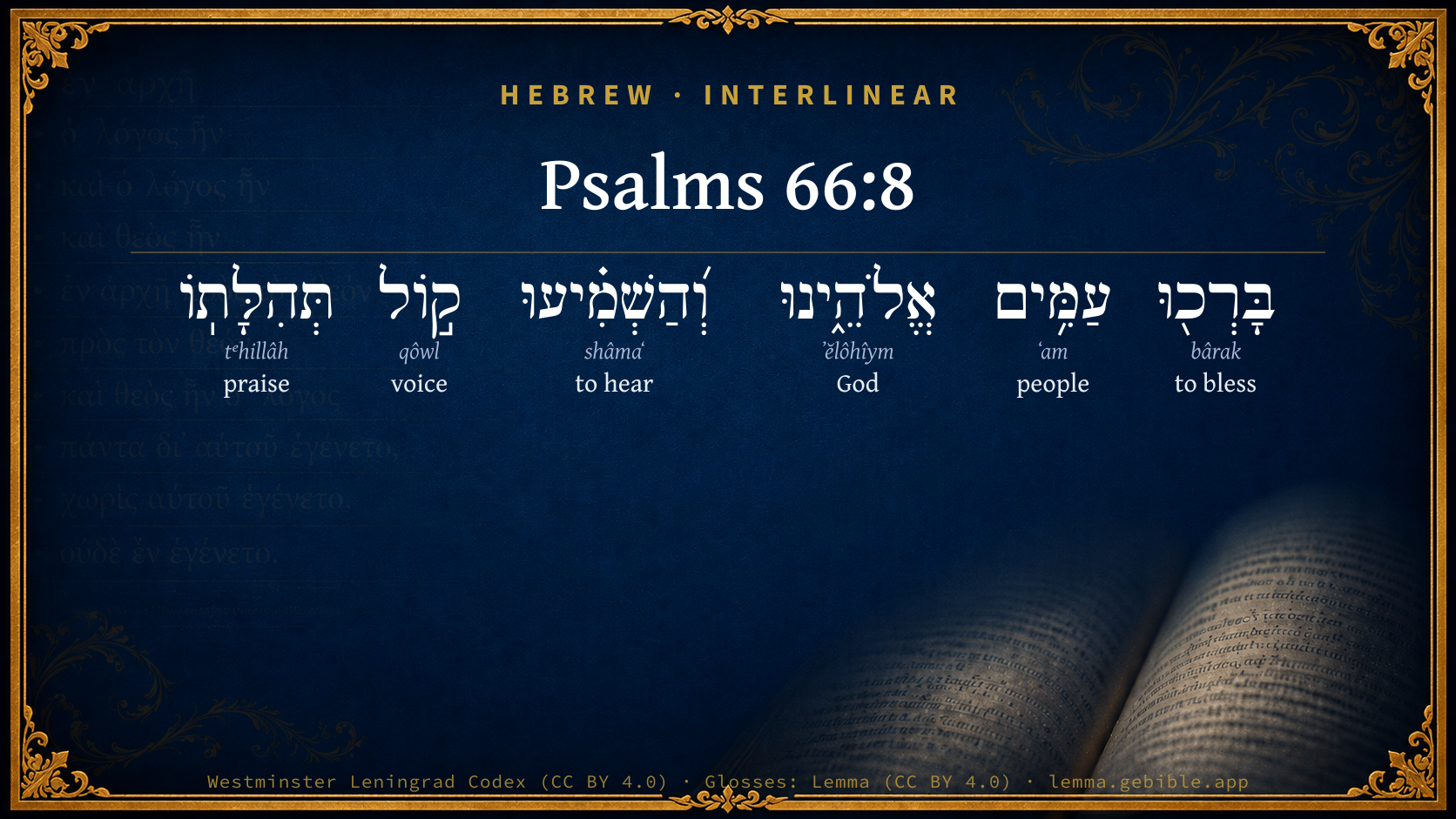
Psalms 66:8

Hebrew (Westminster Leningrad Codex) Psalms 66:8 appears in the Hebrew Old Testament. The text above is from the Westminster Leningrad Codex. Each word links to its Strong’s number, a concise gloss, and parsing drawn from the Open Scriptures Hebrew Bible morphology. Click any word for its full Brown-Driver-Briggs (BDB) entry.
Download image
Cite this verse

Psalms 66:8 (World English Bible). Public Domain. Lemma interlinear Bible study tool, https://lemma.gebible.app/v/psalms/66/8.

Show BibTeX & RIS
BibTeX
RIS
English Translation
Praise our God, you peoples! Make the sound of his praise heard,
World English Bible · Public Domain
Download a study sheet

One document with this verse’s original text, its word-by-word gloss line, the meaning frame, cross-references with their text, attributed commentary, and full source and license credits — printable, and it pastes into notes with its structure intact.

This verse Autodidact and up

Study sheet (.html) Plain text (.txt)

A passage Seminary Student

Up to 50 verses in one chapter. A passage sheet keeps up to 6 commentary sources and 12 cross-references per verse, in the order this page ranks them, and says so on the sheet whenever that leaves anything out. Ask for a single verse and you get the Autodidact verse sheet above.

Everything on this page stays free to read, with no account — the sheet is a download of what is already on screen, not access to it.

Want to remove ads? Support Godless Engineer
Compare translations 3

The same verse in 3 English versions, stacked beneath the original-language interlinear above. Click any original word for its lexicon entry.

Each is an independent rendering of the whole verse — the interlinear is not word-aligned to these translations.

Highlighted words mark where these versions differ — a whole-verse word diff, not a word-by-word alignment.

  • World English Bible Public Domain
    Praise our God, you peoples! Make the sound of his praise heard,
  • King James Version Public Domain
    O bless our God, ye people, and make the voice of his praise to be heard:
  • unfoldingWord Literal Text CC BY-SA 4.0
    Bless our God, peoples, and make the sound of his praise heard,

unfoldingWord Literal Text — © unfoldingWord, licensed CC BY-SA 4.0. Word-aligned USFM3 via Door43 (git.door43.org/unfoldingWord/en_ult).

Versions to compare (up to 4)

3 of 4 selected

Show all 18 translations

Every available English version of this verse, each an independent rendering of the whole verse.

  • World English Bible Public Domain
    Praise our God, you peoples! Make the sound of his praise heard,
  • Berean Standard Bible Public Domain
    Bless our God, O peoples; let the sound of His praise be heard.
  • Majority Standard Bible Public Domain
    Bless our God, O peoples; let the sound of His praise be heard.
  • King James Version Public Domain
    O bless our God, ye people, and make the voice of his praise to be heard:
  • American Standard Version (1901) Public Domain
    Oh bless our God, ye peoples, And make the voice of his praise to be heard;
  • Revised Version (1885) Public Domain
    O bless our God, ye peoples, and make the voice of his praise to be heard.
  • Geneva Bible (1599) Public Domain
    Prayse our God, ye people, and make the voyce of his prayse to be heard.
  • Douay-Rheims (1899) Public Domain
    O bless our God, ye Gentiles: and make the voice of his praise to be heard.
  • Young's Literal Translation Public Domain
    Bless, ye peoples, our God, And sound the voice of His praise,
  • Literal Standard Version CC BY-SA 4.0
    Bless our God you peoples, || And sound the voice of His praise,
  • Unlocked Literal Bible CC BY-SA 4.0
    Give blessing to God, you people, let the sound of his praise be heard.
  • unfoldingWord Literal Text CC BY-SA 4.0
    Bless our God, peoples, and make the sound of his praise heard,
  • Darby Bible Public Domain
    Bless our God, ye peoples, and make the voice of his praise to be heard;
  • World Messianic Bible Public Domain
    Praise our God, you peoples! Make the sound of his praise heard,
  • Webster's Bible Public Domain
    O bless our God, ye people, and make the voice of his praise to be heard:
  • Free Bible Version CC BY-SA 4.0
    Let all people everywhere bless our God, and loudly sing praises to him.
  • Bible in Basic English Public Domain
    Give blessings to our God, O you peoples, let the voice of his praise be loud;
  • JPS Tanakh (1917) Public Domain
    Bless our God, ye peoples, and make the voice of His praise to be heard;

Literal Standard Version (2020), Covenant Press — licensed CC BY-SA 4.0. Text via the HelloAO Bible API (eBible.org). Unlocked Literal Bible (unfoldingWord) — licensed CC BY-SA 4.0. Text via the HelloAO Bible API (eBible.org). unfoldingWord Literal Text — © unfoldingWord, licensed CC BY-SA 4.0. Word-aligned USFM3 via Door43 (git.door43.org/unfoldingWord/en_ult). Free Bible Version, Dr. Jonathan Gallagher — licensed CC BY-SA 4.0. Text via the HelloAO Bible API (eBible.org).

Word by word

More ways to search: Search by grammar → Find every occurrence → Compare this word →

Practice this passage: Drill this verse → Learn its vocabulary →

תְּהִלָּתֽוֹ
tᵉhillâh
H8416
“praise · his”
Noun, Common, Feminine, Singular, Construct + Suffix, Personal, 3rd Person, Masculine, Singular
Part of Speech
Noun
Type
Common
Gender
Feminine
Number
Singular
State
Construct
Full BDB Definition

Origin: from H1984

TWOT: 500c

praise, song or hymn of praise - praise, adoration, thanksgiving (paid to God) - act of general or public praise - praise-song (as title) - praise (demanded by qualities or deeds or attributes of God) - renown, fame, glory - of Damascus, God - object of praise, possessor of renown (figuratively)
  1. בָּרְכ֖וּ bârak H1288 “bless” Verb, Piel, Imperative, 2nd Person, Masculine, Plural
  2. עַמִּ֥ים ʻam H5971 “peoples” Noun, Common, Masculine, Plural, Absolute
  3. אֱלֹהֵ֑ינוּ ʼĕlôhîym H430 “God(s) · our” Noun, Common, Masculine, Plural, Construct + Suffix, Personal, 1st Person, Common, Plural
  4. וְ֝הַשְׁמִ֗יעוּ shâmaʻ H8085 “and · hear” Conjunction + Verb, Hiphil, Imperative, 2nd Person, Masculine, Plural
  5. ק֣וֹל qôwl H6963 “voice of” Noun, Common, Masculine, Singular, Construct

About this verse

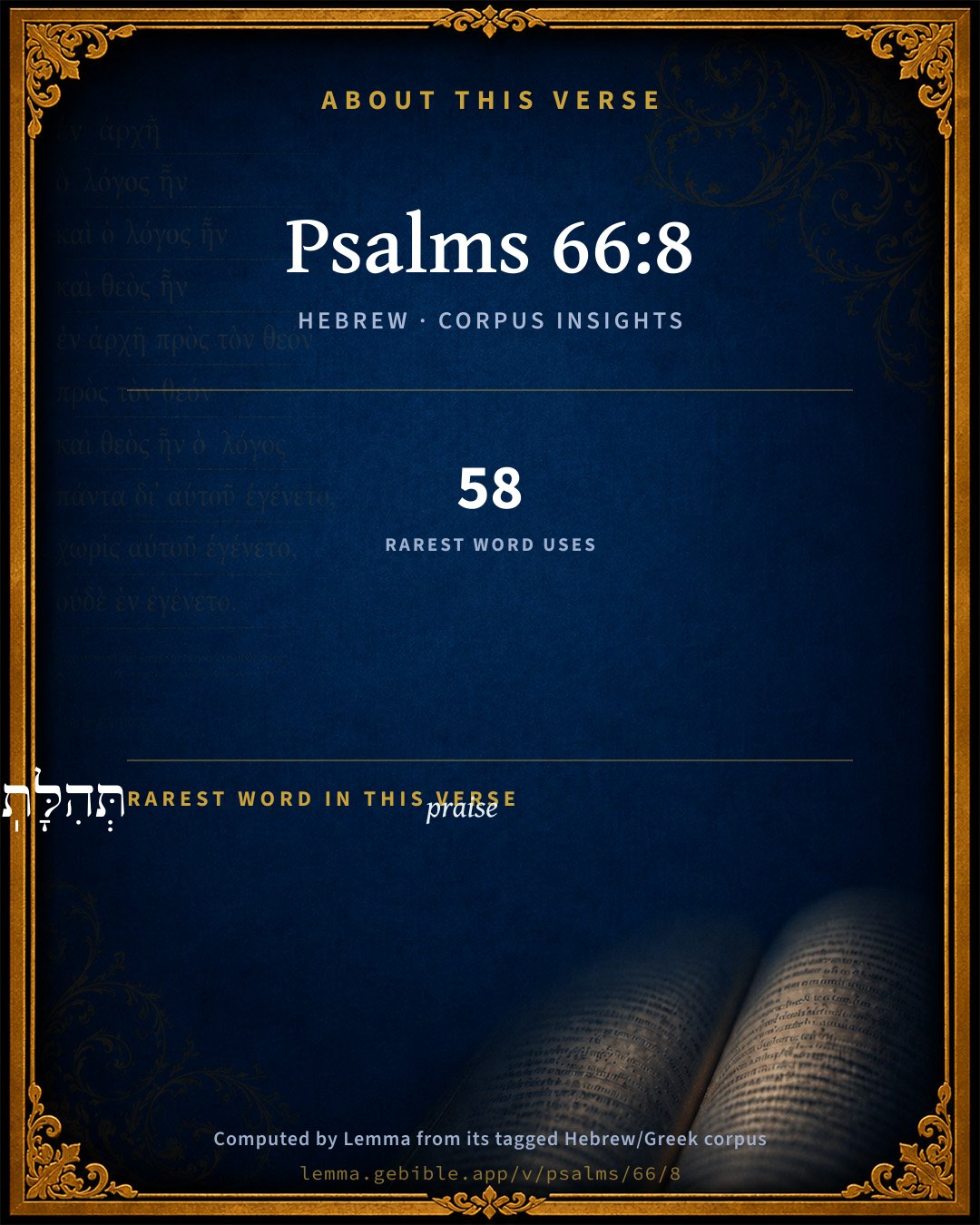
These counts appear in no published source. They are computed here, from the morphology-tagged text and Lemma’s own curated glosses. What Lemma adds →

6
words
6
distinct lemmas
Wisdom
section

Shared distinctive vocabulary

תְּהִלָּתֽוֹ praise H8416 occurs in 57 verses of the Hebrew Bible. Also found in:

Grammatical profile

  • 2 verbs
  • 4 nouns

Verb forms

  • בָּרְכ֖וּ Piel · Imperative
  • וְ֝הַשְׁמִ֗יעוּ Hiphil · Imperative

Hebrew & Septuagint length

In English translation the verse runs 12 words from the Hebrew and 15 from the Septuagint (LXX English) — closely comparable.

A rough comparison of the two English renderings, which tokenize alike — not a word-level alignment.

Word counts can differ between the Hebrew and the Greek without any difference in meaning — e.g. the Hebrew direct-object marker אֵת has no separate Greek word, and Greek often adds the article ὁ.

Cross-references

9

Topical passages linked to Psalms 66:8 in the Treasury of Scripture Knowledge — connected by theme and wording, ordered by reader-vote popularity; previews shown in the World English Bible.

  • Psalms 98:4 Make a joyful noise to Yahweh, all the earth! Burst out and sing for joy, yes, sing praises!
  • Psalms 47:1 Oh clap your hands, all you nations. Shout to God with the voice of triumph!
  • Psalms 66:2 Sing to the glory of his name! Offer glory and praise!
  • Jeremiah 33:11 the voice of joy and the voice of gladness, the voice of the bridegroom and the voice of the bride, the voice of those who say, Give thanks to Yahweh of Hosts, for Yahweh is good, for his loving kindness endures forever; [and of them] who bring [sacrifices of] thanksgiving into the house of Yahweh. For I will cause the captivity of the land to return as at the first, says Yahweh.
  • Revelation 19:1 After these things I heard something like a loud voice of a great multitude in heaven, saying, "Hallelujah! Salvation, power, and glory belong to our God:
  • Deuteronomy 32:43 Rejoice, you nations, [with] his people: For he will avenge the blood of his servants, Will render vengeance to his adversaries, Will make expiation for his land, for his people.
  • Romans 15:10–11 Again he says, "Rejoice, you Gentiles, with his people."
  • Revelation 5:11–14 I saw, and I heard something like a voice of many angels around the throne, the living creatures, and the elders; and the number of them was ten thousands of ten thousands, and thousands of thousands;
  • Revelation 19:5–6 A voice came forth from the throne, saying, "Give praise to our God, all you his servants, you who fear him, the small and the great!"

Cross-references courtesy of OpenBible.info (CC BY 4.0).

Hebrew and Greek witnesses Masoretic Hebrew ↔ Greek Septuagint

The same verse in the two great witnesses to the Old Testament, shown verse-for-verse.

You’re reading Greek Psalm 65 (Hebrew Psalm 66). The Septuagint counts the superscription, so verse numbers can differ from the Hebrew — chapter-level alignment, not verse-by-verse. Numbering follows Rahlfs.

These are two independent witnesses, not word-aligned to each other, and the Septuagint is shown in lemma (dictionary) form.

Hebrew Psalms 66:8 Masoretic · Westminster Leningrad Codex

בָּרְכ֖וּ עַמִּ֥ים אֱלֹהֵ֑ינוּ וְ֝הַשְׁמִ֗יעוּ ק֣וֹל תְּהִלָּתֽוֹ

Praise our God, you peoples! Make the sound of his praise heard,

World English Bible · Public Domain

Greek LXX Greek Psalm 65:8 Septuagint · lemma form

εὐλογέω ἔθνος ὁ θεός ἐγώ καί ἀκουτίζω ὁ φωνή ὁ αἴνεσις αὐτός

Bless our God, you⌃ Gentiles, and make the voice of his praise to be heard;

LXX2012 (modern English Septuagint) · Public Domain

On this verse, Keil & Delitzsch discusses the Septuagint’s reading. Read the note in Commentary ↓

Hebrew: Westminster Leningrad Codex (CC BY 4.0). Greek: Septuagint (public domain); English from LXX2012 (modern English Septuagint) (Public Domain). How the Septuagint differs from the Hebrew →

Commentary

Notes on Psalms 66:8 from classic Christian and Jewish commentators (each source and its license shown beneath its notes). The classic Christian expositions comment on the surrounding passage and are grouped to its opening verse, so a note may address several verses; the Jewish commentaries on the Tanakh (Rashi and others) are per-verse, so they appear only where the commentator wrote on this verse.

Lemma curates 59 commentaries, every one of them public domain or Creative Commons licensed, each selected and text-cleaned for this edition rather than reprinted as found. About our sources →

Matthew Henry's Commentary

In these verses the psalmist calls upon God's people in a special manner to praise him. Let all lands do it, but Israel's land particularly. Bless our God; bless him as ours, a God in covenant with us, and that takes care of us as his own. Let them make the voice of his praise to be heard (Psa 66:8); for from whom should it be heard but from those who are his peculiar favourites and select attendants? Two things we have reason to bless God for: -

I. Common protection (Psa 66:9): He holdeth our soul in life, that it may not drop away of itself; for, being continually in our hands, it is apt to slip through our fingers. We must own that it is the good providence of God that keeps life and soul together and his visitation that preserves our spirit. He puts our soul in life, so the word is. He that gave us our being, by a constant renewed act upholds us in our being, and his providence is a continued creation. When we are ready to faint and perish he restores our soul, and so puts it, as it were, into a new life, giving new comforts. Non est vivere, sed valere, vita - It is not existence, but happiness, that deserves the name of life. But we are apt to stumble and fall, and are exposed to many destructive accidents, killing disasters as well as killing diseases, and therefore as to these also we are guarded by the divine power. He suffers not our feet to be moved, preventing many unforeseen evils, which we ourselves were not aware of our danger from. To him we owe it that we have not, long ere this, fallen into endless ruin. He will keep the feet of his saints.

II. Special deliverance from great distress. Observe,

1. How grievous the distress and danger were, Psa 66:11, Psa 66:12. What particular trouble of the church this refers to does not appear; it might be the trouble of some private persons or families only. But, whatever it was, they were surprised with it as a bird with a snare, enclosed and entangled in it as a fish in a net; they were pressed down with it, and kept under as with a load upon their loins, Psa 66:11. But they owned the hand of God in it. We are never in the net but God brings us into it, never under affliction but God lays it upon us. Is any thing more dangerous than fire and water? We went through both, that is, afflictions of different kinds; the end of one trouble was the beginning of another; when we had got clear of one sort of dangers we found ourselves involved in dangers of another sort. Such may be the troubles of the best of God's saints, but he has promised, When thou passest through the waters, through the fire, I will be with thee, Isa 43:1. Yet proud and cruel men may be as dangerous as fire and water, and more so. Beware of men, Mat 10:17. When men rose up against us, that was fire and water, and all that is threatening (Psa 124:2, Psa 124:3, Psa 124:4), and that was the case here: "Thou hast caused men to ride over our heads, to trample upon us and insult over us, to hector and abuse us, nay, and to make perfect slaves of us; they have said to our souls, Bow down, that we may go over," Isa 51:23. While it is the pleasure of good princes to rule in the hearts of their subjects it is the pride of tyrants to ride over their heads; yet the afflicted church in this also owns the hand of God: "Thou hast caused them thus to abuse us;" for the most furious oppressor has no power but what is given him from above.

2. How gracious God's design was in bringing them into this distress and danger. See what the meaning of it is (Psa 66:10): Thou, O God! hast proved us, and tried us. Then we are likely to get good by our afflictions, when we look upon them under this notion, for then we may see God's grace and love at the bottom of them and our own honour and benefit in the end of them. By afflictions we are proved as silver in the fire. (1.) That our graces, by being tried, may be made more evident and so we may be approved, as silver, when it is touched and marked sterling, and this will be to our praise at the appearing of Jesus Christ (Pe1 1:7) and perhaps in this world. Job's integrity and constancy were manifested by his afflictions. (2.) That our graces, by being exercised, may be made more strong and active, and so we may be improved, as silver when it is refined by the fire and made more clear from its dross; and this will be to our unspeakable advantage, for thus we are made partakers of God's holiness, Heb 12:10. Public troubles are for the purifying of the church, Dan 11:35; Rev 2:10; Deu 8:2.

3. How glorious the issue was at last. The troubles of the church will certainly end well; these do so, for (1.) The outlet of the trouble is happy. They are in fire and water, but they get through them: "We went through fire and water, and did not perish in the flames or floods." Whatever the troubles of the saints are, blessed be God, there is a way through them. (2.) The inlet to a better state is much more happy: Thou broughtest us out into a wealthy place, into a well-watered place (so the word is), like the gardens of the Lord, and therefore fruitful. God brings his people into trouble that their comforts afterwards may be the sweeter and that their affliction may thus yield the peaceable fruit of righteousness, which will make the poorest place in the world a wealthy place.

Matthew Henry's Commentary on the Whole Bible (1708–1710) — public domain (CC PDM 1.0). Text via the HelloAO Bible API.

Trapp's Complete Commentary

John Trapp

Psa 66:8 O bless our God, ye people, and make the voice of his praise to be heard:

Ver. 8. O bless our God, ye people] We must not only publish God’s praises, but provoke others also so to do.

John Trapp, A Commentary or Exposition upon All the Books of the Old and New Testament (1647–1656) — public domain. Text from a community e-Sword module.

Joseph Benson's Commentary

Psa 66:8-9. O bless our God, ye people — Of other nations, who have served, or yet do serve other gods. Who holdeth our soul in life — Who by a succession of miracles of mercy hath preserved us alive in the midst of a thousand deaths, to which we were exposed; and hath restored us to life, when, as a nation, we were like dead men and dry bones, scattered at the mouth of the grave. And suffereth not our feet to be moved — Namely, so as to fall into mischief and utter ruin, as our enemies designed. But the psalmist’s words here are not to be interpreted exclusively of public and national blessings. We ought all, as individuals, to remember and acknowledge our daily and hourly obligations to him, who gave us our being at first, and by a constant renewed act upholds us in being. And, when we are ready to faint and perish, he restores our soul, and so puts it, as it were, into a new life, imparting new supports and comforts. We are apt to stumble and fall, and are exposed to many destructive accidents and disasters, as well as killing diseases; and as to these also we are guarded by the divine power; he suffereth not our feet to be moved, in that he prevents many unforeseen evils, from which we ourselves were not aware of our danger. To him we owe it that we have not, long ere this, fallen into endless ruin.

Joseph Benson's Commentary on the Old and New Testaments (1811–1818) — public domain. Text from a community e-Sword module.

J. A. Alexander on Psalms

Joseph Addison Alexander

8. (Psa 66:8) Bless, O ye nations, our God, cause to be heard the voice of his praise! To the general description of God's gracious dispensations towards his people there seems now to be added the commemoration of a particular event of this kind; not one of merely local interest, however, but of such importance, that the nations are invited to unite in praising God for it. See above, on Psa 18:49; Psa 22:27.

Joseph Addison Alexander, The Psalms Translated and Explained (1850) — public domain. Text from a community e-Sword module.

Tyndale Open Study Notes

Tyndale Open Resources

66:8-10 The orderly lives of the redeemed reflect the order of God’s world. The Lord protects them from evil and purifies them.

Tyndale Open Study Notes — © Tyndale Open Resources, licensed CC BY-SA 4.0. Text via the HelloAO Bible API.

Jamieson, Fausset & Brown

Robert Jamieson, A. R. Fausset & David Brown

Here is, perhaps, cited a case of recent deliverance.

Jamieson, Fausset & Brown — Commentary Critical and Explanatory on the Whole Bible (1871) — public domain (CC PDM 1.0). Text via the HelloAO Bible API.

Adam Clarke's Commentary

Verse 8. O bless our God] Who have so much cause as you to sing praises to the Lord? Hear what he has done for you:

Adam Clarke's Commentary on the Bible (1810–1826) — public domain. Text from a community e-Sword/MySword module.

John Calvin's Commentaries

8 Bless our God, O ye people! Although calling upon all, without exception, to praise God, he refers particularly to some Divine interposition in behalf of the Church. He would seem to hint that the Gentiles were destined, at a future period, to share the favor now exclusively enjoyed by God’s chosen people. In the meantime, he reminds them of the signal and memorable nature of the deliverance granted, by calling upon them to spread abroad the fame of it. Though he speaks of the Jewish people as having been brought unto life, (an expression intended to denote deliverance of a more than ordinary kind,) this means that they had been preserved from approaching danger rather than recovered from a calamity which had actually overtaken them, It is said that their feet had not been suffered to fall, which implies, that, through seasonable help which they had received, they had not fallen, but stood firm. The Psalmist, however, does not take occasion, from the evil having been anticipated and averted, to undervalue it. As they had been preserved safe by an interposition of Divine goodness, he speaks of this as tantamount to having been brought or restored to life.

John Calvin's Commentaries (1540-1563) — public domain. Text from the Calvin Translation Society English edition (1840s-50s) via the Christian Classics Ethereal Library (ccel.org). Calvin's coverage is partial (roughly two-thirds of the Bible); uncommented books and verses are honest gaps, never fabricated. The 19th-century editor's footnotes and remarks are omitted so the notes are faithfully Calvin's own voice.

The Cambridge Bible for Schools and Colleges

gen. ed. J. J. S. Perowne

8. ye people] Ye peoples (R.V.). The nations, not Israel, are still addressed. Conscious of Israel’s mission to the world, the Psalmist can call upon them to give thanks for Israel’s preservation to fulfil its work for them.

8–12. A renewed call to the nations to praise God for His deliverance of Israel from dangers which menaced the very existence of the nation.

The Cambridge Bible for Schools and Colleges (gen. ed. J. J. S. Perowne; Cambridge University Press, 1878–1918) — public domain. Text from a community e-Sword module.

John Gill's Exposition

O bless our God, ye people,.... In all countries, that know the Lord and fear him; ascribe blessing, and honour and glory, to Christ our God, on account of his works, actions, perfections, kingdom and power; and because of the destruction of those who are rebels to his government;

and make the voice of his praise to be heard; far and near, in psalms, and hymns, and spiritual songs; by shoutings, and loud acclamations of joy; see Rev 19:5; where Christ is called our God, and a like exhortation is made as here.

John Gill's Exposition of the Whole Bible (1746–1763) — public domain (CC PDM 1.0). Text via the HelloAO Bible API.

Albert Barnes' Notes on the Bible

O bless our God, ye people - That is, particularly the people of the nation; the Hebrew people. The call here to praise or bless God is on account of some special benefit which had been conferred on them, and which is referred to more particularly in the following verses. It was his gracious interposition in the time of danger, by which they were delivered from their foes, Psa 66:11-12.

And make the voice of his praise to be heard - Let it be sounded out afar, that it may be heard abroad.

Albert Barnes' Notes on the Bible (1834–1885) — public domain. Text from a community e-Sword/MySword module.

Matthew Poole's English Annotations

Ye people of other nations, that have served or yet do serve other gods.

Matthew Poole's English Annotations on the Holy Bible (1683–1685) — public domain. Text from a community e-Sword/MySword module.

The Treasury of David

Charles H. Spurgeon

Ver. 8. O bless our God, ye people. Ye chosen seed, peculiarly beloved, it is yours to bless your covenant God as other nations cannot. Ye should lead the strain, for he is peculiarly your God. First visited by his love, ye should be foremost in his praise.

And make the voice of his praise to be heard. Whoever else may sing with bated breath, do you be sure to give full tongue and volume to the song. Compel unwilling ears to hear the praises of your covenant God. Make rocks, and hills, and earth, and sea, and heaven itself to echo with your joyful shouts.

None.

Ver. 8. (last clause). To get a hearing for the gospel-- difficult, necessary, and possible. Ways and means for so doing.

Ver. 8-9.

I. Praise to.

1. As God.

2. As our God. II. Praise for. Preservation.

1. Of natural life.

2. Of spiritual life. III. Praise by, ye people.

1. On your own account.

2. On account of others. Or,

1. Individually.

2. Unitedly. G. R.

Psalms 66:9*

Ver. 8-9.

I. Praise to.

1. As God.

2. As our God. II. Praise for. Preservation.

1. Of natural life.

2. Of spiritual life. III. Praise by, ye people.

1. On your own account.

2. On account of others. Or,

1. Individually.

2. Unitedly. G. R.

Charles H. Spurgeon's The Treasury of David (1869–1885) — public domain. Psalms only. Text from a community e-Sword/MySword module.

Whedon's Commentary on the Bible

Daniel D. Whedon

8. Bless our God, ye people—The second strophe is here introduced by a call to the Church. “People” stands for the covenant people Israel, the Church, as “nations” does for Gentiles, Psa_66:7; and “all ye lands,” “all the earth,” and “children of men” do for the same, Psa_66:1; Psa_66:4-5. ]n the former verses he speaks of “God,” now he speaks of “our God.” Hitherto he has warned haughty kings and nations, now he invites them to spiritual worship.

Daniel D. Whedon (gen. ed.), Commentary on the Old and New Testaments (1874–1909) — public domain. Text from a community e-Sword module.

The Pulpit Commentary

Vers. 8-15. Here we reach the heart of the psalm. The people are called upon to praise God for a recent deliverance from a long period of severe affliction and oppression at the hand of enemies (vers. 8-12), and to join in the sacrifices which are about to be offered to God in payment of the vows made during the time of trouble (vers. 13-15). As the writer ascribes to himself both the making of the vows and the offering of the sacrifices, he must have been the leader of the nation at the time of the oppression and of the deliverance.

O bless our God, ye people; literally, ye peoples but the plural form here can scarcely point to the "nations," who have just been called, not ammim, but goim (see ver. 7). And make the voice of his praise to be heard. (comp. Psa_33:3; cf. 5) The heartiness of the soul"s devotion was made apparent by the loudness of the voice.

The Pulpit Commentary (1880–1919), ed. H.D.M. Spence-Jones & Joseph S. Exell — public domain. Text from a community e-Sword module.

Keil & Delitzsch

C. F. Keil & F. Delitzsch

The character of the event by which the truth has been verified that the God who redeemed Israel out of Egypt still ever possesses and exercises to the full His ancient sovereign power, is seen from this reiterated call to the peoples to share in Israel's Gloria. God has averted the peril of death and overthrow from His people: He has put their soul in life (בּחיּים, like בּישׁע in Psa 12:6), i.e., in the realm of life; He has not abandoned their foot to tottering unto overthrow (mowT the substantive, as in Psa 121:3; cf. the reversed construction in Psa 55:23). For God has cast His people as it were into a smelting-furnace or fining-pot in order to purify and to prove them by suffering; - this is a favourite figure with Isaiah and Jeremiah, but is also found in Zac 13:9; Mal 3:3. Eze 19:9 is decisive concerning the meaning of מצוּדה, where הביא במצודות signifies "to bring into the holds or prisons;" besides, the figure of the fowling-net (although this is also called מצוּדה as well as מצודה) has no footing here in the context. מצוּדה (vid., Psa 18:3) signifies specula, and that both a natural and an artificial watch-post on a mountain; here it is the mountain-hold or prison of the enemy, as a figure of the total loss of freedom. The laying on of a heavy burden mentioned by the side of it in Psa 66:11 also accords well with this. מוּעקה, a being oppressed, the pressure of a burden, is a Hophal formation, like מטּה, a being spread out, Isa 8:8; cf. the similar masculine forms in Psa 69:3; Isa 8:13; Isa 14:6; Isa 29:3. The loins are mentioned because when carrying heavy loads, which one has to stoop down in order to take up, the lower spinal region is called into exercise. אנושׁ is frequently (Psa 9:20., Psa 10:18; Psa 56:2, Isa 51:12; Ch2 14:10) the word used for tyrants as being wretched mortals, perishable creatures, in contrast with their all the more revolting, imperious, and self-deified demeanour. God so ordered it, that "wretched men" rode upon Israel's head. Or is it to be interpreted: He caused them to pass over Israel (cf. Psa 129:3; Isa 51:23)? It can scarcely mean this, since it would then be in dorso nostro, which the Latin versions capriciously substitute. The preposition ל instead of על is used with reference to the phrase ישׁב ל: sitting upon Israel's head, God caused them to ride along, so that Israel was not able to raise its head freely, but was most ignominiously wounded in its self-esteem. Fire and water are, as in Isa 43:2, a figure of vicissitudes and perils of the most extreme character. Israel was nigh to being burnt up and drowned, but God led it forth לרויה, to an abundant fulness, to abundance and superabundance of prosperity. The lxx, which renders εἰς ἀναψυχήν (Jerome absolutely: in refrigerium), has read לרוחה; Symmachus, εἰς εὐρυχωρίαν, probably reading לרחבה (Psa 119:45; Psa 18:20). Both give a stronger antithesis. But the state of straitness or oppression was indeed also a state of privation.

Keil & Delitzsch — Biblical Commentary on the Old Testament (1861–1891) — public domain (CC PDM 1.0). Text via the HelloAO Bible API. (Old Testament only.)

unfoldingWord translationNotes

Door43 World Missions Community

Give blessing to God ... let the sound of his praise be heard

These two clauses have similar meanings. The idea is repeated to emphasize the importance of praising God. (See: Parallelism)

us ... our

These words refer to David and the people he is speaking to. (See: Inclusive "We")

he does not permit our feet to slip

The writer speaks of God's protection as preventing his people from slipping as they walk or falling off a cliff. AT: "he has not allowed us to fall into disaster" (See: Metaphor)

translationWords

bless

people group

praise

life

unfoldingWord translationNotes — © Distant Shores Media and the Door43 World Missions Community, licensed CC BY-SA 4.0. Source: git.door43.org/Door43/en_tn.

Rashi

Rabbi Shlomo Yitzchaki (Rashi)

O peoples, bless our God for His wonders, that He kept our soul alive in exile, and you cannot annihilate us.

Rashi on the Tanakh — English translations: “The Judaica Press complete Tanach with Rashi, translated by A. J. Rosenberg” (CC BY 4.0); “Pentateuch with Rashi's commentary by M. Rosenbaum and A.M. Silbermann, 1929-1934” (public domain); “The Metsudah Tanach series, Lakewood, N.J” (CC BY 4.0); and “The Book of Joshua, Metsudah Publications, 1997” (CC BY 4.0). Text via Sefaria.

Lesson kit

Teaching starters — assembled from the data on this page, not authored interpretation. Every prompt links to the verse data it draws on. Edit before teaching.

Psalms, in the Wisdom, opens this verse with 6 words (6 distinct Hebrew lemmas). Its most distinctive word is tᵉhillâh (“praise”). A historical commentator’s framing appears above. Read the whole chapter for the surrounding context.

Discussion questions

  1. The word tᵉhillâh carries the sense “praise.” How does it shape the verse?
  2. Exodus 15:11 shares the word «praise» with this verse. How do the two illuminate each other?
  3. These translations render this verse differently. What is at stake in choosing one wording over another?
  4. The verb «בָּרְכ֖וּ» is Piel Imperative. How does its form color the action?
  5. Reading how Matthew Henry's Commentary and Trapp's Complete Commentary read this verse, where do the two commentators agree and where do they part?

Things to notice

Reading settings

Reading text

Shown beneath each verse's original-language words.

Old Testament
Old Testament edition

Read the OT as the Masoretic Hebrew (MT) or the Greek Septuagint (LXX).

English shown for the Greek Septuagint (in the Hebrew ↔ Greek comparison).

Comparing translations? Open the Compare panel on any verse page to stack up to four side by side.