
Psalms 105:20

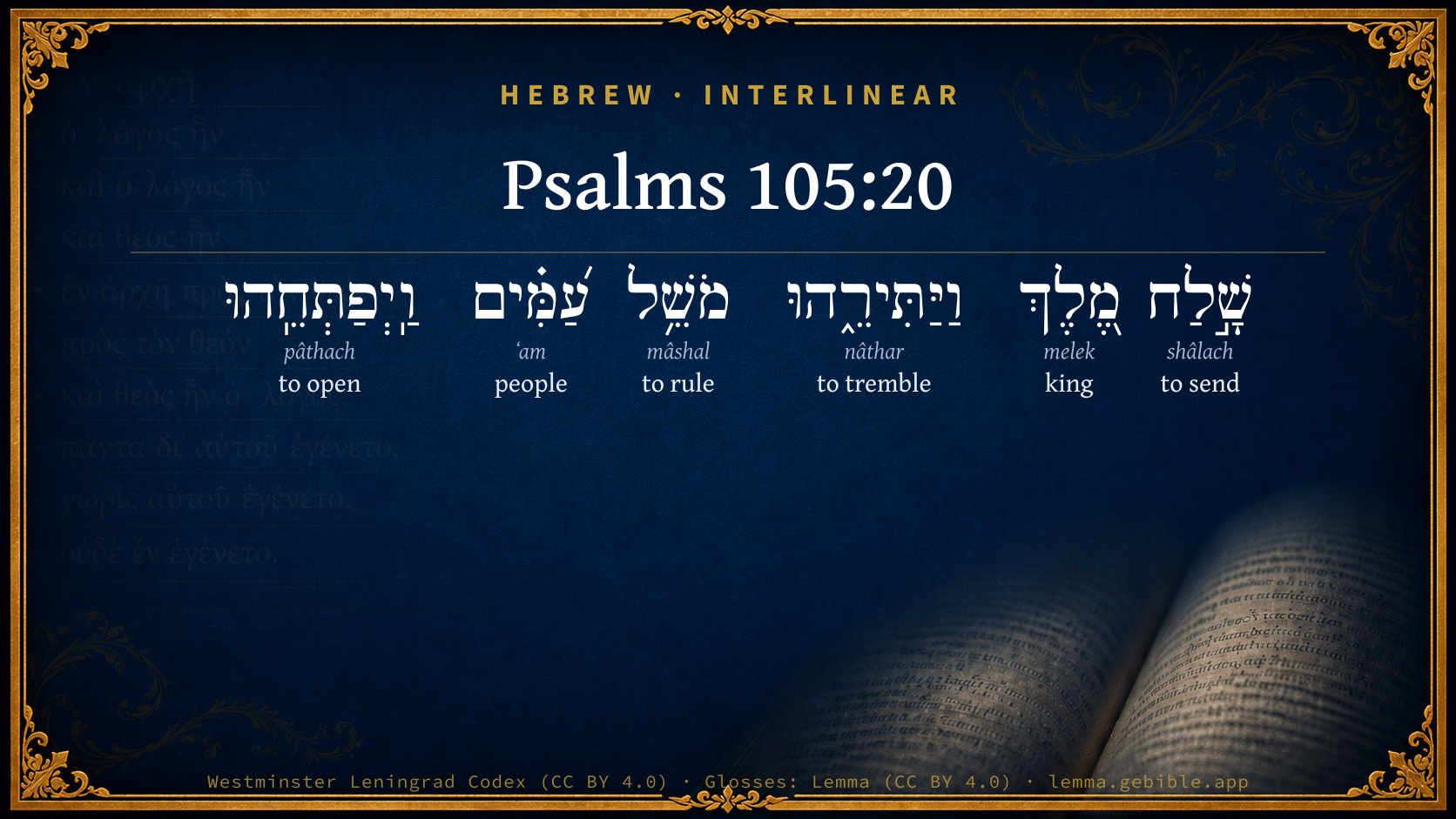
Hebrew (Westminster Leningrad Codex) Psalms 105:20 appears in the Hebrew Old Testament. The text above is from the Westminster Leningrad Codex. Each word links to its Strong’s number, a concise gloss, and parsing drawn from the Open Scriptures Hebrew Bible morphology. Click any word for its full Brown-Driver-Briggs (BDB) entry.
Download image
Cite this verse

Psalms 105:20 (World English Bible). Public Domain. Lemma interlinear Bible study tool, https://lemma.gebible.app/v/psalms/105/20.

Show BibTeX & RIS
BibTeX
RIS
English Translation
The king sent and freed him; Even the ruler of peoples, and let him go free.
World English Bible · Public Domain
Download a study sheet

One document with this verse’s original text, its word-by-word gloss line, the meaning frame, cross-references with their text, attributed commentary, and full source and license credits — printable, and it pastes into notes with its structure intact.

This verse Autodidact and up

Study sheet (.html) Plain text (.txt)

A passage Seminary Student

Up to 50 verses in one chapter. A passage sheet keeps up to 6 commentary sources and 12 cross-references per verse, in the order this page ranks them, and says so on the sheet whenever that leaves anything out. Ask for a single verse and you get the Autodidact verse sheet above.

Everything on this page stays free to read, with no account — the sheet is a download of what is already on screen, not access to it.

Want to remove ads? Support Godless Engineer
Compare translations 3

The same verse in 3 English versions, stacked beneath the original-language interlinear above. Click any original word for its lexicon entry.

Each is an independent rendering of the whole verse — the interlinear is not word-aligned to these translations.

Highlighted words mark where these versions differ — a whole-verse word diff, not a word-by-word alignment.

  • World English Bible Public Domain
    The king sent and freed him; Even the ruler of peoples, and let him go free.
  • King James Version Public Domain
    The king sent and loosed him; even the ruler of the people, and let him go free.
  • unfoldingWord Literal Text CC BY-SA 4.0
    The king sent and released him; the one ruling the people, and liberated him.

unfoldingWord Literal Text — © unfoldingWord, licensed CC BY-SA 4.0. Word-aligned USFM3 via Door43 (git.door43.org/unfoldingWord/en_ult).

Versions to compare (up to 4)

3 of 4 selected

Show all 18 translations

Every available English version of this verse, each an independent rendering of the whole verse.

  • World English Bible Public Domain
    The king sent and freed him; Even the ruler of peoples, and let him go free.
  • Berean Standard Bible Public Domain
    The king sent and released him; the ruler of peoples set him free.
  • Majority Standard Bible Public Domain
    The king sent and released him; the ruler of peoples set him free.
  • King James Version Public Domain
    The king sent and loosed him; even the ruler of the people, and let him go free.
  • American Standard Version (1901) Public Domain
    The king sent and loosed him; Even the ruler of peoples, and let him go free.
  • Revised Version (1885) Public Domain
    The king sent and loosed him; even the ruler of peoples, and let him go free.
  • Geneva Bible (1599) Public Domain
    The King sent and loosed him: euen the Ruler of the people deliuered him.
  • Douay-Rheims (1899) Public Domain
    The king sent, and he released him: the ruler of the people, and he set him at liberty.
  • Young's Literal Translation Public Domain
    The king hath sent, and looseth him, The ruler of the peoples, and draweth him out.
  • Literal Standard Version CC BY-SA 4.0
    The king has sent, and looses him, || The ruler of the peoples, and draws him out.
  • Unlocked Literal Bible CC BY-SA 4.0
    The king sent servants to release him; the ruler of the people set him free.
  • unfoldingWord Literal Text CC BY-SA 4.0
    The king sent and released him; the one ruling the people, and liberated him.
  • Darby Bible Public Domain
    The king sent and loosed him -- the ruler of peoples -- and let him go free.
  • World Messianic Bible Public Domain
    The king sent and freed him, even the ruler of peoples, and let him go free.
  • Webster's Bible Public Domain
    The king sent and loosed him; even the ruler of the people, and let him go free.
  • Free Bible Version CC BY-SA 4.0
    The king sent for him and released him; the king of the people set him free.
  • Bible in Basic English Public Domain
    The king sent men to take off his chains; even the ruler of the people, who let him go free.
  • JPS Tanakh (1917) Public Domain
    The king sent and loosed him; even the ruler of the peoples, and set him free.

Literal Standard Version (2020), Covenant Press — licensed CC BY-SA 4.0. Text via the HelloAO Bible API (eBible.org). Unlocked Literal Bible (unfoldingWord) — licensed CC BY-SA 4.0. Text via the HelloAO Bible API (eBible.org). unfoldingWord Literal Text — © unfoldingWord, licensed CC BY-SA 4.0. Word-aligned USFM3 via Door43 (git.door43.org/unfoldingWord/en_ult). Free Bible Version, Dr. Jonathan Gallagher — licensed CC BY-SA 4.0. Text via the HelloAO Bible API (eBible.org).

Word by word

More ways to search: Search by grammar → Find every occurrence → Compare this word →

Practice this passage: Drill this verse → Learn its vocabulary →

וַיַּתִּירֵ֑הוּ
nâthar
H5425
“and · to tremble · him”
Conjunction + Verb, Hiphil, Sequential Imperfect, 3rd Person, Masculine, Singular + Suffix, Personal, 3rd Person, Masculine, Singular
Part of Speech
Conjunction + Verb
Stem
Hiphil
Form
Sequential Imperfect
Person
3rd Person
Gender
Masculine
Number
Singular
Full BDB Definition

Origin: a primitive root

TWOT: 1448 , 1449

to start up, tremble, shake, spring up - (Qal) to start up - (Piel) to leap - (Hiphil) to cause to start up - to loose, let loose, undo, be free, be loose - (Hiphil) - to unfasten, loosen - to set free, unbind
  1. שָׁ֣לַח shâlach H7971 “to send” Verb, Qal, Perfect, 3rd Person, Masculine, Singular
  2. מֶ֭לֶךְ melek H4428 “king” Noun, Common, Masculine, Singular, Absolute
  3. מֹשֵׁ֥ל mâshal H4910 “ruling” Verb, Qal, Participle Active, Masculine, Singular, Construct
  4. עַ֝מִּ֗ים ʻam H5971 “peoples” Noun, Common, Masculine, Plural, Absolute
  5. וַֽיְפַתְּחֵֽהוּ pâthach H6605 “and · to open · him” Conjunction + Verb, Piel, Sequential Imperfect, 3rd Person, Masculine, Singular + Suffix, Personal, 3rd Person, Masculine, Singular

About this verse

These counts appear in no published source. They are computed here, from the morphology-tagged text and Lemma’s own curated glosses. What Lemma adds →

6
words
6
distinct lemmas
Wisdom
section

Notable vocabulary

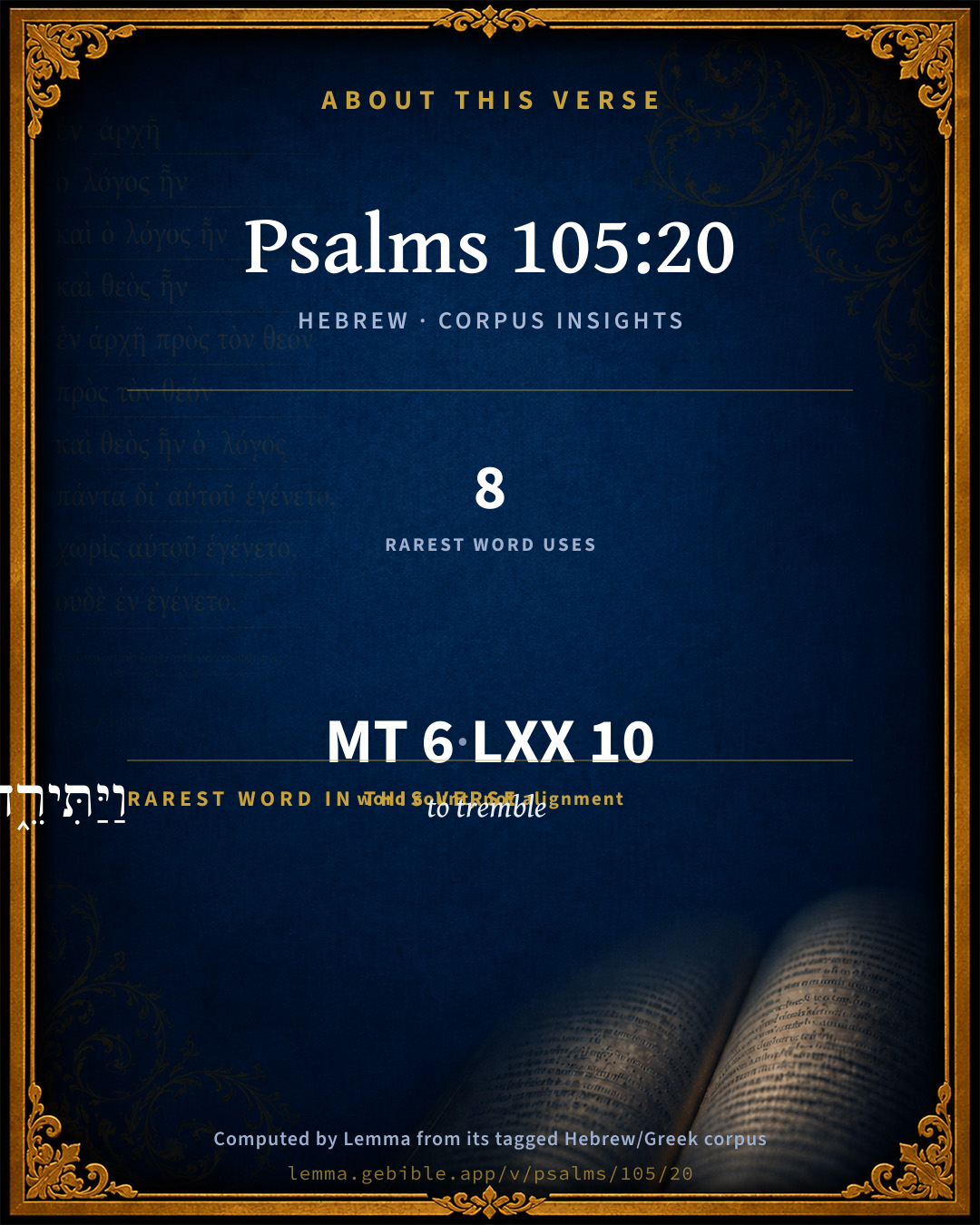
The rarest word here is וַיַּתִּירֵ֑הוּ to tremble H5425 — appearing just 8 times in the whole Hebrew Bible.

Shared distinctive vocabulary

וַיַּתִּירֵ֑הוּ to tremble H5425 occurs in 8 verses of the Hebrew Bible. Also found in:

Grammatical profile

  • 4 verbs
  • 2 nouns

Verb forms

  • שָׁ֣לַח Qal · Perfect
  • וַיַּתִּירֵ֑הוּ Hiphil · Sequential Imperfect
  • מֹשֵׁ֥ל Qal · Participle Active
  • וַֽיְפַתְּחֵֽהוּ Piel · Sequential Imperfect

Hebrew & Septuagint length

In English translation the verse runs 16 words from the Hebrew and 17 from the Septuagint (LXX English) — closely comparable.

A rough comparison of the two English renderings, which tokenize alike — not a word-level alignment.

Word counts can differ between the Hebrew and the Greek without any difference in meaning — e.g. the Hebrew direct-object marker אֵת has no separate Greek word, and Greek often adds the article ὁ.

In the original languages it is 6 Hebrew tokens and 10 Greek tokens — but the two are counted differently (Hebrew bundles its prefixes and suffixes into one token; the Greek is in lemma form), so that isn’t a like-for-like length.

Cross-references

1

Topical passages linked to Psalms 105:20 in the Treasury of Scripture Knowledge — connected by theme and wording, ordered by reader-vote popularity; previews shown in the World English Bible.

  • Genesis 41:14 Then Pharaoh sent and called Joseph, and they brought him hastily out of the dungeon. He shaved himself, changed his clothing, and came in to Pharaoh.

Cross-references courtesy of OpenBible.info (CC BY 4.0).

Hebrew and Greek witnesses Masoretic Hebrew ↔ Greek Septuagint

The same verse in the two great witnesses to the Old Testament, shown verse-for-verse.

You’re reading Greek Psalm 104 (Hebrew Psalm 105). The Septuagint counts the superscription, so verse numbers can differ from the Hebrew — chapter-level alignment, not verse-by-verse. Numbering follows Rahlfs.

These are two independent witnesses, not word-aligned to each other, and the Septuagint is shown in lemma (dictionary) form.

Hebrew Psalms 105:20 Masoretic · Westminster Leningrad Codex

שָׁ֣לַח מֶ֭לֶךְ וַיַּתִּירֵ֑הוּ מֹשֵׁ֥ל עַ֝מִּ֗ים וַֽיְפַתְּחֵֽהוּ

The king sent and freed him; Even the ruler of peoples, and let him go free.

World English Bible · Public Domain

Greek LXX Greek Psalm 104:20 Septuagint · lemma form

ἀποστέλλω βασιλεύς καί λύω αὐτός ἄρχων λαός καί ἀποἵημι αὐτός

The king sent and loosed him; even the prince of the people, and let him go free.

LXX2012 (modern English Septuagint) · Public Domain

Hebrew: Westminster Leningrad Codex (CC BY 4.0). Greek: Septuagint (public domain); English from LXX2012 (modern English Septuagint) (Public Domain). How the Septuagint differs from the Hebrew →

Commentary

Notes on Psalms 105:20 from classic Christian and Jewish commentators (each source and its license shown beneath its notes). The classic Christian expositions comment on the surrounding passage and are grouped to its opening verse, so a note may address several verses; the Jewish commentaries on the Tanakh (Rashi and others) are per-verse, so they appear only where the commentator wrote on this verse.

Lemma curates 59 commentaries, every one of them public domain or Creative Commons licensed, each selected and text-cleaned for this edition rather than reprinted as found. About our sources →

Trapp's Complete Commentary

John Trapp

Psa 105:20 The king sent and loosed him; [even] the ruler of the people, and let him go free.

Ver. 20. The king sent and loosed him] By his own master, Potiphar, who had laid him there at his wife’s instance. Such as are bound ignominiously for righteousness’ sake shall be one way or other loosed honourably.

John Trapp, A Commentary or Exposition upon All the Books of the Old and New Testament (1647–1656) — public domain. Text from a community e-Sword module.

J. A. Alexander on Psalms

Joseph Addison Alexander

20. (Psa 105:20) The King sent and loosed him—the ruler of nations, and set him free. Both verbs strictly apply to the removal of his fetters, the first meaning properly to knock off (Isa 58:6), the other to open for the purpose of removing. See above, on Psa 30:11. The king of Egypt is called a ruler of peoples, either in reference to the tribes or nomes of Egypt itself, or because there were other nations tributary to him.

Joseph Addison Alexander, The Psalms Translated and Explained (1850) — public domain. Text from a community e-Sword module.

John Calvin's Commentaries

20. The king sent and loosed him The Psalmist celebrates in high terms the deliverance of Joseph; for God’s singular power was conspicuously displayed in a matter so incredible. What is of more rare occurrence than for a most powerful monarch to bring a stranger out of prison to constitute him ruler over his whole kingdom, and to raise him to a rank of honor, second only to himself? The phrase in verse 22, to bind his princes, is commonly explained as implying that Joseph was invested with the chief sovereignty in the administration of the government, so that he could cast into prison, at his pleasure, even the nobles of the realm. Others, conceiving this interpretation to be somewhat harsh, derive the verb לאסור, lesor, which Moses employs, not from אסר, asar, which signifies to bind, but from יסר, yasar, which signifies to instruct, by changing the letter י, yod, into א, aleph. But I am surprised that neither of them have perceived the metaphor contained in this word, which is, that Joseph held the lords of Egypt bound to him at his pleasure, or subject to his power. What is here spoken of is not fetters, but the bond or obligation of obedience, both the princes and all others being dependent on his will. The expression, which is added a little after, to teach his elders wisdom, evinces that Joseph did not bear sway like a tyrant, difficult and rare a thing as it is for men, when invested with sovereign power, not to give loose reins to their own humor: but that he was a rule and a pattern, even to the chief of them, in the high degree of discretion which he exemplified in the administering the affairs of state.

John Calvin's Commentaries (1540-1563) — public domain. Text from the Calvin Translation Society English edition (1840s-50s) via the Christian Classics Ethereal Library (ccel.org). Calvin's coverage is partial (roughly two-thirds of the Bible); uncommented books and verses are honest gaps, never fabricated. The 19th-century editor's footnotes and remarks are omitted so the notes are faithfully Calvin's own voice.

The Cambridge Bible for Schools and Colleges

gen. ed. J. J. S. Perowne

20. The king sent. &c.] Gen_41:14

The Cambridge Bible for Schools and Colleges (gen. ed. J. J. S. Perowne; Cambridge University Press, 1878–1918) — public domain. Text from a community e-Sword module.

John Gill's Exposition

The king sent and loosed him,.... That is, Pharaoh king of Egypt sent messengers to the prison, and ordered Joseph to be loosed, as soon as ever he heard the account which the chief butler gave of him, and of his skill in interpreting dreams.

Even the ruler of the people; or "peoples": the subjects of Pharaoh's kingdom being very numerous.

And let him go free, ordered his fetters to be taken off, and him to be set at liberty, to go where he pleased; or, however, that he might come to court, whither he was brought, and which was the end of his releasement; see Gen 41:14, in this he was a type of Christ in his resurrection from the dead; who for a while was under the dominion of death, was held with the pains and cords of it, and was under the power and in the prison of the grave; but it was not possible, considering the dignity of his person, and the performance of his work as a surety, that he should be held here. Wherefore the cords and pains of death were loosed, and he was brought out of prison; God his Father, the King of kings, sent an angel from heaven, to roll away the stone of the sepulchre, and let the prisoner free; so that he was legally and judicially discharged and acquitted; as it was proper he should, having satisfied both law and justice; he was justified in the Spirit when he rose from the dead, and all his people were justified in him, for he rose again for their justification.

John Gill's Exposition of the Whole Bible (1746–1763) — public domain (CC PDM 1.0). Text via the HelloAO Bible API.

Albert Barnes' Notes on the Bible

The king sent and loosed him - Released him from prison. Gen 41:14. The object was that he might interpret the dreams of Pharaoh.

The ruler of the people, and let him go free - Hebrew, “peoples,” in the plural - referring either to the fact that there were “many” people in the land, or that Pharaoh ruled over tributary nations as well as over the Egyptians.

Albert Barnes' Notes on the Bible (1834–1885) — public domain. Text from a community e-Sword/MySword module.

The Treasury of David

Charles H. Spurgeon

Ver. 20. The king sent and loosed him. He was thrust into the roundhouse by an officer, but he was released by the monarch himself.

Even the ruler of the people, and let him go free. The tide had turned, so that Egypt's haughty potentate gave him a call from the prison to the palace. He had interpreted the dreams of captives, himself a captive; he must now interpret for a ruler and become a ruler himself. When God means to enlarge his prisoners, kings become his turnkeys.

Ver. 20. The king sent and loosed him. And that by his own master, Potiphar, who had clapt him up there by his wanton wife's wicked instigation. He had been bound ignominiously, but now comes he to be loosed honourably. Christopher Ness.

Psalms 105:21*

Charles H. Spurgeon's The Treasury of David (1869–1885) — public domain. Psalms only. Text from a community e-Sword/MySword module.

Whedon's Commentary on the Bible

Daniel D. Whedon

20. The king sent—This was the beginning of his exaltation. It was from the pit, or dungeon, by the supreme authority.

Ruler of the people—Same as “king” in preceding line.

Daniel D. Whedon (gen. ed.), Commentary on the Old and New Testaments (1874–1909) — public domain. Text from a community e-Sword module.

The Pulpit Commentary

The king sent and loosed him. (see Gen_41:14) Even the ruler of the people. Pharaoh, ruler of the Egyptians. Let him go free; i.e. made him a free man, instead of a prisoner and a slave.

The Pulpit Commentary (1880–1919), ed. H.D.M. Spence-Jones & Joseph S. Exell — public domain. Text from a community e-Sword module.

unfoldingWord translationNotes

Door43 World Missions Community

The king sent servants to release him; the ruler of the people set him free

These two phrases have basically the same meaning and are used together to emphasize that the king set Joseph free. (See: Parallelism)

Then Israel came into Egypt

Here "Israel" refers to Jacob. Jacob also brought his family with him. AT: "Then Israel and his family came into Egypt" (See: Assumed Knowledge and Implicit Information)

translationWords

rule

people group

free

house

possess

prince

elder

wise

Israel

Egypt

Jacob

life

Ham

unfoldingWord translationNotes — © Distant Shores Media and the Door43 World Missions Community, licensed CC BY-SA 4.0. Source: git.door43.org/Door43/en_tn.

Rashi

Rabbi Shlomo Yitzchaki (Rashi)

A king sent and released him Pharaoh, king of Egypt, sent his messengers and released him. A ruler of peoples, viz. Pharaoh, [sent] and loosed his bonds.

Rashi on the Tanakh — English translations: “The Judaica Press complete Tanach with Rashi, translated by A. J. Rosenberg” (CC BY 4.0); “Pentateuch with Rashi's commentary by M. Rosenbaum and A.M. Silbermann, 1929-1934” (public domain); “The Metsudah Tanach series, Lakewood, N.J” (CC BY 4.0); and “The Book of Joshua, Metsudah Publications, 1997” (CC BY 4.0). Text via Sefaria.

Lesson kit

Teaching starters — assembled from the data on this page, not authored interpretation. Every prompt links to the verse data it draws on. Edit before teaching.

Psalms, in the Wisdom, opens this verse with 6 words (6 distinct Hebrew lemmas). Its most distinctive word is nâthar (“to tremble”). A historical commentator’s framing appears above. Read the whole chapter for the surrounding context.

Discussion questions

  1. What does “to tremble” (nâthar) contribute to the verse as a whole?
  2. Leviticus 11:21 shares the word «to tremble» with this verse. How do the two illuminate each other?
  3. These translations render this verse differently. What is at stake in choosing one wording over another?
  4. The verb «שָׁ֣לַח» is Qal Perfect. How does its form color the action?
  5. Reading how Trapp's Complete Commentary and J. A. Alexander on Psalms read this verse, where do the two commentators agree and where do they part?

Things to notice

Reading settings

Reading text

Shown beneath each verse's original-language words.

Old Testament
Old Testament edition

Read the OT as the Masoretic Hebrew (MT) or the Greek Septuagint (LXX).

English shown for the Greek Septuagint (in the Hebrew ↔ Greek comparison).

Comparing translations? Open the Compare panel on any verse page to stack up to four side by side.