Psalms 45:17

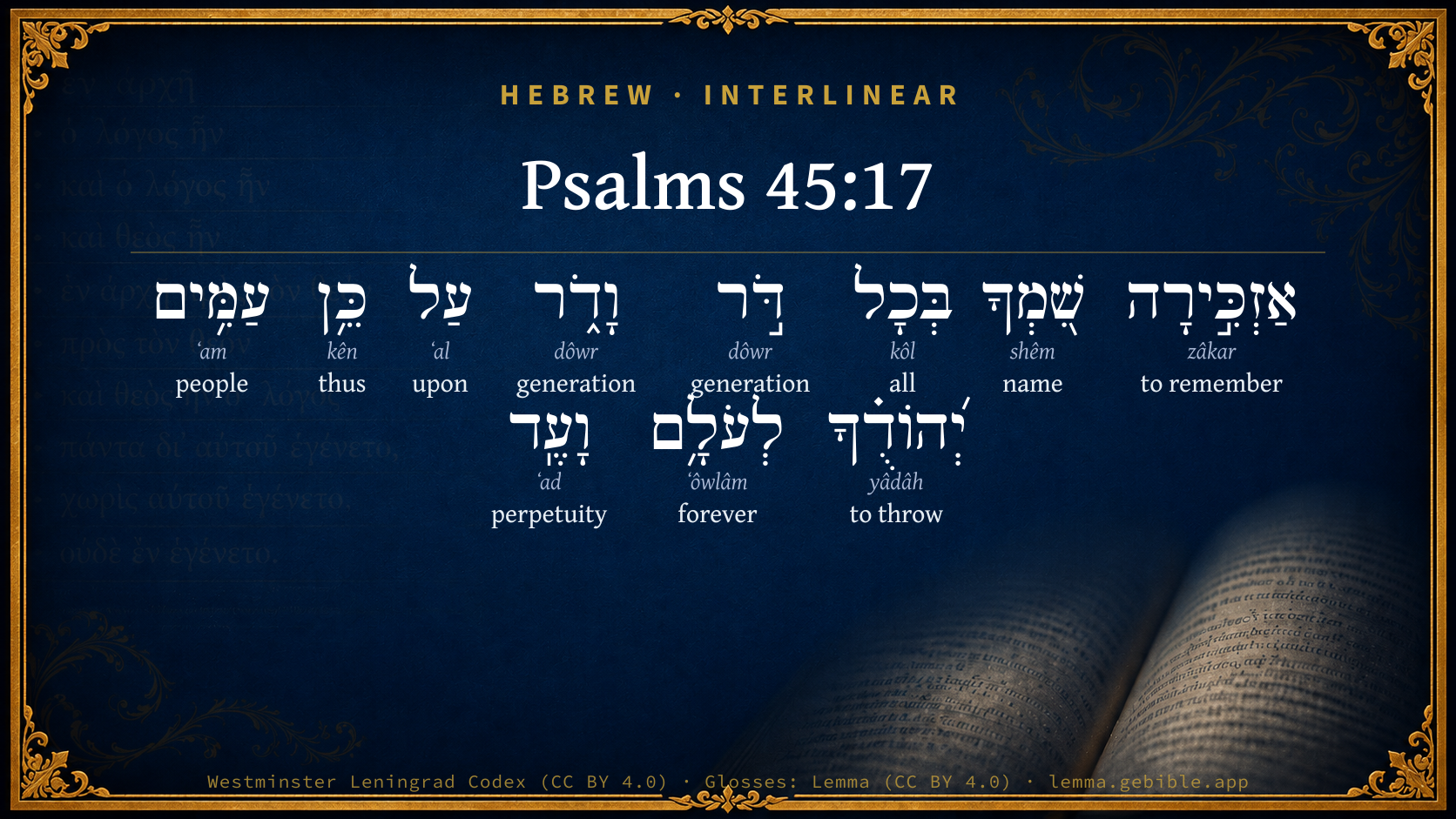
Hebrew (Westminster Leningrad Codex) Psalms 45:17 appears in the Hebrew Old Testament. The text above is from the Westminster Leningrad Codex. Each word links to its Strong’s number, a concise gloss, and parsing drawn from the Open Scriptures Hebrew Bible morphology. Click any word for its full Brown-Driver-Briggs (BDB) entry.
Download image
Cite this verse

Psalms 45:17 (World English Bible). Public Domain. Lemma interlinear Bible study tool, https://lemma.gebible.app/v/psalms/45/17.

Show BibTeX & RIS
BibTeX
RIS
English Translation
I will make your name to be remembered in all generations. Therefore the peoples shall give you thanks forever and ever.
World English Bible · Public Domain
Download a study sheet

One document with this verse’s original text, its word-by-word gloss line, the meaning frame, cross-references with their text, attributed commentary, and full source and license credits — printable, and it pastes into notes with its structure intact.

This verse Autodidact and up

Study sheet (.html) Plain text (.txt)

A passage Seminary Student

Up to 50 verses in one chapter. A passage sheet keeps up to 6 commentary sources and 12 cross-references per verse, in the order this page ranks them, and says so on the sheet whenever that leaves anything out. Ask for a single verse and you get the Autodidact verse sheet above.

Everything on this page stays free to read, with no account — the sheet is a download of what is already on screen, not access to it.

Want to remove ads? Support Godless Engineer
Compare translations 3

The same verse in 3 English versions, stacked beneath the original-language interlinear above. Click any original word for its lexicon entry.

Each is an independent rendering of the whole verse — the interlinear is not word-aligned to these translations.

Highlighted words mark where these versions differ — a whole-verse word diff, not a word-by-word alignment.

  • World English Bible Public Domain
    I will make your name to be remembered in all generations. Therefore the peoples shall give you thanks forever and ever.
  • King James Version Public Domain
    I will make thy name to be remembered in all generations: therefore shall the people praise thee for ever and ever.
  • unfoldingWord Literal Text CC BY-SA 4.0
    Let me make remember your name in every generation to generation; therefore the peoples will thank you forever and ever.

unfoldingWord Literal Text — © unfoldingWord, licensed CC BY-SA 4.0. Word-aligned USFM3 via Door43 (git.door43.org/unfoldingWord/en_ult).

Versions to compare (up to 4)

3 of 4 selected

Show all 18 translations

Every available English version of this verse, each an independent rendering of the whole verse.

  • World English Bible Public Domain
    I will make your name to be remembered in all generations. Therefore the peoples shall give you thanks forever and ever.
  • Berean Standard Bible Public Domain
    I will commemorate your name through all generations; therefore the nations will praise you forever and ever.
  • Majority Standard Bible Public Domain
    I will commemorate your name through all generations; therefore the nations will praise you forever and ever.
  • King James Version Public Domain
    I will make thy name to be remembered in all generations: therefore shall the people praise thee for ever and ever.
  • American Standard Version (1901) Public Domain
    I will make thy name to be remembered in all generations: Therefore shall the peoples give thee thanks for ever and ever. Psalm 46 For the Chief Musician. `A Psalm' of the sons of Korah; set to Alamoth. A Song.
  • Revised Version (1885) Public Domain
    I will make thy name to be remembered in all generations: therefore shall the peoples give thee thanks for ever and ever.
  • Geneva Bible (1599) Public Domain
    I will make thy Name to be remembred through all generations: therefore shall the people giue thanks vnto thee world without ende.
  • Douay-Rheims (1899) Public Domain
    Instead of thy fathers, sons are born to thee: thou shalt make them princes over all the earth.
  • Young's Literal Translation Public Domain
    I make mention of Thy name in all generations, Therefore do peoples praise Thee, To the age, and for ever!
  • Literal Standard Version CC BY-SA 4.0
    I make mention of Your Name in all generations, || Therefore peoples praise You, || For all time and forever!
  • Unlocked Literal Bible CC BY-SA 4.0
    I will make your name to be remembered in all generations; therefore the peoples will give you thanks forever and ever.
  • unfoldingWord Literal Text CC BY-SA 4.0
    Let me make remember your name in every generation to generation; therefore the peoples will thank you forever and ever.
  • Darby Bible Public Domain
    I will make thy name to be remembered throughout all generations; therefore shall the peoples praise thee for ever and ever.
  • World Messianic Bible Public Domain
    I will make your name to be remembered in all generations. Therefore the peoples shall give you thanks forever and ever.
  • Webster's Bible Public Domain
    \\45:16\\Instead of thy fathers shall be thy children, whom thou mayest make princes in all the earth.
  • Free Bible Version CC BY-SA 4.0
    Through my words you will be famous through all generations, and nations will praise you forever and ever.
  • Bible in Basic English Public Domain
    I will keep the memory of your name living through all generations; and because of this the people will give you praise for ever.
  • JPS Tanakh (1917) Public Domain
    (45-18) I will make thy name to be remembered in all generations; therefore shall the peoples praise thee for ever and ever.

Literal Standard Version (2020), Covenant Press — licensed CC BY-SA 4.0. Text via the HelloAO Bible API (eBible.org). Unlocked Literal Bible (unfoldingWord) — licensed CC BY-SA 4.0. Text via the HelloAO Bible API (eBible.org). unfoldingWord Literal Text — © unfoldingWord, licensed CC BY-SA 4.0. Word-aligned USFM3 via Door43 (git.door43.org/unfoldingWord/en_ult). Free Bible Version, Dr. Jonathan Gallagher — licensed CC BY-SA 4.0. Text via the HelloAO Bible API (eBible.org).

Word by word

More ways to search: Search by grammar → Find every occurrence → Compare this word →

Practice this passage: Drill this verse → Learn its vocabulary →

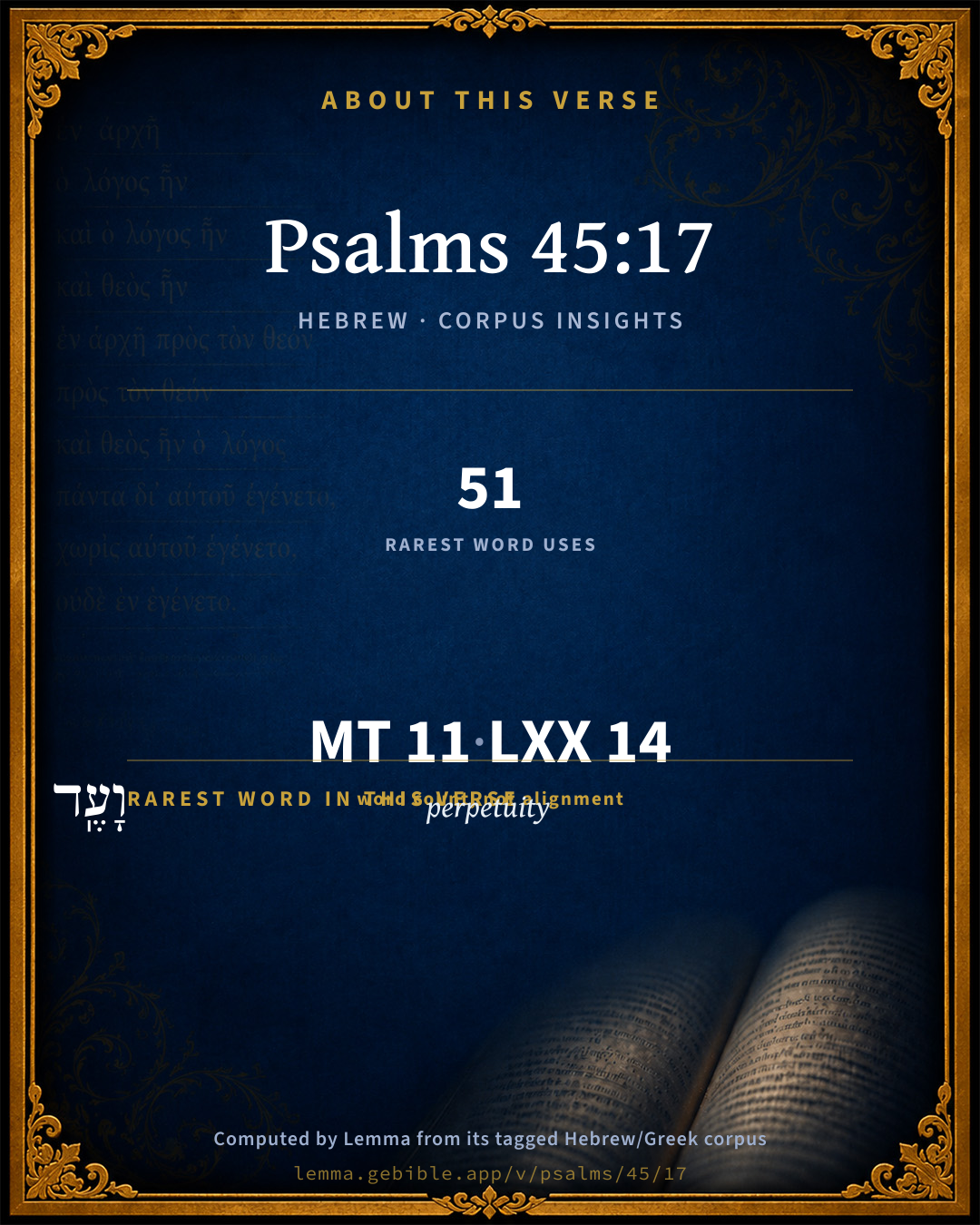
וָעֶֽד
ʻad
H5703
“and · perpetuity”
Conjunction + Noun, Common, Masculine, Singular, Absolute
Part of Speech
Conjunction + Noun
Type
Common
Gender
Masculine
Number
Singular
State
Absolute
Full BDB Definition

Origin: from H5710

TWOT: 1565a

perpetuity, for ever, continuing future - ancient (of past time) - for ever (of future time) - of continuous existence - for ever (of God's existence)
  1. אַזְכִּ֣ירָה zâkar H2142 “to remember” Verb, Hiphil, Cohortative, 1st Person, Common, Singular
  2. שִׁ֭מְךָ shêm H8034 “name · your” Noun, Common, Masculine, Singular, Construct + Suffix, Personal, 2nd Person, Masculine, Singular
  3. בְּכָל kôl H3605 “in/at · all of” Preposition + Noun, Common, Masculine, Singular, Construct
  4. דֹּ֣ר dôwr H1755 “generation” Noun, Common, Masculine, Singular, Absolute
  5. וָדֹ֑ר dôwr H1755 “and · generation” Conjunction + Noun, Common, Masculine, Singular, Absolute
  6. עַל ʻal H5921 “upon” Preposition
  7. כֵּ֥ן kên H3651 “thus” Particle, Demonstrative
  8. עַמִּ֥ים ʻam H5971 “peoples” Noun, Common, Masculine, Plural, Absolute
  9. יְ֝הוֹדֻ֗ךָ yâdâh H3034 “to throw · you” Verb, Hiphil, Imperfect, 3rd Person, Masculine, Plural + Suffix, Personal, 2nd Person, Masculine, Singular
  10. לְעֹלָ֥ם ʻôwlâm H5769 “to/for · forever” Preposition + Noun, Common, Masculine, Singular, Absolute

About this verse

These counts appear in no published source. They are computed here, from the morphology-tagged text and Lemma’s own curated glosses. What Lemma adds →

11
words
10
distinct lemmas
Wisdom
section

Shared distinctive vocabulary

וָעֶֽד perpetuity H5703 occurs in 49 verses of the Hebrew Bible. Also found in:

Grammatical profile

  • 2 verbs
  • 7 nouns
  • 1 preposition
  • 1 particle

Verb forms

  • אַזְכִּ֣ירָה Hiphil · Cohortative
  • יְ֝הוֹדֻ֗ךָ Hiphil · Imperfect

Repetition

A word recurs within this verse — often emphatic in Hebrew:

  • דֹּ֣ר generation H1755 ×2

Hebrew & Septuagint length

In English translation the verse runs 21 words from the Hebrew and 26 from the Septuagint (LXX English) — closely comparable.

A rough comparison of the two English renderings, which tokenize alike — not a word-level alignment.

Word counts can differ between the Hebrew and the Greek without any difference in meaning — e.g. the Hebrew direct-object marker אֵת has no separate Greek word, and Greek often adds the article ὁ.

In the original languages it is 11 Hebrew tokens and 14 Greek tokens — but the two are counted differently (Hebrew bundles its prefixes and suffixes into one token; the Greek is in lemma form), so that isn’t a like-for-like length.

Cross-references

11

Topical passages linked to Psalms 45:17 in the Treasury of Scripture Knowledge — connected by theme and wording, ordered by reader-vote popularity; previews shown in the World English Bible.

  • Isaiah 62:3 You shall also be a crown of beauty in the hand of Yahweh, and a royal diadem in the hand of your God.
  • Malachi 1:11 For from the rising of the sun even to the going down of the same, my name is great among the nations, and in every place incense will be offered to my name, and a pure offering: for my name is great among the nations," says Yahweh of Hosts.
  • Psalms 72:17–19 His name endures forever. His name continues as long as the sun. Men shall be blessed by him. All nations will call him blessed.
  • Isaiah 61:9 Their seed shall be known among the nations, and their offspring among the peoples; all who see them shall acknowledge them, that they are the seed which Yahweh has blessed.
  • Psalms 22:30–31 Posterity shall serve him. Future generations shall be told about the Lord.
  • Psalms 138:4 All the kings of the earth will give you thanks, Yahweh, For they have heard the words of your mouth.
  • Song of Solomon 6:9 My dove, my perfect one, is unique. She is her mother's only daughter. She is the favorite one of her who bore her. The daughters saw her, and called her blessed, The queens and the concubines, and they praised her.
  • Isaiah 59:21 As for me, this is my covenant with them, says Yahweh: my Spirit who is on you, and my words which I have put in your mouth, shall not depart out of your mouth, nor out of the mouth of your seed, nor out of the mouth of your seed's seed, says Yahweh, from henceforth and forever.
  • Matthew 26:13 Most assuredly I tell you, wherever this Gospel is preached in the whole world, what this woman has done will also be spoken of as a memorial of her."
  • Psalms 145:4–7 One generation will commend your works to another, And will declare your mighty acts.
  • 1 Corinthians 11:26 For as often as you eat this bread and drink this cup, you proclaim the Lord's death until he comes.

Cross-references courtesy of OpenBible.info (CC BY 4.0).

Hebrew and Greek witnesses Masoretic Hebrew ↔ Greek Septuagint

The same verse in the two great witnesses to the Old Testament, shown verse-for-verse.

You’re reading Greek Psalm 44 (Hebrew Psalm 45). The Septuagint counts the superscription, so verse numbers can differ from the Hebrew — chapter-level alignment, not verse-by-verse. Numbering follows Rahlfs.

These are two independent witnesses, not word-aligned to each other, and the Septuagint is shown in lemma (dictionary) form.

Hebrew Psalms 45:17 Masoretic · Westminster Leningrad Codex

אַזְכִּ֣ירָה שִׁ֭מְךָ בְּכָל דֹּ֣ר וָדֹ֑ר עַל כֵּ֥ן עַמִּ֥ים יְ֝הוֹדֻ֗ךָ לְעֹלָ֥ם וָעֶֽד

I will make your name to be remembered in all generations. Therefore the peoples shall give you thanks forever and ever.

World English Bible · Public Domain

Greek LXX Greek Psalm 44:17 Septuagint · lemma form

ἀντί ὁ πατήρ σύ γίγνομαι σύ υἱός καταἵστημι αὐτός ἄρχων ἐπί πᾶς ὁ γῆ

They shall make mention of your name from generation to generation: therefore shall the nations give thanks to you for ever, even for ever and ever.

LXX2012 (modern English Septuagint) · Public Domain

Hebrew: Westminster Leningrad Codex (CC BY 4.0). Greek: Septuagint (public domain); English from LXX2012 (modern English Septuagint) (Public Domain). How the Septuagint differs from the Hebrew →

Commentary

Notes on Psalms 45:17 from classic Christian and Jewish commentators (each source and its license shown beneath its notes). The classic Christian expositions comment on the surrounding passage and are grouped to its opening verse, so a note may address several verses; the Jewish commentaries on the Tanakh (Rashi and others) are per-verse, so they appear only where the commentator wrote on this verse.

Lemma curates 59 commentaries, every one of them public domain or Creative Commons licensed, each selected and text-cleaned for this edition rather than reprinted as found. About our sources →

Trapp's Complete Commentary

John Trapp

Psa 45:17 I will make thy name to be remembered in all generations: therefore shall the people praise thee for ever and ever.

Ver. 17. I will make thy name, &c.] This is a second benefit promised to the Church, viz. everlasting renown, with highest estimation and imitation to the world’s end.

John Trapp, A Commentary or Exposition upon All the Books of the Old and New Testament (1647–1656) — public domain. Text from a community e-Sword module.

The Biblical Illustrator

Joseph S. Exell

Psa_45:17

I will make Thy name to be remembered in all generations; therefore shall the people praise Thee.

Christs unending praise

Man knows himself to be a flower, which cometh forth and is cut down; yet he wishes the fragrance of his memory, like a costly perfume, to be perpetuated when he himself shall be crumbled into dust. The celebrated painter of antiquity exclaimed, I paint for eternity. Human ambition always desires to do so. The father hopes to be remembered in his child, the author in his works, the hero in his triumphs, the statesman in his institutions, the legislator in his laws, the patriot in the benefits he has conferred upon his country. We should all love to have the prophecy of the text transferred to ourselves: I will make Thy name to be remembered in all generations. But what is the exceeding brief and transitory remembrance which man seeks from man on earth compared with the unfading honours which Christ attains as the Author and Finisher of faith, or compared with the permanence of those regards which Christ secures to Himself in the hearts of His redeemed people?

I. The import of the Saviours name. His name. In the Old Testament the name of God is employed as a comprehensive formula to express the manifested glory of His entire character and perfections; and the New Testament attributes the same importance and dignity to the name of Christ which the current style of the Old Testament does to the name of Jehovah. We are said to be baptized in His name, to believe in His name; in His name the remission of sins is to be preached among all nations. And He is said to have a name written which no man knew but Himself. The name of Christ comprehends, therefore, all He is, and all He is to us. And in reference to His mediatorial character and triumphs, He is said to have a name which is above every name. The names of majesty and greatness enumerated by Isaiah--the Mighty God, the Everlasting Father, Wonderful Counsellor, Prince of Peace--were names which our Lord possessed by right of nature as an equal sharer with the Eternal Father in the glories of Godhead; but His name Jesus He acquired by purchase, by conquest, by death. It cost Him life. As, therefore, Jacob preferred his name Israel before his former name of Jacob, because he acquired it as a memorial of victory, so our Lord may be considered as valuing the name of Jesus, the Saviour, from the suffering it commemorates, the triumph it records, and the love it implies, Certain it is, that by this designation He emphatically makes Himself known from the highest heaven. Thus He addressed Himself to Saul the persecutor on his way to Damascus, and to John in the Apocalypse.

II. Some of those grounds on which we are encouraged to anticipate the permanent and enduring influence of the name and religion of Christ.

1. From the fact that the dominion of Christ possesses all the elements of perpetuity, being founded on essential truth, and rectitude, and goodness. This is strongly intimated in the connection of the text: Thy throne, O God, is for ever and ever. Why? The sceptre of Thy kingdom is a right sceptre. Thou Lovest righteousness, etc. The Jewish writers have a proverb that falsehood has no feet, and it is certain that in the great cycle of human affairs nothing is durable but truth. In the character and grace of Christ you have the pledge of the permanence of His religion and the perpetuity of His name. For power, He has all power in heaven and on earth. For wisdom in Him are hid all the treasures of wisdom and of knowledge. For love, His love passeth knowledge. For truth and faithfulness, heaven and earth shall pass away; but not one jot nor tittle of His Word shall fail. He awes monarchs on their thrones, and yet welcomes childhood to His embrace, and says, Suffer little children to come unto Me.

2. From the fact that no substitute can be found in the entire universe for the Saviours grace and salvation.

3. From the history and progress of this religion in ages past, which, though it has always been opposed, has always surmounted opposition, and nerved its friends with energy to uphold its interests. The past is in this respect the pledge of the future. The same principles which rendered Christianity triumphant at first can, and will, make it triumphant to the end; since we can scarcely conceive of tests more severe than those to which it has been subjected, of enemies more powerful than those it has overcome, or of conflicts more appalling than those which it has already surmounted. (Homiletic Magazine.)

Christs renown everlasting

By the name of the Son we may understand everything whereby He is made known; especially, however, those amiable and gracious designations which are given to Him in the Bible. This name is remembered when it is known, believed in, and kept in mind as important and interesting. Now, according to the promise, it shall be thus respected, not merely for a short time, but in every age, to all generations. Men shall be raised up, and that means shall be employed to perpetuate his fame; and that, in spite of every attempt to bury Christs honour, God, by His Almighty power, will actually and eternally make His praise glorious.

I. The name of Gods son.

1. Immanuel--God with us. But He is not only God, but God with us. From eternity the Son of God appeared on our side. When the fulness of the time had come, He was manifested in our nature.

2. Jesus--He shall save His people from their sins.

II. The import of Christs name being remembered to all generations. This implies--

1. That in all ages men shall know His name. The Son of God hath come, and hath given them an understanding that they may know Him that is true. What is the consequence? They discern Christ to be singularly excellent in His person, and every way suitable in His offices. We believe, and are sure, is their language, that Thou art Christ, the Son of the living God.

2. That in all ages men shall trust in His name. Is His gracious character revealed in the Gospel? He that remembers it perceives in Him ability and willingness to help. Hence, in the exercise itself of remembering, he appropriates the son of God to himself. Viewing Him as Immanuel, he exclaims, My Lord and my God. Regarding Him as Jesus, he cries, The Lord is my strength and my song; he also is become my salvation.

3. That in all ages men shall meditate on Christs name.

III. The means by which God makes Christs name to be remembered.

1. God preserves the Scriptures in which the name of Christ is recorded.

2. God raises up ministers by whom the name of Christ is published.

3. He continues the sacraments by which the name of Jesus is exhibited. In each of these Christ crucified is evidently set before us.

4. He sends the Spirit by which the name of Christ is impressed upon human hearts. All other means may, and often do, prove ineffectual in securing the remembrance of Christs name. But here is a means which is, and must always be, successful.

IV. The certainty of this matter.

1. The condition of men renders such remembrance of the name of Christ desirable. There is none other name, etc.

2. The perfections of God make the continued remembrance of Christs name possible. What are all difficulties, all opposition before Him?

3. The experience of past ages renders it probable that Christ shall still be remembered.

4. The covenant of promise makes it certain that Christs name shall be remembered. (E. Brown.)

The spiritual seed of Christ praising their heavenly Father

I. Christs name.

1. We find Him called the mighty God (Isa_9:6).

2. His name is Immanuel, that is, God with us (Mat_1:23). God in our nature, God on our side.

3. We find Him called the Messiah.

4. Another name whereby He is called is Jesus, a Saviour.

5. Another name whereby our glorious surety is designed is, the Lord our righteousness (Jer_23:6).

II. Some things imported in the promise.

1. That it is no easy matter to keep up the remembrance of Christs name in a sinful world. To do it is a work that God hath taken into His own hand in an eminent manner.

2. That Christs name is very dear and precious to God the Father.

3. The maintenance and preservation of all the means of Divine appointment for keeping up the remembrance of Christs name.

(1) That God will have a professing and confessing Church, in one place or other of the world, in all generations.

(2) Thai the Scriptures shall be preserved in all generations.

(3) That the glorious Gospel shall be preached in all generations.

(4) That the sacraments of Baptism and the Lords Supper shall be administered in all generations.

III. As Christs name shall be remembered in all generations, so there shall be a people praising him for ever and ever.

1. Mention a few things whirls we take to be supposed in a person or people their praising Christ.

(1). We think this exercise of praising Christ supposes saving acquaintance with Him. Those only are in case to praise Christ to whom He hath manifested forth His glory and given the spiritual eye to behold it.

(2) The promise that Christ shall be praised in all generations supposes that there shall be some inspired with true love to Him in every generation.

(3) The exercise of giving praise and thanks to Christ supposes a humble and thankful frame of spirit.

2. That there shall lie a people praising Christ for ever and over. This truth will appear--

(1) When it is considered that Jehovah the Father hath engaged Himself, by promise to Christ, theft He shall still be praised (Isa_53:11; Psa_22:30-31).

(2) When we consider that the great and leading design of Christ in the whole work of redemption and salvation is to bring in a revenue of praise to the crown of heaven.

IV. The grounds and reasons for which there shall be a people praising Christ for ever and ever.

1. On account of His own personal dignity, worth and excellency.

2. On account of what He has done for them (Rev_5:9).

3. For what He is and ever will continue to be unto them.

V. Use.

1. Inferences.

(1) Hence, see the sinfulness, folly and vanity of every endeavour to blot out the remembrance of Christs name.

(2) We may see what is the duty of all who would evidence themselves to be really the friends of Christ. Do you then ask, after what manner shall we, who are in a private station, contribute our share to the keeping up of the remembrance of Christs name? You are to contribute to the keeping up the remembrance of Christs name by making an open and explicit acknowledgment of all His truths before the world when you have a call in providence to do it. You are to make conscience of observing the worship of God in your families. You are to contribute your share to the keeping up of the remembrance of Christs name in the world by a holy and circumspect walk and conversation.

2. Exhortation. (T. Bennet.)

Psa_46:1-11

The Biblical Illustrator, edited by Joseph S. Exell (c. 1880s–1900s) — public domain. Text from a community e-Sword module.

Joseph Benson's Commentary

Psa 45:17. I will make thy name to be remembered, &c. — As he began the Psalm with the celebration of the King’s praises, so now he ends with it, and adds this important circumstance, that this nuptial song should not only serve for the present solemnity, but should be remembered and sung in all successive generations: which plainly shows that it was not composed upon such a slight and transitory occasion as that of Solomon’s marriage, which was soon forgotten, and which, indeed, the Israelites had little cause to remember with any satisfaction; but upon that great, and glorious, and everlasting marriage between Christ and his church, in which it is most properly and literally verified.

Joseph Benson's Commentary on the Old and New Testaments (1811–1818) — public domain. Text from a community e-Sword module.

J. A. Alexander on Psalms

Joseph Addison Alexander

18. (Psa 45:17). I will make thy name to be remembered in all generations; there fore shall nations acknowledge thee for ever and ever. The Psalmist speaks as one in the long series of inspired heralds, and in behalf of all. The form of the first verb implies fixed determination, and involves a pledge. Thy name, as the expression of thy nature. See above, on Psa 5:12 (11), Psa 44:21 (20). In all generations, literally in every generation and generation. For ever and ever, literally to eternity and perpetuity. See above, on Psa 44:9; Psa 44:24 (8, 23). Therefore, not merely because I celebrate his name, but because his name itself is glorious. Acknowledge thee to be what thou art, involving therefore the ideas of praise in general and thanksgiving in particular. See above, on Psa 6:6 (5), Psa 44:9 (8).

Joseph Addison Alexander, The Psalms Translated and Explained (1850) — public domain. Text from a community e-Sword module.

Geneva Bible (1599)

Geneva Bible translators

This only must be referred to Christ and not to Solomon.

Geneva Bible (1599) marginal notes — public domain. Text via Bolls.life.

Jamieson, Fausset & Brown

Robert Jamieson, A. R. Fausset & David Brown

The glories of this empire shall be as wide as the world and lasting as eternity.

therefore--Because thus glorious, the praise shall be universal and perpetual. Some writers have taxed their ingenuity to find in the history and fortunes of Christ and His Church exact parallels for every part of this splendid allegory, not excepting its gorgeous Oriental imagery. Thus, by the dresses of the king and queen, are thought to be meant the eminent endowments and graces of Christ and His people. The attendant women, supposed (though inconsistently it might seem with the inspired character of the work) to be concubines, are thought to represent the Gentile churches, and the bride the Jewish, &c. But it is evident that we cannot pursue such a mode of interpretation. For, following the allegory, we must suspend to the distant future the results of a union whose consummation as a marriage is still distant (compare Rev 21:9). In fact, the imagery here and elsewhere sets before us the Church in two aspects. As a body, it is yet incomplete, the whole is yet ungathered. As a moral institution, it is yet imperfect. In the final catastrophe it will be complete and perfect. Thus, as a bride adorned, &c., it will be united with its Lord. Thus the union of Christ and the Church triumphant is set forth. On the other hand, in regard to its component parts, the relation of Christ as head, as husband, &c., already exists, and as these parts form an institution in this world, it is by His union with it, and the gifts and graces with which He endows it, that a spiritual seed arises and spreads in the world. Hence we must fix our minds only on the one simple but grand truth, that Christ loves the Church, is head over all things for it, raises it in His exaltation to the highest moral dignity--a dignity of which every, even the meanest, sincere disciple will partake. As to the time, then, in which this allegorical prophecy is to fulfilled, it may be said that no periods of time are specially designated. The characteristics of the relation of Christ and His Church are indicated, and we may suppose that the whole process of His exaltation from the declaration of His Sonship, by His resurrection, to the grand catastrophe of the final judgment, with all the collateral blessings to the Church and the world, lay before the vision of the inspired prophet.

Next: Psalms Chapter 46

Jamieson, Fausset & Brown — Commentary Critical and Explanatory on the Whole Bible (1871) — public domain (CC PDM 1.0). Text via the HelloAO Bible API.

Adam Clarke's Commentary

Verse 17. Therefore shall the people praise thee] They shall magnify the heavenly Bridegroom, and sing the wonderful displays of his love to the Church, his spouse. And the constant use of this Psalm in the Christian Church is a literal fulfillment of the prophecy.

ANALYSIS OF THE FORTY-FIFTH PSALM

The type of the Messiah is Solomon; of the Church, especially of the Gentiles to be espoused, Pharaoh's daughter.

There are three parts in this Psalm: -

I. A preface, Ps 45:1-2.

II. The body of this Psalm contains two commendations, -

1. Of the bridegroom, Ps 45:3-9.

2. Of the bride, Ps 45:10-15.

III. The conclusion promissory and laudatory, Ps 45:16-17.

I. In the preface the prophet commends the subject he is to treat of, -

1. Signifying that it is a good thing; good, as speaking of the Son of God, who is the chief good.

2. And good for us; for, on our union with the Church, and Christ's union with that, depends our eternal good.

That the author of this Psalm, and the subject of it, is God: the psalmist was but the pen to write, for he was full of the Holy Ghost. Therefore, his heart was inditing, and his tongue followed the dictate of his heart, and presently became the instrument of a ready writer, viz., of the Holy Spirit: "My tongue is the pen of a ready writer."

Thus, having endeavoured to gain over his auditory, 1. By the commendation of the matter of which he is to treat, viz., that it is good. 2. That it tends to a good end, viz., the honour of the King, that is, Christ, the King of the Church: he then enters on the main business, which has two particulars.

II. 1. He turns his speech to Christ, the King, and commends him for many eminent and excellent endowments: -

1. His beauty: "Thou art fairer than the children of men."

2. His elocution: "Grace is poured into thy lips."

3. For his valour: "O hero, gird thy sword upon thy thigh."

4. For his prosperity in his kingdom: "In thy majesty ride prosperously."

5. For his just administration of public affairs. "Ride on, because of truth, meekness, and righteousness."

6. For his battles and conquests: "Thy right hand shall teach thee terrible things. Thy arrows are sharp in the hearts of the king's enemies, whereby the people shall fall under thee."

7. For the stability and eternity of his power: "Thy throne, O God, is for ever and ever."

8. For his justice and equity: "The sceptre of thy kingdom is a right sceptre. Thou lovest righteousness, and hatest iniquity."

9. For the fulness of his gifts and graces, beyond all others: "Therefore God - hath anointed thee with the oil of gladness above thy fellows."

10. For the splendour of his apparel and buildings. "All thy garments smell of myrrh, c., out of the ivory palaces." There is nothing we can call good, great, or excellent nothing praiseworthy in a prince; that may not be found in this king.

2. From the bridegroom he proceeds to the bride, which here means the universal Church; whom he sets forth: -

1. By her attendants; no mean persons: kings' daughters and honourable women.

2. By her name, title, and dignity: a queen.

3. By her place: she stood on the right hand, the place of confidence and respect.

4. By her attire and vesture: she stood in a gesture of gold of Ophir.

In the midst of this great encomium he breaks off and, by an apostrophe, turns his speech to the Church lest she should forget herself in the height of her honour; giving her this good counsel: -

1. "Hearken, O daughter!" mark what Christ saith unto thee.

2. "Consider." Look about, and see what is done for thee.

3. "Incline thine ear." Be obedient.

4. "Forget thine own people, and thy father's house." Leave all for Christ; leave thy old way, old opinions, and old companions.

5. The consequence of which will be, "The king shall greatly desire thy beauty."

6. And there is the utmost reason that thou shouldst hear, and be obedient, and conformable to his will. 1. For, "He is the Lord thy God, and thou shalt worship him." 2. This will promote thy interest: "Tyre shall be there with a gift, and the rich among the people shall entreat thy favour."

This counsel and admonition being ended, he returns again to the encomium of the spouse, and commends her, -

1. For her inward virtues and endearments: "The king's daughter (that is, the Church) is all glorious within."

2. For her externals; whether doctrine, morals, offices, which are, as it were, her clothing: "It is of wrought gold."

3. For her rites and ceremonies, - they are a needlework of divers colours, in divers Churches.

4. Her maids of honour, virgins; holy and sincere souls. Believers, pure in heart, life, and doctrine, living in every particular Church. These, her companions, shall follow her: 1. These shall be brought to thee (the Church) from all nations. 2. They shall be brought with joy and gladness, and enter into the king's palace. Gladly and willingly, shall they enter her courts here below, and afterwards be received to mansions in heaven.

5. For her fruitfulness. She shall have many children, good, and great. For the fathers, patriarchs, prophets, and priests, under the Old Law; apostles, evangelists, and their successors, under the New; that they may be made princes in all lands. Her officers are not contemptible.

III. The conclusion which is gratulatory. For this honour the Church would,

1. Set up a memorial to the honour of the Bridegroom: "I will make thy name to be remembered in all generations."

2. The praise of the heavenly Bridegroom shall be ever perpetuated: "Therefore, shall the people praise thee for ever and ever."

The Christian Church shall ever proclaim the name of Jesus, as the name alone in which salvation is to be found; and as the eternal Fountain of all blessings.

Adam Clarke's Commentary on the Bible (1810–1826) — public domain. Text from a community e-Sword/MySword module.

John Calvin's Commentaries

17 I will make thy name to be remembered, etc. This also is equally inapplicable to Solomon, who, by his shameful and impious rebellion, stained the memory of his name with disgrace. In polluting by superstitious abominations the land which was consecrated to God, did he not bring upon himself indelible ignominy and shame? For this deed alone his name deserves to be buried in everlasting oblivion. Nor was his son Rehoboam in any degree more deserving of praise; for through his own foolish presumption he lost the better part of his kingdom. To find, therefore, the true accomplishment of what is here said, we must come to Christ, the memory of whose name continues to prosper and prevail. It is no doubt despised by the world, nay, wicked men, in the pride of their hearts, even reproach his sacred name, and outrageously trample it under their feet; but still it survives in its undiminished majesty. It is also true, that his enemies rise up on all sides in vast numbers to overthrow his kingdom; but notwithstanding, men are already beginning to bow the knee before him, which they will continue to do, until the period arrive when he shall tread down all the powers that are opposed to him. The furious efforts of Satan and the whole world have not been able to extinguish the name of Christ, which, being transmitted from one generation to another, still retains its glory in every age, even as at this day we see it celebrated in every language. And although the greater part of the world tear it in pieces by their impious blasphemies, yet it is enough that God stirs up his servants every where to proclaim with fidelity and with unfeigned zeal the praises of Christ. In the meantime, it is our duty diligently to use our endeavors, that the memory of Christ, which ought to prosper and prevail throughout all ages, to the eternal salvation of men, may never at any time lose any of its renown.

John Calvin's Commentaries (1540-1563) — public domain. Text from the Calvin Translation Society English edition (1840s-50s) via the Christian Classics Ethereal Library (ccel.org). Calvin's coverage is partial (roughly two-thirds of the Bible); uncommented books and verses are honest gaps, never fabricated. The 19th-century editor's footnotes and remarks are omitted so the notes are faithfully Calvin's own voice.

The Cambridge Bible for Schools and Colleges

gen. ed. J. J. S. Perowne

17. The poet’s song will perpetuate the memory of the king; and that not in Israel only, but among other peoples (Psa_72:17).

therefore shall the people praise thee] Therefore shall the peoples praise thee, or (R.V.) give thee thanks: a word commonly applied to God (Psa_42:5; Psa_42:11; Psa_43:4-5; and often), rarely to men (Gen_49:8; Psa_49:18). Solomon’s name is remembered while the names of monarchs far more powerful from a worldly point of view have been forgotten, because God had made him His representative and the head of His visible kingdom upon earth, the type of His perfect representative who should come to establish His universal kingdom among men.

The Cambridge Bible for Schools and Colleges (gen. ed. J. J. S. Perowne; Cambridge University Press, 1878–1918) — public domain. Text from a community e-Sword module.

John Gill's Exposition

I will make thy name to be remembered in all generations,.... These are the words of the psalmist, spoken to the King Messiah, declaring what he would do with respect to him; cause his name, that is, not any particular name or title of his, but rather his Gospel, the good matter he had endited concerning him; or he himself to be remembered, desired, loved, thought of, called upon, and praised in all succeeding generations; and which he did by penning of this psalm, which has been the occasion of the remembrance of Christ's name in all ages, to the present time; and of its being remembered by us now, and the same use it will have in time to come; see Pe2 1:13;

therefore shall the people praise thee for ever and ever; because of the excellencies of his person; and particularly because of his greatness and glory as a King; as well as for all mercies, temporal and spiritual, they have from him; and this is but just, meet, and lovely, and is and will be their employment, as long as they live in this world, and to all eternity. This must be understood not of all people, but of God's chosen and covenant people; those that are given to Christ to be his people, and whom he has redeemed and purified to himself, a peculiar people; and particularly his people among the Gentiles: and so the Targum interprets it of such that are proselytes.

Next: Psalms Chapter 46

John Gill's Exposition of the Whole Bible (1746–1763) — public domain (CC PDM 1.0). Text via the HelloAO Bible API.

Albert Barnes' Notes on the Bible

I will make thy name to be remembered in all generations - The psalmist here evidently speaks as an inspired man, and the idea is that his thus singing the praises of the “king” - the Messiah - would be among the means of causing His name to be celebrated in all future ages. This song would go down to future times, and would serve to keep up the true knowledge of the Messiah in the far distant ages of the world. No one can doubt that this has been thus far accomplished; no one has any reason to doubt that this psalm “will be” among the means of keeping up the true knowledge of the Messiah, and of securing the remembrance of him upon the earth in all future periods of the world’s history. This psalm has been on million of lips, in praise of the Messiah; it will be on hundreds of million more in future times, as expressive of tender love for the Redeemer.

Therefore shall the people praise thee forever and ever - Thy praise will never cease to be celebrated. The time will never come on earth when that praise will die away; and in all the eternity beyond the termination of this world’s history there never will arrive a period when thy name will not be honored, and when thy praises shall cease to be sung. Compare the notes at Rev 4:10; notes at Rev 5:9-13. Happy are they who join in that song on earth; happy they who will unite in it in the heavenly world!

Albert Barnes' Notes on the Bible (1834–1885) — public domain. Text from a community e-Sword/MySword module.

Matthew Poole's English Annotations

As he began the Psalm with the celebration of the king’s praises, so now he endeth with it, and adds this important circumstance, that this nuptial song should not only serve for the present solemnity, as others of that kind do, but that it should be remembered and sung in all successive generations; which plainly showeth that it was not composed upon such a slight and transitory occasion as that of Solomon’s marriage with Pharaoh’s daughter, which was soon forgotten, and the Israelites had little cause to remember it with any satisfaction; but upon that great and glorious and everlasting marriage between Christ and his church, of which this is most properly and literally verified.

Matthew Poole's English Annotations on the Holy Bible (1683–1685) — public domain. Text from a community e-Sword/MySword module.

The Treasury of David

Charles H. Spurgeon

Ver. 17. I will make thy name to be remembered in all generations. Jehovah by the prophet's mouth promises to the Prince of Peace eternal fame as well as a continuous progeny. His name is his fame, his character, his person; these are dear to his people nowthey never can forget them; and it shall be so as long as men exist. Names renowned in one generation have been unknown to the next era, but the laurels of Jesus shall ever be fresh, his renown ever new. God will see to this; his providence and his grace shall make it so. The fame of Messiah is not left to human guardianship; the Eternal guarantees it, and his promise never fails. All down the ages the memories of Gethsemane and Calvary shall glow with inextinguishable light; nor shall the lapse of time, the smoke of error, or the malice of hell be able to dim the glory of the Redeemer's fame. Therefore shall the people praise thee for ever and ever. They shall confess thee to be what thou art, and shall render to thee in perpetuity the homage due. Praise is due from every heart to him who loved us, and redeemed us by his blood; this praise will never be fully paid, but will be ever a standing and growing debt. His daily benefits enlarge our obligations, let them increase the number of our songs. Age to age reveals more of his love, let every year swell the volume of the music of earth and heaven, and let thunders of song roll up in full diapason to the throne of him that liveth, and was dead, and is alive for evermore, and hath the keys of hell and of death.

"Let him be crowned with majesty

Who bowed his head to death,

And be his honours sounded high

By all things that have breath."

Ver. 17. Therefore shall the people praise thee. Christ's espousing unto himself a church, and gathering more and more from age to age by his word and Spirit unto it, his converting souls and bringing them into the fellowship of his family, and giving unto them princely minds and affections, wherever they live, is a large matter of growing and everlasting glory unto his majesty; for in regard of this point, and what is said before in this Psalm, he addeth as the close of all, Therefore shall the people praise thee. David Dickson.

Ver. 17. In the Hebrew text, which is here quoted, there is a particle added to the word ever, which in that case intends a proper everlastingness, without any period or end at all, and thereupon translated for ever and ever. William Gouge, D.D., on Heb 1:8.

Ver. 17. (last clause):

"When morning gilds the skies,

My heart awakening cries;

May Jesus Christ be praised."

"When sleep her balm denies,

My silent spirit sighs;

May Jesus Christ be praised."

"In heaven's eternal bliss,

The loveliest strain is this;

May Jesus Christ be praised."

"To God the Word on high.

The hosts of angels cry;

May Jesus Christ be praised."

"Let mortals too, upraise

Their voice in hymns of praise;

May Jesus Christ be praised."

"Let earth's wide circle round,

In joyful notes resound;

May Jesus Christ be praised."

"Let air, and sea, and sky,

From depths to height reply;

May Jesus Christ be praised."

"Be this while life is mine,

My canticles divine;

May Jesus Christ be praised."

"Be this the eternal song

Through all the ages on;

May Jesus Christ be praised."

Translated by Edward Caswall, in "Poems." 1861.

Ver. 17.

1. Christ is the Father's delight. "I will make, "etc.

2. He is the church's themehis name shall be remembered; and

3. He is heaven's glory, "Shall praise thee, "etc. G.R.

Charles H. Spurgeon's The Treasury of David (1869–1885) — public domain. Psalms only. Text from a community e-Sword/MySword module.

The Pulpit Commentary

I will make thy name to be remembered in all generations. I, the psalmist, with my "pen of a ready writer," will so sing thy praise that thy name shall always he had in remembrance; and therefore because of my wordsshall the peoples i.e. all the nations of the earthpraise thee for ever and ever. There is here, mixed with the praise of Messiah, a certain amount of self-glorification; but perhaps the "son of Korah," who had composed so noble a poem, may be excused for somewhat "vaunting himself."

The Pulpit Commentary (1880–1919), ed. H.D.M. Spence-Jones & Joseph S. Exell — public domain. Text from a community e-Sword module.

John Wesley's Explanatory Notes

Remembered - As he began the psalm with the celebration of the king's praises, so now he ends with it, and adds this important circumstance, that this nuptial song should not only serve for the present solemnity, but should be remembered and sung in all successive generations.

John Wesley, Explanatory Notes Upon the Whole Bible (1754–1765) — public domain. Text via the GEBible commentary corpus.

Rashi

Rabbi Shlomo Yitzchaki (Rashi)

Instead of your forefathers, etc. He addresses each Israelite.

Rashi on the Tanakh — English translations: “The Judaica Press complete Tanach with Rashi, translated by A. J. Rosenberg” (CC BY 4.0); “Pentateuch with Rashi's commentary by M. Rosenbaum and A.M. Silbermann, 1929-1934” (public domain); “The Metsudah Tanach series, Lakewood, N.J” (CC BY 4.0); and “The Book of Joshua, Metsudah Publications, 1997” (CC BY 4.0). Text via Sefaria.

Lesson kit

Teaching starters — assembled from the data on this page, not authored interpretation. Every prompt links to the verse data it draws on. Edit before teaching.

Psalms, in the Wisdom, opens this verse with 11 words (10 distinct Hebrew lemmas). Its most distinctive word is ʻad (“perpetuity”). A historical commentator’s framing appears above. Read the whole chapter for the surrounding context.

Discussion questions

  1. The word ʻad carries the sense “perpetuity.” How does it shape the verse?
  2. How does Exodus 15:18, which shares the word «perpetuity», read alongside this verse?
  3. What does the repetition of “generation” (2× in this one verse) do in this verse?
  4. These translations render this verse differently; the difference is in the English rendering, not the original. What questions does that raise?
  5. «אַזְכִּ֣ירָה» is a Hiphil Cohortative verb. How does that grammatical form shape the action described?
  6. Compare how Trapp's Complete Commentary and The Biblical Illustrator read this verse. Where do they agree or differ?

Things to notice

Reading settings

Reading text

Shown beneath each verse's original-language words.

Old Testament
Old Testament edition

Read the OT as the Masoretic Hebrew (MT) or the Greek Septuagint (LXX).

English shown for the Greek Septuagint (in the Hebrew ↔ Greek comparison).

Comparing translations? Open the Compare panel on any verse page to stack up to four side by side.