
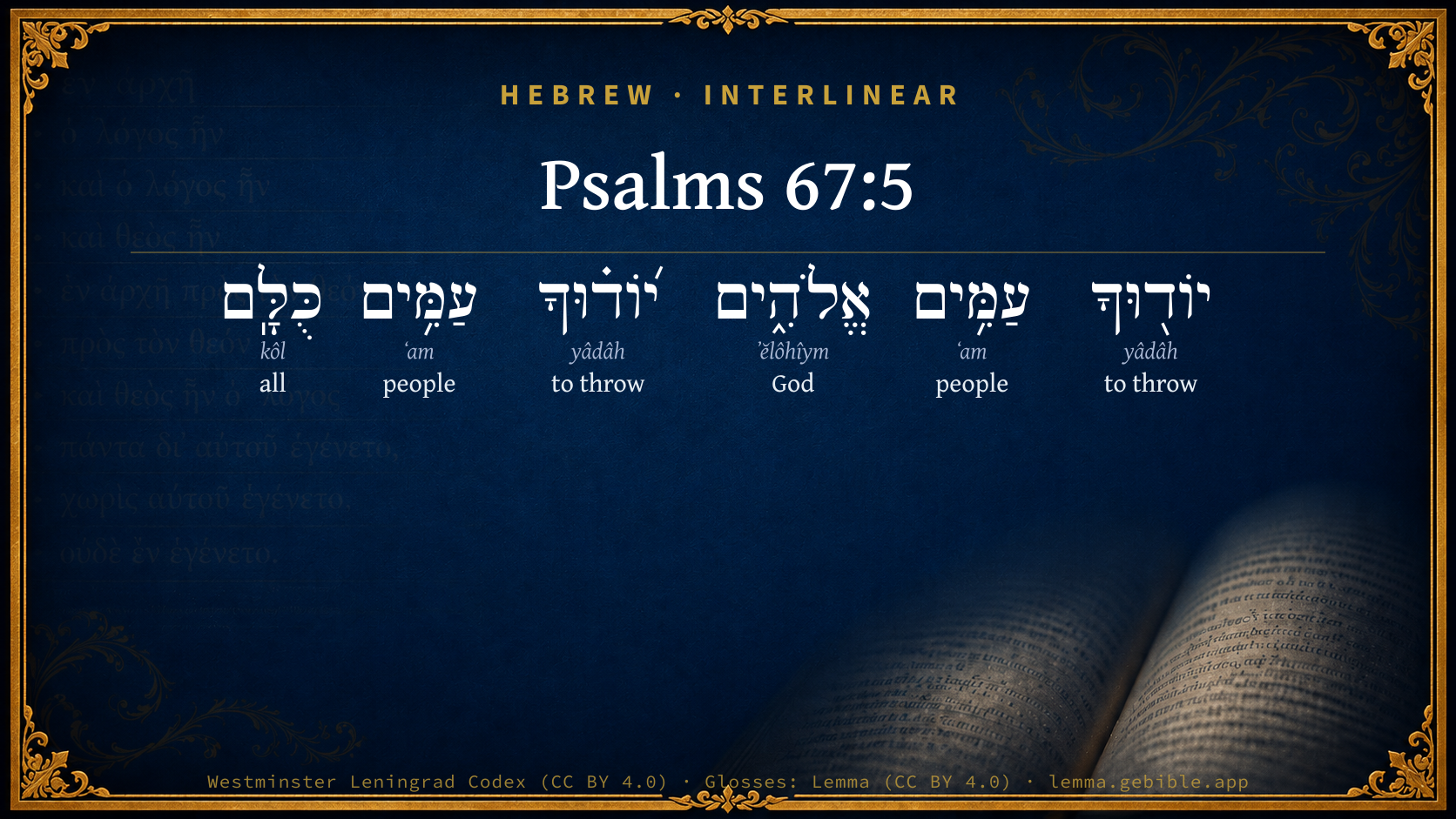
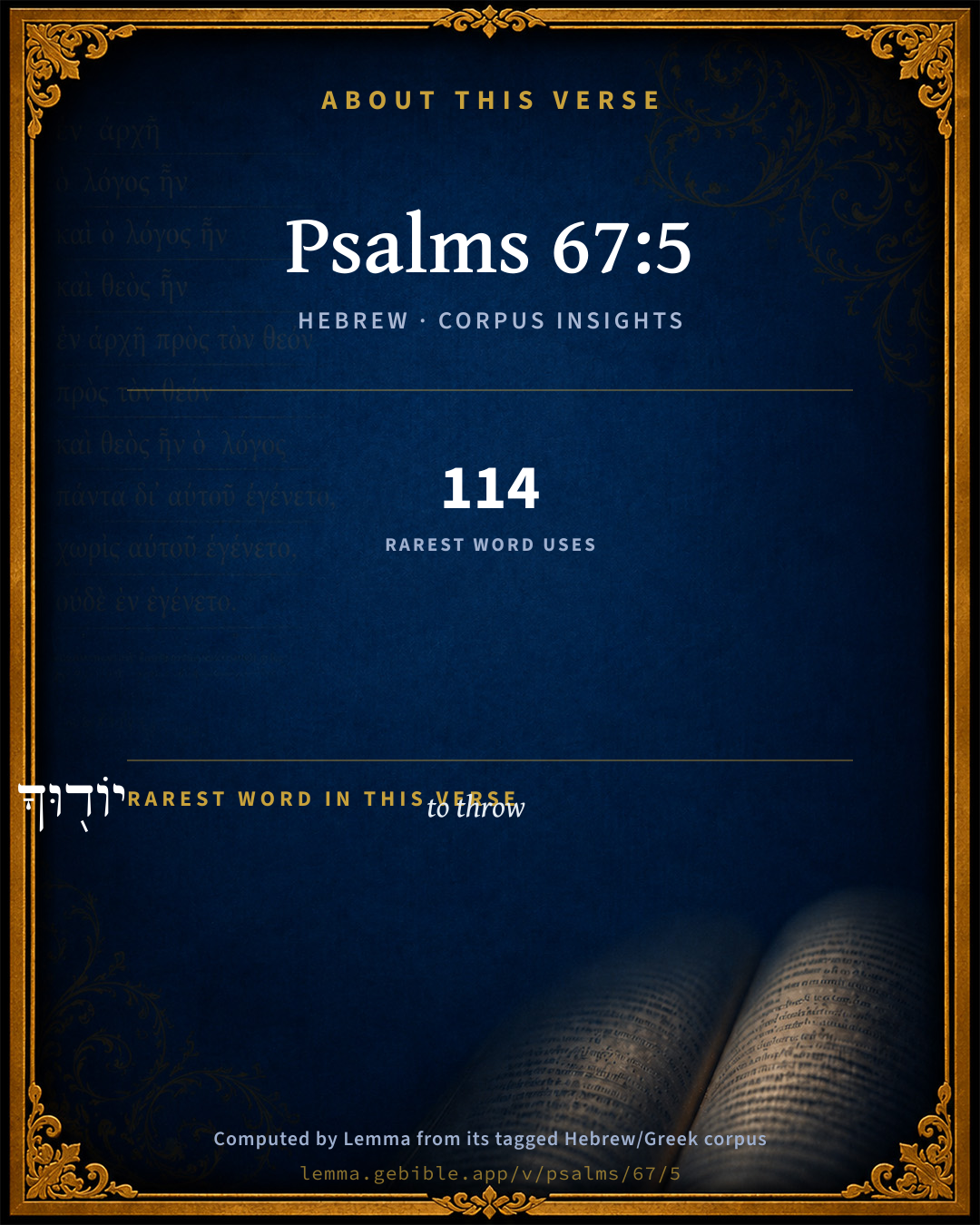
Psalms 67:5

Hebrew (Westminster Leningrad Codex) Psalms 67:5 appears in the Hebrew Old Testament. The text above is from the Westminster Leningrad Codex. Each word links to its Strong’s number, a concise gloss, and parsing drawn from the Open Scriptures Hebrew Bible morphology. Click any word for its full Brown-Driver-Briggs (BDB) entry.
Download image
Cite this verse

Psalms 67:5 (World English Bible). Public Domain. Lemma interlinear Bible study tool, https://lemma.gebible.app/v/psalms/67/5.

Show BibTeX & RIS
BibTeX
RIS
English Translation
Let the peoples praise you, God. Let all the peoples praise you.
World English Bible · Public Domain
Download a study sheet

One document with this verse’s original text, its word-by-word gloss line, the meaning frame, cross-references with their text, attributed commentary, and full source and license credits — printable, and it pastes into notes with its structure intact.

This verse Autodidact and up

Study sheet (.html) Plain text (.txt)

A passage Seminary Student

Up to 50 verses in one chapter. A passage sheet keeps up to 6 commentary sources and 12 cross-references per verse, in the order this page ranks them, and says so on the sheet whenever that leaves anything out. Ask for a single verse and you get the Autodidact verse sheet above.

Everything on this page stays free to read, with no account — the sheet is a download of what is already on screen, not access to it.

Want to remove ads? Support Godless Engineer
Compare translations 3

The same verse in 3 English versions, stacked beneath the original-language interlinear above. Click any original word for its lexicon entry.

Each is an independent rendering of the whole verse — the interlinear is not word-aligned to these translations.

Highlighted words mark where these versions differ — a whole-verse word diff, not a word-by-word alignment.

  • World English Bible Public Domain
    Let the peoples praise you, God. Let all the peoples praise you.
  • King James Version Public Domain
    Let the people praise thee, O God; let all the people praise thee.
  • unfoldingWord Literal Text CC BY-SA 4.0
    May the peoples thank you, God; may the peoples thank you, all of them.

unfoldingWord Literal Text — © unfoldingWord, licensed CC BY-SA 4.0. Word-aligned USFM3 via Door43 (git.door43.org/unfoldingWord/en_ult).

Versions to compare (up to 4)

3 of 4 selected

Show all 18 translations

Every available English version of this verse, each an independent rendering of the whole verse.

  • World English Bible Public Domain
    Let the peoples praise you, God. Let all the peoples praise you.
  • Berean Standard Bible Public Domain
    Let the peoples praise You, O God; let all the peoples praise You.
  • Majority Standard Bible Public Domain
    Let the peoples praise You, O God; let all the peoples praise You.
  • King James Version Public Domain
    Let the people praise thee, O God; let all the people praise thee.
  • American Standard Version (1901) Public Domain
    Let the peoples praise thee, O God; Let all the peoples praise thee.
  • Revised Version (1885) Public Domain
    Let the peoples praise thee, O God; let all the peoples praise thee.
  • Geneva Bible (1599) Public Domain
    Let the people prayse thee, O God: let all the people prayse thee.
  • Douay-Rheims (1899) Public Domain
    Let the nations be glad and rejoice: for thou judgest the people with justice, and directest the nations upon earth.
  • Young's Literal Translation Public Domain
    Confess Thee do peoples, O God, Confess Thee do peoples -- all of them.
  • Literal Standard Version CC BY-SA 4.0
    Peoples confess You, O God, || Peoples confess You—all of them.
  • Unlocked Literal Bible CC BY-SA 4.0
    Let the peoples praise you, God; let all the peoples praise you.
  • unfoldingWord Literal Text CC BY-SA 4.0
    May the peoples thank you, God; may the peoples thank you, all of them.
  • Darby Bible Public Domain
    Let the peoples praise thee, O God; let all the peoples praise thee.
  • World Messianic Bible Public Domain
    Let the peoples praise you, God. Let all the peoples praise you.
  • Webster's Bible Public Domain
    \\67:4\\O let the nations be glad and sing for joy: for thou shalt judge the people righteously, and govern the nations upon earth. Selah.
  • Free Bible Version CC BY-SA 4.0
    May the people praise you, God; may all the people praise you.
  • Bible in Basic English Public Domain
    Let the peoples give you praise, O God; let all the peoples give you praise.
  • JPS Tanakh (1917) Public Domain
    (67-6) Let the peoples give thanks unto Thee, O God; let the peoples give thanks unto Thee, all of them.

Literal Standard Version (2020), Covenant Press — licensed CC BY-SA 4.0. Text via the HelloAO Bible API (eBible.org). Unlocked Literal Bible (unfoldingWord) — licensed CC BY-SA 4.0. Text via the HelloAO Bible API (eBible.org). unfoldingWord Literal Text — © unfoldingWord, licensed CC BY-SA 4.0. Word-aligned USFM3 via Door43 (git.door43.org/unfoldingWord/en_ult). Free Bible Version, Dr. Jonathan Gallagher — licensed CC BY-SA 4.0. Text via the HelloAO Bible API (eBible.org).

Word by word

More ways to search: Search by grammar → Find every occurrence → Compare this word →

Practice this passage: Drill this verse → Learn its vocabulary →

יוֹד֖וּךָ
yâdâh
H3034
“to throw · you”
Verb, Hiphil, Imperfect, 3rd Person, Masculine, Plural + Suffix, Personal, 2nd Person, Masculine, Singular
Part of Speech
Verb
Stem
Hiphil
Form
Imperfect
Person
3rd Person
Gender
Masculine
Number
Plural
Full BDB Definition

Origin: a primitive root; used only as denominative from H3027

TWOT: 847

to throw, shoot, cast - (Qal) to shoot (arrows) - (Piel) to cast, cast down, throw down - (Hiphil) - to give thanks, laud, praise - to confess, confess (the name of God) - (Hithpael) - to confess (sin) - to give thanks
  1. עַמִּ֥ים ʻam H5971 “peoples” Noun, Common, Masculine, Plural, Absolute
  2. אֱלֹהִ֑ים ʼĕlôhîym H430 “God(s)” Noun, Common, Masculine, Plural, Absolute
  3. י֝וֹד֗וּךָ yâdâh H3034 “to throw · you” Verb, Hiphil, Imperfect, 3rd Person, Masculine, Plural + Suffix, Personal, 2nd Person, Masculine, Singular
  4. עַמִּ֥ים ʻam H5971 “peoples” Noun, Common, Masculine, Plural, Absolute
  5. כֻּלָּֽם kôl H3605 “all · their” Noun, Common, Masculine, Singular, Construct + Suffix, Personal, 3rd Person, Masculine, Plural

About this verse

These counts appear in no published source. They are computed here, from the morphology-tagged text and Lemma’s own curated glosses. What Lemma adds →

6
words
4
distinct lemmas
Wisdom
section

Grammatical profile

  • 2 verbs
  • 4 nouns

Verb forms

  • יוֹד֖וּךָ Hiphil · Imperfect
  • י֝וֹד֗וּךָ Hiphil · Imperfect

Repetition

Words recur within this verse — often emphatic in Hebrew:

  • יוֹד֖וּךָ to throw H3034 ×2
  • עַמִּ֥ים people H5971 ×2

Hebrew & Septuagint length

In English translation the verse runs 12 words from the Hebrew and 17 from the Septuagint (LXX English) — closely comparable.

A rough comparison of the two English renderings, which tokenize alike — not a word-level alignment.

Word counts can differ between the Hebrew and the Greek without any difference in meaning — e.g. the Hebrew direct-object marker אֵת has no separate Greek word, and Greek often adds the article ὁ.

Cross-references

2

Topical passages linked to Psalms 67:5 in the Treasury of Scripture Knowledge — connected by theme and wording, ordered by reader-vote popularity; previews shown in the World English Bible.

  • Psalms 67:3 Let the peoples praise you, God. Let all the peoples praise you.
  • Matthew 6:9–10 Pray like this: 'Our Father in heaven, may your name be kept holy.

Cross-references courtesy of OpenBible.info (CC BY 4.0).

Hebrew and Greek witnesses Masoretic Hebrew ↔ Greek Septuagint

The same verse in the two great witnesses to the Old Testament, shown verse-for-verse.

You’re reading Greek Psalm 66 (Hebrew Psalm 67). The Septuagint counts the superscription, so verse numbers can differ from the Hebrew — chapter-level alignment, not verse-by-verse. Numbering follows Rahlfs.

These are two independent witnesses, not word-aligned to each other, and the Septuagint is shown in lemma (dictionary) form.

Hebrew Psalms 67:5 Masoretic · Westminster Leningrad Codex

יוֹד֖וּךָ עַמִּ֥ים אֱלֹהִ֑ים י֝וֹד֗וּךָ עַמִּ֥ים כֻּלָּֽם

Let the peoples praise you, God. Let all the peoples praise you.

World English Bible · Public Domain

Greek LXX Greek Psalm 66:5 Septuagint · lemma form

εὐφραίνω καί ἀγαλλιάομαι ἔθνος ὅτι κρίνω λαός ἐν εὐθύτης καί ἔθνος ἐν ὁ γῆ ὁδηγέω διάψαλμα

Let the peoples, O God, give thanks to you; let all the peoples give thanks to you.

LXX2012 (modern English Septuagint) · Public Domain

Hebrew: Westminster Leningrad Codex (CC BY 4.0). Greek: Septuagint (public domain); English from LXX2012 (modern English Septuagint) (Public Domain). How the Septuagint differs from the Hebrew →

Commentary

Notes on Psalms 67:5 from classic Christian and Jewish commentators (each source and its license shown beneath its notes). The classic Christian expositions comment on the surrounding passage and are grouped to its opening verse, so a note may address several verses; the Jewish commentaries on the Tanakh (Rashi and others) are per-verse, so they appear only where the commentator wrote on this verse.

Lemma curates 59 commentaries, every one of them public domain or Creative Commons licensed, each selected and text-cleaned for this edition rather than reprinted as found. About our sources →

Trapp's Complete Commentary

John Trapp

Psa 67:5 Let the people praise thee, O God; let all the people praise thee.

Ver. 5. Versus amoibaeus. See Psa 67:3.

John Trapp, A Commentary or Exposition upon All the Books of the Old and New Testament (1647–1656) — public domain. Text from a community e-Sword module.

Albert Barnes' Notes on the Bible

Let the people praise thee ... - See Psa 67:5. The repetition shows that this was the principal thought in the mind of the author of the psalm. It expresses an earnest - an intense - desire, that all nations should acknowledge God as the true God, and praise him for his mercies.

Albert Barnes' Notes on the Bible (1834–1885) — public domain. Text from a community e-Sword/MySword module.

The Treasury of David

Charles H. Spurgeon

Ver. 5. These words are no vain repetition, but are a chorus worthy to be sung again and again. The great theme of the psalm is the participation of the Gentiles in the worship of Jehovah; the psalmist is full of it, he hardly knows how to contain or express his joy.

Ver. 5-6. Let the people praise thee, O God; let all the people praise thee! What then? Then shall the earth yield her increase; and God, even our own God, shall bless us. Our unthankfulness is the cause of the earth's unfruitfulness. While man is blessing God for his mercies, He is blessing man with his mercies. William Secker, in "The Nonsuch Professor, " 1660.

Ver. 5-7.

I. The prayer (Ps 67:5).

II. The promise (Ps 67:6).

1. Of temporal good.

2. Of spiritual good. III. The prediction (Ps 67:7).

Psalms 67:6*

Ver. 5-6. Let the people praise thee, O God; let all the people praise thee! See Psalms on "Ps 67:5" for further information.

Ver. 5-7.

I. The prayer (Ps 67:5).

II. The promise (Ps 67:6).

1. Of temporal good.

2. Of spiritual good. III. The prediction (Ps 67:7).

Ver. 5-7.

I. The prayer (Ps 67:5).

II. The promise (Ps 67:6).

1. Of temporal good.

2. Of spiritual good. III. The prediction (Ps 67:7).

Charles H. Spurgeon's The Treasury of David (1869–1885) — public domain. Psalms only. Text from a community e-Sword/MySword module.

Keil & Delitzsch

C. F. Keil & F. Delitzsch

The joyous prospect of the conversion of heathen, expressed in the same words as in Psa 67:5, here receives as its foundation a joyous event of the present time: the earth has just yielded its fruit (cf. Psa 85:13), the fruit that had been sown and hoped for. This increase of corn and fruits is a blessing and an earnest of further blessing, by virtue of which (Jer 33:9; Isa 60:3; cf. on the contrary Joe 2:17) it shall come to pass that all peoples unto the uttermost bounds of the earth shall reverence the God of Israel. For it is the way of God, that all the good that He manifests towards Israel shall be for the well-being of mankind.

Keil & Delitzsch — Biblical Commentary on the Old Testament (1861–1891) — public domain (CC PDM 1.0). Text via the HelloAO Bible API. (Old Testament only.)

J. A. Alexander on Psalms

Joseph Addison Alexander

6. (Psa 67:5). The nations shall acknowledge thee, O God, the nations shall acknowledge thee—all of them. This repetition spews the anticipation here expressed to be the principal though not the primary subject of the psalm. The position of the universal terms, at the close of this verse and Psa 67:3, is highly emphatic, and precludes, in the most explicit manner, all restriciton

Joseph Addison Alexander, The Psalms Translated and Explained (1850) — public domain. Text from a community e-Sword module.

Adam Clarke's Commentary

Verse 5. Let the people praise thee] Seeing the abundance of the blessings which the Gentiles were to receive, he calls again and again upon them to magnify God for such mercies.

Adam Clarke's Commentary on the Bible (1810–1826) — public domain. Text from a community e-Sword/MySword module.

The Cambridge Bible for Schools and Colleges

gen. ed. J. J. S. Perowne

5. the people] As before, the peoples. This refrain is generally treated as before as a wish or prayer; but it is worth considering whether the tone of the last stanza does not change throughout from prayer to confident hope, so that we should render, The peoples shall give thanks unto thee, O God. The form of a refrain is often slightly varied, why not its tone? The ambiguity arises from the fact that Heb. (with some exceptions) does not possess separate forms for the future and the optative.

5–7. The special occasion of the Psalm in the present bountiful harvest.

The Cambridge Bible for Schools and Colleges (gen. ed. J. J. S. Perowne; Cambridge University Press, 1878–1918) — public domain. Text from a community e-Sword module.

John Gill's Exposition

Let the people praise thee, O God; let all the people praise thee. See Gill on Psa 67:3. This is repeated from that preceding verse to show the earnest desire of the church that it might be so; or that there might be an occasion for it; the ardour of her mind, and fervency of her petitions, and how much she was solicitous for the praise and glory of God; or to declare the certainty of it, she most strongly believing that so it would be; as the Targum, "the people shall confess", &c. because of a new favour to be enjoyed, mentioned in Psa 67:6.

.

Psalms 67:6

psa 67:6

psa 67:6

psa 67:6Then shall the earth yield her increase,.... Not literally the land of Israel, as in some copies of the Targum, and as Kimchi interprets it; see Lev 26:3; but mystically and spiritually the church of God in the times of the Messiah, Eze 34:23; the word of God preached in the world is the seed sown in it; converts to Christ are the increase or fruit of it; and the church is God's husbandry, where it is yielded or brought forth; and this increase is of God, and is owing to the efficacy of his grace attending the ministration of the word, Co1 3:6; it had its accomplishment in part in the first times of the Gospel, when it was preached by the apostles throughout the earth, and brought forth fruit everywhere, Col 1:5; and has been fulfilling more or less ever since, and will appear more abundantly in the latter day; a large increase and a plentiful harvest of souls shall be brought in, both Jews and Gentiles: or this may be understood of the fruitfulness of believers in Christ, who may be called "earth", because of their common original from the earth with the rest of mankind; because they are inhabitants of the earth; and because they have earthly as well as heavenly principles in them; but more especially because they are the good ground on whom the seed of the word falls and becomes fruitful; or are the earth which drinks in the rain of the Gospel, and of grace, and brings forth fruit meet for them, by whom it is dressed, and receives blessing of God, Mat 13:23; these yield the fruits of the Spirit, increase in grace, and abound in the exercise of it; bring forth fruits meet for repentance, being filled with the fruits of righteousness by Christ; for the increase and fruit yielded by them are owing to the grace of God, to their grafting into Christ the vine, and to the influence of the blessed Spirit. Some of the ancients understand this of the incarnation of Christ; see Psa 85:11; then "the earth" is the Virgin Mary, who was, as to her original, of the earth, earthly; of whose earthly substance Christ took flesh, and is called the fruit of her womb; yea, the fruit of the earth, Luk 1:42; for though he is the Lord from heaven, as to his divine nature, and came down from thence, not by change of place, but by assumption of nature; yet, as to his human nature, he was made of a woman, and is the seed of the woman, the promised seed, in whom all nations of the earth were to be blessed; and it here follows:

and God, even our own God, shall bless us; not as the God of nature and providence only; but as the God of grace, as a covenant God in Christ, in which sense he is peculiarly his people's own God, so as he is not others; and as such he blesses them with all spiritual blessings in Christ: or the repetition of the word "God", with the affix "our own", may denote the certainty of the divine blessing, the assurance had of it, and the great affection of the persons that express it: and some think, because the word is repeated three times in this verse and Psa 68:7, respect is had to the trinity of Persons in the Godhead; God the Father blesses his people in Christ with the blessings of justification, pardon, adoption, and eternal life: the Son, who is Immanuel, God with us, God in our nature, our own God, God manifest in the flesh; he blesses with the same blessings of grace, peace, and eternal happiness; he was raised up of God as man and Mediator, and sent to bless his people, Act 3:26.

John Gill's Exposition of the Whole Bible (1746–1763) — public domain (CC PDM 1.0). Text via the HelloAO Bible API.

The Pulpit Commentary

Let the people praise thee, O God; let all the people praise thee. A repetition of ver. 3 without any change.

The Pulpit Commentary (1880–1919), ed. H.D.M. Spence-Jones & Joseph S. Exell — public domain. Text from a community e-Sword module.

unfoldingWord translationNotes

Door43 World Missions Community

Let the peoples praise you ... let all the peoples praise you

The second clause intensifies the meaning of the first to emphasize how important it is to praise God. (See: Parallelism)

The earth has yielded its harvest

Here the writer speaks of "the earth" as if it has chosen to provide a harvest to the people. AT: "We have reaped a bountiful harvest from our crops" (See: Personification)

translationWords

harvest

God

unfoldingWord translationNotes — © Distant Shores Media and the Door43 World Missions Community, licensed CC BY-SA 4.0. Source: git.door43.org/Door43/en_tn.

Rashi

Rabbi Shlomo Yitzchaki (Rashi)

for You will judge peoples fairly Favorably.

You will lead them You will lead them in a fair way; therefore, all peoples will thank You.

Rashi on the Tanakh — English translations: “The Judaica Press complete Tanach with Rashi, translated by A. J. Rosenberg” (CC BY 4.0); “Pentateuch with Rashi's commentary by M. Rosenbaum and A.M. Silbermann, 1929-1934” (public domain); “The Metsudah Tanach series, Lakewood, N.J” (CC BY 4.0); and “The Book of Joshua, Metsudah Publications, 1997” (CC BY 4.0). Text via Sefaria.

Lesson kit

Teaching starters — assembled from the data on this page, not authored interpretation. Every prompt links to the verse data it draws on. Edit before teaching.

Psalms, in the Wisdom, opens this verse with 6 words (4 distinct Hebrew lemmas). Its most distinctive word is yâdâh (“to throw”). A historical commentator’s framing appears above. Read the whole chapter for the surrounding context.

Discussion questions

  1. What does “to throw” (yâdâh) contribute to the verse as a whole?
  2. Psalms 67:3 shares this passage’s theme. How do the two illuminate each other?
  3. “to throw” occurs 2× in this one verse. What is the effect of the repetition?
  4. These translations render this verse differently; the difference is in the English rendering, not the original. What questions does that raise?
  5. The verb «יוֹד֖וּךָ» is Hiphil Imperfect. How does its form color the action?
  6. Reading how Trapp's Complete Commentary and Albert Barnes' Notes on the Bible read this verse, where do the two commentators agree and where do they part?

Things to notice

  • These translations choose different wording for 8 words in this verse.
  • “to throw” occurs 2× in this single verse.
  • 4 distinct Hebrew lemmas span 6 words in this verse.

Reading settings

Reading text

Shown beneath each verse's original-language words.

Old Testament
Old Testament edition

Read the OT as the Masoretic Hebrew (MT) or the Greek Septuagint (LXX).

English shown for the Greek Septuagint (in the Hebrew ↔ Greek comparison).

Comparing translations? Open the Compare panel on any verse page to stack up to four side by side.