Psalms 68:35

Hebrew (Westminster Leningrad Codex) Psalms 68:35 appears in the Hebrew Old Testament. The text above is from the Westminster Leningrad Codex. Each word links to its Strong’s number, a concise gloss, and parsing drawn from the Open Scriptures Hebrew Bible morphology. Click any word for its full Brown-Driver-Briggs (BDB) entry.
Download image
Cite this verse

Psalms 68:35 (World English Bible). Public Domain. Lemma interlinear Bible study tool, https://lemma.gebible.app/v/psalms/68/35.

Show BibTeX & RIS
BibTeX
RIS
English Translation
You are awesome, God, in your sanctuaries. The God of Israel gives strength and power to his people. Praise be to God!
World English Bible · Public Domain
Highlights
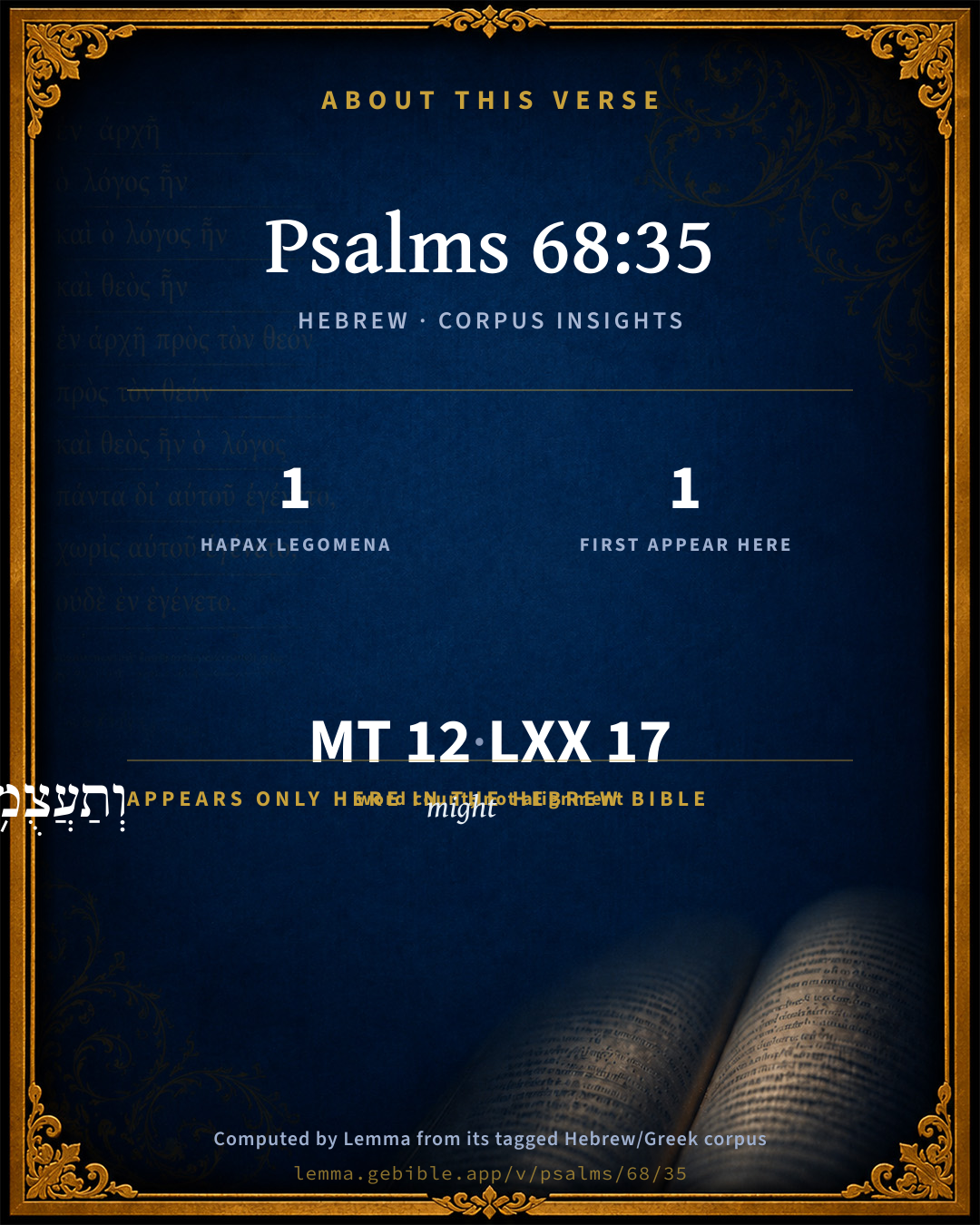
  • 1 hapax legomenon — only here in the Hebrew Bible
  • 1 first appearance in the Hebrew Bible
Full analysis ↓
Download a study sheet

One document with this verse’s original text, its word-by-word gloss line, the meaning frame, cross-references with their text, attributed commentary, and full source and license credits — printable, and it pastes into notes with its structure intact.

This verse Autodidact and up

Study sheet (.html) Plain text (.txt)

A passage Seminary Student

Up to 50 verses in one chapter. A passage sheet keeps up to 6 commentary sources and 12 cross-references per verse, in the order this page ranks them, and says so on the sheet whenever that leaves anything out. Ask for a single verse and you get the Autodidact verse sheet above.

Everything on this page stays free to read, with no account — the sheet is a download of what is already on screen, not access to it.

Want to remove ads? Support Godless Engineer
Compare translations 3

The same verse in 3 English versions, stacked beneath the original-language interlinear above. Click any original word for its lexicon entry.

Each is an independent rendering of the whole verse — the interlinear is not word-aligned to these translations.

Highlighted words mark where these versions differ — a whole-verse word diff, not a word-by-word alignment.

  • World English Bible Public Domain
    You are awesome, God, in your sanctuaries. The God of Israel gives strength and power to his people. Praise be to God!
  • King James Version Public Domain
    O God, thou art terrible out of thy holy places: the God of Israel is he that giveth strength and power unto his people. Blessed be God.
  • unfoldingWord Literal Text CC BY-SA 4.0
    God, fearsome from your sanctuary! The God of Israel, he is giving strength and forces to the people. Blessed God!

unfoldingWord Literal Text — © unfoldingWord, licensed CC BY-SA 4.0. Word-aligned USFM3 via Door43 (git.door43.org/unfoldingWord/en_ult).

Versions to compare (up to 4)

3 of 4 selected

Show all 18 translations

Every available English version of this verse, each an independent rendering of the whole verse.

  • World English Bible Public Domain
    You are awesome, God, in your sanctuaries. The God of Israel gives strength and power to his people. Praise be to God!
  • Berean Standard Bible Public Domain
    O God, You are awesome in Your sanctuary; the God of Israel Himself gives strength and power to His people. Blessed be God!
  • Majority Standard Bible Public Domain
    O God, You are awesome in Your sanctuary; the God of Israel Himself gives strength and power to His people. Blessed be God!
  • King James Version Public Domain
    O God, thou art terrible out of thy holy places: the God of Israel is he that giveth strength and power unto his people. Blessed be God.
  • American Standard Version (1901) Public Domain
    O God, `thou art' terrible out of thy holy places: The God of Israel, he giveth strength and power unto `his' people. Blessed be God. Psalm 69 For the Chief Musician; set to Shoshanim. `A Psalm' of David.
  • Revised Version (1885) Public Domain
    O God, thou art terrible out of thy holy places: the God of Israel, he giveth strength and power unto his people. Blessed be God.
  • Geneva Bible (1599) Public Domain
    O God, thou art terrible out of thine holie places: the God of Israel is hee that giueth strength and power vnto the people: praised be God.
  • Douay-Rheims (1899) Public Domain
    give ye glory to God for Israel, his magnificence, and his power is in the clouds.
  • Young's Literal Translation Public Domain
    Fearful, O God, out of Thy sanctuaries, The God of Israel Himself, Giving strength and might to the people. Blessed `is' God!
  • Literal Standard Version CC BY-SA 4.0
    Fearful, O God, out of Your sanctuaries, || The God of Israel Himself, || Giving strength and might to the people. Blessed [is] God!
  • Unlocked Literal Bible CC BY-SA 4.0
    God, you are fearsome in your holy place; the God of Israel—he gives strength and power to his people. Blessed be God.
  • unfoldingWord Literal Text CC BY-SA 4.0
    God, fearsome from your sanctuary! The God of Israel, he is giving strength and forces to the people. Blessed God!
  • Darby Bible Public Domain
    Terrible art thou, O God, out of thy sanctuaries, -- the ùGod of Israel! He it is that giveth strength and might unto the people. Blessed be God!
  • World Messianic Bible Public Domain
    You are awesome, God, in your sanctuaries. The God of Israel gives strength and power to his people. Praise be to God!
  • Webster's Bible Public Domain
    \\68:34\\Ascribe ye strength to God: his excellence is over Israel, and his strength is in the clouds.
  • Free Bible Version CC BY-SA 4.0
    How awesome is God in his Temple! The God of Israel gives strength and power to his people! Praise God!
  • Bible in Basic English Public Domain
    O God, you are to be feared in your holy place: the God of Israel gives strength and power to his people. Praise be to God.
  • JPS Tanakh (1917) Public Domain
    (68-36) Awful is God out of thy holy places; the God of Israel, He giveth strength and power unto the people; blessed be God.

Literal Standard Version (2020), Covenant Press — licensed CC BY-SA 4.0. Text via the HelloAO Bible API (eBible.org). Unlocked Literal Bible (unfoldingWord) — licensed CC BY-SA 4.0. Text via the HelloAO Bible API (eBible.org). unfoldingWord Literal Text — © unfoldingWord, licensed CC BY-SA 4.0. Word-aligned USFM3 via Door43 (git.door43.org/unfoldingWord/en_ult). Free Bible Version, Dr. Jonathan Gallagher — licensed CC BY-SA 4.0. Text via the HelloAO Bible API (eBible.org).

Word by word

More ways to search: Search by grammar → Find every occurrence → Compare this word →

Practice this passage: Drill this verse → Learn its vocabulary →

וְתַעֲצֻמ֥וֹת
taʻătsumâh
H8592
“and · might”
Conjunction + Noun, Common, Feminine, Plural, Absolute
Part of Speech
Conjunction + Noun
Type
Common
Gender
Feminine
Number
Plural
State
Absolute
Full BDB Definition

Origin: from H6105

TWOT: 1673e

might, power
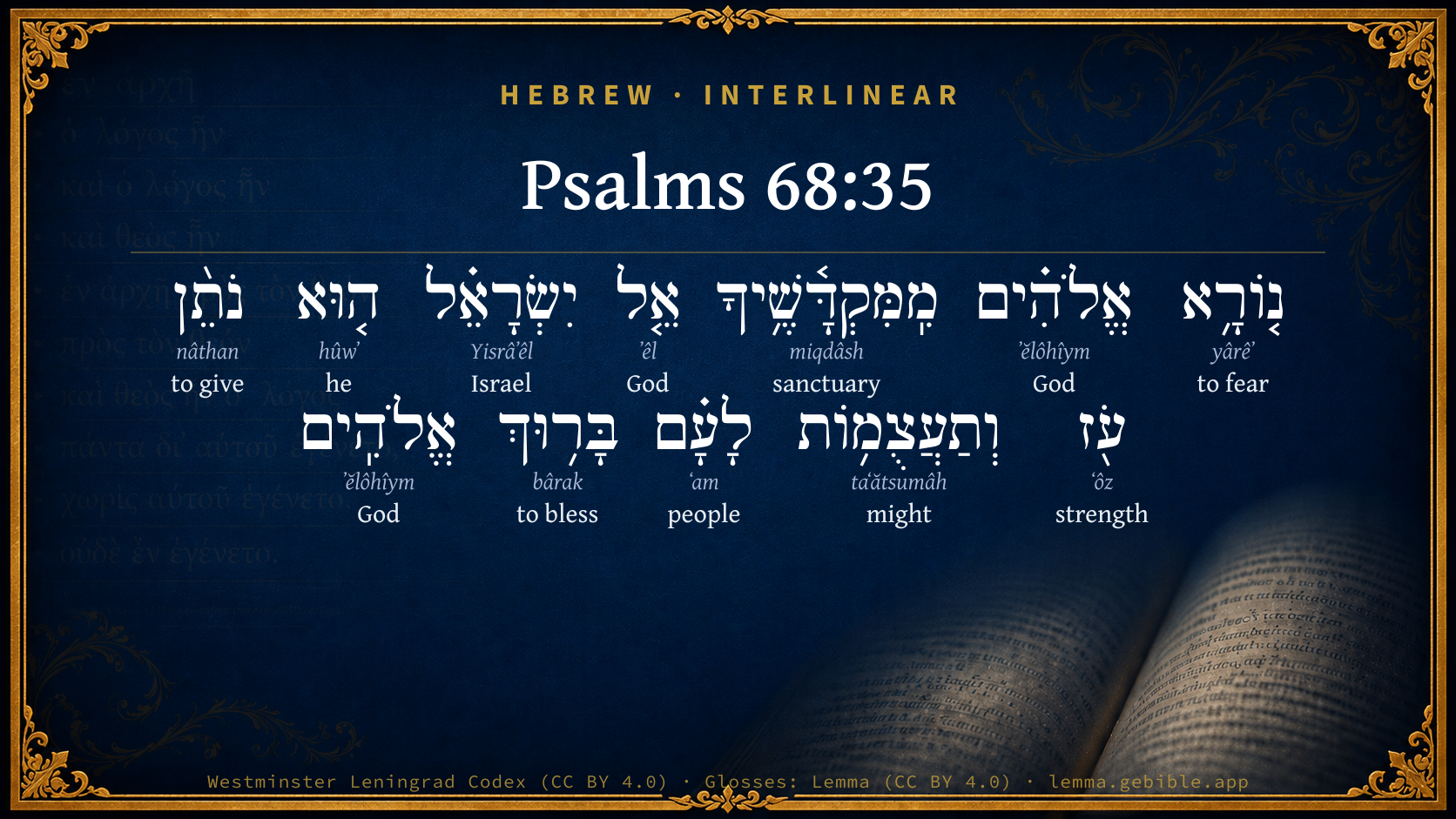
  1. נ֤וֹרָ֥א yârêʼ H3372 “fearing” Verb, Niphal, Participle Active, Masculine, Singular, Absolute
  2. אֱלֹהִ֗ים ʼĕlôhîym H430 “God(s)” Noun, Common, Masculine, Plural, Absolute
  3. מִֽמִּקְדָּ֫שֶׁ֥יךָ miqdâsh H4720 “from · sanctuaries · your” Preposition + Noun, Common, Masculine, Plural, Construct + Suffix, Personal, 2nd Person, Masculine, Singular
  4. אֵ֤ל ʼêl H410 “God of” Noun, Common, Masculine, Singular, Construct
  5. יִשְׂרָאֵ֗ל Yisrâʼêl H3478 “Israel” Noun, Proper
  6. ה֤וּא hûwʼ H1931 “he” Pronoun, Personal, 3rd Person, Masculine, Singular
  7. נֹתֵ֨ן nâthan H5414 “giving” Verb, Qal, Participle Active, Masculine, Singular, Absolute
  8. עֹ֖ז ʻôz H5797 “strength” Noun, Common, Masculine, Singular, Absolute
  9. לָעָ֗ם ʻam H5971 “to/for the · people” Preposition, Determined + Noun, Common, Masculine, Singular, Absolute
  10. בָּר֥וּךְ bârak H1288 “blessed” Verb, Qal, Participle Passive, Masculine, Singular, Absolute
  11. אֱלֹהִֽים ʼĕlôhîym H430 “God(s)” Noun, Common, Masculine, Plural, Absolute

About this verse

These counts appear in no published source. They are computed here, from the morphology-tagged text and Lemma’s own curated glosses. What Lemma adds →

12
words
11
distinct lemmas
Wisdom
section

Notable vocabulary

1 hapax legomenon — a word that appears only here in the entire Hebrew Bible:

  • וְתַעֲצֻמ֥וֹת might H8592

First appearance in Scripture

This word makes its first canonical appearance in the Hebrew Bible here:

  • וְתַעֲצֻמ֥וֹת might H8592

Grammatical profile

  • 3 verbs
  • 8 nouns
  • 1 pronoun

Verb forms

  • נ֤וֹרָ֥א Niphal · Participle Active
  • נֹתֵ֨ן Qal · Participle Active
  • בָּר֥וּךְ Qal · Participle Passive

Repetition

A word recurs within this verse — often emphatic in Hebrew:

  • אֱלֹהִ֗ים God H430 ×2

Hebrew & Septuagint length

In English translation the verse runs 22 words from the Hebrew and 23 from the Septuagint (LXX English) — closely comparable.

A rough comparison of the two English renderings, which tokenize alike — not a word-level alignment.

Word counts can differ between the Hebrew and the Greek without any difference in meaning — e.g. the Hebrew direct-object marker אֵת has no separate Greek word, and Greek often adds the article ὁ.

In the original languages it is 12 Hebrew tokens and 17 Greek tokens — but the two are counted differently (Hebrew bundles its prefixes and suffixes into one token; the Greek is in lemma form), so that isn’t a like-for-like length.

Cross-references

20

Topical passages linked to Psalms 68:35 in the Treasury of Scripture Knowledge — connected by theme and wording, ordered by reader-vote popularity; previews shown in the World English Bible.

  • Psalms 29:11 Yahweh will give strength to his people. Yahweh will bless his people with peace.
  • Colossians 1:11 strengthened with all power, according to the might of his glory, for all endurance and perseverance with joy;
  • Philippians 4:13 I can do all things through Christ, who strengthens me.
  • Isaiah 40:29 He gives power to the faint; and to him who has no might he increases strength.
  • Psalms 65:5 By awesome deeds of righteousness, you answer us, God of our salvation. You who are the hope of all the ends of the earth, Of those who are far away on the sea;
  • Zechariah 10:12 I will strengthen them in Yahweh; And they will walk up and down in his name," says Yahweh.
  • Nehemiah 1:5 and said, I beg you, Yahweh, the God of heaven, the great and awesome God, who keeps covenant and loving kindness with those who love him and keep his commandments:
  • Revelation 6:16–17 They told the mountains and the rocks, "Fall on us, and hide us from the face of him who sits on the throne, and from the wrath of the Lamb,
  • Psalms 66:5 Come, and see God's deeds-- Awesome work on behalf of the children of men.
  • Isaiah 40:31 but those who wait for Yahweh shall renew their strength; they shall mount up with wings as eagles; they shall run, and not be weary; they shall walk, and not faint.
  • Ephesians 3:16 that he would grant you, according to the riches of his glory, that you may be strengthened with power through his Spirit in the inward man;
  • Exodus 15:1 Then Moses and the children of Israel sang this song to Yahweh, and said, "I will sing to Yahweh, for he has triumphed gloriously: The horse and his rider he has thrown into the sea.
  • Deuteronomy 33:25 Your bars shall be iron and brass; As your days, so shall your strength be.
  • Psalms 45:4 In your majesty ride on victoriously on behalf of truth, humility, and righteousness. Let your right hand display awesome deeds.
  • Psalms 47:2 For Yahweh Most High is awesome. He is a great King over all the earth.
  • Psalms 66:20 Blessed be God, who has not turned away my prayer, Nor his loving kindness from me.
  • Psalms 72:18–19 Praise be to Yahweh God, the God of Israel, Who alone does marvelous deeds.
  • Psalms 76:12 He will cut off the spirit of princes. He is feared by the kings of the earth.
  • Isaiah 45:21 Declare you, and bring [it] forth; yes, let them take counsel together: who has shown this from ancient time? who has declared it of old? Haven't I, Yahweh? and there is no God else besides me, a just God and a Savior; there is no one besides me.
  • Hebrews 12:24–29 to Jesus, the mediator of a new covenant, and to the blood of sprinkling that speaks better than that of Abel.

Cross-references courtesy of OpenBible.info (CC BY 4.0).

Hebrew and Greek witnesses Masoretic Hebrew ↔ Greek Septuagint

The same verse in the two great witnesses to the Old Testament, shown verse-for-verse.

You’re reading Greek Psalm 67 (Hebrew Psalm 68). The Septuagint counts the superscription, so verse numbers can differ from the Hebrew — chapter-level alignment, not verse-by-verse. Numbering follows Rahlfs.

These are two independent witnesses, not word-aligned to each other, and the Septuagint is shown in lemma (dictionary) form.

Hebrew Psalms 68:35 Masoretic · Westminster Leningrad Codex

נ֤וֹרָ֥א אֱלֹהִ֗ים מִֽמִּקְדָּ֫שֶׁ֥יךָ אֵ֤ל יִשְׂרָאֵ֗ל ה֤וּא נֹתֵ֨ן עֹ֖ז וְתַעֲצֻמ֥וֹת לָעָ֗ם בָּר֥וּךְ אֱלֹהִֽים

You are awesome, God, in your sanctuaries. The God of Israel gives strength and power to his people. Praise be to God!

World English Bible · Public Domain

Greek LXX Greek Psalm 67:35 Septuagint · lemma form

δίδωμι δόξα ὁ θεός ἐπί ὁ ἰσραήλ ὁ μεγαλοπρέπεια αὐτός καί ὁ δύναμις αὐτός ἐν ὁ νεφέλη

God is wonderful in his holy places, the God of Israel: he will give power and strength to his people: blessed be God.

LXX2012 (modern English Septuagint) · Public Domain

On this verse, The Cambridge Bible for Schools and Colleges discusses the Septuagint’s reading. Read the note in Commentary ↓

Hebrew: Westminster Leningrad Codex (CC BY 4.0). Greek: Septuagint (public domain); English from LXX2012 (modern English Septuagint) (Public Domain). How the Septuagint differs from the Hebrew →

Commentary

Notes on Psalms 68:35 from classic Christian and Jewish commentators (each source and its license shown beneath its notes). The classic Christian expositions comment on the surrounding passage and are grouped to its opening verse, so a note may address several verses; the Jewish commentaries on the Tanakh (Rashi and others) are per-verse, so they appear only where the commentator wrote on this verse.

Lemma curates 59 commentaries, every one of them public domain or Creative Commons licensed, each selected and text-cleaned for this edition rather than reprinted as found. About our sources →

Trapp's Complete Commentary

John Trapp

Psa 68:35 O God, [thou art] terrible out of thy holy places: the God of Israel [is] he that giveth strength and power unto [his] people. Blessed [be] God.

Ver. 35. O God, thou art terrible out of thy holy places] So the sanctuary is called, because divided into three parts; and here hence God was terrible in his manifestations to his people, and in his operations to his enemies. See Psa 67:2-3.

Blessed be God] Hereupon, saith one, God was called in Israel, Baruc-hu, the Blessed, as Mar 14:61, with Mat 26:63. See Luk 1:68.

John Trapp, A Commentary or Exposition upon All the Books of the Old and New Testament (1647–1656) — public domain. Text from a community e-Sword module.

Joseph Benson's Commentary

Psa 68:35. O God, thou art terrible — Hebrew, נורא, nora, venerable, yea, infinitely worthy to be both reverenced and feared. Out of thy holy places — Or, sanctuaries. “Heaven was his sanctuary of old; his earthly sanctuary was in Zion: he was worthy to be feared as inhabiting both, and he is represented as going out of them, to take vengeance on the enemies of his people, and as dreadful on account of the judgments which, from thence, as the places of his dwelling, he executes on them. He giveth strength and power to his people — Though the marks of his displeasure are dreadful to his enemies, yet he gives fortitude and courage unto his people, inspires them with resolution and vigour, and renders them victorious over all that oppose them. The psalmist adds, Blessed be God! And surely men and angels, heaven and earth, ought to say, Amen! All is from him; let all be returned to him, in praise and thanksgiving; and let the whole intelligent creation exclaim, Blessed be God, who hath so wonderfully blessed us!

Joseph Benson's Commentary on the Old and New Testaments (1811–1818) — public domain. Text from a community e-Sword module.

J. A. Alexander on Psalms

Joseph Addison Alexander

36. (Psa 68:35). Terrible (art thou), O God, out of thy holy places; the Mighty (God) of Israel—he is (a God) giving strength and forces to the people. Blessed (be) God! The winding up is like that of the twenty-ninth psalm. Out of thy sanctuaries, as displayed thence, in blessings bestowed upon thy people. He is not only mighty in himself, but the giver of might to others. Compare Isa 40:29; Isa 40:31.

Joseph Addison Alexander, The Psalms Translated and Explained (1850) — public domain. Text from a community e-Sword module.

Geneva Bible (1599)

Geneva Bible translators

In showing fearful judgments against thine enemies for the salvation of thy people.

He alludeth to the Tabernacle which was divided in three parts.

Geneva Bible (1599) marginal notes — public domain. Text via Bolls.life.

Adam Clarke's Commentary

Verse 35. O God, thou art terrible out of thy holy places] The sanctuary and heaven. Out of the former he had often shone forth with consuming splendour; see the case of Korah and his company: out of the latter he had often appeared in terrible majesty in storms, thunder, lightning, c.

He that giveth strength and power unto his people.] Therefore that people must be invincible who have this strong and irresistible God for their support.

Blessed be God.] He alone is worthy to be worshipped. Without him nothing is wise, nothing holy, nothing strong and from him, as the inexhaustible Fountain, all good must be derived. His mercy over his creatures is equal to his majesty in the universe, and as he has all good in his possession, so is he willing to deal it out, to supply the utmost necessities of his creatures. Blessed be God! The Arabic adds, Alleluiah!

The best analysis I find of this Psalm is that by Bishop Nicholson. I shall give it at large; begging the reader to refer particularly to those passages on which the preceding notes are written, as in some of them the analysis gives a different view of the subject. The old Psalter gives the whole Psalm a spiritual and mystical interpretation. And this is commonly the case in the commentaries of the fathers.

ANALYSIS OF THE SIXTY-EIGHTH PSALM

There are many conjectures as to the occasion of the composing of this Psalm; but the most probable is, that it was composed by David when he brought up the ark of God, which was the type of the Church and symbol of God's presence, to Jerusalem. After the ark was sent home by the Philistines, it rested first in the obscure lodge of Aminadab; it then for a time stayed with Obed-edom, nearly sixty years in both places. It was David's care to provide a fit room for it in the head of the tribes, even in his own city; and to express his joy, and honour the solemnity, David led the way, dancing with all his might in a linen ephod; and all the house of Israel followed with shouts and instruments of music in a triumphant manner. Now, that the choir might not want to know how to express their joyful affections, the sweet singer of Israel made this anthem, beginning the verse himself, as was commanded at the removal of the ark, Nu 10:35. The Psalm has six parts:-

I. The entrance, or exordium, Ps 68:1-4.

II. The invitation to praise God, Ps 68:4.

III. The confirmation of it by many arguments, Ps 68:4-24.

IV. A lively description of triumph, or pomp of the ark's deportation, Ps 68:24-28.

V. A petition, which has three parts, Ps 68:28-31.

VI. An exhortation to all nations to praise God, Ps 68:31-35.

I. "Let God arise" is either a prayer or acclamation; a prayer that he would, or an acclamation that he does, show his power and presence. Of which the consequence would be double:-

1. Towards his enemies, destruction; for he prays, "Let his enemies be scattered; let those that hate him fly before him."

He illustrates it by a twofold comparison: -

(1) "As smoke (when it is at the highest) is driven away, so drive them away."

(2) "As wax melteth before the fire, so let the wicked perish in the presence of God."

2. Towards good men, his servants; which is quite contrary to the other: "Let the righteous be glad; let them rejoice before God; yea, let them exceedingly rejoice." Thus it happened; for when the ark was taken by the Philistines, the glory was departed from Israel, and there was nothing but sadness and sorrow: but with the return of the ark the glory returned and all was joy and gladness.

II. And so, by an apostrophe, he turns his speech to all good men, and exhorts them to praise God.

1. "Sing unto God." Let it be done with your voice publicly.

2. Psallite: "Sing praises to his name," with Instruments of music."

3. "Extol him." Show his way, as in a triumph. Thus, when our Saviour rode into Jerusalem they cut down branches, and strewed their garments in the way.

III. And so David enters upon his confirmation, producing his reasons why they should praise God.

1. Drawn from his majesty: "He rideth upon the heavens;" that is, he rules in the heavens.

2. From the essence: "By his name Jah," the contraction of Jehovah, I am. He gives essence to all things; therefore, "rejoice before him."

3. From his general providence and goodness towards his Church.

(1) "He is the father of the fatherless." Loves, cares, and provides an inheritance for them.

(2) "A judge of the widows." He cares for his people when deserted, and for whom no man cares, and when exposed to injury. Such is God in his holy habitation; whose presence is represented by this ark.

(3) "God setteth the solitary in families." He makes the barren woman to keep house, and to be the joyful mother of children. As also the barren woman - the Gentile Church that had no husband, to bring forth children to God.

(4) He brings forth those which are bound with chains; as Joseph, Jeremiah, Daniel, Peter, Paul.

4. On the contrary: "But the rebellious dwell in a dry land;" perish with want and hunger.

IV. From his special providence toward his people Israel, which he introduces by an elegant apostrophe: "O God, when thou wentest forth before thy people;" thus amplified: -

1. God's going before them, and marching along with them in Egypt, in the wilderness. These signs manifested his presence: "The earth shook, the heavens also dropped at the presence of God: even Sinai itself was moved at the presence of God, the God of Israel."

2. God's provision for them after he gave them the possession of the good land. He fed, sustained them there, counted them his inheritance, and gave them rain and fruitful seasons: "Thou, O God, didst send a plentiful rain, whereby thou didst confirm thine inheritance, when it was weary. The congregation hath dwelt therein: thou, O God, hast prepared of thy goodness for the poor."

3. The victories he gave them over their enemies, Ps 68:12, which he prefaces by imitation of the song of the victory, sung usually by the women and damsels of those times, Ps 68:11: "The Lord gave the word," that is, either the word of war, or else the song; and then "Great was the company of those that published it." As Miriam, Deborah, c. And in these songs they sang, "Kings of armies did flee apace and she that tarried at home divided the spoil." So great was the prey.

4. The deliverance he sends from troubles, and the joy he gives after them. "Though ye have lien among the pots," that is, cast aside as some useless or broken pot, the offscouring of all things; "yet shall ye be as the wings of a dove covered with silver, and her feathers with yellow gold; " i.e., shining and glorious. The allusion seems to be taken from some standard, whose portraiture and device was a dove so overlaid. The Babylonian ensign was a dove. But see the note on this passage.

And this he farther declares by another similitude: "When the Almighty scattered kings in it:" or for her, i.e., his Church, it was white-glittering, glorious, to be seen afar off; "it was white as snow in Salmon," with which it is generally covered.

5. From God's especial presence among them, which, that he might make it more evident, David enters upon the commendation of the hill of Sion to which the ark was at this time brought, comparing it with other hills, especially with Bashan. That is a hill of God; a high, plentiful, and fertile hill. As if he had said, So much I grant. But, "why leap ye, ye high hills?" Why are ye so proud? Why do ye boast your vines, your fruits, your pastures, your cattle? Sion has the pre-eminence of you all in two respects: -

1. For God's continual habitation and common presence is there: "This is the hill which God desireth to dwell in; yea, the Lord will dwell in it for ever."

2. For his defence of it. "The chariots of God are twenty thousand, even thousands of angels:" and these are for the defence of Sion, his Church; "for God is among them as in Sinai, in the holy place;" in glory and majesty, to Sinai, and in Sion.

And yet he goes on to persuade us to praise God, 1. For his strange and wonderful works. 2. For the performance of his promises. Among his great works there was none so glorious as the ascension of our Saviour, of which the ark's ascension to Jerusalem at this time was a type.

First. 1. Before the ark David and the people used this acclamation: "Thou hast ascended on high." Thou, O God, whose presence is shadowed out by the ark, hast ascended from an obscure house to a kingly palace, Sion.

2. "Thou hast led captivity captive;" those that led us captives being captives themselves, and now led in triumph.

3. "Thou hast received gifts for men;" spoils and gifts from the conquered kings; or who may become homagers unto him, and redeem their peace.

4. "Yea, for the rebellious also: "Formerly so, but now tributaries.

5. "That the Lord God might dwell among them;" might have a certain place to dwell in; and the ark not be carried, as before, from place to place.

This is the literal sense; but the mystical refers to our Saviour's ascension. St. Paul says, Eph 4:8:

1. "Thou hast ascended on high:" when the cloud carried him from earth to heaven.

2. "Thou hast led captivity," those who captured us, "captive;" death, the devil, sin, the power of hell, the curse of the law.

3. "He received, and gave gifts to men:" The apostles, evangelists, prophets, doctors, and teachers, were these gifts - graces, gifts of the Spirit.

4. "Yea, for the rebellious also:" Paul, a persecutor; Austin, a Manichhaean.

5. "That the Lord God might dwell among them:" for to that end St. Paul says these gifts were given, "to the work of the ministry, to the edification of the Church, to the building up of the body of Christ." Eph 4:12, c.

The two effects of his ascension then were, one towards his enemies, the other for his friends: "When thou ascendest up on high: - "

1. "Thou leddest captivity captive:" this was the consequence to his enemies.

2. "Thou receivedst, and gavest gifts:" This for his friends. For which he sings, "Blessed be God" for he comes over both again: -

1. The gifts to his friends: "Blessed be the Lord, who daily loadeth us with benefits, even the God of our salvation." "He that is our God is the God of salvation; and unto God the Lord belong the issues from death." He knows many ways to deliver in death itself, when there is no hope.

2. The conquest of his enemies; for such he counts obstinate impenitent sinners; those he will destroy: "God shall wound the head of his enemies, and the hairy scalp of such a one as goeth on still in his trespasses."

Secondly, His last argument is, God's performance of his promise to save them. When you were in the wilderness; when you fought with Og, king of Bashan, when at the Red Sea, I delivered you. The Lord saith still to his people: -

1. "I will bring again from Bashan;" from equally great dangers.

2. "I will bring my people again from the depths of the sea:" when there is no hope.

3. And for thy enemies, they shall be destroyed by a great effusion of blood: "That thy foot may be dipped in the blood of thine enemies, and the tongue of thy dogs in the same;" thou shalt waste, and make a great slaughter.

4. And now he descends to set before our eyes the pomp and show which was used in the ascent and bringing back of the ark, and the proceeding of it.

1. The people were present to witness it: "They have seen thy goings, O God; even the goings of my God, my King, in the sanctuary."

2. The manner of the pomp: "The singers went before, the players on instruments followed after; among them were the damsels playing with timbrels."

3. In the pomp they were not silent; and that they be not, he exhorts them: "Bless ye God in the congregations, even the Lord, from the fountain of Israel," - Jacob's posterity.

4. And he gives in the catalogue of the tribes that were present, but these especially, -

1. "There is little Benjamin," Jacob's youngest son, or now the least, wasted with war, "with their ruler," the chief prince of their tribe.

2. "The princes of Judah, and their council."

3. "The princes of Zebulun, and the princes of Naphtali;" the farthest tribes, therefore the nearest.

V. And in the midst of the pomp he makes a prayer which has three vows, before which he prefixes the acknowledgment that all the power and strength of Israel was from God: "Thy God hath commanded thy strength." He then prays, -

1. For the confirmation, establishment, and continuance of this strength: "Strengthen, O God, that which thou hast wrought for us; " and let this be evinced "by the kings and tributaries that shall bring gifts. Because of thy temple at Jerusalem shall kings bring presents unto thee."

2. For the conquest and subduing of the enemy, until they become tributaries, and do homage: "Rebuke the company of spearmen, the multitude of the bulls, with the calves of the people;" kings, princes, and their potent subjects; "till every one submit himself with pieces of silver: scatter thou the people that delight in war." See the note.

3. For the increase of Christ's kingdom, of which David was but a type, by the access of the Gentiles. "Princes shall come out of Egypt; Ethiopia shall soon stretch out her hands unto God." These, by a synecdoche, being put for all nations.

VI. This excellent Psalm draws now towards a conclusion; and it is a resumption of that which he principally intended; that is, that God be blessed, honoured, praised. He first exhorts, then shows the reasons for it.

1. He exhorts all nations to perform this duty: at first, the Jews, but now all universally: "Sing unto God, ye kingdoms of the earth; O sing praises unto the Lord."

2. His reasons to induce them to do it.

The majesty of God testified, -

1. By his works: "To him that rideth upon the heaven of heavens, which were of old."

2. His power, in his thunder, in his word: "He doth send out his voice, and that a mighty voice."

3. His wise protection of and providence over his people: "Ascribe ye strength unto God: his excellency is over Israel, and his strength is in the clouds."

4. His communication of himself to his Church in particular: 1. "O God, thou art terrible out of thy holy places." 2. "The God of Israel is he that giveth strength and power unto his people." 3. "Blessed be God." With this epiphonema he concludes.

Adam Clarke's Commentary on the Bible (1810–1826) — public domain. Text from a community e-Sword/MySword module.

Ellicott's Commentary for English Readers

(35) Out of thy holy places—i.e., out of Zion. The plural “places” occurs also in Ps. lxxiii, 17 (Heb.).

A Bible Commentary for English Readers, edited by Charles John Ellicott (1878–1897) — public domain. Text from a community e-Sword module.

The Cambridge Bible for Schools and Colleges

gen. ed. J. J. S. Perowne

35. O God, thou art terrible &c.] This rendering is retained in R.V., but grammar requires us to render (cp. R.V. marg.); Terrible is God out of thy sanctuary. Israel is addressed: and the verse is the answer of the nations to the summons of Psa_68:34, acknowledging the awful might (Exo_15:11; Deu_10:17; Psa_47:2) which God displays from His sanctuary in the midst of Israel (cp. Psa_68:29 note), recognising Him as the source of Israel’s preeminence, and in conclusion reechoing Israel’s watchword of praise, Blessed be God. Simpler but less forcible is the reading of LXX and Jer., out of his sanctuary, making the verse the Psalmist’s own conclusion.

thy holy places] Better, thy sanctuary, as the word is generally rendered (Exo_15:17; Psa_78:69; Psa_96:6, &c.). The plural is an idiomatic plural of ‘extension’ or ‘amplification,’ denoting the various parts of the Temple, or its dignity.

the God of Israel is he that giveth] Better as R.V., the God of Israel, he giveth &c.

power] Or, mightiness. The subst. is found here only, but the adj. is common, cp. Deu_4:38; Isa_60:22.

unto his people] Cp. Psa_29:11; Isa_40:29. Lit., the people, which stands out among the nations of the world as the people of His choice.

Thus the Psalmist’s outlook reaches forward to the final triumph celebrated in the Apocalyptic song, Rev_15:3 f.

The Cambridge Bible for Schools and Colleges (gen. ed. J. J. S. Perowne; Cambridge University Press, 1878–1918) — public domain. Text from a community e-Sword module.

John Gill's Exposition

O God, thou art terrible,.... In his judgments and acts of vengeance, on antichrist and the antichristian states; being the Lion of the tribe of Judah, that will break them to pieces as a potter's vessel: or "reverend" (s); to be feared and worshipped by his saints;

out of thy holy places; both out of heaven, the habitation of his holiness, by angels and glorified saints there; and out of all his churches, the several assemblies of them, among whom he is greatly to be feared and adored: the Targum interprets it of the house of the sanctuary;

the God of Israel is he that giveth strength and power unto his people; his peculiar covenant people, his Israel he is the God of. These are weak, and encompassed about with infirmities; he has strength in himself for them; he has promised it to them, and he gives it to them as a pure gift and unmerited favour of his. It may be understood of the great degree of strength that will be given them in the latter day; when a small one shall be a strong nation, and the feeble shall be as David, and David as God, as the Angel of the Lord, Isa 60:21; and of the dominion and greatness of the kingdom under the whole heaven; which will be given to the saints of the most High, Dan 7:27;

blessed be God: the psalm is concluded with an ascription of blessing to the Messiah, who is God blessed for evermore; and who, as Mediator, is the promised seed, in whom all nations were to be blessed, and now will be; see Rev 5:12.

(s) "venerandus", Michaelis.

Next: Psalms Chapter 69

John Gill's Exposition of the Whole Bible (1746–1763) — public domain (CC PDM 1.0). Text via the HelloAO Bible API.

Albert Barnes' Notes on the Bible

O God, thou art terrible out of thy holy places - The places where thou dwellest, and from which thou dost manifest thyself. That is, The manifestations which thou dost make of thyself when thou seemest to come forth from thine abode are “terrible,” or are suited to fill the mind with awe. Compare Psa 45:4, note; Psa 65:5, note; Psa 66:5, note.

The God of Israel - The God who is adored by Israel, or by his true people; our God.

Is he that giveth strength and power unto his people - He is not weak and feeble. He is able to protect them. He shows that he can gird them with strength; that he can defend them; that he can sustain them in the trials of life. The God whom they acknowledge as their God is not one whose strength fails, or who is seen to be feeble and powerless when his aid is needed. He is fully equal to all their needs, and they never trust him in vain. “Blessed be God.” For all that he is, for all that he has done. This is the language of joy and praise in view of the contemplation of his character as depicted in the psalm. At the close of every right contemplation of his character, his government, his plans, his claims, his law, his gospel, the heart that is right will say, “Blessed be such a God.” To one endowed with “such” attributes, praise - everlasting praise - is due.

Albert Barnes' Notes on the Bible (1834–1885) — public domain. Text from a community e-Sword/MySword module.

Matthew Poole's English Annotations

Terrible; or, venerable; deservedly to be both reverenced and feared.

Holy places; or, sanctuaries. He useth the plural number; either,

1. Of the sanctuary in Zion, because the tabernacle and temple consisted of three parts; the court, the holy place, and the holy of holies. Or rather,

2. With respect to that twofold sanctuary here mentioned, one in Zion, and the other in heaven. And out of both these holy places God appeared, and put forth such acts of his power as might justly terrify his enemies.

God giveth strength and power unto his people; the strength which the kingdom of Israel now hath, is not to be ascribed to my valour or conduct, nor to the courage or numbers of the people, nor to that happy union now made, and established among all the tribes, but only to the might and grace of God.

Matthew Poole's English Annotations on the Holy Bible (1683–1685) — public domain. Text from a community e-Sword/MySword module.

The Treasury of David

Charles H. Spurgeon

Ver. 35. O God, thou art terrible out of thy holy places. You inspire awe and fear. Thy saints obey with fear and trembling, and thine enemies flee in dismay. From thy threefold courts, and especially from the holy of holies, thy majesty flashes forth and makes the sons of men prostrate themselves in awe.

The God of Israel is he that giveth strength and power unto his people. In this thou, who art Israel's God by covenant, art terrible to thy foes by making thy people strong, so that one shall chase a thousand, and two put ten thousand to flight. All the power of Israel's warriors is derived from the Lord, the fountain of all might. He is strong, and makes strong: blessed are they who draw from his resources, they shall renew their strength. While the self sufficient faint, the All sufficient shall sustain the feeblest believer,

Blessed be God. A short but sweet conclusion. Let our souls say Amen to it, and yet again, Amen.

None.

Ver. 35.

I. Consider God's jealousy towards his people for his

holiness in the three "holy places."

1. In the outer court of profession.

2. In the holy place of our priesthood.

3. In the holy of holies with his Son. II. Consider his terribleness to his foes, as inferred from those "holy places."

Ver. 35. Blessed be God. A brief, but very suggestive text.

Charles H. Spurgeon's The Treasury of David (1869–1885) — public domain. Psalms only. Text from a community e-Sword/MySword module.

Whedon's Commentary on the Bible

Daniel D. Whedon

35. Holy places—Or sanctuaries. The plural is used either for heaven and earth, as places of his abode and worship, or to denote that his earthly sanctuary, where he may be statedly found, is manifold. Giveth strength and power unto his people—Precious thought!

“This awful God is ours,

Our Father and our love.”

The psalm properly closes with an ascription of praise to God.

Daniel D. Whedon (gen. ed.), Commentary on the Old and New Testaments (1874–1909) — public domain. Text from a community e-Sword module.

The Pulpit Commentary

O God, thou art terrible out of thy holy places. "Terrible," i.e., in the things that thou accomplishest out of thy holy places, as Sinai, Zion, heaven. (On the "terribleness" of God, see Deu_7:21 Deu_10:17 Job_37:22 Psa_47:2 Psa_66:3, 5 Jer_20:11 Zep_2:11 Neh_1:5 Neh_4:14 Heb_12:29) The God of Israel is he that giveth strength and power unto his people (comp. ver. 28). Blessed be God. A worthy ending to this glorious hymn of praise.

The Pulpit Commentary (1880–1919), ed. H.D.M. Spence-Jones & Joseph S. Exell — public domain. Text from a community e-Sword module.

John Wesley's Explanatory Notes

Terrible - Deservedly to be feared.

John Wesley, Explanatory Notes Upon the Whole Bible (1754–1765) — public domain. Text via the GEBible commentary corpus.

Lesson kit

Teaching starters — assembled from the data on this page, not authored interpretation. Every prompt links to the verse data it draws on. Edit before teaching.

Psalms, in the Wisdom, opens this verse with 12 words (11 distinct Hebrew lemmas). Its most distinctive word is taʻătsumâh (“might”). A historical commentator’s framing appears above. Read the whole chapter for the surrounding context.

Discussion questions

  1. What does “might” (taʻătsumâh) contribute to the verse as a whole?
  2. This verse holds 1 word here found nowhere else in the Hebrew Bible. What might the rare word draw attention to?
  3. The word “might” first appears here in Scripture. What is being introduced at this debut?
  4. Psalms 29:11 shares this passage’s theme. How do the two illuminate each other?
  5. “God” occurs 2× in this one verse. What is the effect of the repetition?
  6. The translations on this page render this verse differently — a whole-verse word diff, not a word-by-word alignment. What might account for the different wordings?
  7. The verb «נ֤וֹרָ֥א» is Niphal Participle Active. How does its form color the action?
  8. Reading how Trapp's Complete Commentary and Joseph Benson's Commentary read this verse, where do the two commentators agree and where do they part?

Things to notice

  • 1 word in this verse appears nowhere else in the Hebrew Bible.
  • 1 word makes its first canonical appearance in Scripture here.
  • This verse counts 12 Hebrew ↔ 17 Greek words.
  • These translations choose different wording for 17 words in this verse.
  • “God” occurs 2× in this single verse.

Reading settings

Reading text

Shown beneath each verse's original-language words.

Old Testament
Old Testament edition

Read the OT as the Masoretic Hebrew (MT) or the Greek Septuagint (LXX).

English shown for the Greek Septuagint (in the Hebrew ↔ Greek comparison).

Comparing translations? Open the Compare panel on any verse page to stack up to four side by side.