
Psalms 96:5

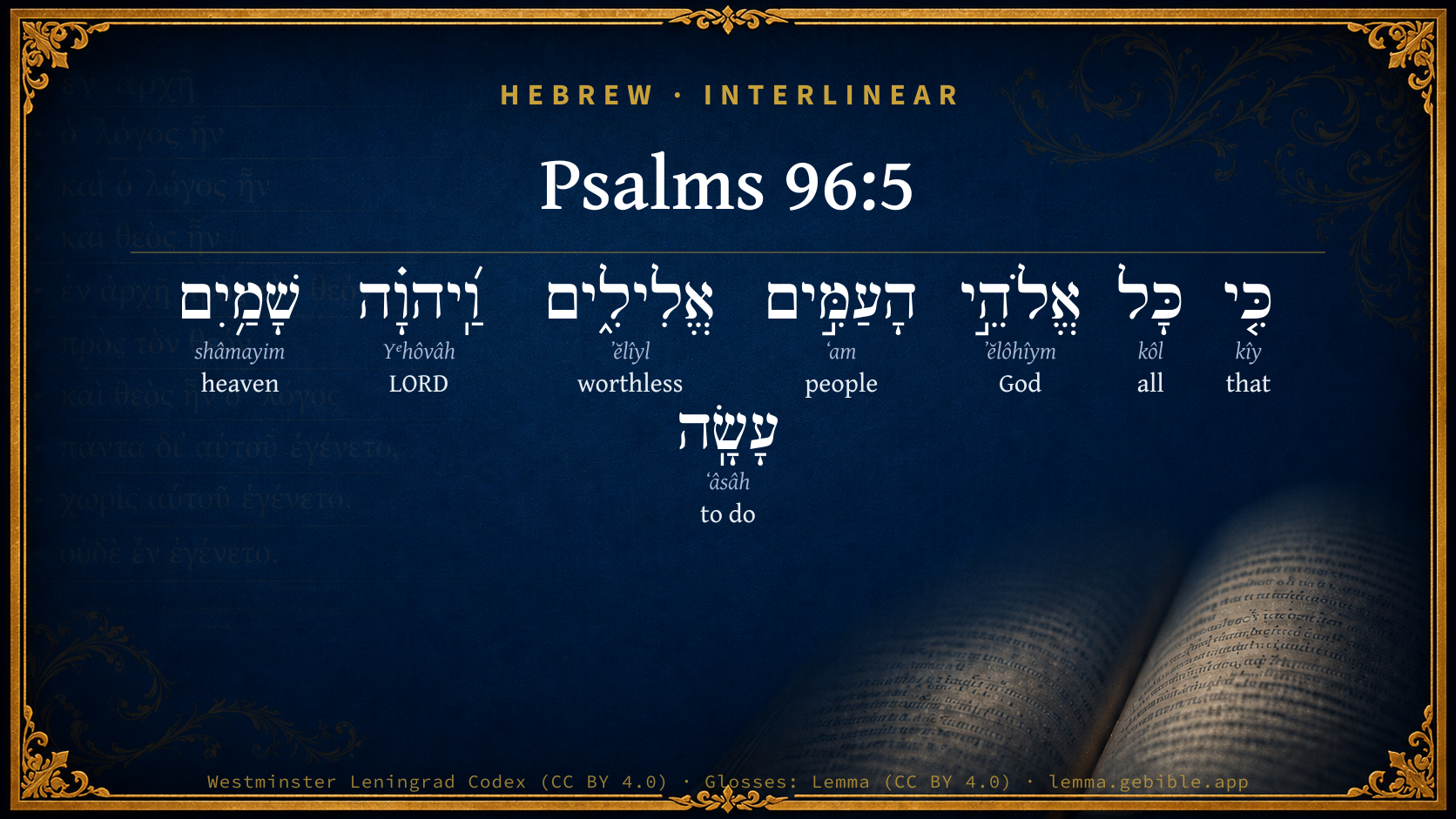
Hebrew (Westminster Leningrad Codex) Psalms 96:5 appears in the Hebrew Old Testament. The text above is from the Westminster Leningrad Codex. Each word links to its Strong’s number, a concise gloss, and parsing drawn from the Open Scriptures Hebrew Bible morphology. Click any word for its full Brown-Driver-Briggs (BDB) entry.
Download image
Cite this verse

Psalms 96:5 (World English Bible). Public Domain. Lemma interlinear Bible study tool, https://lemma.gebible.app/v/psalms/96/5.

Show BibTeX & RIS
BibTeX
RIS
English Translation
For all the gods of the peoples are idols, But Yahweh made the heavens.
World English Bible · Public Domain
Download a study sheet

One document with this verse’s original text, its word-by-word gloss line, the meaning frame, cross-references with their text, attributed commentary, and full source and license credits — printable, and it pastes into notes with its structure intact.

This verse Autodidact and up

Study sheet (.html) Plain text (.txt)

A passage Seminary Student

Up to 50 verses in one chapter. A passage sheet keeps up to 6 commentary sources and 12 cross-references per verse, in the order this page ranks them, and says so on the sheet whenever that leaves anything out. Ask for a single verse and you get the Autodidact verse sheet above.

Everything on this page stays free to read, with no account — the sheet is a download of what is already on screen, not access to it.

Want to remove ads? Support Godless Engineer
Compare translations 3

The same verse in 3 English versions, stacked beneath the original-language interlinear above. Click any original word for its lexicon entry.

Each is an independent rendering of the whole verse — the interlinear is not word-aligned to these translations.

Highlighted words mark where these versions differ — a whole-verse word diff, not a word-by-word alignment.

  • World English Bible Public Domain
    For all the gods of the peoples are idols, But Yahweh made the heavens.
  • King James Version Public Domain
    For all the gods of the nations are idols: but the LORD made the heavens.
  • unfoldingWord Literal Text CC BY-SA 4.0
    For all the gods of the peoples are idols, but Yahweh made the heavens.

unfoldingWord Literal Text — © unfoldingWord, licensed CC BY-SA 4.0. Word-aligned USFM3 via Door43 (git.door43.org/unfoldingWord/en_ult).

Versions to compare (up to 4)

3 of 4 selected

Show all 18 translations

Every available English version of this verse, each an independent rendering of the whole verse.

  • World English Bible Public Domain
    For all the gods of the peoples are idols, But Yahweh made the heavens.
  • Berean Standard Bible Public Domain
    For all the gods of the nations are idols, but it is the LORD who made the heavens.
  • Majority Standard Bible Public Domain
    For all the gods of the nations are idols, but it is the LORD who made the heavens.
  • King James Version Public Domain
    For all the gods of the nations are idols: but the LORD made the heavens.
  • American Standard Version (1901) Public Domain
    For all the gods of the peoples are idols; But Jehovah made the heavens.
  • Revised Version (1885) Public Domain
    For all the gods of the peoples are idols: but the LORD made the heavens.
  • Geneva Bible (1599) Public Domain
    For all the gods of the people are idoles: but the Lord made the heauens.
  • Douay-Rheims (1899) Public Domain
    For all the gods of the Gentiles are devils: but the Lord made the heavens.
  • Young's Literal Translation Public Domain
    For all the gods of the peoples `are' nought, And Jehovah made the heavens.
  • Literal Standard Version CC BY-SA 4.0
    For all the gods of the peoples [are] nothing, || And YHWH made the heavens.
  • Unlocked Literal Bible CC BY-SA 4.0
    For all the gods of the nations are idols, but it is Yahweh who made the heavens.
  • unfoldingWord Literal Text CC BY-SA 4.0
    For all the gods of the peoples are idols, but Yahweh made the heavens.
  • Darby Bible Public Domain
    For all the gods of the peoples are idols; but Jehovah made the heavens.
  • World Messianic Bible Public Domain
    For all the gods of the peoples are idols, but the LORD made the heavens.
  • Webster's Bible Public Domain
    For all the gods of the nations are idols: but the LORD made the heavens.
  • Free Bible Version CC BY-SA 4.0
    For all the gods of other nations are idols; but the Lord made the heavens!
  • Bible in Basic English Public Domain
    For all the gods of the nations are false gods; but the Lord made the heavens.
  • JPS Tanakh (1917) Public Domain
    For all the gods of the peoples are things of nought; but the LORD made the heavens.

Literal Standard Version (2020), Covenant Press — licensed CC BY-SA 4.0. Text via the HelloAO Bible API (eBible.org). Unlocked Literal Bible (unfoldingWord) — licensed CC BY-SA 4.0. Text via the HelloAO Bible API (eBible.org). unfoldingWord Literal Text — © unfoldingWord, licensed CC BY-SA 4.0. Word-aligned USFM3 via Door43 (git.door43.org/unfoldingWord/en_ult). Free Bible Version, Dr. Jonathan Gallagher — licensed CC BY-SA 4.0. Text via the HelloAO Bible API (eBible.org).

Word by word

More ways to search: Search by grammar → Find every occurrence → Compare this word →

Practice this passage: Drill this verse → Learn its vocabulary →

About this verse

These counts appear in no published source. They are computed here, from the morphology-tagged text and Lemma’s own curated glosses. What Lemma adds →

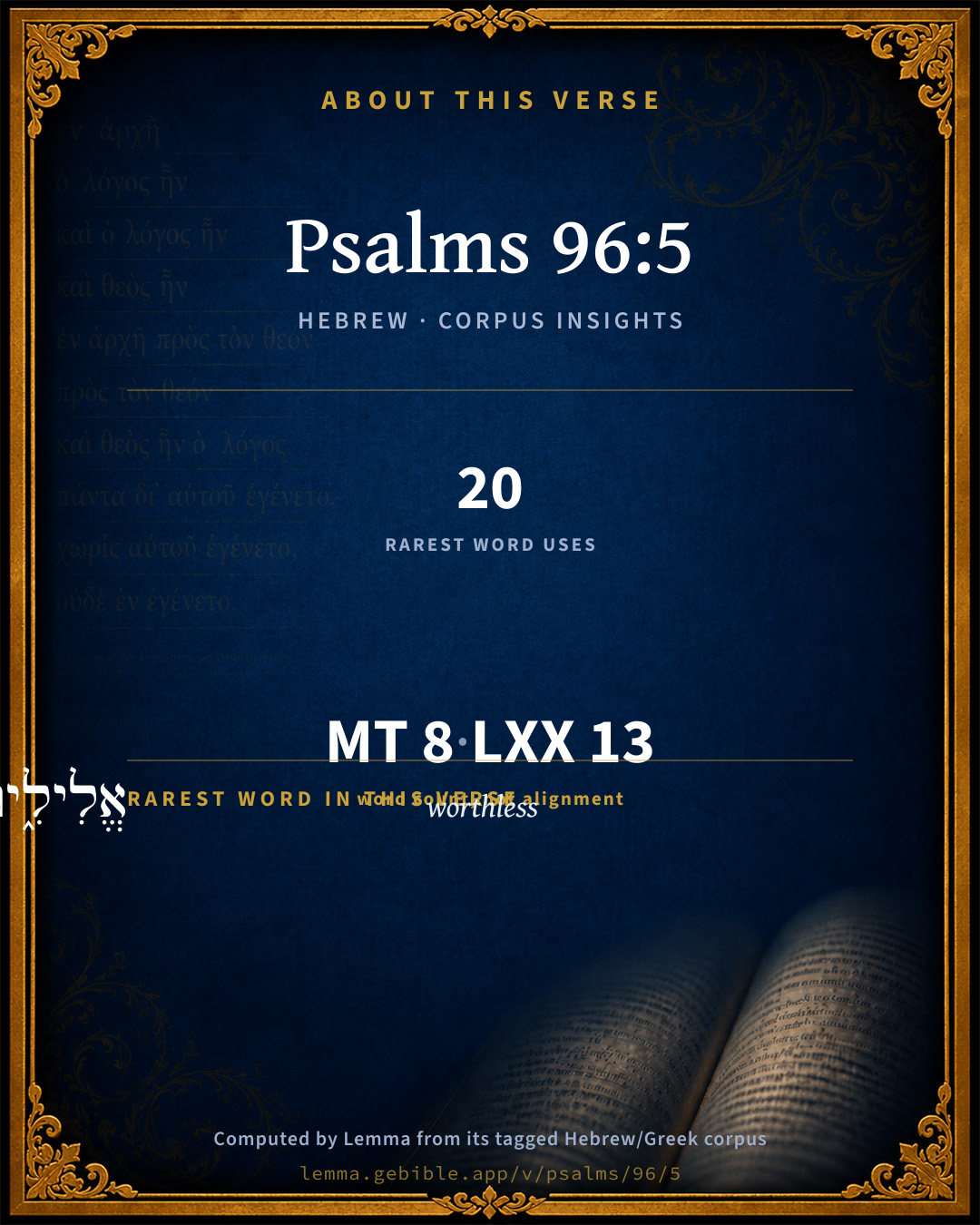
8
words
8
distinct lemmas
Wisdom
section

Notable vocabulary

The rarest word here is אֱלִילִ֑ים worthless H457 — appearing just 20 times in the whole Hebrew Bible.

Shared distinctive vocabulary

אֱלִילִ֑ים worthless H457 occurs in 18 verses of the Hebrew Bible. Also found in:

Grammatical profile

  • 1 verb
  • 6 nouns
  • 1 conjunction

Verb forms

  • עָשָֽׂה Qal · Perfect

Hebrew & Septuagint length

In English translation the verse runs 14 words from the Hebrew and 15 from the Septuagint (LXX English) — closely comparable.

A rough comparison of the two English renderings, which tokenize alike — not a word-level alignment.

Word counts can differ between the Hebrew and the Greek without any difference in meaning — e.g. the Hebrew direct-object marker אֵת has no separate Greek word, and Greek often adds the article ὁ.

In the original languages it is 8 Hebrew tokens and 13 Greek tokens — but the two are counted differently (Hebrew bundles its prefixes and suffixes into one token; the Greek is in lemma form), so that isn’t a like-for-like length.

Cross-references

13

Topical passages linked to Psalms 96:5 in the Treasury of Scripture Knowledge — connected by theme and wording, ordered by reader-vote popularity; previews shown in the World English Bible.

  • Psalms 115:15 Blessed are you by Yahweh, Who made heaven and earth.
  • Isaiah 42:5 Thus says God Yahweh, he who created the heavens, and stretched them forth; he who spread abroad the earth and that which comes out of it; he who gives breath to the people on it, and spirit to those who walk therein:
  • Psalms 135:18 Those who make them will be like them; Yes, everyone who trusts in them.
  • Jeremiah 10:11–12 Thus shall you say to them, The gods that have not made the heavens and the earth, these shall perish from the earth, and from under the heavens.
  • 1 Corinthians 8:4 Therefore concerning the eating of things sacrificed to idols, we know that no idol is anything in the world, and that there is no other God but one.
  • Genesis 1:1 In the beginning God created the heavens and the earth.
  • Psalms 115:3–8 But our God is in the heavens. He does whatever he pleases.
  • Psalms 135:15 The idols of the nations are silver and gold, The work of men's hands.
  • Isaiah 44:8–28 Don't fear, neither be afraid: haven't I declared to you of old, and shown it? You are my witnesses. Is there a God besides me? Indeed, there is not. I don't know any Rock.
  • Isaiah 46:1–2 Bel bows down, Nebo stoops; their idols are on the animals, and on the cattle: the things that you carried about are made a load, a burden to the weary [animal].
  • Jeremiah 10:3–5 For the customs of the peoples are vanity; for one cuts a tree out of the forest, the work of the hands of the workman with the axe.
  • Jeremiah 10:14–15 Every man is become brutish [and is] without knowledge; every goldsmith is disappointed by his engraved image; for his molten image is falsehood, and there is no breath in them.
  • Acts 19:26 You see and hear, that not at Ephesus alone, but almost throughout all Asia, this Paul has persuaded and turned away many people, saying that they are no gods, that are made with hands.

Cross-references courtesy of OpenBible.info (CC BY 4.0).

Hebrew and Greek witnesses Masoretic Hebrew ↔ Greek Septuagint

The same verse in the two great witnesses to the Old Testament, shown verse-for-verse.

You’re reading Greek Psalm 95 (Hebrew Psalm 96). The Septuagint counts the superscription, so verse numbers can differ from the Hebrew — chapter-level alignment, not verse-by-verse. Numbering follows Rahlfs.

These are two independent witnesses, not word-aligned to each other, and the Septuagint is shown in lemma (dictionary) form.

Hebrew Psalms 96:5 Masoretic · Westminster Leningrad Codex

כִּ֤י כָּל אֱלֹהֵ֣י הָעַמִּ֣ים אֱלִילִ֑ים וַֽ֝יהוָ֗ה שָׁמַ֥יִם עָשָֽׂה

For all the gods of the peoples are idols, But Yahweh made the heavens.

World English Bible · Public Domain

Greek LXX Greek Psalm 95:5 Septuagint · lemma form

ὅτι πᾶς ὁ θεός ὁ ἔθνος δαιμόνιον ὁ δέ κύριος ὁ οὐρανός ποιέω

For all the gods of the heathen are devils: but the Lord made the heavens.

LXX2012 (modern English Septuagint) · Public Domain

On this verse, Ellicott's Commentary for English Readers discusses the Septuagint’s reading. Read the note in Commentary ↓

Hebrew: Westminster Leningrad Codex (CC BY 4.0). Greek: Septuagint (public domain); English from LXX2012 (modern English Septuagint) (Public Domain). How the Septuagint differs from the Hebrew →

Commentary

Notes on Psalms 96:5 from classic Christian and Jewish commentators (each source and its license shown beneath its notes). The classic Christian expositions comment on the surrounding passage and are grouped to its opening verse, so a note may address several verses; the Jewish commentaries on the Tanakh (Rashi and others) are per-verse, so they appear only where the commentator wrote on this verse.

Lemma curates 59 commentaries, every one of them public domain or Creative Commons licensed, each selected and text-cleaned for this edition rather than reprinted as found. About our sources →

Trapp's Complete Commentary

John Trapp

Psa 96:5 For all the gods of the nations [are] idols: but the LORD made the heavens.

Ver. 5. For all the gods, &c.] Deunculi, deastri, those petty gods, those dunghill deities of the heathens, are nullities; indeed, they are devils, and those idols were their receptacles, and, as it were, their bodies, from whence in some places they gave oracles; but were silenced at Christ’s coming in the flesh, to the great amazement of their superstitious worshippers.

But the Lord made the heavens] With singular artifice, Heb 11:10, using παση σοφιας μηχανη, every engine of wisdom (Clem. Alex. Paid. l. 1. c. 9).

John Trapp, A Commentary or Exposition upon All the Books of the Old and New Testament (1647–1656) — public domain. Text from a community e-Sword module.

The Treasury of David

Charles H. Spurgeon

Ver. 5. For all the gods of the nations are idols. Mere images of wood and stone, vanities, nothings.

But the Lord made the heavens. The reality of his Godhead is proved by his works, and foremost among these the psalmist mentions that matchless piece of architecture which casts its arch over every man's head, whose lamps are the light of all mankind, whose rains and dew fall upon the fields of every people, and whence the Lord in voice of thunder is heard speaking to every creature. The idol gods have no existence, but our God is the author of all existences; they are mere earthly vanities, while he is not only heavenly, but made the heavens. This is mentioned as an argument for Jehovah's universal praise. Who can be worshipped but he? Since none can rival him, let him be adored alone.

Ver. 5. For all the gods of the nations are idols. Nothings, nonentities, a favourite description of idols in Isaiah's later prophecies. See eg Isa 41:24, and compare Le 19:4 26:1, 1Co 8:4-6 10:19. A less probable etymology of the Hebrew word makes it a diminutive of (la) El, analogous to godlings as an expression of contempt. J. A. Alexander.

Ver. 5. The gods of the nations are idols. Their Elohim are elilim. See 1Ch 16:26. The word elilim occurs in two places in the Psalms, here and Ps 97:7. It is used most frequently by Isaiah, and properly signifies nothings, as St. Paul says, "an idol is nothing." (1Co 8:4.) Chr. Wordsworth.

Ver. 5. The Lord made the heavens. Ps 96:5 is a notandum. What a tribute to astronomy is it that the Lord is so often done homage to as having made the heavens! Let the theology of nature be blended with the theology of consciencea full recognition of the strength and the glory which shine palpably forth in the wonders of creation, with the spiritual offerings of holy worship and holy service. Thomas Chalmers.

Psalms 96:6*

Charles H. Spurgeon's The Treasury of David (1869–1885) — public domain. Psalms only. Text from a community e-Sword/MySword module.

J. A. Alexander on Psalms

Joseph Addison Alexander

5. (Psa 96:5) For all the gods of the nations are nothings, and Jehovah the heavens did make. Nothings, nonentities, a favourite description of idols in Isaiah's later prophecies. See e.g. Isa 41:24, and compare Lev 19:4; Lev 26:1, 1Co 8:4-6; 1Co 10:19. A less probable etymology of the Hebrew word makes it a diminutive of El, analogous to godlings, as an expression of contempt. The contrast intended is extreme and absolute. He called the world into existence; they do not even exist themselves. See above, Psa 95:4.

Joseph Addison Alexander, The Psalms Translated and Explained (1850) — public domain. Text from a community e-Sword module.

Tyndale Open Study Notes

Tyndale Open Resources

96:5 The Lord made the heavens, an even greater task than creating the earth. The idols, made by human hands (115:4), created nothing.

Tyndale Open Study Notes — © Tyndale Open Resources, licensed CC BY-SA 4.0. Text via the HelloAO Bible API.

Geneva Bible (1599)

Geneva Bible translators

Or, vanities.

Then the idols, or whatsoever made not the heavens, are not God.

Geneva Bible (1599) marginal notes — public domain. Text via Bolls.life.

Adam Clarke's Commentary

Verse 5. All the gods of the nations are idols] אלהי elohey. All those reputed or worshipped as gods among the heathens are אלילים elilim, vanities, emptinesses, things of nought. Instead of being Elohim, they are elilim; they are not only not GOD, but they are nothing." "Jehovah made the heavens." He who is the creator is alone worthy of adoration.

Adam Clarke's Commentary on the Bible (1810–1826) — public domain. Text from a community e-Sword/MySword module.

Ellicott's Commentary for English Readers

(5) Idols.—Literally, nothings; Heb., elîlîm, with a play on the word el, God. This plainly shows that by Gods, in Psa_96:4, the heathen deities, and not angels, are meant. (See Note, Psa_95:3.) The LXX. sometimes renders the Hebrew word “idols,” sometimes “vanities,” but here “demons.” Symmachus “nonexistences.”

But the Lord made the heavens.—Nothings could not do that, but only Jehovah.

A Bible Commentary for English Readers, edited by Charles John Ellicott (1878–1897) — public domain. Text from a community e-Sword module.

The Cambridge Bible for Schools and Colleges

gen. ed. J. J. S. Perowne

5. For all the gods of the peoples are things of nought [or, idols]; powerless, nay, non-existent. Cp. the argument of Isa_40:18 ff; Isa_44:9 ff.

but the Lord &c.] The appeal to the works of creation as a proof of Jehovah’s power occurs frequently in Isaiah 40-66. See Isa_40:22; Isa_42:5; Isa_44:24.

The Cambridge Bible for Schools and Colleges (gen. ed. J. J. S. Perowne; Cambridge University Press, 1878–1918) — public domain. Text from a community e-Sword module.

John Gill's Exposition

For all the gods of the nations are idols,.... Or are "nothings" (o), nonentities; such as have not, and never had, any being, at least many of them, but in the fancies of men; and all of them such as have no divinity in them;

an idol is nothing in the world, Co1 8:4,

but the Lord made the heavens; and all the hosts of them, the sun, moon, and stars; these are the curious workmanship of his fingers, and which declare his glory, and show him to be truly and properly God, who is to be feared and worshipped; see Heb 1:10.

(o) "nihila", Tigurine version, Cocceius, Michaelis.

John Gill's Exposition of the Whole Bible (1746–1763) — public domain (CC PDM 1.0). Text via the HelloAO Bible API.

Albert Barnes' Notes on the Bible

For all the gods of the nations are idols - All the gods worshipped by the people of other lands are mere “idols.” None of them can claim to have a real existence as gods. The word here rendered “idols” is translated by the Septuagint, δαιμόνια daimonia, “demons.” So the Latin Vulgate “daemonia.” The Hebrew word - אליל 'ĕlı̂yl - means properly “of nothing, nought, empty, vain.” See Job 13:4. The meaning here is, that they were mere nothings; they had no real existence; they were the creations of the imagination; they could not in any sense be regarded as what it was pretended they were; they had no claim to reverence and worship as gods. Of most of them it was a fact that they had no existence at all, but were mere creatures of fancy. Of those that did really exist, as the sun, moon, stars, animals, or the spirits of departed people, though it was true that they had an actual existence, yet it was also true that they had no existence “as gods,” or as entitled to worship; and hence, it was also true that the worship offered to them was as vain as that which was offered to mere beings of the imagination. This verse is extracted literally from 1Ch 16:26. The Hebrew is the same.

But the Lord made the heavens - Yahweh created the heavenly hosts, and therefore he is the true God, and is entitled to worship. The power of “creation” - of causing anything to exist where there was nothing before - must pertain to God alone, and is the highest act of Divinity. No pretended pagan god has that power; no man has that power. The true God has reserved the exercise of that power to himself, and has never, in any instance, imparted it to a created being.

Albert Barnes' Notes on the Bible (1834–1885) — public domain. Text from a community e-Sword/MySword module.

Matthew Poole's English Annotations

Idols; or, nothings, as they are called, 1Co 8:4; 10:19; or, vain things, as the word signifies, and is translated by others. The sense is, Though they have usurped the name and place of the Divine Majesty, yet they have nothing of his nature or power in them.

Matthew Poole's English Annotations on the Holy Bible (1683–1685) — public domain. Text from a community e-Sword/MySword module.

Whedon's Commentary on the Bible

Daniel D. Whedon

5. Idols—The name is one of contempt: אלילים(eleeleem,) images, nothings, vanities, in opposition to אלהים, (Eloheem,) God. The former word is a play upon the latter, (by paronomasia;) by altering the letters a little the similarity of sound is retained with a sense satirically opposite. Thus, the heathen gods are called “no gods,” (2Ch_13:9,) in opposition to the true God, (chap. Psa_15:3;) “nothing,” (1Co_8:4,) “vanity,” (Jer_14:22,) and “devils,” from the character and effect of their worship. 1Co_10:19-20; Rev_9:20.

The Lord made the heavens—He is to be judged of by his works. They are his “glory,” his “wonders,” (Psa_96:3,) and the appeal is made to show that the Author of nature and of salvation is one and the same God. Psa_95:4-5

Daniel D. Whedon (gen. ed.), Commentary on the Old and New Testaments (1874–1909) — public domain. Text from a community e-Sword module.

The Pulpit Commentary

For all the gods of the nations are idols; rather, vanities, or nothings. In the original there is a play upon the words the elohim of the nations are mere elilim. Elilim is a favourite designation of the heathen gods in Isaiah. Compare the statement of St. Paul, "We know that an idol is nothing in the world". (1Co_8:4) But the Lord made the heavens. That which is nothing can do nothing, can make nothing. How far superior is Jehovah, who "made the heavens"! (comp. Gen_1:1 Isa_42:5 Isa_44:24)

Idolatry.

Thus it was three thousand years ago. Thus, to an extent as astounding as melancholy, it is today. Population of globe estimated at fourteen hundred millions; if so, one thousand millions heathen. Considering the prevalence, permanence, antiquity, of idolatry, that these words and many like these should have been written when and where they were, is no unsubstantial proof of the superhuman authorship, Divine inspiration, of Old Testament Scriptures. History presents no more impressive and significant sight than that of the little nation of Israel, holding a tiny corner of earth not twice the size of Yorkshire, hemmed in by mighty empires and ancient civilizations, often crushed by their irresistible weight; with absolutely no advantage over other peoples in the struggle for life, save their religion; yet maintaining for fifteen centuries their single-handed witness to the foundation-truth of religion, and protest against the perverted faiths of the world.

(1) The causes of idolatry;

(2) its evil;

(3) our duty.

I THE CAUSES OF IDOLATRY. How to account for this terrible and amazing fact the widespread, long continued prevalence of idolatry? No single origin can be historically verified. Worship of forces and forms of nature, of ancestors, of deified heroes, of symbols or personified attributes, of partial and degraded conceptions of the one living God, or fading traditions of his worship, all these have their place in the labyrinth of the history of national faiths. The theory propounded with immense assurance and eclat a generation ago, that fetishism was the parent of polytheism, and the worship of many gods crystallized into the worship of One, has shared the fate of theories which facts are forced or invented to fit, in place of theory being fitted to fact. Degraded superstitions of barbarous nations have the clear marks of being dust and dregs of ruined faiths (most striking illustration in the history of Madagascar, where proverbs still bore witness to God, while idols were bundles of sticks and rags). American Indians (types, according to Sir W. Dawson, of pre-historic men), among remnants of decayed civilization, have preserved the ancient faith in "the Great Spirit." Greece and India bear witness to the fact that the worship of nature preceded that of deities in human shape. In China, where the emperor once a year publicly worships "the God of heaven," and where worship of ancestors is the strongest form of religion, Buddhism, dating only some five centuries B.C. at first a system of atheistic morality has been transformed into idolatry. The two most amazing proofs of the all but irresistible tendency of human nature are found in the history of Israel and the history of Christianity. From the time of Joshua"s successors to the Babylonian Captivity, the incurable propensity of rulers and people to idolatry is scarcely a less striking feature of Israel"s history than the steadfast witness of the prophets and of the faithful remnant against it and on behalf of the truth. Christianity itself, whose glorious message to the heathen was to turn from dumb idols to the living God, became in five centuries so encrusted with the worship of saints, the Virgin, the Host, relics, images, that when Mohammed drew the sword against idolatry, he reckoned Christians among idolaters. What is, then, the explanation? We find in it

(1) man"s need of worship his "feeling after God.

(2) In all which makes men shrink from worshipping the Holy One, who says to his worshippers, "Be ye holy, for I am holy." St. Paul gives the true philosophy of religion. (Rom_1:18-25)

II THE EVIL OF IDOLATRY. People ask Is not this greatly overrated? Does there not lie in the heart of idolatry a craving after God? Is it not better to worship an idol (as a symbol, it may be, of an unseen power) than not to worship at all blind reverence better than none? Answer: Granting this, it does not change the fact that idolatry has death at its root, and death as its fruit. (Jer_2:13) Blind reverence brings no fruit of blessing into life, pardon, love of goodness, strength for duty, comfort in trouble, moral renewal, or spiritual life. To be Godless is to be Christless, hopeless. (Eph_2:12) False substitutes for God do not prepare the heart to know and love him, but harden and close it against his voice. And for the most part idolatry brings the grossest immorality in its train.

III THE DUTY, therefore, of delivering from the curse of blind, false, degrading worship a thousand millions of mankind, and spreading in its place the true knowledge of the ever-living Creator, the Father of spirits, and the glad tidings of reconciliation to him, and life eternal, as his children by faith in Christ Jesus, is one of the noblest, happiest, most imperative, to which Christians are called.

The God of heaven.

This seems to have been the Babylonian name for the God of the Jews. "Lord of heaven;" "King of heaven." It expresses the apprehension gained by the Babylonians. (see Nebuchadnezzar"s acknowledgment, Dan_5:3-7) It intimates that Jehovah, though an all-powerful God, was in no sense a local God, with a limited kingdom and ordinary earthly claims. To call God the "God of heaven" is at least making a beginning towards the realization of him as spiritual.

I GODS OF EARTH. Explain the strictly local and limited area of the kingdoms possessed by idol gods. Bel belonged to Babylon; Ra to Egypt. There were "gods of the hills and gods of the valleys." There were distinct conceptions of, and representations of, Baal for each country and almost for each city. Jealous over their own particular divinity, no missionary idea found place in the ancient world. Nobody wanted to share his god with any one else. (A striking exception to this is found in the proselyting spirit of Jezebel) Curiously, the god of the limited district was conceived as almighty within his limits. Even when the world conquering idea took possession of nations, such as Assyria, Babylonia, Persia, Grecia, Rome, in no case did propagating the religion become a primary inspiration. The conquerors freely left the conquered their local religion. So we can see the force with which the local limitations of the gods took possession of the ancient mind.

II GOD OF HEAVEN. Observe the strong contrast. Jehovah is unlocalized, above earth, and doming all the earth. It is impossible to express, not only the superiority, but also the essential difference, of Jehovah in more brief and succinct terms. Down on earth, a multitude of small spaces, each with a petty deity. Up above, ruling from rim to rim, the one eternal God. The all-hallowing dome is heaven. This was more strikingly apprehended when the prevailing idea was that earth was a flat surface, with the blue heaven fitting to it like the cover of a dish. Work out these points concerning the "God of heaven.

1. His forces are not exclusively material. He does control the material, but he commands the spiritual.

2. His forces are working universally. We can think of no sphere in which we may not find their operation.

3. His forces claim for him universal recognition. See how the Christian revelation has taken this figure for God, and glorified it. R.T.

The Pulpit Commentary (1880–1919), ed. H.D.M. Spence-Jones & Joseph S. Exell — public domain. Text from a community e-Sword module.

unfoldingWord translationNotes

Door43 World Missions Community

in his presence

"where he is"

Splendor and majesty are in his presence

The psalmist speaks as if splendor and majesty are people who can stand before a king. AT: "Everyone knows of his splendor and majesty" (See: Personification)

Strength and beauty are in his sanctuary

The words "strength" and "beauty" are metonyms for the ark of the covenant decrees, which is found in the sanctuary. AT: "It is his sanctuary that contains the ark of the covenant decrees" (See: Metonymy)

translationWords

false god

false god

heaven

splendor

majesty

sanctuary

unfoldingWord translationNotes — © Distant Shores Media and the Door43 World Missions Community, licensed CC BY-SA 4.0. Source: git.door43.org/Door43/en_tn.

Lesson kit

Teaching starters — assembled from the data on this page, not authored interpretation. Every prompt links to the verse data it draws on. Edit before teaching.

Psalms, in the Wisdom, opens this verse with 8 words (8 distinct Hebrew lemmas). Its most distinctive word is ʼĕlîyl (“worthless”). A historical commentator’s framing appears above. Read the whole chapter for the surrounding context.

Discussion questions

  1. What does “worthless” (ʼĕlîyl) contribute to the verse as a whole?
  2. Leviticus 19:4 shares the word «worthless» with this verse. How do the two illuminate each other?
  3. These translations render this verse differently; the difference is in the English rendering, not the original. What questions does that raise?
  4. The verb «עָשָֽׂה» is Qal Perfect. How does its form color the action?
  5. Reading how Trapp's Complete Commentary and The Treasury of David read this verse, where do the two commentators agree and where do they part?

Things to notice

Reading settings

Reading text

Shown beneath each verse's original-language words.

Old Testament
Old Testament edition

Read the OT as the Masoretic Hebrew (MT) or the Greek Septuagint (LXX).

English shown for the Greek Septuagint (in the Hebrew ↔ Greek comparison).

Comparing translations? Open the Compare panel on any verse page to stack up to four side by side.