
Psalms 56:7

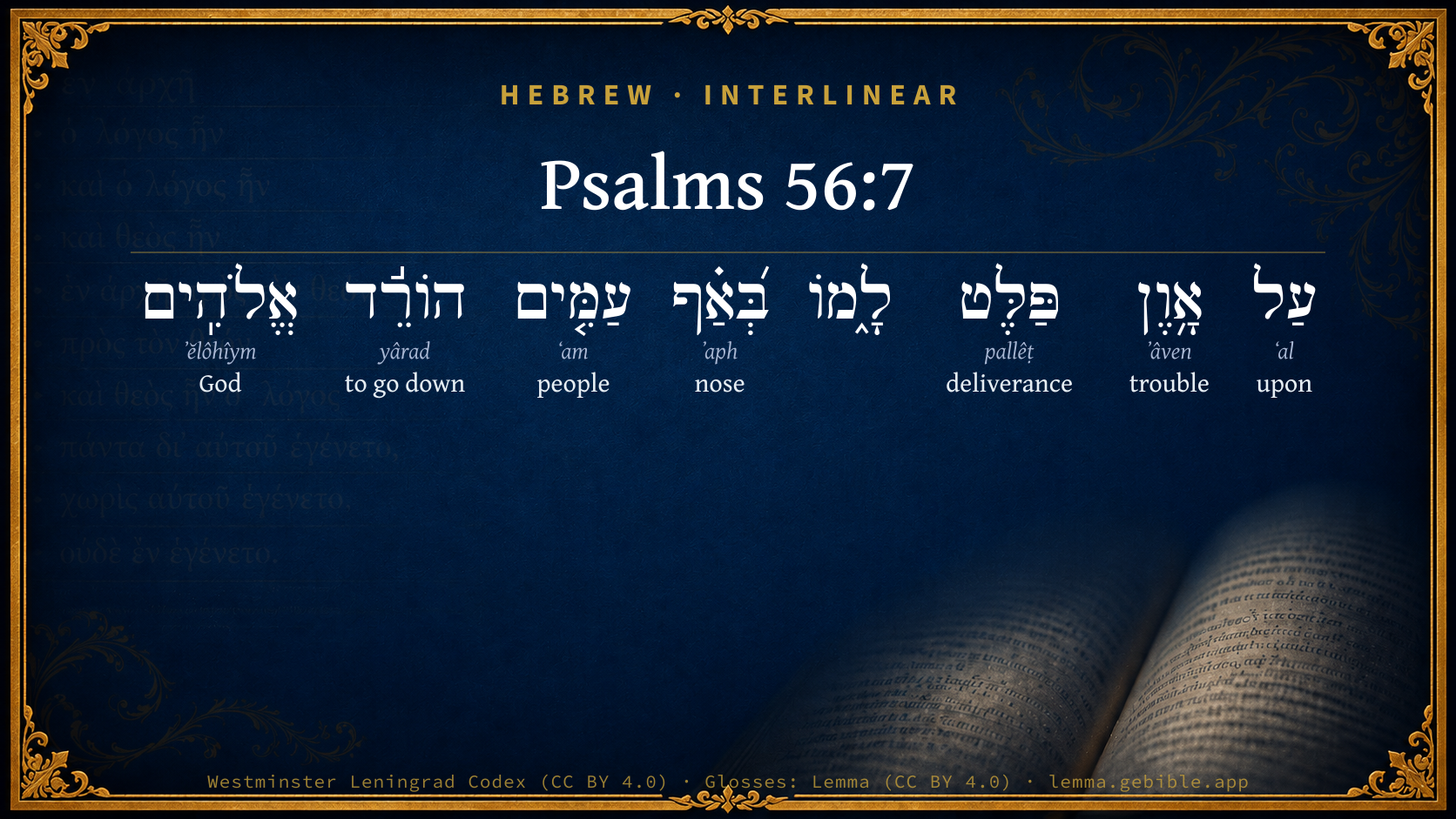
Hebrew (Westminster Leningrad Codex) Psalms 56:7 appears in the Hebrew Old Testament. The text above is from the Westminster Leningrad Codex. Each word links to its Strong’s number, a concise gloss, and parsing drawn from the Open Scriptures Hebrew Bible morphology. Click any word for its full Brown-Driver-Briggs (BDB) entry.
Download image
Cite this verse

Psalms 56:7 (World English Bible). Public Domain. Lemma interlinear Bible study tool, https://lemma.gebible.app/v/psalms/56/7.

Show BibTeX & RIS
BibTeX
RIS
English Translation
Shall they escape by iniquity? In anger cast down the peoples, God.
World English Bible · Public Domain
Download a study sheet

One document with this verse’s original text, its word-by-word gloss line, the meaning frame, cross-references with their text, attributed commentary, and full source and license credits — printable, and it pastes into notes with its structure intact.

This verse Autodidact and up

Study sheet (.html) Plain text (.txt)

A passage Seminary Student

Up to 50 verses in one chapter. A passage sheet keeps up to 6 commentary sources and 12 cross-references per verse, in the order this page ranks them, and says so on the sheet whenever that leaves anything out. Ask for a single verse and you get the Autodidact verse sheet above.

Everything on this page stays free to read, with no account — the sheet is a download of what is already on screen, not access to it.

Want to remove ads? Support Godless Engineer
Compare translations 3

The same verse in 3 English versions, stacked beneath the original-language interlinear above. Click any original word for its lexicon entry.

Each is an independent rendering of the whole verse — the interlinear is not word-aligned to these translations.

Highlighted words mark where these versions differ — a whole-verse word diff, not a word-by-word alignment.

  • World English Bible Public Domain
    Shall they escape by iniquity? In anger cast down the peoples, God.
  • King James Version Public Domain
    Shall they escape by iniquity? in thine anger cast down the people, O God.
  • unfoldingWord Literal Text CC BY-SA 4.0
    Upon iniquity an escape for them? In nose, make the peoples go down, God.

unfoldingWord Literal Text — © unfoldingWord, licensed CC BY-SA 4.0. Word-aligned USFM3 via Door43 (git.door43.org/unfoldingWord/en_ult).

Versions to compare (up to 4)

3 of 4 selected

Show all 18 translations

Every available English version of this verse, each an independent rendering of the whole verse.

  • World English Bible Public Domain
    Shall they escape by iniquity? In anger cast down the peoples, God.
  • Berean Standard Bible Public Domain
    In spite of such sin, will they escape? In Your anger, O God, cast down the nations.
  • Majority Standard Bible Public Domain
    In spite of such sin, will they escape? In Your anger, O God, cast down the nations.
  • King James Version Public Domain
    Shall they escape by iniquity? in thine anger cast down the people, O God.
  • American Standard Version (1901) Public Domain
    Shall they escape by iniquity? In anger cast down the peoples, O God.
  • Revised Version (1885) Public Domain
    Shall they escape by iniquity? in anger cast down the peoples, O God.
  • Geneva Bible (1599) Public Domain
    They thinke they shall escape by iniquitie: O God, cast these people downe in thine anger.
  • Douay-Rheims (1899) Public Domain
    They will dwell and hide themselves: they will watch my heel. As they have waited for my soul,
  • Young's Literal Translation Public Domain
    By iniquity they escape, In anger the peoples put down, O God.
  • Literal Standard Version CC BY-SA 4.0
    They escape by iniquity, || In anger put down the peoples, O God.
  • Unlocked Literal Bible CC BY-SA 4.0
    Do not let them escape doing iniquity. Bring down the peoples in your anger, God.
  • unfoldingWord Literal Text CC BY-SA 4.0
    Upon iniquity an escape for them? In nose, make the peoples go down, God.
  • Darby Bible Public Domain
    Shall they escape by iniquity? In anger cast down the peoples, O God.
  • World Messianic Bible Public Domain
    Shall they escape by iniquity? In anger cast down the peoples, God.
  • Webster's Bible Public Domain
    \\56:6\\They assemble themselves, they hide themselves, they mark my steps, when they wait for my soul.
  • Free Bible Version CC BY-SA 4.0
    Will they escape when they do so much evil? God, in anger bring these people down!
  • Bible in Basic English Public Domain
    By evil-doing they will not get free from punishment. In wrath, O God, let the peoples be made low.
  • JPS Tanakh (1917) Public Domain
    (56-8) Because of iniquity cast them out; in anger bring down the peoples, O God.

Literal Standard Version (2020), Covenant Press — licensed CC BY-SA 4.0. Text via the HelloAO Bible API (eBible.org). Unlocked Literal Bible (unfoldingWord) — licensed CC BY-SA 4.0. Text via the HelloAO Bible API (eBible.org). unfoldingWord Literal Text — © unfoldingWord, licensed CC BY-SA 4.0. Word-aligned USFM3 via Door43 (git.door43.org/unfoldingWord/en_ult). Free Bible Version, Dr. Jonathan Gallagher — licensed CC BY-SA 4.0. Text via the HelloAO Bible API (eBible.org).

Word by word

More ways to search: Search by grammar → Find every occurrence → Compare this word →

Practice this passage: Drill this verse → Learn its vocabulary →

About this verse

These counts appear in no published source. They are computed here, from the morphology-tagged text and Lemma’s own curated glosses. What Lemma adds →

8
words
7
distinct lemmas
Wisdom
section

Notable vocabulary

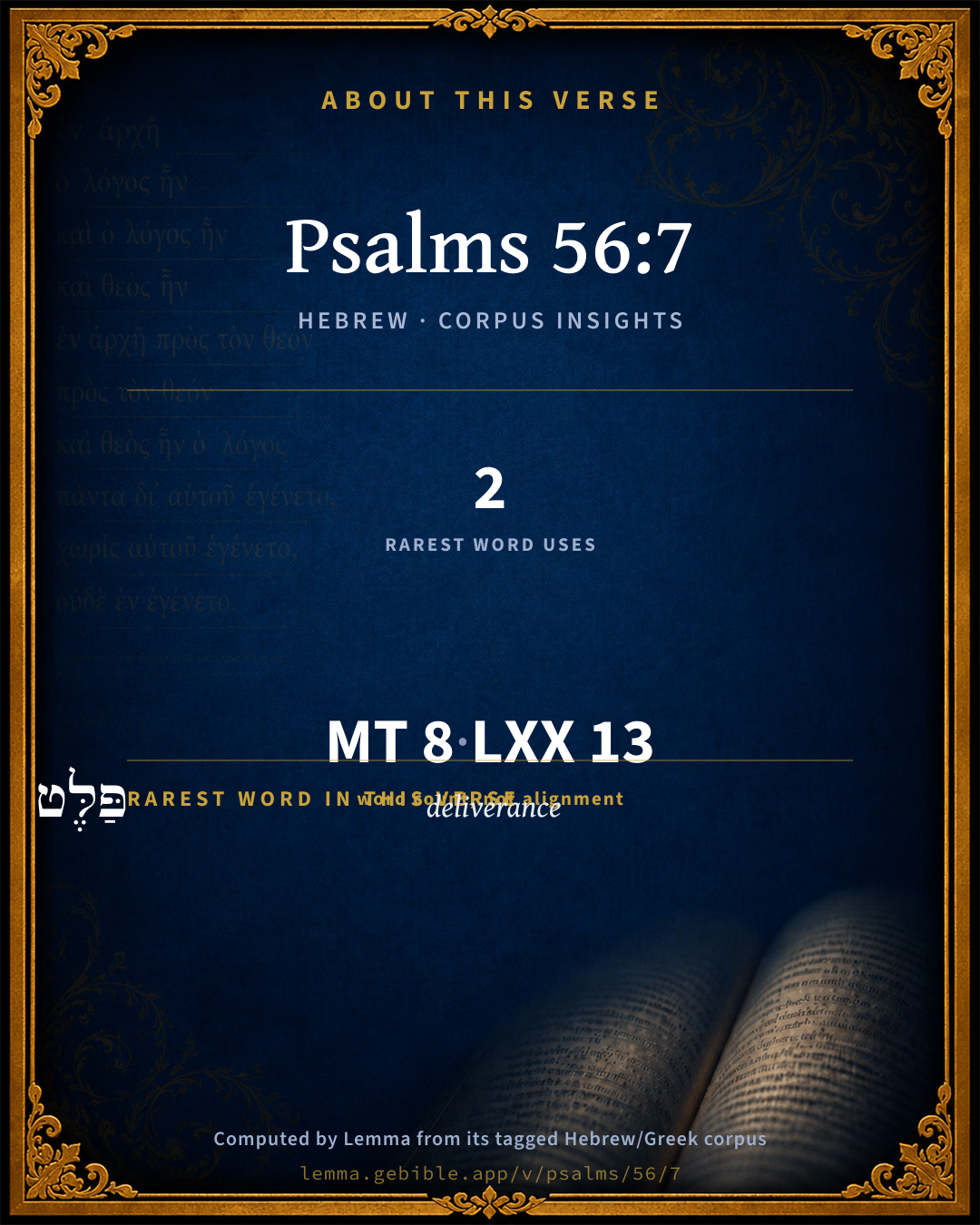
The rarest word here is פַּלֶּט deliverance H6405 — appearing just 2 times in the whole Hebrew Bible.

Shared distinctive vocabulary

פַּלֶּט deliverance H6405 occurs in 2 verses of the Hebrew Bible. Also found in:

Grammatical profile

  • 2 verbs
  • 4 nouns
  • 2 prepositions

Verb forms

  • פַּלֶּט Piel · Imperative
  • הוֹרֵ֬ד Hiphil · Imperative

Hebrew & Septuagint length

In English translation the verse runs 12 words from the Hebrew and 15 from the Septuagint (LXX English) — closely comparable.

A rough comparison of the two English renderings, which tokenize alike — not a word-level alignment.

Word counts can differ between the Hebrew and the Greek without any difference in meaning — e.g. the Hebrew direct-object marker אֵת has no separate Greek word, and Greek often adds the article ὁ.

In the original languages it is 8 Hebrew tokens and 13 Greek tokens — but the two are counted differently (Hebrew bundles its prefixes and suffixes into one token; the Greek is in lemma form), so that isn’t a like-for-like length.

Cross-references

11

Topical passages linked to Psalms 56:7 in the Treasury of Scripture Knowledge — connected by theme and wording, ordered by reader-vote popularity; previews shown in the World English Bible.

  • Psalms 55:23 But you, God, will bring them down into the pit of destruction. Bloodthirsty and deceitful men shall not live out half their days, But I will trust in you.
  • Psalms 36:12 There the workers of iniquity are fallen. They are thrust down, and shall not be able to rise.
  • Psalms 55:9 Confuse them, Lord, and confound their language, For I have seen violence and strife in the city.
  • Psalms 55:15 Let death come suddenly on them. Let them go down alive into Sheol. For wickedness is in their dwelling, in the midst of them.
  • Psalms 94:20–21 Shall the throne of wickedness have fellowship with you, Which brings about mischief by statute?
  • Ecclesiastes 8:8 There is no man who has power over the spirit to contain the spirit; neither does he have power over the day of death. There is no discharge in war; neither shall wickedness deliver those who practice it.
  • Isaiah 28:15 Because you have said, We have made a covenant with death, and with Sheol are we at agreement; when the overflowing scourge shall pass through, it shall not come to us; for we have made lies our refuge, and under falsehood have we hid ourselves:
  • Jeremiah 7:10 and come and stand before me in this house, which is called by my name, and say, We are delivered; that you may do all these abominations?
  • Jeremiah 10:25 Pour out your wrath on the nations that don't know you, and on the families that don't call on your name: for they have devoured Jacob, yes, they have devoured him and consumed him, and have laid waste his habitation.
  • Jeremiah 18:19–23 Give heed to me, Yahweh, and listen to the voice of those who contend with me.
  • Habakkuk 1:13 You who have purer eyes than to see evil, and who cannot look on perversity, why do you tolerate those who deal treacherously, and keep silent when the wicked swallows up the man who is more righteous than he,

Cross-references courtesy of OpenBible.info (CC BY 4.0).

Hebrew and Greek witnesses Masoretic Hebrew ↔ Greek Septuagint

The same verse in the two great witnesses to the Old Testament, shown verse-for-verse.

You’re reading Greek Psalm 55 (Hebrew Psalm 56). The Septuagint counts the superscription, so verse numbers can differ from the Hebrew — chapter-level alignment, not verse-by-verse. Numbering follows Rahlfs.

These are two independent witnesses, not word-aligned to each other, and the Septuagint is shown in lemma (dictionary) form.

Hebrew Psalms 56:7 Masoretic · Westminster Leningrad Codex

עַל אָ֥וֶן פַּלֶּט לָ֑מוֹ בְּ֝אַ֗ף עַמִּ֤ים הוֹרֵ֬ד אֱלֹהִֽים

Shall they escape by iniquity? In anger cast down the peoples, God.

World English Bible · Public Domain

Greek LXX Greek Psalm 55:7 Septuagint · lemma form

παραοἰκέω καί κατακρύπτω αὐτός ὁ πτέρνα ἐγώ φυλάσσω καθάπερ ὑπομένω ὁ ψυχή ἐγώ

You will on no account save them; you will bring down the people in wrath.

LXX2012 (modern English Septuagint) · Public Domain

On this verse, Albert Barnes' Notes on the Bible discusses the Septuagint’s reading. Read the note in Commentary ↓

Hebrew: Westminster Leningrad Codex (CC BY 4.0). Greek: Septuagint (public domain); English from LXX2012 (modern English Septuagint) (Public Domain). How the Septuagint differs from the Hebrew →

Commentary

Notes on Psalms 56:7 from classic Christian and Jewish commentators (each source and its license shown beneath its notes). The classic Christian expositions comment on the surrounding passage and are grouped to its opening verse, so a note may address several verses; the Jewish commentaries on the Tanakh (Rashi and others) are per-verse, so they appear only where the commentator wrote on this verse.

Lemma curates 59 commentaries, every one of them public domain or Creative Commons licensed, each selected and text-cleaned for this edition rather than reprinted as found. About our sources →

Trapp's Complete Commentary

John Trapp

Psa 56:7 Shall they escape by iniquity? in [thine] anger cast down the people, O God.

Ver. 7. Shall they escape by iniquity?] q.d. No, let them never think it, their sin will surely find them out, as cunning as they are; and since they are so foolhardy as to walk upon iniquity’s fireworks, let them look to be blown up; and they shall have my prayers to that purpose.

In thine anger cast down, &c.] It is prophetic as well as optative.

John Trapp, A Commentary or Exposition upon All the Books of the Old and New Testament (1647–1656) — public domain. Text from a community e-Sword module.

Joseph Benson's Commentary

Psa 56:7. Shall they escape by iniquity — Shall they secure themselves by such injurious and malicious practices, whereby they do not only vex me, but provoke and despise thee? Shall they have success instead of the punishments which thou hast threatened, and they have deserved? But the words may be read without an interrogation, By their iniquity they hope to escape; or, they do escape, namely, at present: but, Lord, do not suffer them thus to escape. In thine anger cast down the people — That is, these people of whom I am speaking, namely, my malicious and wicked enemies, as well those followers of Saul, as these Philistines among whom I now am. This request is opposed to their present exultation and triumphs over him, and to their hopes and confidence of safety and success.

Joseph Benson's Commentary on the Old and New Testaments (1811–1818) — public domain. Text from a community e-Sword module.

J. A. Alexander on Psalms

Joseph Addison Alexander

8. (Psa 56:7). By iniquity (there is) escape to them; in anger bring down nations, O God! The first clause is obscure, but may mean either that they have hitherto escaped by their iniquity, or that they now depend, rely upon it for deliverance. The interrogative construction commonly adopted ought not to be assumed, in the absence of an interrogative particle, without a decided exegetical necessity. The Hebrew particle at the beginning sometimes indicates the means or instrument, with the additional idea of dependence or reliance, as in the English phrase to live on bread and water. See Gen 27:40.

Joseph Addison Alexander, The Psalms Translated and Explained (1850) — public domain. Text from a community e-Sword module.

Geneva Bible (1599)

Geneva Bible translators

They think not only to escape punishment, but the more wicked they are, the more impudent they wax.

Geneva Bible (1599) marginal notes — public domain. Text via Bolls.life.

Jamieson, Fausset & Brown

Robert Jamieson, A. R. Fausset & David Brown

Shall they escape? &c.--or better, "Their escape is by iniquity."

cast . . . people--humble those who so proudly oppose Thy servant.

Jamieson, Fausset & Brown — Commentary Critical and Explanatory on the Whole Bible (1871) — public domain (CC PDM 1.0). Text via the HelloAO Bible API.

Adam Clarke's Commentary

Verse 7. Shall they escape by iniquity?] Shall such conduct go unpunished? Shall their address, their dexterity in working iniquity, be the means of their escape? No. "In anger, O God, wilt thou cast down the people."

Adam Clarke's Commentary on the Bible (1810–1826) — public domain. Text from a community e-Sword/MySword module.

John Calvin's Commentaries

7. After their mischief they think to escape. The beginning of this verse is read by some interrogatively, Shall they escape in their iniquity? But there is no necessity for having recourse to this distant meaning. It is much better to understand the words in the sense which they naturally suggest when first read, That the wicked think to escape in their iniquity, but that God will cast them down. He alludes to the fact that the ungodly, when allowed to proceed without interruption in their evil courses, indulge the idea that they have a license to perpetrate the worst wickedness with impunity. In these our own times, we see many such profane characters, who display an unmeasured audacity under the assurance that God’s hand can never reach them. They not only look to go unpunished, but found their hopes of success upon their evil deeds, and encourage themselves to farther wickedness, by cherishing the opinion that they will contrive a way of escape from every adversity. David has no sooner stated this vain confident persuasion of the wicked, than he refutes it by an appeal to the judgment of God, declaring his conviction that, however proudly they might exalt themselves, the hour of vengeance would come when God would cast down the peoples He makes use of the plural number, to fortify his mind against fear, when he reflected upon the array of his enemies. Let us remember, when our enemies are many, that it is one of the prerogatives of God to cast down the people, and not one nation of foes merely, but the world.

John Calvin's Commentaries (1540-1563) — public domain. Text from the Calvin Translation Society English edition (1840s-50s) via the Christian Classics Ethereal Library (ccel.org). Calvin's coverage is partial (roughly two-thirds of the Bible); uncommented books and verses are honest gaps, never fabricated. The 19th-century editor's footnotes and remarks are omitted so the notes are faithfully Calvin's own voice.

Ellicott's Commentary for English Readers

(7) Shall they . . .—Literally, upon iniquity escape to them; the meaning of which is by no means clear. The ancient versions do not help us. If we adopt a slight change of reading, viz., palles for pallet, the meaning will be clear, for iniquity thou wilt requite them.

A Bible Commentary for English Readers, edited by Charles John Ellicott (1878–1897) — public domain. Text from a community e-Sword module.

The Cambridge Bible for Schools and Colleges

gen. ed. J. J. S. Perowne

7. Shall they escape by iniquity?] Or, In spite of iniquity shall they escape? When their conduct is so inhuman, shall they escape the judgement? Less probable is the rendering of R.V. marg. (for the thought of which cp. Isa_28:15), They think to escape by iniquity. But the phrase is obscure, and the emendation pallçs for pallçt adopted by many critics deserves consideration: Weigh unto them (i.e. pay them, cp. Psa_58:2) according to their iniquity.

in thine anger &c.] In anger bring down peoples, O God: humble them by judgement. Cp. Psa_55:23; Isa_63:6. This prayer, it is said, is unsuitable for an individual: it must be the voice of the congregation demanding the humiliation of its proud oppressors. But here, as in Psa_7:6 ff., the appeal for a particular judgement is absorbed in the desire for a general judgement of the world.

The Cambridge Bible for Schools and Colleges (gen. ed. J. J. S. Perowne; Cambridge University Press, 1878–1918) — public domain. Text from a community e-Sword module.

John Gill's Exposition

Shall they escape by iniquity?.... Shall such iniquity as this, or persons guilty of it, go unpunished, or escape righteous judgment, and the vengeance of God? No; and much less shall they escape by means of their iniquity; by their wicked subtlety, or by any evil arts and methods made use of, by making a covenant with death, and an agreement with hell; or escape because of their iniquity; or be delivered because of the abominations done by them, as they flatter themselves, Jer 7:10. Some understand these words, not as referring to the escape of David's enemies, but of himself; and render them, either by way of petition, "because of iniquity", the iniquity of his enemies before described, "deliver me from them"; or "deliver them" (z), meaning his heels they marked, and his soul they waited for: or by way of assertion or interrogation, "because of iniquity" there shall be; or shall there be "a deliverance to them?" (a) his heels and his soul; or from them, his enemies. Though others choose to render the words thus; "because of their iniquity", there shall be "a casting of them away" (b) by the Lord, and from his presence, with loathing and contempt, as sons of Belial; reprobate silver, rejected of the Lord; which agrees with what follows:

in thine anger, cast down the people, O God; Saul's courtiers, or the servants of Achish king of Gath, or both, who were in high places, but slippery ones; and such are sometimes brought down to destruction in a moment, by that God from whom promotion comes; who putteth down one, and sets up another, and which he does in wrath and anger.

(z) "ob iniquitatem eorum eripe me", Schmidt; "illos", Gejerus; "ipsis", De Dieu. (a) "Ipsis est liberatio", Cocceius; "evasio erit eis?" Pagninus, Vatablus; "ereptio erit eis?" Piscator. (b) "Abjectio erit iis", Hammond.

John Gill's Exposition of the Whole Bible (1746–1763) — public domain (CC PDM 1.0). Text via the HelloAO Bible API.

Albert Barnes' Notes on the Bible

Shall they escape by iniquity? - This expression in the original is very obscure. There is in the Hebrew no mark of interrogation; and a literal rendering would be, “By iniquity (there is) escape to them;” and, according to this, the sense would be, that they contrived to escape from just punishment by their sins; by the boldness of their crimes; by their wicked arts. The Septuagint renders it, “As I have suffered this for my life, thou wilt on no account save them.” Luther, “What they have done evil, that is already forgiven.” DeWette reads it, as in our translation, as a question: “Shall their deliverance be in wickedness?” Probably this is the true idea. The psalmist asks with earnestness and amazement whether, under the divine administration, people “can” find safety in mere wickedness; whether great crimes constitute an evidence of security; whether his enemies owed their apparent safety to the fact that they were so eminently wicked. He prays, therefore, that God would interfere, and show that this was not, and could not be so.

In thine anger cast down the people, O God - That is, show by thine own interposition - by the infliction of justice - by preventing the success of their plans - by discomfiting them - that under the divine administration wickedness does not constitute security; in other words, that thou art a just God, and that wickedness is not a passport to thy favor.

Albert Barnes' Notes on the Bible (1834–1885) — public domain. Text from a community e-Sword/MySword module.

Matthew Poole's English Annotations

Shall they escape by iniquity? shall they secure themselves by such injurious and malicious practices, whereby they do not only vex me, but provoke and despise thee? Shall they have success instead of the punishments which thou hast threatened, and they have deserved? God forbid. But the words may be read without an interrogation,

By their iniquity they hope to escape; or, they do escape at present; but, Lord, do not suffer them thus to escape.

Cast down: this is opposed to their present exaltation and triumphs over poor David, and to their hopes and confidence of safety and success.

The people, i.e. these people of whom I am speaking, to wit, my malicious and wicked enemies, as well those followers of Saul, as these Philistines, amongst whom I now am.

Matthew Poole's English Annotations on the Holy Bible (1683–1685) — public domain. Text from a community e-Sword/MySword module.

The Treasury of David

Charles H. Spurgeon

Ver. 7. Shall they escape by iniquity? Will such wickedness as this stand them in good stead? Can it be that this conduct shall enable them to avoid the sentence of earthly punishment? They slander the good man to screen themselves--will this avail them? They have cunningly managed hitherto, but will there not be an end to their games?

In thine anger cast down the people, O God. Trip them up in their tricks. Hurl them from the Tarpeian rock. A persecuted man finds a friend even in an angry God, how much more in the God of love! When men seek to cast us down, it is but natural and not at all unlawful to pray that they may be disabled from the accomplishment of their infamous designs. What God often does we may safely ask him to do.

None.

Ver. 7.

I. From iniquity there is an escape.

II. By iniquity there is no escape. The mercy of God

secures the one. The justice of God prevents the

other. G. R.

Psalms 56:8*

Charles H. Spurgeon's The Treasury of David (1869–1885) — public domain. Psalms only. Text from a community e-Sword/MySword module.

Whedon's Commentary on the Bible

Daniel D. Whedon

7. Shall they escape by iniquity—Shall they escape because of (as the reward of) iniquity? Here was the point of his concern, lest the wicked, despite their evil doing, should slide away and escape justice, and their success embolden men in sin, and the righteous lose faith in moral government. The fearful question seems negatived instantly, and he adds:

In… anger cast down the people—The “anger” of God is always to be understood of his moral displeasure at sin, coupled with his judicial purpose to punish it. The violence with which he would have the sentence executed, (“cast down,” bring down with violence,) is for the end that men may see that their downfall was a divine judgment, and not due to mere secondary causes. “People,” here, is in the plural, (peoples,) and in this form, according to usage, applies to the Gentile nations.

Daniel D. Whedon (gen. ed.), Commentary on the Old and New Testaments (1874–1909) — public domain. Text from a community e-Sword module.

The Pulpit Commentary

Shall they escape by iniquity? Shall they escape God"s judgments, the psalmist asks, by their iniquity? Assuredly not. God will prevent such an escape. In thine anger cast down the people, O God; literally, the peoples; i.e. the heathen generally, to whom David"s enemies, the Gittites, belong. Though assured that they will not escape, the psalmist, to make assurance doubly sure, prays that they may not.

The Pulpit Commentary (1880–1919), ed. H.D.M. Spence-Jones & Joseph S. Exell — public domain. Text from a community e-Sword module.

John Wesley's Explanatory Notes

Escape - Shall they secure themselves by injurious and malicious practices. The people - These who are mine enemies.

John Wesley, Explanatory Notes Upon the Whole Bible (1754–1765) — public domain. Text via the GEBible commentary corpus.

unfoldingWord translationNotes

Door43 World Missions Community

Do not let them escape doing iniquity

What they might escape can be sued clearly. AT: "Do not let them escape your punishment for their iniquity" or "Do not let them escape when you punish them for the wicked things they do" (See: Assumed Knowledge and Implicit Information)

Bring down the peoples

Defeating the enemies is spoken of as bringing them down. AT: "Defeat the peoples" (See: Metaphor)

You number my wanderings

God's concern for the psalmist is spoken of as if God counted each time that the psalmist has walked in sadness and with no place to go for comfort. AT: "You care about all the times that I have been wandering alone" (See: Metaphor)

put my tears into your bottle

God's concern for the psalmist is spoken of as if God saved the psalmist's tears in a bottle. The tears represent crying. AT: "you know how much I have cried and you care about me" (See: Metaphor and Metonymy)

are they not in your book?

God's concern for the psalmist is spoken of as if he wrote the number of the psalmist's tears in his book. This question is used to remind God about how greatly he cares for the psalmist. AT: "you have written about them in your book!" or "you remember my cries!" (See: Metaphorand Rhetorical Question)

translationWords

iniquity

people group

anger

unfoldingWord translationNotes — © Distant Shores Media and the Door43 World Missions Community, licensed CC BY-SA 4.0. Source: git.door43.org/Door43/en_tn.

Rashi

Rabbi Shlomo Yitzchaki (Rashi)

They lodge, they hide They lurk and lodge in the place they hope I will go, and they watch my steps (traces in French, tracks, explained in Gen. 49:19, Song of Songs 1:8) to spy on me and to lead pursuers there. All this he would complain about the wicked of Israel: that they would lie in wait for him and out of fear of them he had fled to Achish.

they hide They lurk.

when they hope for my life When they know [that I will pass] and hope for me, “He will go this way.”

Rashi on the Tanakh — English translations: “The Judaica Press complete Tanach with Rashi, translated by A. J. Rosenberg” (CC BY 4.0); “Pentateuch with Rashi's commentary by M. Rosenbaum and A.M. Silbermann, 1929-1934” (public domain); “The Metsudah Tanach series, Lakewood, N.J” (CC BY 4.0); and “The Book of Joshua, Metsudah Publications, 1997” (CC BY 4.0). Text via Sefaria.

Lesson kit

Teaching starters — assembled from the data on this page, not authored interpretation. Every prompt links to the verse data it draws on. Edit before teaching.

Psalms, in the Wisdom, opens this verse with 8 words (7 distinct Hebrew lemmas). Its most distinctive word is pallêṭ (“deliverance”). A historical commentator’s framing appears above. Read the whole chapter for the surrounding context.

Discussion questions

  1. How does “deliverance” (pallêṭ) shape what this verse is saying?
  2. Psalms 32:7 shares the word «deliverance» with this verse. How do the two illuminate each other?
  3. These translations render this verse differently; the difference is in the English rendering, not the original. What questions does that raise?
  4. The verb «פַּלֶּט» is Piel Imperative. How does its form color the action?
  5. Reading how Trapp's Complete Commentary and Joseph Benson's Commentary read this verse, where do the two commentators agree and where do they part?

Things to notice

Reading settings

Reading text

Shown beneath each verse's original-language words.

Old Testament
Old Testament edition

Read the OT as the Masoretic Hebrew (MT) or the Greek Septuagint (LXX).

English shown for the Greek Septuagint (in the Hebrew ↔ Greek comparison).

Comparing translations? Open the Compare panel on any verse page to stack up to four side by side.