
Psalms 67:3

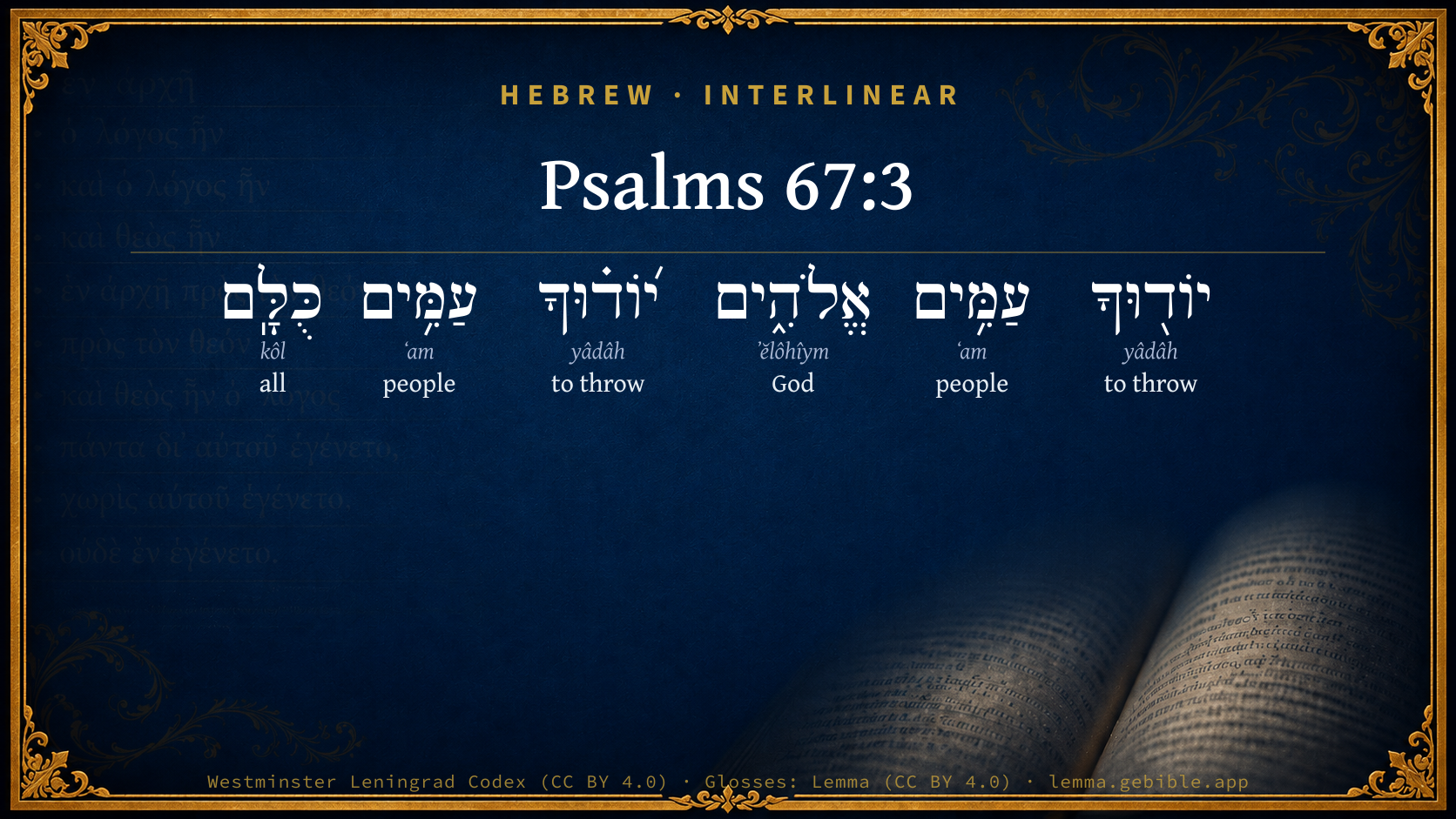
Hebrew (Westminster Leningrad Codex) Psalms 67:3 appears in the Hebrew Old Testament. The text above is from the Westminster Leningrad Codex. Each word links to its Strong’s number, a concise gloss, and parsing drawn from the Open Scriptures Hebrew Bible morphology. Click any word for its full Brown-Driver-Briggs (BDB) entry.
Download image
Cite this verse

Psalms 67:3 (World English Bible). Public Domain. Lemma interlinear Bible study tool, https://lemma.gebible.app/v/psalms/67/3.

Show BibTeX & RIS
BibTeX
RIS
English Translation
Let the peoples praise you, God. Let all the peoples praise you.
World English Bible · Public Domain
Download a study sheet

One document with this verse’s original text, its word-by-word gloss line, the meaning frame, cross-references with their text, attributed commentary, and full source and license credits — printable, and it pastes into notes with its structure intact.

This verse Autodidact and up

Study sheet (.html) Plain text (.txt)

A passage Seminary Student

Up to 50 verses in one chapter. A passage sheet keeps up to 6 commentary sources and 12 cross-references per verse, in the order this page ranks them, and says so on the sheet whenever that leaves anything out. Ask for a single verse and you get the Autodidact verse sheet above.

Everything on this page stays free to read, with no account — the sheet is a download of what is already on screen, not access to it.

Want to remove ads? Support Godless Engineer
Compare translations 3

The same verse in 3 English versions, stacked beneath the original-language interlinear above. Click any original word for its lexicon entry.

Each is an independent rendering of the whole verse — the interlinear is not word-aligned to these translations.

Highlighted words mark where these versions differ — a whole-verse word diff, not a word-by-word alignment.

  • World English Bible Public Domain
    Let the peoples praise you, God. Let all the peoples praise you.
  • King James Version Public Domain
    Let the people praise thee, O God; let all the people praise thee.
  • unfoldingWord Literal Text CC BY-SA 4.0
    May the peoples thank you, God; may the peoples thank you, all of them.

unfoldingWord Literal Text — © unfoldingWord, licensed CC BY-SA 4.0. Word-aligned USFM3 via Door43 (git.door43.org/unfoldingWord/en_ult).

Versions to compare (up to 4)

3 of 4 selected

Show all 18 translations

Every available English version of this verse, each an independent rendering of the whole verse.

  • World English Bible Public Domain
    Let the peoples praise you, God. Let all the peoples praise you.
  • Berean Standard Bible Public Domain
    Let the peoples praise You, O God; let all the peoples praise You.
  • Majority Standard Bible Public Domain
    Let the peoples praise You, O God; let all the peoples praise You.
  • King James Version Public Domain
    Let the people praise thee, O God; let all the people praise thee.
  • American Standard Version (1901) Public Domain
    Let the peoples praise thee, O God; Let all the peoples praise thee.
  • Revised Version (1885) Public Domain
    Let the peoples praise thee, O God; let all the peoples praise thee.
  • Geneva Bible (1599) Public Domain
    Let the people prayse thee, O God: let all the people prayse thee.
  • Douay-Rheims (1899) Public Domain
    That we may know thy way upon earth: thy salvation in all nations.
  • Young's Literal Translation Public Domain
    Praise Thee do peoples, O God, Praise Thee do peoples, all of them.
  • Literal Standard Version CC BY-SA 4.0
    Peoples praise You, O God, || Peoples praise You, all of them.
  • Unlocked Literal Bible CC BY-SA 4.0
    Let the peoples praise you, God; let all the peoples praise you.
  • unfoldingWord Literal Text CC BY-SA 4.0
    May the peoples thank you, God; may the peoples thank you, all of them.
  • Darby Bible Public Domain
    Let the peoples praise thee, O God, let all the peoples praise thee.
  • World Messianic Bible Public Domain
    let the peoples praise you, God. Let all the peoples praise you.
  • Webster's Bible Public Domain
    \\67:2\\That thy way may be known upon earth, thy saving health among all nations.
  • Free Bible Version CC BY-SA 4.0
    May the people praise you, God; may all the people praise you.
  • Bible in Basic English Public Domain
    Let the peoples give you praise, O God; let all the peoples give you praise.
  • JPS Tanakh (1917) Public Domain
    (67-4) Let the peoples give thanks unto Thee, O God; let the peoples give thanks unto Thee, all of them.

Literal Standard Version (2020), Covenant Press — licensed CC BY-SA 4.0. Text via the HelloAO Bible API (eBible.org). Unlocked Literal Bible (unfoldingWord) — licensed CC BY-SA 4.0. Text via the HelloAO Bible API (eBible.org). unfoldingWord Literal Text — © unfoldingWord, licensed CC BY-SA 4.0. Word-aligned USFM3 via Door43 (git.door43.org/unfoldingWord/en_ult). Free Bible Version, Dr. Jonathan Gallagher — licensed CC BY-SA 4.0. Text via the HelloAO Bible API (eBible.org).

Word by word

More ways to search: Search by grammar → Find every occurrence → Compare this word →

Practice this passage: Drill this verse → Learn its vocabulary →

יוֹד֖וּךָ
yâdâh
H3034
“to throw · you”
Verb, Hiphil, Imperfect, 3rd Person, Masculine, Plural + Suffix, Personal, 2nd Person, Masculine, Singular
Part of Speech
Verb
Stem
Hiphil
Form
Imperfect
Person
3rd Person
Gender
Masculine
Number
Plural
Full BDB Definition

Origin: a primitive root; used only as denominative from H3027

TWOT: 847

to throw, shoot, cast - (Qal) to shoot (arrows) - (Piel) to cast, cast down, throw down - (Hiphil) - to give thanks, laud, praise - to confess, confess (the name of God) - (Hithpael) - to confess (sin) - to give thanks
  1. עַמִּ֥ים ʻam H5971 “peoples” Noun, Common, Masculine, Plural, Absolute
  2. אֱלֹהִ֑ים ʼĕlôhîym H430 “God(s)” Noun, Common, Masculine, Plural, Absolute
  3. י֝וֹד֗וּךָ yâdâh H3034 “to throw · you” Verb, Hiphil, Imperfect, 3rd Person, Masculine, Plural + Suffix, Personal, 2nd Person, Masculine, Singular
  4. עַמִּ֥ים ʻam H5971 “peoples” Noun, Common, Masculine, Plural, Absolute
  5. כֻּלָּֽם kôl H3605 “all · their” Noun, Common, Masculine, Singular, Construct + Suffix, Personal, 3rd Person, Masculine, Plural

About this verse

These counts appear in no published source. They are computed here, from the morphology-tagged text and Lemma’s own curated glosses. What Lemma adds →

6
words
4
distinct lemmas
Wisdom
section

Grammatical profile

  • 2 verbs
  • 4 nouns

Verb forms

  • יוֹד֖וּךָ Hiphil · Imperfect
  • י֝וֹד֗וּךָ Hiphil · Imperfect

Repetition

Words recur within this verse — often emphatic in Hebrew:

  • יוֹד֖וּךָ to throw H3034 ×2
  • עַמִּ֥ים people H5971 ×2

Hebrew & Septuagint length

In English translation the verse runs 12 words from the Hebrew and 17 from the Septuagint (LXX English) — closely comparable.

A rough comparison of the two English renderings, which tokenize alike — not a word-level alignment.

Word counts can differ between the Hebrew and the Greek without any difference in meaning — e.g. the Hebrew direct-object marker אֵת has no separate Greek word, and Greek often adds the article ὁ.

Cross-references

6

Topical passages linked to Psalms 67:3 in the Treasury of Scripture Knowledge — connected by theme and wording, ordered by reader-vote popularity; previews shown in the World English Bible.

  • Psalms 67:5 Let the peoples praise you, God. Let all the peoples praise you.
  • Psalms 74:21 Don't let the oppressed return ashamed. Let the poor and needy praise your name.
  • Psalms 45:17 I will make your name to be remembered in all generations. Therefore the peoples shall give you thanks forever and ever.
  • Psalms 119:175 Let my soul live, that I may praise you. Let your ordinances help me.
  • Psalms 142:7 Bring my soul out of prison, That I may give thanks to your name. The righteous will surround me, For you will be good to me.
  • Isaiah 38:18–19 For Sheol can't praise you, death can't celebrate you: Those who go down into the pit can't hope for your truth.

Cross-references courtesy of OpenBible.info (CC BY 4.0).

Hebrew and Greek witnesses Masoretic Hebrew ↔ Greek Septuagint

The same verse in the two great witnesses to the Old Testament, shown verse-for-verse.

You’re reading Greek Psalm 66 (Hebrew Psalm 67). The Septuagint counts the superscription, so verse numbers can differ from the Hebrew — chapter-level alignment, not verse-by-verse. Numbering follows Rahlfs.

These are two independent witnesses, not word-aligned to each other, and the Septuagint is shown in lemma (dictionary) form.

Hebrew Psalms 67:3 Masoretic · Westminster Leningrad Codex

יוֹד֖וּךָ עַמִּ֥ים אֱלֹהִ֑ים י֝וֹד֗וּךָ עַמִּ֥ים כֻּלָּֽם

Let the peoples praise you, God. Let all the peoples praise you.

World English Bible · Public Domain

Greek LXX Greek Psalm 66:3 Septuagint · lemma form

ὁ γιγνώσκω ἐν ὁ γῆ ὁ ὁδός σύ ἐν πᾶς ἔθνος ὁ σωτήριον σύ

Let the nations, O God, give thanks to you; let all the nations give thanks to you.

LXX2012 (modern English Septuagint) · Public Domain

Hebrew: Westminster Leningrad Codex (CC BY 4.0). Greek: Septuagint (public domain); English from LXX2012 (modern English Septuagint) (Public Domain). How the Septuagint differs from the Hebrew →

Commentary

Notes on Psalms 67:3 from classic Christian and Jewish commentators (each source and its license shown beneath its notes). The classic Christian expositions comment on the surrounding passage and are grouped to its opening verse, so a note may address several verses; the Jewish commentaries on the Tanakh (Rashi and others) are per-verse, so they appear only where the commentator wrote on this verse.

Lemma curates 59 commentaries, every one of them public domain or Creative Commons licensed, each selected and text-cleaned for this edition rather than reprinted as found. About our sources →

Trapp's Complete Commentary

John Trapp

Psa 67:3 Let the people praise thee, O God; let all the people praise thee.

Ver. 3. Let the people praise thee, O God] Enlarge the bounds of thy Church; and bring in the hallelujahs of the Gentiles also. Let them praise thee (that pronoun "thee" is emphatic and exclusive), and not their gods of gold and silver. Let them turn to God from idols to serve the living and true God, 1Th 1:9.

John Trapp, A Commentary or Exposition upon All the Books of the Old and New Testament (1647–1656) — public domain. Text from a community e-Sword module.

Joseph Benson's Commentary

Psa 67:3-5. Let all the people praise thee — O hasten that time when the Gentiles shall forsake their dumb idols, and serve and praise thee, the living God, as they have abundant cause to do. O let the nations be glad — For thy great mercy to them in rescuing them from the idolatries and superstitions, the errors and vices of their fathers, and in bringing them to the knowledge of thyself, the true God, and of eternal life. For thou shall judge the people — Shalt rule them, as it is explained in the next clause; righteously — Which is the great commendation of any government, and the greatest argument and encouragement to the Gentiles to put themselves under the government of God; and the rather, because they had found by experience the misery of living under the unrighteous and tyrannical government of Satan, and of their idolatrous and heathen rulers. And govern the nations — Hebrew, תנחם, tanchem, shall lead them, namely, gently, as a shepherd doth his sheep, or a general his soldiers, and not rule them with rigour, as other lords have done. “Thou shall hereafter govern them by righteous and good laws, who were before under the government of the prince of this world, and had nothing to guide them but some few laws and tendencies of nature, or some precepts of an old tradition, which are now almost obliterated.”

Joseph Benson's Commentary on the Old and New Testaments (1811–1818) — public domain. Text from a community e-Sword module.

J. A. Alexander on Psalms

Joseph Addison Alexander

4. (Psa 67:3). The nations shall acknowledge thee, O God, the nations shall acknowledge thee—all of them. The common version of the verb here twice used (praise) is too wide. As it is commonly applied to the acknowledgment of benefits, a nearer equivalent is thank. See above, on Psa 57:9.

Joseph Addison Alexander, The Psalms Translated and Explained (1850) — public domain. Text from a community e-Sword module.

Tyndale Open Study Notes

Tyndale Open Resources

67:3 God’s international reputation leads to his praise among the nations (see 138:4), whose turmoil and rebelliousness will cease when they join Israel in praise of God. • One God rules over all, and the nations will give thanks for God’s just rule (see 67:4).

Tyndale Open Study Notes — © Tyndale Open Resources, licensed CC BY-SA 4.0. Text via the HelloAO Bible API.

Jamieson, Fausset & Brown

Robert Jamieson, A. R. Fausset & David Brown

Thanks will be rendered for the blessings of His wise and holy government (compare Isa 2:3-4; Isa 11:4).

Jamieson, Fausset & Brown — Commentary Critical and Explanatory on the Whole Bible (1871) — public domain (CC PDM 1.0). Text via the HelloAO Bible API.

Adam Clarke's Commentary

Verse 3. Let the people praise thee] When this is done, the people - the Gentiles, will praise thee; all will give thanks to God for his unspeakable gift.

Adam Clarke's Commentary on the Bible (1810–1826) — public domain. Text from a community e-Sword/MySword module.

John Calvin's Commentaries

3 Let the people praise thee, O God! Having spoken of all nations participating in the saving knowledge of God, he next tells us that they would proclaim his goodness, and exhorts them to the exercise of gratitude. The repetition used clearly shows of itself that he alludes to an event of a new and unprecedented kind. Had the allusion been to some such manifestation of his favor as he ordinarily made to the Jews, we would not have looked for the same vehemency of expression. First he says, Let the people praise thee; then he adds, Let all the people praise thee Afterwards he repeats the exclamation once more. But he appropriately makes mention, between, of rejoicing, and the occasion there was for it, since it is impossible that we can praise God aright, unless our minds be tranquil and cheerful — unless, as persons reconciled to God, we are animated with the hope of salvation, and “the peace of God, which passeth all understanding,” reign in our hearts, (Philippians 4:7.) The cause assigned for joy plainly in itself points to the event of the calling of the Gentiles. The reference is not to that government of God which is general in its nature, but to that special and spiritual jurisdiction which he exercises over the Church, in which he cannot properly be said to govern any but such as he has gathered under his sway by the doctrine of his law. The word righteousness is inserted in commendation of his government. Language almost identical is used by Isaiah and Micah when they speak of the times in which the word of salvation would be diffused throughout all the earth, (Isaiah 11:4; Micah 4:3.)

John Calvin's Commentaries (1540-1563) — public domain. Text from the Calvin Translation Society English edition (1840s-50s) via the Christian Classics Ethereal Library (ccel.org). Calvin's coverage is partial (roughly two-thirds of the Bible); uncommented books and verses are honest gaps, never fabricated. The 19th-century editor's footnotes and remarks are omitted so the notes are faithfully Calvin's own voice.

Ellicott's Commentary for English Readers

(3)Praise.—Better, give thanks.

A Bible Commentary for English Readers, edited by Charles John Ellicott (1878–1897) — public domain. Text from a community e-Sword module.

The Cambridge Bible for Schools and Colleges

gen. ed. J. J. S. Perowne

3. Let the peoples give thanks unto thee, O God;

Let all the peoples give thanks unto thee.

The A.V. people is misleading. It is not Israel that is meant, but all the peoples of the earth. Cp. Psa_117:1 f.

3, 4. May all nations soon acknowledge the God of Israel as their God!

The Cambridge Bible for Schools and Colleges (gen. ed. J. J. S. Perowne; Cambridge University Press, 1878–1918) — public domain. Text from a community e-Sword module.

John Gill's Exposition

Let the people praise thee, O God,.... Let them have occasion to praise God, the people of the Jews, for the mission of Christ, and for the blessings of grace and peace with him;

let all the people praise thee; all the nations of the world, for making known the way of life and grace, and the saving health or salvation of God unto them: the word used signifies to "confess" (m); and so the Targum,

"the people shall confess before thee, O God; all the people shall confess before thee;''

that is, shall confess their sins, being made sensible of them; and confess the true and living God, turning from their idols to serve him; and Christ to be the only Saviour and Redeemer, being now made known unto them, through the preaching of the Gospel.

(m) "confiteantur", V. L. Pagninus, Montanus, &c.

John Gill's Exposition of the Whole Bible (1746–1763) — public domain (CC PDM 1.0). Text via the HelloAO Bible API.

Albert Barnes' Notes on the Bible

Let the people praise thee, O God - Do thou incline them to praise thee: a prayer that all people might so understand the character and ways of God, and might have such a sense of his claims upon them, as to lead them to praise him.

Let all the people praise thee - The people of all lands. See the notes at Psa 22:27. Compare Psa 66:4.

Albert Barnes' Notes on the Bible (1834–1885) — public domain. Text from a community e-Sword/MySword module.

Matthew Poole's English Annotations

O hasten that time, when all the Gentiles shall forsake their dumb idols, and serve and praise thee the living God, as they will have abundant cause to do.

Matthew Poole's English Annotations on the Holy Bible (1683–1685) — public domain. Text from a community e-Sword/MySword module.

The Treasury of David

Charles H. Spurgeon

Ver. 3. Let the people praise thee, O God. Cause them to own thy goodness and thank thee with all their hearts; let nations do this, and do it continually, being instructed in thy gracious way.

Let all the people praise thee. May every man bring his music, every citizen his canticle, every peasant his praise, every prince his psalm. All are under obligations to thee, to thank thee will benefit all, and praise from all will greatly glorify thee; therefore, O Lord, give all men the grace to adore thy grace, the goodness to see thy goodness. What is here expressed as a prayer in our translation, may be read as a prophecy, if we follow the original Hebrew.

Ver. 3. Let the people praise thee. Mark the sweet order of the blessed Spirit: first, mercy; than, knowledge; last of all, praising of God. We cannot see his countenance except he be merciful to us; and we cannot praise him except his way be known upon earth. His mercy breeds knowledge; his knowledge, praise. John Boys.

Ver. 3. Let the people praise thee, O God; let all the people praise thee. What then? "Then shall the earth yield her increase; and God, even our own God, shall bless us." We have comforts increased, the more we praise God for what we have already received. The more vapours go up, the more showers come down; as the rivers receive, so they pour out, and all run into the sea again. There is a constant circular course and recourse from the sea, unto the sea; so there is between God and us; the more we praise him, the more our blessings come down; and the more his blessings come down, the more we praise him again; so that we do not so much bless God as bless ourselves. When the springs lie low, we pour a little water into the pump, not to enrich the fountain, but to bring up more for ourselves. Thomas Manton.

Ver. 3. This verse is exceedingly emphatic.

1. First, by an apostrophe to God, in the pronoun, Thee. As if he said: Let the people praise thee, not strange gods; for thou art the only true God.

2. Secondly, inasmuch as it is not said, Let us praise thee, O God; but let the people praise thee, and let all the people. For here is expressed the longing of the pious heart, and its fond desire that God should be praised and magnified throughout all lands and by all people of the round earth.

3. Thirdly, by the iteration, in which the same particle is repeated in this and the fifth verse no less than four times, as if the duty could not be sufficiently inculcated. It is not enough to have said it once; it is delightful to repeat it again. Wolfgang Musculus (1497-1563).

Verse 3. Viewed,

I. As the desire of every renewed heart.

II. As a prayer.

III. As a prophecy.

Psalms 67:4*

Charles H. Spurgeon's The Treasury of David (1869–1885) — public domain. Psalms only. Text from a community e-Sword/MySword module.

Whedon's Commentary on the Bible

Daniel D. Whedon

3. Let all the people praise thee—Hebrew, the peoples, or nations, shall give thee thanks, all of them. A beautiful refrain, repeated in Psa_67:5, and in musical performance sung as a responsive chorus.

Daniel D. Whedon (gen. ed.), Commentary on the Old and New Testaments (1874–1909) — public domain. Text from a community e-Sword module.

The Pulpit Commentary

Let the people praise thee, O God; let all the people praise thee; rather, the peoples, in both clauses. In the second clause the prayer is intensified by the addition of the word cullam, "all of them."

The Pulpit Commentary (1880–1919), ed. H.D.M. Spence-Jones & Joseph S. Exell — public domain. Text from a community e-Sword module.

Keil & Delitzsch

C. F. Keil & F. Delitzsch

Now follows the prospect of the entrance of all peoples into the kingdom of God, who will then praise Him in common with Israel as their God also. His judging (שׁפט) in this instance is not meant as a judicial punishment, but as a righteous and mild government, just as in the christological parallels Psa 72:12., Isa 11:3. מישׁר in an ethical sense for מישׁרים, as in Psa 45:7; Isa 11:4; Mal 2:6. הנחה as in Psa 31:4 of gracious guidance (otherwise than in Job 12:23).

Keil & Delitzsch — Biblical Commentary on the Old Testament (1861–1891) — public domain (CC PDM 1.0). Text via the HelloAO Bible API. (Old Testament only.)

unfoldingWord translationNotes

Door43 World Missions Community

Let the peoples praise you ... let all the peoples praise you

The second clause intensifies the meaning of the first to emphasize the importance of praising God. (See: Parallelism)

let the nations ... govern the nations

Here "nations" represents the people who live in all the nations on the earth. (See: Metonymy)

with justice

"fairly" or "justly"

translationWords

people group

praise

joy

judge

just

govern

selah

unfoldingWord translationNotes — © Distant Shores Media and the Door43 World Missions Community, licensed CC BY-SA 4.0. Source: git.door43.org/Door43/en_tn.

Rashi

Rabbi Shlomo Yitzchaki (Rashi)

That Your way should be known on earth To make known that Your trait is to benefit Your people, and because of this, kingdoms will rejoice and sing praises.

Rashi on the Tanakh — English translations: “The Judaica Press complete Tanach with Rashi, translated by A. J. Rosenberg” (CC BY 4.0); “Pentateuch with Rashi's commentary by M. Rosenbaum and A.M. Silbermann, 1929-1934” (public domain); “The Metsudah Tanach series, Lakewood, N.J” (CC BY 4.0); and “The Book of Joshua, Metsudah Publications, 1997” (CC BY 4.0). Text via Sefaria.

Lesson kit

Teaching starters — assembled from the data on this page, not authored interpretation. Every prompt links to the verse data it draws on. Edit before teaching.

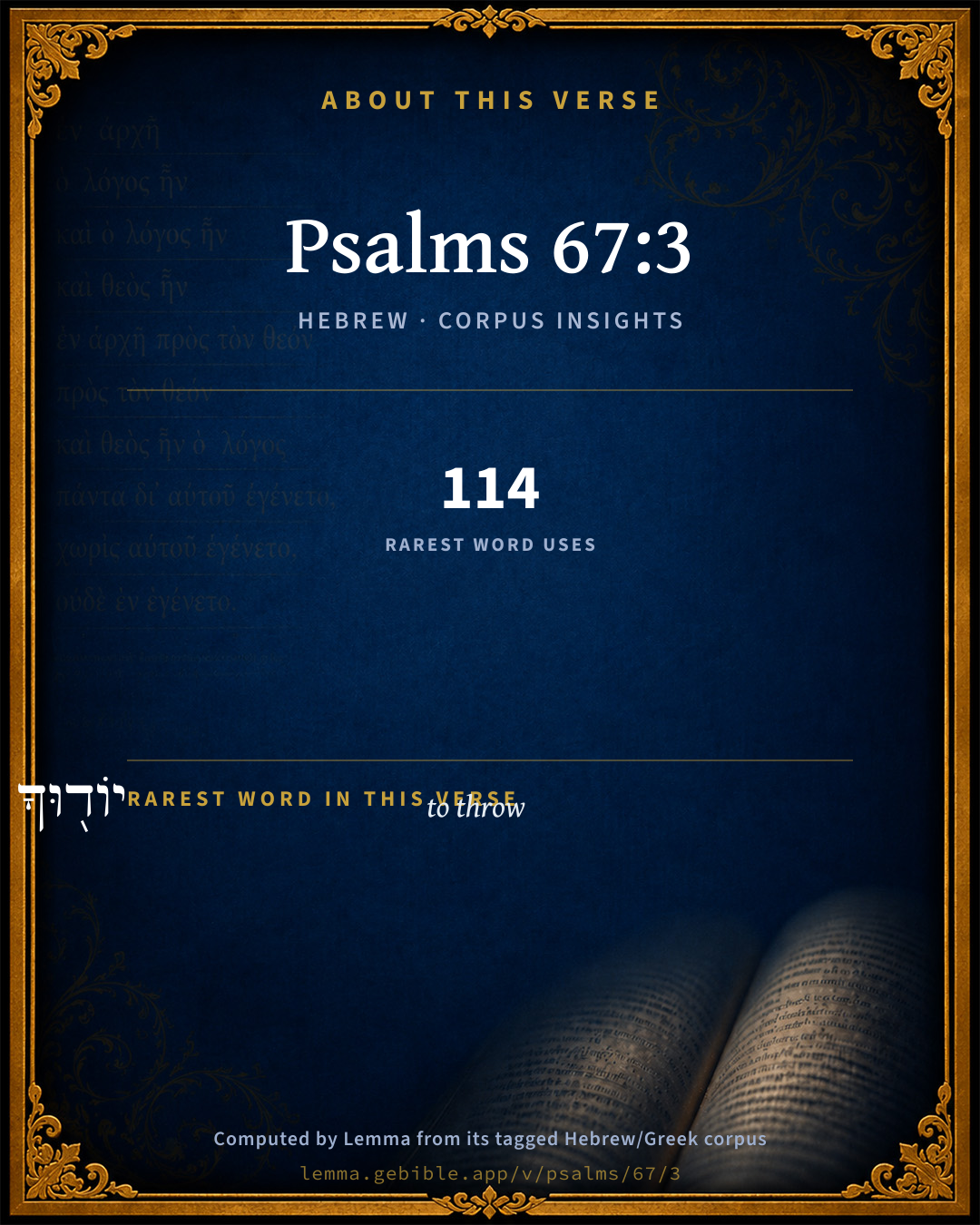
Psalms, in the Wisdom, opens this verse with 6 words (4 distinct Hebrew lemmas). Its most distinctive word is yâdâh (“to throw”). A historical commentator’s framing appears above. Read the whole chapter for the surrounding context.

Discussion questions

  1. What does “to throw” (yâdâh) contribute to the verse as a whole?
  2. Psalms 67:5 shares this passage’s theme. How do the two illuminate each other?
  3. “to throw” occurs 2× in this one verse. What is the effect of the repetition?
  4. The translations on this page render this verse differently — a whole-verse word diff, not a word-by-word alignment. What might account for the different wordings?
  5. The verb «יוֹד֖וּךָ» is Hiphil Imperfect. How does its form color the action?
  6. Reading how Trapp's Complete Commentary and Joseph Benson's Commentary read this verse, where do the two commentators agree and where do they part?

Things to notice

  • These translations choose different wording for 8 words in this verse.
  • “to throw” occurs 2× in this single verse.
  • 4 distinct Hebrew lemmas span 6 words in this verse.

Reading settings

Reading text

Shown beneath each verse's original-language words.

Old Testament
Old Testament edition

Read the OT as the Masoretic Hebrew (MT) or the Greek Septuagint (LXX).

English shown for the Greek Septuagint (in the Hebrew ↔ Greek comparison).

Comparing translations? Open the Compare panel on any verse page to stack up to four side by side.