
Psalms 144:15

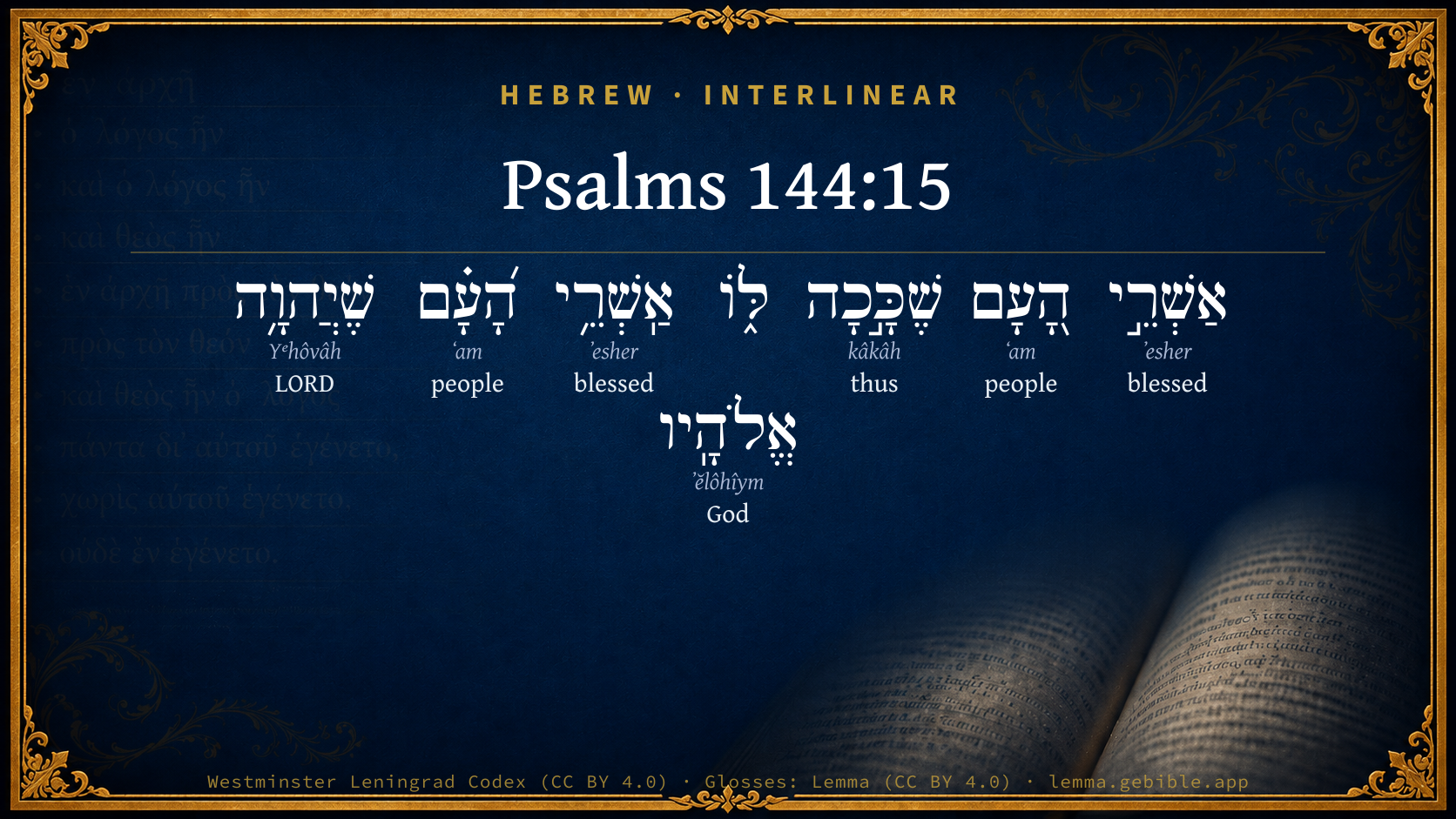
Hebrew (Westminster Leningrad Codex) Psalms 144:15 appears in the Hebrew Old Testament. The text above is from the Westminster Leningrad Codex. Each word links to its Strong’s number, a concise gloss, and parsing drawn from the Open Scriptures Hebrew Bible morphology. Click any word for its full Brown-Driver-Briggs (BDB) entry.
Download image
Cite this verse

Psalms 144:15 (World English Bible). Public Domain. Lemma interlinear Bible study tool, https://lemma.gebible.app/v/psalms/144/15.

Show BibTeX & RIS
BibTeX
RIS
English Translation
Happy are the people who are in such a situation. Happy are the people whose God is Yahweh.
World English Bible · Public Domain
Download a study sheet

One document with this verse’s original text, its word-by-word gloss line, the meaning frame, cross-references with their text, attributed commentary, and full source and license credits — printable, and it pastes into notes with its structure intact.

This verse Autodidact and up

Study sheet (.html) Plain text (.txt)

A passage Seminary Student

Up to 50 verses in one chapter. A passage sheet keeps up to 6 commentary sources and 12 cross-references per verse, in the order this page ranks them, and says so on the sheet whenever that leaves anything out. Ask for a single verse and you get the Autodidact verse sheet above.

Everything on this page stays free to read, with no account — the sheet is a download of what is already on screen, not access to it.

Want to remove ads? Support Godless Engineer
Compare translations 3

The same verse in 3 English versions, stacked beneath the original-language interlinear above. Click any original word for its lexicon entry.

Each is an independent rendering of the whole verse — the interlinear is not word-aligned to these translations.

Highlighted words mark where these versions differ — a whole-verse word diff, not a word-by-word alignment.

  • World English Bible Public Domain
    Happy are the people who are in such a situation. Happy are the people whose God is Yahweh.
  • King James Version Public Domain
    Happy is that people, that is in such a case: yea, happy is that people, whose God is the LORD.
  • unfoldingWord Literal Text CC BY-SA 4.0
    The happinesses of the people for whom thus to it! The happinesses of the people for whom Yahweh its God!

unfoldingWord Literal Text — © unfoldingWord, licensed CC BY-SA 4.0. Word-aligned USFM3 via Door43 (git.door43.org/unfoldingWord/en_ult).

Versions to compare (up to 4)

3 of 4 selected

Show all 17 translations

Every available English version of this verse, each an independent rendering of the whole verse.

  • World English Bible Public Domain
    Happy are the people who are in such a situation. Happy are the people whose God is Yahweh.
  • Berean Standard Bible Public Domain
    Blessed are the people of whom this is so; blessed are the people whose God is the LORD.
  • Majority Standard Bible Public Domain
    Blessed are the people of whom this is so; blessed are the people whose God is the LORD.
  • King James Version Public Domain
    Happy is that people, that is in such a case: yea, happy is that people, whose God is the LORD.
  • American Standard Version (1901) Public Domain
    Happy is the people that is in such a case; `Yea', happy is the people whose God is Jehovah. Psalm 145 `A' `Psalm' `of' praise; of David.
  • Revised Version (1885) Public Domain
    Happy is the people, that is in such a case: yea, happy is the people, whose God is the LORD.
  • Geneva Bible (1599) Public Domain
    Blessed are the people, that be so, yea, blessed are the people, whose God is the Lord.
  • Young's Literal Translation Public Domain
    O the happiness of the people that is thus, O the happiness of the people whose God `is' Jehovah!
  • Literal Standard Version CC BY-SA 4.0
    O the blessedness of the people that is thus, || O the blessedness of the people whose God [is] YHWH!
  • Unlocked Literal Bible CC BY-SA 4.0
    Blessed is the people with such blessings; happy is the people whose God is Yahweh.
  • unfoldingWord Literal Text CC BY-SA 4.0
    The happinesses of the people for whom thus to it! The happinesses of the people for whom Yahweh its God!
  • Darby Bible Public Domain
    Blessed the people that is in such a case! Blessed the people whose God is Jehovah!
  • World Messianic Bible Public Domain
    Happy are the people who are in such a situation. Happy are the people whose God is the LORD.
  • Webster's Bible Public Domain
    Happy is that people, that is in such a case: yes, happy is that people, whose God is the LORD.
  • Free Bible Version CC BY-SA 4.0
    The people who live like this will be happy. Happy are those whose God is the Lord.
  • Bible in Basic English Public Domain
    Happy is the nation whose ways are so ordered: yes, happy is the nation whose God is the Lord.
  • JPS Tanakh (1917) Public Domain
    Happy is the people that is in such a case. Yea, happy is the people whose God is the LORD.

Literal Standard Version (2020), Covenant Press — licensed CC BY-SA 4.0. Text via the HelloAO Bible API (eBible.org). Unlocked Literal Bible (unfoldingWord) — licensed CC BY-SA 4.0. Text via the HelloAO Bible API (eBible.org). unfoldingWord Literal Text — © unfoldingWord, licensed CC BY-SA 4.0. Word-aligned USFM3 via Door43 (git.door43.org/unfoldingWord/en_ult). Free Bible Version, Dr. Jonathan Gallagher — licensed CC BY-SA 4.0. Text via the HelloAO Bible API (eBible.org).

Word by word

More ways to search: Search by grammar → Find every occurrence → Compare this word →

Practice this passage: Drill this verse → Learn its vocabulary →

About this verse

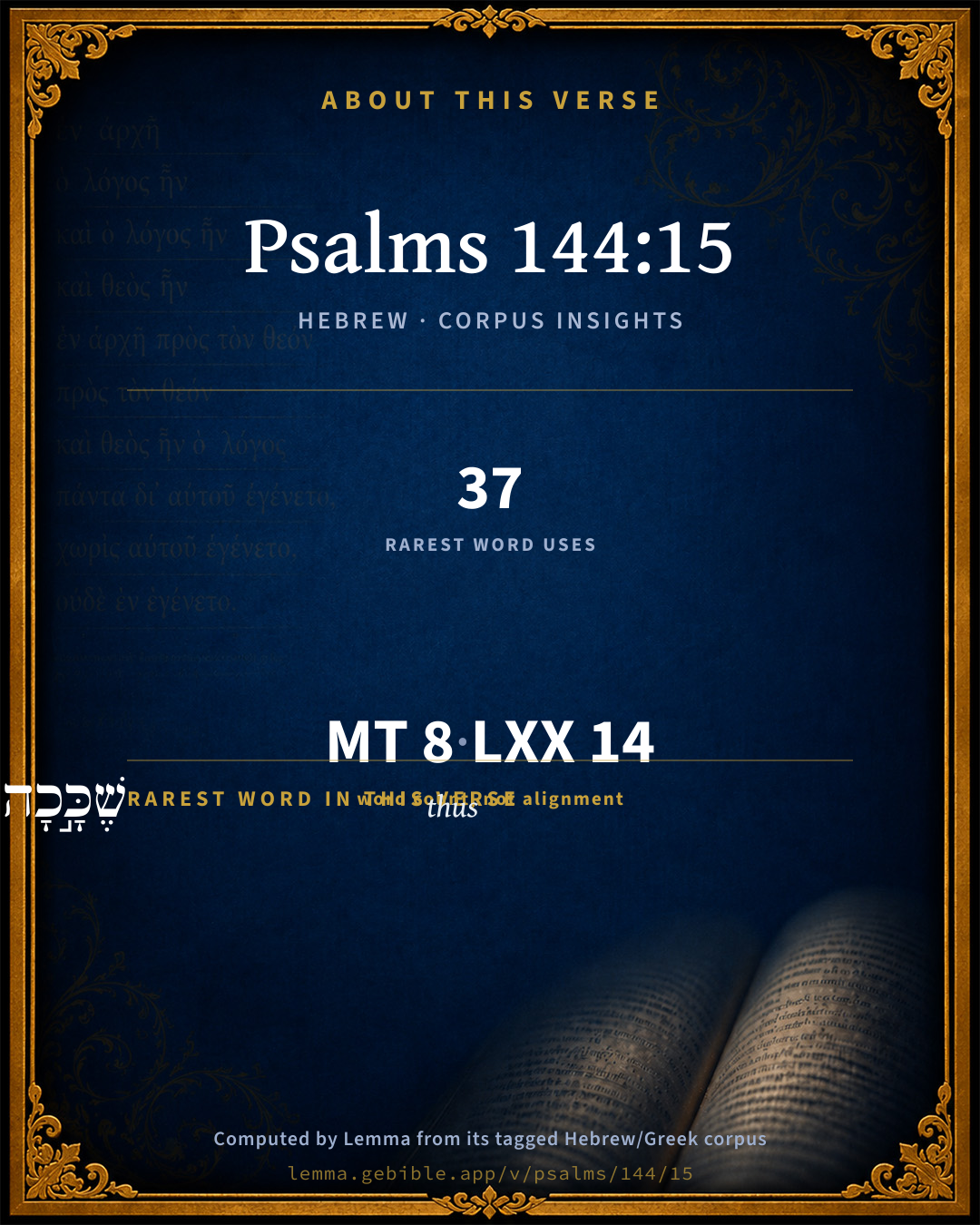
These counts appear in no published source. They are computed here, from the morphology-tagged text and Lemma’s own curated glosses. What Lemma adds →

8
words
5
distinct lemmas
Wisdom
section

Shared distinctive vocabulary

שֶׁכָּ֣כָה thus H3602 occurs in 35 verses of the Hebrew Bible. Also found in:

Grammatical profile

  • 6 nouns
  • 1 preposition
  • 1 adverb

Repetition

Words recur within this verse — often emphatic in Hebrew:

  • אַשְׁרֵ֣י blessed H835 ×2
  • הָ֭עָם people H5971 ×2

Hebrew & Septuagint length

In English translation the verse runs 18 words from the Hebrew and 19 from the Septuagint (LXX English) — closely comparable.

A rough comparison of the two English renderings, which tokenize alike — not a word-level alignment.

Word counts can differ between the Hebrew and the Greek without any difference in meaning — e.g. the Hebrew direct-object marker אֵת has no separate Greek word, and Greek often adds the article ὁ.

In the original languages it is 8 Hebrew tokens and 14 Greek tokens — but the two are counted differently (Hebrew bundles its prefixes and suffixes into one token; the Greek is in lemma form), so that isn’t a like-for-like length.

Cross-references

6

Topical passages linked to Psalms 144:15 in the Treasury of Scripture Knowledge — connected by theme and wording, ordered by reader-vote popularity; previews shown in the World English Bible.

  • Psalms 33:12 Blessed is the nation whose God is Yahweh, The people whom he has chosen for his own inheritance.
  • Ephesians 1:3 Blessed be the God and Father of our Lord Jesus Christ, who has blessed us with every spiritual blessing in the heavenly places in Christ;
  • Psalms 146:5 Happy is he who has the God of Jacob for his help, Whose hope is in Yahweh, his God:
  • Deuteronomy 33:29 Happy are you, Israel: Who is like you, a people saved by Yahweh, The shield of your help, The sword of your excellency! Your enemies shall submit themselves to you; You shall tread on their high places.
  • Psalms 65:4 Blessed is one whom you choose, and cause to come near, That he may live in your courts. We will be filled with the goodness of your house, Your holy temple.
  • Psalms 89:15 Blessed are the people who learn to acclaim you. They walk in the light of your presence, Yahweh.

Cross-references courtesy of OpenBible.info (CC BY 4.0).

Hebrew and Greek witnesses Masoretic Hebrew ↔ Greek Septuagint

The same verse in the two great witnesses to the Old Testament, shown verse-for-verse.

You’re reading Greek Psalm 143 (Hebrew Psalm 144). The Septuagint counts the superscription, so verse numbers can differ from the Hebrew — chapter-level alignment, not verse-by-verse. Numbering follows Rahlfs.

These are two independent witnesses, not word-aligned to each other, and the Septuagint is shown in lemma (dictionary) form.

Hebrew Psalms 144:15 Masoretic · Westminster Leningrad Codex

אַשְׁרֵ֣י הָ֭עָם שֶׁכָּ֣כָה לּ֑וֹ אַֽשְׁרֵ֥י הָ֝עָ֗ם שֶׁיֲהוָ֥ה אֱלֹהָֽיו

Happy are the people who are in such a situation. Happy are the people whose God is Yahweh.

World English Bible · Public Domain

Greek LXX Greek Psalm 143:15 Septuagint · lemma form

μακαρίζω ὁ λαός ὅς οὗτος εἰμί μακάριος ὁ λαός ὅς κύριος ὁ θεός αὐτός

Men bless the people to whom this lot belongs, but blessed is the people whose God is the Lord.

LXX2012 (modern English Septuagint) · Public Domain

Hebrew: Westminster Leningrad Codex (CC BY 4.0). Greek: Septuagint (public domain); English from LXX2012 (modern English Septuagint) (Public Domain). How the Septuagint differs from the Hebrew →

Commentary

Notes on Psalms 144:15 from classic Christian and Jewish commentators (each source and its license shown beneath its notes). The classic Christian expositions comment on the surrounding passage and are grouped to its opening verse, so a note may address several verses; the Jewish commentaries on the Tanakh (Rashi and others) are per-verse, so they appear only where the commentator wrote on this verse.

Lemma curates 59 commentaries, every one of them public domain or Creative Commons licensed, each selected and text-cleaned for this edition rather than reprinted as found. About our sources →

Trapp's Complete Commentary

John Trapp

Psa 144:15 Happy [is that] people, that is in such a case: [yea], happy [is that] people, whose God [is] the LORD.

Ver. 15. Happy is that people] That hath such a confluence of outward comforts. In Hezekiah’s days only it was so, say the Rabbis, peace, plenty, and posterity. The Syriac rendereth it questionwise: Is not the people happy that is in such a case? No, not except they have God to boot; as, if they have, they are happy howsoever, Deu 33:29 : ut vita carnis anima est, ita beatitudo hominis Deus, saith Austin.

John Trapp, A Commentary or Exposition upon All the Books of the Old and New Testament (1647–1656) — public domain. Text from a community e-Sword module.

The Biblical Illustrator

Joseph S. Exell

Psa_144:15

Happy is that people whose God is the Lord.

A happy people

I. Examine what is comprehended in the relation referred to. This may refer--

1. To God as the object of religious worship.

2. To Him as the author of every blessing.

3. To the covenant relation in which He condescends to stand to His people. This includes--

(1)Divine acceptance.

(2) Delightful intercourse.

(3) Pleasing satisfaction.

II. Illustrate and confirm the declaration itself. Such persons are happy--

1. Because all the Divine perfections are engaged in their behalf.

(1) Mercy to pardon their sins, and deliver them from guilt and misery.

(2) Wisdom to remove their ignorance, and guide them through the intricate mazes of this world.

(3) Power to assist their weakness, and be their guard and defence.

(4) Omnipresence to survey them in every possible condition.

(5) Holiness to conquer all their depravity.

(6) Riches to chase away their poverty.

(7) Plenty to supply all their wants. Faithfulness to perform all that has been promised.

2. Because in Him they are assured of finding a refuge in every time of need.

3. Because they are warranted to expect every needful supply.

4. Because in Him they have a friend that sticketh closer than a brother.

5. Because to them all the promises of the Gospel are yea and amen in Christ Jesus.

6. Because they have a sure prospect of being with Him for ever.

Learn--

1. How mistaken the men of the world are with respect to the people of God.

2. How insignificant is the worldlings portion.

3. How dangerous is the condition of those who have not the Lord for their portion. (T. Lewis.)

National religion

There is in this psalm the outline-sketch of an ideal people. The tuneful seer pictures a nation whose every citizen is animated by the love of God, a community in which each separate soul is governed and guided by the wisdom which is from above. Redeemed by Divine grace, every man lives to the full the manifold life that is in him. There is no discord between a mans duties and his desires, no disproportion and no inequity between the functions of the flesh and those of the mind and spirit. Every man achieves and sustains a large and harmonious life. Recognizing the fatherhood of God, every man realizes and ministers to the brotherhood of man. Freedom is unrestrained by law because conditioned by love. Selfishness is banished under the gracious constraint of truth and charity. Righteousness is wedded to peace. The sunshine of plenty is unsullied by shadows of want. Progress leaves in its train no accumulation of poverty. Law is no longer an imposed coercion but an indwelling and spontaneous rule. Culture is sweetened by piety. Power yields to the loving dominance of gentleness. Religion is crowned with humanity. And upon this happy nation bountiful Nature, as the minister of God, showers the blessings of abundance and content. This splendid ideal, lifted up by Hebrew bard and preacher, given them by inspiration of God, naturally found its clearest expression, its most attractive unfolding, in Gods Messiah. It was the declared purpose of our Lord Jesus Christ to inaugurate upon earth this kingdom of heaven. With suggestive repetition He spoke of this kingdom, this new society or body politic. He ever looked beyond, while He looked redemptively at, the individuals who gathered around Him. He saw as from a mountain-top the distant beauty of a new heaven and a new earth, and He saw that the path to it lay through the slow achievement of individual conversion. But the end was clear to Him, and certain. The kingdoms of this world are to become the kingdoms of our God and of His Christ. And that is our dream because it is Christs.

I. Here, then, we emerge into the broader outlooks and ideals of a truly national movement in religion. It is a movement to win England for Christ through the regeneration of every Englishman by the Spirit. We may get, we ought to toil for, more Christian laws, fairer conditions and better prospects for the people. We may, through the social elevation of men, and through the cleansing of their environment, help to advance them to a higher stage of life. By the organization and impact of Christian opinion we may prevent national iniquity and promote public righteousness. All these instruments of battle and victory are within the Christian armoury. But only through new men can new nations emerge, and only through the patient evangelization of our people can our country become a truly Christian land.

II. Let me now remind you that we are moved to this high effort by reverence for Christ and loving passion for men. The first of these motives has already been emphasized. It springs from the belief that everything was made for Christ as well as by Him; that the nations are His inheritance and the uttermost parts of the earth His possession. It proceeds upon a broad conception of Christs work as the redemption to God of all lifes departments and faculties, of all earths dominions and resources. It is fired by the determination to lay at Christs feet everything the world counts glorious, and to place on His head the many crowns. Nothing smaller can satisfy our gratitude or reverence. We cannot rest content till the world for which He died acclaims Him Saviour and King. And we are stirred to the same endeavour by our compassion for men, and by our belief that the Gospel holds the secret of all wealth and joy. It is new life men need, the new life of a pardoned and accepted and endowed soul. And because we possess the secret of it in the Gospel we cannot rest. Its possession is an impulse, its experience a contagion. Its incoming peace creates an outgoing sympathy. We can only keep it by giving it; the heart would break did the mouth not speak. Yes, the enthusiasm of humanity is the essential effect of Christ in the heart.

III. It is in no sense derogatory to the sublime spirituality of our theme to say that by love of country, not less than by promptings of piety, are we impelled to this broad mission. Our desire to see England, the land of our birth and love, foremost among the nations in the cause of Christ and humanity, is a distinct and legitimate factor in our zeal. Patriotism is a noble word, and it stands for a grand quality. The England whose glory shines through many clouds, whose fair fame has won affection and scattered blessing the wide world over, is the England of the martyrs, the confessors, those speakers for God who made room for man, whose blood has been the seed of religion and liberty. It is the England of the missionary, the explorer, the emancipator, the philanthropist; the land of the open Book and the free charter, of the pious home and the sacred sanctuary, of the day of rest and the progressive faith; the land where heroes and saints have wrought to make life possible and to stir the grand enthusiasms of a broad humanity. That is our England. Round her our affections cling. For her our prayers arise. In her our faith and hope find anchorage. Love of such an England is love of all mankind through her. The patriotism which is loyal to such a land is the initial form of an enthusiasm for humanity. Hers is the opportunity, and hers the obligation, to lead the world to the knowledge of Christ; to teach mankind how to blend culture with piety, intelligence with faith, spiritual aspiration with practical service, and freedom of action with gracious constraint of obedience. Yes, that, and that supremely, is Englands mission.

IV. Is it possible our dream may be realized? I for one dare believe no less. But as to its probability, that depends. Others before us were called to do Gods work, and they perished miserably because of failure. That fate may be ours. Should we grow into a nation of idlers, sensualists, atheists, our candlestick will surely be removed out of its place. It depends upon Christian men and Churches whether our sun is to sink in storm. If we would have England saved for her noble destiny, we must be more true in faith and practice. To that noble undertaking let me once more call you. Then shall the past of our country pale before its future. Our song shall be without discord, our glory shall be as the glory of the Lord, and in the gathering of the nations around the throne of the King our fatherland shall be foremost in service and reward. (C. A. Berry, D. D.)

The happiness of those whose God is the Lord

As a child in any of the families in our midst can only be happy by being docile and obedient and trustful to the wise and benevolent guidance of a godly father, or to the tender leading of a gentle and saintly mother, so, we all acknowledge at least, can we experience the highest good of the soul only by being reverent and truthful towards Him who is the Parent of us all--in whom we live and move and have our being. To be thus is to have Jehovah for our God; and only in this way shall we be happy. Now, if this is true, as unquestionably it is, of individuals, it follows that it must also be so of large collections of individuals or of nations; and this is the idea which the psalmist had principally in his mind when the words of the text were uttered. The true happiness--may I not go farther, and say the true prosperity?--of a nation will rise or fall, advance or recede, just as the love of God and the practice of justice and goodness and generosity and forbearance are or are not prevalent among the people, from the sovereign and the advisers of the crown downwards to the very humblest in the land. The true recognition of God or a conscientious regard for goodness and straightforward dealing, existing to any extent in a vast community, is a solid ground of hope in the midst of national distress or under the cloud of national calamity. If ten righteous men had been found in Sodom that city would have been saved from the destroying fire. Not only a ground of hope, therefore, but also a token of safety--of returning prosperity, of reappearing happiness. It was so as to the experience of Gods ancient people, commemorated in the psalm from which our text is taken. The wrath of God had kindled against the apostate race; the proud tyrant of Babylon had been permitted to carry them away on account of their sins; but by and by this affliction became a purifying process. The love of God returned to their hearts, and the darkness began to brighten; and here there is anticipated in lofty strains a renewed golden age of power and plenty, of prosperity and happiness. The youth of the land are to be marked by native strength and vigour and freedom, whilst the maidens in their polished gracefulness and quiet beauty are to resemble the exquisitely sculptured forms which adorn the corners of some magnificent hall or chamber of a palace. Plenty both in the produce of the field and in flocks and herds is to be granted by a kindly-disposed Heaven; the very streets of their towns and villages are to re-echo to nothing but sounds of joy and thankfulness. Happiness is to prevail, but that simply because goodness is to be the national characteristic. Not one of us can fail to see most clearly his duty in this connection. We love our country, and we desire to see it great and glorious and free and happy; but let us recollect that the only way in which this result can be obtained is by the individual members of the community devoting themselves to the honest service of goodness--in their homes, at their business, in the company into which they go, at their everyday work, always and everywhere. Thus only shall we be happy individually, and also as a people. (W. M. Arthur, M. A.)

.

Psa_145:1-21

The Biblical Illustrator, edited by Joseph S. Exell (c. 1880s–1900s) — public domain. Text from a community e-Sword module.

Joseph Benson's Commentary

Psa 144:15. Happy is that people that is in such a case — The fathers, with many others, have supposed these wishes for sons, daughters, corn, sheep, oxen, &c., to be uttered by the strange children, the aliens and idolaters, mentioned Psa 144:11, but there is no reason for such a supposition. The good things of this world were promised to Israel of old, on condition of their obedience, and were bestowed on them while they observed God’s laws. And national piety and virtue are generally followed by national prosperity; for nations, as such, in their national capacity, are only capable of rewards and punishments in this life. And secular prosperity may fall, and sometimes does fall, to the lot of the righteous, “who are distinguished from the wicked by the use which they make of temporal blessings, when given, and by their meek resignation of them, when taken away. Whatever be the will of God concerning our having or wanting these outward comforts, we know that we have, as the faithful servants of God have had in every age before us, greater and more precious promises, a better and an enduring substance, pleasures that fade not, and riches that fly not away, reserved for us in a heavenly country, and a city that hath foundations.” — Horne. Hence the psalmist corrects the former clause of the verse by adding, Happy is that people whose God is the Lord — As if he had said, It is desirable to have temporal prosperity, but the true and chief happiness of God’s people doth not consist therein, nor in any thing common to them with the people of the world, but in this peculiar privilege, that the living, true, and blessed God is their God by covenant and special relation, and that they enjoy his favour, love, and grace, according to the tenor of the covenant, though they may not have abundance of this world’s goods, but may be in a state of great poverty, reproach, and affliction.

Joseph Benson's Commentary on the Old and New Testaments (1811–1818) — public domain. Text from a community e-Sword module.

J. A. Alexander on Psalms

Joseph Addison Alexander

13. (Psa 144:15) Our garners full, affording from kind to kind; our flocks bearing thousands, multiplied by myriads, in our streets. From kind to kind seems to denote not only variety but regular succession, as expressed in Hengstenberg's version, one kind after another. Compare Psa 84:7. The participles in the next clause are highly idiomatic and scarcely reproduciblein any other language. A somewhat similar example occurs above, Psa 69:31. But there both forms are active, whereas here we have one active and one passive participle, formed directly from the Hebrew words denoting a thousand and a myriad, the last of which is a derivative of the verb to increase or multiply, and would therefore necessarily suggest that idea. See above, on Psa 3:6; Psa 69:17. Streets, though not incorrect, is an inadequate translation of the Hebrew word, which means external spaces, streets as opposed to the inside of houses, fields or country as opposed to a whole town. Here it includes not only roads but fields.

15. (Psa 144:15) Happy the people (with) whom (it is) thus! Happy the people whose God (is) Jehovah! The clauses are not antithetical, but equivalent. The people means the (chosen) people, Israel, with whom, in prosperous times, it was thus, and was thus for the very reason that Jehovah was their God.

Joseph Addison Alexander, The Psalms Translated and Explained (1850) — public domain. Text from a community e-Sword module.

Geneva Bible (1599)

Geneva Bible translators

And if God give not to all his children all these blessings, yet he recompenseth them with better things.

Geneva Bible (1599) marginal notes — public domain. Text via Bolls.life.

Adam Clarke's Commentary

Verse 15. Happy is that people] "O how happy are the people!" Such were his people; and they had not only all this secular happiness, but they had Jehovah for their God; and in him had a ceaseless fountain of strength, protection, earthly blessings, and eternal mercies! A people in such a case to rebel, must have the curse of God and man.

ANALYSIS OF THE HUNDRED AND FORTY-FOURTH PSALM

This Psalm is divided into three parts: -

I. A thanksgiving, Ps 144:1-5.

II. A petition, Ps 144:5-11.

III. A discussion on happiness, and in what it consists, Ps 144:12-15.

I. The prophet gives thanks, and praises God.

1. "Blessed be the Lord:" c. Who has taught me in a general way the art of war, in a particular way the use of the sling giving me skill, c.

2. "He is my strength," &c. The strength I have is from him.

3. "My goodness," &c. Benignity or mercy.

4. "My fortress," &c. To him I fly as to a stronghold.

5. "And my Deliverer." Therefore will I trust in him.

From the consideration of so many benefits, the psalmist exclaims, "Lord what is man," &c.

To which question he replies, -

1. "Man is like to vanity." If God be not his fulness and strength.

2. "His days," &c. God is always the same but man changes every moment.

II. He prays for God's assistance: "Bow thy heavens," c. "Cast forth lightning," &c. If men will not acknowledge thy mercy, let them see thy judgments. This first part of his petition against his enemies being ended, he prays, -

1. "Rid me, and deliver me:" &c. From dangers of men.

2. "From the hand of strange children:" &c. Moabites, Philistines, &c.

Upon whom he sets these two characters.

1. "Whose mouth speaketh vanity:" &c. Lies, insincere words.

2. "At their right hand:" &c. They use their power to oppress and deceive.

Then the psalmist exclaims, as in a short hymn -

1. "I will sing a new song," &c. And this I will do because "thou hast given victory," &c. "Thou hast delivered David," &c., from Saul, Absalom, &c.

2. And then he repeats, and concludes his petition as before: "Rid me," &c.

III. His petition being ended, he discourses on the nature of happiness, which is of two kinds, temporal and spiritual. The addition of temporal blessings is pleasant, and promised to the obedient: but godliness is the only safety in this, and especially in the life to come: "For godliness," &c. God created temporal goods not merely for the wicked they are often the rewards of piety. The psalmist therefore prays, -

1. "That our sons," c. They are the pillars of a house let them be flourishing.

2. "That our daughters," c. Stones that join the building, beautiful as well as useful.

3. "That our garners may be full," &c. That we may have abundance.

4. "That our sheep," &c. Our flocks' increase.

5. "That our oxen," &c. May be healthy and strong.

6. "That there be no breaking," &c. No plundering among us.

7. "That there be no complaining," &c. No want of bread, or any cause of tumult. David prays that, during his reign, the people may be happy, and enjoy the fruits of peace.

Then he concludes the Psalm with this acclamation: -

1. "Happy is that people," &c. Those he has described.

2. "Yea, happy," &c. That have the true God for their God who know God to be their Father, and that he takes care of them, providing for their temporal necessities, and supplying all their spiritual wants. Others understand these words, not as prayers, but as a description of the state David and his people were then in. See the notes.

Adam Clarke's Commentary on the Bible (1810–1826) — public domain. Text from a community e-Sword/MySword module.

John Calvin's Commentaries

15. Happy the people, etc. He thus concludes that the divine favor had been sufficiently shown and manifested to his people. Should any object that it breathed altogether a gross and worldly spirit to estimate man’s happiness by benefits of a transitory description, I would say in reply that we must read the two things in connection, that those are happy who recognize the favor of God in the abundance they enjoy, and have such a sense of it from these transitory blessings as leads them through a persuasion of his fatherly love to aspire after the true inheritance. There is no impropriety in calling those happy whom God blesses in this world, provided they do not show themselves blinded in the improvement and use which they make of their mercies, or foolishly and supinely overlook the author of them. The kind providence of God in not suffering us to want any of the means of life is surely a striking illustration of his wonderful love. What more desirable than to be the objects of God’s care, especially if we have sufficient understanding to conclude from the liberality with which he supports us he is our Father? For everything is to be viewed with a reference to this point. Better it were at once to perish for want than have a mere brute satisfaction, and forget the main thing of all, that they and they only are happy whom God has chosen for his people. We are to observe this, that while God in giving us meat and drink admits us to the enjoyment of a certain measure of happiness, it does not follow that those believers are miserable who struggle through life in want and poverty, for this want, whatever it be, God can counterbalance by better consolations.

John Calvin's Commentaries (1540-1563) — public domain. Text from the Calvin Translation Society English edition (1840s-50s) via the Christian Classics Ethereal Library (ccel.org). Calvin's coverage is partial (roughly two-thirds of the Bible); uncommented books and verses are honest gaps, never fabricated. The 19th-century editor's footnotes and remarks are omitted so the notes are faithfully Calvin's own voice.

Ellicott's Commentary for English Readers

(15) Happy.—It is only a narrow and one-sided religion that can see anything out of place in this beatitude of plenty and peace. If we could rejoice with the psalms, fully and without misgiving, in the temporal blessings bestowed by Heaven, we should the more readily and sincerely enter into the depths of their spiritual experience. And the secret of this lies in the full comprehension and contemplation of the beautiful and pleasant as the gift of God.

A Bible Commentary for English Readers, edited by Charles John Ellicott (1878–1897) — public domain. Text from a community e-Sword module.

The Cambridge Bible for Schools and Colleges

gen. ed. J. J. S. Perowne

15. Happy is the people of Jehovah’s choice, to whom He shews such manifest tokens of His favour in temporal prosperity; and yet more truly happy are they in the spiritual blessing of having Jehovah for their God. He is the source and sum of all true happiness, temporal and eternal.

The second line is from Psa_33:12, with the substitution of the later form of the relative pronoun sh for asher. See note on p. 739.

The Cambridge Bible for Schools and Colleges (gen. ed. J. J. S. Perowne; Cambridge University Press, 1878–1918) — public domain. Text from a community e-Sword module.

John Gill's Exposition

Happy is that people that is in such a case,.... Whose families are in good order and behave well; who enjoy plenty of all good things; whose flocks and herds increase, and who live in peace and prosperity; these are temporal blessings highly valuable, and for which those who have them should be thankful, as being happy in comparison of others that are destitute of them, Deu 28:3; and especially who besides these are blessed with spiritual blessings, signified by them, and of which these were typical;

yea, happy is that people, whose God is the Lord; whose God the Lord is, not only by creation, and as he is a common benefactor and preserver, but as their God in covenant, their covenant God and Father in Christ; whom he has loved, chosen, redeemed, adopted, justified, pardoned, regenerated, and sanctified; all which appears to them in effectual calling, is manifested by the application of covenant grace to them, and is witnessed to their spirits by the spirit of God, and which their faith claims an interest in: and these are happy, thrice happy persons; for all that God has are theirs; all his perfections are on their side and for their good; he is their portion, shield, reward, and their all in all; his covenant, its blessings and promises, are all theirs; they have enough, having all things, and can want no good thing; nor need they fear any enemy; the Lord takes care of them, sets a guard about them, resents all injuries done them, prevents the designs of their enemies, makes all things work together for their good, provides all things necessary for them for time and eternity, and will be their God and guide even unto death; covenant interest always continues, and therefore such must be ever happy.

Next: Psalms Chapter 145

John Gill's Exposition of the Whole Bible (1746–1763) — public domain (CC PDM 1.0). Text via the HelloAO Bible API.

Albert Barnes' Notes on the Bible

Happy is that people that is in such a case - In such a condition; or, where these things prevail.

Yea, happy is that people, whose God is the Lord - Whose God is Yahweh; who worship and serve Him as their God. The worship of Yahweh - the religion of Yahweh - is “adapted” to make a people happy; peaceful; quiet; blessed. Prosperity and peace, such as are referred to in the previous verses, are, and must be, the result of pure religion. Peace, order, abundance, attend it everywhere, and the best security for a nation’s prosperity is the worship of God; that which is most certain to make a nation happy and blessed, is to acknowledge God and to keep his laws.

Albert Barnes' Notes on the Bible (1834–1885) — public domain. Text from a community e-Sword/MySword module.

Matthew Poole's English Annotations

This is a correction of the last sentence. This is a very desirable estate; but the true and chief happiness of our Israel doth not consist in these things, which are common to others with us, but in this peculiar privilege, that the true and blessed God is our God by covenant and special relation.

Matthew Poole's English Annotations on the Holy Bible (1683–1685) — public domain. Text from a community e-Sword/MySword module.

The Treasury of David

Charles H. Spurgeon

Ver. 15. Happy is that people that is in such a case. Such things are not to be overlooked. Temporal blessings are not trifles, for the miss of them would be a dire calamity. It is a great happiness to belong to a people so highly favoured.

Yea, happy is that people, whose God is the LORD. This comes in as an explanation of their prosperity. Under the Old Testament Israel had present earthly rewards for obedience: when Jehovah was their God they were a nation enriched and flourishing. This sentence is also a sort of correction of all that had gone before; as if the poet would say all these temporal gifts are a part of happiness, but still the heart and soul of happiness lies in the people being right with God, and having a full possession of him. Those who worship the happy God become a happy people. Then if we have not temporal mercies literally we have something better: if we have not the silver of earth we have the gold of heaven, which is better still.

In this psalm David ascribes his own power over the people, and the prosperity which attended his reign, to the Lord himself. Happy was the nation which he ruled; happy in its king, in its families, in its prosperity, and in the possession of peace; but yet more in enjoying true religion and worshipping Jehovah, the only living and true God.

Ver. 15. Happy is that people, etc. We have in the text happiness with an echo, or ingemination; "happy" and "happy." From this ingemination arise the parts of the text; the same which are the parts both of the greater world and the less. As the heaven and earth in the one, and the body and soul in the other; so are the passages of this Scripture in the two veins of happiness. We may range them as Isaac does the two parts of his blessing (Ge 27:28); the vein of civil happiness, in "the fatness of the earth"; and the vein of Divine happiness, in "the fatness of heaven." Or (if you will have it out of the gospel), here's Martha's portion in the "many things" of the body; and Mary's better part in the unum necessarium of the soul. To give it yet more concisely, here's the path of prosperity in outward comforts, "Happy is that people that is in such a case"; and the path of piety in comforts spiritual: Yea, happy is that people, whose God is the LORD.

In the handling of the first, without any further subdivision, I will only show what it is the Psalmist treats of; and that shall be by way of gradation, in these three particulars. It is De Felicitate; De Felicitate Populi; De Hac Felicitate Populi: of happiness; of the people's happiness; of the people's happiness, as in such a case.

Happiness is the general, and the first: a noble argument, and worthy of an inspired pen, especially the Psalmist's. Of all other there can be none better to speak of popular happiness than such a king; nor of celestial, than such a prophet. Yet I mean not to discourse of it in the full latitude, but only as it hath a peculiar posture in this psalm, very various and different from the order of other psalms. In this psalm it is reserved to the end, as the close of the foregoing meditations. In other psalms it is set in the front, or first place of all; as in Ps 32:1-11, in Ps 112:1-10, in Ps 119:1-176, and in the Ps 128:1-6. Again, in this the Psalmist ends with our happiness and begins with God's. "Blessed be the LORD my strength." In Ps 41:1-13, contrary, he makes his exordium from man's; "Blessed is he that considereth the poor"; his conclusion with God's; "Blessed be the Lend God of Israel." I therefore observe these variations, because they are helpful to the understanding both of the essence and splendour of true happiness. To the knowledge of the essence they help, because they demonstrate how our own happiness is enfolded in the glory of God, and subordinate unto it. As we cannot begin with beatus unless we end with benedictus: so we must begin with benedictus that we may end with beatus. The reason is this, because the glory of God is as well the consummation as the introduction to a Christian's happiness. Therefore as in the other psalm he begins below and ends upwards; so in this, having begun from above with that which is principal, "Blessed be the LORD"; he fixes his second thoughts upon the subordinate, "Blessed, or happy, are the people." He could not proceed in a better order: he first looks up to God's kingdom, then reflects upon his own, as not meaning to take blessedness before he had given it. Richard Holdsworth.

Ver. 15. Happy is that people, that is in such a case, etc. The first part of this text hath relation to temporal blessings, "Blessed is the people that be so": the second to spiritual, "Yea, blessed is the people while God is the LORD." "His left hand is under my head", saith the spouse (So 2:6); that sustains me from falling into murmuring, or diffidence of his providence, because out of his left hand he hath given me a competency of his temporal blessings; "But his right hand doth embrace me", saith the spouse there; his spiritual blessings fill me, possess me so that no rebellious fire breaks out within me, no outward temptation breaks in upon me. So also Solomon says again, "In her left hand is riches and glory" (temporal blessings) "and in her right hand length of days" (Pr 3:16), all that accomplishes and fulfils the eternal joys of the saints of heaven. The person to whom Solomon attributes this right and left hand is Wisdom; and a wise man may reach out his right and left hand, to receive the blessings of both sorts. And the person whom Solomon represents by Wisdom there, is Christ himself. So that not only a worldly wise man, but a Christian wise man may reach out both hands, to both kinds of blessings, right and left, spiritual and temporal.

Now, for this first blessedness, as no philosophers could ever tell us amongst the Gentiles what true blessedness was, so no grammarian amongst the Jews, amongst the Hebrews, could ever tell us what the right signification of this word is, in which David expresses blessedness here; whether asherei, which is the word, be a plural noun, and signify beatitudines, blessednesses in the plural, and intimate thus much, that blessedness consists not in any one thing, but in a harmony and consent of many; or whether this asherei be an adverb, and signify beate, and so be an acclamation, O how happily, how blessedly are such men provided for that are so; they cannot tell. Whatsoever it be, it is the very first word with which David begins his Book of Psalms; beatus vir; as the last word of that book is, laudate Dominum; to show that all that passes between God and man, from first to last, is blessings from God to man, and praises from man to God; and that the first degree of blessedness is to find the print of the hand of God even in his temporal blessednesses, and to praise and glorify him for them in the right use of them. A man that hath no land to hold by it, nor title to recover by it, is never the better for finding, or buying, or having a fair piece of evidence, a fair instrument, fairly written, duly sealed, authentically testified; a man that hath not the grace of God, and spiritual blessings too, is never the nearer happiness, for all his abundances of temporal blessedness. Evidences are evidences to them who have title. Temporal blessings are evidences to them who have a testimony of God's spiritual blessings in the temporal. Otherwise, as in his hands who hath no title, it is a suspicious thing to find evidences, and he will be thought to have embezzled and purloined them, he will be thought to have forged and counterfeited them, and he will be called to an account for them, how he came by them, and what he meant to do with them: so to them who have temporal blessings without spiritual, they are but useless blessings, they are but counterfeit blessings, they shall not purchase a minute's peace here, nor a minute's refreshing to the soul hereafter; and there must be a heavy account made for them, both how they were got, and how they were employed. John Donne.

Ver. 15. Happy is that people, etc. It is only a narrow and one sided religion that can see anything out of place in this beatitude of plenty and peace. If we could rejoice with the psalms fully and without misgiving, in the temporal blessings bestowed by heaven, we should the more readily and sincerely enter into the depths of their spiritual experience. And the secret of this lies in the full comprehension and contemplation of the beautiful and pleasant as the gift of God. A.S. Aglen.

Ver. 15. Yea, happy is that people, whose God is the LORD. "Yea, happy." This is the best wine, kept to the last, though all men be not of this opinion. You shall hardly bring a worldly man to think so. The world is willing enough to misconstrue the order of the words, and to give the priority to civil happiness, as if it were first in dignity, because 'tis first named: they like better to hear of the cui sic than the cui Dominus. To prevent this folly, the Psalmist interposes a caution in this corrective particle, "yea, happy." It hath the force of a revocation, whereby he seems to retract what went before, not simply and absolutely, but in a certain degree, lest worldly men should wrest it to a misinterpretation. It is not an absolute revocation, but a comparative; it doth not simply deny that there is some part of popular happiness in these outward things, but it prefers the spirituals before them: "Yea", that is, Yea more, or, Yea rather; like that of Christ in the Gospel, when one in the company blessed the womb that bare him, he presently replies, "Yea, rather blessed are they that hear the word of God and keep it": Lu 11:28. In like manner, the prophet David, having first premised the inferior part and outside of a happy condition; fearing lest any should of purpose mistake his meaning, and, hearing the first proposition, should either there set up their rest, and not at all take up the second; or if they take it in, do it preposterously, and give it the precedence before the second, according to the world's order, Virtus post nummos. In this respect he puts in the clause of revocation, whereby he shows that these outward things, though named first, yet they are not to be reputed first. The particle "Yea" removes them to the second place; it tacitly transposes the order; and the path of piety, which was locally after, it places virtually before. 'Tis as if he had said, Did I call them happy who are in such a case? Nay, miserable are they if they be only in such a case: the temporal part cannot make them so without the spiritual. Admit the windows of the visible heaven were opened, and all outward blessings poured down upon us; admit we did perfectly enjoy whatsoever the vastness of the earth contains in it; tell me, What will it profit to gain all and lose God? If the earth be bestowed upon us, and not heaven; or the material heaven be opened, and not the beatifical; or the whole world made ours, and God not ours; we do not arrive at happiness. All that is in the first proposition is nothing unless this be added, "Yea, happy are the people which have the Lord for their God." Richard Holdsworth.

Ver. 15.

Thrice happy nations, where with look benign

Thine aspect bends; beneath thy smile divine

The fields are with increasing harvests crown'd,

The flocks grow fast, and plenty reigns around,

Nor sire, nor infant son, black death shall crave,

Till ripe with age they drop into the grave;

Nor fell suspicion, nor relentless care,

Nor peace destroying discord enter there,

But friends and brothers, wives and sisters, join

The feast in concord and in love divine. Callimachus.

Ver. 15. David having prayed for many temporal blessings in the behalf of the people from Ps 144:12-15, at last concludes, Blessed are the people that are in such a case; but presently he checks and corrects himself, and eats, as it were, his own words, but rather, happy is that people whose God is the Lord. The Syriac rendereth it question wise, "Is not the people (happy) that is in such a case?" The answer is, "No", except they have God to boot: Ps 146:5. Nothing can make that man truly miserable that hath God for his portion, and nothing can make that man truly happy that wants God for his portion. God is the author of all true happiness; he is the donor of all true happiness; he is the maintainer of all true happiness, and he is the centre of all true happiness; and, therefore, he that hath him for his God, and for his portion, is the only happy man in the world. Thomas Brooks.

Ver. 15. Whose God is JEHOVAH. A word or name well known to us English, by our translators now often retaining that name in the mention of God in our English Bible, and therefore we shall do well to retain it. Lord was a lower word, in common acceptation, than God. But JEHOVAH is a higher name than either, and more peculiar, incommunicable, and comprehensive. Ex 6:3: "I appeared" (saith the Lord) "unto Abraham, unto Isaac, and unto Jacob, by the name God Almighty, but by my name JEHOVAH was I not known to them."

To have God to be our Jehovah is the insurance of happiness to us. For of many, observe but these two things in the name Jehovah: First, God's absolute independency that he is of himself omnipotent, Ex 3:14: "And God said, I AM THAT I AM." Secondly, God's faithfulness, that he cannot but be as good as his word, Ex 6:2-4, 6: "And I have also established my covenant with them; wherefore say unto the children of Israel, I am JEHOVAH (so in the Hebrew), and I will bring you out from under the burdens of the Egyptians." So that this name is our security of God's performance. Examine we therefore our bonds, and bills, that is, his promises to us; behold, they are all the promises of Jehovah; they must stand good, for they bear his name; they must reflect his name, and promote both our good and God's grand design. Nathanael Homes, 1678.

With this prayer of Jehovah's anointed One end the prayers of the Book of Psalms. The remaining six psalms consist exclusively of praise and high Hallelujahs. Lord Congleton, in "The Psalms: a new Version, with Notes", 1875.

Ver. 15. The peculiar happiness of those whose God is the Lord.

Charles H. Spurgeon's The Treasury of David (1869–1885) — public domain. Psalms only. Text from a community e-Sword/MySword module.

Whedon's Commentary on the Bible

Daniel D. Whedon

15. Happy is that people—A climax is here given. “Happy” is the people that has such material prosperity, but happier still is the people among whom the true God is known. Every good gift is indeed from him, and they with whom he dwells have the sure fountain of good. Also, tobe the chosen people of the Lord was the crown of the blessings of Israel.

Daniel D. Whedon (gen. ed.), Commentary on the Old and New Testaments (1874–1909) — public domain. Text from a community e-Sword module.

The Pulpit Commentary

Happy is that people, that is in such a case! yea, happy is that people, whose God is the Lord! The cause of Israel"s prosperity is their faithfulness to Jehovah.

The Pulpit Commentary (1880–1919), ed. H.D.M. Spence-Jones & Joseph S. Exell — public domain. Text from a community e-Sword module.

Rashi

Rabbi Shlomo Yitzchaki (Rashi)

Praiseworthy is the people that has this That has all this good.

Rashi on the Tanakh — English translations: “The Judaica Press complete Tanach with Rashi, translated by A. J. Rosenberg” (CC BY 4.0); “Pentateuch with Rashi's commentary by M. Rosenbaum and A.M. Silbermann, 1929-1934” (public domain); “The Metsudah Tanach series, Lakewood, N.J” (CC BY 4.0); and “The Book of Joshua, Metsudah Publications, 1997” (CC BY 4.0). Text via Sefaria.

Lesson kit

Teaching starters — assembled from the data on this page, not authored interpretation. Every prompt links to the verse data it draws on. Edit before teaching.

Psalms, in the Wisdom, opens this verse with 8 words (5 distinct Hebrew lemmas). Its most distinctive word is kâkâh (“thus”). A historical commentator’s framing appears above. Read the whole chapter for the surrounding context.

Discussion questions

  1. The word kâkâh carries the sense “thus.” How does it shape the verse?
  2. How does Exodus 12:11, which shares the word «thus», read alongside this verse?
  3. What does the repetition of “blessed” (2× in this one verse) do in this verse?
  4. These translations render this verse differently. What is at stake in choosing one wording over another?
  5. Compare how Trapp's Complete Commentary and The Biblical Illustrator read this verse. Where do they agree or differ?

Things to notice

Reading settings

Reading text

Shown beneath each verse's original-language words.

Old Testament
Old Testament edition

Read the OT as the Masoretic Hebrew (MT) or the Greek Septuagint (LXX).

English shown for the Greek Septuagint (in the Hebrew ↔ Greek comparison).

Comparing translations? Open the Compare panel on any verse page to stack up to four side by side.