
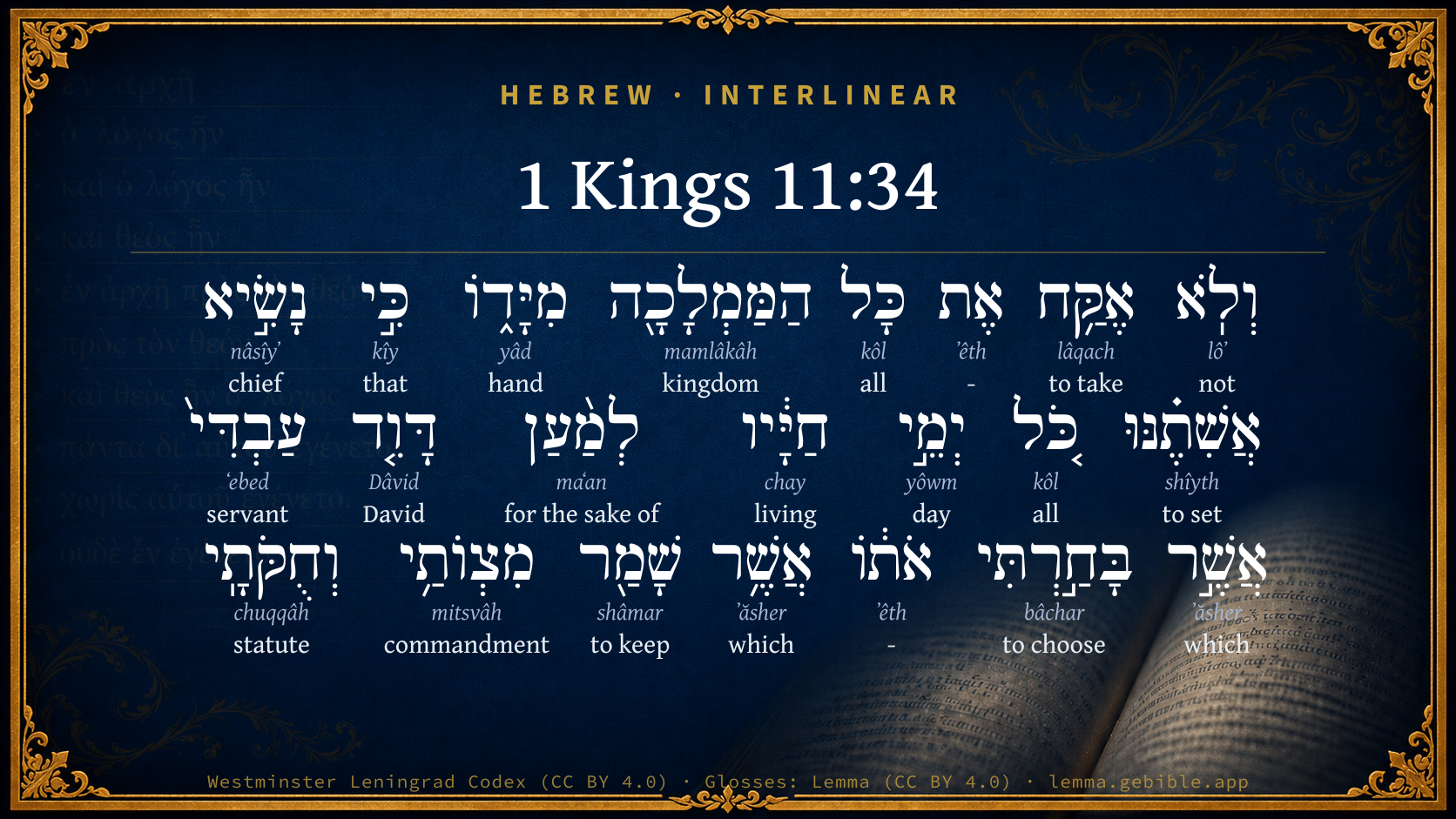
1 Kings 11:34

Hebrew (Westminster Leningrad Codex) 1 Kings 11:34 appears in the Hebrew Old Testament. The text above is from the Westminster Leningrad Codex. Each word links to its Strong’s number, a concise gloss, and parsing drawn from the Open Scriptures Hebrew Bible morphology. Click any word for its full Brown-Driver-Briggs (BDB) entry.
Download image
Cite this verse

1 Kings 11:34 (World English Bible). Public Domain. Lemma interlinear Bible study tool, https://lemma.gebible.app/v/1-kings/11/34.

Show BibTeX & RIS
BibTeX
RIS
English Translation
However I will not take the whole kingdom out of his hand; but I will make him prince all the days of his life, for David my servant's sake whom I chose, who kept my commandments and my statutes;
World English Bible · Public Domain
Download a study sheet

One document with this verse’s original text, its word-by-word gloss line, the meaning frame, cross-references with their text, attributed commentary, and full source and license credits — printable, and it pastes into notes with its structure intact.

This verse Autodidact and up

Study sheet (.html) Plain text (.txt)

A passage Seminary Student

Up to 50 verses in one chapter. A passage sheet keeps up to 6 commentary sources and 12 cross-references per verse, in the order this page ranks them, and says so on the sheet whenever that leaves anything out. Ask for a single verse and you get the Autodidact verse sheet above.

Everything on this page stays free to read, with no account — the sheet is a download of what is already on screen, not access to it.

Want to remove ads? Support Godless Engineer
Compare translations 3

The same verse in 3 English versions, stacked beneath the original-language interlinear above. Click any original word for its lexicon entry.

Each is an independent rendering of the whole verse — the interlinear is not word-aligned to these translations.

Highlighted words mark where these versions differ — a whole-verse word diff, not a word-by-word alignment.

  • World English Bible Public Domain
    However I will not take the whole kingdom out of his hand; but I will make him prince all the days of his life, for David my servant's sake whom I chose, who kept my commandments and my statutes;
  • King James Version Public Domain
    Howbeit I will not take the whole kingdom out of his hand: but I will make him prince all the days of his life for David my servant's sake, whom I chose, because he kept my commandments and my statutes:
  • unfoldingWord Literal Text CC BY-SA 4.0
    But I will not take all of the kingdom from his hand. Rather, I will put him as a leader all of the days of his life for the sake of David my servant, him whom I chose, who kept my commandments and my statutes.

unfoldingWord Literal Text — © unfoldingWord, licensed CC BY-SA 4.0. Word-aligned USFM3 via Door43 (git.door43.org/unfoldingWord/en_ult).

Versions to compare (up to 4)

3 of 4 selected

Show all 18 translations

Every available English version of this verse, each an independent rendering of the whole verse.

  • World English Bible Public Domain
    However I will not take the whole kingdom out of his hand; but I will make him prince all the days of his life, for David my servant's sake whom I chose, who kept my commandments and my statutes;
  • Berean Standard Bible Public Domain
    Nevertheless, I will not take the whole kingdom out of Solomon’s hand, because I have made him ruler all the days of his life for the sake of David My servant, whom I chose because he kept My commandments and statutes.
  • Majority Standard Bible Public Domain
    Nevertheless, I will not take the whole kingdom out of Solomon’s hand, because I have made him ruler all the days of his life for the sake of David My servant, whom I chose because he kept My commandments and statutes.
  • King James Version Public Domain
    Howbeit I will not take the whole kingdom out of his hand: but I will make him prince all the days of his life for David my servant's sake, whom I chose, because he kept my commandments and my statutes:
  • American Standard Version (1901) Public Domain
    Howbeit I will not take the whole kingdom out of his hand; but I will make him prince all the days of his life, for David my servant's sake whom I chose, who kept my commandments and my statutes;
  • Revised Version (1885) Public Domain
    Howbeit I will not take the whole kingdom out of his hand: but I will make him prince all the days of his life, for David my servant’s sake, whom I chose, because he kept my commandments and my statutes:
  • Geneva Bible (1599) Public Domain
    But I will not take the whole kingdome out of his hande: for I will make him prince all his life long for Dauid my seruants sake, whome I haue chosen, and who kept my commandements and my statutes.
  • Douay-Rheims (1899) Public Domain
    Yet I will not take away all the kingdom out of his hand, but I will make him prince all the days of his life, for David my servant's sake, whom I chose, who kept my commandments and my precepts.
  • Young's Literal Translation Public Domain
    `And I do not take the whole of the kingdom out of his hand, for prince I make him all days of his life, for the sake of David My servant whom I chose, who kept My commands and My statutes;
  • Literal Standard Version CC BY-SA 4.0
    And I do not take the whole of the kingdom out of his hand, for I make him prince all [the] days of his life, for the sake of My servant David whom I chose, who kept My commands and My statutes;
  • Unlocked Literal Bible CC BY-SA 4.0
    However, I will not take the whole kingdom out of Solomon's hand. Instead, I have made him ruler all the days of his life, for David my servant's sake whom I chose, the one who kept my commandments and my statutes.
  • unfoldingWord Literal Text CC BY-SA 4.0
    But I will not take all of the kingdom from his hand. Rather, I will put him as a leader all of the days of his life for the sake of David my servant, him whom I chose, who kept my commandments and my statutes.
  • Darby Bible Public Domain
    But I will not take the whole kingdom out of his hand; for I will make him prince all the days of his life for David my servant's sake, whom I chose, who kept my commandments and my statutes;
  • World Messianic Bible Public Domain
    “‘However, I will not take the whole kingdom out of his hand, but I will make him prince all the days of his life for David my servant’s sake whom I chose, who kept my commandments and my statutes,
  • Webster's Bible Public Domain
    Yet I will not take the whole kingdom out of his hand: but I will make him prince all the days of his life for David my servant's sake, whom I chose, because he kept my commandments and my statutes:
  • Free Bible Version CC BY-SA 4.0
    Even so, I'm not going to take the whole kingdom from Solomon, because I made him ruler for his lifetime for the sake of my servant David. I chose him because he kept my commandments and laws.
  • Bible in Basic English Public Domain
    But I will not take the kingdom from him; I will let him be king all the days of his life, because of David my servant, in whom I took delight because he kept my orders and my laws.
  • JPS Tanakh (1917) Public Domain
    Howbeit I will not take the whole kingdom out of his hand; but I will make him prince all the days of his life, for David My servant's sake, whom I chose, because he kept My commandments and My statutes;

Literal Standard Version (2020), Covenant Press — licensed CC BY-SA 4.0. Text via the HelloAO Bible API (eBible.org). Unlocked Literal Bible (unfoldingWord) — licensed CC BY-SA 4.0. Text via the HelloAO Bible API (eBible.org). unfoldingWord Literal Text — © unfoldingWord, licensed CC BY-SA 4.0. Word-aligned USFM3 via Door43 (git.door43.org/unfoldingWord/en_ult). Free Bible Version, Dr. Jonathan Gallagher — licensed CC BY-SA 4.0. Text via the HelloAO Bible API (eBible.org).

Word by word

More ways to search: Search by grammar → Find every occurrence → Compare this word →

Practice this passage: Drill this verse → Learn its vocabulary →

אֲשִׁתֶ֗נּוּ
shîyth
H7896
“to set · him”
Verb, Qal, Imperfect, 1st Person, Common, Singular + Suffix, Personal, 3rd Person, Masculine, Singular
Part of Speech
Verb
Stem
Qal
Form
Imperfect
Person
1st Person
Gender
Common
Number
Singular
Full BDB Definition

Origin: a primitive root

TWOT: 2380

to put, set - (Qal) - to put, lay (hand upon) - to set, station, appoint, fix, set mind to - to constitute, make (one something), make like, perform - to take one's stand - to lay waste - (Hophal) to be imposed, be set upon
  1. וְלֹֽא lôʼ H3808 “and · not” Conjunction + Particle, Negative
  2. אֶקַּ֥ח lâqach H3947 “to take” Verb, Qal, Imperfect, 1st Person, Common, Singular
  3. אֶת ʼêth H853 “-” Particle, Direct Object
  4. כָּל kôl H3605 “all of” Noun, Common, Masculine, Singular, Construct
  5. הַמַּמְלָכָ֖ה mamlâkâh H4467 “the · kingdom” Particle, Definite Article + Noun, Common, Feminine, Singular, Absolute
  6. מִיָּד֑וֹ yâd H3027 “from · hand · his” Preposition + Noun, Common, Both, Singular, Construct + Suffix, Personal, 3rd Person, Masculine, Singular
  7. כִּ֣י kîy H3588 “that” Conjunction
  8. נָשִׂ֣יא nâsîyʼ H5387 “chief” Noun, Common, Masculine, Singular, Absolute
  9. כֹּ֚ל kôl H3605 “all of” Noun, Common, Masculine, Singular, Construct
  10. יְמֵ֣י yôwm H3117 “days of” Noun, Common, Masculine, Plural, Construct
  11. חַיָּ֔יו chay H2416 “living things · his” Noun, Common, Masculine, Plural, Construct + Suffix, Personal, 3rd Person, Masculine, Singular
  12. לְמַ֨עַן maʻan H4616 “for the sake of” Preposition
  13. דָּוִ֤ד Dâvid H1732 “David” Noun, Proper
  14. עַבְדִּי֙ ʻebed H5650 “servant · my” Noun, Common, Masculine, Singular, Construct + Suffix, Personal, 1st Person, Common, Singular
  15. אֲשֶׁ֣ר ʼăsher H834 “which” Particle, Relative
  16. בָּחַ֣רְתִּי bâchar H977 “to choose” Verb, Qal, Perfect, 1st Person, Common, Singular
  17. אֹת֔וֹ ʼêth H853 “- · him” Particle, Direct Object + Suffix, Personal, 3rd Person, Masculine, Singular
  18. אֲשֶׁ֥ר ʼăsher H834 “which” Particle, Relative
  19. שָׁמַ֖ר shâmar H8104 “to keep” Verb, Qal, Perfect, 3rd Person, Masculine, Singular
  20. מִצְוֺתַ֥י mitsvâh H4687 “commandments · my” Noun, Common, Feminine, Plural, Construct + Suffix, Personal, 1st Person, Common, Singular
  21. וְחֻקֹּתָֽי chuqqâh H2708 “and · statutes · my” Conjunction + Noun, Common, Both, Plural, Construct + Suffix, Personal, 1st Person, Common, Singular

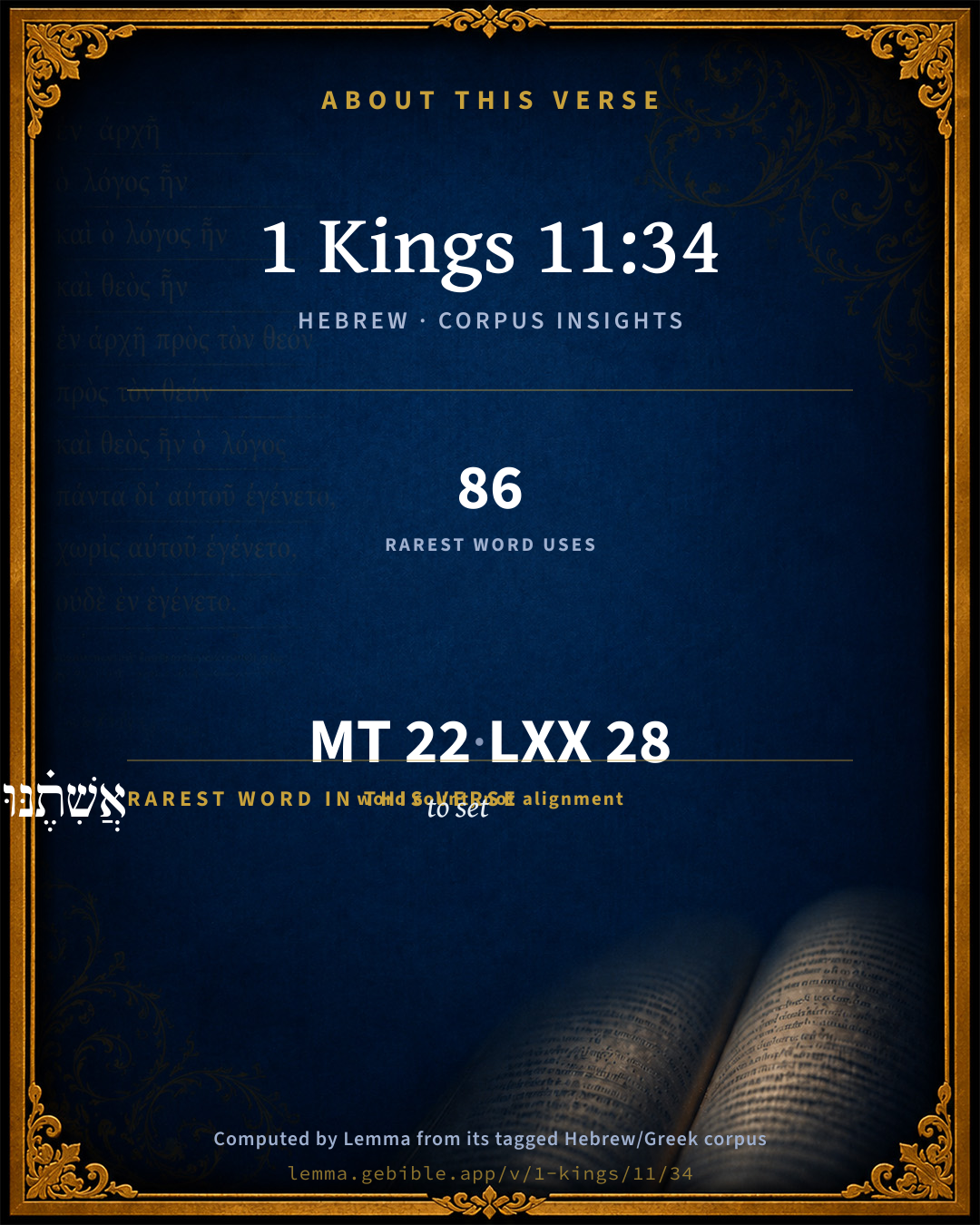
About this verse

These counts appear in no published source. They are computed here, from the morphology-tagged text and Lemma’s own curated glosses. What Lemma adds →

22
words
19
distinct lemmas
Historical
section

Grammatical profile

  • 4 verbs
  • 11 nouns
  • 1 preposition
  • 1 conjunction
  • 5 particles

Verb forms

  • אֶקַּ֥ח Qal · Imperfect
  • אֲשִׁתֶ֗נּוּ Qal · Imperfect
  • בָּחַ֣רְתִּי Qal · Perfect
  • שָׁמַ֖ר Qal · Perfect

Repetition

Words recur within this verse — often emphatic in Hebrew:

  • כָּל all H3605 ×2
  • אֲשֶׁ֣ר which H834 ×2

Hebrew & Septuagint length

In English translation the verse runs 39 words from the Hebrew and 33 from the Septuagint (LXX English) — closely comparable.

A rough comparison of the two English renderings, which tokenize alike — not a word-level alignment.

Word counts can differ between the Hebrew and the Greek without any difference in meaning — e.g. the Hebrew direct-object marker אֵת has no separate Greek word, and Greek often adds the article ὁ.

In the original languages it is 22 Hebrew tokens and 28 Greek tokens — but the two are counted differently (Hebrew bundles its prefixes and suffixes into one token; the Greek is in lemma form), so that isn’t a like-for-like length.

Cross-references

6

Topical passages linked to 1 Kings 11:34 in the Treasury of Scripture Knowledge — connected by theme and wording, ordered by reader-vote popularity; previews shown in the World English Bible.

  • 1 Kings 11:12–13 Notwithstanding in your days I will not do it, for David your father's sake: but I will tear it out of the hand of your son.
  • 1 Kings 11:31 He said to Jeroboam, Take ten pieces; for thus says Yahweh, the God of Israel, Behold, I will tear the kingdom out of the hand of Solomon, and will give ten tribes to you
  • Job 11:6 That he would show you the secrets of wisdom! For true wisdom has two sides. Know therefore that God exacts of you less than your iniquity deserves.
  • Psalms 103:10 He has not dealt with us according to our sins, Nor repaid us for our iniquities.
  • Isaiah 55:3 Turn your ear, and come to me; hear, and your soul shall live: and I will make an everlasting covenant with you, even the sure mercies of David.
  • Habakkuk 3:2 Yahweh, I have heard of your fame. I stand in awe of your deeds, Yahweh. Renew your work in the midst of the years. In the midst of the years make it known. In wrath, you remember mercy.

Cross-references courtesy of OpenBible.info (CC BY 4.0).

Hebrew and Greek witnesses Masoretic Hebrew ↔ Greek Septuagint

The same verse in the two great witnesses to the Old Testament, shown verse-for-verse.

These are two independent witnesses, not word-aligned to each other, and the Septuagint is shown in lemma (dictionary) form.

Hebrew 1 Kings 11:34 Masoretic · Westminster Leningrad Codex

וְלֹֽא אֶקַּ֥ח אֶת כָּל הַמַּמְלָכָ֖ה מִיָּד֑וֹ כִּ֣י נָשִׂ֣יא אֲשִׁתֶ֗נּוּ כֹּ֚ל יְמֵ֣י חַיָּ֔יו לְמַ֨עַן דָּוִ֤ד עַבְדִּי֙ אֲשֶׁ֣ר בָּחַ֣רְתִּי אֹת֔וֹ אֲשֶׁ֥ר שָׁמַ֖ר מִצְוֺתַ֥י וְחֻקֹּתָֽי

However I will not take the whole kingdom out of his hand; but I will make him prince all the days of his life, for David my servant's sake whom I chose, who kept my commandments and my statutes;

World English Bible · Public Domain

Greek LXX 1 Kings 11:34 Septuagint · lemma form

καί οὐ μή λαμβάνω ὅλος ὁ βασιλεία ἐκ χείρ αὐτός διότι ἀντιτάσσω ἀντιτάσσω αὐτός πᾶς ὁ ἡμέρα ὁ ζωή αὐτός διά δαυίδ ὁ δοῦλος ἐγώ ὅς ἐκλέγω αὐτός

Howbeit I will not take the whole kingdom out of his hand, (for I will certainly resist him all the days of his life,) for David my servant's sake, whom I have chosen.

LXX2012 (modern English Septuagint) · Public Domain

On this verse, The Pulpit Commentary discusses the Septuagint’s reading. Read the note in Commentary ↓

Hebrew: Westminster Leningrad Codex (CC BY 4.0). Greek: Septuagint (public domain); English from LXX2012 (modern English Septuagint) (Public Domain). How the Septuagint differs from the Hebrew →

Targum (Aramaic paraphrase)

1

The Targum is the ancient Jewish Aramaic paraphrase of the Hebrew Scriptures — an interpretive translation, not the Hebrew text itself. Onkelos (literal) and Pseudo-Jonathan (expansive) render the Torah, and Jonathan the Prophets. Coverage is partial: where no permissively-licensed English translation exists for a verse, only the Aramaic is shown. This is verse-level text, not a word-by-word alignment to the Hebrew.

  1. Targum Jonathan Prophets (Joshua–Malachi)
    וְלָא אֶסַב יַת כָּל מַלְכוּתָא מִינֵיהּ אֲרֵי מַלְכָּא אֲשַׁוִינֵיהּ כָּל יוֹמֵי חַיוֹהִי בְּדִיל דָוִד עַבְדִי דְאִתְרְעֵיתִי בֵיהּ דִנְטַר פִּקוּדֵי וְאוֹרַיְתִי וּקְיָמַי:

    (no public-domain English translation for this verse)

    Targum Jonathan — Aramaic: “Mikraot Gedolot” (public domain). English: “Sefaria Community Translation” (CC0 1.0 (public-domain dedication)); “London "Chaldee Paraphrase," 1871” (public domain). Text via Sefaria.

Commentary

Notes on 1 Kings 11:34 from classic Christian and Jewish commentators (each source and its license shown beneath its notes). The classic Christian expositions comment on the surrounding passage and are grouped to its opening verse, so a note may address several verses; the Jewish commentaries on the Tanakh (Rashi and others) are per-verse, so they appear only where the commentator wrote on this verse.

Lemma curates 59 commentaries, every one of them public domain or Creative Commons licensed, each selected and text-cleaned for this edition rather than reprinted as found. About our sources →

Trapp's Complete Commentary

John Trapp

1Ki 11:34 Howbeit I will not take the whole kingdom out of his hand: but I will make him prince all the days of his life for David my servant’s sake, whom I chose, because he kept my commandments and my statutes:

Ver. 34. Howbeit I will not.] See on 1Ki 11:13.

But I will make him prince all the days, &c.] Jeroboam therefore was too hasty, if he attempted anything by word or deed in Solomon’s days.

John Trapp, A Commentary or Exposition upon All the Books of the Old and New Testament (1647–1656) — public domain. Text from a community e-Sword module.

Joseph Benson's Commentary

1Ki 11:34. I will not take the whole kingdom out of his hands — Solomon held even the ten tribes as long as he lived. But I will make him prince all the days of his life — This was an admonition to Jeroboam not to molest Solomon in his life-time, by raising a rebellion against him; and also to walk in God’s ways as David did, and not fall into idolatry; for which sin God resolved to punish Solomon so severely as to rend the greatest part of his kingdom from his posterity. For David my servant’s sake — Not for his own sake; he had forfeited his crown to the justice of God; but for his father’s sake. “Children that do not tread in their parents’ steps,” says Henry, “yet often fare the better in this world for their good parents’ piety.”

Joseph Benson's Commentary on the Old and New Testaments (1811–1818) — public domain. Text from a community e-Sword module.

Tyndale Open Study Notes

Tyndale Open Resources

11:34-39 Ahijah further described the coming division of the kingdom and delivered God’s offer of blessing and perpetuity to Jeroboam, who was required to obey the Lord in order to receive the offer.

11:34 For the sake of my servant David: Although Solomon violated the terms of God’s covenant, God remained faithful in not revoking his promises to David (see also Ps 89:28-37).

Tyndale Open Study Notes — © Tyndale Open Resources, licensed CC BY-SA 4.0. Text via the HelloAO Bible API.

John Gill's Exposition

And unto his son will I give one tribe,.... Judah and Benjamin reckoned as one; See Gill on Kg1 11:13, that David my servant may have a light always before me in Jerusalem, the city which I have chosen me to put my name there; or a kingdom, as the Targum; or an illustrious prince, a successor, shining in royal majesty and glory, to guide and direct, cheer and comfort, the people of Israel; be an honour to David's family, and a means of continuing the pure worship of God in the temple at Jerusalem; see Sa2 21:17.

.

1 Kings 11:37

kg1 11:37

kg1 11:37

kg1 11:37And I will take thee,.... From the low estate in which he was, to be king:

and thou shall reign according to all that thy soul desireth; he being ambitious of the kingdom, and having already formed in his mind some designs upon it:

and shall be king over Israel; the ten tribes.

John Gill's Exposition of the Whole Bible (1746–1763) — public domain (CC PDM 1.0). Text via the HelloAO Bible API.

Albert Barnes' Notes on the Bible

Translate - “Howbeit I will not take ought of the kingdom out of his hand.” The context requires this sense.

Albert Barnes' Notes on the Bible (1834–1885) — public domain. Text from a community e-Sword/MySword module.

Haydock's Catholic Bible Commentary

Make, or permit him to reign. (Menochius)

George Leo Haydock (1774–1849), Haydock's Catholic Family Bible and Commentary, 1859 edition — public domain. Excludes Psalms (Douay-Rheims chapter numbering differs from Protestant) and Deuterocanonical books (Catholic canon only).

Matthew Poole's English Annotations

The whole kingdom, to wit, of Israel, that which I have designed for thee. Or rather, I will not take any thing, or part of the kingdom. For the Hebrew phrase lo col, which properly signifies not all, or not the whole, doth usually signify not any thing, as Deu 8:9, thou shalt not want every thing, i.e. not any thing. So also Gen 4:15; 23:6; 39:23; Psa 49:17; 143:2, &c. The whole kingdom out of his hand; he shall possess it whilst he lives, as it follows; and therefore thou shalt not yet attempt to invade it.

Because he kept my commandments and my statutes; whereby he showeth that he doth not judge of men by some particular acts, but by their general purpose and course of life.

Matthew Poole's English Annotations on the Holy Bible (1683–1685) — public domain. Text from a community e-Sword/MySword module.

The Pulpit Commentary

Howbeit I will not take the whole kingdom Rawlinson says the context requires aught of the kingdom," and affirms that the Hebrew will bear this rendering. But he surely forgets that the Hebrew has the def. art. hklmMjAlKAta, can only represent "all the kingdom, thn, basileian olhn (LXX) See Gesen., Thesau. s.v. lKo d. It would certainly seem as if this verse should speak of Solomon"s retaining the sceptre during his lifetime, and not of his retaining a part of the empire. But we may not go against the grammar out of his hand: but I will make him prince all the days of his life for David my servant"s sake, whom I chose, because he kept my commandments and my statutes.

Solomon break his covenant with God, God will not break his covenant with the father of Solomon" (Hall).

The Pulpit Commentary (1880–1919), ed. H.D.M. Spence-Jones & Joseph S. Exell — public domain. Text from a community e-Sword module.

unfoldingWord translationNotes

Door43 World Missions Community

General Information:

Ahijah continues to tell Jeroboam what Yahweh has said.

I will not take

Here the word "I" refers to Yahweh.

out of Solomon's hand

Here the word "hand" is a metonym that refers to a person's authority, control and power. AT: "out of Solomon's control" (See: Metonymy)

I will give it to you

Here the word "you" refers to Jeroboam.

may always have a lamp before me

The word "lamp" is a metonym that refers to a person's influence and guidance. AT: "will always have a descendant to rule as an influence and a guide for obeying my covenant with David's family" (See: Metonymy)

translationWords

Solomon

hand

rule

David

command

son

lamp

name

unfoldingWord translationNotes — © Distant Shores Media and the Door43 World Missions Community, licensed CC BY-SA 4.0. Source: git.door43.org/Door43/en_tn.

Lesson kit

Teaching starters — assembled from the data on this page, not authored interpretation. Every prompt links to the verse data it draws on. Edit before teaching.

1 Kings, in the Historical, opens this verse with 22 words (19 distinct Hebrew lemmas). Its most distinctive word is shîyth (“to set”). A historical commentator’s framing appears above. Read the whole chapter for the surrounding context.

Discussion questions

  1. What does “to set” (shîyth) contribute to the verse as a whole?
  2. 1 Kings 11:12–13 shares this passage’s theme. How do the two illuminate each other?
  3. “all” occurs 2× in this one verse. What is the effect of the repetition?
  4. The translations on this page render this verse differently — a whole-verse word diff, not a word-by-word alignment. What might account for the different wordings?
  5. The verb «אֶקַּ֥ח» is Qal Imperfect. How does its form color the action?
  6. Reading how Trapp's Complete Commentary and Joseph Benson's Commentary read this verse, where do the two commentators agree and where do they part?

Things to notice

Reading settings

Reading text

Shown beneath each verse's original-language words.

Old Testament
Old Testament edition

Read the OT as the Masoretic Hebrew (MT) or the Greek Septuagint (LXX).

English shown for the Greek Septuagint (in the Hebrew ↔ Greek comparison).

Comparing translations? Open the Compare panel on any verse page to stack up to four side by side.