
Psalms 119:10

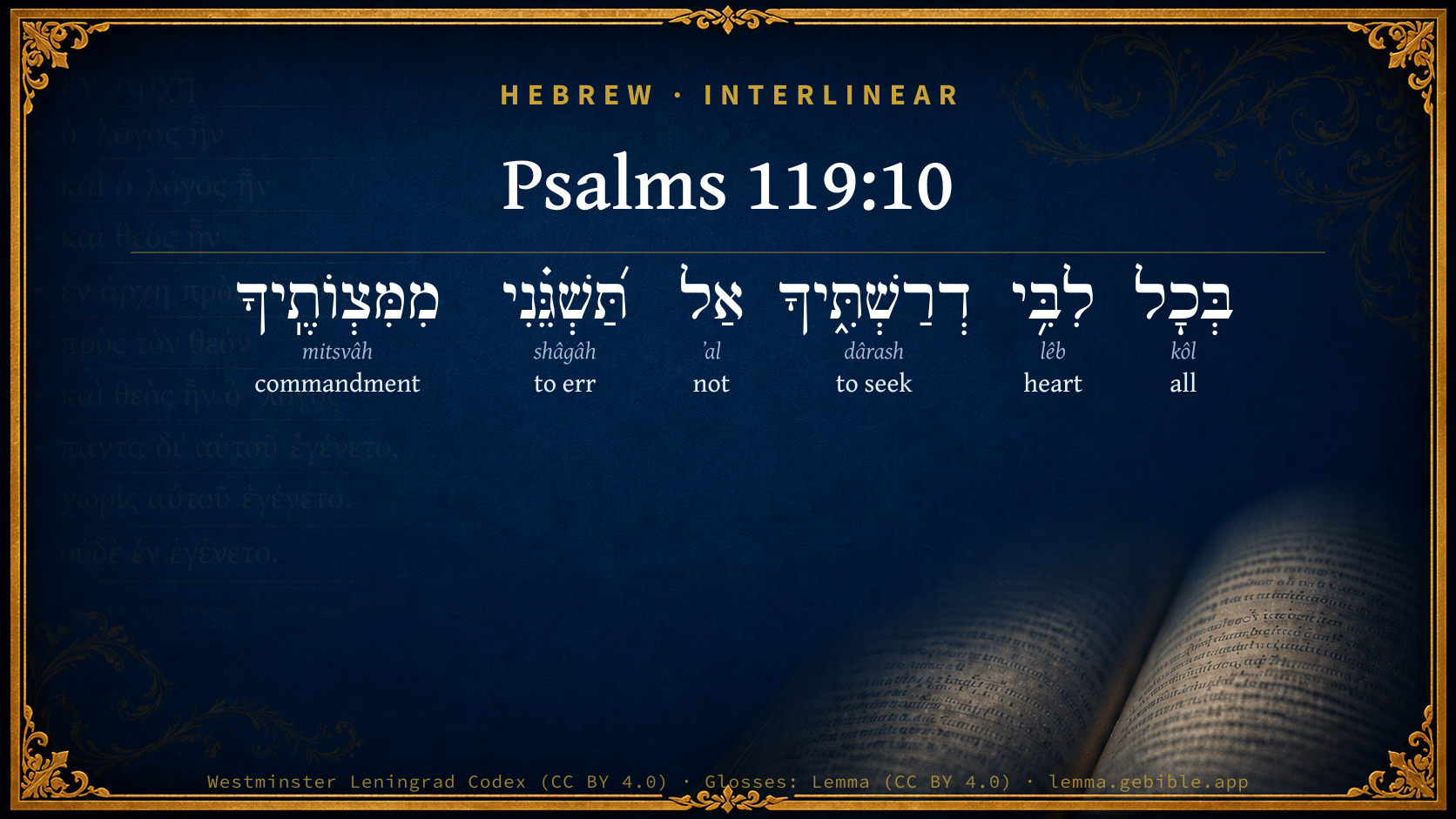
Hebrew (Westminster Leningrad Codex) Psalms 119:10 appears in the Hebrew Old Testament. The text above is from the Westminster Leningrad Codex. Each word links to its Strong’s number, a concise gloss, and parsing drawn from the Open Scriptures Hebrew Bible morphology. Click any word for its full Brown-Driver-Briggs (BDB) entry.
Download image
Cite this verse

Psalms 119:10 (World English Bible). Public Domain. Lemma interlinear Bible study tool, https://lemma.gebible.app/v/psalms/119/10.

Show BibTeX & RIS
BibTeX
RIS
English Translation
With my whole heart, I have sought you. Don't let me wander from your commandments.
World English Bible · Public Domain
Download a study sheet

One document with this verse’s original text, its word-by-word gloss line, the meaning frame, cross-references with their text, attributed commentary, and full source and license credits — printable, and it pastes into notes with its structure intact.

This verse Autodidact and up

Study sheet (.html) Plain text (.txt)

A passage Seminary Student

Up to 50 verses in one chapter. A passage sheet keeps up to 6 commentary sources and 12 cross-references per verse, in the order this page ranks them, and says so on the sheet whenever that leaves anything out. Ask for a single verse and you get the Autodidact verse sheet above.

Everything on this page stays free to read, with no account — the sheet is a download of what is already on screen, not access to it.

Want to remove ads? Support Godless Engineer
Compare translations 3

The same verse in 3 English versions, stacked beneath the original-language interlinear above. Click any original word for its lexicon entry.

Each is an independent rendering of the whole verse — the interlinear is not word-aligned to these translations.

Highlighted words mark where these versions differ — a whole-verse word diff, not a word-by-word alignment.

  • World English Bible Public Domain
    With my whole heart, I have sought you. Don't let me wander from your commandments.
  • King James Version Public Domain
    With my whole heart have I sought thee: O let me not wander from thy commandments.
  • unfoldingWord Literal Text CC BY-SA 4.0
    With all of my heart I seek you. Do not let me stray from your commandments.

unfoldingWord Literal Text — © unfoldingWord, licensed CC BY-SA 4.0. Word-aligned USFM3 via Door43 (git.door43.org/unfoldingWord/en_ult).

Versions to compare (up to 4)

3 of 4 selected

Show all 17 translations

Every available English version of this verse, each an independent rendering of the whole verse.

  • World English Bible Public Domain
    With my whole heart, I have sought you. Don't let me wander from your commandments.
  • Berean Standard Bible Public Domain
    With all my heart I have sought You; do not let me stray from Your commandments.
  • Majority Standard Bible Public Domain
    With all my heart I have sought You; do not let me stray from Your commandments.
  • King James Version Public Domain
    With my whole heart have I sought thee: O let me not wander from thy commandments.
  • American Standard Version (1901) Public Domain
    With my whole heart have I sought thee: Oh let me not wander from thy commandments.
  • Revised Version (1885) Public Domain
    With my whole heart have I sought thee: O let me not wander from thy commandments.
  • Geneva Bible (1599) Public Domain
    With my whole heart haue I sought thee: let me not wander from thy commandements.
  • Young's Literal Translation Public Domain
    With all my heart I have sought Thee, Let me not err from Thy commands.
  • Literal Standard Version CC BY-SA 4.0
    I have sought You with all my heart, || Do not let me err from Your commands.
  • Unlocked Literal Bible CC BY-SA 4.0
    With my whole heart I seek you; Do not let me stray from your commandments.
  • unfoldingWord Literal Text CC BY-SA 4.0
    With all of my heart I seek you. Do not let me stray from your commandments.
  • Darby Bible Public Domain
    With my whole heart have I sought thee: let me not wander from thy commandments.
  • World Messianic Bible Public Domain
    With my whole heart I have sought you. Don’t let me wander from your commandments.
  • Webster's Bible Public Domain
    With my whole heart have I sought thee: O let me not wander from thy commandments.
  • Free Bible Version CC BY-SA 4.0
    I worship you sincerely; please don't let me stray from your commands.
  • Bible in Basic English Public Domain
    I have made search for you with all my heart: O let me not go wandering far from your teaching.
  • JPS Tanakh (1917) Public Domain
    With my whole heart have I sought Thee; O let me not err from Thy commandments.

Literal Standard Version (2020), Covenant Press — licensed CC BY-SA 4.0. Text via the HelloAO Bible API (eBible.org). Unlocked Literal Bible (unfoldingWord) — licensed CC BY-SA 4.0. Text via the HelloAO Bible API (eBible.org). unfoldingWord Literal Text — © unfoldingWord, licensed CC BY-SA 4.0. Word-aligned USFM3 via Door43 (git.door43.org/unfoldingWord/en_ult). Free Bible Version, Dr. Jonathan Gallagher — licensed CC BY-SA 4.0. Text via the HelloAO Bible API (eBible.org).

Word by word

More ways to search: Search by grammar → Find every occurrence → Compare this word →

Practice this passage: Drill this verse → Learn its vocabulary →

תַּ֝שְׁגֵּ֗נִי
shâgâh
H7686
“to err · me”
Verb, Hiphil, Jussive, 2nd Person, Masculine, Singular + Suffix, Personal, 1st Person, Common, Singular
Part of Speech
Verb
Stem
Hiphil
Form
Jussive
Person
2nd Person
Gender
Masculine
Number
Singular
Full BDB Definition

Origin: a primitive root

TWOT: 2325

to go astray, stray, err - (Qal) - to err, stray - to swerve, meander, reel, roll, be intoxicated, err (in drunkenness) - to go astray (morally) - to commit sin of ignorance or inadvertence, err (ignorantly) - (Hiphil) - to lead astray - to lead astray, mislead (mentally) - to lead astray (morally)
  1. בְּכָל kôl H3605 “in/at · all of” Preposition + Noun, Common, Masculine, Singular, Construct
  2. לִבִּ֥י lêb H3820 “heart · my” Noun, Common, Masculine, Singular, Construct + Suffix, Personal, 1st Person, Common, Singular
  3. דְרַשְׁתִּ֑יךָ dârash H1875 “to seek · you” Verb, Qal, Perfect, 1st Person, Common, Singular + Suffix, Personal, 2nd Person, Masculine, Singular
  4. אַל ʼal H408 “not” Particle, Negative
  5. מִמִּצְוֺתֶֽיךָ mitsvâh H4687 “from · commandments · your” Preposition + Noun, Common, Feminine, Plural, Construct + Suffix, Personal, 2nd Person, Masculine, Singular

About this verse

These counts appear in no published source. They are computed here, from the morphology-tagged text and Lemma’s own curated glosses. What Lemma adds →

6
words
6
distinct lemmas
Wisdom
section

Notable vocabulary

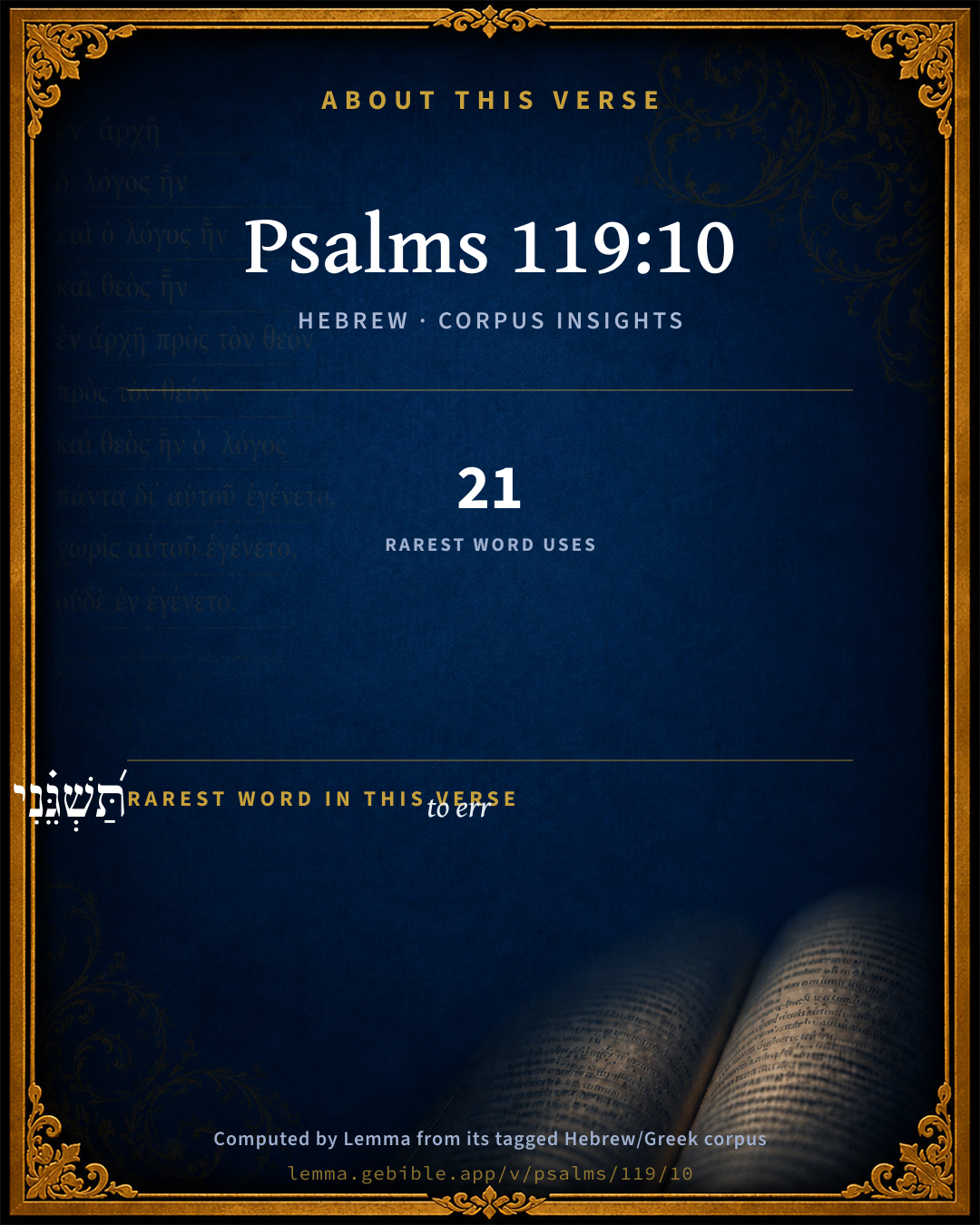
The rarest word here is תַּ֝שְׁגֵּ֗נִי to err H7686 — appearing just 21 times in the whole Hebrew Bible.

Shared distinctive vocabulary

תַּ֝שְׁגֵּ֗נִי to err H7686 occurs in 19 verses of the Hebrew Bible. Also found in:

Grammatical profile

  • 2 verbs
  • 3 nouns
  • 1 particle

Verb forms

  • דְרַשְׁתִּ֑יךָ Qal · Perfect
  • תַּ֝שְׁגֵּ֗נִי Hiphil · Jussive

Hebrew & Septuagint length

In English translation the verse runs 15 words from the Hebrew and 16 from the Septuagint (LXX English) — closely comparable.

A rough comparison of the two English renderings, which tokenize alike — not a word-level alignment.

Word counts can differ between the Hebrew and the Greek without any difference in meaning — e.g. the Hebrew direct-object marker אֵת has no separate Greek word, and Greek often adds the article ὁ.

Cross-references

25

Topical passages linked to Psalms 119:10 in the Treasury of Scripture Knowledge — connected by theme and wording, ordered by reader-vote popularity; previews shown in the World English Bible.

  • Psalms 119:34 Give me understanding, and I will keep your law. Yes, I will obey it with my whole heart.
  • 2 Chronicles 15:15 All Judah rejoiced at the oath; for they had sworn with all their heart, and sought him with their whole desire; and he was found of them: and Yahweh gave them rest round about.
  • Psalms 23:3 He restores my soul. He guides me in the paths of righteousness for his name's sake.
  • Psalms 119:2 Blessed are those who keep his statutes, Who seek him with their whole heart.
  • Psalms 119:133 Establish my footsteps in your word. Don't let any iniquity have dominion over me.
  • Isaiah 35:8 A highway shall be there, and a way, and it shall be called The way of holiness. The unclean shall not pass over it, but is shall be for for him who walks in the Way. Wicked fools will not go there.
  • Psalms 78:37 For their heart was not right with him, Neither were they faithful in his covenant.
  • Psalms 119:118 You reject all those who stray from your statutes, For their deceit is in vain.
  • Psalms 125:5 But as for those who turn aside to their crooked ways, Yahweh will lead them away with the workers of iniquity. Peace be on Israel.
  • Jeremiah 3:10 Yet for all this her treacherous sister Judah has not returned to me with her whole heart, but only in pretense, says Yahweh.
  • Psalms 119:21 You have rebuked the proud who are cursed, Who wander from your commandments.
  • Proverbs 2:13 Who forsake the paths of uprightness, To walk in the ways of darkness;
  • Proverbs 21:16 The man who wanders out of the way of understanding Shall rest in the assembly of the dead.
  • Hosea 10:2 Their heart is divided. Now they will be found guilty. He will demolish their altars. He will destroy their sacred stones.
  • Colossians 3:22 Servants, obey in all things those who are your masters according to the flesh, not just when they are looking, as men-pleasers, but in singleness of heart, fearing God.
  • 1 Samuel 7:3 Samuel spoke to all the house of Israel, saying, If you do return to Yahweh with all your heart, then put away the foreign gods and the Ashtaroth from among you, and direct your hearts to Yahweh, and serve him only; and he will deliver you out of the hand of the Philistines.
  • Psalms 119:176 I have gone astray like a lost sheep. Seek your servant, for I don't forget your commandments.
  • 1 John 2:15 Don't love the world, neither the things that are in the world. If anyone loves the world, the Father's love isn't in him.
  • Psalms 119:69 The proud have smeared a lie upon me. With my whole heart, I will keep your precepts.
  • Psalms 143:8–10 Cause me to hear your loving kindness in the morning, For I trust in you. Cause me to know the way in which I should walk, For I lift up my soul to you.
  • Ezekiel 34:6 My sheep wandered through all the mountains, and on every high hill: yes, my sheep were scattered on all the surface of the earth; and there was none who searched or sought.
  • Zephaniah 1:5–6 those who worship the host of the sky on the housetops, those who worship and swear by Yahweh and also swear by Malcam,
  • Matthew 6:24 "No one can serve two masters, for either he will hate the one and love the other; or else he will be devoted to one and despise the other. You can't serve both God and Mammon.
  • Psalms 119:58 I sought your favor with my whole heart. Be merciful to me according to your word.
  • 2 Peter 2:15–22 forsaking the right way, they went astray, having followed the way of Balaam the son of Beor, who loved the wages of wrong-doing;

Cross-references courtesy of OpenBible.info (CC BY 4.0).

Hebrew and Greek witnesses Masoretic Hebrew ↔ Greek Septuagint

The same verse in the two great witnesses to the Old Testament, shown verse-for-verse.

You’re reading Greek Psalm 118 (Hebrew Psalm 119). The Septuagint counts the superscription, so verse numbers can differ from the Hebrew — chapter-level alignment, not verse-by-verse. Numbering follows Rahlfs.

These are two independent witnesses, not word-aligned to each other, and the Septuagint is shown in lemma (dictionary) form.

Hebrew Psalms 119:10 Masoretic · Westminster Leningrad Codex

בְּכָל לִבִּ֥י דְרַשְׁתִּ֑יךָ אַל תַּ֝שְׁגֵּ֗נִי מִמִּצְוֺתֶֽיךָ

With my whole heart, I have sought you. Don't let me wander from your commandments.

World English Bible · Public Domain

Greek LXX Greek Psalm 118:10 Septuagint · lemma form

ἐν ὅλος καρδία ἐγώ ἐκζητέω σύ μή ἀποὠθέω ἐγώ ἀπό ὁ ἐντολή σύ

With my whole heart have I diligently sought you: cast me not away from your commandments.

LXX2012 (modern English Septuagint) · Public Domain

Hebrew: Westminster Leningrad Codex (CC BY 4.0). Greek: Septuagint (public domain); English from LXX2012 (modern English Septuagint) (Public Domain). How the Septuagint differs from the Hebrew →

Commentary

Notes on Psalms 119:10 from classic Christian and Jewish commentators (each source and its license shown beneath its notes). The classic Christian expositions comment on the surrounding passage and are grouped to its opening verse, so a note may address several verses; the Jewish commentaries on the Tanakh (Rashi and others) are per-verse, so they appear only where the commentator wrote on this verse.

Lemma curates 59 commentaries, every one of them public domain or Creative Commons licensed, each selected and text-cleaned for this edition rather than reprinted as found. About our sources →

Trapp's Complete Commentary

John Trapp

Psa 119:10 With my whole heart have I sought thee: O let me not wander from thy commandments.

Ver. 10. With my whole heart have I sought thee] And that of a child little, being nourished up in the words of faith and of good doctrine, 1Ti 4:6. I did all the wills of God, and so became a man after his own heart, Act 13:22.

O let me not wander] As I shall surely, if thou but withdraw thy grace; for I subsist merely by thy manutension.

John Trapp, A Commentary or Exposition upon All the Books of the Old and New Testament (1647–1656) — public domain. Text from a community e-Sword module.

The Biblical Illustrator

Joseph S. Exell

Psa_119:10

With my whole heart have I sought Thee: O let me not wander from Thy commandments.

Mans distinguishing capacity and fearful liability

I. Mans distinguishing capacity. What is that? Power to wander from the Divine law. He can bound from his orbit, he has done so, is doing so. Sublimely awful power this, the power that makes us men and links us to moral government.

II. Mans fearful liability. The possession of this power is a dignity of our natures, the wrong use of this power is our crime and our ruin, and to the wrong use, alas, we are all fearfully liable. If I wander from Gods commandment I wander from the right into the wrong, from light into darkness, from liberty to thraldom, from happiness to misery. (Homilist.)

The grandest pursuit and the greatest peril

I. The grandest pursuit of man.

1. The object of pursuit--God. Not merely His works, but Himself. Not a mere knowledge of Him, but the possession of Him. To obtain God as the Father of the soul is the grandest end of being.

2. The mode of pursuit. Unless it is done with the whole heart, the concentration of the soul, it is never done.

II. The greatest peril of man. To wander from Gods commandments is to wander from light into darkness, from order into confusion, from plenty into pauperism, from happiness into misery, from life into death. (Homilist.)

Keeping to the path

Old Humphrey has a good paper against wandering from the path of duty, suggested by a notice at the entrance of a park:--Take notice. In walking through these grounds, you are requested to keep the foot-path. Bunyan has supplied the same theme for solemn warning, in the pilgrim straying into Bye-path meadow. (Bowes.)

The Biblical Illustrator, edited by Joseph S. Exell (c. 1880s–1900s) — public domain. Text from a community e-Sword module.

Joseph Benson's Commentary

Psa 119:10-11. With my whole heart have I sought thee — Deny me not that aid of thy grace which I have so sincerely and earnestly desired and laboured to obtain. O let me not wander — Hebrew, אל תשׁגני, do not make me to wander, namely, by leading me into temptation, or by withdrawing thy grace, which is necessary to keep me from wandering. Thy word have I hid in my heart — I have not contented myself with merely hearing or reading thy word, but have received it in the love of it, have diligently considered it, and have laid it up in my mind, like a choice treasure, to be ready upon all occasions to counsel, quicken, or caution me, as need may require. That I might not sin against thee — That by a diligent and affectionate consideration of thy precepts, promises, and threatenings, I might be kept from all sinful practices.

Joseph Benson's Commentary on the Old and New Testaments (1811–1818) — public domain. Text from a community e-Sword module.

J. A. Alexander on Psalms

Joseph Addison Alexander

10. (Psa 119:10) With my whole heart have I sought thee; let me not err from thy commandments. While the first clause alleges his sincerity in seeking God, the second and third owns his dependence on him for success and safety.

Joseph Addison Alexander, The Psalms Translated and Explained (1850) — public domain. Text from a community e-Sword module.

Tyndale Open Study Notes

Tyndale Open Resources

119:10 The student asks God the teacher to discipline him so that he will not wander.

Tyndale Open Study Notes — © Tyndale Open Resources, licensed CC BY-SA 4.0. Text via the HelloAO Bible API.

Matthew Henry's Commentary

Here is, 1. David's experience of a good work God had wrought in him, which he takes the comfort of and pleads with God: "I have sought thee, sought to thee as my oracle, sought after thee as my happiness, sought thee as my God; for should not a people seek unto their God? If I have not yet found thee, I have sought thee, and thou never saidst, Seek in vain, nor wilt say so to me, for I have sought thee with my heart, with my whole heart, sought thee only, sought thee diligently." 2. His prayer for the preservation of that work: "Thou that hast inclined me to seek thy precepts, never suffer me to wander from them." The best are sensible of their aptness to wander; and the more we have found of the pleasure there is in keeping God's commandments the more afraid we shall be of wandering from them and the more earnest we shall be in prayer to God for his grace to prevent our wanderings.

Matthew Henry's Commentary on the Whole Bible (1708–1710) — public domain (CC PDM 1.0). Text via the HelloAO Bible API.

Adam Clarke's Commentary

Verse 10. With my whole heart have I sought thee]

4. He must seek God; make earnest prayer and supplication to him for Divine light, for a tender conscience, and for strength to walk uprightly.

5. His whole heart; all his affections must be engaged here, or he cannot succeed. If he keep any affection for the idol or abomination; if his heart do not give it before the Lord, he may make many prayers, but God will answer none of them.

6. He must take care to keep in the path of duty, of abstinence and self-denial; not permitting either his eye, his hand, or his heart to wander from the commandments of his Maker.

Adam Clarke's Commentary on the Bible (1810–1826) — public domain. Text from a community e-Sword/MySword module.

John Calvin's Commentaries

10. With my whole heart Conscious of the integrity of his heart, the prophet still implores the help of God, that he might not stumble by reason of his infirmity. He makes no boast of self-preparation, as if he had spontaneously begun to inquire after God, but in praising the grace which he had experienced, he at the same time aspires after steadfastness to persevere in walking in his ways. It is folly on the part of the Papists to seize upon this and similar passages, as if the saints, of their own free will, anticipated the grace of the Holy Spirit, and afterwards were favored with his aid. The prophet does not make a division between God and himself, but rather prays God to continue his work till it is completed, agreeably with what we are generally taught, to keep God mindful of his benefits until he accomplish them.

In the meantime, there is good cause for presenting our supplication to God, to stretch out his hand towards us when he sees our minds so settled, that we are solicitous of nothing so much as acting uprightly. And as he elevates us with confidence to ask the gift of perseverance, when he inspires our hearts with proper affection towards him, so also does he entreat us for the future not to sink into a careless and languid state like soldiers who have been discharged, but seek to be constantly directed by the spirit of wisdom, and to be sustained by the principles of fortitude and virtue. David here, from his own example, points out to us a rule, that by how much a man finds himself succored by God, by so much ought he to be induced the more carefully and earnestly to implore the continuance of his aid; for unless he restrain us, we will instantly wander and go astray. This sentiment is more explicitly stated in the original word תשגני, tashqeni, which is in the passive voice, and signifies, to be led astray From the import of the term, I do not mean to establish the doctrine that God secretly incites us to commit sin, but only to let my readers know, that such is our liability to err, that we immediately relapse into sin the instant he leaves us to ourselves. This passage also admonishes us that the man who swerves but a little from God’s commandments is guilty of going astray.

John Calvin's Commentaries (1540-1563) — public domain. Text from the Calvin Translation Society English edition (1840s-50s) via the Christian Classics Ethereal Library (ccel.org). Calvin's coverage is partial (roughly two-thirds of the Bible); uncommented books and verses are honest gaps, never fabricated. The 19th-century editor's footnotes and remarks are omitted so the notes are faithfully Calvin's own voice.

Ellicott's Commentary for English Readers

(10) With my whole heart . . .—The self-mistrust of the second clause is a proof of the reality of the first. “Lord, I believe; help thou my unbelief,” is another form of this.

A Bible Commentary for English Readers, edited by Charles John Ellicott (1878–1897) — public domain. Text from a community e-Sword module.

The Cambridge Bible for Schools and Colleges

gen. ed. J. J. S. Perowne

10. ’Orach, ‘path,’ a poetical synonym for derek; not in Deut., but common in Prov.

The attributes applied to the Law should also be studied. Like its Author (Psa_119:137, cp. Deu_32:4) it is perfectly righteous. The note of righteousness is constantly repeated; in all its aspects the Law answers to that perfect standard which God is to Himself for all His works and words. Its faithfulness and truth correspond to the faithfulness and truth of His nature; it is sharply contrasted with all that is false in belief and conduct.

Other constantly recurring expressions should also be noted. The Psalmist’s repeated protestations that he has ‘observed’ or ‘kept’ the law, his resolutions to do so, and his prayers for strength to fulfil them, answer to the repeated injunctions of Deut. (Psa_4:2 &c.). ‘With a (my) whole heart,’ with entire devotion of thought and will, is a phrase characteristic alike of this Psalm and of the Book of Deut.[80] (Deu_4:29; Deu_6:5 &c.) where it is often coupled with ‘the whole soul,’ the organ of feeling and emotion. In Deut. the Israelites are repeatedly exhorted to learn the statutes and judgements (Deu_5:1) and to teach them to their children (Deu_4:10); and repeatedly the Psalmist prays that he may be taught. The Psalmist’s reiterated prayers for ‘understanding’ recall the language of Deu_4:6. ‘Life’ is held out in Deut. (Deu_4:1 &c.) as the reward of obedience; and for ‘life’ the Psalmist continually pleads—‘quicken thou me’—‘let me live’ (Psa 25, 37, 40, 88, 107, 149, 154, 156, 159, 116, 144). The source of ‘life’ he finds in the law and promises of God (50, 93): and by ‘life’ he means not simply preservation from death, but liberation from all, whether within or without, that crushes and paralyses life, and hinders its proper use and enjoyment; for ‘life’ includes the ideas of light and joy and prosperity. It finds its fullest realisation in communion with God. The original promise of life to the nation is coupled with the promise of the possession of the land, but the latter now drops out of sight, and the conception of ‘life’ is approximating towards the higher meaning of the word in the N.T. Cp. Deu_8:3. Very noteworthy is the Psalmist’s enthusiastic love for the Law. The love which the Israelite was bidden to cherish for Jehovah (Deu_6:5 &c.) is kindled by the manifold revelation of His Will in the Law. “O how I love thy law: it is my meditation all the day” (97). It is no irksome restraint of his liberty, but his delight, his joy, his treasure, his comfort, the subject of his meditations by day and by night, the source of trust and hope amid all the perplexities and troubles of life. “Thy word is a lamp unto my feet and a light unto my path.”

[80] Deut. prefers the form lçbâb, the Psalm, except in Psa_119:7, uses lçb.

10. Cp. Psa_119:2 b.

O let me not wander &c.] Let me not err through ignorance or inadvertence (Psa_119:67; Psa_19:12). My intention is good, but my knowledge is imperfect and my strength is small. “The self-mistrust of the second clause is a proof of the reality of the first” (Aglen).

The Cambridge Bible for Schools and Colleges (gen. ed. J. J. S. Perowne; Cambridge University Press, 1878–1918) — public domain. Text from a community e-Sword module.

John Gill's Exposition

Thy word have I hid in mine heart,.... Not only heard and read it, but received it into his affections; mixed it with faith, laid it up in his mind and memory for future use; preserved it in his heart as a choice treasure, where it might dwell richly, and be of service to him on many occasions; and particularly be of the following use:

that I might not sin against thee; the word of God is a most powerful antidote against sin, when it has a place in the heart; not only the precepts of it forbid sin, but the promises of it influence and engage to purity of heart and life, and to the perfecting of holiness in the fear of the Lord; and all the doctrines of grace in it effectually teach the saints to deny all sin and worldly lusts, and to live a holy life and conversation; see Co2 7:1.

John Gill's Exposition of the Whole Bible (1746–1763) — public domain (CC PDM 1.0). Text via the HelloAO Bible API.

Albert Barnes' Notes on the Bible

With my whole heart have I sought thee - See the notes at Psa 119:2. The psalmist in Psa 119:2 speaks of the “blessedness of those who seek the Lord with the whole heart;” in this verse he says that this blessedness was his. He could affirm that he had thus sought God. He had such a consciousness that this was the aim and purpose of his life that he could say so without hesitation. Every man who claims to be a religious man ought to be able to say this. Alas, how few can do it!

O let me not wander ... - Keep me in this steady purpose; this fixed design. This is the language of a heart where there is a consciousness of its weakness, and its liability to err, strong as may be its purpose to do right. Such an apprehension is one of the best means of security, for such an apprehension will lead a man to “pray,” and while a man prays he is safe.

Albert Barnes' Notes on the Bible (1834–1885) — public domain. Text from a community e-Sword/MySword module.

Matthew Poole's English Annotations

Deny me not thy grace and assistance, which I have so sincerely and earnestly desired, and laboured to obtain.

Let me not wander, Heb. do not make me to wander, to wit, by leading me into temptation, by withdrawing thy grace, which is necessary to keep me from wandering.

Matthew Poole's English Annotations on the Holy Bible (1683–1685) — public domain. Text from a community e-Sword/MySword module.

The Treasury of David

Charles H. Spurgeon

Ver. 10. With my whole heart have I sought thee. His heart had gone after God himself: he had not only desired to obey his laws, but to commune with his person. This is a right royal search and pursuit, and well may it be followed with the whole heart. The surest mode of cleansing the way of our life is to seek after God himself, and to endeavour to abide in fellowship with him. Up to the good hour in which he was speaking to his Lord, the Psalmist had been an eager seeker after the Lord, and if faint, he was still pursuing. Had he not sought the Lord he would never have been so anxious to cleanse his way.

It is pleasant to see how the writer's heart turns distinctly and directly to God. He had been considering an important truth in the preceding verse, but here he so powerfully feels the presence of his God that he speaks to him, and prays to him as to one who is near. A true heart cannot long live without fellowship with God.

His petition is founded on his life's purpose: he is seeking the Lord, and he prays the Lord to prevent his going astray in or from his search. It is by obedience that we follow after God, hence the prayer,

O let me not wander from thy commandments; for if we leave the ways of God's appointment we certainly shall not find the God who appointed them. The more a man's whole heart is set upon holiness the more does he dread falling into sin; he is not so much fearful of deliberate transgression as of inadvertent wandering: he cannot endure a wandering look, or a rambling thought, which might stray beyond the pale of the precept. We are to be such wholehearted seekers that we have neither time nor will to be wanderers, and yet with all our wholeheartedness we are to cultivate a jealous fear lest even then we should wander from the path of holiness.

Two things may be very like and yet altogether different: saints are "strangers" "I am a stranger in the earth" (Ps 119:19), but they are not wanderers: they are passing through an enemy's country, but their route is direct; they are seeking their Lord while they traverse this foreign land. Their way is hidden from men; but yet they have not lost their way.

The man of God exerts himself, but does not trust himself: his heart is in his walking with God: but he knows that even his whole strength is not enough to keep him right unless his King shall be his keeper, and he who made the commands shall make him constant in obeying them: hence the prayer, "O let me not wander." Still, this sense of need was never turned into an argument for idleness; for while he prayed to be kept in the right road he took care to run in it with his whole heart seeking the Lord.

It is curious again to note how the second part of the Psalm keeps step with the first; for where Ps 119:2 pronounces that man to be blessed who seeks the Lord with his whole heart, the present verse claims the blessing by pleading the character: With my whole heart have I sought thee.

Ver. 10. With my whole heart have I sought thee. There are very few of us that are able to say with the prophet David that we have sought God with our whole heart; to wit, with such integrity and pureness that we have not turned away from that mark as from the most principal thing of our salvation. John Calvin.

Ver. 10. With my whole heart have I sought thee. Sincerity is in every expression; the heart is open before God. The young man can so speak to the Searcher of hearts... Let us consider the directness of this kind of converse with God. We use round about expressions in drawing nigh to God. We say, With my whole heart would I seek thee. We are afraid to be direct... See how decided in his conscious acting is the young man before you, how open and confiding he is, and such you will find to be the characteristic of his pious mind throughout the varied expressions unfolded in this Psalm. Here he declares to the Omniscient One that he had sought him with all his heart. He desired to realize God in everything. John Stephen.

Ver. 10 (first clause). God alone sees the heart; the heart alone sees God. John Donne, 1573-1631.

Ver. 10. O let me not wander from thy commandments. David after he had protested that he sought God with his whole heart, besought God that he would not suffer him to decline from his commandments. Hereby let us see what great need we have to call upon God, to the end he may hold us with a mighty strong hand. Yea, and though he hath already mightily put to his healing hand, and we also know that he hath bestowed upon us great and manifest graces; yet this is not all: for there are so many vices and imperfections in our nature, and we are so feeble and weak that we have very great need daily to pray unto him, yea, and that more and more, that he will not suffer us to decline from his commandments. John Calvin.

Ver. 10. The more experience a man hath in the ways of God, the more sensible is he of his own readiness to wander insensibly, by ignorance and inadvertency, from the ways of God; but the young soldier dares run hazards, ride into his adversary's camp, and talk with temptation, being confident he cannot easily go wrong; he is not so much in fear as David who here cries, O let me not wander. David Dickson, 1583-1662.

Ver. 10.

1. A grateful review.

2. An anxious forecast.

3. A commendable prayer.

Ver. 10. The believer's two great solicitudes.

1. What he is anxious to find: "I have sought thee."

2. What he is afraid of losing: "Thy commandments." W. D.

Ver. 10. Sincerity not self sufficiency.

1. The believer must be conscious of wholeheartedness in seeking God.

2. But consciousness of sincerity does not warrant self sufficiency.

3. The most wholehearted seeker must still look to divine grace to keep him from wandering. C.A.D.

Psalms 119:11*

Charles H. Spurgeon's The Treasury of David (1869–1885) — public domain. Psalms only. Text from a community e-Sword/MySword module.

The Pulpit Commentary

With my whole heart have I sought thee (comp. ver. 2). O let me not wander from thy commandments; i.e. "let me not accidentally and through ignorance stray from the right path."

The Pulpit Commentary (1880–1919), ed. H.D.M. Spence-Jones & Joseph S. Exell — public domain. Text from a community e-Sword module.

Lesson kit

Teaching starters — assembled from the data on this page, not authored interpretation. Every prompt links to the verse data it draws on. Edit before teaching.

Psalms, in the Wisdom, opens this verse with 6 words (6 distinct Hebrew lemmas). Its most distinctive word is shâgâh (“to err”). A historical commentator’s framing appears above. Read the whole chapter for the surrounding context.

Discussion questions

  1. The word shâgâh carries the sense “to err.” How does it shape the verse?
  2. Leviticus 4:13 shares the word «to err» with this verse. How do the two illuminate each other?
  3. These translations render this verse differently; the difference is in the English rendering, not the original. What questions does that raise?
  4. The verb «דְרַשְׁתִּ֑יךָ» is Qal Perfect. How does its form color the action?
  5. Reading how Trapp's Complete Commentary and The Biblical Illustrator read this verse, where do the two commentators agree and where do they part?

Things to notice

Reading settings

Reading text

Shown beneath each verse's original-language words.

Old Testament
Old Testament edition

Read the OT as the Masoretic Hebrew (MT) or the Greek Septuagint (LXX).

English shown for the Greek Septuagint (in the Hebrew ↔ Greek comparison).

Comparing translations? Open the Compare panel on any verse page to stack up to four side by side.