
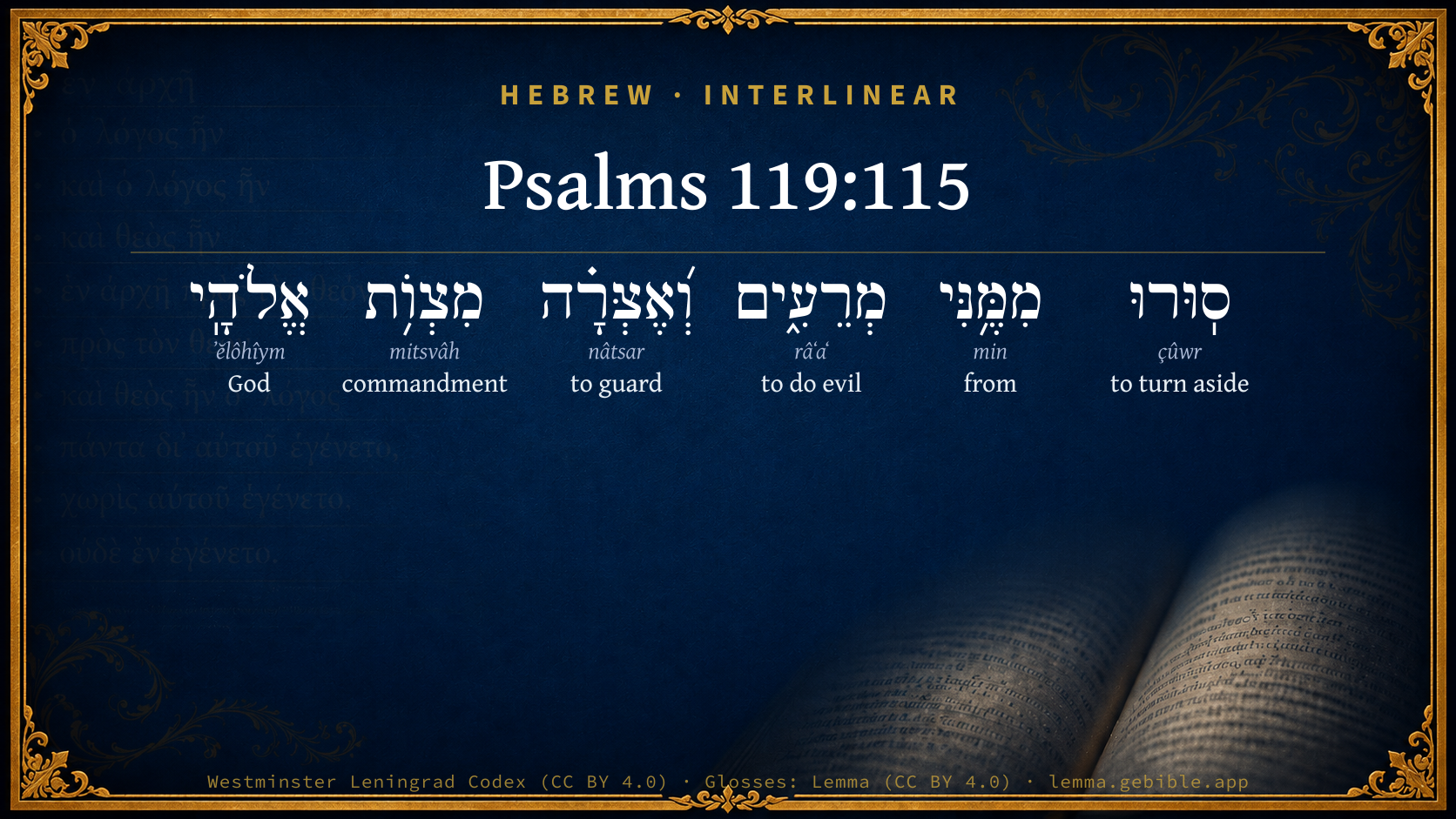
Psalms 119:115

Hebrew (Westminster Leningrad Codex) Psalms 119:115 appears in the Hebrew Old Testament. The text above is from the Westminster Leningrad Codex. Each word links to its Strong’s number, a concise gloss, and parsing drawn from the Open Scriptures Hebrew Bible morphology. Click any word for its full Brown-Driver-Briggs (BDB) entry.
Download image
Cite this verse

Psalms 119:115 (World English Bible). Public Domain. Lemma interlinear Bible study tool, https://lemma.gebible.app/v/psalms/119/115.

Show BibTeX & RIS
BibTeX
RIS
English Translation
Depart from me, you evildoers, That I may keep the commandments of my God.
World English Bible · Public Domain
Download a study sheet

One document with this verse’s original text, its word-by-word gloss line, the meaning frame, cross-references with their text, attributed commentary, and full source and license credits — printable, and it pastes into notes with its structure intact.

This verse Autodidact and up

Study sheet (.html) Plain text (.txt)

A passage Seminary Student

Up to 50 verses in one chapter. A passage sheet keeps up to 6 commentary sources and 12 cross-references per verse, in the order this page ranks them, and says so on the sheet whenever that leaves anything out. Ask for a single verse and you get the Autodidact verse sheet above.

Everything on this page stays free to read, with no account — the sheet is a download of what is already on screen, not access to it.

Want to remove ads? Support Godless Engineer
Compare translations 3

The same verse in 3 English versions, stacked beneath the original-language interlinear above. Click any original word for its lexicon entry.

Each is an independent rendering of the whole verse — the interlinear is not word-aligned to these translations.

Highlighted words mark where these versions differ — a whole-verse word diff, not a word-by-word alignment.

  • World English Bible Public Domain
    Depart from me, you evildoers, That I may keep the commandments of my God.
  • King James Version Public Domain
    Depart from me, ye evildoers: for I will keep the commandments of my God.
  • unfoldingWord Literal Text CC BY-SA 4.0
    Turn aside from me, doers of evil, and let me keep the commandments of my God.

unfoldingWord Literal Text — © unfoldingWord, licensed CC BY-SA 4.0. Word-aligned USFM3 via Door43 (git.door43.org/unfoldingWord/en_ult).

Versions to compare (up to 4)

3 of 4 selected

Show all 17 translations

Every available English version of this verse, each an independent rendering of the whole verse.

  • World English Bible Public Domain
    Depart from me, you evildoers, That I may keep the commandments of my God.
  • Berean Standard Bible Public Domain
    Depart from me, you evildoers, that I may obey the commandments of my God.
  • Majority Standard Bible Public Domain
    Depart from me, you evildoers, that I may obey the commandments of my God.
  • King James Version Public Domain
    Depart from me, ye evildoers: for I will keep the commandments of my God.
  • American Standard Version (1901) Public Domain
    Depart from me, ye evil-doers, That I may keep the commandments of my God.
  • Revised Version (1885) Public Domain
    Depart from me, ye evil-doers; that I may keep the commandments of my God.
  • Geneva Bible (1599) Public Domain
    Away from mee, yee wicked: for I will keepe the commandements of my God.
  • Young's Literal Translation Public Domain
    Turn aside from me, ye evil-doers, And I keep the commands of my God.
  • Literal Standard Version CC BY-SA 4.0
    Turn aside from me, you evildoers, || And I keep the commands of my God.
  • Unlocked Literal Bible CC BY-SA 4.0
    Get away from me, you evil doers, so that I may observe the commandments of my God.
  • unfoldingWord Literal Text CC BY-SA 4.0
    Turn aside from me, doers of evil, and let me keep the commandments of my God.
  • Darby Bible Public Domain
    Depart from me, ye evil-doers; and I will observe the commandments of my God.
  • World Messianic Bible Public Domain
    Depart from me, you evildoers, that I may keep the commandments of my God.
  • Webster's Bible Public Domain
    Depart from me, ye evil-doers: for I will keep the commandments of my God.
  • Free Bible Version CC BY-SA 4.0
    Leave me alone, you evil people, and let me keep the commandments of my God.
  • Bible in Basic English Public Domain
    Go far from me, you evil-doers; so that I may keep the teachings of my God.
  • JPS Tanakh (1917) Public Domain
    Depart from me, ye evildoers; that I may keep the commandments of my God.

Literal Standard Version (2020), Covenant Press — licensed CC BY-SA 4.0. Text via the HelloAO Bible API (eBible.org). Unlocked Literal Bible (unfoldingWord) — licensed CC BY-SA 4.0. Text via the HelloAO Bible API (eBible.org). unfoldingWord Literal Text — © unfoldingWord, licensed CC BY-SA 4.0. Word-aligned USFM3 via Door43 (git.door43.org/unfoldingWord/en_ult). Free Bible Version, Dr. Jonathan Gallagher — licensed CC BY-SA 4.0. Text via the HelloAO Bible API (eBible.org).

Word by word

More ways to search: Search by grammar → Find every occurrence → Compare this word →

Practice this passage: Drill this verse → Learn its vocabulary →

About this verse

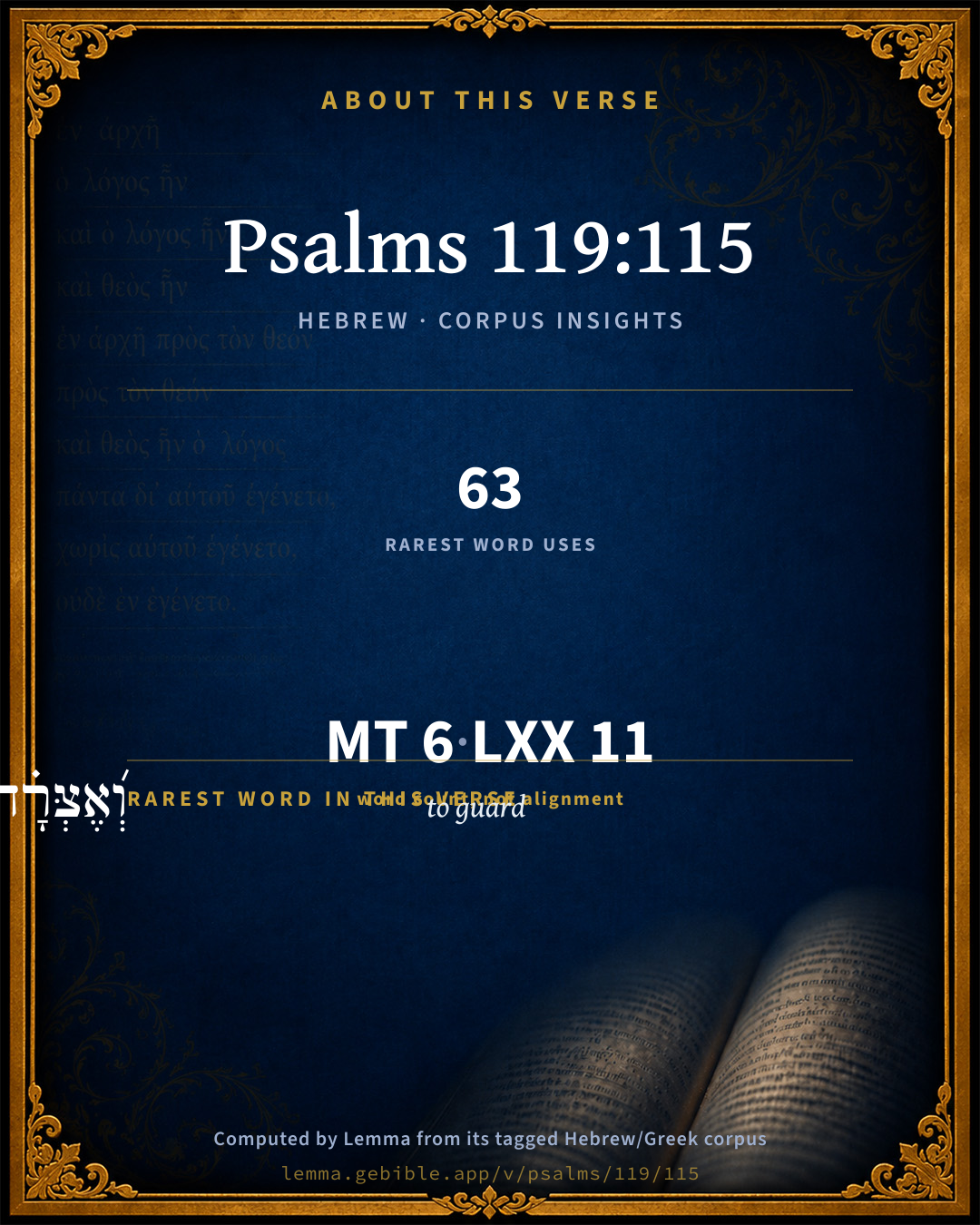
These counts appear in no published source. They are computed here, from the morphology-tagged text and Lemma’s own curated glosses. What Lemma adds →

6
words
6
distinct lemmas
Wisdom
section

Grammatical profile

  • 3 verbs
  • 2 nouns
  • 1 preposition

Verb forms

  • סֽוּרוּ Qal · Imperative
  • מְרֵעִ֑ים Hiphil · Participle Active
  • וְ֝אֶצְּרָ֗ה Qal · Cohortative

Hebrew & Septuagint length

In English translation the verse runs 14 words from the Hebrew and 15 from the Septuagint (LXX English) — closely comparable.

A rough comparison of the two English renderings, which tokenize alike — not a word-level alignment.

Word counts can differ between the Hebrew and the Greek without any difference in meaning — e.g. the Hebrew direct-object marker אֵת has no separate Greek word, and Greek often adds the article ὁ.

In the original languages it is 6 Hebrew tokens and 11 Greek tokens — but the two are counted differently (Hebrew bundles its prefixes and suffixes into one token; the Greek is in lemma form), so that isn’t a like-for-like length.

Cross-references

9

Topical passages linked to Psalms 119:115 in the Treasury of Scripture Knowledge — connected by theme and wording, ordered by reader-vote popularity; previews shown in the World English Bible.

  • 1 Corinthians 15:33 Don't be deceived! "Evil companionships corrupt good morals."
  • Psalms 6:8 Depart from me, all you workers of iniquity, For Yahweh has heard the voice of my weeping.
  • Matthew 7:23 Then I will tell them, 'I never knew you. Depart from me, you who work iniquity.'
  • Psalms 26:5 I hate the assembly of evil-doers, And will not sit with the wicked.
  • Psalms 119:106 I have sworn, and have confirmed it, That I will obey your righteous ordinances.
  • Psalms 139:19 If only you, God, would kill the wicked. Get away from me, you bloodthirsty men!
  • Psalms 26:9 Don't gather my soul with sinners, Nor my life with bloodthirsty men;
  • Matthew 25:41 Then he will say also to those on the left hand, 'Depart from me, you cursed, into the eternal fire which is prepared for the devil and his angels;
  • Joshua 24:15 If it seem evil to you to serve Yahweh, choose you this day whom you will serve; whether the gods which your fathers served that were beyond the River, or the gods of the Amorites, in whose land you dwell: but as for me and my house, we will serve Yahweh.

Cross-references courtesy of OpenBible.info (CC BY 4.0).

Hebrew and Greek witnesses Masoretic Hebrew ↔ Greek Septuagint

The same verse in the two great witnesses to the Old Testament, shown verse-for-verse.

You’re reading Greek Psalm 118 (Hebrew Psalm 119). The Septuagint counts the superscription, so verse numbers can differ from the Hebrew — chapter-level alignment, not verse-by-verse. Numbering follows Rahlfs.

These are two independent witnesses, not word-aligned to each other, and the Septuagint is shown in lemma (dictionary) form.

Hebrew Psalms 119:115 Masoretic · Westminster Leningrad Codex

סֽוּרוּ מִמֶּ֥נִּי מְרֵעִ֑ים וְ֝אֶצְּרָ֗ה מִצְוֺ֥ת אֱלֹהָֽי

Depart from me, you evildoers, That I may keep the commandments of my God.

World English Bible · Public Domain

Greek LXX Greek Psalm 118:115 Septuagint · lemma form

ἐκκλίνω ἀπό ἐγώ πονηρεύομαι καί ἐκἐρευνάω ὁ ἐντολή ὁ θεός ἐγώ

Depart from me, you⌃ evil-doers; for I will search out the commandments of my God.

LXX2012 (modern English Septuagint) · Public Domain

Hebrew: Westminster Leningrad Codex (CC BY 4.0). Greek: Septuagint (public domain); English from LXX2012 (modern English Septuagint) (Public Domain). How the Septuagint differs from the Hebrew →

Commentary

Notes on Psalms 119:115 from classic Christian and Jewish commentators (each source and its license shown beneath its notes). The classic Christian expositions comment on the surrounding passage and are grouped to its opening verse, so a note may address several verses; the Jewish commentaries on the Tanakh (Rashi and others) are per-verse, so they appear only where the commentator wrote on this verse.

Lemma curates 59 commentaries, every one of them public domain or Creative Commons licensed, each selected and text-cleaned for this edition rather than reprinted as found. About our sources →

Trapp's Complete Commentary

John Trapp

Psa 119:115 Depart from me, ye evildoers: for I will keep the commandments of my God.

Ver. 115. Depart from me, ye evildoers] For what reason? there is no doing my duty in your company; besides, a double danger: 1. Infection of sin; 2. Infliction of punishment, Rev 18:4.

For I will keep the commandments] Which it booteth me not to set about unless I do first abandon your society, hating the garment spotted by the flesh, that is, avoiding evil company (saith Mr Perkins), that remora or pest of true piety. See Lev 15:4.

John Trapp, A Commentary or Exposition upon All the Books of the Old and New Testament (1647–1656) — public domain. Text from a community e-Sword module.

The Biblical Illustrator

Joseph S. Exell

Psa_119:115

Depart from me, ye evil-doers; for I will keep the commandments of my God.

Go! and they go

You go your way, he says in effect, and I will go mine; I am for obedience, you are not for that, and you are asking the wrong man to be your companion. Away to your own sort!

I. Here is a dismissal that there is absolutely no help for if we will be faithful to God. So incongruous are evil companionships. Two attempting to walk together who as to destination and route are not agreed! Darkness assaying fellowship with light! How contrary the self-seeker to the child of God! What a great gulf between the worldling and the follower after holiness! Strange that association should be thought of. But there is a policy in it. There is a tempter. Ungodliness is eager for recruits. To company with evil men is to walk into the snare. All worldly currents are against godliness, how soon the heart may be drawn from the living God, how mighty the influence of those with whom we voluntarily associate, how soon divine love may be robbed of its fervour, and tenderness of conscience become less. Evil men are the messengers and tools of Satan, and as a matter of course seek to make others like themselves. With what craft-this is often done.

II. Here is a dismissal that when it is meant is always understood, and speedily takes effect. There are many ways of uttering that Depart. There is the formal way, and the timid, apologetic way, and the half-hearted and wavering way. Evil-doers can always tell how much real force there is in that word. And when without any nonsense or faltering they are told to go, they go. Give it forth, not rudely, but with all the truth and strength of your soul. (B. E. Hawkins.)

The Biblical Illustrator, edited by Joseph S. Exell (c. 1880s–1900s) — public domain. Text from a community e-Sword module.

J. A. Alexander on Psalms

Joseph Addison Alexander

115. (Psa 119:115) Depart from me, evil doers, and I will keep the commandments of God. The first clause is borrowed from Psa 6:8. The meaning in both cases seems to be, that he has no fear of their enmity. The reason given in this case is, because he is resolved to do the will of God, and is therefore sure of his protection.

Joseph Addison Alexander, The Psalms Translated and Explained (1850) — public domain. Text from a community e-Sword module.

Geneva Bible (1599)

Geneva Bible translators

And hinder me not to keep the Law of the Lord.

Geneva Bible (1599) marginal notes — public domain. Text via Bolls.life.

Matthew Henry's Commentary

Here is, 1. David's firm and fixed resolution to live a holy life: I will keep the commandments of my God. Bravely resolved! like a saint, like a soldier; for true courage consists in a steady resolution against all sin and for all duty. Those that would keep God's commandments must be often renewing their resolutions to do so: "I will keep them. Whatever others do, this I will do; though I be singular, though all about me be evil-doers, and desert me; whatever I have done hitherto, I will for the future walk closely with God. They are the commandments of God, of my God, and therefore I will keep them. He is God and may command me, my God and will command me nothing but what is for my good." 2. His farewell to bad company, pursuant to this resolution: Depart from me, you evil-doers. Though David, as a good magistrate, was a terror to evil-doers, yet there were many such, even about court, intruding near his person; these he here abdicates, and resolves to have no conversation with them. Note, Those that resolve to keep the commandments of God must have no society with evil-doers; for bad company is a great hindrance to a holy life. We must not choose wicked people for our companions, nor be intimate with them; we must not do as they do nor do as they would have us do, Psa 1:1; Eph 5:11.

Matthew Henry's Commentary on the Whole Bible (1708–1710) — public domain (CC PDM 1.0). Text via the HelloAO Bible API.

Adam Clarke's Commentary

Verse 115. Depart from me] Odi profanum vulgus, etarceo, I abominate the profane, and will have no communion with them. I drive them away from my presence.

Adam Clarke's Commentary on the Bible (1810–1826) — public domain. Text from a community e-Sword/MySword module.

John Calvin's Commentaries

115. Depart from me, ye wicked! Some explain this verse as if David declared that he would devote himself with more alacrity and greater earnestness to the keeping of the law, when the wicked should have desisted from assaulting him. And, unquestionably, when we feel that God has delivered us, we are more than stupid if this experience does not stir up within us an earnest desire to serve him. If godliness does not increase in us in proportion to the sense and experience we have of God’s grace, we betray base ingratitude. This, then, is a true and useful doctrine; but the prophet meant to convey a different sentiment in this place. As he saw how great a hindrance the ungodly are to us, he banishes them to a distance from him; or rather, he testifies that he will beware of entangling himself in their society. Nor has he said this so much for his own sake as to teach us by his example, that if we would hold on in the way of the Lord without stumbling, we must endeavor, above all things, to keep at the greatest possible distance from worldly and wicked men, not in regard to distance of place, but in respect of intercourse and conversation. Provided we contract an intimate acquaintance with them, it is scarcely possible for us to avoid being speedily corrupted by the contagion of their example. The dangerous influence of fellowship with wicked men is but too evident from observation; and to this it is owing, that few continue in their integrity to the close of life, the world being fraught with corruption’s. From the extreme infirmity of our nature, it is the easiest thing in the world to catch infection, and to contract pollution even from the slightest touch. The prophet, then, with good reason, bids the wicked depart from him, that he may advance in the fear of God without obstruction. Whoever entangles himself in their companionship will, in process of time, proceed the length of abandoning himself to a contempt, of God, and of leading a dissolute life. With this statement agrees the admonition of Paul, in 2 Corinthians 6:14, “Be ye not unequally yoked together with unbelievers.” It was, indeed, beyond the prophet’s power to chase the wicked to a distance from him; but by these words he intimates, that from henceforth he will have no intercourse with them. He emphatically designates God as his God, to testify that he makes more account of him alone than of all mankind. Finding extreme wickedness universally prevailing on the earth, he separated himself from men, that he might join himself wholly to God. At the present day, that bad examples may not carry us away to evil, it greatly concerns us to put God on our side, and to abide constantly in him, because he is ours.

John Calvin's Commentaries (1540-1563) — public domain. Text from the Calvin Translation Society English edition (1840s-50s) via the Christian Classics Ethereal Library (ccel.org). Calvin's coverage is partial (roughly two-thirds of the Bible); uncommented books and verses are honest gaps, never fabricated. The 19th-century editor's footnotes and remarks are omitted so the notes are faithfully Calvin's own voice.

Ellicott's Commentary for English Readers

(115) For.—Better, and. The presence of the wicked was a hindrance to religion. It is Israel trying to purify itself from the leaven of evil influence that speaks. The first clause is from Psa_6:8.

A Bible Commentary for English Readers, edited by Charles John Ellicott (1878–1897) — public domain. Text from a community e-Sword module.

The Cambridge Bible for Schools and Colleges

gen. ed. J. J. S. Perowne

115. Cp. Psa_6:8.

for I will keep … my God] R.V. that I may keep. He would be rid of their presence, that they may no longer hinder him from keeping the law, by evil example or even by actual persecution. Significantly he calls God ‘my God,’ implying that though they profess to serve Him, He is not really theirs.

The Cambridge Bible for Schools and Colleges (gen. ed. J. J. S. Perowne; Cambridge University Press, 1878–1918) — public domain. Text from a community e-Sword module.

John Gill's Exposition

Thou puttest away all the wicked of the earth like dross,.... Which is of no worth and value, useless and unprofitable; which is cast into the fire, and separated from the choice metal. This expresses the character and state of wicked men; who are of no account with God, are of no profit and advantage to him; nor to men, but harmful and pernicious; are cast into the fire of God's judgments here, and into everlasting burnings hereafter; and will be separated from the righteous, and have no part and lot with them: these seem to be hypocrites also, who have made a show of being gold and silver, when they were nothing but dross; and being reprobate silver, were rejected of God as such;

therefore I love thy testimonies; which discover such persons when brought to be tried by them; and which require purity of heart and life, and caution against evil ways and evil men, and are a means of preserving from them.

John Gill's Exposition of the Whole Bible (1746–1763) — public domain (CC PDM 1.0). Text via the HelloAO Bible API.

Albert Barnes' Notes on the Bible

Depart from me, ye evil-doers - Workers of iniquity; bad men. See the notes at Psa 6:8. This indicates a determined purpose that nothing should deter or allure him from the service of God. A man who wishes to serve God, and lead a religious life, must separate himself from the society, as such, of unprincipled people.

For I will keep the commandments of my God - This is my fixed resolution. It may be remarked here

(1) that bad people will turn away from the society of one who has formed such a resolution, and who carries it out;

(2) the resolution is a necessary one to be formed and executed, if a man will serve God;

(3) the formation and execution of such a purpose, is the best way to get rid of the society of bad people.

Albert Barnes' Notes on the Bible (1834–1885) — public domain. Text from a community e-Sword/MySword module.

Matthew Poole's English Annotations

And therefore will avoid your society and conversation, lest I should be hindered from that which is good, and drawn to sin by your evil counsel or example.

Matthew Poole's English Annotations on the Holy Bible (1683–1685) — public domain. Text from a community e-Sword/MySword module.

The Treasury of David

Charles H. Spurgeon

Ver. 115. Depart from me, ye evil doers. Those who make a conscience of their thoughts are not likely to tolerate evil company. If we fly to God from vain thoughts, much more shall we avoid vain men. Kings are all too apt to be surrounded by a class of men who flatter them, and at the same time take liberty to break the laws of God: David purged his palace of such parasites; he would not harbour them beneath his roof. No doubt they would have brought upon him an ill name, for their doings would have been imputed to him, since the acts of courtiers are generally set down as acts of the court itself; therefore the king sent them packing bag and baggage, saying, "Depart from me." Herein he anticipated the sentence of the last great day, when the Son of David shall say, "Depart from me, ye workers of iniquity." We cannot thus send all malefactors out of our houses, but it will often become a duty to do so where there is right and reason for it. A house is all the better for being rid of liars, pilferers, lewd talkers, and slanderers. We are bound at all hazards to keep ourselves clear of such companions as come to us by our own choice if we have any reason to believe that their character is vicious. Evil doers make evil counsellors. Those who say unto God, "Depart from us, " ought to hear the immediate echo of their words from the mouths of God's children, "Depart from us. We cannot eat bread with traitors."

For I will keep the commandments of my God. Since he found it hard to keep the commandments in the company of the ungodly, he gave them their marching orders. He must keep the commandments, but he did not need to keep their company. What a beautiful title for the Lord this verse contains! The word God only occurs in this one place in all this lengthened psalm, and then it is attended by the personal word "my" "my God."

"My God! how charming is the sound!.

How pleasant to repeat!

Well may that heart with pleasure bound,

Where God hath fixed his seat."

Doddridge.

Because Jehovah is our God therefore we resolve to obey him, and to chase out of our sight those who would hinder us in his service. It is a grand thing for the mind to have come to a point, and to be steadfastly fixed m the holy determination, "I will keep the commandments." God's law is our pleasure when the God of the law is our God.

Ver. 115. Depart from me, ye evil doers, etc. As if he had said, talk no more of it, save your breath, I am resolved on my course, I have sworn, and am steadfastly purposed to keep the commandments of my God; with God's help, there will I hold me, and all the world shall not wrest me from it. Robert Sanderson, 1587-1663.

Ver. 115. Depart from me, ye workers of iniquity, etc. It is common to sin for company, and that cup usually goeth round, and is handed from one to another. It is therefore wise to quit the company which is infected by sin. It can bring thee no benefit. At least evil company will abate the good in thee. The herb of grace will never thrive in such a cold soil. How poorly doth the good corn grow which is compassed about with weeds! Cordials and restoratives will do little good to the natural body, whilst it aboundeth with ill humours. Ordinances are little effectual to souls which are distempered with such noxious inmates. It is said of the mountain Kadish, that whatsoever vine be planted near it, it causeth it to wither and die: it is exceeding rare for saints to thrive near such pull backs. It is difficult, even to a miracle, to keep God's commandments and evil company too; therefore when David would marry himself to God's commands, to love them, and live with them, for better for worse, all his days, he is forced to give a bill of divorce to wicked companions, knowing that otherwise the match could never be made: "Depart from me, ye workers of iniquity, for I will keep the commandments of my God." As if he had said, Be it known unto you, O sinners, that I am striking a hearty covenant with God's commands; I like them so well, that I am resolved to give myself up to them, and to please them well in all things, which I can never do unless ye depart; ye are like a strumpet, which will steal away the love from the true wife. I cannot, as I ought, obey my God's precepts, whilst ye abide in my presence; therefore depart from me, ye workers of iniquity, for I will keep the commandments of my God. George Swinnock.

Ver. 115. Depart from me, ye evil doers. Woe be to the wicked man, and woe to those who adhere to him and associate with him, saith Ben Sira. And even the pagans of old thought that a curse went along with those who kept evil company. To inhabit, or to travel with an impious man, and one not beloved of the gods, was held by them to be unlucky and unfortunate.

Vetabo qui Cercris sacrum

Vulgavit, sub isdem

Sit trabibus, fragilemque mecuin

Solvat phaselum,

as Horace speaks.

They who mysteries reveal

Beneath my roof shall never live,

Shall never hoist with me the doubtful sail.

To dwell under the same roof, or to sail in the same yacht or pleasure boat with profane persons was deemed unsafe and dangerous by men of Pagan principles. How much more, then, ought Christians to be thoroughly persuaded of the mischief and danger of conversing with wicked men? It can no ways be safe to hold correspondence with them. Yea, we are in great danger all the while we are with them. You have heard, I suppose, who it was that would not stay in the bath so long as an arch heretic was there. It was St. John the Evangelist; he would not (as Iranaeus acquaints us) remain in that place because Cerinthus, who denied the divinity of Christ, was then present there. That holy man thought no place was safe where such persons are.

Therefore be mindful of the Apostle's exhortation, and "Come out from among them" (2Co 6:17); listen to that voice from heaven: "Come out, that ye be not partakers of their sins, and that ye receive not of their plagues." Separate yourselves from them lest you not only in damage your souls, but your bodies, lest some remarkable judgment arrest you here, and lest the divine vengeance more furiously assault you hereafter. The fanciful poets tell us that Theseus and Perithous (a pair of intimate friends) loved one another so well that they went down to hell together. I am sure it is no poetical fiction that many do thus; that is to say, that they perish together, and descend into the bottomless pit for company's sake. John Edwards (1637-1716), in "Theologia Reformata."

Ver. 115. Depart from them that depart from God. T. Manton.

Ver. 115. Of my God. As a man can esteem of anything which he knows is his own; so if once he know that God is his, he cannot but love him, and carefully obey him: neither is it possible that any man can give to God hearty and permanent service, who is not persuaded to say with David, He is my God. All the pleasures, all the terrors of the world cannot sunder that soul from God, who can truly say, The Lord is my God. W. Cowper.

Ver. 115.

1. Ill company hinders piety.

2. Piety quits ill company.

3. Piety, in compelling this departure, acts as God will do at the last.

Ver. 115. Evil companionship incompatible with genuine righteousness.

1. They necessitate concealment and compromise.

2. They destroy the capability of communion with God, and the relish for spiritual things.

3. They blunt the sensitiveness of conscience.

4. They involve deliberate disobedience to God. J.F.

Psalms 119:116*

Charles H. Spurgeon's The Treasury of David (1869–1885) — public domain. Psalms only. Text from a community e-Sword/MySword module.

The Pulpit Commentary

Depart from me, ye evildoers. There is no fellowship between light and darkness, between righteousness and unrighteousness. (2Co_10:16) Good men must separate themselves from those who are manifestly workers of iniquity. (comp. Psa_6:8) For I will keep the commandments of my God (see ver. 106). Association with the wicked hinders men from keeping God"s Law. Not only is there the danger of corruption; (1Co_15:3) but, at the best, attention is distracted, and energies weakened.

The mischievous influence of the disobedient.

"Away from me, ye wicked!" (Prayer-book Version). If we take the psalmist as representing the nation Israel establishing itself again after the Captivity, then the verse expresses its determination to purify itself from the leaven of evil influence; from the power of every one who, and everything which, could be a hindrance to the full and worthy reestablishment of the Jehovah-religion. We may somewhat enlarge on this so as to get a point that will give us practical and helpful applications. Here is a distinct apprehension of the evil influence exerted by the wicked, which rouses indignation, and impels the psalmist to say vigorously, "Away from me, ye wicked!" The wicked man, in the view of the psalmist, is the self-willed man, who refuses to shape his conduct by the rule and Law and will of God. And that sort of man is found in every sphere of human association in the home, the business, the social circle, the senate. And everywhere that man is, he must be, a mischief-maker. What is the mischievous influence that he exerts?

I HE PRESENTS AN EVIL EXAMPLE. This is familiar, but point may be gained by showing that in every sphere of life there are the immature, who are specially susceptible to influence, and unable to resist the attractiveness of evil example. For instance, the insidious doubtings and questionings of the evil ones have no power on the matured, but seriously affect the immature.

II HE BREAKS UP THE UNITY OF ENTERPRISE. He is always the other one, the objector, the one who pulls the other way, who wants something else. He is the drag on all good effort. This may be illustrated in relation to united prayer. He prays against the prayer, and so prevents the blessing which is promised to unity.

III HE BEINGS ON THE JUDGMENTS OF GOD WHICH AFFECT OTHERS BESIDE HIMSELF. "The wicked shall not go unpunished," but it is not possible, under the conditions of human existence, to isolate the punishment to the evildoer. Those in association with him must share in the effects of the judgment (see the cases of Achan, Korah, etc.). The evil-disposed persons in the new Jewish nation might bring judgments on the nation by their willful doings. Therefore the psalmist is anxious for distinct and entire separation from them. R.T.

The Pulpit Commentary (1880–1919), ed. H.D.M. Spence-Jones & Joseph S. Exell — public domain. Text from a community e-Sword module.

unfoldingWord translationNotes

Door43 World Missions Community

Sustain me by your word

"Give me strength as you said you would" or "Enable me to be strong as you promised"

and not be ashamed of my hope

Here "my hope" represents the writer's trust in God and his promises. This can be stated as a complete sentence. AT: "Do not disappoint me" or "Do not cause me shame by not doing what you promised to do"

translationWords

evil

command

God

life

shame

hope

unfoldingWord translationNotes — © Distant Shores Media and the Door43 World Missions Community, licensed CC BY-SA 4.0. Source: git.door43.org/Door43/en_tn.

Lesson kit

Teaching starters — assembled from the data on this page, not authored interpretation. Every prompt links to the verse data it draws on. Edit before teaching.

Psalms, in the Wisdom, opens this verse with 6 words (6 distinct Hebrew lemmas). Its most distinctive word is nâtsar (“to guard”). A historical commentator’s framing appears above. Read the whole chapter for the surrounding context.

Discussion questions

  1. The word nâtsar carries the sense “to guard.” How does it shape the verse?
  2. 1 Corinthians 15:33 shares this passage’s theme. How do the two illuminate each other?
  3. These translations render this verse differently. What is at stake in choosing one wording over another?
  4. The verb «סֽוּרוּ» is Qal Imperative. How does its form color the action?
  5. Reading how Trapp's Complete Commentary and The Biblical Illustrator read this verse, where do the two commentators agree and where do they part?

Things to notice

Reading settings

Reading text

Shown beneath each verse's original-language words.

Old Testament
Old Testament edition

Read the OT as the Masoretic Hebrew (MT) or the Greek Septuagint (LXX).

English shown for the Greek Septuagint (in the Hebrew ↔ Greek comparison).

Comparing translations? Open the Compare panel on any verse page to stack up to four side by side.