Jeremiah 35:16

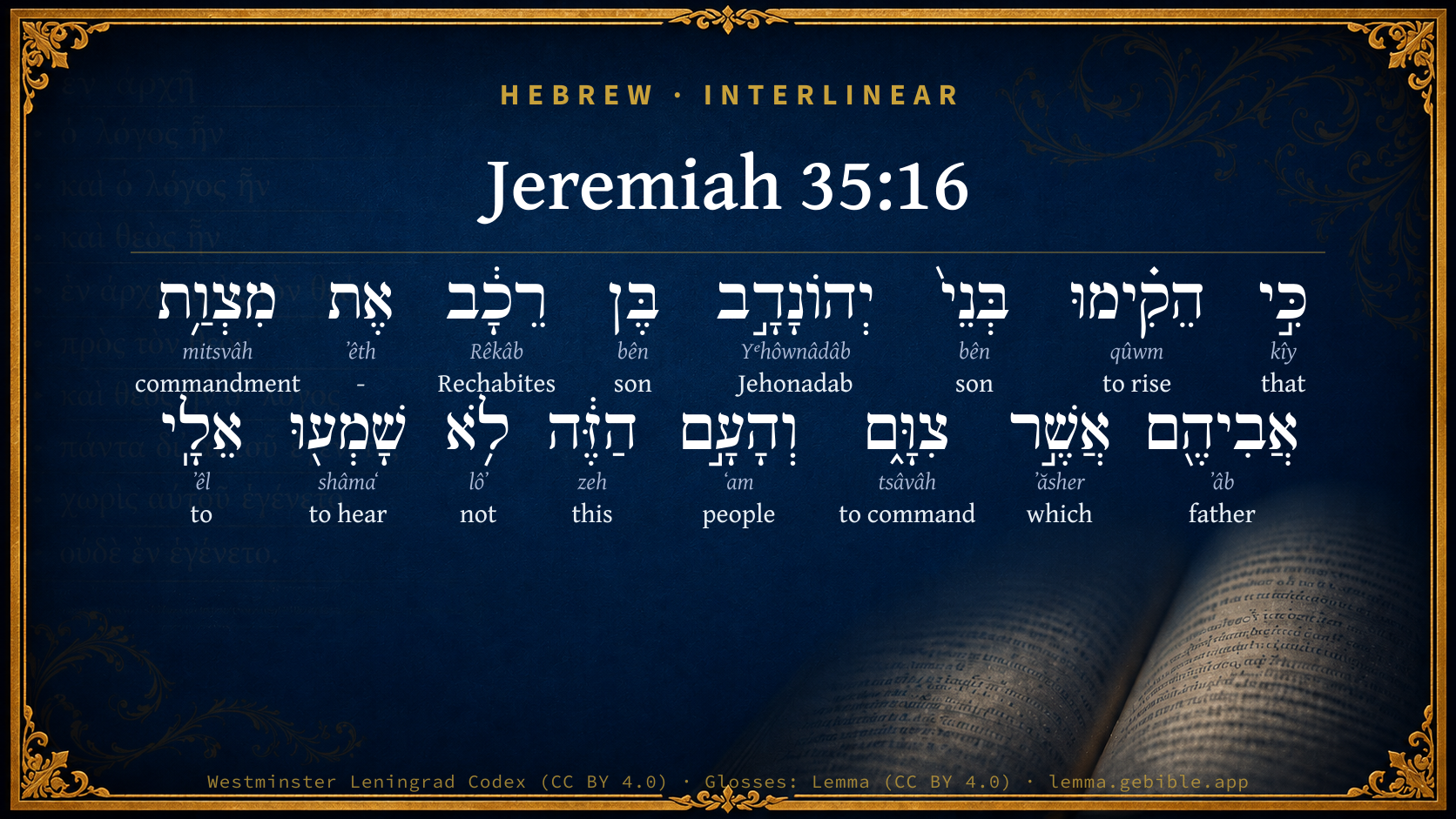
Hebrew (Westminster Leningrad Codex) Jeremiah 35:16 appears in the Hebrew Old Testament. The text above is from the Westminster Leningrad Codex. Each word links to its Strong’s number, a concise gloss, and parsing drawn from the Open Scriptures Hebrew Bible morphology. Click any word for its full Brown-Driver-Briggs (BDB) entry.
Download image
Cite this verse

Jeremiah 35:16 (World English Bible). Public Domain. Lemma interlinear Bible study tool, https://lemma.gebible.app/v/jeremiah/35/16.

Show BibTeX & RIS
BibTeX
RIS
English Translation
Because the sons of Jonadab the son of Rechab have performed the commandment of their father which he commanded them, but this people has not listened to me;
World English Bible · Public Domain
Download a study sheet

One document with this verse’s original text, its word-by-word gloss line, the meaning frame, cross-references with their text, attributed commentary, and full source and license credits — printable, and it pastes into notes with its structure intact.

This verse Autodidact and up

Study sheet (.html) Plain text (.txt)

A passage Seminary Student

Up to 50 verses in one chapter. A passage sheet keeps up to 6 commentary sources and 12 cross-references per verse, in the order this page ranks them, and says so on the sheet whenever that leaves anything out. Ask for a single verse and you get the Autodidact verse sheet above.

Everything on this page stays free to read, with no account — the sheet is a download of what is already on screen, not access to it.

Want to remove ads? Support Godless Engineer
Compare translations 3

The same verse in 3 English versions, stacked beneath the original-language interlinear above. Click any original word for its lexicon entry.

Each is an independent rendering of the whole verse — the interlinear is not word-aligned to these translations.

Highlighted words mark where these versions differ — a whole-verse word diff, not a word-by-word alignment.

  • World English Bible Public Domain
    Because the sons of Jonadab the son of Rechab have performed the commandment of their father which he commanded them, but this people has not listened to me;
  • King James Version Public Domain
    Because the sons of Jonadab the son of Rechab have performed the commandment of their father, which he commanded them; but this people hath not hearkened unto me:
  • unfoldingWord Literal Text CC BY-SA 4.0
    For the descendants of Jonadab son of Rekab have observed the commands of their ancestor that he gave them, but this people refuses to listen to me.”’

unfoldingWord Literal Text — © unfoldingWord, licensed CC BY-SA 4.0. Word-aligned USFM3 via Door43 (git.door43.org/unfoldingWord/en_ult).

Versions to compare (up to 4)

3 of 4 selected

Show all 18 translations

Every available English version of this verse, each an independent rendering of the whole verse.

  • World English Bible Public Domain
    Because the sons of Jonadab the son of Rechab have performed the commandment of their father which he commanded them, but this people has not listened to me;
  • Berean Standard Bible Public Domain
    Yes, the sons of Jonadab son of Rechab carried out the command their forefather gave them, but these people have not listened to Me.
  • Majority Standard Bible Public Domain
    Yes, the sons of Jonadab son of Rechab carried out the command their forefather gave them, but these people have not listened to Me.
  • King James Version Public Domain
    Because the sons of Jonadab the son of Rechab have performed the commandment of their father, which he commanded them; but this people hath not hearkened unto me:
  • American Standard Version (1901) Public Domain
    Forasmuch as the sons of Jonadab the son of Rechab have performed the commandment of their father which he commanded them, but this people hath not hearkened unto me;
  • Revised Version (1885) Public Domain
    Forasmuch as the sons of Jonadab the son of Rechab have performed the commandment of their father which he commanded them, but this people hath not hearkened unto me;
  • Geneva Bible (1599) Public Domain
    Surely the sonnes of Ionadab the sonne of Rechab, haue kept the commandement of their father, which he gaue them, but this people hath not obeyed me.
  • Douay-Rheims (1899) Public Domain
    So the sons of Jonadab the son of Rechab have constantly kept the commandment of their father, which he commanded them: but this people hath not obeyed me.
  • Young's Literal Translation Public Domain
    `Because the sons of Jonadab son of Rechab have performed the command of their father, that he commanded them, and this people have not hearkened unto Me,
  • Literal Standard Version CC BY-SA 4.0
    Because the sons of Jonadab son of Rechab have stood by the command of their father that he commanded them, and this people have not listened to Me,
  • Unlocked Literal Bible CC BY-SA 4.0
    For the descendants of Jonadab son of Rekab have observed the commands of their ancestor that he gave them, but this people refuses to listen to me.”'
  • unfoldingWord Literal Text CC BY-SA 4.0
    For the descendants of Jonadab son of Rekab have observed the commands of their ancestor that he gave them, but this people refuses to listen to me.”’
  • Darby Bible Public Domain
    Yea, the sons of Jonadab the son of Rechab have performed the commandment of their father which he commanded them, but this people hath not hearkened unto me;
  • World Messianic Bible Public Domain
    The sons of Jonadab the son of Rechab have performed the commandment of their father which he commanded them, but this people has not listened to me.”’
  • Webster's Bible Public Domain
    Because the sons of Jonadab the son of Rechab have performed the commandment of their father, which he commanded them; but this people hath not hearkened to me:
  • Free Bible Version CC BY-SA 4.0
    These descendants of Jonadab son of Rechab have followed the command given to them by their forefather, but these people haven't obeyed me.
  • Bible in Basic English Public Domain
    Though the sons of Jonadab the son of Rechab have done the orders of their father which he gave them, this people has not given ear to me:
  • JPS Tanakh (1917) Public Domain
    Because the sons of Jonadab the son of Rechab have performed the commandment of their father which he commanded them, but this people hath not hearkened unto Me;

Literal Standard Version (2020), Covenant Press — licensed CC BY-SA 4.0. Text via the HelloAO Bible API (eBible.org). Unlocked Literal Bible (unfoldingWord) — licensed CC BY-SA 4.0. Text via the HelloAO Bible API (eBible.org). unfoldingWord Literal Text — © unfoldingWord, licensed CC BY-SA 4.0. Word-aligned USFM3 via Door43 (git.door43.org/unfoldingWord/en_ult). Free Bible Version, Dr. Jonathan Gallagher — licensed CC BY-SA 4.0. Text via the HelloAO Bible API (eBible.org).

Word by word

More ways to search: Search by grammar → Find every occurrence → Compare this word →

Practice this passage: Drill this verse → Learn its vocabulary →

יְהוֹנָדָ֣ב
Yᵉhôwnâdâb
H3082
“Jehonadab”
Noun, Proper
Part of Speech
Noun
Type
Proper
Full BDB Definition

Origin: from H3068 and H5068

TWOT: None

Jehonadab = "Jehovah is willing" - a son of Rechab, chief of the Rechabites, in the time of Jehu and Ahab - a nephew of David
  1. כִּ֣י kîy H3588 “that” Conjunction
  2. הֵקִ֗ימוּ qûwm H6965 “to rise” Verb, Hiphil, Perfect, 3rd Person, Common, Plural
  3. בְּנֵי֙ bên H1121 “sons of” Noun, Common, Masculine, Plural, Construct
  4. בֶּן bên H1121 “son of” Noun, Common, Masculine, Singular, Construct
  5. רֵכָ֔ב Rêkâb H7394 “Rechabites” Noun, Proper
  6. אֶת ʼêth H853 “-” Particle, Direct Object
  7. מִצְוַ֥ת mitsvâh H4687 “commandment of” Noun, Common, Feminine, Singular, Construct
  8. אֲבִיהֶ֖ם ʼâb H1 “father · their” Noun, Common, Masculine, Singular, Construct + Suffix, Personal, 3rd Person, Masculine, Plural
  9. אֲשֶׁ֣ר ʼăsher H834 “which” Particle, Relative
  10. צִוָּ֑ם tsâvâh H6680 “to command · them” Verb, Piel, Perfect, 3rd Person, Masculine, Singular + Suffix, Personal, 3rd Person, Masculine, Plural
  11. וְהָעָ֣ם ʻam H5971 “and · the · people” Conjunction + Particle, Definite Article + Noun, Common, Masculine, Singular, Absolute
  12. הַזֶּ֔ה zeh H2088 “the · this” Particle, Definite Article + Pronoun, Demonstrative, Masculine, Singular
  13. לֹ֥א lôʼ H3808 “not” Particle, Negative
  14. שָׁמְע֖וּ shâmaʻ H8085 “to hear” Verb, Qal, Perfect, 3rd Person, Common, Plural
  15. אֵלָֽי ʼêl H413 “to · me” Preposition + Suffix, Personal, 1st Person, Common, Singular

About this verse

These counts appear in no published source. They are computed here, from the morphology-tagged text and Lemma’s own curated glosses. What Lemma adds →

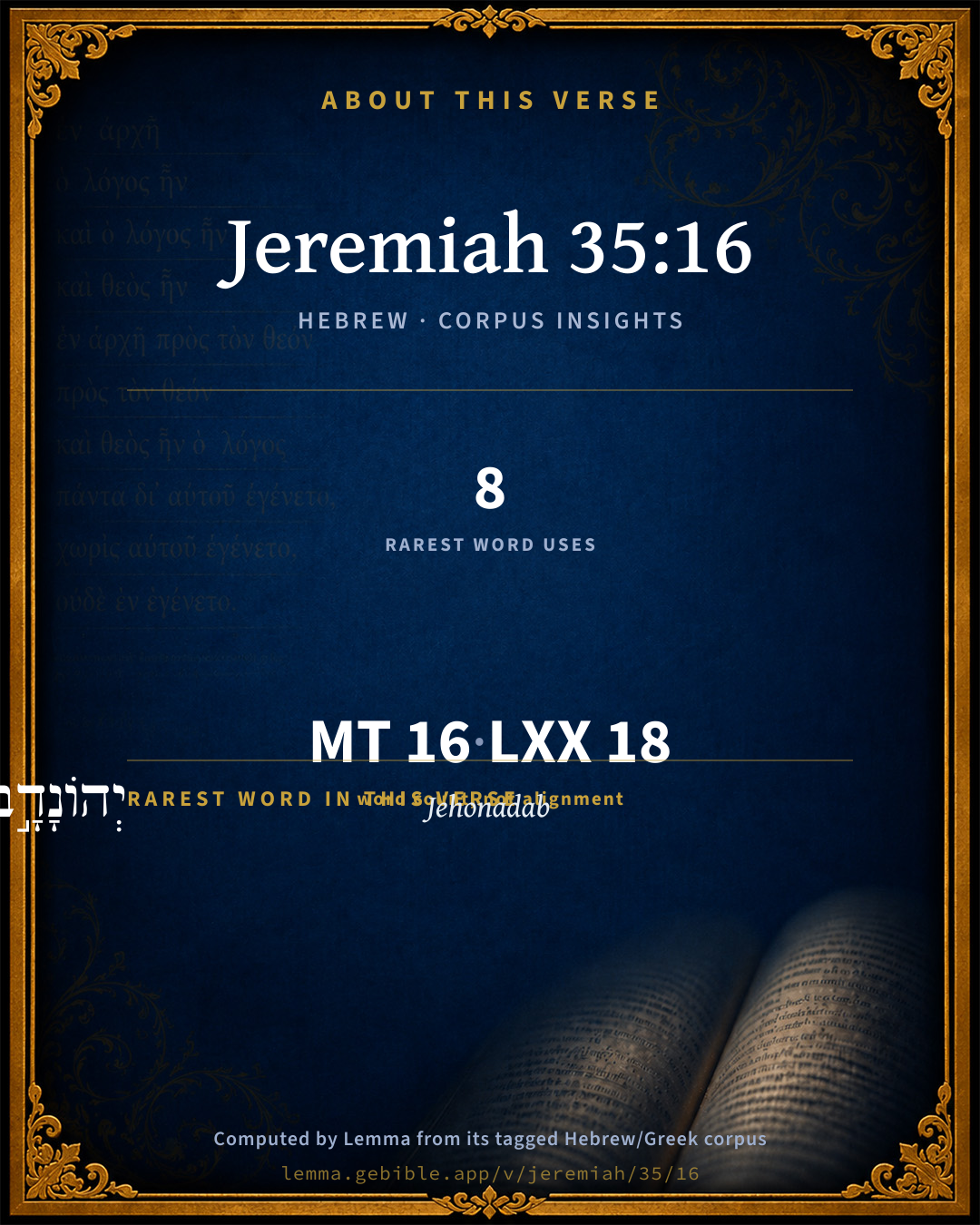
16
words
15
distinct lemmas
Prophets
section

Notable vocabulary

The rarest word here is יְהוֹנָדָ֣ב Jehonadab H3082 — appearing just 8 times in the whole Hebrew Bible.

Shared distinctive vocabulary

יְהוֹנָדָ֣ב Jehonadab H3082 occurs in 7 verses of the Hebrew Bible. Also found in:

Grammatical profile

  • 3 verbs
  • 7 nouns
  • 1 pronoun
  • 1 preposition
  • 1 conjunction
  • 3 particles

Verb forms

  • הֵקִ֗ימוּ Hiphil · Perfect
  • צִוָּ֑ם Piel · Perfect
  • שָׁמְע֖וּ Qal · Perfect

Repetition

A word recurs within this verse — often emphatic in Hebrew:

  • בְּנֵי֙ son H1121 ×2

Hebrew & Septuagint length

In the original languages it is 16 Hebrew tokens and 18 Greek tokens — but the two are counted differently (Hebrew bundles its prefixes and suffixes into one token; the Greek is in lemma form), so that isn’t a like-for-like length.

Cross-references

6

Topical passages linked to Jeremiah 35:16 in the Treasury of Scripture Knowledge — connected by theme and wording, ordered by reader-vote popularity; previews shown in the World English Bible.

  • Jeremiah 35:14 The words of Jonadab the son of Rechab, that he commanded his sons, not to drink wine, are performed; and to this day they drink none, for they obey their father's commandment: but I have spoken to you, rising up early and speaking; and you have not listened to me.
  • Malachi 1:6 "A son honors his father, and a servant his master. If I am a father, then where is my honor? And if I am a master, where is the respect due me? Says Yahweh of Hosts to you, priests, who despise my name. You say, 'How have we despised your name?'
  • Isaiah 1:3 The ox knows his owner, And the donkey his master's crib; But Israel doesn't know, My people don't consider.
  • Matthew 11:28–30 "Come to me, all you who labor and are heavily burdened, and I will give you rest.
  • Luke 15:11–13 He said, "A certain man had two sons.
  • Luke 15:28–30 But he was angry, and would not go in. Therefore his father came out, and begged him.

Cross-references courtesy of OpenBible.info (CC BY 4.0).

Hebrew and Greek witnesses Masoretic Hebrew ↔ Greek Septuagint

The same verse in the two great witnesses to the Old Testament, shown verse-for-verse.

These are two independent witnesses, not word-aligned to each other, and the Septuagint is shown in lemma (dictionary) form.

Hebrew Jeremiah 35:16 Masoretic · Westminster Leningrad Codex

כִּ֣י הֵקִ֗ימוּ בְּנֵי֙ יְהוֹנָדָ֣ב בֶּן רֵכָ֔ב אֶת מִצְוַ֥ת אֲבִיהֶ֖ם אֲשֶׁ֣ר צִוָּ֑ם וְהָעָ֣ם הַזֶּ֔ה לֹ֥א שָׁמְע֖וּ אֵלָֽי

Because the sons of Jonadab the son of Rechab have performed the commandment of their father which he commanded them, but this people has not listened to me;

World English Bible · Public Domain

Greek LXX Structure differs

In the Septuagint, Jeremiah is about an eighth shorter than the Hebrew and arranges its material differently — the Oracles Against the Nations (Hebrew chapters 46–51) appear in the middle of the Greek book, after 25:13. Because the chapter and verse boundaries do not line up, a verse-for-verse comparison with the Hebrew is not shown.

A verse-for-verse comparison isn’t shown here because the chapters and verses don’t line up. Switch to the LXX edition with the MT / LXX toggle above to read the Greek directly.

Hebrew: Westminster Leningrad Codex (CC BY 4.0). Greek: Septuagint (public domain); English from a public-domain English Septuagint. How the Septuagint differs from the Hebrew →

Targum (Aramaic paraphrase)

1

The Targum is the ancient Jewish Aramaic paraphrase of the Hebrew Scriptures — an interpretive translation, not the Hebrew text itself. Onkelos (literal) and Pseudo-Jonathan (expansive) render the Torah, and Jonathan the Prophets. Coverage is partial: where no permissively-licensed English translation exists for a verse, only the Aramaic is shown. This is verse-level text, not a word-by-word alignment to the Hebrew.

  1. Targum Jonathan Prophets (Joshua–Malachi)
    אֲרֵי אֲקִימוּ בְּנֵי יוֹנָדָב בַּר רֵכָב יַת תַּפְקֵדְתָּא דַאֲבוּהוֹן דְפַקְדִינוּן וְעַמָא הָדֵין לָא קַבִּילוּ לְמֵימְרִי:

    (no public-domain English translation for this verse)

    Targum Jonathan — Aramaic: “Mikraot Gedolot” (public domain). English: “Sefaria Community Translation” (CC0 1.0 (public-domain dedication)); “London "Chaldee Paraphrase," 1871” (public domain). Text via Sefaria.

Commentary

Notes on Jeremiah 35:16 from classic Christian and Jewish commentators (each source and its license shown beneath its notes). The classic Christian expositions comment on the surrounding passage and are grouped to its opening verse, so a note may address several verses; the Jewish commentaries on the Tanakh (Rashi and others) are per-verse, so they appear only where the commentator wrote on this verse.

Lemma curates 59 commentaries, every one of them public domain or Creative Commons licensed, each selected and text-cleaned for this edition rather than reprinted as found. About our sources →

Trapp's Complete Commentary

John Trapp

Jer 35:16 Because the sons of Jonadab the son of Rechab have performed the commandment of their father, which he commanded them; but this people hath not hearkened unto me:

Ver. 16. Because the sons of Jonadab.] This was a lively way of confuting their contumacy, far more convincing than that of the heathens not changing their gods, or the beasts knowing their owners, the birds their seasons.

But this people have not hearkened unto me.] Whereas, "if I be a father, where is mine honour? and if a master, where is mine obedience?" {Mal 1:6} {See Trapp on "Mal 1:6"}

John Trapp, A Commentary or Exposition upon All the Books of the Old and New Testament (1647–1656) — public domain. Text from a community e-Sword module.

The Biblical Illustrator

Joseph S. Exell

Jer_35:16-17

I will bring upon Judah and upon all the inhabitants of Jerusalem all the evil that I have pronounced against them: because I have spoken unto them, but they have not heard; and I have called unto them, but they have not answered.

Condemned by our virtues

How did the obedience of the Rechabites prove inexcusable, and therefore worthy of the severest punishment, the disobedience of the Jews? Their obedience was the obedience of children to their father, and sufficiently showed that even in a matter which crossed their natural inclinations men were capable of acting on a parental command and practising self-denial. The Jews then could not plead that they had no power of hearkening unto God. The Rechabites were witnesses against them. If Jonadab were obeyed because he was a father, had not Jehovah a right to expect to be obeyed, seeing that He was a father unto Israel? If the Rechabites could obey, obey as children, the Israelites might have obeyed, obeyed as children. Thus the instance or example of the Rechabites rose up in the sternest condemnation of the Jews, and in the clearest vindication of the judgments with which God was about to visit their transgressions. Now let us extend the argument, and exhibit it in such shape as may make it applicable to ourselves. It is a very hard doctrine which we have to enforce, when we press on your attention the utter worthlessness, so far as our procuring favour with God is concerned, of those virtues and excellences which are so much admired in society. There is something so graceful, and beautiful, and beneficial around a man of unblemished morals, of high rectitude, of large generosity--the dutiful son, the affectionate husband and parent, the loyal subject, the staunch friend--that you seem to shrink instinctively from statements which go to the bringing him to a level with those whom you abhor as the hardened and the injurious, and to the declaring him possibly as far off from the kingdom of heaven as though he lived a dissolute life, or were dishonourable in his dealings. But the statements are not the less true because they may jar with your feelings; and the minister cannot,, without the worst dishonesty, soften down facts on which Scripture is most explicit, and which even experience sufficiently establishes--the facts that there may be as thorough enmity to God beneath the aspect which is most attractive, as beneath that which is most repulsive, and that the virtues which shed a blandness over domestic life, and a dignity over commercial transactions, and a strength over political relations, may as well coexist with complete want of the religion of the heart, as those vices which break up the peace of families, and outrage all the decencies of a neighbourhood. But the principle involved in the text requires us to go even further than this, and to maintain, not only that there is no justifying power in these virtues, hut that there is even a condemning power--that they may be brought up as witnesses against their possessors, and used as proofs of their being without excuse in their neglect of God and disobedience to His Gospel. The man of great native kindliness of heart has evidently even less excuse than one of worse nature for withholding from God the offerings of thankfulness. Where there is a fine generosity, a gushing sensibility, a quick appreciation of what is noble and disinterested, what shall extenuate indifference to the Gospel, with all its holy story of love and condescension and conquest? We have thus engaged you with the general argument, rather than with the particular case presented by our text. You will, probably, however, understand the argument better, if we now confine ourselves to the relation which subsists between parent and child; for it is on this that God grounds His complaint against the Jews. Now there is no more beautiful and graceful affection of our nature than that which subsists between parents and children. We cannot but admire this affection, even as exhibited amongst inferior animals; and no passage in natural history is so attractive as that which tells how tenderly the wild beast of the forest will watch over her young, or with what assiduousness the fowls of the air will tend their helpless brood. But with the inferior animals the affection is but an instinct which lasts for a time, just long enough to ensure attention to the offspring whilst yet unable to provide for themselves; when this time is past, the tie is for the most part altogether broken; there is no keeping up of the relationship; however exquisitely the beast of the field and the fowl of the air may have nourished their young during their weeks of helplessness, they become afterwards as strangers to them, and seem not to distinguish them from others of their tribe. There is for a time a great exhibition of parental affection, but comparatively little of filial; there is apparently no reciprocity, for when the offspring has reached an age at which the kindness might be returned, the connection seems at an end, and the offspring goes away from the parent, though, becoming a parent itself, it displays the very instinct of which it has been the object. But in the human race the connection goes beyond this; if not so very intense at the first, it is abiding and reciprocal; the love of a parent for a child does not terminate when the child has grown into strength and asks no further help--it continues through life, increasing, for the most part, rather than diminishing, so that though the child may have been long absent from his home, wandering in foreign lands, or domesticated among strangers, yet can he always reckon that the hearts of his father and mother are beating kindly towards him, and that he has only again to present himself at their door, to unlock a tide of rich sensibilities, and be folded in an ardent embrace, and welcomed with deep gratulations. But whilst parents are thus abidingly and profitably actuated by affection for their children, children entertain an affection towards their parents which is scarcely less graceful and scarcely less advantageous. Of course there are exceptions, but they provoke unmingled reprobation, as though all the feelings of a community rose up against that unnatural being, a thankless child, and prompted the fitness of ejecting him from its circles. It is comparatively but seldom that children show themselves void of affection towards a father and a mother, when that father and that mother have done their part as parents; on the contrary, whether it be in the highest or the lowest families of the land, there is generally a frank yielding to its heads of that respect and that gratitude which they have a right to look for from their offspring. And from this fact, illustrated in the particular case of the Rechabites, God proceeds in our text to justify His complaint against the Jews. We stay not to demonstrate to you the paternal character of God; it is the character which pervades the whole of revelation, and is outlined by the whole of providence. The question is not as to whether God acts towards us as a father--it is only whether we act towards God as children; and here comes the melancholy contrast between men as members of particular families, and men as members of the universal family. The very beings who can recognise most cordially the claims of earthly parents, who can manifest themselves a reverence and a homage which give to the domestic picture an exquisite moral beauty, and who would show themselves monstrously indignant at any tale of filial disobedience or unthankfulness, have only to be viewed as children of God, and presently they would be convicted of all that unnaturalness, all that ingratitude, and all that baseness, on which they are so ready to pour unmingled reprobation. You cannot for a moment profess to deny, that in the heart which is all alive to filial emotions, and which beats with so true an affection towards a father and a mother, that the whole strength is gathered in the showing them respect and ministering to their comfort, there may be an utter indifference towards the heavenly Parent--ay, no more practical remembrance of Him in whom we live, and move, and have our being, than if it were the heart of one of those blots upon our race, in which all the family charities appear to have been extinguished, or never to have grown. Then do ye not further perceive how thoroughly self-condemned must all of us stand, if we act faithfully the part of a child toward an earthly parent, but utterly fail to act that part towards a heavenly? It will be demonstrable from our own actions that we were quite without excuse, as members of the universal family; we shall be put to shame by our very excellence as members of individual families. (H. Melvill, B. D.)

A wilful rejection of salvation

Mr. Spurgeon has said, To me it is especially appalling that a man should perish through wilfully rejecting the Divine salvation. A drowning man throwing away the life-belt, a poisoned man pouring the antidote upon the floor, a wounded man tearing open his wounds--any of these is a sad sight. But what shall we say of a soul refusing its Saviour and choosing its own destruction? (R. Venting.)

The Biblical Illustrator, edited by Joseph S. Exell (c. 1880s–1900s) — public domain. Text from a community e-Sword module.

MacLaren's Expositions of Holy Scripture

Alexander MacLaren

Jeremiah

THE RECHABITES

Jer 35:16.

The Rechabites had lived a nomad life, dwelling in tents, not practising agriculture, abstaining from intoxicants. They were therein obeying the command of their ancestor, Jonadab. They had been driven by the Babylonian invasion to take refuge in Jerusalem, and, no doubt, were a nine days’ wonder there, with their strange ways. Jeremiah seized on their loyalty to their dead ancestor’s command as an object-lesson, by which he put a still sharper edge on his rebukes. The Rechabites gave their ancestral law an obedience which shamed Judah’s disobedience to Jehovah. God asks from us only what we are willing to give to one another, and God is often refused what men have but to ask and it is given. The virtues which we exercise to each other rebuke us, because we so often refuse to exercise them towards God.

I. Men’s love to men condemns their lovelessness towards God.

These Rechabites witnessed to the power of loyal love to their ancestor. Think of the wealth of love which we have all poured out on husbands, wives, parents, children, and of the few drops that we have diverted to flow towards God. What a full flood fills the one channel; what a shrunken stream the other!

Think of the infinitely stronger reasons for loving God than for loving our dearest.

II. Men’s faith in men condemns their distrust of God.

However you define faith, you find it abundantly exercised by us on the low plane of earthly relations. Is it belief in testimony? You men of business regulate your course by reports of markets on the other side of the world, and in a hundred ways extend your credence to common report, with but little, and often with no examination of the evidence. ‘If we believe the witness of men, the witness of God is greater.’ And how do we treat it? We are ready to accept and to act on men’s testimony; we are slow to believe God’s, and still slower to act on it, and to let it mould our lives.

Is faith the realising of the unseen? We exercise it in reference to the earthly unseen; we are slow to do so in reference to the heavenly things which are invisible.

Is faith the act of trust? Life is impossible without it. Not only is commerce a great system of credit, but no relations of life could last for a day without mutual confidence. We depend on one another, like a row of slightly built houses that help to hold each other up. These earthly exercises of trust should make it easier for us to rise to trusting God as much as we do each other. They ought to reveal to us the heavenly things. For indeed our human trust in one another should be a sample and shadow of our wise trust in the adequate Object of trust.

III. Men’s obedience to human authority condemns their rebellion against God.

Jonadab’s commandment evoked implicit obedience from his descendants for generations. Side by side in man’s strange nature, with his self-will and love of independence, lies an equally strong tendency to obey and follow any masterful voice that speaks loudly and with an assumption of authority. The opinions of a clique, the dogmas of a sect, the habits of a set, the sayings of a favourite author, the fashions of our class-all these rule men with a sway far more absolute than is exercised on them by the known will of God. The same man is a slave to usurped authority and a rebel against rightful and divine dominion.

Whether we consider the law of God in its claims or its contents, or its ultimate object, it is worthy of entire obedience. And what does it receive?

God asks from us only what we willingly give to men. Even the qualities and acts, such as love, trust, obedience, which as exercised towards men give dignity and beauty and strength, rise up in judgment to condemn us. There is a sense in which Augustine’s often-denounced saying that they are ‘splendid vices’ is true, for they are turned in the wrong direction, and very often their being directed so completely towards men and women is the reason why they are not directed towards God, who alone deserves and alone can satisfy and reward them. Then they become sins and condemn us.

Alexander MacLaren, Expositions of Holy Scripture (1904–1910) — public domain. Text from a community e-Sword module.

John Calvin's Commentaries

The Prophet says nothing new here, but confirms what has been said before; and this he did, that the indignity of the people’s conduct might more fully appear, inasmuch as, on one hand, a mortal man, and he now dead, retained authority over his posterity, having once laid on them a restraint in a matter hard and difficult; while God, on the other hand, effected nothing, though he had constantly addressed and exhorted his people, had sent prophets, and ceased not to invite them to himself, and had not only invited them, but also kindly allured them by setting before them his favors, and gave them hope as to the time to come. Since God, then, had tried all means, but without any success, the hopeless depravity of the people became hence evident. This is the import of the whole.

John Calvin's Commentaries (1540-1563) — public domain. Text from the Calvin Translation Society English edition (1840s-50s) via the Christian Classics Ethereal Library (ccel.org). Calvin's coverage is partial (roughly two-thirds of the Bible); uncommented books and verses are honest gaps, never fabricated. The 19th-century editor's footnotes and remarks are omitted so the notes are faithfully Calvin's own voice.

John Gill's Exposition

Because the son of Jonadab the son of Rechab,.... Here we have the contrast between the Rechabites and the Israelites; the obedience of the one, and the disobedience of the other; the design of which is to aggravate and expose the sin of the Jews, since the former

have performed the commandment of their father, which he commanded them; that particular commandment of not drinking wine, which they had never once violated in such a course of time; nor could they now be prevailed upon, even by the prophet himself, to do it:

but this people hath not hearkened unto me; the Lord their God, their father that bought them, made them, and established them. Gross ingratitude! Deu 32:6.

John Gill's Exposition of the Whole Bible (1746–1763) — public domain (CC PDM 1.0). Text via the HelloAO Bible API.

The Pulpit Commentary

Because, etc. This rendering is against Hebrew usage, and any reader will see that the obedience of the Rechabites stands in no inner connection with the sentence pronounced upon Judah. Ver. 16 is rather an emphatic recapitulation of what has preceded. It runs literally, (I say) that the sons of Jonadab have performed, etc., but (that) this people hath not hearkened unto me; or, in more English phraseology, "Yea, the sons of Jonadab," etc.

The Pulpit Commentary (1880–1919), ed. H.D.M. Spence-Jones & Joseph S. Exell — public domain. Text from a community e-Sword module.

Lesson kit

Teaching starters — assembled from the data on this page, not authored interpretation. Every prompt links to the verse data it draws on. Edit before teaching.

Jeremiah, in the Prophets, opens this verse with 16 words (15 distinct Hebrew lemmas). Its most distinctive word is Yᵉhôwnâdâb (“Jehonadab”). A historical commentator’s framing appears above. Read the whole chapter for the surrounding context.

Discussion questions

  1. What does “Jehonadab” (Yᵉhôwnâdâb) contribute to the verse as a whole?
  2. 2 Samuel 13:5 shares the word «Jehonadab» with this verse. How do the two illuminate each other?
  3. “son” occurs 2× in this one verse. What is the effect of the repetition?
  4. These translations render this verse differently. What is at stake in choosing one wording over another?
  5. The verb «הֵקִ֗ימוּ» is Hiphil Perfect. How does its form color the action?
  6. Reading how Trapp's Complete Commentary and The Biblical Illustrator read this verse, where do the two commentators agree and where do they part?

Things to notice

Reading settings

Reading text

Shown beneath each verse's original-language words.

Old Testament
Old Testament edition

Read the OT as the Masoretic Hebrew (MT) or the Greek Septuagint (LXX).

English shown for the Greek Septuagint (in the Hebrew ↔ Greek comparison).

Comparing translations? Open the Compare panel on any verse page to stack up to four side by side.