Numbers 15:22

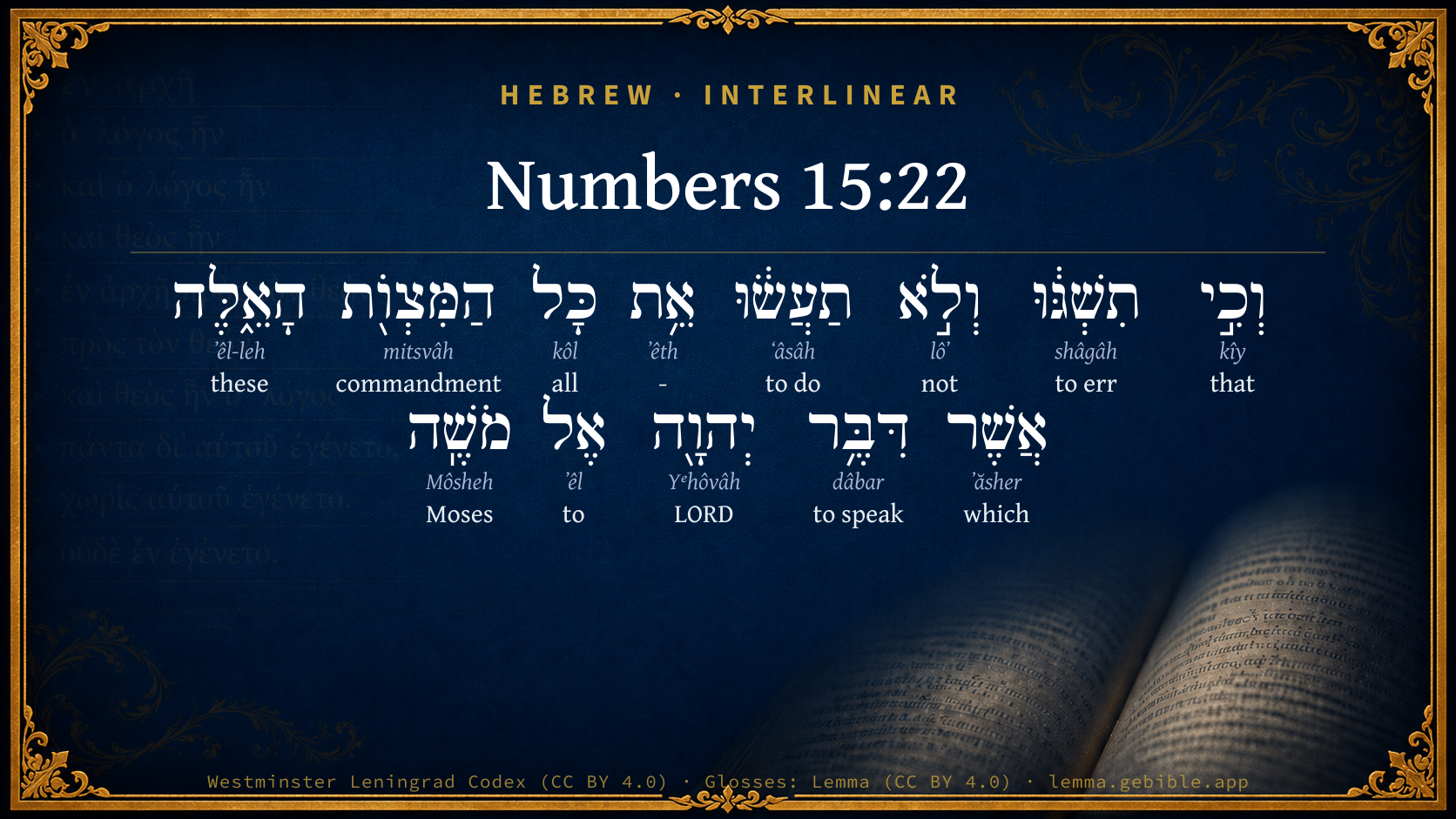
Hebrew (Westminster Leningrad Codex) Numbers 15:22 appears in the Hebrew Old Testament. The text above is from the Westminster Leningrad Codex. Each word links to its Strong’s number, a concise gloss, and parsing drawn from the Open Scriptures Hebrew Bible morphology. Click any word for its full Brown-Driver-Briggs (BDB) entry.
Download image
Cite this verse

Numbers 15:22 (World English Bible). Public Domain. Lemma interlinear Bible study tool, https://lemma.gebible.app/v/numbers/15/22.

Show BibTeX & RIS
BibTeX
RIS
English Translation
When you shall err, and not observe all these commandments, which Yahweh has spoken to Moses,
World English Bible · Public Domain
Download a study sheet

One document with this verse’s original text, its word-by-word gloss line, the meaning frame, cross-references with their text, attributed commentary, and full source and license credits — printable, and it pastes into notes with its structure intact.

This verse Autodidact and up

Study sheet (.html) Plain text (.txt)

A passage Seminary Student

Up to 50 verses in one chapter. A passage sheet keeps up to 6 commentary sources and 12 cross-references per verse, in the order this page ranks them, and says so on the sheet whenever that leaves anything out. Ask for a single verse and you get the Autodidact verse sheet above.

Everything on this page stays free to read, with no account — the sheet is a download of what is already on screen, not access to it.

Want to remove ads? Support Godless Engineer
Compare translations 3

The same verse in 3 English versions, stacked beneath the original-language interlinear above. Click any original word for its lexicon entry.

Each is an independent rendering of the whole verse — the interlinear is not word-aligned to these translations.

Highlighted words mark where these versions differ — a whole-verse word diff, not a word-by-word alignment.

  • World English Bible Public Domain
    When you shall err, and not observe all these commandments, which Yahweh has spoken to Moses,
  • King James Version Public Domain
    And if ye have erred, and not observed all these commandments, which the LORD hath spoken unto Moses,
  • unfoldingWord Literal Text CC BY-SA 4.0
    And when you err and do not do all these commandments that Yahweh has spoken to Moses,

unfoldingWord Literal Text — © unfoldingWord, licensed CC BY-SA 4.0. Word-aligned USFM3 via Door43 (git.door43.org/unfoldingWord/en_ult).

Versions to compare (up to 4)

3 of 4 selected

Show all 18 translations

Every available English version of this verse, each an independent rendering of the whole verse.

  • World English Bible Public Domain
    When you shall err, and not observe all these commandments, which Yahweh has spoken to Moses,
  • Berean Standard Bible Public Domain
    Now if you stray unintentionally and do not obey all these commandments that the LORD has spoken to Moses—
  • Majority Standard Bible Public Domain
    Now if you stray unintentionally and do not obey all these commandments that the LORD has spoken to Moses—
  • King James Version Public Domain
    And if ye have erred, and not observed all these commandments, which the LORD hath spoken unto Moses,
  • American Standard Version (1901) Public Domain
    And when ye shall err, and not observe all these commandments, which Jehovah hath spoken unto Moses,
  • Revised Version (1885) Public Domain
    And when ye shall err, and not observe all these commandments, which the LORD hath spoken unto Moses,
  • Geneva Bible (1599) Public Domain
    And if ye haue erred, and not obserued all these commandements, which the Lord hath spoken vnto Moses,
  • Douay-Rheims (1899) Public Domain
    And if through ignorance you omit any of these things, which the Lord hath spoken to Moses,
  • Young's Literal Translation Public Domain
    `And when ye err, and do not all these commands which Jehovah hath spoken unto Moses,
  • Literal Standard Version CC BY-SA 4.0
    And when you err, and do not do all these commands which YHWH has spoken to Moses—
  • Unlocked Literal Bible CC BY-SA 4.0
    You will sometimes sin without intending to do so, when you do not obey all these commands that I have spoken to Moses—
  • unfoldingWord Literal Text CC BY-SA 4.0
    And when you err and do not do all these commandments that Yahweh has spoken to Moses,
  • Darby Bible Public Domain
    And if ye sin inadvertently, and do not all these commandments, which Jehovah hath spoken unto Moses,
  • World Messianic Bible Public Domain
    “‘When you err, and don’t observe all these commandments which the LORD has spoken to Moses—
  • Webster's Bible Public Domain
    And if ye have erred, and not observed all these commandments which the LORD hath spoken to Moses,
  • Free Bible Version CC BY-SA 4.0
    Now if you collectively sin without meaning to and don't follow all these instructions that the Lord has given Moses—
  • Bible in Basic English Public Domain
    And if in error you go against any of these laws which the Lord has given to Moses,
  • JPS Tanakh (1917) Public Domain
    And when ye shall err, and not observe all these commandments, which the LORD hath spoken unto Moses,

Literal Standard Version (2020), Covenant Press — licensed CC BY-SA 4.0. Text via the HelloAO Bible API (eBible.org). Unlocked Literal Bible (unfoldingWord) — licensed CC BY-SA 4.0. Text via the HelloAO Bible API (eBible.org). unfoldingWord Literal Text — © unfoldingWord, licensed CC BY-SA 4.0. Word-aligned USFM3 via Door43 (git.door43.org/unfoldingWord/en_ult). Free Bible Version, Dr. Jonathan Gallagher — licensed CC BY-SA 4.0. Text via the HelloAO Bible API (eBible.org).

Word by word

More ways to search: Search by grammar → Find every occurrence → Compare this word →

Practice this passage: Drill this verse → Learn its vocabulary →

תִשְׁגּ֔וּ
shâgâh
H7686
“to err”
Verb, Qal, Imperfect, 2nd Person, Masculine, Plural
Part of Speech
Verb
Stem
Qal
Form
Imperfect
Person
2nd Person
Gender
Masculine
Number
Plural
Full BDB Definition

Origin: a primitive root

TWOT: 2325

to go astray, stray, err - (Qal) - to err, stray - to swerve, meander, reel, roll, be intoxicated, err (in drunkenness) - to go astray (morally) - to commit sin of ignorance or inadvertence, err (ignorantly) - (Hiphil) - to lead astray - to lead astray, mislead (mentally) - to lead astray (morally)
  1. וְכִ֣י kîy H3588 “and · that” Conjunction + Conjunction
  2. וְלֹ֣א lôʼ H3808 “and · not” Conjunction + Particle, Negative
  3. תַעֲשׂ֔וּ ʻâsâh H6213 “to do” Verb, Qal, Imperfect, 2nd Person, Masculine, Plural
  4. אֵ֥ת ʼêth H853 “-” Particle, Direct Object
  5. כָּל kôl H3605 “all of” Noun, Common, Masculine, Singular, Construct
  6. הַמִּצְוֺ֖ת mitsvâh H4687 “the · commandments” Particle, Definite Article + Noun, Common, Feminine, Plural, Absolute
  7. הָאֵ֑לֶּה ʼêl-leh H428 “the · these” Particle, Definite Article + Pronoun, Demonstrative, Common, Plural
  8. אֲשֶׁר ʼăsher H834 “which” Particle, Relative
  9. דִּבֶּ֥ר dâbar H1696 “to speak” Verb, Piel, Perfect, 3rd Person, Masculine, Singular
  10. יְהוָ֖ה Yᵉhôvâh H3068 “LORD” Noun, Proper
  11. אֶל ʼêl H413 “to” Preposition
  12. מֹשֶֽׁה Môsheh H4872 “Moses” Noun, Proper

About this verse

These counts appear in no published source. They are computed here, from the morphology-tagged text and Lemma’s own curated glosses. What Lemma adds →

13
words
13
distinct lemmas
Pentateuch
section

Notable vocabulary

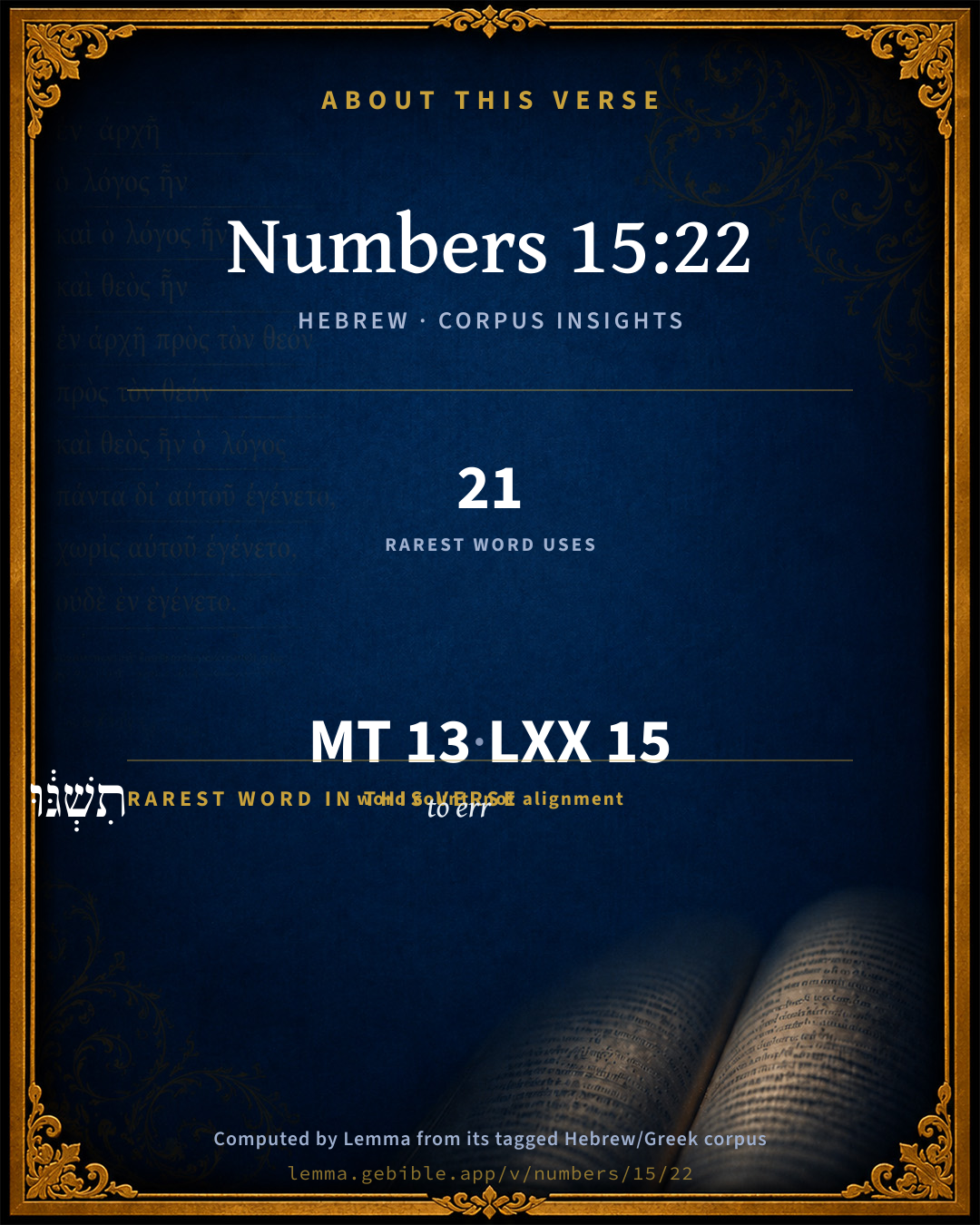
The rarest word here is תִשְׁגּ֔וּ to err H7686 — appearing just 21 times in the whole Hebrew Bible.

Shared distinctive vocabulary

תִשְׁגּ֔וּ to err H7686 occurs in 19 verses of the Hebrew Bible. Also found in:

Grammatical profile

  • 3 verbs
  • 4 nouns
  • 1 pronoun
  • 1 preposition
  • 1 conjunction
  • 3 particles

Verb forms

  • תִשְׁגּ֔וּ Qal · Imperfect
  • תַעֲשׂ֔וּ Qal · Imperfect
  • דִּבֶּ֥ר Piel · Perfect

Hebrew & Septuagint length

In English translation the verse runs 16 words from the Hebrew and 17 from the Septuagint (LXX English) — closely comparable.

A rough comparison of the two English renderings, which tokenize alike — not a word-level alignment.

Word counts can differ between the Hebrew and the Greek without any difference in meaning — e.g. the Hebrew direct-object marker אֵת has no separate Greek word, and Greek often adds the article ὁ.

In the original languages it is 13 Hebrew tokens and 15 Greek tokens — but the two are counted differently (Hebrew bundles its prefixes and suffixes into one token; the Greek is in lemma form), so that isn’t a like-for-like length.

Cross-references

8

Topical passages linked to Numbers 15:22 in the Treasury of Scripture Knowledge — connected by theme and wording, ordered by reader-vote popularity; previews shown in the World English Bible.

  • Leviticus 4:2 "Speak to the children of Israel, saying, 'If anyone sins unintentionally, in any of the things which Yahweh has commanded not to be done, and does any one of them:
  • Leviticus 4:13–14 "'If the whole congregation of Israel sins, and the thing is hidden from the eyes of the assembly, and they have done any of the things which Yahweh has commanded not to be done, and are guilty;
  • Leviticus 4:22 "'When a ruler sins, and unwittingly does any one of all the things which Yahweh his God has commanded not to be done, and is guilty;
  • Leviticus 4:27 "'If anyone of the common people sins unwittingly, in doing any of the things which Yahweh has commanded not to be done, and is guilty;
  • Leviticus 5:13 The priest shall make atonement for him concerning his sin that he has sinned in any of these things, and he will be forgiven; and the rest shall be the priest's, as the meal offering.'"
  • Leviticus 5:15–17 "If anyone commits a trespass, and sins unwittingly, in the holy things of Yahweh; then he shall bring his trespass offering to Yahweh, a ram without blemish from the flock, according to your estimation in silver by shekels, after the shekel of the sanctuary, for a trespass offering.
  • Psalms 19:12 Who can discern his errors? Forgive me from hidden errors.
  • Luke 12:48 but he who didn't know, and did things worthy of stripes, will be beaten with few stripes. To whoever much is given, of him will much be required; and to whom much was entrusted, of him more will be asked.

Cross-references courtesy of OpenBible.info (CC BY 4.0).

Hebrew and Greek witnesses Masoretic Hebrew ↔ Greek Septuagint

The same verse in the two great witnesses to the Old Testament, shown verse-for-verse.

These are two independent witnesses, not word-aligned to each other, and the Septuagint is shown in lemma (dictionary) form.

Hebrew Numbers 15:22 Masoretic · Westminster Leningrad Codex

וְכִ֣י תִשְׁגּ֔וּ וְלֹ֣א תַעֲשׂ֔וּ אֵ֥ת כָּל הַמִּצְוֺ֖ת הָאֵ֑לֶּה אֲשֶׁר דִּבֶּ֥ר יְהוָ֖ה אֶל מֹשֶֽׁה

When you shall err, and not observe all these commandments, which Yahweh has spoken to Moses,

World English Bible · Public Domain

Greek LXX Numbers 15:22 Septuagint · lemma form

ὅταν δέ διαμαρτυρέω καί μή ποιέω πᾶς ὁ ἐντολή οὗτος ὅς λαλέω κύριος πρός μωυσῆς

But whenever you⌃ shall transgress, and not perform all these commands, which the Lord spoke to Moses;

LXX2012 (modern English Septuagint) · Public Domain

Hebrew: Westminster Leningrad Codex (CC BY 4.0). Greek: Septuagint (public domain); English from LXX2012 (modern English Septuagint) (Public Domain). How the Septuagint differs from the Hebrew →

Targum (Aramaic paraphrase)

2

The Targum is the ancient Jewish Aramaic paraphrase of the Hebrew Scriptures — an interpretive translation, not the Hebrew text itself. Onkelos (literal) and Pseudo-Jonathan (expansive) render the Torah, and Jonathan the Prophets. Coverage is partial: where no permissively-licensed English translation exists for a verse, only the Aramaic is shown. This is verse-level text, not a word-by-word alignment to the Hebrew.

  1. Targum Onkelos Torah (Genesis–Deuteronomy)
    וַאֲרֵי תִשְׁתְּלוּן וְלָא תַעְבְּדוּן יָת כָּל פִּקוֹדַיָא הָאִלֵין דִי מַלִיל יְיָ עִם משֶׁה

    (no public-domain English translation for this verse)

    Targum Onkelos — Aramaic: “Onkelos Genesis” (public domain); “Onkelos Exodus” (public domain); “Onkelos Leviticus” (public domain); “Onkelos Numbers” (public domain); “Onkelos Deuteronomy” (public domain). English: “Sefaria Community Translation” (CC0 1.0 (public-domain dedication)); “J.W. Etheridge. The Targums of Onkelos and Jonathan Ben Uzziel on the Pentateuch. London: Longmans, Green, 1862” (public domain). Text via Sefaria.

  2. Targum Pseudo-Jonathan Torah (Genesis–Deuteronomy)
    וַאֲרוּם תִּשְׁתְּלוּן וְלָא תַעַבְדוּן חֲדָא מִכָּל פִּקוּדַיָא הָאִלֵין דְמַלֵיל יְיָ עִם משֶׁה

    And should you have erred, and not performed some one of all these commandments which the Lord hath spoken with Mosheh;

    Targum Pseudo-Jonathan — Aramaic: “Targum Jonathan on Genesis” (public domain); “Targum Jonathan on Exodus” (public domain); “Targum Jonathan on Leviticus” (public domain); “Targum Jonathan on Numbers” (public domain); “Targum Jonathan on Deuteronomy” (public domain). English: “The Targum of Jonathan ben Uzziel, trans. J. W. Etheridge, London, 1862” (public domain). Text via Sefaria.

Commentary

Notes on Numbers 15:22 from classic Christian and Jewish commentators (each source and its license shown beneath its notes). The classic Christian expositions comment on the surrounding passage and are grouped to its opening verse, so a note may address several verses; the Jewish commentaries on the Tanakh (Rashi and others) are per-verse, so they appear only where the commentator wrote on this verse.

Lemma curates 59 commentaries, every one of them public domain or Creative Commons licensed, each selected and text-cleaned for this edition rather than reprinted as found. About our sources →

Matthew Henry's Commentary

We have here the laws concerning sacrifices for sins of ignorance; the Jews understand it of idolatry, or false worship, through the error of their teachers. The case here supposed is that they had not observed all these commandments, Num 15:22, Num 15:23. If they had failed in the offerings of their acknowledgment, and had not brought them according to the law, then they must bring an offering of atonement, yea, though the omission had been through forgetfulness or mistake. If they failed in one part of the ceremony, they must make it up by the observance of another part, which was in the nature of a remedial law. 1. The case is put of a national sin, committed through ignorance, and become customary through a vulgar error (Num 15:24) - the congregation, that is, the body of the people, for so it is explained (Num 15:25): All the congregation of the children of Israel. The ceremonial observances were so numerous, and so various, that, it might easily be supposed, some of them by degrees would be forgotten and disused, as particularly that immediately before concerning the heave-offering of their dough: now if, in process of time, upon consulting the law, there should appear to have been a general neglect of that or any other appointment, then a sacrifice must be offered for the whole congregation, and the oversight shall be forgiven (Num 15:25, Num 15:26) and not punished, as it deserved, with some national judgment. The offering of the sacrifice according to the manner, or ordinance, plainly refers to a former statute, of which this is the repetition; and the same bullock which is there called a sin-offering (Lev 4:13, Lev 4:21) is here called a burnt-offering (Num 15:24), because it was wholly burnt, though not upon the altar, yet without the camp. And here is the addition of a kid of the goats for a sin-offering. According to this law, we find that Hezekiah made atonement for the errors of his father's reign, by seven bullocks, seven rams, seven lambs, and seven he-goats, which he offered as a sin-offering for the kingdom, and for the sanctuary, and for Judah (Ch2 29:21), and for all Israel, Num 15:24. And we find the like done after the return out of captivity, Ezr 8:35. 2. It is likewise supposed to be the case of a particular person: If any soul sin through ignorance (Num 15:27), neglecting any part of his duty, he must bring his offering, as was appointed, Lev 4:27, etc. Thus atonement shall be made for the soul that sins, when he sins through ignorance, Num 15:28. Observe, (1.) Sins committed ignorantly need to have atonement made for them; for, though ignorance will in a degree excuse, it will not justify those that might have known their Lord's will and did it not. David prayed to be cleansed from his secret faults, that is, those sins which he himself was not aware of, the errors he did not understand, Psa 19:12. (2.) Sins committed ignorantly shall be forgiven, through Christ the great sacrifice, who, when he offered up himself once for all upon the cross, seemed to explain the intention of his offering in that prayer, Father, forgive them, for they know not what they do. And Paul seems to allude to this law concerning sins of ignorance (Ti1 1:13), I obtained mercy, because I did it ignorantly and in unbelief. And it looked favourable upon the Gentiles that this law of atoning for sins of ignorance is expressly made to extend to those who were strangers to the commonwealth of Israel (Num 15:29), but supposed to be proselytes of righteousness. Thus the blessing of Abraham comes upon the Gentiles.

Matthew Henry's Commentary on the Whole Bible (1708–1710) — public domain (CC PDM 1.0). Text via the HelloAO Bible API.

The Cambridge Bible for Schools and Colleges

gen. ed. J. J. S. Perowne

22–26. Errors of the whole congregation. No detailed instances are given; but such errors might consist in some mistake or omission in ritual, or some miscarriage of justice discovered too late; or the error might not be traceable, but the occurrence of some public catastrophe or trouble would be assumed to be a divine punishment for a mistake which had been committed.

22–31. Propitiation for inadvertent transgressions—(a) Num_15:22-36 committed by the congregation as a whole; (b) Num_15:27-29 by individuals. To these is added the provision that deliberate transgressions cannot be atoned for (Num_15:30-31). Another set of laws relating to inadvertent transgressions, apparently dating from a different period, is found in Leviticus 4, Leviticus 5; it is more elaborate, dealing with four classes of persons—the high priest, the congregation, a prince, and a private individual.

The Cambridge Bible for Schools and Colleges (gen. ed. J. J. S. Perowne; Cambridge University Press, 1878–1918) — public domain. Text from a community e-Sword module.

Trapp's Complete Commentary

John Trapp

Num 15:22 And if ye have erred, and not observed all these commandments, which the LORD hath spoken unto Moses,

Ver. 22. And if ye hath erred and not observed.] Not serving of God, not sacrificing, is a sin. {Mal 3:8 Ecc 9:2} Not robbing only, but the not relieving of the poor, was the rich man’s ruin. {Luk 16:21} Omission of diet breeds diseases, so doth omission of duty; and makes work for hell, or for the physician of our souls.

John Trapp, A Commentary or Exposition upon All the Books of the Old and New Testament (1647–1656) — public domain. Text from a community e-Sword module.

Albert Barnes' Notes on the Bible

The heavy punishments which had already overtaken the people might naturally give rise to apprehensions for the future, especially in view of the fact that on the approaching entrance into Canaan the complete observance of the Law in all its details would become imperative on them. To meet such apprehensions a distinction is emphatically drawn between sins of ignorance (Lev 4:13 ff) and those of presumption Num 15:30-31. The passage deals separately with imperfections of obedience which would be regarded as attaching to the whole nation Num 15:22-26, and those of individuals Num 15:27-30.

Num 15:24

Without the knowledge of the congregation - literally, as marginal. The words point to an error of omission which escaped notice at the time: i. e. to an oversight.

Num 15:30

Presumptuously - The original (compare the margin, and Exo 14:8) imports something done willfully and openly; in the case of a sin against God it implies that the act is committed ostentatiously and in bravado.

Reproacheth the Lord - Rather, revileth or blasphemeth the Lord: compare Eze 20:27.

Albert Barnes' Notes on the Bible (1834–1885) — public domain. Text from a community e-Sword/MySword module.

Joseph Benson's Commentary

Num 15:22. Have erred, and not observed all these commandments — If the whole body of the people be guilty of any neglect of the public ceremonies of religion, or of any deviation from any of the rites instituted concerning the outward service of God, (for of these only Moses seems here to speak,) which might happen involuntarily, and through ignorance, then the following method is prescribed to expiate the sin of such omissions or deviations upon their being known. It may be observed, however, that this plea of ignorance could not be admitted except in cases that were liable to obscurity. The law in Lev 4:13, which appears partly similar to this, probably speaks of some positive miscarriage, or the doing what ought not to have been done; whereas this speaks of an omission of something which ought to have been done.

Joseph Benson's Commentary on the Old and New Testaments (1811–1818) — public domain. Text from a community e-Sword module.

Tyndale Open Study Notes

Tyndale Open Resources

15:22-29 Unintentional sins were treated differently than intentional sins (15:30-31), and the actions of the community were distinguished from those of an individual (see also Lev 4–5).

Tyndale Open Study Notes — © Tyndale Open Resources, licensed CC BY-SA 4.0. Text via the HelloAO Bible API.

Geneva Bible (1599)

Geneva Bible translators

As by oversight or ignorance, read Lev. 4:2, 13.

Geneva Bible (1599) marginal notes — public domain. Text via Bolls.life.

Jamieson, Fausset & Brown

Robert Jamieson, A. R. Fausset & David Brown

if ye have erred, and not observed all these commandments, &c.--respecting the performance of divine worship, and the rites and ceremonies that constitute the holy service. The law relates only to any omission and consequently is quite different from that laid down in Lev 4:13, which implies a transgression or positive neglect of some observances required. This law relates to private parties or individual tribes; that to the whole congregation of Israel.

Jamieson, Fausset & Brown — Commentary Critical and Explanatory on the Whole Bible (1871) — public domain (CC PDM 1.0). Text via the HelloAO Bible API.

Ellicott's Commentary for English Readers

(22) And if ye have erred, and not observed.—Rather, And if ye shall err and not observe.

A Bible Commentary for English Readers, edited by Charles John Ellicott (1878–1897) — public domain. Text from a community e-Sword module.

John Gill's Exposition

Even all that the Lord hath commanded you by the hand of Moses,.... Recorded in this book and the two preceding, whether of a moral, ceremonial, or judicial kind; the whole body of laws given to the people of Israel from the Lord by Moses:

from the day that the Lord commanded Moses, and henceforward among your generations; all that he had commanded, or should hereafter command.

John Gill's Exposition of the Whole Bible (1746–1763) — public domain (CC PDM 1.0). Text via the HelloAO Bible API.

Haydock's Catholic Bible Commentary

Ignorance. Other victims are prescribed; (Leviticus iv. 13,) so that the ignorance here mentioned must be of a different nature. The former was perhaps a sin of commission, and this a sin of omission; such as if the whole people should neglect to eat the paschal lamb. The Rabbins think that the law alludes here to idolatry, committed for want of knowledge. But that is next to impossible in a whole nation. Outram believes, that the Book of Leviticus speaks of those who transgress the negative precepts, without abandoning the true religion; but the present law alludes to those who forget the laws of their fathers, and embrace a false worship. Thus Ezechias offered the victims here prescribed, though more in number, to expiate the idolatry of the people under Achaz, 1 Paralipomenon xxix. 21. See also 1 Esdras viii. 35. Some think Moses has supplied in this place what was left deficient before. But it is more probable, that he supposes here only some of the tribes have sinned ignorantly, while in Leviticus he speaks of the whole nation. (Calmet) --- No one sins for the sake of the offence, but for some advantage which we falsely persuade ourselves we shall derive from doing so. (St. Augustine, q. 24.)

George Leo Haydock (1774–1849), Haydock's Catholic Family Bible and Commentary, 1859 edition — public domain. Excludes Psalms (Douay-Rheims chapter numbering differs from Protestant) and Deuterocanonical books (Catholic canon only).

Matthew Poole's English Annotations

To wit, those now spoken of, those which concern the outward worship and servicc of God, or the rites or ceremonies belonging to it. And herein principally this law may seem to differ from that Lev 14:13, which speaks of some positive miscarriage, or doing that which ought not to have been done about the holy things of God, whereas this speaks only of an omissiou of somcthing which ought to have been done about holy ccrcmonies. But besides this, that law, Lev 4:13, concerns the whole congregration of Israel, as it is there expressed, but this concerns only the congregation, or a congregation, as it is here expressed, Num 15:24, i.e. any particular congregation of Israelites, whether of a whole tribe meeting together by their representatives, or a lesser congregation, such as there were to be many in Canaan; and the words rendered all the congregation may be, and are by some here, rendered every congregation. And by virtue of this law, as some suppose, the Israelites newly after their return from the captivity offered twelve bullocks, one for each tribe, Ezr 8:35.

Matthew Poole's English Annotations on the Holy Bible (1683–1685) — public domain. Text from a community e-Sword/MySword module.

Whedon's Commentary on the Bible

Daniel D. Whedon

22. If ye have erred — This refers not to individual sins of ignorance, (see Lev_4:2, note,) but to the whole congregation.

Not observed — The particular delinquency is the inadvertent omission of a Mosaic precept. “This was a striking feature of the present enactment, that it tended to make the whole community feel itself charged with the responsibility of the conduct of each of its members.” — Bush.

Daniel D. Whedon (gen. ed.), Commentary on the Old and New Testaments (1874–1909) — public domain. Text from a community e-Sword module.

The Pulpit Commentary

And if ye have erred. The absence of the usual formula, "and the Lord spake unto Moses," is singular, because what follows has reference not to the enactment just made, but to the whole Law. Perhaps it is a part of the thoroughly unscientific and inartificial character of the Mosaic legislation that a principle of extreme importance and wide application is appended to an insignificant matter of ceremonial. Provision is here made for the forgiveness of sins due to ignorance and oversight a provision which was sorely needed, considering the great complexity of the Law, and the bad training they had for the accurate observance of it. (Deu_12:8) A similar provision had been made in Le 4. The two, however, differ, inasmuch as this contemplates sins of commission, while this contemplates sins of omission.

HOMILIES BY W. BINNIE Vers. 22-31. Presumptuous sins and sins of ignorance.

Some sins are more heinous in the sight of God than others; more heinous in their own nature, or by reason of aggravating circumstances. The distinction is familiar to all. Murder is a sin more heinous in the sight of God and man than petty theft. Armed rebellion against just authority is a greater sin than heedless omission to pay due honour and courtesy to a superior in office. Yet old and familiar as the distinction is, it is one in connexion with which men have often fallen into mischievous error. Hence the value of texts like this in Numbers, which throw light upon it.

I Observe How THE DISTINCTION BETWEEN GREATER AND LESSER SINS IS HERE STATED.

1. Some sins are described as sins of ignorance. The reference is to faults that are due to error or inadvertence. We all know, to our cost, how liable we are to these. Never a day passes but we omit duty and commit faults, either because we knew no better, or because we were "off our guard" and stumbled before we were aware. These are sins of infirmity, such as cleave to the best of men in the present life.

2. Other sins are done presumptuously. (Literally, "with a high hand.") The matter is one about which there is no dubiety; the person knows well what is right and what is wrong; knowing this, he deliberately and purposely does the wrong. He offends against light, conviction, conscience. This is presumptuous sin. I have said that the distinction between greater and lesser sins is old and familiar. Turning to any Roman Catholic book of devotion, you will find tables in which are enumerated respectively the "mortal sins" and the "venial sins." That is one way of describing the two classes. I very much prefer the terms employed here in God"s word. And the superior wisdom of God is to be seen not only in the fitter terms employed, but also in the absence of any attempt, here or elsewhere in the Bible, to give a tabular enumeration of the sins belonging to either class. For one thing, a correct distribution is impossible. The same act which, in ordinary circumstances, one might deem trivial, may in other circumstances be a most heinous crime; whereas what seems a heinous crime may be found to have been committed in circumstances so extenuating, that you hesitate to pronounce it a crime at all. Besides, the distribution, if it were possible to be made, could only do mischief. It is not good for men to be trying to find out how near they may go to the line which separates sins of infirmity from presumptuous sins, without actually passing over. The Bible refuses to give help in that sort of study. It indicates the quality which aggravates offences, so that we may learn to fear it and keep as far off from it as we can.

II Observe THE LAW WHICH IS LAID DOWN WITH REFERENCE TO THE TWO KINDS OF SIN.

1. When the party whether it be the congregation or an individual Israelite who has sinned inadvertently becomes aware of the sin, a sin-offering is to be presented with the accustomed rites, and the sin will be forgiven (verses 24, 25, 27, 28). The point to be noted here is, that however much the sin may have been due to mere ignorance or inadvertence, the law demanded satisfaction; that is to say, Transgression of God"s law is transgression still, though done through mere heedlessness or error. Ignorance and heedlessness may extenuate, but they do not justify; nor do they exempt from suffering the consequences of evil doing. Nor ought this to be deemed strange or harsh. The same principle prevails in human governments. A transgressor does not escape the penalties annexed to his acts because he did not know they were forbidden, or because he acted recklessly. It is a mischievous abuse of the distinction between sins, if occasion is taken from it to make light of any sin. Remember that all sin is, in its own nature, mortal. Paul persecuted "ignorantly and in unbelief;" yet, for having persecuted, he reckoned himself the chief of sinners.

2. As for the presumptuous transgressor, the law holds out to him no hope (verses 30, 31). The reference, no doubt, is, in the first instance, to deliberate violations of the Mosaic constitution the refusal to accept circumcision, or celebrate the Passover, or observe the Sabbatic rest. For such offences no sacrifice was provided. The person forfeited his place in the covenant society. But this part of the law, like the former part, has an ultimate reference to offences considered as strictly moral. It suggests lessons regarding all deliberate and presumptuous sins. It is a most striking and significant fact, that for such sins the law of Moses provided no sacrifice. What are we to make of this?

(1) It may remind us that there is such a thing as "a sin unto death," and for which "there remaineth no more sacrifice". (Heb_10:26, 27 1Jn_5:16) We believe, indeed, that no penitent, however heinous his sin, will be turned away from God"s door unforgiven; but there are dark admonitory texts of Scripture, of which this in Numbers is one, which distinctly warn us that God"s mercy will not be trifled with; that there is a point to which, if men go, in resisting the testimony of God"s word and Spirit in their consciences, the Spirit will withdraw and give them over to hardness and impenitence.

(2) But there is a brighter side of the matter. "By Christ all that believe are justified from all things, from which they could not be justified by the law of Moses". (Act_13:39) David"s great crime was a "presumptuous sin." The law prescribed no sacrifice for it. The law could suggest to him no hope. What then? He remembered the name of the Lord which was enshrined in the Pentateuch side by side with the law. (Exo_34:6) He confessed and was forgiven. In Psalm 19 there occur a remarkable succession of meditations and prayers which, to all appearance, were suggested originally by this law in Numbers, and which may be taken as expressing the thoughts and exercises to which the study of it gave birth in the soul of David. At all events, they so perfectly indicate the practical use to be made of the law that they cannot be too earnestly commended to your consideration. "Who can understand his errors? (Who can make sure that he has noted, or can remember and confess his sins in this kind?) Cleanse thou me from secret faults." "Keep back thy servant also from presumptuous sins; let them not have dominion over me: then shall I be upright, and I shall be innocent from the great transgression. B.

Vers. 22-29. God shows himself strict and yet considerate.

I THE SERIOUSNESS OF GOD"S EXPECTATIONS. God gave to Israel many and elaborate commandments, in the mode of obeying" which he left nothing to personal discretion. Hence the work of obedience was often a difficult and always a careful one, and sometimes the people might be tempted to say, "Surely this minute and unvarying compliance in outward things cannot be seriously intended." But everything God commands has a reason, even though we see it not. God hides reasons in order that the obedience of faith may be complete. An Israelite quite conceivably might say, "Surely I am not expected to remember all these commandments in all their details." The answer is, that though the commandments might not all be remembered, yet every one of them was important. And so we find that God made it a dangerous, even a deadly thing, knowingly and willfully to disobey them. He has high aims with respect to his people, far higher than they can at present appreciate, and this is the surest way of getting great results. He may seem to be imposing intolerable burdens, but he is really leading us onward in strength and capacity until we shall be able to bear the burdens. Hence the large demands which Christ also makes on his disciples. He came to fulfill the law. His people are not only to do more than others, but much more, and in many ways. Whatever be provided for in the way of pardon and expiation, the standard must not be lowered in the least. God has constituted man to reach great attainments, and he will enable him to reach them, if only the proper means be taken.

II HIS REMEMBRANCE OF HUMAN INFIRMITY. It is no real contradiction, to them who will consider, that God meant his commandments to be kept, yet knew they would be oftentimes broken. As he was serious in giving the commandments, h, wished the people to be serious in trying to keep them, and serious also in asking why they were not able to keep them. He provided for the commandments being broken. While serious in expectations, he was also considerate and encouraging. He who knows what his people will one day be able to do, knows full well how little they can do at present. He is really more considerate of feeble men than they are of each other. The parable of the servant forgiven of his master, yet refusing to forgive his fellow-servant, finds its application only too often in the difference between God"s tender treatment of man, and man"s harsh treatment of his fellow-man. God makes allowance for the difficulty of turning away from inveterate habits. He makes allowance for what we know by daily experience is a great infirmity of men, sheer forgetfulness. He considers how many suffer from defective instruction, bad example, and early orphanhood. He can say far more for us than with our utmost skill we can plead for ourselves. He knows all the difficulties we have, in getting at the knowledge and practice of his truth. What comfort could we possibly have in the midst of all our differing sects, confessions, and ceremonies, did we not think of God looking kindly and patiently on the sins of ignorance, and remembering that we know only in part? It was Paul"s great comfort to feel that the cruelties of his persecuting days had been committed ignorantly and in unbelief.

III HIS STRICT REQUIREMENT OF EXPIATION. They were not allowed to say, "We knew it not; therefore it will not be required from us." Evil done in ignorance does not cease to be evil because done in ignorance. Whatever is commanded ought to be done, and if omitted there is loss somewhere in God"s universe because of the omission. We must not plead ignorance of the commandment, for the reason of that ignorance lies with man, and not with God. It may not lie with the particular transgressor, but still it lies with man, and therefore the transgression must be confessed and atoned for; and when we humble ourselves in confession of sin committed and service omitted, there is need that we should dwell with much self-examination and seeking for light on the things that have been left undone through ignorance. What we have done that we ought not to have done is much more discoverable than what ought to have been done, yet has been left undone. Many conscientious, earnest, and enlightened Christians have been transgressors through ignorance. Prayer for the doing of God"s will on earth as it is done in heaven must be accompanied by an incessant seeking for the knowledge of his will. Assuredly we suffer by our ignorance in this matter, even though, in a certain sense and to a certain extent, this ignorance cannot be helped. This provision here made for atonement, this prophecy, as it were, that many transgressions unconsciously committed would be discovered in due time, is a reminder to us how much we may still have to discover of God"s will concerning us. Much as we may know, and much as we may do, there may be large fields of obedience where we have not taken a single step. The great essentials, of course, if we be Christians at all, we cannot be ignorant of, but it is quite possible to know them, yet be ignorant of other things God would also have us know. We are not to look for the laws of life in Scripture only; God has put there such things as are not to be found in nature and the dealings of Ms common providence. We must look for his will in every place where intimations of it are to be found, and be quick in discovering what has been revealed to others. Mark these words of Joseph Sturge: seems to be the will of him who is infinite in wisdom that light upon great subjects should first arise, and be gradually spread through the faithfulness of individuals in acting up to their own convictions. Y.

The Pulpit Commentary (1880–1919), ed. H.D.M. Spence-Jones & Joseph S. Exell — public domain. Text from a community e-Sword module.

John Wesley's Explanatory Notes

All these commandments - Those now spoken of, which concern the outward service of God, or the rites or ceremonies belonging to it. And herein principally this law may seem to differ from that Lev. iv, 13, which speaks of some positive miscarriage, or doing that which ought not to have been done, about the holy things of God; whereas this speaks only of an omission of something which ought to have been done about holy ceremonies.

John Wesley, Explanatory Notes Upon the Whole Bible (1754–1765) — public domain. Text via the GEBible commentary corpus.

unfoldingWord translationNotes

Door43 World Missions Community

Connecting Statement:

God continues telling Moses what he must tell the people.

General Information:

The word "you" here refers to Israelite people.

to produce a sweet aroma for Yahweh

"to produce a smell that pleases Yahweh." The Lord being pleased with the sincere worshipers who offer the sacrifice is spoken of as if God were pleased with the aroma of the sacrifice. AT: "to please Yahweh by burning it" (See: Metaphor)

must be made a grain offering and drink offering

This can be stated in active form. AT: "you must make a grain offering and drink offering" (See: Active or Passive)

as commanded by the decree

This can be stated in active form. AT: "as the decree commands" or "as I commanded when I made the decree" (See: Active or Passive)

translationWords

sin

obey

command

know

cow

burnt offering

grain offering

drink offering

decree

goat

sin offering

unfoldingWord translationNotes — © Distant Shores Media and the Door43 World Missions Community, licensed CC BY-SA 4.0. Source: git.door43.org/Door43/en_tn.

Rashi

Rabbi Shlomo Yitzchaki (Rashi)

וכי תשגו ולא תעשו AND IF YE HAVE ERRED, AND NOT DONE [ALL THESE COMMANDMENTS WHICH THE LORD HATH SPOKEN UNTO MOSES] — Idolatry (which is the transgression referred to here; cf. Rashi on next passage) is naturally comprehended under the general term “all the commandments” (see Leviticus 4:13) for which the whole community brings a bullock as a sin-offering if it infringes one of them, but, you see, Scripture here excepts it (the sin of idolatry) from the general law about them, to bring it under the law of a bullock as a burnt-offering, and a he-goat for a sin-offering (whilst the rule in Leviticus 4:13 is a bullock for sin-offering, and no he-goat is prescribed) (Sifrei Bamidbar 111:1).

וכי תשגו וגו׳ AND IF YE HAVE ERRED etc. — Scripture is speaking of the sin of idolatry. Or perhaps not, but of the transgression of any of all the commandments? It, however, states, “[And if ye have erred, and not done] all these commandments” which implies “one command that is the same as (the equivalent of) all the commands”. What is the case of one who transgresses all the commandments? He throws off the yoke of the Law, breaks the covenant and bids defiance to the Torah (more lit., exposes his face, acts bare-facedly). So, too, must this single commandment referred to here be of such a nature that by transgressing it one throws off the yoke, breaks the covenant and bids defiance to the Torah. And which is this? It is idolatry (Sifrei Bamidbar 111:1).

אשר דבר ה’ אל משה WHICH THE LORD HATH SPOKEN UNTO MOSES — [This refers to the two commandments prohibiting idolatry:] “I am the Lord, thy God”, and “Thou shalt have no other gods, etc.”, which we heard from the mouth of the Almighty (and which God also commanded us by Moses (v. 23) in many other passages where idolatry is forbidden), as it is written (Psalms 62:12): “Once did God speak these commandments to us but we heard them twice” (cf. Sifrei Bamidbar 111:1; Horayot 8a).

Rashi on the Tanakh — English translations: “The Judaica Press complete Tanach with Rashi, translated by A. J. Rosenberg” (CC BY 4.0); “Pentateuch with Rashi's commentary by M. Rosenbaum and A.M. Silbermann, 1929-1934” (public domain); “The Metsudah Tanach series, Lakewood, N.J” (CC BY 4.0); and “The Book of Joshua, Metsudah Publications, 1997” (CC BY 4.0). Text via Sefaria.

Ramban (Nachmanides)

Rabbi Moshe ben Nachman (Ramban / Nachmanides)

AND WHEN YE SHALL ERR, AND NOT OBSERVE ALL THESE COMMANDMENTS. This section is obscure in meaning, and the commentators of the plain meaning of Scripture have mistakenly explained it as referring to an offering which must be brought by one who has unwittingly failed to observe what G-d has commanded him to do. But these words are words of wind! For if so, there would be an obligation to bring an offering for any of the positive commandments of the Torah, if a person did not fulfill them all and unwittingly [neglected to do] any one of them, and there would [also] be the punishment of excision for anyone who does not fulfill them all, that is, who neglected knowingly to do [any] one of them, since Scripture states, even all that the Eternal hath commanded him unto you! Moreover, He stated here, And it shall be if it be ‘done’ in error by the congregation, [clearly indicating] that the error consists of a [positive] act which they did, and not of sitting back and failing to act! Similarly, But the soul that ‘doeth’ ought with a high hand [which also indicates that the sin consisted of doing something which the Torah prohibited]. But the meaning [of the verse before us] is: “When ye shall err and not observe what G-d has commanded [you to do], but you do the opposite.” Or it [may be that the verse] is stating that [if] “ye shall err and not observe His commandments, namely those things that He has commanded you not to do,” since matters prohibited by a negative commandment are also called “commandments,” just as He said, If any one shall sin through error against any of ‘the commandments’ of the Eternal concerning things which ought not to be done. Now this offering [mentioned here] which the congregation has to bring when sinning in error is different from the offering mentioned in the section of Vayikra, for there He commanded [the congregation] to bring a bullock for a sin-offering, Verse 14. and here He commanded them to bring a bullock for a burnt-offering and a he-goat for a sin-offering. Therefore our Rabbis had to say that this offering [mentioned here] applies only to worshipping idols in error [and hence has a stricter form of atonement].The language of the verses [here] without being taken out of its simple meaning and implication is [to be understood as if] He were saying: “And when ye shall err in all the commandments, and transgress all that G-d has commanded you by the hand of Moses, inasmuch as you will not do anything of that which He has commanded you, then you shall bring this offering.” Therefore He does not mention here, as He does with reference to those offerings [brought] for [committing a particular] sin, ‘any of all the commandments’ of the Eternal [since the reference here is to transgressing all the commandments, and not just one of them, as is explained further on]. Thus this section according to its plain meaning refers to [the duty of] one who is unwittingly an “apostate” with regard to the entire Torah, [to bring] an offering, such as one who goes and becomes assimilated amongst one of the nations, and behaves as they do and does not want to be part of Israel at all. This applies if it was all done in error, such as — in the case of an individual — a child who was taken into captivity among the nations [and grew up unaware of his Jewish origin], and in the case of the community, if they [mistakenly] thought that the time of the Torah had already passed, and that it was not given for all generations; or if they say — as is mentioned in the Sifre 115. — “‘Why did G-d give [the Torah]? Was it not so that we should observe it and be rewarded for it? We will not observe it, and will take no reward!’ This is similar to that which the Israelites said and asked of Ezekiel, as it is stated, certain of the elders of Israel came to inquire of the Eternal and sat before me. They said to him: ‘Our master Ezekiel: A slave that was sold by his master, does he not go out of his control?’ (50:1). The exile was thus no “sale” of Israel. Instead, it continues to be G-d’s people and duty-bound to keep His commandments. etc.” Or [the section here may refer to a time] when people forget the Torah. This has already happened to us, because of our sins, for in the days of the wicked kings [of the kingdom] of Israel, such as Jeroboam, most of the people forgot the Torah and the commandments completely, as is mentioned [also] — in the Book of Ezra etc. It is thus clear that the majority of the people had forgotten this commandment. See my Hebrew commentary p. 252, for a further elucidation of this point. It is important to point out that Ramban is referring only to the majority of the ordinary people, but of course even in the dark times of the kingdom of Israel, there were a significant number of individuals, who observed every commandment of the Torah. — [Ramban here calls the Book of Nehemiah “Ezra,” because it was Ezra who wrote it (Baba Bathra 15a). It is generally referred to, as such by many commentators (see e.g., Rashi on Succah 12a)]. concerning the people of the Second Temple. This, then, is the purport of our verse, for the “error” mentioned here refers to the totality of the Torah and the commandments. Therefore our Rabbis singled out one commandment, through the unwitting violation of which a person goes out of the community of Israel and all that they have been commanded, namely worshipping idols. The explanation of the verse is thus: “And when ye shall err, to walk after other gods, and not observe one [particular] thing [which is in itself a denial] of all the commandments of the Eternal;” because one who acknowledges any divinity apart from Him, has already rendered meaningless all that the Glorious Name, 28:58. has commanded, whether positive commandments or negative commandments, since if there were to be a deity other than Him, then the [duty of] fearing Him and [keeping] His commandments and all the obligations they entail are of no consequence.This section thus comes to complete the laws of the priests with the law of one who worships idols in error, for this book [of Numbers] completes the laws of the offerings, as I have explained. It was put in here because the people [after hearing the false report of the spies] rebelled against the word of G-d, and said, Let us make a captain, and let us return into Egypt, which means to remain in Egypt as they were originally, without Torah and without the commandments. The section thus comes to inform them that even in the case of idolatry, He forgives those who are in error, but those who do it in a high hand He will cut them off [from among their people]. I have already explained in Seder Acharei Moth the meaning of this excision.

Ramban (Nachmanides) on the Tanakh — English translation: “Commentary on the Torah by Ramban (Nachmanides). Translated and annotated by Charles B. Chavel. New York, Shilo Pub. House, 1971-1976” (CC BY 4.0). Text via Sefaria.

Sforno

Rabbi Ovadia Sforno

If you should err. Our tradition explains that Scripture speaks here of an error regarding idol worship.

And not fulfill all of these commandments. Since they erred in idol worship, even if they fulfilled all the actions of the commandments, they have not performed the commandments that Hashem spoke about to Moshe. This is because Hashem preceded all the commandments with the knowledge of His Divinity, as it says, “I am Hashem, your God.” Similarly, our Sages said: One who acknowledges idol worship is as one who denies the entire Torah.

Sforno on the Tanakh — English translation: “Yalkut, Sifsei Chachomim Chumash, Metsudah Publications, 2009” (CC BY 4.0). Text via Sefaria.

Lesson kit

Teaching starters — assembled from the data on this page, not authored interpretation. Every prompt links to the verse data it draws on. Edit before teaching.

Numbers, in the Pentateuch, opens this verse with 13 words (13 distinct Hebrew lemmas). Its most distinctive word is shâgâh (“to err”). A historical commentator’s framing appears above. Read the whole chapter for the surrounding context.

Discussion questions

  1. The word shâgâh carries the sense “to err.” How does it shape the verse?
  2. Leviticus 4:13 shares the word «to err» with this verse. How do the two illuminate each other?
  3. The translations on this page render this verse differently — a whole-verse word diff, not a word-by-word alignment. What might account for the different wordings?
  4. The verb «תִשְׁגּ֔וּ» is Qal Imperfect. How does its form color the action?
  5. Reading how Matthew Henry's Commentary and The Cambridge Bible for Schools and Colleges read this verse, where do the two commentators agree and where do they part?

Things to notice

Reading settings

Reading text

Shown beneath each verse's original-language words.

Old Testament
Old Testament edition

Read the OT as the Masoretic Hebrew (MT) or the Greek Septuagint (LXX).

English shown for the Greek Septuagint (in the Hebrew ↔ Greek comparison).

Comparing translations? Open the Compare panel on any verse page to stack up to four side by side.