Job 23:12

Hebrew (Westminster Leningrad Codex) Job 23:12 appears in the Hebrew Old Testament. The text above is from the Westminster Leningrad Codex. Each word links to its Strong’s number, a concise gloss, and parsing drawn from the Open Scriptures Hebrew Bible morphology. Click any word for its full Brown-Driver-Briggs (BDB) entry.
Download image
Cite this verse

Job 23:12 (World English Bible). Public Domain. Lemma interlinear Bible study tool, https://lemma.gebible.app/v/job/23/12.

Show BibTeX & RIS
BibTeX
RIS
English Translation
I haven't gone back from the commandment of his lips. I have treasured up the words of his mouth more than my necessary food.
World English Bible · Public Domain
Download a study sheet

One document with this verse’s original text, its word-by-word gloss line, the meaning frame, cross-references with their text, attributed commentary, and full source and license credits — printable, and it pastes into notes with its structure intact.

This verse Autodidact and up

Study sheet (.html) Plain text (.txt)

A passage Seminary Student

Up to 50 verses in one chapter. A passage sheet keeps up to 6 commentary sources and 12 cross-references per verse, in the order this page ranks them, and says so on the sheet whenever that leaves anything out. Ask for a single verse and you get the Autodidact verse sheet above.

Everything on this page stays free to read, with no account — the sheet is a download of what is already on screen, not access to it.

Want to remove ads? Support Godless Engineer
Compare translations 3

The same verse in 3 English versions, stacked beneath the original-language interlinear above. Click any original word for its lexicon entry.

Each is an independent rendering of the whole verse — the interlinear is not word-aligned to these translations.

Highlighted words mark where these versions differ — a whole-verse word diff, not a word-by-word alignment.

  • World English Bible Public Domain
    I haven't gone back from the commandment of his lips. I have treasured up the words of his mouth more than my necessary food.
  • King James Version Public Domain
    Neither have I gone back from the commandment of his lips; I have esteemed the words of his mouth more than my necessary food.
  • unfoldingWord Literal Text CC BY-SA 4.0
    I have not departed from the commandment of his lips; I have treasured the words of his mouth more than my portion.

unfoldingWord Literal Text — © unfoldingWord, licensed CC BY-SA 4.0. Word-aligned USFM3 via Door43 (git.door43.org/unfoldingWord/en_ult).

Versions to compare (up to 4)

3 of 4 selected

Show all 18 translations

Every available English version of this verse, each an independent rendering of the whole verse.

  • World English Bible Public Domain
    I haven't gone back from the commandment of his lips. I have treasured up the words of his mouth more than my necessary food.
  • Berean Standard Bible Public Domain
    I have not departed from the command of His lips; I have treasured the words of His mouth more than my daily bread.
  • Majority Standard Bible Public Domain
    I have not departed from the command of His lips; I have treasured the words of His mouth more than my daily bread.
  • King James Version Public Domain
    Neither have I gone back from the commandment of his lips; I have esteemed the words of his mouth more than my necessary food.
  • American Standard Version (1901) Public Domain
    I have not gone back from the commandment of his lips; I have treasured up the words of his mouth more than my necessary food.
  • Revised Version (1885) Public Domain
    I have not gone back from the commandment of his lips; I have treasured up the words of his mouth more than my necessary food.
  • Geneva Bible (1599) Public Domain
    Neyther haue I departed from the commandement of his lippes, and I haue esteemed the words of his mouth more then mine appointed foode.
  • Douay-Rheims (1899) Public Domain
    I have not departed from the commandments of his lips, and the words of his mouth I have hid in my bosom.
  • Young's Literal Translation Public Domain
    The command of His lips, and I depart not. Above my allotted portion I have laid up The sayings of His mouth.
  • Literal Standard Version CC BY-SA 4.0
    The command of His lips, and I do not depart. I have laid up above my allotted portion || The sayings of His mouth.
  • Unlocked Literal Bible CC BY-SA 4.0
    I have not gone back from the commandment of his lips; I have treasured the words of his mouth more than my portion of food.
  • unfoldingWord Literal Text CC BY-SA 4.0
    I have not departed from the commandment of his lips; I have treasured the words of his mouth more than my portion.
  • Darby Bible Public Domain
    Neither have I gone back from the commandment of his lips; I have laid up the words of his mouth more than the purpose of my own heart.
  • World Messianic Bible Public Domain
    I haven’t gone back from the commandment of his lips. I have treasured up the words of his mouth more than my necessary food.
  • Webster's Bible Public Domain
    Neither have I gone back from the commandment of his lips; I have esteemed the words of his mouth more than my necessary food.
  • Free Bible Version CC BY-SA 4.0
    I have not neglected his commands, for I value what he has told me to do more than the food I eat every day.
  • Bible in Basic English Public Domain
    I have never gone against the orders of his lips; the words of his mouth have been stored up in my heart.
  • JPS Tanakh (1917) Public Domain
    I have not gone back from the commandment of His lips; I have treasured up the words of His mouth more than my necessary food.

Literal Standard Version (2020), Covenant Press — licensed CC BY-SA 4.0. Text via the HelloAO Bible API (eBible.org). Unlocked Literal Bible (unfoldingWord) — licensed CC BY-SA 4.0. Text via the HelloAO Bible API (eBible.org). unfoldingWord Literal Text — © unfoldingWord, licensed CC BY-SA 4.0. Word-aligned USFM3 via Door43 (git.door43.org/unfoldingWord/en_ult). Free Bible Version, Dr. Jonathan Gallagher — licensed CC BY-SA 4.0. Text via the HelloAO Bible API (eBible.org).

Word by word

More ways to search: Search by grammar → Find every occurrence → Compare this word →

Practice this passage: Drill this verse → Learn its vocabulary →

אָמִ֑ישׁ
mûwsh
H4185
“to depart”
Verb, Hiphil, Imperfect, 1st Person, Common, Singular
Part of Speech
Verb
Stem
Hiphil
Form
Imperfect
Person
1st Person
Gender
Common
Number
Singular
Full BDB Definition

Origin: a primitive root [perhaps rather the same as H4184 through the idea of receding by contact]

TWOT: 1167

to depart, remove - (Qal) - to depart - to remove - to be removed (of inanimate objects) - (Hiphil) to remove, depart
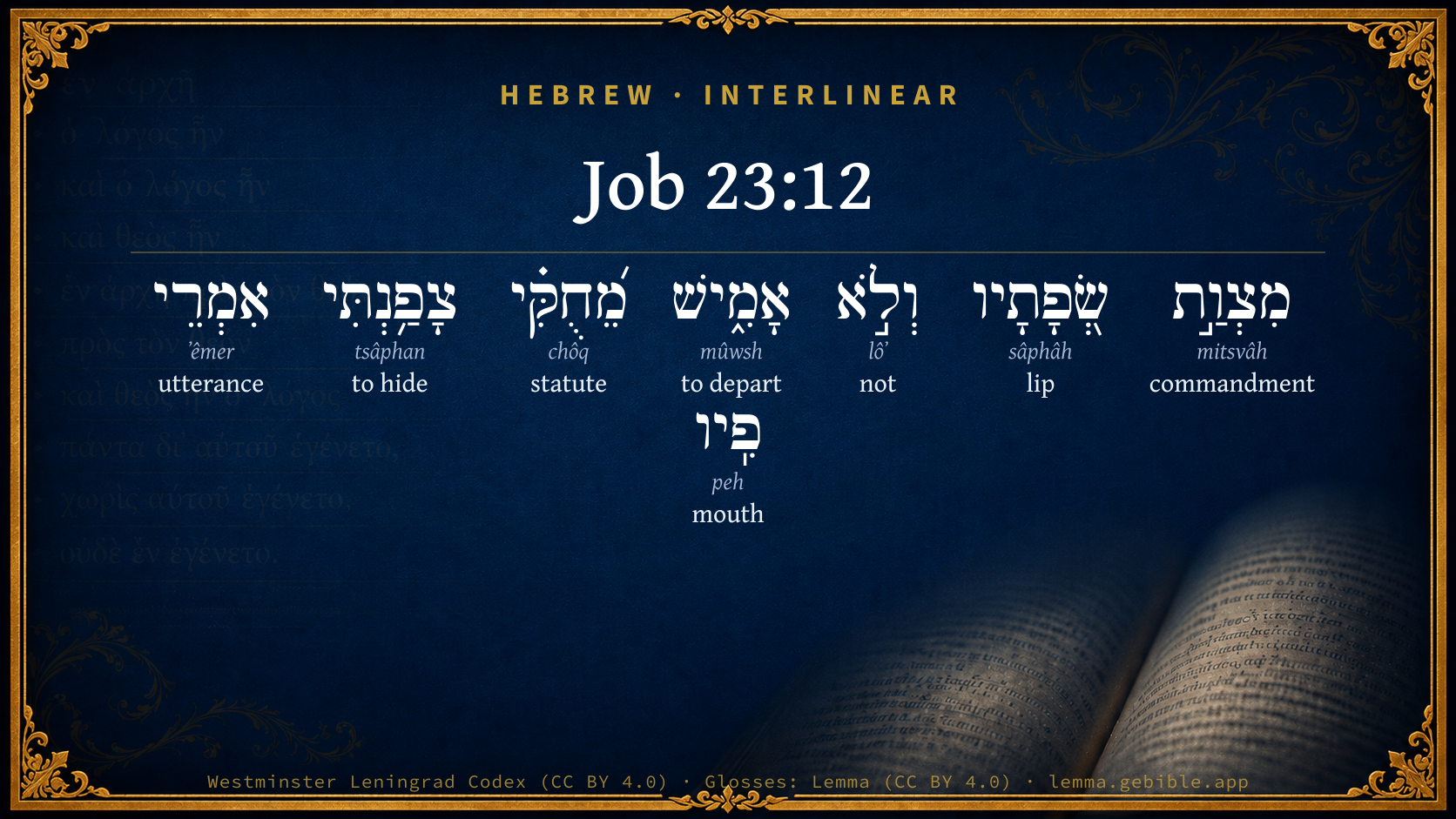
  1. מִצְוַ֣ת mitsvâh H4687 “commandment of” Noun, Common, Feminine, Singular, Construct
  2. שְׂ֭פָתָיו sâphâh H8193 “lips · his” Noun, Common, Feminine, Dual, Construct + Suffix, Personal, 3rd Person, Masculine, Singular
  3. וְלֹ֣א lôʼ H3808 “and · not” Conjunction + Particle, Negative
  4. מֵ֝חֻקִּ֗י chôq H2706 “from · statute · my” Preposition + Noun, Common, Masculine, Singular, Construct + Suffix, Personal, 1st Person, Common, Singular
  5. צָפַ֥נְתִּי tsâphan H6845 “to hide” Verb, Qal, Perfect, 1st Person, Common, Singular
  6. אִמְרֵי ʼêmer H561 “utterances of” Noun, Common, Masculine, Plural, Construct
  7. פִֽיו peh H6310 “mouth · his” Noun, Common, Masculine, Singular, Construct + Suffix, Personal, 3rd Person, Masculine, Singular

About this verse

These counts appear in no published source. They are computed here, from the morphology-tagged text and Lemma’s own curated glosses. What Lemma adds →

8
words
8
distinct lemmas
Wisdom
section

Notable vocabulary

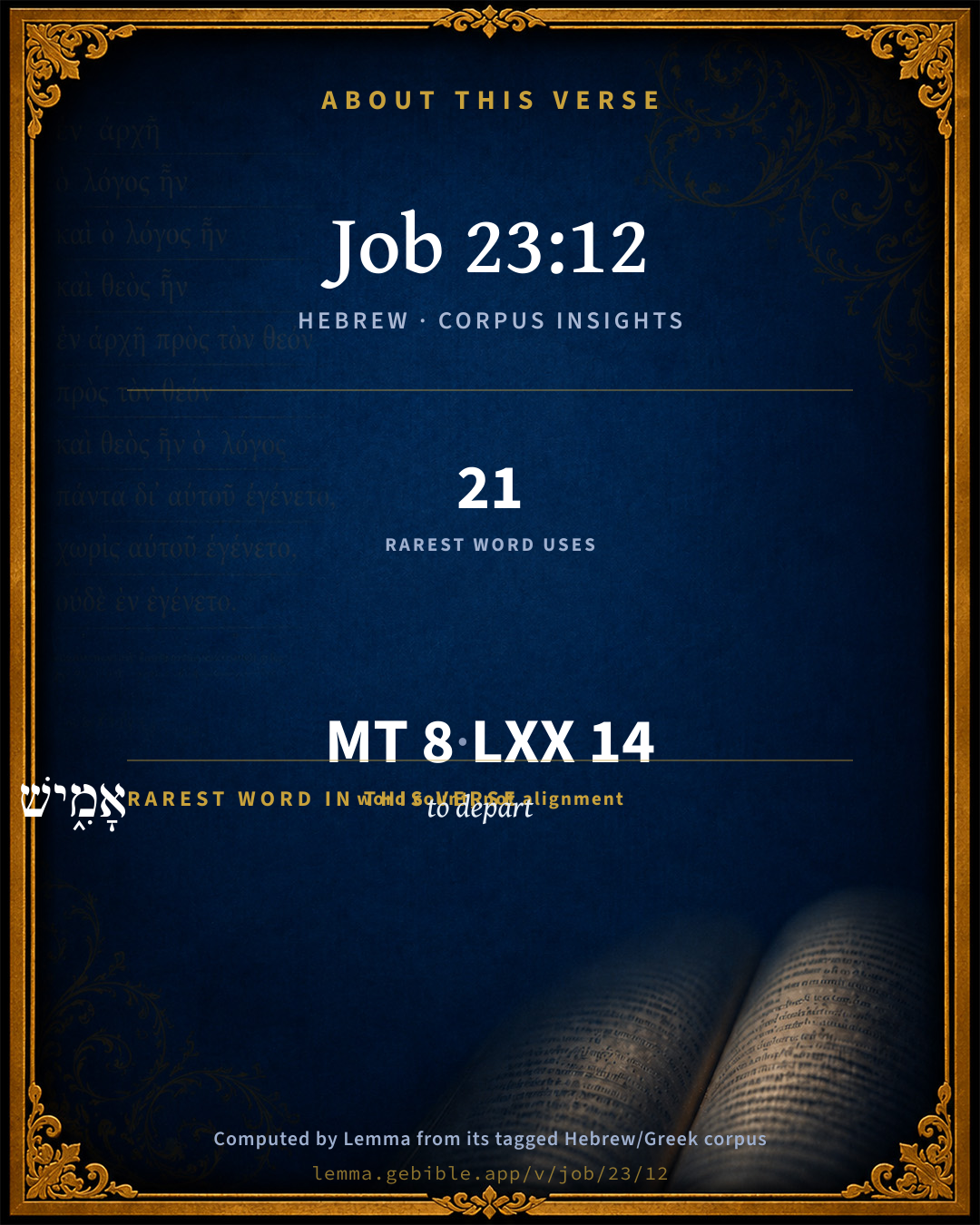
The rarest word here is אָמִ֑ישׁ to depart H4185 — appearing just 21 times in the whole Hebrew Bible.

Shared distinctive vocabulary

אָמִ֑ישׁ to depart H4185 occurs in 19 verses of the Hebrew Bible. Also found in:

Grammatical profile

  • 2 verbs
  • 5 nouns
  • 1 particle

Verb forms

  • אָמִ֑ישׁ Hiphil · Imperfect
  • צָפַ֥נְתִּי Qal · Perfect

Hebrew & Septuagint length

In English translation the verse runs 24 words from the Hebrew and 13 from the Septuagint (LXX English) — the Septuagint runs noticeably shorter here. See the side-by-side →

A rough comparison of the two English renderings, which tokenize alike — not a word-level alignment.

Word counts can differ between the Hebrew and the Greek without any difference in meaning — e.g. the Hebrew direct-object marker אֵת has no separate Greek word, and Greek often adds the article ὁ.

In the original languages it is 8 Hebrew tokens and 14 Greek tokens — but the two are counted differently (Hebrew bundles its prefixes and suffixes into one token; the Greek is in lemma form), so that isn’t a like-for-like length.

Cross-references

16

Topical passages linked to Job 23:12 in the Treasury of Scripture Knowledge — connected by theme and wording, ordered by reader-vote popularity; previews shown in the World English Bible.

  • Jeremiah 15:16 Your words were found, and I ate them; and your words were to me a joy and the rejoicing of my heart: for I am called by your name, Yahweh, God of hosts.
  • Psalms 119:11 I have hidden your word in my heart, That I might not sin against you.
  • Psalms 119:103 How sweet are your promises to my taste, More than honey to my mouth!
  • John 4:34 Jesus said to them, "My food is to do the will of him who sent me, and to accomplish his work.
  • Psalms 19:9–10 The fear of Yahweh is clean, enduring forever. Yahweh's ordinances are true, and righteous altogether.
  • Job 22:22 Please receive instruction from his mouth, And lay up his words in your heart.
  • John 4:32 But he said to them, "I have food to eat that you don't know about."
  • John 8:31 Jesus therefore said to those Jews who had believed him, "If you remain in my word, then you are truly my disciples.
  • Psalms 119:127 Therefore I love your commandments more than gold, Yes, more than pure gold.
  • Job 6:10 Be it still my consolation, Yes, let me exult in pain that doesn't spare, That I have not denied the words of the Holy One.
  • John 6:66–69 At this, many of his disciples went back, and walked no more with him.
  • Acts 14:22 confirming the souls of the disciples, exhorting them to continue in the faith, and that through many afflictions we must enter into the Kingdom of God.
  • 1 Peter 2:2 as newborn babes, long for the pure milk of the Word, that you may grow thereby,
  • Luke 12:42 The Lord said, "Who then is the faithful and wise steward, whom his lord will set over his household, to give them their portion of food at the right times?
  • Luke 12:46 then the lord of that servant will come in a day when he isn't expecting him, and in an hour that he doesn't know, and will cut him in two, and place his portion with the unfaithful.
  • Hebrews 10:38–39 But the righteous will live by faith. If he shrinks back, my soul has no pleasure in him."

Cross-references courtesy of OpenBible.info (CC BY 4.0).

Hebrew and Greek witnesses Masoretic Hebrew ↔ Greek Septuagint

The same verse in the two great witnesses to the Old Testament, shown verse-for-verse.

Here the Septuagint runs noticeably shorter than the Hebrew — LXX2012 (modern English Septuagint) 13 words vs World English Bible 24. A rough length comparison of the two English translations, not a word-level alignment — read both below.

These are two independent witnesses, not word-aligned to each other, and the Septuagint is shown in lemma (dictionary) form.

Hebrew Job 23:12 Masoretic · Westminster Leningrad Codex

מִצְוַ֣ת שְׂ֭פָתָיו וְלֹ֣א אָמִ֑ישׁ מֵ֝חֻקִּ֗י צָפַ֥נְתִּי אִמְרֵי פִֽיו

I haven't gone back from the commandment of his lips. I have treasured up the words of his mouth more than my necessary food.

World English Bible · Public Domain

Greek LXX Job 23:12 Septuagint · lemma form

ἀπό ἔνταλμα αὐτός καί οὐ μή παραἔρχομαι ἐν δέ κόλπος ἐγώ κρύπτω ῥῆμα αὐτός

neither shall I transgress; but I have hid his words in my bosom.

LXX2012 (modern English Septuagint) · Public Domain

On this verse, Ellicott's Commentary for English Readers discusses the Septuagint’s reading. Read the note in Commentary ↓

Hebrew: Westminster Leningrad Codex (CC BY 4.0). Greek: Septuagint (public domain); English from LXX2012 (modern English Septuagint) (Public Domain). How the Septuagint differs from the Hebrew →

Commentary

Notes on Job 23:12 from classic Christian and Jewish commentators (each source and its license shown beneath its notes). The classic Christian expositions comment on the surrounding passage and are grouped to its opening verse, so a note may address several verses; the Jewish commentaries on the Tanakh (Rashi and others) are per-verse, so they appear only where the commentator wrote on this verse.

Lemma curates 59 commentaries, every one of them public domain or Creative Commons licensed, each selected and text-cleaned for this edition rather than reprinted as found. About our sources →

Trapp's Complete Commentary

John Trapp

Job 23:12 Neither have I gone back from the commandment of his lips; I have esteemed the words of his mouth more than my necessary [food].

Ver. 12. Neither have I gone back from the commandment of his lips] i.e. Ab ipsissimo Dei verbo, from the very word of God, that sure cynosura, which he that holdeth straitly to may truly say, Lord, if I be deceived, thou and thy word hath deceived me. But of that there is no danger, since the Scripture is the invariable canon or rule of truth, saith Irenaeus, the cubit of the sanctuary, the touchstone of error, the divine beam, and most exact balance, as Austin and Chrysostom style it, Kανων της αληθειας ακλινης, yea, the very heart and soul of God, as Gregory. And if Job lived before the word was written, yet not before the law of nature and the traditions of the patriarchs; which while they remained uncorrupted, were the commandment also of God’s lips, as having been received from his very mouth; and might far better be called ipsissimum Dei verbum the very word of God itself, than the pope’s pronunciata, which Cardinal Hosius profanely and blasphemously pronounceth to be the very word of God.

I have esteemed the words of his mouth more than my necessary food] I have preferred Heb. I have hid, or laid up, as men do precious things, as housekeepers do provision for their family them before my bodily food, my daily bread; and we see what pains men take, what shift they make, Ut bene sit ventri, ut lateri, for food and raiment, and other things requisite to the preservation of this present life. Now Job knew that God’s holy word is ψυχης προφη, as Athanasius calleth it, the soul’s nourishment; and that the promises are pabulum fidei, the food of faith, as another calleth them; that we may better lack bread than that bread of life. Hence he esteemed it more, not only than his dainties or superfluities, but than his substantial food, without which he could not live and subsist; more than his appointed portion (so some render it) set out for him by the Divine providence, which cutteth out to every man his allowance. I would rather be without meat, drink, light, anything, everything, saith one, than that sweet text, "Come unto me, all ye that are weary and heavy laden," &c. (Selneccer). I would not for all the world, saith another, than that one verse, Joh 17:24 ("Father, I will that they also, whom thou hast given me, be where I am; that they may behold my glory, which thou hast given me: for thou lovedst me before the foundation of the world"), had been left out of the Bible (Mr Baxter’s Saints’ Everlasting Rest, p. 24). And again, There is more worth (saith the same author) in those four chapters, Joh 14:1-31; Joh 15:1-27; Joh 16:1-33; Joh 17:1-26, than in all the books in the world besides. Luther said, He would not live in Paradise without the Word; as with the Word it were no hard matter to live even in hell itself (Tom. 4, Oper. Lat. p. 424). Of old they were wont to say, It were better for the Church that the sun should not shine than that Chrysostom should not preach to the people. The Jews in this day will not omit prayers for their food or labour. They divide the day, even the working day, in three parts, the first ad Tephilla, for prayer; the second ad Torn, for the reading of God’s law; and the third ad Malacca, for the works of their calling (Weemsc.). And when they have read one section they begin another, lest they should seem to be weary of their task. Whereas if we read but a chapter (not a quarter so long as one of their sections or paragraphs), Oh what a weariness is it! neither begin we till we have looked over the leaf to see how long it is; so soon sated are we with this heavenly manna.

John Trapp, A Commentary or Exposition upon All the Books of the Old and New Testament (1647–1656) — public domain. Text from a community e-Sword module.

Geneva Bible (1599)

Geneva Bible translators

His word is more precious unto me, than the meat wherewith the body is sustained.

Geneva Bible (1599) marginal notes — public domain. Text via Bolls.life.

Jamieson, Fausset & Brown

Robert Jamieson, A. R. Fausset & David Brown

esteemed--rather, "laid up," namely, as a treasure found (Mat 13:44; Psa 119:11); alluding to the words of Eliphaz (Job 22:22). There was no need to tell me so; I have done so already (Jer 15:16).

necessary--"Appointed portion" (of food; as in Pro 30:8). UMBREIT and MAURER translate, "More than my law," my own will, in antithesis to "the words of His mouth" (Joh 6:38). Probably under the general term, "what is appointed to me" (the same Hebrew is in Job 23:14), all that ministers to the appetites of the body and carnal will is included.

Jamieson, Fausset & Brown — Commentary Critical and Explanatory on the Whole Bible (1871) — public domain (CC PDM 1.0). Text via the HelloAO Bible API.

Adam Clarke's Commentary

Verse 12. The commandment of his lips] The written law that proceeded from his own mouth.

I have esteemed the words of his mouth] Mr. Good has given a better version of the original: In my bosom have I stored up the words of his mouth. The Asiatics carry every thing precious or valuable in their bosom, their handkerchiefs, jewels, purses, &c. Job, therefore, intimates that the words of God's mouth were to him a most precious treasure.

Adam Clarke's Commentary on the Bible (1810–1826) — public domain. Text from a community e-Sword/MySword module.

Ellicott's Commentary for English Readers

(12) I have esteemed the words of his mouth more than my necessary food.—Comp. Joh_4:32-34. Or, I have treasured up the words, &c., according to the statute prescribed to me, or from my own law: i.e., “I made it a principle with myself to treasure up the words of His mouth.” The LXX. and the Vulg. have a differing reading, and render in my bosom.

A Bible Commentary for English Readers, edited by Charles John Ellicott (1878–1897) — public domain. Text from a community e-Sword module.

The Cambridge Bible for Schools and Colleges

gen. ed. J. J. S. Perowne

12. more than my necessary food] Lit. more than (or, above) my own law; i. e. perhaps, more than the law of my own mind or inclination. The words recall the exhortation of Eliphaz, ch. Job_22:22. Any reference to food seems out of place.

The Cambridge Bible for Schools and Colleges (gen. ed. J. J. S. Perowne; Cambridge University Press, 1878–1918) — public domain. Text from a community e-Sword module.

John Gill's Exposition

But he is in one mind,.... Either with respect to his commandments, every precept remains in full force, he never alters the thing that is gone out of his lips, or delivers out other commandments different from, or contrary to what he has given; and therefore Job thought it his duty to abide by them, and not decline from them; which is the sense of a Jewish commentator (c), connecting the words with the preceding: Or with respect to his dispensations towards Job in afflicting him; which he continued notwithstanding his innocence, because he is a sovereign Being, and does whatsoever he pleases; he is unchangeable in his purposes and decrees; he is not to be wrought upon by any means to alter his fixed course; he is not to be contradicted nor resisted; and this was the reason why he would not be found by him, though he sought him so earnestly and diligently, and why he would not hear him, and would not appear to try his cause, though he knew he was innocent, because he was determined to go on to afflict him; and he never changes his mind, or alters his counsels, on any account whatever. The Vulgate Latin version renders it, "for he is alone": and so the Targum,

"if he is alone, or the only one;''

there is none with him to advise him, for "with whom took he counsel?" or to persuade him to be of another mind, and take contrary measures, who might be applied to, to use their interest with him to act it, a different manner; but he is alone, there are none with him that have any influence upon him, and can prevail with him to do otherwise than he does; some translate the words, "if he acts against one" (d); against a man in a hostile way, if he sets his face against him, and comes upon him as an enemy; and so Mr. Broughton, "yet when he is against me, who can stay him?" notwithstanding my innocence and integrity, though I keep his ways, and do not go back from his commandments. Some think there is a redundancy of a letter, which we translate "in", and then the words wilt be read thus: "but he is one"; the one only living and true God; this is the voice of reason and revelation, "hear, O Israel, the Lord thy God is one Lord", Deu 6:4; for though there are three Persons in the Godhead, Father, Son, and Holy Ghost, "these three are one God", Jo1 5:7; and so the words are expressive of the unity of the Divine Being; but this seems not to be Job's sense: Aben Ezra says, the truth is, that the letter is not added, is no redundancy, and should be read "he is in one"; but, says he, I cannot explain it, there is a great mystery in it: what the Jew understood not may be more clear and plain to us Christians, who are taught the mystery of the indwelling of the divine Persons in each other, the Father is in the Son, and the Son is in the Father, as they are divine Persons; though in what manner they are we are not able to explain; besides, God was in Christ, as Mediator, reconciling the world, choosing his people in him, and blessing them with all spiritual blessings in him; though the true sense seems to, be what is before given, agreeably to our version, that God is in one mind, purpose, and design; that his decrees are unchangeable and invariable; that he always acts according to them, and never alters them:

and who can turn him? turn his mind, or cause him to change his counsel, and alter his purposes; or turn his hand, or stop and stay it from the execution of them; it is not to be done by force and power, there is no power equal to his, and much less superior to his; which must be the case, if any could turn him: and though he may be turned by the prayers of his people, and by the repentance of men, so as to repent himself, and not do what he has threatened to do; yet this is no change of his mind and counsels, only an alteration in the course of his providence, or a change of his outward dealings with men, according to his unchangeable will; see Isa 14:27;

and what his soul desireth, even that he doth: that is, what he himself desireth earnestly and vehemently; he has done all things in creation according to the good pleasure of his will; and he does all things in providence according to the counsel of it, and as seems best in his sight; and so he does all things in grace, chooses whom he will, predestinates to the adoption of children according to the good pleasure of his will: redeems whom he pleases, and calls by his grace, and brings to glory whomsoever he will be gracious to; see Psa 115:3.

(c) Sophorno. (d) "sed si ipse contra unum agit", Junius & Tremellius; so Piscator, Cocceius.

John Gill's Exposition of the Whole Bible (1746–1763) — public domain (CC PDM 1.0). Text via the HelloAO Bible API.

Albert Barnes' Notes on the Bible

Neither have I gone back - I have not put away or rejected.

The commandment of his lips - That which he has spoken, or which has proceeded out of his mouth.

I have esteemed - Margin, “hid,” or, “laid up.” The Hebrew is, “I have hid,” as we hide or lay up that which is valuable. It is a word often applied to laying up treasures, or concealing them so that they would be safe.

More than my necessary food - Margin, “or, appointed portion.” Dr. Good renders it, “In my bosom have I laid up the words of his mouth.” So Noyes, “The words of his mouth I have treasured up in my bosom.” So Wemyss; and so it is rendered in the Vulgate, and by the Septuagint. The variety in the translation has arisen from the difference of reading in regard to the Hebrew word מחקי mēchôqı̂y. Instead of this meaning “more than my portion” or “allowance,” the Septuagint and Vulgate appear to have read בחקי bēchôqı̂y - “in my bosom.” But there is no authority for the change, and there seems to be no reason for it. The word חק chôq, means something decreed, designated, appointed; then an appointed portion, as of labor, Exo 5:14; then of food - an allowance of food, Pro 30:8; then a limit, bound, law, statute, etc. It seems to me that the word here means “purpose, intention, rule, or design,” and that the idea is that he had regarded the commands of God more “than his own purposes.” He had been willing to sacrifice his own designs to the will of God, and had thus shown his preference for God and his law. This sense seems to be the most simple of any, and it is surprising that it has not occurred to any expositors. So the same word is used in Job 23:14. If this be the meaning, it expresses a true sentiment of piety in all ages. He who is truly religious is willing to sacrifice and abandon his own plans at the command of God. Job says that he was conscious of having done this, and he thus had a firm conviction that he was a pious man.

Albert Barnes' Notes on the Bible (1834–1885) — public domain. Text from a community e-Sword/MySword module.

Haydock's Catholic Bible Commentary

Lips, given to Noe, (Genesis ix. 5.) or to Moses. This work was written by a Jew, who dresses up the sentiments of Job in his own style. The holy man was also acquainted with the Mosaic dispensation, though he was not bound to observe the ceremonial part of it. (Calmet) --- His words, may, however, be verified, though he speak only of the natural law, or of that which was preserved by tradition of the patriarchs, as both proceeded from God. (Haydock) --- Hid. Protestants, "esteemed....more than my necessary food." (Haydock) --- Septuagint agree with the Vulgate. The ancients placed in their bosom what they greatly esteemed. The Turks still use it as a pocket. (Thevenot xxii.) (Calmet)

George Leo Haydock (1774–1849), Haydock's Catholic Family Bible and Commentary, 1859 edition — public domain. Excludes Psalms (Douay-Rheims chapter numbering differs from Protestant) and Deuterocanonical books (Catholic canon only).

Matthew Poole's English Annotations

Neither have I gone back, i.e. not turned aside to any crooked or sinful path or course of life, human infirmity excepted.

I have esteemed, Heb. I have hid, or laid it up, as men do their best treasures, or what they most love and value. The phrase notes a high estimation of it, a hearty affection to it, and a diligent care to preserve it.

My necessary food, or my appointed food, or my daily portion, i.e. that food or provision which is necessary for the support of my life, as this word is used, Gen 47:22; Pro 30:8; 31:15, which is more prized and desired than all the riches in the world.

Matthew Poole's English Annotations on the Holy Bible (1683–1685) — public domain. Text from a community e-Sword/MySword module.

Whedon's Commentary on the Bible

Daniel D. Whedon

12. My necessary (food) חקי— Gen_47:22; Pro_30:8. Recent interpreters mostly render it my law, meaning his own natural desires contrasted with God’s law. This law of his sinful nature answers to what the apostle designates as the law in his members warring against the law of his mind. Rom_7:23. Job has subordinated his own to the divine will.

Daniel D. Whedon (gen. ed.), Commentary on the Old and New Testaments (1874–1909) — public domain. Text from a community e-Sword module.

The Pulpit Commentary

Neither have I gone back from the commandment of his lips. Professor Lee rightly observes that this declaration "takes it for granted that, at least, some precepts of God had been revealed before this time" ("Book of Job," p. 370). Them were "commandments" which Job recognized as having proceeded from God, and "words" which he looked upon as being the utterances of his mouth. This is strong evidence of a primeval revelation which, if not reduced to writing, had, at any rate, been handed down by tradition to Job"s day. Gen_3:14-19 and Gen_9:1-7 may afford the true explanation of this difficulty. I have esteemed the words of his mouth more than my necessary food. This is scarcely strong enough. Job says, I have treasured uptaken to myself, and preserved the words of his mouth," either "more than my necessary food" or "more than my own law." If the former rendering be preferred, there is no need of explanation; if the latter, we must regard "my own law" as meaning "the law of my own mind, my own will, the will of the natural man" (Cook).

The Pulpit Commentary (1880–1919), ed. H.D.M. Spence-Jones & Joseph S. Exell — public domain. Text from a community e-Sword module.

Rashi

Rabbi Shlomo Yitzchaki (Rashi)

more than my daily bread I kept the words of His mouth More than my daily food I was eager to keep the words of His mouth. [The expression חקי] is like (Prov. 30:8), “my daily bread (לחם חקי),” my food.

Rashi on the Tanakh — English translations: “The Judaica Press complete Tanach with Rashi, translated by A. J. Rosenberg” (CC BY 4.0); “Pentateuch with Rashi's commentary by M. Rosenbaum and A.M. Silbermann, 1929-1934” (public domain); “The Metsudah Tanach series, Lakewood, N.J” (CC BY 4.0); and “The Book of Joshua, Metsudah Publications, 1997” (CC BY 4.0). Text via Sefaria.

Lesson kit

Teaching starters — assembled from the data on this page, not authored interpretation. Every prompt links to the verse data it draws on. Edit before teaching.

Job, in the Wisdom, opens this verse with 8 words (8 distinct Hebrew lemmas). Its most distinctive word is mûwsh (“to depart”). The Greek Septuagint runs shorter here. A historical commentator’s framing appears above. Read the whole chapter for the surrounding context.

Discussion questions

  1. The word mûwsh carries the sense “to depart.” How does it shape the verse?
  2. How does Exodus 13:22, which shares the word «to depart», read alongside this verse?
  3. The Septuagint runs shorter here than the Hebrew. What might account for the difference?
  4. These translations render this verse differently. What is at stake in choosing one wording over another?
  5. «אָמִ֑ישׁ» is a Hiphil Imperfect verb. How does that grammatical form shape the action described?
  6. Compare how Trapp's Complete Commentary and Geneva Bible (1599) read this verse. Where do they agree or differ?

Things to notice

Reading settings

Reading text

Shown beneath each verse's original-language words.

Old Testament
Old Testament edition

Read the OT as the Masoretic Hebrew (MT) or the Greek Septuagint (LXX).

English shown for the Greek Septuagint (in the Hebrew ↔ Greek comparison).

Comparing translations? Open the Compare panel on any verse page to stack up to four side by side.