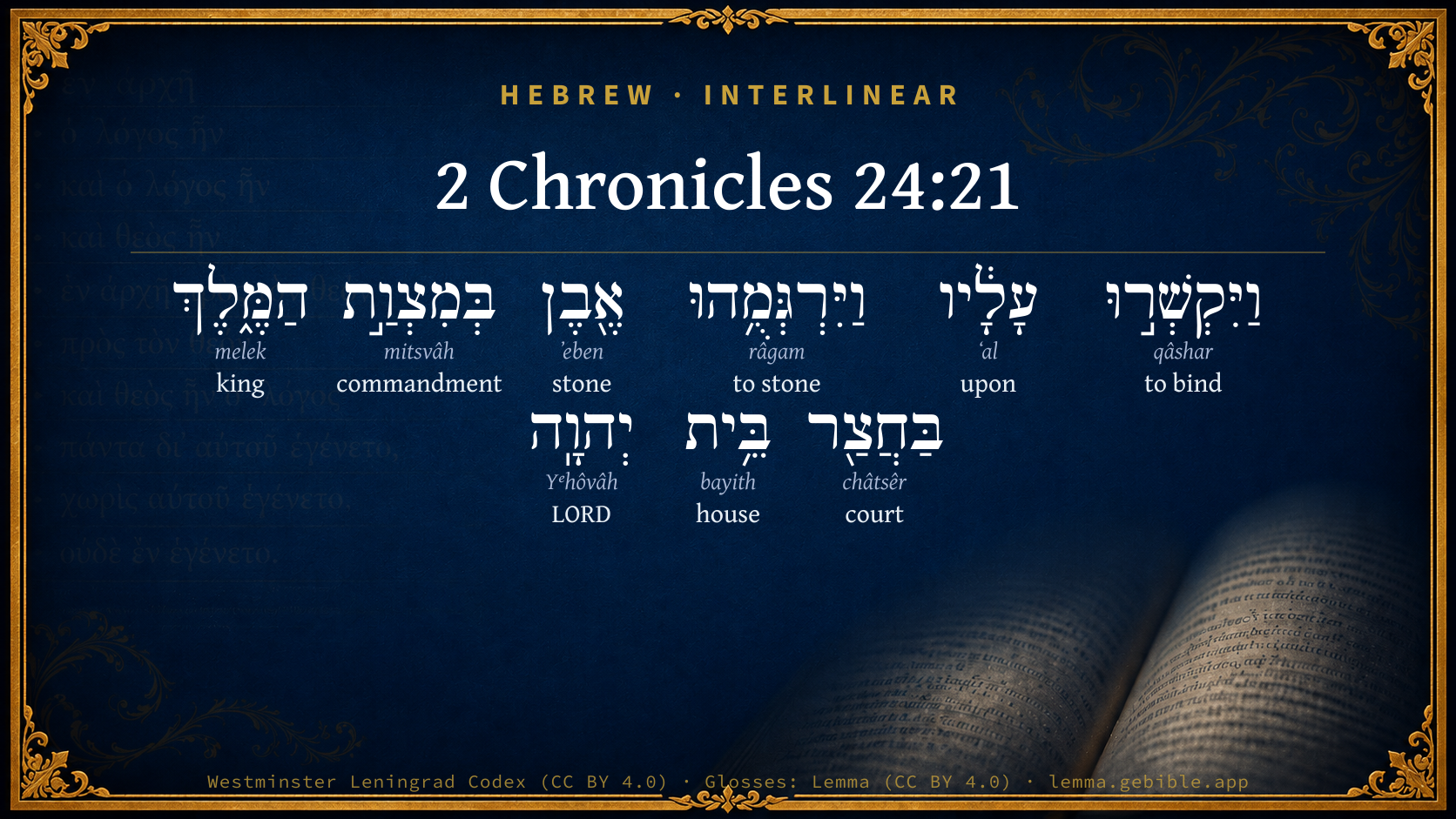
2 Chronicles 24:21

Hebrew (Westminster Leningrad Codex) 2 Chronicles 24:21 appears in the Hebrew Old Testament. The text above is from the Westminster Leningrad Codex. Each word links to its Strong’s number, a concise gloss, and parsing drawn from the Open Scriptures Hebrew Bible morphology. Click any word for its full Brown-Driver-Briggs (BDB) entry.
Download image
Cite this verse

2 Chronicles 24:21 (World English Bible). Public Domain. Lemma interlinear Bible study tool, https://lemma.gebible.app/v/2-chronicles/24/21.

Show BibTeX & RIS
BibTeX
RIS
English Translation
They conspired against him, and stoned him with stones at the commandment of the king in the court of the house of Yahweh.
World English Bible · Public Domain
Download a study sheet

One document with this verse’s original text, its word-by-word gloss line, the meaning frame, cross-references with their text, attributed commentary, and full source and license credits — printable, and it pastes into notes with its structure intact.

This verse Autodidact and up

Study sheet (.html) Plain text (.txt)

A passage Seminary Student

Up to 50 verses in one chapter. A passage sheet keeps up to 6 commentary sources and 12 cross-references per verse, in the order this page ranks them, and says so on the sheet whenever that leaves anything out. Ask for a single verse and you get the Autodidact verse sheet above.

Everything on this page stays free to read, with no account — the sheet is a download of what is already on screen, not access to it.

Want to remove ads? Support Godless Engineer
Compare translations 3

The same verse in 3 English versions, stacked beneath the original-language interlinear above. Click any original word for its lexicon entry.

Each is an independent rendering of the whole verse — the interlinear is not word-aligned to these translations.

Highlighted words mark where these versions differ — a whole-verse word diff, not a word-by-word alignment.

  • World English Bible Public Domain
    They conspired against him, and stoned him with stones at the commandment of the king in the court of the house of Yahweh.
  • King James Version Public Domain
    And they conspired against him, and stoned him with stones at the commandment of the king in the court of the house of the LORD.
  • unfoldingWord Literal Text CC BY-SA 4.0
    But they conspired against him, and they stoned him with stones by the command of the king in the court of the house of Yahweh.

unfoldingWord Literal Text — © unfoldingWord, licensed CC BY-SA 4.0. Word-aligned USFM3 via Door43 (git.door43.org/unfoldingWord/en_ult).

Versions to compare (up to 4)

3 of 4 selected

Show all 18 translations

Every available English version of this verse, each an independent rendering of the whole verse.

  • World English Bible Public Domain
    They conspired against him, and stoned him with stones at the commandment of the king in the court of the house of Yahweh.
  • Berean Standard Bible Public Domain
    But they conspired against Zechariah, and by order of the king, they stoned him in the courtyard of the house of the LORD.
  • Majority Standard Bible Public Domain
    But they conspired against Zechariah, and by order of the king, they stoned him in the courtyard of the house of the LORD.
  • King James Version Public Domain
    And they conspired against him, and stoned him with stones at the commandment of the king in the court of the house of the LORD.
  • American Standard Version (1901) Public Domain
    And they conspired against him, and stoned him with stones at the commandment of the king in the court of the house of Jehovah.
  • Revised Version (1885) Public Domain
    And they conspired against him, and stoned him with stones at the commandment of the king in the court of the house of the LORD.
  • Geneva Bible (1599) Public Domain
    Then they conspired against him and stoned him with stones at the commandement of the King, in the court of the house of the Lord.
  • Douay-Rheims (1899) Public Domain
    And they gathered themselves together against him, and stoned him at the king's commandment in the court of the house of the Lord.
  • Young's Literal Translation Public Domain
    And they conspire against him, and stone him with stones by the command of the king, in the court of the house of Jehovah,
  • Literal Standard Version CC BY-SA 4.0
    And they conspire against him, and stone him [with] stone by the command of the king, in the court of the house of YHWH,
  • Unlocked Literal Bible CC BY-SA 4.0
    But they plotted against him; at the king's command, they stoned him with stones in the courtyard of the house of Yahweh.
  • unfoldingWord Literal Text CC BY-SA 4.0
    But they conspired against him, and they stoned him with stones by the command of the king in the court of the house of Yahweh.
  • Darby Bible Public Domain
    And they conspired against him, and stoned him with stones at the command of the king in the court of the house of Jehovah.
  • World Messianic Bible Public Domain
    They conspired against him, and stoned him with stones at the commandment of the king in the court of the LORD’s house.
  • Webster's Bible Public Domain
    And they conspired against him, and stoned him with stones at the commandment of the king in the court of the house of the LORD.
  • Free Bible Version CC BY-SA 4.0
    Then the leaders hatched a plot to kill Zechariah, and on the orders of the king they stoned him to death in the courtyard of the Lord's Temple.
  • Bible in Basic English Public Domain
    But when they had made a secret design against him, he was stoned with stones, by the king's order, in the outer square of the Lord's house.
  • JPS Tanakh (1917) Public Domain
    And they conspired against him, and stoned him with stones at the commandment of the king in the court of the house of the LORD.

Literal Standard Version (2020), Covenant Press — licensed CC BY-SA 4.0. Text via the HelloAO Bible API (eBible.org). Unlocked Literal Bible (unfoldingWord) — licensed CC BY-SA 4.0. Text via the HelloAO Bible API (eBible.org). unfoldingWord Literal Text — © unfoldingWord, licensed CC BY-SA 4.0. Word-aligned USFM3 via Door43 (git.door43.org/unfoldingWord/en_ult). Free Bible Version, Dr. Jonathan Gallagher — licensed CC BY-SA 4.0. Text via the HelloAO Bible API (eBible.org).

Word by word

More ways to search: Search by grammar → Find every occurrence → Compare this word →

Practice this passage: Drill this verse → Learn its vocabulary →

וַיִּרְגְּמֻ֥הוּ
râgam
H7275
“and · to stone · him”
Conjunction + Verb, Qal, Sequential Imperfect, 3rd Person, Masculine, Plural + Suffix, Personal, 3rd Person, Masculine, Singular
Part of Speech
Conjunction + Verb
Stem
Qal
Form
Sequential Imperfect
Person
3rd Person
Gender
Masculine
Number
Plural
Full BDB Definition

Origin: a primitive root [compare H7263 , H7321 , H7551 ]

TWOT: 2114

to stone, slay or kill by stoning - (Qal) to stone
  1. וַיִּקְשְׁר֣וּ qâshar H7194 “and · to bind” Conjunction + Verb, Qal, Sequential Imperfect, 3rd Person, Masculine, Plural
  2. עָלָ֔יו ʻal H5921 “upon · him” Preposition + Suffix, Personal, 3rd Person, Masculine, Singular
  3. אֶ֖בֶן ʼeben H68 “stone” Noun, Common, Feminine, Singular, Absolute
  4. בְּמִצְוַ֣ת mitsvâh H4687 “in/at · commandment of” Preposition + Noun, Common, Feminine, Singular, Construct
  5. הַמֶּ֑לֶךְ melek H4428 “the · king” Particle, Definite Article + Noun, Common, Masculine, Singular, Absolute
  6. בַּחֲצַ֖ר châtsêr H2691 “in/at · court of” Preposition + Noun, Common, Both, Singular, Construct
  7. בֵּ֥ית bayith H1004 “house of” Noun, Common, Masculine, Singular, Construct
  8. יְהוָֽה Yᵉhôvâh H3068 “LORD” Noun, Proper

About this verse

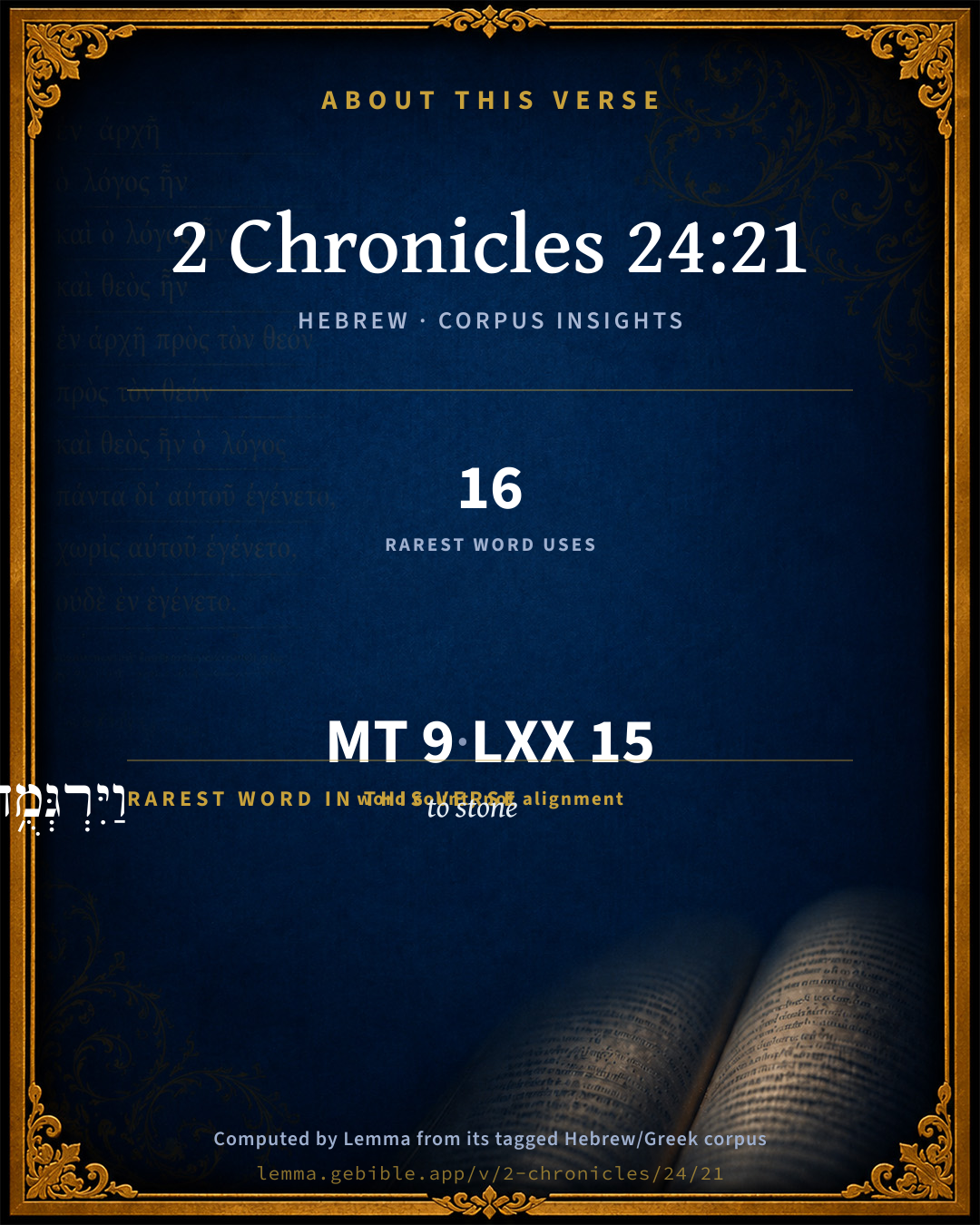
These counts appear in no published source. They are computed here, from the morphology-tagged text and Lemma’s own curated glosses. What Lemma adds →

9
words
9
distinct lemmas
Historical
section

Notable vocabulary

The rarest word here is וַיִּרְגְּמֻ֥הוּ to stone H7275 — appearing just 16 times in the whole Hebrew Bible.

Shared distinctive vocabulary

וַיִּרְגְּמֻ֥הוּ to stone H7275 occurs in 15 verses of the Hebrew Bible. Also found in:

Grammatical profile

  • 2 verbs
  • 6 nouns
  • 1 preposition

Verb forms

  • וַיִּקְשְׁר֣וּ Qal · Sequential Imperfect
  • וַיִּרְגְּמֻ֥הוּ Qal · Sequential Imperfect

Hebrew & Septuagint length

In English translation the verse runs 23 words from the Hebrew and 20 from the Septuagint (LXX English) — closely comparable.

A rough comparison of the two English renderings, which tokenize alike — not a word-level alignment.

Word counts can differ between the Hebrew and the Greek without any difference in meaning — e.g. the Hebrew direct-object marker אֵת has no separate Greek word, and Greek often adds the article ὁ.

In the original languages it is 9 Hebrew tokens and 15 Greek tokens — but the two are counted differently (Hebrew bundles its prefixes and suffixes into one token; the Greek is in lemma form), so that isn’t a like-for-like length.

Cross-references

7

Topical passages linked to 2 Chronicles 24:21 in the Treasury of Scripture Knowledge — connected by theme and wording, ordered by reader-vote popularity; previews shown in the World English Bible.

  • Nehemiah 9:26 Nevertheless they were disobedient, and rebelled against you, and cast your law behind their back, and killed your prophets that testified against them to turn them again to you, and they committed awful blasphemies.
  • Acts 7:58–59 They threw him out of the city, and stoned him. The witnesses placed their garments at the feet of a young man named Saul.
  • Jeremiah 11:19 But I was like a gentle lamb that is led to the slaughter; and I didn't know that they had devised devices against me, [saying], Let us destroy the tree with the fruit of it, and let us cut him off from the land of the living, that his name may be no more remembered.
  • Jeremiah 18:18 Then said they, Come, and let us devise devices against Jeremiah; for the law shall not perish from the priest, nor counsel from the wise, nor the word from the prophet. Come, and let us strike him with the tongue, and let us not give heed to any of his words.
  • Jeremiah 38:4–6 Then the princes said to the king, Let this man, we pray you, be put to death; because he weakens the hands of the men of war who remain in this city, and the hands of all the people, in speaking such words to them: for this man doesn't seek the welfare of this people, but the hurt.
  • Matthew 21:35 The farmers took his servants, beat one, killed another, and stoned another.
  • Matthew 23:34–37 Therefore, behold, I send to you prophets, wise men, and scribes. Some of them you will kill and crucify; and some of them you will scourge in your synagogues, and persecute from city to city;

Cross-references courtesy of OpenBible.info (CC BY 4.0).

Hebrew and Greek witnesses Masoretic Hebrew ↔ Greek Septuagint

The same verse in the two great witnesses to the Old Testament, shown verse-for-verse.

These are two independent witnesses, not word-aligned to each other, and the Septuagint is shown in lemma (dictionary) form.

Hebrew 2 Chronicles 24:21 Masoretic · Westminster Leningrad Codex

וַיִּקְשְׁר֣וּ עָלָ֔יו וַיִּרְגְּמֻ֥הוּ אֶ֖בֶן בְּמִצְוַ֣ת הַמֶּ֑לֶךְ בַּחֲצַ֖ר בֵּ֥ית יְהוָֽה

They conspired against him, and stoned him with stones at the commandment of the king in the court of the house of Yahweh.

World English Bible · Public Domain

Greek LXX 2 Chronicles 24:21 Septuagint · lemma form

καί ἐπιτίθημι αὐτός καί λιθοβολέω αὐτός διά ἐντολή ιωας ὁ βασιλεύς ἐν αὐλή οἶκος κύριος

And they conspired against him, and stone him by command of king Joas in the court of the Lord's house.

LXX2012 (modern English Septuagint) · Public Domain

Hebrew: Westminster Leningrad Codex (CC BY 4.0). Greek: Septuagint (public domain); English from LXX2012 (modern English Septuagint) (Public Domain). How the Septuagint differs from the Hebrew →

Commentary

Notes on 2 Chronicles 24:21 from classic Christian and Jewish commentators (each source and its license shown beneath its notes). The classic Christian expositions comment on the surrounding passage and are grouped to its opening verse, so a note may address several verses; the Jewish commentaries on the Tanakh (Rashi and others) are per-verse, so they appear only where the commentator wrote on this verse.

Lemma curates 59 commentaries, every one of them public domain or Creative Commons licensed, each selected and text-cleaned for this edition rather than reprinted as found. About our sources →

Trapp's Complete Commentary

John Trapp

2Ch 24:21 And they conspired against him, and stoned him with stones at the commandment of the king in the court of the house of the LORD.

Ver. 21. And stoned him with stones.] This is mercis mundi: this is the lot of downright dealing prophets, even the same as of hares that will needs give laws to lions: it is Aristotle’s comparison. {a} The post truly saith,

“ Nihil est violentius aure tyranni. ”

Tyrants are very touchy: Tange montes et fumigabunt, Touch those mountains, and they will smoke: none but silken words will down with them. Maneinellus, for his plain dealing in a sermon preached at Rome before Pope Alexander VI, had first his hands cut off, and then his tongue cut out, of which wound he died. Savanarola was served in like manner; so was Lambert, bishop of Trajectum, for reproving King Pipin, &c. Muleasses, king of Tunes, cruelly tortured to death the Manifet and Mesnar by whose means especially he had attained to the kingdom, grieving to see them live to whom he was so much beholden, and therefore rewarded them with such sharp punishment. Who knoweth but Joash might be of the same mind toward good Zechariah? See 2Ch 23:11.

{a} In Politic.

John Trapp, A Commentary or Exposition upon All the Books of the Old and New Testament (1647–1656) — public domain. Text from a community e-Sword module.

Joseph Benson's Commentary

2Ch 24:21. And they conspired against him — Namely, the people whom he addressed, having been easily corrupted by the examples of their apostate king and princes. And stoned him with stones — And that immediately, without even colour of law; not so much as accusing him of being a blasphemer, a traitor, a false prophet, or guilty of any crime whatever; at the commandment of the king — Who owed his crown and life to Jehoiada his father; and in the court of the house of the Lord — Whose minister and messenger he was! As horrid a piece of wickedness this as any we read of in all the history of the kings! The person was sacred, a prophet; the place sacred, the court of the temple, either the court of the priests, or the inner court, between the porch and the altar; the message was yet more sacred, a message which, we have reason to believe, they knew proceeded from the spirit of prophecy; the reproof was just, the warning fair, and both grounded on Scripture acknowledged by themselves to be divinely inspired; and yet so impudently and daringly do they defy God himself, that nothing less than the blood of the prophet can satisfy their indignation at his prophecy. Be astonished, O heavens, at this, and tremble, O earth, that ever such villany should be committed by men, by Israelites, in contempt and violation of every thing that was just, honourable, and sacred! That a king, a king in covenant with God, should command the murder of one whom it was his office to protect and countenance! The Jews say, there were seven transgressions in one: they killed a priest, a prophet, a judge; they shed innocent blood; polluted the court of the temple, the sabbath, and the day of expiation: for on that day, their tradition says, this happened.

Joseph Benson's Commentary on the Old and New Testaments (1811–1818) — public domain. Text from a community e-Sword module.

Geneva Bible (1599)

Geneva Bible translators

There is no rage so cruel and beastly as of them whose hearts God hath hardened, and which delight more in superstition and idolatry than in the true service of God and pure simplicity of his word.

Geneva Bible (1599) marginal notes — public domain. Text via Bolls.life.

Adam Clarke's Commentary

Verse 21. Stoned him - at the commandment of the king] What a most wretched and contemptible man was this, who could imbrue his hands in the blood of a prophet of God, and the son of the man who had saved him from being murdered, and raised him to the throne! Alas, alas! Can even kings forget benefits? But when a man falls from God, the devil enters into him; and then he is capable of every species of cruelty.

Adam Clarke's Commentary on the Bible (1810–1826) — public domain. Text from a community e-Sword/MySword module.

Ellicott's Commentary for English Readers

(21) And they conspired against him.—The conspiracy of 2Ch_24:25 was the Divine recompense for this one.

And stoned him.—The legal penalty of idolatry (Lev_20:2; Deu_17:2-5).

At the commandment of the king.—Probably Zechariah’s words had been represented to Joash as treasonable. The Syrian invasion may have been already threatening, when his prophecy was uttered; and in that case it would be easy to allege against the prophet that his “wish was father to his thought.” (Comp. the similar case of Jeremiah, Jer_32:1-5; and 1Ki_21:8-13.)

In the court of the house of the Lord.—There is little doubt that the allusion of Christ (Mat_23:35; Luk_11:51) to the death of “Zacharias son of Barachias, whom ye slew between the Temple and the altar,” refers to this murder. The altar stood in the court, before the Temple. Barachias (Berechiah) may have been Zechariah’s father, and Jehoiada his grandfather. Moreover the Lord appears to be thinking of the honourable burial of Jehoiada, in contrast with the murder of his son, in Mat_23:29-32, verses which immediately precede the mention of Zacharias.

A Bible Commentary for English Readers, edited by Charles John Ellicott (1878–1897) — public domain. Text from a community e-Sword module.

John Gill's Exposition

And it came to pass at the end of the year,.... After the death of Zechariah; so soon had his prophecy its accomplishment:

that the host of Syria came up against him; against Joash, king of Judah, under Hazael king of Syria, or however sent by him; for some think this is a different expedition from that in Kg2 12:17 though others take it to be the same:

and they came to Judah and Jerusalem; not only came into the land of Judah, but as far as Jerusalem, the forces of Joash not being able to stop them:

and destroyed all the princes of the people from among the people; the idolatrous princes of Judah, Ch2 24:17, which is very remarkable that they should be distinguished from the people in their destruction, who had been the chief cause of the wrath of God coming upon them:

and sent all the spoil of them unto the king of Damascus; all the riches that were taken from them were sent to the king of Syria at Damascus; this looks as if Hazael was not with this army.

John Gill's Exposition of the Whole Bible (1746–1763) — public domain (CC PDM 1.0). Text via the HelloAO Bible API.

Albert Barnes' Notes on the Bible

In the court of the house of the Lord - “Between the altar and the Temple,” or directly in front of the temple porch, if it be this Zechariah of whom our Lord speaks Mat 23:35. A horror of the impious deed long possessed the Jews, who believed that the b ood could not be effaced, but continued to bubble on the stones of the court, like blood newly shed, until the temple was entered, just prior to its destruction, by Nebuzaradan.

Albert Barnes' Notes on the Bible (1834–1885) — public domain. Text from a community e-Sword/MySword module.

Matthew Poole's English Annotations

They conspired, i. e. the people to whom he preached, who were easily corrupted by the examples of their apostate king and princes.

Matthew Poole's English Annotations on the Holy Bible (1683–1685) — public domain. Text from a community e-Sword/MySword module.

The Pulpit Commentary

Stoned him. Yet this was their Law"s punishment for themselves, for idolaters. (Lev_20:2) At the commandment of the king. The king, who had yielded to the flattering obeisance and worship of the princes, is now driven on a grievous length further. In the court of the house of the Lord. So Mat_23:35, "between the temple Revised Version, "sanctuary" and the altar."

The Pulpit Commentary (1880–1919), ed. H.D.M. Spence-Jones & Joseph S. Exell — public domain. Text from a community e-Sword module.

John Wesley's Explanatory Notes

Stoned him - They stoned him immediately, without even colour of law; as horrid a piece of wickedness, as any we read of in all the history of the kings. That ever such a villainy should be committed, by men, by Israelites, in contempt and violation of everything that is just, honourable, and sacred! The Jews say, there were seven transgressions in one: They killed a priest, a prophet, a judge; they shed innocent blood; polluted the court of the temple, the Sabbath, and the day of expiation: for on that day, their tradition says, this happened.

John Wesley, Explanatory Notes Upon the Whole Bible (1754–1765) — public domain. Text via the GEBible commentary corpus.

Lesson kit

Teaching starters — assembled from the data on this page, not authored interpretation. Every prompt links to the verse data it draws on. Edit before teaching.

2 Chronicles, in the Historical, opens this verse with 9 words (9 distinct Hebrew lemmas). Its most distinctive word is râgam (“to stone”). A historical commentator’s framing appears above. Read the whole chapter for the surrounding context.

Discussion questions

  1. What does “to stone” (râgam) contribute to the verse as a whole?
  2. How does Leviticus 20:2, which shares the word «to stone», read alongside this verse?
  3. The translations on this page render this verse differently — a whole-verse word diff, not a word-by-word alignment. What might account for the different wordings?
  4. «וַיִּקְשְׁר֣וּ» is a Qal Sequential Imperfect verb. How does that grammatical form shape the action described?
  5. Compare how Trapp's Complete Commentary and Joseph Benson's Commentary read this verse. Where do they agree or differ?

Things to notice

Reading settings

Reading text

Shown beneath each verse's original-language words.

Old Testament
Old Testament edition

Read the OT as the Masoretic Hebrew (MT) or the Greek Septuagint (LXX).

English shown for the Greek Septuagint (in the Hebrew ↔ Greek comparison).

Comparing translations? Open the Compare panel on any verse page to stack up to four side by side.