

Psalms 119:66

Hebrew (Westminster Leningrad Codex) Psalms 119:66 appears in the Hebrew Old Testament. The text above is from the Westminster Leningrad Codex. Each word links to its Strong’s number, a concise gloss, and parsing drawn from the Open Scriptures Hebrew Bible morphology. Click any word for its full Brown-Driver-Briggs (BDB) entry.
Download image
Cite this verse

Psalms 119:66 (World English Bible). Public Domain. Lemma interlinear Bible study tool, https://lemma.gebible.app/v/psalms/119/66.

Show BibTeX & RIS
BibTeX
RIS
English Translation
Teach me good judgment and knowledge, For I believe in your commandments.
World English Bible · Public Domain
Download a study sheet

One document with this verse’s original text, its word-by-word gloss line, the meaning frame, cross-references with their text, attributed commentary, and full source and license credits — printable, and it pastes into notes with its structure intact.

This verse Autodidact and up

Study sheet (.html) Plain text (.txt)

A passage Seminary Student

Up to 50 verses in one chapter. A passage sheet keeps up to 6 commentary sources and 12 cross-references per verse, in the order this page ranks them, and says so on the sheet whenever that leaves anything out. Ask for a single verse and you get the Autodidact verse sheet above.

Everything on this page stays free to read, with no account — the sheet is a download of what is already on screen, not access to it.

Want to remove ads? Support Godless Engineer
Compare translations 3

The same verse in 3 English versions, stacked beneath the original-language interlinear above. Click any original word for its lexicon entry.

Each is an independent rendering of the whole verse — the interlinear is not word-aligned to these translations.

Highlighted words mark where these versions differ — a whole-verse word diff, not a word-by-word alignment.

  • World English Bible Public Domain
    Teach me good judgment and knowledge, For I believe in your commandments.
  • King James Version Public Domain
    Teach me good judgment and knowledge: for I have believed thy commandments.
  • unfoldingWord Literal Text CC BY-SA 4.0
    Teach me good discernment and understanding, for I trust in your commandments.

unfoldingWord Literal Text — © unfoldingWord, licensed CC BY-SA 4.0. Word-aligned USFM3 via Door43 (git.door43.org/unfoldingWord/en_ult).

Versions to compare (up to 4)

3 of 4 selected

Show all 17 translations

Every available English version of this verse, each an independent rendering of the whole verse.

  • World English Bible Public Domain
    Teach me good judgment and knowledge, For I believe in your commandments.
  • Berean Standard Bible Public Domain
    Teach me good judgment and knowledge, for I believe in Your commandments.
  • Majority Standard Bible Public Domain
    Teach me good judgment and knowledge, for I believe in Your commandments.
  • King James Version Public Domain
    Teach me good judgment and knowledge: for I have believed thy commandments.
  • American Standard Version (1901) Public Domain
    Teach me good judgment and knowledge; For I have believed in thy commandments.
  • Revised Version (1885) Public Domain
    Teach me good judgment and knowledge; for I have believed in thy commandments.
  • Geneva Bible (1599) Public Domain
    Teach me good iudgement and knowledge: for I haue beleeued thy commandements.
  • Young's Literal Translation Public Domain
    The goodness of reason and knowledge teach me, For in Thy commands I have believed.
  • Literal Standard Version CC BY-SA 4.0
    Teach me the goodness of reason and knowledge, || For I have believed in Your commands.
  • Unlocked Literal Bible CC BY-SA 4.0
    Teach me proper discernment and understanding, for I have believed in your commandments.
  • unfoldingWord Literal Text CC BY-SA 4.0
    Teach me good discernment and understanding, for I trust in your commandments.
  • Darby Bible Public Domain
    Teach me good discernment and knowledge; for I have believed in thy commandments.
  • World Messianic Bible Public Domain
    Teach me good judgment and knowledge, for I believe in your commandments.
  • Webster's Bible Public Domain
    Teach me good judgment and knowledge: for I have believed thy commandments.
  • Free Bible Version CC BY-SA 4.0
    Now teach me wise judgment and discernment because I believe in your instructions.
  • Bible in Basic English Public Domain
    Give me knowledge and good sense; for I have put my faith in your teachings.
  • JPS Tanakh (1917) Public Domain
    Teach me good discernment and knowledge; for I have believed Thy commandments.

Literal Standard Version (2020), Covenant Press — licensed CC BY-SA 4.0. Text via the HelloAO Bible API (eBible.org). Unlocked Literal Bible (unfoldingWord) — licensed CC BY-SA 4.0. Text via the HelloAO Bible API (eBible.org). unfoldingWord Literal Text — © unfoldingWord, licensed CC BY-SA 4.0. Word-aligned USFM3 via Door43 (git.door43.org/unfoldingWord/en_ult). Free Bible Version, Dr. Jonathan Gallagher — licensed CC BY-SA 4.0. Text via the HelloAO Bible API (eBible.org).

Word by word

More ways to search: Search by grammar → Find every occurrence → Compare this word →

Practice this passage: Drill this verse → Learn its vocabulary →

About this verse

These counts appear in no published source. They are computed here, from the morphology-tagged text and Lemma’s own curated glosses. What Lemma adds →

7
words
7
distinct lemmas
Wisdom
section

Notable vocabulary

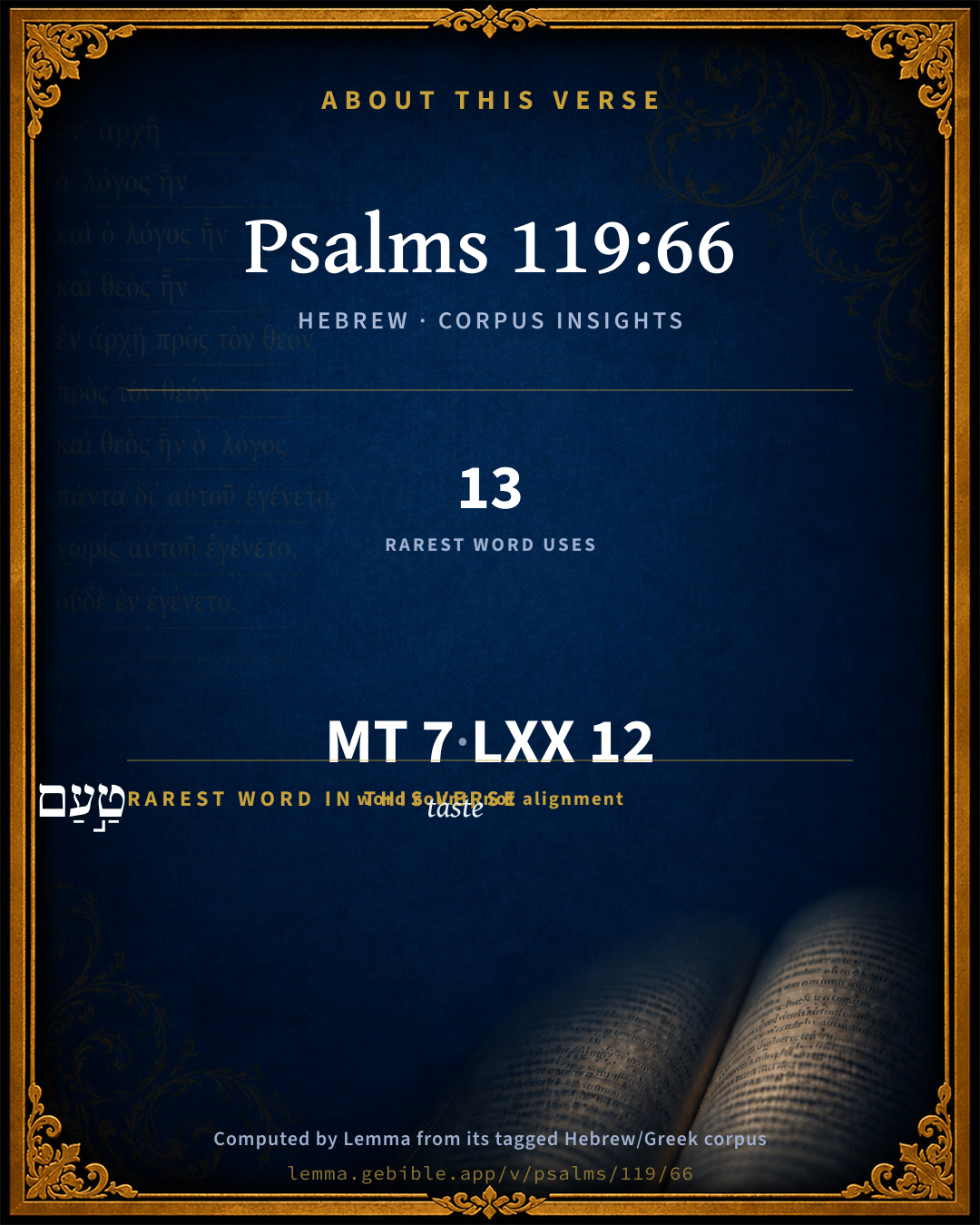
The rarest word here is טַ֣עַם taste H2940 — appearing just 13 times in the whole Hebrew Bible.

Shared distinctive vocabulary

טַ֣עַם taste H2940 occurs in 12 verses of the Hebrew Bible. Also found in:

Grammatical profile

  • 2 verbs
  • 4 nouns
  • 1 conjunction

Verb forms

  • לַמְּדֵ֑נִי Piel · Imperative
  • הֶאֱמָֽנְתִּי Hiphil · Perfect

Hebrew & Septuagint length

In English translation the verse runs 12 words from the Hebrew and 13 from the Septuagint (LXX English) — closely comparable.

A rough comparison of the two English renderings, which tokenize alike — not a word-level alignment.

Word counts can differ between the Hebrew and the Greek without any difference in meaning — e.g. the Hebrew direct-object marker אֵת has no separate Greek word, and Greek often adds the article ὁ.

In the original languages it is 7 Hebrew tokens and 12 Greek tokens — but the two are counted differently (Hebrew bundles its prefixes and suffixes into one token; the Greek is in lemma form), so that isn’t a like-for-like length.

Cross-references

15

Topical passages linked to Psalms 119:66 in the Treasury of Scripture Knowledge — connected by theme and wording, ordered by reader-vote popularity; previews shown in the World English Bible.

  • Philippians 1:9 This I pray, that your love may abound yet more and more in knowledge and all discernment;
  • Proverbs 2:1–9 My son, if you will receive my words, And store up my commandments within you;
  • 1 Kings 3:9 Give your servant therefore an understanding heart to judge your people, that I may discern between good and evil; for who is able to judge this your great people?
  • James 3:13–18 Who is wise and understanding among you? Let him show by his good conduct that his deeds are done in gentleness of wisdom.
  • Psalms 119:34 Give me understanding, and I will keep your law. Yes, I will obey it with my whole heart.
  • Psalms 119:128 Therefore I consider all of your precepts to be right. I hate every false way.
  • Psalms 119:160 All of your words are truth. Every one of your righteous ordinances endures forever.
  • Psalms 119:172 Let my tongue sing of your word, For all your commandments are righteousness.
  • Isaiah 11:2–4 The Spirit of Yahweh shall rest on him, the spirit of wisdom and understanding, the spirit of counsel and might, the spirit of knowledge and of the fear of Yahweh.
  • Matthew 13:11 He answered them, "To you it is given to know the mysteries of the Kingdom of Heaven, but it is not given to them.
  • Nehemiah 9:13–14 You came down also on Mount Sinai, and spoke with them from heaven, and gave them right ordinances and true laws, good statutes and commandments,
  • Psalms 72:1–2 God, give the king your justice; Your righteousness to the royal son.
  • Proverbs 8:20 I walk in the way of righteousness, In the midst of the paths of justice;
  • Judges 3:15 But when the children of Israel cried to Yahweh, Yahweh raised them up a savior, Ehud the son of Gera, the Benjamite, a man left-handed. The children of Israel sent tribute by him to Eglon the king of Moab.
  • 1 Kings 3:28 All Israel heard of the judgment which the king had judged; and they feared the king: for they saw that the wisdom of God was in him, to do justice.

Cross-references courtesy of OpenBible.info (CC BY 4.0).

Hebrew and Greek witnesses Masoretic Hebrew ↔ Greek Septuagint

The same verse in the two great witnesses to the Old Testament, shown verse-for-verse.

You’re reading Greek Psalm 118 (Hebrew Psalm 119). The Septuagint counts the superscription, so verse numbers can differ from the Hebrew — chapter-level alignment, not verse-by-verse. Numbering follows Rahlfs.

These are two independent witnesses, not word-aligned to each other, and the Septuagint is shown in lemma (dictionary) form.

Hebrew Psalms 119:66 Masoretic · Westminster Leningrad Codex

ט֤וּב טַ֣עַם וָדַ֣עַת לַמְּדֵ֑נִי כִּ֖י בְמִצְוֺתֶ֣יךָ הֶאֱמָֽנְתִּי

Teach me good judgment and knowledge, For I believe in your commandments.

World English Bible · Public Domain

Greek LXX Greek Psalm 118:66 Septuagint · lemma form

χρηστότης καί παιδεία καί γνῶσις διδάσκω ἐγώ ὅτι ὁ ἐντολή σύ πιστεύω

Teach me kindness, and instruction, and knowledge: for I have believed your commandments.

LXX2012 (modern English Septuagint) · Public Domain

Hebrew: Westminster Leningrad Codex (CC BY 4.0). Greek: Septuagint (public domain); English from LXX2012 (modern English Septuagint) (Public Domain). How the Septuagint differs from the Hebrew →

Commentary

Notes on Psalms 119:66 from classic Christian and Jewish commentators (each source and its license shown beneath its notes). The classic Christian expositions comment on the surrounding passage and are grouped to its opening verse, so a note may address several verses; the Jewish commentaries on the Tanakh (Rashi and others) are per-verse, so they appear only where the commentator wrote on this verse.

Lemma curates 59 commentaries, every one of them public domain or Creative Commons licensed, each selected and text-cleaned for this edition rather than reprinted as found. About our sources →

Trapp's Complete Commentary

John Trapp

Psa 119:66 Teach me good judgment and knowledge: for I have believed thy commandments.

Ver. 66. Teach me good judgment] Heb. good taste, for the soul also hath her senses; and as the mouth tasteth meat, so the ear trieth words; the mind relisheth religion.

For I have believed thy commandments] But would do yet more: 1Jn 5:13. "These things have I written unto you that believe on the name of the Son of God, that ye may know that ye have eternal life; and that ye may believe on the name of the Son of God."

John Trapp, A Commentary or Exposition upon All the Books of the Old and New Testament (1647–1656) — public domain. Text from a community e-Sword module.

The Biblical Illustrator

Joseph S. Exell

Psa_119:66

Teach me good judgment and knowledge: for l have believed Thy commandments.

Excellence of the law

I. What is implied in believing Gods commandments.

1. That we are persuaded of their reality and existence.

2. That we are convinced of their excellence and absolute perfection.

3. That we receive them as of perpetual and everlasting obligation.

4. A holy dread of their rigour and severity.

5. Prayer to God for strength to obey them.

II. The importance and necessity of such a faith.

1. Gods commands are a part of Divine revelation, and therefore the proper objects of faith. Being the word of God, they must be received as such.

2. A supposed faith in Gods promises, and not in His commands, will prove only a delusion.

3. Faith is necessary in order to acceptable obedience. (B. Beddome, M. A.)

The Biblical Illustrator, edited by Joseph S. Exell (c. 1880s–1900s) — public domain. Text from a community e-Sword module.

The Treasury of David

Charles H. Spurgeon

Ver. 66. Teach me good judgment and knowledge. Again he begs for teaching, as in verse 64, and again he uses God's mercy as an argument. Since God had dealt well with him, he is encouraged to pray for judgment to appreciate the Lord's goodness. Good judgment is the form of goodness which the godly man most needs and most desires, and it is one which the Lord is most ready to bestow. David felt that he had frequently failed in judgment in the matter of the Lord's dealings with him: from want of knowledge he had misjudged the chastening hand of the heavenly Father, and therefore he now asks to be better instructed, since he perceives the injustice which he had done to the Lord by his hasty conclusions. He means to say Lord, thou didst deal well with me when I thought thee hard and stern, be pleased to give me more wit, that I may not a second time think so ill of my Lord. A sight of our errors and a sense of our ignorance should make us teachable. We are not able to judge, for our knowledge is so sadly inaccurate and imperfect; if the Lord teaches us knowledge we shall attain to good judgment, but not otherwise. The Holy Ghost alone can fill us with light, and set the understanding upon a proper balance: let us ardently long for his teachings, since it is most desirable that we should be no longer mere children in knowledge and understanding.

For I have believed thy commandments. His heart was right, and therefore he hoped his head would be made right. He had faith, and therefore he hoped to receive wisdom. His mind had been settled in the conviction that the precepts of the word were from the Lord, and were therefore just, wise, kind, and profitable; he believed in holiness, and as that belief is no mean work of grace upon the soul, he looked for yet further operations of divine grace. He who believes the commands is the man to know and understand the doctrines and the promises. If in looking back upon our mistakes and ignorance we can yet see that we heartily loved the precepts of the divine will, we have good reason to hope that we are Christ's disciples, and that he will teach us and make us men of good judgment and sound knowledge. A man who has learned discernment by experience, and has thus become a man of sound judgment, is a valuable member of a church, and the means of much edification to others. Let all who would be greatly useful offer the prayer of this verse: "Teach me good judgment and knowledge."

Ver. 66. Teach me good judgment, etc. David, who discovered a holy taste (Ps 19:10 104:34 119:103) and recommended it to others (Ps 34:8), requests in our text to have it increased. For the word rendered "judgment", properly signifies taste, and denotes that relish for divine truth, and for the divine goodness and holiness, which is peculiar to true saints. I propose therefore to consider the nature and objects of that spiritual taste which is possessed by every gracious soul, and which all true saints desire to possess in a still greater degree.

The original word, which is often applied to those objects of sense which are distinguished by the palate, is here used in a metaphorical sense, as the corresponding term frequently is in our own language. "Doth not the car try words, and the mouth taste meat?" (Joh 12:11). Our translators in this place render it, "judgment, " which is nearly the same thing; yet as the terms are applied among us, there is a difference between them. Taste is that which enables a man to form a more compendious judgment. Judgment is slower in its operations than taste; it forms its decisions in a more circuitous way. So we apply the term taste to many objects of mental decision, to the beauty of a poem, to excellence of style, to elegance of dress or of deportment, to painting, to music, etc., in which a good taste will lead those who possess it, to decide speedily, and yet accurately, on the beauty, excellence, and propriety of the objects with which it has long been conversant without laborious examination.

Just so, true saints have a power of receiving pleasure from the beauty of holiness, which shines forth resplendently in the word of God, in the divine character, in the law, in the gospel, in the cross of Christ, in the example of Christ, and in the conduct of all his true followers, so far as they are conformed to his lovely image. I do not mean by this that they are influenced by a blind instinct, for which they can assign no sufficient reason: the genuine feelings of a true Christian can all of them be justified by the soundest reason: but those feelings which were first produced by renewing grace, are so strengthened by daily communion with God, and by frequent contemplation of spiritual things, that they acquire a delicacy and readiness of perception, which no one can possess who has never tasted how gracious the Lord is. You cannot touch, as it were, a certain string, but the renewed heart must needs answer to it. Whatever truly tends to exalt God, to bring the soul near to him, and to insure his being glorified and enjoyed, will naturally attract the notice, excite the affections, and influence the conduct of one who is born of God. "Sweeter also than honey, and the honeycomb." "My meditation of thee shall be sweet." "How sweet are thy words to my taste! sweeter than honey to my mouth." "O taste and see that the Lord is good." John Ryland, 1753-1825.

Ver. 66. Teach me good judgment and knowledge, etc. Literally it may be rendered thus, Teach me goodness, discernment and knowledge; for I have believed or confided in thy commandments. In our system of divine things, we might be inclined to place knowledge and discernment first, as begetting the "goodness." But it is a well ascertained fact, that the intellectual and moral powers are reciprocal that the moral also give strength to the intellectual. Moreover, it is only the spiritual man that discerns the things of God. The state of being spiritually minded, and also conversant with divine things, gives a rigour and breadth to the intellect itself, that remarkably appears in the lives of eminent men. And if you remark that some have been eminent who were devoid of spiritual qualities, the reply might be How much more eminent would they have been had they possessed these qualities. The petition is, "Teach me goodness, discernment, and knowledge." The principle of pleasing God may be within, and yet the mind may require to be enlightened in all duty; and again, though all duty be known, we may require spiritual discernment to see and feel it aright. John Stephen.

Ver. 66. Teach me good judgment. In a lecture of Sir John Lubbock's on the fertilization of flowers by the agency of insects, a striking distinction is noted in regard to this operation between beautiful and hideous plants. Bees, it would appear, delight in pleasant odours and bright colours, and invariably choose those plants which give pleasure to man. If we watch the course of these insects on their visit to a garden, we shall observe them settling upon the rose, the lavender, and all other similar agreeable flowers of brilliant hues or sweet scent. In marked contrast with this is the conduct of flies, which always show a preference for livid yellow or dingy red plants, and those which possess an unpleasant smell. The bee is a creature of fine and sensitive tastes. The fly is "a species of insectoid vulture, "naturally turning to such vegetable food as resembles carrion. Let two plates be placed on a lawn, at a little distance apart, the one containing that ill scented underground fungus, the Stink horn, and the other a handful of moss roses, and this difference will be immediately discerned. The foul odour and unsightly fungus will soon be covered with flies, while the bees will resort to the plate of roses. To this love of bees for fine colours and fragrant perfumes we are indebted for our choicest flowers. For by taking the pollen dust of some conspicuous flower to the stigma of another, they have by this union produced the seed of a still richer variety. Thus, age after age, many blossoms have been growing increasingly beautiful. On the other hand, strange to say, through a similar process, a progress in the opposite direction has taken place in those plants which are frequented by flies, and their unwholesome and repulsive qualities have become intensified.

So is it with the two great classes into which mankind may be divided the men of this world, and the men of the next. While the purified affections of the one centre continually on "whatsoever things are honest, whatsoever things are just, whatsoever things are pure, whatsoever things are lovely, whatsoever things are of good report, "so the earthward and vile affections of the other fasten on corruption. Not more surely does the laborious bee fly from one beautiful flower to another, than does the Christian seek of set purpose all that is fairest, sweetest, and best on earth. His prayer is that of David, in Ps 119:66, "Teach me good taste" (which is the literal translation); and "if there be any virtue, and if there be any Praise, "he thinks on these things. James Neil, in "Rays from the Realms of Nature", 1879.

Ver. 66. Good judgment and knowledge. No blessings are more suitable than "good judgment and knowledge" "knowledge" of ourselves, of our Saviour, of the way of obedience and "good judgment" to direct and apply this knowledge to some valuable end. These two parts of our intellectual furniture have a most important connexion and dependence upon each other. "Knowledge" is the speculative perception of general truth. "Judgment" is the practical application of it to the heart and conduct. Charles Bridges.

Ver. 66. For I have believed thy commandments. These words deserve a little consideration, because believing is here joined to an unusual object. Had it been, "for I have believed thy promises, "or, "obeyed thy commandments, "the sense of the clause had been more obvious to every vulgar apprehension. To believe commandments, sounds as harsh to a common ear, as to see with the ear, and hear with the eye; but, for all this, the commandments are the object; and of them he saith, not, "I have obeyed"; but, "I have believed."

To take off the seeming asperity of the phrase, some interpreters conceive that "commandments" is put for the word in general; and so promises are included, yea, they think, principally intended, especially those promises which encouraged him to look to God for necessary things, such as good judgment and knowledge are. But this interpretation would divert us from the weight and force of these significant words. Therefore let us note,

1. Certainly there is a faith in the commandments, as well as in the promises. We must believe that God is their author, and that they are the expressions of his commanding and legislative will, which we are bound to obey. Faith must discern the sovereignty and goodness of the law maker and believe that his commands are holy, just, and good; it must also teach us that God loves those who keep his law and is angry with those who transgress, and that he will see to it that His law is vindicated at the last great day.

2. Faith in the commandments is as necessary as faith in the promises; for, as the promises are not esteemed, embraced, and improved, unless they are believed to be of God, so neither are the precepts: they do not sway the conscience, nor incline the affections, except as they are believed to be divine.

3. Faith in the commands must be as lively as faith in the promises. As the promises are not believed with a lively faith, unless they draw off the heart from carnal vanities to seek that happiness which they offer to us; so the precepts are not believed rightly, unless we be fully resolved to acquiesce in them as the only rule to guide us in obtaining that happiness, and unless we are determined to adhere to them, and obey them. As the king's laws are not kept as soon as they are believed to be the king's laws, unless also, upon the consideration of his authority and power, we subject ourselves to them; so this believing notes a ready alacrity to hear God's voice and obey it, and to govern our hearts and actions according to his counsel and direction in the word. Thomas Manton.

Ver. 66. For I have believed thy commandments. The commandments of God are not alone; but they have promises of grace on the right hand, and threatenings of wrath on the left: upon both of these faith exercises itself, and without such faith no one will be able to render obedience to God's commands, Wolfgang Musculus.

Ver. 66.

1. Singular faith: "I have believed thy commandments."

2. Special petition based upon it: "Teach me."

Ver. 66. The value of a good judgment to sound knowledge.

1. It carefully discriminates between truth and error.

2. It puts each truth in its proper relation to other truths.

3. It holds every truth firmly, but has the greater care for the more important.

4. It rather avoids the curious and the speculative, but really loves the plain and useful.

5. Knowing that truths are rightly held only, when applied, it turns all to practical account.

6. Knowing also, that good food may, under some circumstances, become poisonous, it is careful in its selection and use of truths. J.F.

Psalms 119:67*

Charles H. Spurgeon's The Treasury of David (1869–1885) — public domain. Psalms only. Text from a community e-Sword/MySword module.

Joseph Benson's Commentary

TETH.

Psa 119:66. Teach me good judgment — Whereby I may rightly discern between truth and falsehood, good and evil; that so I may be kept from those errors in which many are involved, and may clearly understand what thy law requires or permits, and what it forbids. The Hebrew, שׂוב שׂעם, properly signifies goodness of taste, referring to the palate; and it is only figuratively and by way of analogy that it signifies goodness of judgment, or the good sense and discernment of the mind. And knowledge — A spiritual and experimental knowledge, added to that sense of, and relish for, divine things, implied in the former clause. For I have believed thy commandments — I have believed the divine authority of them, and the truth and certainty of those promises and threatenings wherewith thou hast enforced them.

Joseph Benson's Commentary on the Old and New Testaments (1811–1818) — public domain. Text from a community e-Sword module.

J. A. Alexander on Psalms

Joseph Addison Alexander

66. (Psa 119:66) Goodness of judgment and knowledge teach me, for in thy commandments I believe. The first word in Hebrew is not the adjective good, as in Psa 119:65, but the corresponding abstract noun meaning goodness, as in Psa 25:7; Psa 27:13; Psa 31:9. That it here denotes not moral but intellectual excellence, is determined by the addition of a word originally meaning taste, and then transferred to reason, judgment, understanding. See above, on Psa 34:1. Teach me good judgment, i.e. impart it by divine instruction. Judgment and knowledge may be here distinguished as in common parlance, the one denoting the faculty employed, the other the result of its exertion. The knowledge meant is that continually prayed for in this psalm; to wit, the knowledge of God's will. The connection of the clauses seems to be, that he has faith and would fain have knowledge; he takes God's precepts upon trust, but then prays that he may understand them. To believe in God's commandments is to believe that they are his, and therefore right and binding.

Joseph Addison Alexander, The Psalms Translated and Explained (1850) — public domain. Text from a community e-Sword module.

Adam Clarke's Commentary

Verse 66. Teach me good judgment and knowledge] טוב טעם ודעי למדני tob taam vedaath lammnedeni. Teach me (to have) a good taste and discernment. Let me see and know the importance of Divine things, and give me a relish for them.

Adam Clarke's Commentary on the Bible (1810–1826) — public domain. Text from a community e-Sword/MySword module.

John Calvin's Commentaries

66. Teach me goodness of taste and acknowledge After having confessed that he had found, by experience, the faithfulness of God to his promises, David here adds a request similar to what is contained in the 64th verse, namely, that he may grow in right understanding; although the phraseology is somewhat different; for instead of thy statutes, as in that verse, he here uses goodness of taste and knowledge. As the verb טעם taam, signifies to taste, the noun which is derived from it properly denotes taste It is, however, applied to the mind. David, there is no doubt, prays that knowledge, accompanied with sound discretion and judgment, might. be imparted to him. Those who read, disjunctively, goodness and taste, mar the whole sentence. It is, however, necessary, in order to our arriving at the full meaning, that the latter clause should be added. He asserts that he believed God’s commandments, in other words, that he cheerfully embraced whatever is prescribed in the law; and thus he describes himself as docile and obedient. As it was by the guidance of the Holy Spirit that he became thus inclined to obedience, he pleads that another gift may be bestowed upon him — the gift of a sound taste and good understanding. Whence we learn, that these two things, right affection and good understanding, are indispensably necessary to the due regulation of the life. The prophet already believed God’s commandments; but his veneration for the law, proceeding from a holly zeal, led him to desire conformity to it, and made him afraid, and not without cause, of inconsiderately going astray. Let us then learn, that after God has framed our hearts to the obedience of his law, we must, at the same time, ask wisdom from him by which to regulate our zeal.

John Calvin's Commentaries (1540-1563) — public domain. Text from the Calvin Translation Society English edition (1840s-50s) via the Christian Classics Ethereal Library (ccel.org). Calvin's coverage is partial (roughly two-thirds of the Bible); uncommented books and verses are honest gaps, never fabricated. The 19th-century editor's footnotes and remarks are omitted so the notes are faithfully Calvin's own voice.

Ellicott's Commentary for English Readers

TETH.

(66) Good judgment.—More exactly, good taste. Here, however, in a moral, not æsthetic sense. Perhaps tact or delicate moral perception represents it. We may compare St. Paul’s use of the Greek words, ἐπιγνώσις and αἰσθήσις in Php_1:9.

A Bible Commentary for English Readers, edited by Charles John Ellicott (1878–1897) — public domain. Text from a community e-Sword module.

The Cambridge Bible for Schools and Colleges

gen. ed. J. J. S. Perowne

66. good judgment] Lit. goodness of taste, the power to distinguish promptly and surely between right and wrong.

for I have believed in thy commandments] Prayer for further instruction is grounded on past loyalty to the known Will of God.

The Cambridge Bible for Schools and Colleges (gen. ed. J. J. S. Perowne; Cambridge University Press, 1878–1918) — public domain. Text from a community e-Sword module.

John Gill's Exposition

The proud have forged a lie against me,.... Or, "sewed a lie to him" (r); fastened a lie upon him, or sewed and added one lie to another. Either with respect to politics, as the proud and haughty courtiers of Saul, who represented David to him as a traitor, that had treasonable designs against him to take away his life, and seize his crown and kingdom, Sa1 24:9; or with respect to religion; so some proud scornful men, that derided him for his piety, and scoffed at his seriousness, gave out that it was all grimace and hypocrisy; raised calumnies upon him, and laid things to his charge he knew nothing of; and which were all lies, forged out of their own brains, and artfully and purposely put together to blacken his character, and lessen his esteem among men: and it is no unusual thing for wicked men to speak all manner of evil falsely against the people of God;

but I will keep thy precepts with my whole heart; observe the commands of God sincerely, heartily, and affectionately, and not in show and appearance only; and so make it evident that it was a lie that was forged against him; and this is the best way of answering such liars and defamers; see Pe1 3:16.

(r) "consuerunt", Tigurine version; "assuerunt", Muis.

John Gill's Exposition of the Whole Bible (1746–1763) — public domain (CC PDM 1.0). Text via the HelloAO Bible API.

Albert Barnes' Notes on the Bible

Teach me good judgment - The word here rendered “judgment” means, properly, “taste,” that power by which we determine the quality of things as sweet, bitter, sour, etc. Then it is applied to the mind or understanding, as that by which we determine the moral quality of things, or decide what is right or wrong; wise or foolish; good or evil. Here it means that he desired to have in full exercise the faculty of appreciating what is right, and of distinguishing it from what is wrong.

And knowledge - Knowledge of the truth; knowledge of thy will; knowledge of duty.

For I have believed thy commandments - I have confided in thy commandments. He believed that such a keeping of the law of God would be connected with a correct view of things. The keeping of the commands of God is one of the best means of growing in true knowledge, and of cultivating the understanding; of promoting a just taste or perception of what is true, and of developing the powers of the soul in the best proportions. Compare Joh 7:17.

Albert Barnes' Notes on the Bible (1834–1885) — public domain. Text from a community e-Sword/MySword module.

Matthew Poole's English Annotations

Good judgment; whereby I may rightly discern between truth and falsehood, good and evil, between the mind of God and my own or others’ inventions; that so I may be kept from those mistakes and errors in which many are involved, that I may truly judge what thy law requires or permits, and what it forbids. Heb. the goodness of taste, an experimental sense and relish of divine things. Compare Psa 34:8.

Knowledge; a spiritual and experimental knowledge. And judgment, or taste, and knowledge may, by a usual figure called hendiadis, be put for judicious, or solid, or practical knowledge.

I have believed thy commandments; I have believed the Divine authority of them, and the truth and certainty of those promises and threatenings which thou hast annexed to them.

Matthew Poole's English Annotations on the Holy Bible (1683–1685) — public domain. Text from a community e-Sword/MySword module.

The Pulpit Commentary

Teach me good judgment and knowledge; i.e. give me sound judgment and wisdom, to discern right from wrong. For I have believed thy commandments. I have looked to them, and trusted in them as my guides in the way of righteousness (comp. ver. 105).

The Pulpit Commentary (1880–1919), ed. H.D.M. Spence-Jones & Joseph S. Exell — public domain. Text from a community e-Sword module.

John Wesley's Explanatory Notes

Judgment - Whereby I may rightly discern between truth and falsehood. Knowledge - A spiritual experimental knowledge.

John Wesley, Explanatory Notes Upon the Whole Bible (1754–1765) — public domain. Text via the GEBible commentary corpus.

Lesson kit

Teaching starters — assembled from the data on this page, not authored interpretation. Every prompt links to the verse data it draws on. Edit before teaching.

Psalms, in the Wisdom, opens this verse with 7 words (7 distinct Hebrew lemmas). Its most distinctive word is ṭaʻam (“taste”). A historical commentator’s framing appears above. Read the whole chapter for the surrounding context.

Discussion questions

  1. How does “taste” (ṭaʻam) shape what this verse is saying?
  2. How does Exodus 16:31, which shares the word «taste», read alongside this verse?
  3. These translations render this verse differently; the difference is in the English rendering, not the original. What questions does that raise?
  4. «לַמְּדֵ֑נִי» is a Piel Imperative verb. How does that grammatical form shape the action described?
  5. Compare how Trapp's Complete Commentary and The Biblical Illustrator read this verse. Where do they agree or differ?

Things to notice

Reading settings

Reading text

Shown beneath each verse's original-language words.

Old Testament
Old Testament edition

Read the OT as the Masoretic Hebrew (MT) or the Greek Septuagint (LXX).

English shown for the Greek Septuagint (in the Hebrew ↔ Greek comparison).

Comparing translations? Open the Compare panel on any verse page to stack up to four side by side.