Leviticus 26:15

Hebrew (Westminster Leningrad Codex) Leviticus 26:15 appears in the Hebrew Old Testament. The text above is from the Westminster Leningrad Codex. Each word links to its Strong’s number, a concise gloss, and parsing drawn from the Open Scriptures Hebrew Bible morphology. Click any word for its full Brown-Driver-Briggs (BDB) entry.
Download image
Cite this verse

Leviticus 26:15 (World English Bible). Public Domain. Lemma interlinear Bible study tool, https://lemma.gebible.app/v/leviticus/26/15.

Show BibTeX & RIS
BibTeX
RIS
English Translation
and if you shall reject my statutes, and if your soul abhors my ordinances, so that you will not do all my commandments, but break my covenant;
World English Bible · Public Domain
Highlights
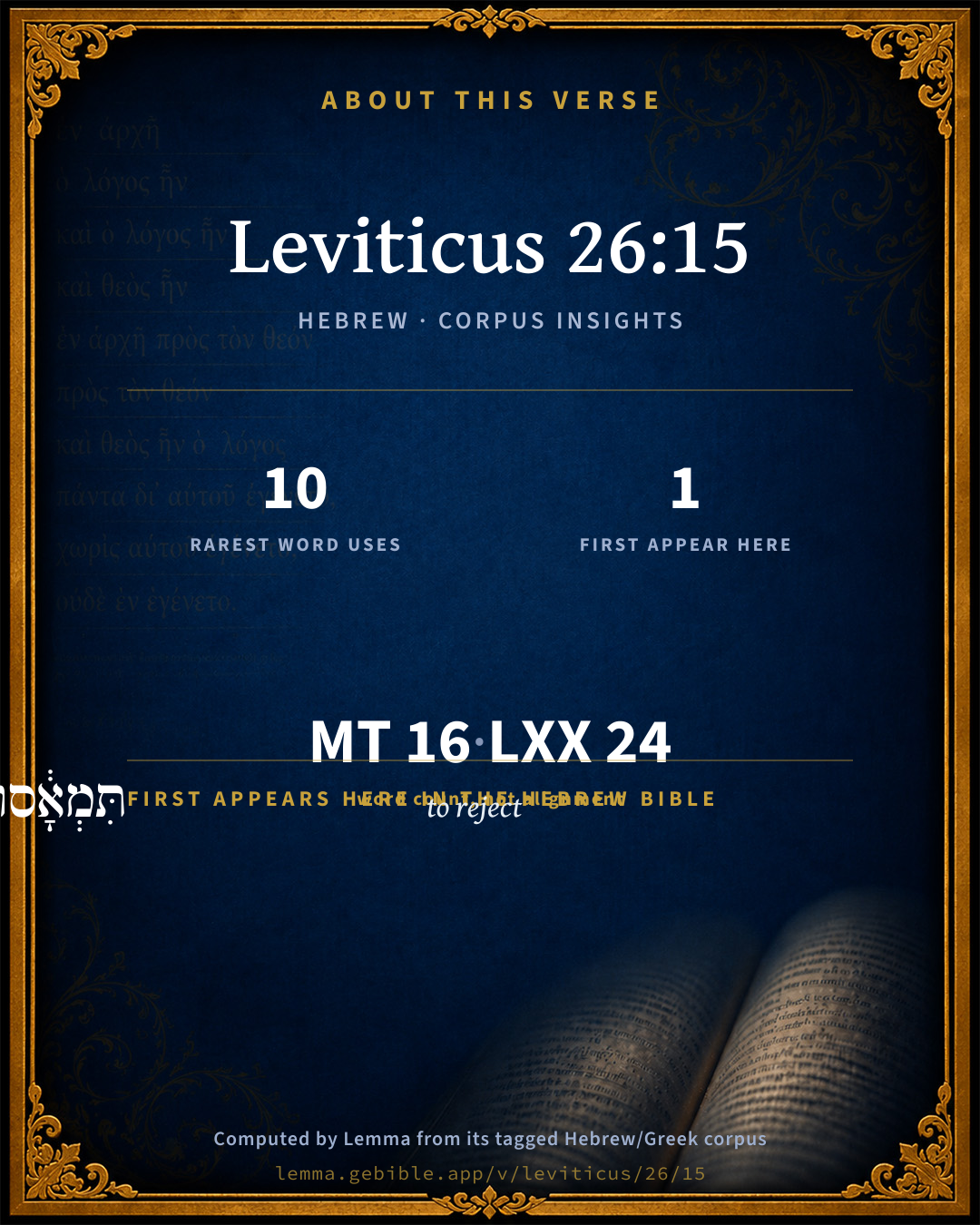
  • 1 first appearance in the Hebrew Bible
Full analysis ↓
Download a study sheet

One document with this verse’s original text, its word-by-word gloss line, the meaning frame, cross-references with their text, attributed commentary, and full source and license credits — printable, and it pastes into notes with its structure intact.

This verse Autodidact and up

Study sheet (.html) Plain text (.txt)

A passage Seminary Student

Up to 50 verses in one chapter. A passage sheet keeps up to 6 commentary sources and 12 cross-references per verse, in the order this page ranks them, and says so on the sheet whenever that leaves anything out. Ask for a single verse and you get the Autodidact verse sheet above.

Everything on this page stays free to read, with no account — the sheet is a download of what is already on screen, not access to it.

Want to remove ads? Support Godless Engineer
Compare translations 3

The same verse in 3 English versions, stacked beneath the original-language interlinear above. Click any original word for its lexicon entry.

Each is an independent rendering of the whole verse — the interlinear is not word-aligned to these translations.

Highlighted words mark where these versions differ — a whole-verse word diff, not a word-by-word alignment.

  • World English Bible Public Domain
    and if you shall reject my statutes, and if your soul abhors my ordinances, so that you will not do all my commandments, but break my covenant;
  • King James Version Public Domain
    And if ye shall despise my statutes, or if your soul abhor my judgments, so that ye will not do all my commandments, but that ye break my covenant:
  • unfoldingWord Literal Text CC BY-SA 4.0
    and if you reject my statutes, and if your soul detests my judgments so as not to do all my commandments, you break my covenant,

unfoldingWord Literal Text — © unfoldingWord, licensed CC BY-SA 4.0. Word-aligned USFM3 via Door43 (git.door43.org/unfoldingWord/en_ult).

Versions to compare (up to 4)

3 of 4 selected

Show all 18 translations

Every available English version of this verse, each an independent rendering of the whole verse.

  • World English Bible Public Domain
    and if you shall reject my statutes, and if your soul abhors my ordinances, so that you will not do all my commandments, but break my covenant;
  • Berean Standard Bible Public Domain
    and if you reject My statutes, despise My ordinances, and neglect to carry out all My commandments, and so break My covenant,
  • Majority Standard Bible Public Domain
    and if you reject My statutes, despise My ordinances, and neglect to carry out all My commandments, and so break My covenant,
  • King James Version Public Domain
    And if ye shall despise my statutes, or if your soul abhor my judgments, so that ye will not do all my commandments, but that ye break my covenant:
  • American Standard Version (1901) Public Domain
    and if ye shall reject my statutes, and if your soul abhor mine ordinances, so that ye will not do all my commandments, but break my covenant;
  • Revised Version (1885) Public Domain
    and if ye shall reject my statutes, and if your soul abhor my judgments, so that ye will not do all my commandments, but break my covenant;
  • Geneva Bible (1599) Public Domain
    And if ye shall despise mine ordinances, either if your soule abhorre my lawes, so that yee will not do all my commandements, but breake my couenant,
  • Douay-Rheims (1899) Public Domain
    If you despise my laws, and contemn my judgments so as not to do those things which are appointed by me, and to make void my covenant:
  • Young's Literal Translation Public Domain
    and if at My statutes ye kick, and if My judgments your soul loathe, so as not to do all My commands -- to your breaking My covenant --
  • Literal Standard Version CC BY-SA 4.0
    and if you kick at My statutes, and if your soul loathes My judgments, so as not to do all My commands—to your breaking My covenant—
  • Unlocked Literal Bible CC BY-SA 4.0
    and if you reject my decrees and detest my laws, so that you will not obey all my commandments, but break my covenant—
  • unfoldingWord Literal Text CC BY-SA 4.0
    and if you reject my statutes, and if your soul detests my judgments so as not to do all my commandments, you break my covenant,
  • Darby Bible Public Domain
    and if ye shall despise my statutes, and if your soul shall abhor mine ordinances, so that ye do not all my commandments, that ye break my covenant,
  • World Messianic Bible Public Domain
    and if you shall reject my statutes, and if your soul abhors my ordinances, so that you will not do all my commandments, but break my covenant,
  • Webster's Bible Public Domain
    And if ye shall despise my statutes, or if your soul shall abhor my judgments, so that ye will not do all my commandments, but that ye break my covenant:
  • Free Bible Version CC BY-SA 4.0
    if you reject my laws, hate my regulations, and refuse to follow my commandments, and consequently break my agreement,
  • Bible in Basic English Public Domain
    And if you go against my rules and if you have hate in your souls for my decisions and you do not do all my orders, but go against my agreement;
  • JPS Tanakh (1917) Public Domain
    and if ye shall reject My statutes, and if your soul abhor Mine ordinances, so that ye will not do all My commandments, but break My covenant;

Literal Standard Version (2020), Covenant Press — licensed CC BY-SA 4.0. Text via the HelloAO Bible API (eBible.org). Unlocked Literal Bible (unfoldingWord) — licensed CC BY-SA 4.0. Text via the HelloAO Bible API (eBible.org). unfoldingWord Literal Text — © unfoldingWord, licensed CC BY-SA 4.0. Word-aligned USFM3 via Door43 (git.door43.org/unfoldingWord/en_ult). Free Bible Version, Dr. Jonathan Gallagher — licensed CC BY-SA 4.0. Text via the HelloAO Bible API (eBible.org).

Word by word

More ways to search: Search by grammar → Find every occurrence → Compare this word →

Practice this passage: Drill this verse → Learn its vocabulary →

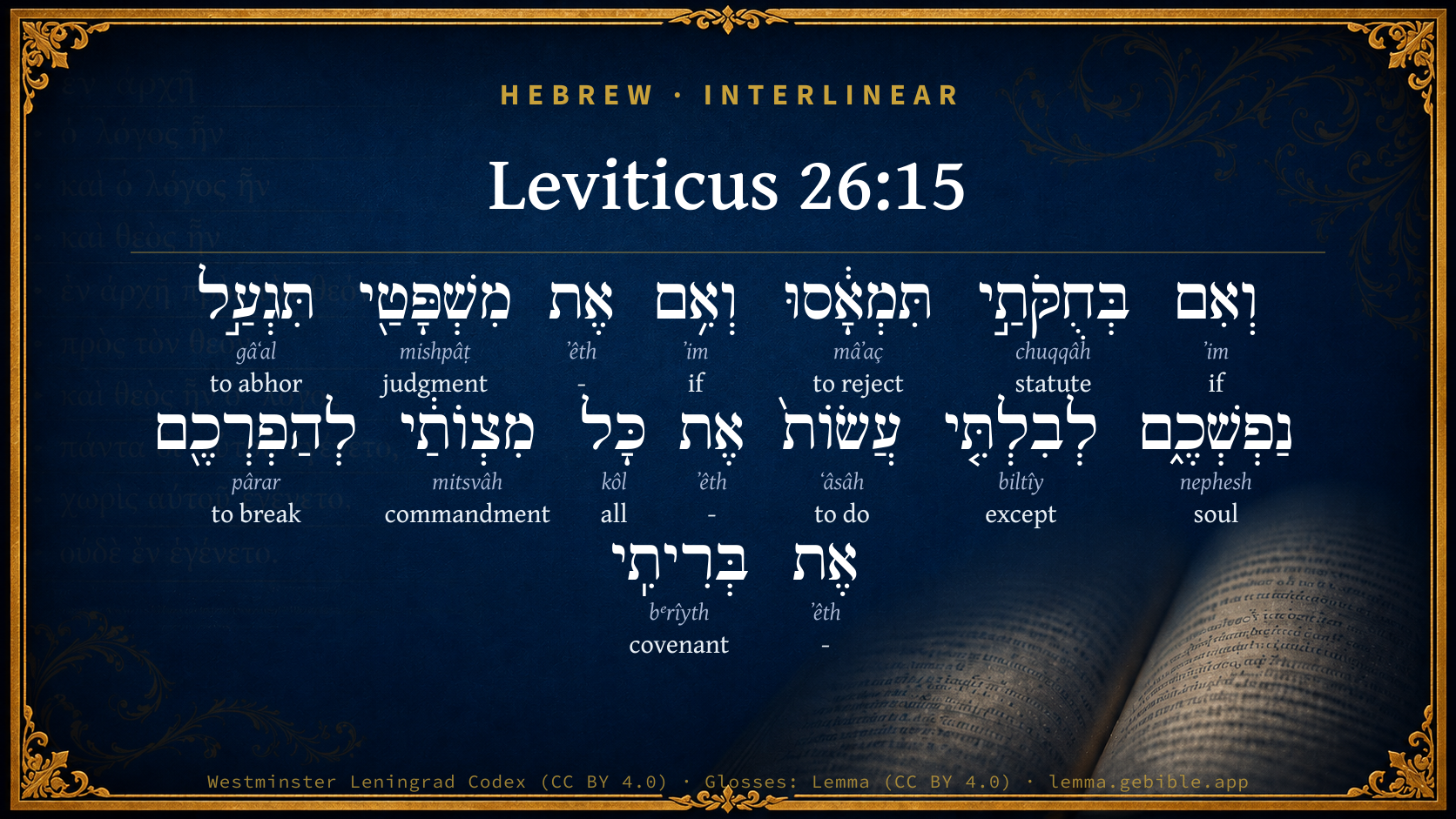
תִּגְעַ֣ל
gâʻal
H1602
“to abhor”
Verb, Qal, Imperfect, 3rd Person, Feminine, Singular
Part of Speech
Verb
Stem
Qal
Form
Imperfect
Person
3rd Person
Gender
Feminine
Number
Singular
Full BDB Definition

Origin: a primitive root

TWOT: 369

to abhor, loathe, be vilely cast away, fall - (Qal) to abhor, loathe - (Niphal) to be defiled - (Hiphil) to reject as loathsome, show aversion
  1. וְאִם ʼim H518 “and · if” Conjunction + Conjunction
  2. בְּחֻקֹּתַ֣י chuqqâh H2708 “in/at · statutes · my” Preposition + Noun, Common, Both, Plural, Construct + Suffix, Personal, 1st Person, Common, Singular
  3. תִּמְאָ֔סוּ mâʼaç H3988 “to reject” Verb, Qal, Imperfect, 2nd Person, Masculine, Plural
  4. וְאִ֥ם ʼim H518 “and · if” Conjunction + Conjunction
  5. אֶת ʼêth H853 “-” Particle, Direct Object
  6. מִשְׁפָּטַ֖י mishpâṭ H4941 “judgments · my” Noun, Common, Masculine, Plural, Construct + Suffix, Personal, 1st Person, Common, Singular
  7. נַפְשְׁכֶ֑ם nephesh H5315 “soul · your” Noun, Common, Both, Singular, Construct + Suffix, Personal, 2nd Person, Masculine, Plural
  8. לְבִלְתִּ֤י biltîy H1115 “to/for · except” Preposition + Conjunction
  9. עֲשׂוֹת֙ ʻâsâh H6213 “to do” Verb, Qal, Infinitive Construct
  10. אֶת ʼêth H853 “-” Particle, Direct Object
  11. כָּל kôl H3605 “all of” Noun, Common, Masculine, Singular, Construct
  12. מִצְוֺתַ֔י mitsvâh H4687 “commandments · my” Noun, Common, Feminine, Plural, Construct + Suffix, Personal, 1st Person, Common, Singular
  13. לְהַפְרְכֶ֖ם pârar H6565 “to break · you” Preposition + Verb, Hiphil, Infinitive Construct + Suffix, Personal, 2nd Person, Masculine, Plural
  14. אֶת ʼêth H853 “-” Particle, Direct Object
  15. בְּרִיתִֽי bᵉrîyth H1285 “covenant · my” Noun, Common, Feminine, Singular, Construct + Suffix, Personal, 1st Person, Common, Singular

About this verse

These counts appear in no published source. They are computed here, from the morphology-tagged text and Lemma’s own curated glosses. What Lemma adds →

16
words
13
distinct lemmas
Pentateuch
section

Notable vocabulary

The rarest word here is תִּגְעַ֣ל to abhor H1602 — appearing just 10 times in the whole Hebrew Bible.

First appearance in Scripture

This word makes its first canonical appearance in the Hebrew Bible here:

  • תִּמְאָ֔סוּ to reject H3988

Shared distinctive vocabulary

תִּגְעַ֣ל to abhor H1602 occurs in 9 verses of the Hebrew Bible. Also found in:

Grammatical profile

  • 4 verbs
  • 6 nouns
  • 3 conjunctions
  • 3 particles

Verb forms

  • תִּמְאָ֔סוּ Qal · Imperfect
  • תִּגְעַ֣ל Qal · Imperfect
  • עֲשׂוֹת֙ Qal · Infinitive Construct
  • לְהַפְרְכֶ֖ם Hiphil · Infinitive Construct

Repetition

A word recurs within this verse — often emphatic in Hebrew:

  • וְאִם if H518 ×2

Hebrew & Septuagint length

In English translation the verse runs 27 words from the Hebrew and 25 from the Septuagint (LXX English) — closely comparable.

A rough comparison of the two English renderings, which tokenize alike — not a word-level alignment.

Word counts can differ between the Hebrew and the Greek without any difference in meaning — e.g. the Hebrew direct-object marker אֵת has no separate Greek word, and Greek often adds the article ὁ.

In the original languages it is 16 Hebrew tokens and 24 Greek tokens — but the two are counted differently (Hebrew bundles its prefixes and suffixes into one token; the Greek is in lemma form), so that isn’t a like-for-like length.

Cross-references

23

Topical passages linked to Leviticus 26:15 in the Treasury of Scripture Knowledge — connected by theme and wording, ordered by reader-vote popularity; previews shown in the World English Bible.

  • Deuteronomy 31:16 Yahweh said to Moses, Behold, you shall sleep with your fathers; and this people will rise up, and play the prostitute after the strange gods of the land, where they go to be among them, and will forsake me, and break my covenant which I have made with them.
  • 2 Kings 17:15 They rejected his statutes, and his covenant that he made with their fathers, and his testimonies which he testified to them; and they followed vanity, and became vain, and [went] after the nations that were round about them, concerning whom Yahweh had charged those who they should not do like them.
  • Numbers 15:31 Because he has despised the word of Yahweh, and has broken his commandment, that soul shall utterly be cut off; his iniquity shall be on him.
  • Isaiah 24:5 The earth also is polluted under the inhabitants of it; because they have transgressed the laws, violated the statutes, broken the everlasting covenant.
  • Jeremiah 11:10 They are turned back to the iniquities of their forefathers, who refused to hear my words; and they are gone after other gods to serve them: the house of Israel and the house of Judah have broken my covenant which I made with their fathers.
  • Ezekiel 16:59 For thus says the Lord Yahweh: I will also deal with you as you have done, who have despised the oath in breaking the covenant.
  • Zechariah 7:11–13 But they refused to listen, and turned their backs, and stopped their ears, that they might not hear.
  • Genesis 17:14 The uncircumcised male who is not circumcised in the flesh of his foreskin, that soul shall be cut off from his people. He has broken my covenant."
  • Exodus 19:5 Now therefore, if you will indeed obey my voice, and keep my covenant, then you shall be my own possession from among all peoples; for all the earth is mine;
  • Exodus 24:7 He took the book of the covenant and read it in the hearing of the people, and they said, "All that Yahweh has spoken will we do, and be obedient."
  • Leviticus 26:43 The land also will be left by them, and will enjoy its sabbaths while it lies desolate without them: and they will accept the punishment of their iniquity; because, even because they rejected my ordinances, and their soul abhorred my statutes.
  • 2 Samuel 12:9–10 Why have you despised the word of Yahweh, to do that which is evil in his sight? You have struck Uriah the Hittite with the sword, and have taken his wife to be your wife, and have slain him with the sword of the children of Ammon.
  • 2 Chronicles 36:16 but they mocked the messengers of God, and despised his words, and scoffed at his prophets, until the wrath of Yahweh arose against his people, until there was no remedy.
  • Psalms 50:17 Seeing you hate instruction, And throw my words behind you?
  • Proverbs 1:7 The fear of Yahweh is the beginning of knowledge; But the foolish despise wisdom and instruction.
  • Proverbs 1:30 They wanted none of my counsel. They despised all my reproof.
  • Proverbs 5:12 And say, "How I have hated instruction, And my heart despised reproof;
  • Jeremiah 6:19 Hear, earth: behold, I will bring evil on this people, even the fruit of their thoughts, because they have not listened to my words; and as for my law, they have rejected it.
  • Jeremiah 31:32 not according to the covenant that I made with their fathers in the day that I took them by the hand to bring them out of the land of Egypt; which my covenant they broke, although I was a husband to them, says Yahweh.
  • Acts 13:41 'Behold, you scoffers, and wonder, and perish; For I work a work in your days, A work which you will in no way believe, if one declares it to you.'"
  • Romans 8:7 because the mind of the flesh is hostile towards God; for it is not subject to God's law, neither indeed can it be.
  • 1 Thessalonians 4:8 Therefore he who rejects doesn't reject man, but God, who has also given his Holy Spirit to you.
  • Hebrews 8:9 Not according to the covenant that I made with their fathers, In the day that I took them by the hand to lead them out of the land of Egypt; For they didn't continue in my covenant, And I disregarded them," says the Lord.

Cross-references courtesy of OpenBible.info (CC BY 4.0).

Hebrew and Greek witnesses Masoretic Hebrew ↔ Greek Septuagint

The same verse in the two great witnesses to the Old Testament, shown verse-for-verse.

These are two independent witnesses, not word-aligned to each other, and the Septuagint is shown in lemma (dictionary) form.

Hebrew Leviticus 26:15 Masoretic · Westminster Leningrad Codex

וְאִם בְּחֻקֹּתַ֣י תִּמְאָ֔סוּ וְאִ֥ם אֶת מִשְׁפָּטַ֖י תִּגְעַ֣ל נַפְשְׁכֶ֑ם לְבִלְתִּ֤י עֲשׂוֹת֙ אֶת כָּל מִצְוֺתַ֔י לְהַפְרְכֶ֖ם אֶת בְּרִיתִֽי

and if you shall reject my statutes, and if your soul abhors my ordinances, so that you will not do all my commandments, but break my covenant;

World English Bible · Public Domain

Greek LXX Leviticus 26:15 Septuagint · lemma form

ἀλλά ἀπειθέω αὐτός καί ὁ κρίμα ἐγώ προςὀχθίζω ὁ ψυχή σύ ὥστε σύ μή ποιέω πᾶς ὁ ἐντολή ἐγώ ὥστε διασκεδάζω ὁ διαθήκη ἐγώ

but disobey them, and your soul should loathe my judgments, so that you⌃ should not keep all my commands, so as to break my covenant,

LXX2012 (modern English Septuagint) · Public Domain

On this verse, John Gill's Exposition discusses the Septuagint’s reading. Read the note in Commentary ↓

Hebrew: Westminster Leningrad Codex (CC BY 4.0). Greek: Septuagint (public domain); English from LXX2012 (modern English Septuagint) (Public Domain). How the Septuagint differs from the Hebrew →

Targum (Aramaic paraphrase)

2

The Targum is the ancient Jewish Aramaic paraphrase of the Hebrew Scriptures — an interpretive translation, not the Hebrew text itself. Onkelos (literal) and Pseudo-Jonathan (expansive) render the Torah, and Jonathan the Prophets. Coverage is partial: where no permissively-licensed English translation exists for a verse, only the Aramaic is shown. This is verse-level text, not a word-by-word alignment to the Hebrew.

  1. Targum Onkelos Torah (Genesis–Deuteronomy)
    וְאִם בִּקְיָמַי תְּקוֹצוּן וְאִם יָת דִינַי תְּרַחֵק נַפְשְׁכוֹן בְּדִיל דְלָא לְמֶעְבַּד יָת כָּל פִּקוֹדַי לְאַשְׁנָיוּתְכוֹן יָת קְיָמִי

    (no public-domain English translation for this verse)

    Targum Onkelos — Aramaic: “Onkelos Genesis” (public domain); “Onkelos Exodus” (public domain); “Onkelos Leviticus” (public domain); “Onkelos Numbers” (public domain); “Onkelos Deuteronomy” (public domain). English: “Sefaria Community Translation” (CC0 1.0 (public-domain dedication)); “J.W. Etheridge. The Targums of Onkelos and Jonathan Ben Uzziel on the Pentateuch. London: Longmans, Green, 1862” (public domain). Text via Sefaria.

  2. Targum Pseudo-Jonathan Torah (Genesis–Deuteronomy)
    וְאִין בִּקְיָמֵי אוֹרַיְיתִי תְקוּצוּן וְאִין יַת סִדְרֵי דִינֵי תַּרְחִיק נַפְשָׁתֵיכוֹן בְּדִיל דְלָא לְמֶעְבַּד יַת כָּל פִּקוּדַי וְסוֹפְכוֹן לִמְבַטְלָא יַת קְיָימַי

    and if you despise My statutes, and hate in your soul the orders of My judgments, to do not all My precepts, but your purpose be to abolish My covenant;

    Targum Pseudo-Jonathan — Aramaic: “Targum Jonathan on Genesis” (public domain); “Targum Jonathan on Exodus” (public domain); “Targum Jonathan on Leviticus” (public domain); “Targum Jonathan on Numbers” (public domain); “Targum Jonathan on Deuteronomy” (public domain). English: “The Targum of Jonathan ben Uzziel, trans. J. W. Etheridge, London, 1862” (public domain). Text via Sefaria.

Commentary

Notes on Leviticus 26:15 from classic Christian and Jewish commentators (each source and its license shown beneath its notes). The classic Christian expositions comment on the surrounding passage and are grouped to its opening verse, so a note may address several verses; the Jewish commentaries on the Tanakh (Rashi and others) are per-verse, so they appear only where the commentator wrote on this verse.

Lemma curates 59 commentaries, every one of them public domain or Creative Commons licensed, each selected and text-cleaned for this edition rather than reprinted as found. About our sources →

Trapp's Complete Commentary

John Trapp

Lev 26:15 And if ye shall despise my statutes, or if your soul abhor my judgments, so that ye will not do all my commandments, [but] that ye break my covenant:

Ver. 15. Or if your soul abhor my judgments.] As, so it may prove; such is the vile canker of your corrupt natures.

John Trapp, A Commentary or Exposition upon All the Books of the Old and New Testament (1647–1656) — public domain. Text from a community e-Sword module.

Joseph Benson's Commentary

Lev 26:15. Break my covenant — That is, your part of the covenant made between me and you, and thereby discharge me from giving you the blessings promised on my part.

Joseph Benson's Commentary on the Old and New Testaments (1811–1818) — public domain. Text from a community e-Sword module.

Geneva Bible (1599)

Geneva Bible translators

Which I made with you in choosing you to be my people.

Geneva Bible (1599) marginal notes — public domain. Text via Bolls.life.

Adam Clarke's Commentary

Verse 15. If ye shall despise my statutes - abhor my judgments] As these words, and others of a similar import, which point out different properties of the revelation of God, are frequently occurring, I Judge it best to take a general view of them, once for all, in this place, and show how they differ among themselves, and what property of the Divine law each points out.

1. STATUTES. חקת chukkoth, from חק chak, to mark out, define, c. This term seems to signify the things which God has defined, marked, and traced out, that men might have a perfect copy of pure conduct always before their eyes, to teach them how they might walk so as to please him in all things, which they could not do without such instruction as God gives in his word, and the help which he affords by his Spirit.

2. JUDGMENTS. שפטים shephatim, from שפט shaphat, to distinguish, regulate, and determine meaning those things which God has determined that men shall pursue, by which their whole conduct shall be regulated, making the proper distinction between virtue and vice, good and evil, right and wrong, justice and injustice; in a word, between what is proper to be done, and what is proper to be left undone.

3. COMMANDMENTS. מצות mitsvoth, from צוה tsavah, to command, ordain, and appoint, as a legislator. This term is properly applied to those parts of the law which contain the obligation the people are under to act according to the statutes, judgments, c., already established, and which prohibit them by penal sanctions from acting contrary to the laws.

4. COVENANT. ברית berith, from בר bar, to clear, cleanse, or purify because the covenant, the whole system of revelation given to the Jews, was intended to separate them from all the people of the earth, and to make them holy. Berith also signifies the covenant-sacrifice, which prefigured the atonement made by Christ for the sin of the world, by which he purifies believers unto himself, and makes them a peculiar people, zealous of good works. Besides those four, we may add the following, from other places of Scripture.

5. TESTIMONIES. עדות edoth, from עד ad, beyond, farther, besides; because the whole ritual law referred to something farther on or beyond the Jewish dispensation, even to that sacrifice which in the fulness of time was to be offered for the sins of men. Thus all the sacrifices, c., of the Mosaic law referred to Christ, and bore testimony to him who was to come.

6. ORDINANCES. משמרות mishmaroth, from שמר shamar, to guard, keep safe, watch over those parts of Divine revelation which exhorted men to watch their ways, keep their hearts, and promised them, in consequence, the continual protection and blessing of God their Maker.

7. PRECEPTS. פקודים pikkudim, from פקד pakad, to overlook, take care or notice of, to visit; a very expressive character of the Divine testimonies, the overseers of a man's conduct, those who stand by and look on to see whether he acts according to the commands of his Master; also the visiters, because God's precepts are suited to all the circumstances of human life; some are applicable in adversity, others in prosperity; some in times of temptation and sadness, others in seasons of spiritual joy and exultation, c., c. Thus they may be said to overlook and visit man in all times, places, and circumstances.

8. TRUTH. אמת emeth, from אם am, to support, sustain, confirm because God is immutable who has promised, threatened, commanded, and therefore all his promises, threatenings, commandments, c., are unalterable and eternal. Error and falsity promise to direct and sustain, but they fail. God's word is supported by his own faithfulness, and it supports and confirms them who conscientiously believe it.

9. RIGHTEOUSNESS. צדקה tsedakah, from צדק which, though not used as a verb in the Hebrew Bible, seems to convey, from its use as a noun, the idea of giving just weight or good measure, see Le 19:36. This is one of the characters which is attributed to the revelation God makes of himself (see Ps 119:137-144) and by this the impartiality of the Divine testimonies is pointed out. God gives to all their due, and his word distributes to every man according to his state, circumstances, talents, graces, c. to none too much, to none too little, to all enough.

10. WORD of JEHOVAH. דבר יהוה debar Yehovah, from דבר, dabar, to drive, lead, bring forward, hence to bring forward, or utter one's sentiments; so the word of God is what God has brought forth to man from his own mind and counsel; it is a perfect similitude of his own righteousness, holiness, goodness, and truth. This Divine law is sometimes expressed by: -

11. אמרה imrah, speech or word, variously modified from אמר amar, to branch out, because of the interesting details into which the word of God enters in order to instruct man and make him wise unto salvation, or, as the apostle expresses it, "God, who at sundry times, and in divers manners, spake unto the fathers by the prophets," πολυμερως και πολυτροπως, in many distinct parcels, and by various tropes or figures; a curious and elegant description of Divine revelation; Heb 1:1.

12. All these collectively are termed the LAW תורה torah, or תורת יהוה torath Yehovah, the law of the Lord, from ירה yarah, to direct, set straight and true, as stones in a building, to teach and instruct, because this whole system of Divine revelation is calculated to direct men to the attainment of present and eternal felicity, to set them right in their notions concerning the supreme God, to order and adjust them in the several departments of civil and religious society, and thus to teach and instruct them in the knowledge of themselves, and in the true knowledge of God. Thus those who receive the truth become the city of the living God - the temple of the Most High, built together for a habitation of God through the Spirit. To complete this description of the word law, See Clarke on Ex 12:49, where other properties of the law of God are specified.

Adam Clarke's Commentary on the Bible (1810–1826) — public domain. Text from a community e-Sword/MySword module.

Ellicott's Commentary for English Readers

(15) And if ye shall despise my statutes.—From passive indifference to the Divine statutes mentioned in the preceding verse, their falling away is sure to follow. Hence what was at first mere listlessness now develops itself into a contemptuous education of God’s ordinances.

Or if your soul abhor my judgments.—Better, and if your soul, &c, as the picture of their Apostasy goes on developing itself.

But that ye break my covenant.—Better, that ye break, &c, without the “but,” which is not in the original, and obscures the sense of the passage, since it is the fact of their abhorrence of God’s law which breaks the Divine covenant with them. (See Gen_17:14.) The sense is more correctly given by rendering this clause “Thus breaking my covenant,” or “Thereby breaking my covenant.”

A Bible Commentary for English Readers, edited by Charles John Ellicott (1878–1897) — public domain. Text from a community e-Sword module.

John Gill's Exposition

I also will do this unto you,.... Henceforward follow threatenings of dreadful evils to the transgressors and despisers of the commandments of God, which thus begin:

I will even appoint over you terror, consumption, and the burning ague, that shall consume the eyes, and cause sorrow of heart; some, as Aben Ezra observes, take these to design what may affect the seed sown and the increase of it, such as blasting and mildew, because it follows: "ye shall sow in vain"; but no doubt diseases of the body are intended; for what we translate "terror" does not signify terror of mind, but some sudden, hasty, terrible distemper; perhaps the pestilence, as the Targum of Jonathan; some have thought of the falling sickness, as Bishop Patrick, because the word has the signification of haste and precipitance; and the second is a disease well known among us, and so called from its wasting and consuming nature; Jarchi interprets it of a disease which swells the flesh, either fills it with tumours and pustules, the Septuagint calls it the itch; or with wind or water, which has led some to think of the dropsy; and the last of them seems to be rightly rendered a burning ague or fever, though the Septuagint takes it for the jaundice, but that seems not to be so threatening, terrible, and dangerous, as what may be here supposed: now these diseases and all others are by the appointment of God, they come and go by his order, and while they continue have the power over persons, nor can they rid themselves of them at pleasure; and these have such an effect on persons seized by them, as to cause dimness of sight, a hollowness of their eyes, which sink into the head, as well as fill the heart with grief and sorrow; either through present pains and agonies, or in a view of future judgment and wrath to come:

and ye shall sow your seed in vain, for your enemies shall eat it; either eat it up for forage before it is ripe, or, if ripe and gathered in the barn, should come and besiege their cities and plunder their granaries.

John Gill's Exposition of the Whole Bible (1746–1763) — public domain (CC PDM 1.0). Text via the HelloAO Bible API.

Matthew Poole's English Annotations

i.e. Break your part or conditions of that covenant made between me and you, and thereby discharge me from the blessings promised on my part.

Matthew Poole's English Annotations on the Holy Bible (1683–1685) — public domain. Text from a community e-Sword/MySword module.

Whedon's Commentary on the Bible

Daniel D. Whedon

15. Despise my statutes — In all deliberate rejection of God’s law, there is the offensive element of pride lifting itself above the divine wisdom and majesty. All wilful sin contemns Jehovah. Herein is the very essence of its turpitude. The following judgments are not for single transgressions, but for an inward contempt of all the divine commandments, breaking out in presumptuous and incorrigible rebellion against Jehovah, who had openly set his name in Israel.

Break my covenant — The successive clauses of this verse are in the form of a climax, rising step by step till the culminating sin is reached — a violation of that solemn compact whose seal was upon the person of every male, and which was pregnant with blessings, to the seed of Abraham. This would be national suicide. “O Israel, thou hast destroyed thyself.”

Daniel D. Whedon (gen. ed.), Commentary on the Old and New Testaments (1874–1909) — public domain. Text from a community e-Sword module.

John Wesley's Explanatory Notes

Break my covenant - Break your part of that covenant made between me and you, and thereby discharge me from the blessings promised on my part.

John Wesley, Explanatory Notes Upon the Whole Bible (1754–1765) — public domain. Text via the GEBible commentary corpus.

Rashi

Rabbi Shlomo Yitzchaki (Rashi)

ואם בחקתי תמאסו AND IF YE WILL SCORN MY ORDINANCES — scorn those who practise them.

משפטי תגעל נפשם [IF] YOUR SOUL LOTH MY JUDGMENTS — This implies hating the Sages.

לבלתי עשות (lit., that my commandments should not be done) — this therefore implies that one prevents others from practising them. (That they themselves do not do them has already been stated in v. 14).

את כל מצותי ALL MY COMMANDMENTS — This refers to him who denies the Divine origin of the commandments, asserting that I have not commanded them. It is for this reason that Scripture states, “all My commands” and does not state, as in v. 14, "all these commands”.

להפרכם את בריתי TO MAKE VOID MY COVENANT — denying the great principle of the existence of God (Sifra, Bechukotai, Section 2 3). — Thus you have here seven sins the first of which brings the second in its train and so on to the seventh. And these are: he has not studied and therefore has not practised the commandments; consequently he scorns others who do practise them, hates the Sages, prevents others from practising, denies the Divine origin of the commandments, and finally denies the existence of God.

Rashi on the Tanakh — English translations: “The Judaica Press complete Tanach with Rashi, translated by A. J. Rosenberg” (CC BY 4.0); “Pentateuch with Rashi's commentary by M. Rosenbaum and A.M. Silbermann, 1929-1934” (public domain); “The Metsudah Tanach series, Lakewood, N.J” (CC BY 4.0); and “The Book of Joshua, Metsudah Publications, 1997” (CC BY 4.0). Text via Sefaria.

Ramban (Nachmanides)

Rabbi Moshe ben Nachman (Ramban / Nachmanides)

AND IF YE SHALL REJECT MY STATUTES. Because “statutes” are commandments the reasons for which have not been revealed to the majority of the people, therefore fools reject them, saying: “Why does G-d desire that I should not wear this garment which is woven with threads of linen and of blue wool? And how do we benefit by burning the [Red] Heifer, and sprinkling upon us the ashes thereof?” The “ordinances,” however, everyone desires and everyone needs, for there can be no civilized life for any people or country without ordinances. No one will reject the ordinances of: he that smiteth a man so that he dieth; and if men strive together;, Verse 22. and the laws of the ox and the pit, Verses 28-37. and the [four] guardians, 22:6-14. and so on. However, the judgment that we execute upon those who transgress the commandments, such as one who has forbidden sexual intercourse, or profanes the Sabbath, or does [the sorcery of] the ov or yid’oni they will despise, because of [the necessity of keeping these] commandments, which constitute a heavy yoke upon the wicked. Therefore He said, and if your soul abhor Mine ordinances so that ye will not do all My commandments, for their abhorrence of the “ordinances” is in order that they should not keep the commandments.

THAT YE MAKE VOID MY COVENANT. [This means that they desire] that the covenant be completely voided so that they will thus be without Torah, in order to permit themselves openly forbidden sexual intercourse, and every desire which is sweet to their soul. By way of the Truth, [the mystic teachings of the Cabala], the verse means that this covenant will be made void and annulled, [this being] the opposite of [the Divine assurance], and I will give peace in the Land. It is with reference to this that He said, forasmuch as they voided My covenant, although I ruled over them, [meaning that] “because they annulled My covenant of peace, I Myself ruled over them.”

Ramban (Nachmanides) on the Tanakh — English translation: “Commentary on the Torah by Ramban (Nachmanides). Translated and annotated by Charles B. Chavel. New York, Shilo Pub. House, 1971-1976” (CC BY 4.0). Text via Sefaria.

Lesson kit

Teaching starters — assembled from the data on this page, not authored interpretation. Every prompt links to the verse data it draws on. Edit before teaching.

Leviticus, in the Pentateuch, opens this verse with 16 words (13 distinct Hebrew lemmas). Its most distinctive word is gâʻal (“to abhor”). A historical commentator’s framing appears above. Read the whole chapter for the surrounding context.

Discussion questions

  1. The word gâʻal carries the sense “to abhor.” How does it shape the verse?
  2. The word “to reject” first appears here in Scripture. What is being introduced at this debut?
  3. Leviticus 26:11 shares the word «to abhor» with this verse. How do the two illuminate each other?
  4. “if” occurs 2× in this one verse. What is the effect of the repetition?
  5. These translations render this verse differently; the difference is in the English rendering, not the original. What questions does that raise?
  6. The verb «תִּמְאָ֔סוּ» is Qal Imperfect. How does its form color the action?
  7. Reading how Trapp's Complete Commentary and Joseph Benson's Commentary read this verse, where do the two commentators agree and where do they part?

Things to notice

Reading settings

Reading text

Shown beneath each verse's original-language words.

Old Testament
Old Testament edition

Read the OT as the Masoretic Hebrew (MT) or the Greek Septuagint (LXX).

English shown for the Greek Septuagint (in the Hebrew ↔ Greek comparison).

Comparing translations? Open the Compare panel on any verse page to stack up to four side by side.