Leviticus 21:2

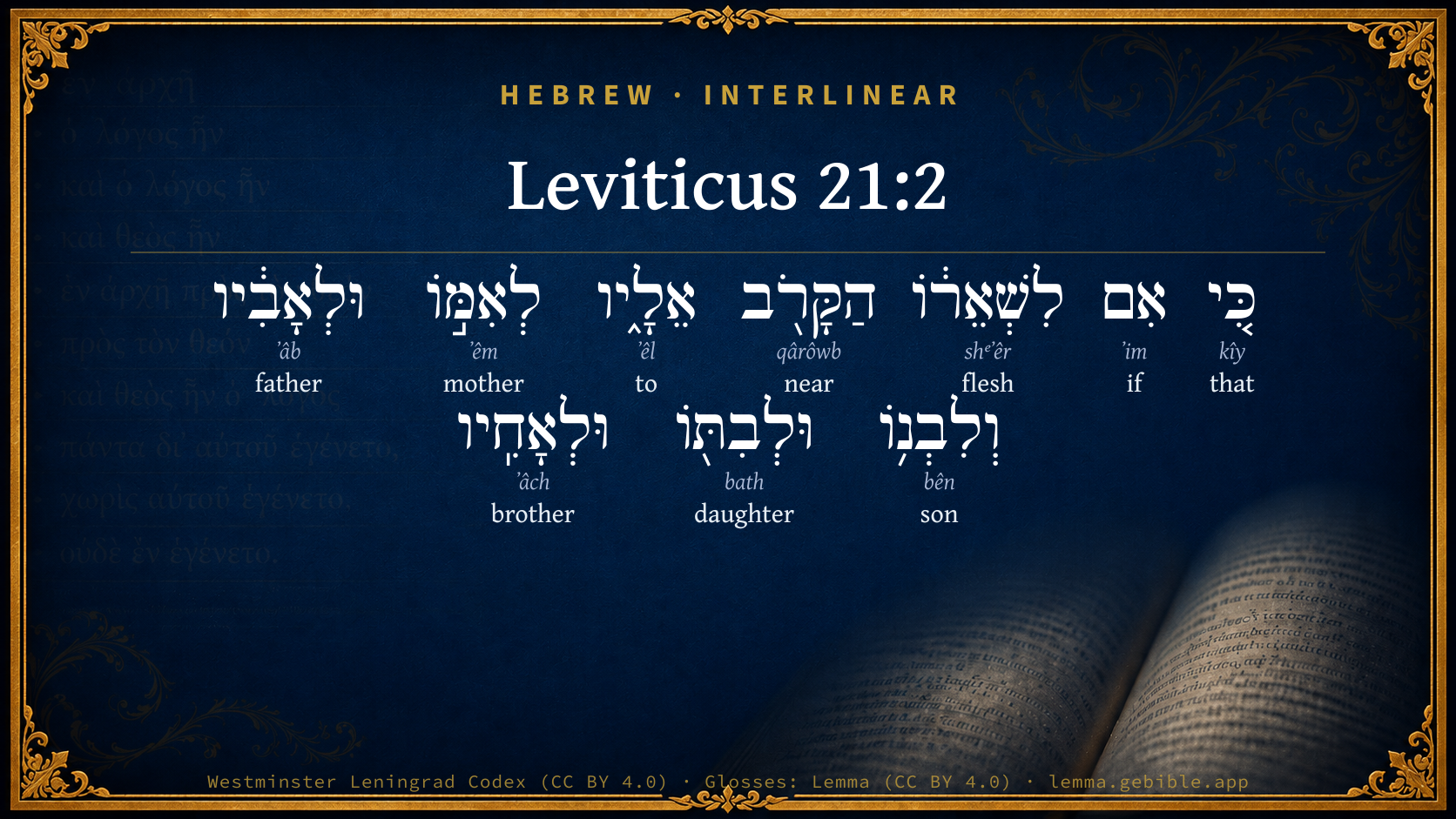
Hebrew (Westminster Leningrad Codex) Leviticus 21:2 appears in the Hebrew Old Testament. The text above is from the Westminster Leningrad Codex. Each word links to its Strong’s number, a concise gloss, and parsing drawn from the Open Scriptures Hebrew Bible morphology. Click any word for its full Brown-Driver-Briggs (BDB) entry.
Download image
Cite this verse

Leviticus 21:2 (World English Bible). Public Domain. Lemma interlinear Bible study tool, https://lemma.gebible.app/v/leviticus/21/2.

Show BibTeX & RIS
BibTeX
RIS
English Translation
except for his relatives that are near to him: for his mother, for his father, for his son, for his daughter, for his brother,
World English Bible · Public Domain
Download a study sheet

One document with this verse’s original text, its word-by-word gloss line, the meaning frame, cross-references with their text, attributed commentary, and full source and license credits — printable, and it pastes into notes with its structure intact.

This verse Autodidact and up

Study sheet (.html) Plain text (.txt)

A passage Seminary Student

Up to 50 verses in one chapter. A passage sheet keeps up to 6 commentary sources and 12 cross-references per verse, in the order this page ranks them, and says so on the sheet whenever that leaves anything out. Ask for a single verse and you get the Autodidact verse sheet above.

Everything on this page stays free to read, with no account — the sheet is a download of what is already on screen, not access to it.

Want to remove ads? Support Godless Engineer
Compare translations 3

The same verse in 3 English versions, stacked beneath the original-language interlinear above. Click any original word for its lexicon entry.

Each is an independent rendering of the whole verse — the interlinear is not word-aligned to these translations.

Highlighted words mark where these versions differ — a whole-verse word diff, not a word-by-word alignment.

  • World English Bible Public Domain
    except for his relatives that are near to him: for his mother, for his father, for his son, for his daughter, for his brother,
  • King James Version Public Domain
    But for his kin, that is near unto him, that is, for his mother, and for his father, and for his son, and for his daughter, and for his brother.
  • unfoldingWord Literal Text CC BY-SA 4.0
    except for his flesh, the one close to him, for his mother or for his father or for his son or for his daughter or for his brother

unfoldingWord Literal Text — © unfoldingWord, licensed CC BY-SA 4.0. Word-aligned USFM3 via Door43 (git.door43.org/unfoldingWord/en_ult).

Versions to compare (up to 4)

3 of 4 selected

Show all 18 translations

Every available English version of this verse, each an independent rendering of the whole verse.

  • World English Bible Public Domain
    except for his relatives that are near to him: for his mother, for his father, for his son, for his daughter, for his brother,
  • Berean Standard Bible Public Domain
    except for his immediate family—his mother, father, son, daughter, or brother,
  • Majority Standard Bible Public Domain
    except for his immediate family—his mother, father, son, daughter, or brother,
  • King James Version Public Domain
    But for his kin, that is near unto him, that is, for his mother, and for his father, and for his son, and for his daughter, and for his brother.
  • American Standard Version (1901) Public Domain
    except for his kin, that is near unto him, for his mother, and for his father, and for his son, and for his daughter, and for his brother,
  • Revised Version (1885) Public Domain
    except for his kin, that is near unto him, for his mother, and for his father, and for his son, and for his daughter, and for his brother;
  • Geneva Bible (1599) Public Domain
    But by his kinseman that is neere vnto him: to wit, by his mother, or by his father, or by his sonne, or by his daughter, or by his brother,
  • Douay-Rheims (1899) Public Domain
    But only for his kin, such as are near in blood, that is to say, for his father and for his mother, and for his son, and for his daughter, for his brother also,
  • Young's Literal Translation Public Domain
    except for his relation who `is' near unto him -- for his mother, and for his father, and for his son, and for his daughter, and for his brother.
  • Literal Standard Version CC BY-SA 4.0
    except for his relation who [is] near to him: for his mother, and for his father, and for his son, and for his daughter, and for his brother,
  • Unlocked Literal Bible CC BY-SA 4.0
    except for his closest relatives—his mother, his father, his son, his daughter, his brother,
  • unfoldingWord Literal Text CC BY-SA 4.0
    except for his flesh, the one close to him, for his mother or for his father or for his son or for his daughter or for his brother
  • Darby Bible Public Domain
    except for his immediate relation, who is near unto him -- for his mother, and for his father, and for his son, and for his daughter, and for his brother;
  • World Messianic Bible Public Domain
    except for his relatives that are near to him: for his mother, for his father, for his son, for his daughter, for his brother,
  • Webster's Bible Public Domain
    But for his kin, that is near to him, that is, for his mother, and for his father, and for his son, and for his daughter, and for his brother,
  • Free Bible Version CC BY-SA 4.0
    The only exceptions are for his immediate family. This includes his mother, father, son, daughter, or brother,
  • Bible in Basic English Public Domain
    But only for his near relations, for his mother or his father, his son or his daughter, and his brother;
  • JPS Tanakh (1917) Public Domain
    except for his kin, that is near unto him, for his mother, and for his father, and for his son, and for his daughter, and for his brother;

Literal Standard Version (2020), Covenant Press — licensed CC BY-SA 4.0. Text via the HelloAO Bible API (eBible.org). Unlocked Literal Bible (unfoldingWord) — licensed CC BY-SA 4.0. Text via the HelloAO Bible API (eBible.org). unfoldingWord Literal Text — © unfoldingWord, licensed CC BY-SA 4.0. Word-aligned USFM3 via Door43 (git.door43.org/unfoldingWord/en_ult). Free Bible Version, Dr. Jonathan Gallagher — licensed CC BY-SA 4.0. Text via the HelloAO Bible API (eBible.org).

Word by word

More ways to search: Search by grammar → Find every occurrence → Compare this word →

Practice this passage: Drill this verse → Learn its vocabulary →

לִשְׁאֵר֔וֹ
shᵉʼêr
H7607
“to/for · flesh · his”
Preposition + Noun, Common, Masculine, Singular, Construct + Suffix, Personal, 3rd Person, Masculine, Singular
Part of Speech
Preposition + Noun
Type
Common
Gender
Masculine
Number
Singular
State
Construct
Full BDB Definition

Origin: from H7604

TWOT: 2308a

flesh, food, body, near kin, near kinswoman - flesh - as food - for physical power (figuratively) - flesh relation, blood relation - self
  1. כִּ֚י kîy H3588 “that” Conjunction
  2. אִם ʼim H518 “if” Conjunction
  3. הַקָּרֹ֖ב qârôwb H7138 “the · near” Particle, Definite Article + Adjective, Adjective, Masculine, Singular, Absolute
  4. אֵלָ֑יו ʼêl H413 “to · him” Preposition + Suffix, Personal, 3rd Person, Masculine, Singular
  5. לְאִמּ֣וֹ ʼêm H517 “to/for · mother · his” Preposition + Noun, Common, Feminine, Singular, Construct + Suffix, Personal, 3rd Person, Masculine, Singular
  6. וּלְאָבִ֔יו ʼâb H1 “and · to/for · father · his” Conjunction + Preposition + Noun, Common, Masculine, Singular, Construct + Suffix, Personal, 3rd Person, Masculine, Singular
  7. וְלִבְנ֥וֹ bên H1121 “and · to/for · son · his” Conjunction + Preposition + Noun, Common, Masculine, Singular, Construct + Suffix, Personal, 3rd Person, Masculine, Singular
  8. וּלְבִתּ֖וֹ bath H1323 “and · to/for · daughter · his” Conjunction + Preposition + Noun, Common, Feminine, Singular, Construct + Suffix, Personal, 3rd Person, Masculine, Singular
  9. וּלְאָחִֽיו ʼâch H251 “and · to/for · brother · his” Conjunction + Preposition + Noun, Common, Masculine, Singular, Construct + Suffix, Personal, 3rd Person, Masculine, Singular

About this verse

These counts appear in no published source. They are computed here, from the morphology-tagged text and Lemma’s own curated glosses. What Lemma adds →

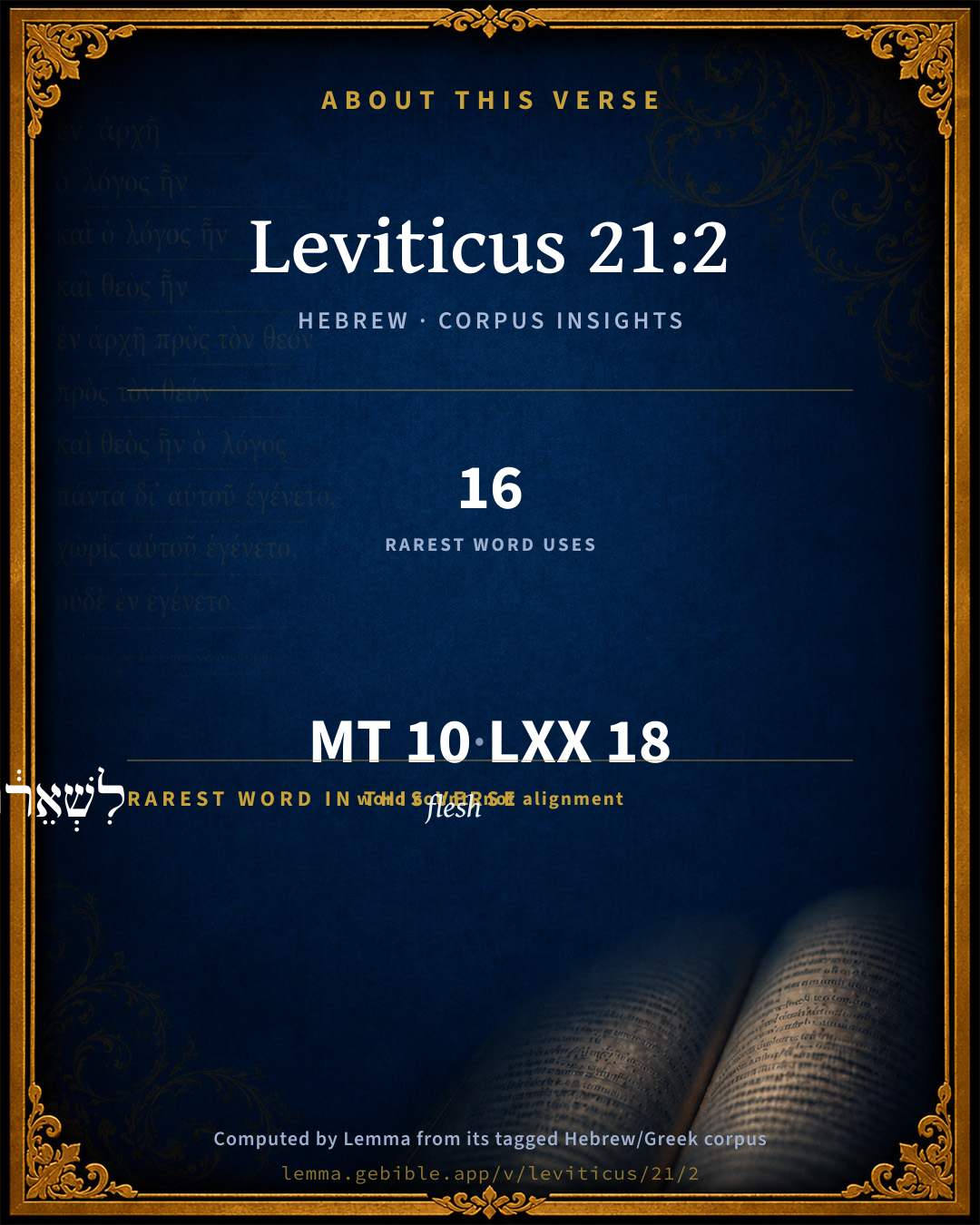
10
words
10
distinct lemmas
Pentateuch
section

Notable vocabulary

The rarest word here is לִשְׁאֵר֔וֹ flesh H7607 — appearing just 16 times in the whole Hebrew Bible.

Shared distinctive vocabulary

לִשְׁאֵר֔וֹ flesh H7607 occurs in 16 verses of the Hebrew Bible. Also found in:

Grammatical profile

  • 6 nouns
  • 1 adjective
  • 1 preposition
  • 2 conjunctions

Hebrew & Septuagint length

In English translation the verse runs 24 words from the Hebrew and 25 from the Septuagint (LXX English) — closely comparable.

A rough comparison of the two English renderings, which tokenize alike — not a word-level alignment.

Word counts can differ between the Hebrew and the Greek without any difference in meaning — e.g. the Hebrew direct-object marker אֵת has no separate Greek word, and Greek often adds the article ὁ.

In the original languages it is 10 Hebrew tokens and 18 Greek tokens — but the two are counted differently (Hebrew bundles its prefixes and suffixes into one token; the Greek is in lemma form), so that isn’t a like-for-like length.

Cross-references

2

Topical passages linked to Leviticus 21:2 in the Treasury of Scripture Knowledge — connected by theme and wording, ordered by reader-vote popularity; previews shown in the World English Bible.

  • Leviticus 18:6 "'None of you shall approach anyone who are his close relatives, to uncover their nakedness: I am Yahweh.
  • 1 Thessalonians 4:13 But we don't want you to be ignorant, brothers, concerning those who have fallen asleep, so that you don't grieve like the rest, who have no hope.

Cross-references courtesy of OpenBible.info (CC BY 4.0).

Hebrew and Greek witnesses Masoretic Hebrew ↔ Greek Septuagint

The same verse in the two great witnesses to the Old Testament, shown verse-for-verse.

These are two independent witnesses, not word-aligned to each other, and the Septuagint is shown in lemma (dictionary) form.

Hebrew Leviticus 21:2 Masoretic · Westminster Leningrad Codex

כִּ֚י אִם לִשְׁאֵר֔וֹ הַקָּרֹ֖ב אֵלָ֑יו לְאִמּ֣וֹ וּלְאָבִ֔יו וְלִבְנ֥וֹ וּלְבִתּ֖וֹ וּלְאָחִֽיו

except for his relatives that are near to him: for his mother, for his father, for his son, for his daughter, for his brother,

World English Bible · Public Domain

Greek LXX Leviticus 21:2 Septuagint · lemma form

ἀλλά ἤ ἐν ὁ οἰκεῖος ὁ ἐγγύς αὐτός ἐπί πατήρ καί μήτηρ καί υἱός καί θυγάτηρ ἐπί ἀδελφός

but they may mourn for a relative who is very near to them, for a father and mother, and sons and daughters, for a brother,

LXX2012 (modern English Septuagint) · Public Domain

Hebrew: Westminster Leningrad Codex (CC BY 4.0). Greek: Septuagint (public domain); English from LXX2012 (modern English Septuagint) (Public Domain). How the Septuagint differs from the Hebrew →

Targum (Aramaic paraphrase)

2

The Targum is the ancient Jewish Aramaic paraphrase of the Hebrew Scriptures — an interpretive translation, not the Hebrew text itself. Onkelos (literal) and Pseudo-Jonathan (expansive) render the Torah, and Jonathan the Prophets. Coverage is partial: where no permissively-licensed English translation exists for a verse, only the Aramaic is shown. This is verse-level text, not a word-by-word alignment to the Hebrew.

  1. Targum Onkelos Torah (Genesis–Deuteronomy)
    אֱלָהֵן לְקָרִיבֵהּ דְקָרִיב לֵהּ לְאִמֵהּ וְלַאֲבוּהִי וְלִבְרֵהּ וְלִבְרַתֵּהּ וְלַאֲחוּהִי

    (no public-domain English translation for this verse)

    Targum Onkelos — Aramaic: “Onkelos Genesis” (public domain); “Onkelos Exodus” (public domain); “Onkelos Leviticus” (public domain); “Onkelos Numbers” (public domain); “Onkelos Deuteronomy” (public domain). English: “Sefaria Community Translation” (CC0 1.0 (public-domain dedication)); “J.W. Etheridge. The Targums of Onkelos and Jonathan Ben Uzziel on the Pentateuch. London: Longmans, Green, 1862” (public domain). Text via Sefaria.

  2. Targum Pseudo-Jonathan Torah (Genesis–Deuteronomy)
    אֱלָהֵן לְאִנְתְּתָא דִקְרִיבָא לְגוּפֵיהּ לְאִימֵיהּ וּלְאָבוֹי וְלִבְרֵיהּ וְלִבְרַתֵּיהּ וּלְאָחוֹי

    but for a woman who is of kin to his flesh, for his daughter, and for his father, and for his son, and for his daughter, and for his brother,

    Targum Pseudo-Jonathan — Aramaic: “Targum Jonathan on Genesis” (public domain); “Targum Jonathan on Exodus” (public domain); “Targum Jonathan on Leviticus” (public domain); “Targum Jonathan on Numbers” (public domain); “Targum Jonathan on Deuteronomy” (public domain). English: “The Targum of Jonathan ben Uzziel, trans. J. W. Etheridge, London, 1862” (public domain). Text via Sefaria.

Commentary

Notes on Leviticus 21:2 from classic Christian and Jewish commentators (each source and its license shown beneath its notes). The classic Christian expositions comment on the surrounding passage and are grouped to its opening verse, so a note may address several verses; the Jewish commentaries on the Tanakh (Rashi and others) are per-verse, so they appear only where the commentator wrote on this verse.

Lemma curates 59 commentaries, every one of them public domain or Creative Commons licensed, each selected and text-cleaned for this edition rather than reprinted as found. About our sources →

Trapp's Complete Commentary

John Trapp

Lev 21:2 But for his kin, that is near unto him, [that is], for his mother, and for his father, and for his son, and for his daughter, and for his brother,

Ver. 2. And for his brother.] The high priest might not for any of these, {Lev 21:10-11} nor might Eleazar and Ithamar for their dead brethren Nadab and Abihu, {Lev 10:6} because in that case, mourning might have seemed murmuring.

John Trapp, A Commentary or Exposition upon All the Books of the Old and New Testament (1647–1656) — public domain. Text from a community e-Sword module.

Joseph Benson's Commentary

Lev 21:2. Near to him — Under which general expression his wife seems to be comprehended, though she be not expressed. And hence it is noted as a peculiar case, that Ezekiel, who was a priest, was forbidden to mourn for his wife, Eze 24:16, &c. These exceptions God made in condescension to human infirmity; because in such cases it was very hard to restrain the affections. But this allowance concerns only the inferior priests, not the high-priest.

Joseph Benson's Commentary on the Old and New Testaments (1811–1818) — public domain. Text from a community e-Sword module.

Ellicott's Commentary for English Readers

(2) But for his kin, that is near unto him.—There are, however, seven exceptions to the general rule. According to the administrators of the Law during the second Temple, the phrase, “his kin that is near unto him,” or rather, “his flesh that is near unto him” (comp. Lev_18:6 with Gen_2:24), denotes “wife.” Hence the Chaldee version of Jonathan renders it, “but for a wife who is of kin to his flesh.”

For his mother, and for his father.—This is the second of the three instances in the Bible where the mother is mentioned before the father (see Lev_19:3). The Jewish canonists, who call attention to this unusual phrase, account for it by saying that she is placed first because the son’s qualifications for the priesthood depend more upon his having a good mother (see Lev_21:7). This will be readily understood when it is borne in mind that the regulations about the woman whom a priest was allowed to marry during the second Temple were of the most stringent nature, and that the slightest infringement of them disqualified the son for performing sacerdotal functions. Thus the daughter of a foreigner or of a released captive was forbidden to the priest, and when a city was besieged and taken by the enemy all the wives of the priests had to be divorced for fear lest they had suffered violence.

A Bible Commentary for English Readers, edited by Charles John Ellicott (1878–1897) — public domain. Text from a community e-Sword module.

The Cambridge Bible for Schools and Colleges

gen. ed. J. J. S. Perowne

2. The defilement prohibited in Lev_21:1 is allowed for certain near relations.

The Cambridge Bible for Schools and Colleges (gen. ed. J. J. S. Perowne; Cambridge University Press, 1878–1918) — public domain. Text from a community e-Sword module.

John Gill's Exposition

But for his kin that is near unto him,.... For such he might be defiled and mourn, or be where they were, and take care of, and attend their funerals: this clause some take to be general, of which the particulars follow, as Aben Ezra; but others take it to be the first particular excepted, and instanced in, and intends his wife; for it may be rendered, as by some, "for his flesh", or "the rest of him" (p), the other part of himself, his wife, which is his other self, and one flesh with him; and so Jarchi and others observe, there is no flesh of his, but his wife; and if she is not intended here, she is not expressed elsewhere, though must be supposed, because it is allowed the priest to defile himself for other relations not so near; and it is plain from the case of Ezekiel, that a priest might mourn for his wife, Eze 24:15; he being forbid it, shows his case to be an extraordinary one, and that ordinarily it was admitted, otherwise there would have been no need of a particular prohibition of him:

that is, for his mother, and for his father, and for his son, and for his daughter, and his brother; R. Alphes adds (q), "and his wife"; these being all near relations, and for whom natural affection would lead and oblige him to mourn, and show a concern for their death, and to take care of their funeral. This is to be understood of common priests; for as for the high priest, he might not mourn, or be concerned for either of these.

(p) "carne sua", Pagninus, Montanus. (q) Sepher Alphes, par. 1. fol. 410. 2.

John Gill's Exposition of the Whole Bible (1746–1763) — public domain (CC PDM 1.0). Text via the HelloAO Bible API.

Matthew Poole's English Annotations

For his kin that is near unto him: under this general expression his wife seems to be comprehended, though she be not expressed in the following instances, because from the mention of others more remote it was easy to gather that so near a relation was not excluded. And hence it is noted as a peculiar and extraordinary case, that Ezekiel, who was a priest, was forbidden to mourn for his wife, Eze 24:16, &c. These exceptions God here makes in condescension to human infirmity, because in such cases it was very hard to restrain the affections. But this allowance concerns only the inferior priest, not the high priest, as we shall see.

For his brother.

Object. Eleazar and Ithamar are forbidden to mourn for their brethren, Nadab and Abihu.

Answ. 1. That case was singular, both because such a mourning might seem to be a censure of God’s severity upon them, and because they were then in the actual execution of their office, and in their initiation to it, and they were the only persons, besides Aaron, that could perform that work, and therefore their attendance upon it was more necessary than it would be in after-times and other cases.

2. The latter law can either limit of enlarge the former at the pleasure of the lawgiver. And this law may seem to be added, lest that prohibition, Le 10, should be taken for a general rule.

Matthew Poole's English Annotations on the Holy Bible (1683–1685) — public domain. Text from a community e-Sword/MySword module.

Whedon's Commentary on the Bible

Daniel D. Whedon

2. His kin, that is near — The nearness, or “remainder of flesh,” includes all within the first degree of consanguinity, and a portion of the kin within the second. By a glance at the table at the end of chap. xviii it will be seen that of the second degree of consanguinity the grandparent, the grandchild, and the married sister are not to be mourned for, while all the kindred by marriage, whatever the degree, even the wife, are prohibited to the priest for mourning, if we adopt the exclusive interpretation. The case of Ezekiel, the prophet-priest, in Eze_24:16-18, who was expressly forbidden to exhibit the customary tokens of mourning for his deceased wife, would seem to prove that the wife was not excluded in the law of priestly mourning. Keil argues that the wife is included in the near of kin from the fact that she is pronounced to be of “one flesh” with her husband.

Gen_2:24. Yet we confess that this verse has every appearance of an exhaustive and exclusive catalogue.

Daniel D. Whedon (gen. ed.), Commentary on the Old and New Testaments (1874–1909) — public domain. Text from a community e-Sword module.

John Wesley's Explanatory Notes

Near to him - Under which general expression his wife seems to be comprehended, though she be not expressed. And hence it is noted as a peculiar case, that Ezekiel, who was a priest, was forbidden to mourn for his wife, Ezek. xxiv, 16, &c. These exceptions God makes in condescension to human infirmity, because in such cases it was very hard to restrain the affections. But this allowance concerns only the inferior priest, not the high- priest.

John Wesley, Explanatory Notes Upon the Whole Bible (1754–1765) — public domain. Text via the GEBible commentary corpus.

Rashi

Rabbi Shlomo Yitzchaki (Rashi)

כי אם לשארו BUT FOR HIS KIN [THAT IS NEAR TO HIM] — שאר here denotes his wife (Sifra, Emor, Section 1 4; Yevamot 22b).

Rashi on the Tanakh — English translations: “The Judaica Press complete Tanach with Rashi, translated by A. J. Rosenberg” (CC BY 4.0); “Pentateuch with Rashi's commentary by M. Rosenbaum and A.M. Silbermann, 1929-1934” (public domain); “The Metsudah Tanach series, Lakewood, N.J” (CC BY 4.0); and “The Book of Joshua, Metsudah Publications, 1997” (CC BY 4.0). Text via Sefaria.

Lesson kit

Teaching starters — assembled from the data on this page, not authored interpretation. Every prompt links to the verse data it draws on. Edit before teaching.

Leviticus, in the Pentateuch, opens this verse with 10 words (10 distinct Hebrew lemmas). Its most distinctive word is shᵉʼêr (“flesh”). A historical commentator’s framing appears above. Read the whole chapter for the surrounding context.

Discussion questions

  1. What does “flesh” (shᵉʼêr) contribute to the verse as a whole?
  2. How does Exodus 21:10, which shares the word «flesh», read alongside this verse?
  3. These translations render this verse differently. What is at stake in choosing one wording over another?
  4. Compare how Trapp's Complete Commentary and Joseph Benson's Commentary read this verse. Where do they agree or differ?

Things to notice

Reading settings

Reading text

Shown beneath each verse's original-language words.

Old Testament
Old Testament edition

Read the OT as the Masoretic Hebrew (MT) or the Greek Septuagint (LXX).

English shown for the Greek Septuagint (in the Hebrew ↔ Greek comparison).

Comparing translations? Open the Compare panel on any verse page to stack up to four side by side.