Nehemiah 10:32

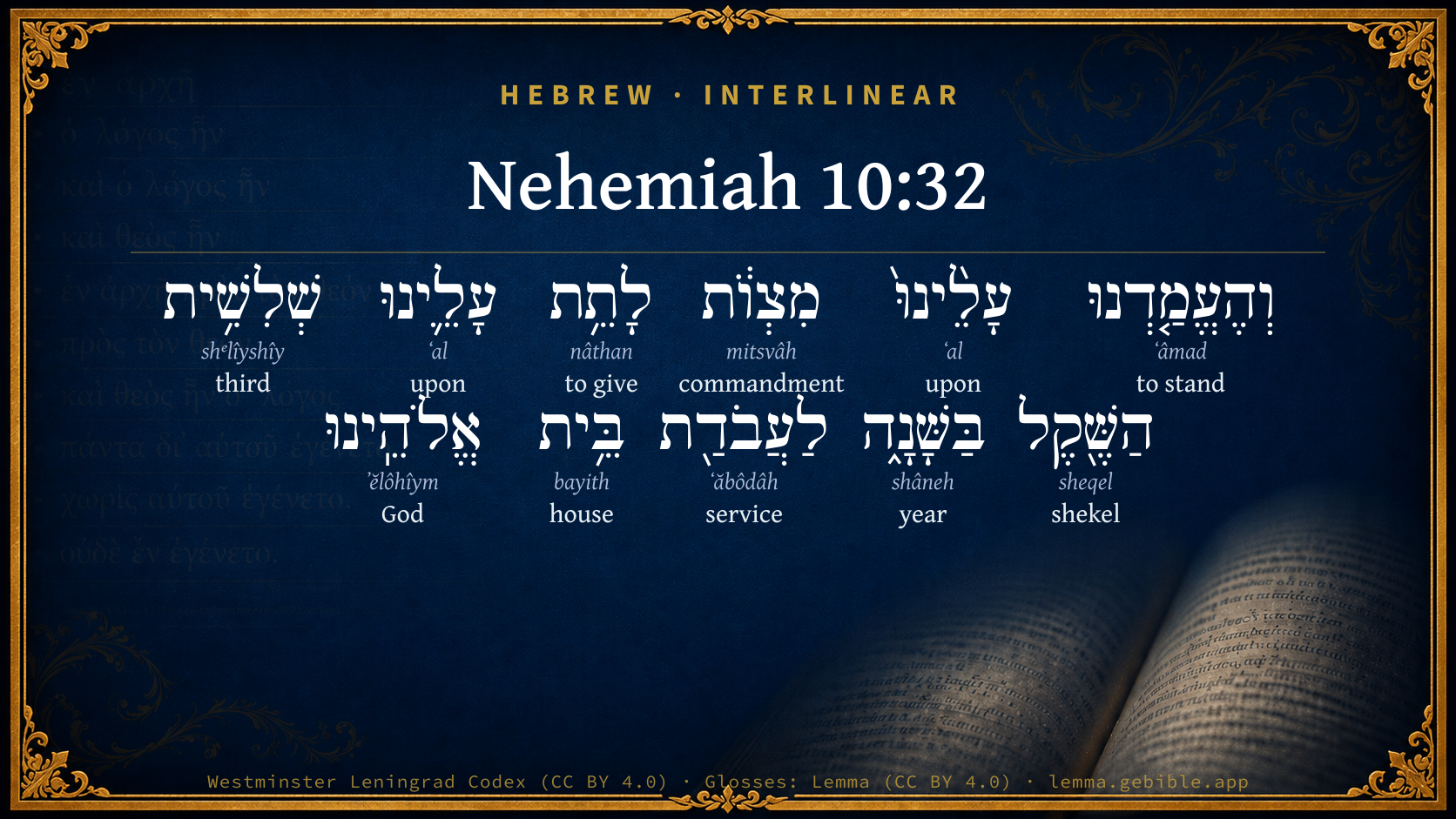
Hebrew (Westminster Leningrad Codex) Nehemiah 10:32 appears in the Hebrew Old Testament. The text above is from the Westminster Leningrad Codex. Each word links to its Strong’s number, a concise gloss, and parsing drawn from the Open Scriptures Hebrew Bible morphology. Click any word for its full Brown-Driver-Briggs (BDB) entry.
Download image
Cite this verse

Nehemiah 10:32 (World English Bible). Public Domain. Lemma interlinear Bible study tool, https://lemma.gebible.app/v/nehemiah/10/32.

Show BibTeX & RIS
BibTeX
RIS
English Translation
Also we made ordinances for us, to charge ourselves yearly with the third part of a shekel for the service of the house of our God;
World English Bible · Public Domain
Download a study sheet

One document with this verse’s original text, its word-by-word gloss line, the meaning frame, cross-references with their text, attributed commentary, and full source and license credits — printable, and it pastes into notes with its structure intact.

This verse Autodidact and up

Study sheet (.html) Plain text (.txt)

A passage Seminary Student

Up to 50 verses in one chapter. A passage sheet keeps up to 6 commentary sources and 12 cross-references per verse, in the order this page ranks them, and says so on the sheet whenever that leaves anything out. Ask for a single verse and you get the Autodidact verse sheet above.

Everything on this page stays free to read, with no account — the sheet is a download of what is already on screen, not access to it.

Want to remove ads? Support Godless Engineer
Compare translations 3

The same verse in 3 English versions, stacked beneath the original-language interlinear above. Click any original word for its lexicon entry.

Each is an independent rendering of the whole verse — the interlinear is not word-aligned to these translations.

Highlighted words mark where these versions differ — a whole-verse word diff, not a word-by-word alignment.

  • World English Bible Public Domain
    Also we made ordinances for us, to charge ourselves yearly with the third part of a shekel for the service of the house of our God;
  • King James Version Public Domain
    Also we made ordinances for us, to charge ourselves yearly with the third part of a shekel for the service of the house of our God;
  • unfoldingWord Literal Text CC BY-SA 4.0
    Also, we caused to stand for us commandments to give over us a third of a shekel in a year for the service of the house of our God:

unfoldingWord Literal Text — © unfoldingWord, licensed CC BY-SA 4.0. Word-aligned USFM3 via Door43 (git.door43.org/unfoldingWord/en_ult).

Versions to compare (up to 4)

3 of 4 selected

Show all 18 translations

Every available English version of this verse, each an independent rendering of the whole verse.

  • World English Bible Public Domain
    Also we made ordinances for us, to charge ourselves yearly with the third part of a shekel for the service of the house of our God;
  • Berean Standard Bible Public Domain
    We also place ourselves under the obligation to contribute a third of a shekel yearly for the service of the house of our God:
  • Majority Standard Bible Public Domain
    We also place ourselves under the obligation to contribute a third of a shekel yearly for the service of the house of our God:
  • King James Version Public Domain
    Also we made ordinances for us, to charge ourselves yearly with the third part of a shekel for the service of the house of our God;
  • American Standard Version (1901) Public Domain
    Also we made ordinances for us, to charge ourselves yearly with the third part of a shekel for the service of the house of our God;
  • Revised Version (1885) Public Domain
    Also we made ordinances for us, to charge ourselves yearly with the third part of a shekel for the service of the house of our God;
  • Geneva Bible (1599) Public Domain
    And we made statutes for our selues to giue by the yeere the thirde part of a shekel for the seruice of the house of our God,
  • Douay-Rheims (1899) Public Domain
    And we made ordinances for ourselves, to give the third part of a side every year for the work of the house of our God,
  • Young's Literal Translation Public Domain
    And we have appointed for ourselves commands, to put on ourselves the third of a shekel in a year, for the service of the house of our God,
  • Literal Standard Version CC BY-SA 4.0
    And we have appointed for ourselves commands, to put on ourselves the third of a shekel in a year, for the service of the house of our God,
  • Unlocked Literal Bible CC BY-SA 4.0
    We accepted the commands to give a third of a shekel each year for the service of the house of our God,
  • unfoldingWord Literal Text CC BY-SA 4.0
    Also, we caused to stand for us commandments to give over us a third of a shekel in a year for the service of the house of our God:
  • Darby Bible Public Domain
    And we made ordinances for us, to charge ourselves yearly with the third part of a shekel for the service of the house of our God,
  • World Messianic Bible Public Domain
    Also we made ordinances for ourselves, to charge ourselves yearly with the third part of a shekel for the service of the house of our God:
  • Webster's Bible Public Domain
    Also we made ordinances for us, to charge ourselves yearly with the third part of a shekel for the service of the house of our God;
  • Free Bible Version CC BY-SA 4.0
    We accept the obligation to pay one third of a shekel for the operation of the Temple of God,
  • Bible in Basic English Public Domain
    And we made rules for ourselves, taxing ourselves a third of a shekel every year for the upkeep of the house of our God;
  • JPS Tanakh (1917) Public Domain
    (10-33) Also we made ordinances for us, to charge ourselves yearly with the third part of a shekel for the service of the house of our God;

Literal Standard Version (2020), Covenant Press — licensed CC BY-SA 4.0. Text via the HelloAO Bible API (eBible.org). Unlocked Literal Bible (unfoldingWord) — licensed CC BY-SA 4.0. Text via the HelloAO Bible API (eBible.org). unfoldingWord Literal Text — © unfoldingWord, licensed CC BY-SA 4.0. Word-aligned USFM3 via Door43 (git.door43.org/unfoldingWord/en_ult). Free Bible Version, Dr. Jonathan Gallagher — licensed CC BY-SA 4.0. Text via the HelloAO Bible API (eBible.org).

Word by word

More ways to search: Search by grammar → Find every occurrence → Compare this word →

Practice this passage: Drill this verse → Learn its vocabulary →

הַשֶּׁ֖קֶל
sheqel
H8255
“the · shekel”
Particle, Definite Article + Noun, Common, Masculine, Singular, Absolute
Part of Speech
Particle + Noun
Type
Common
Gender
Masculine
Number
Singular
State
Absolute
Full BDB Definition

Origin: from H8254

TWOT: 2454a

shekel - the chief unit of weight or measure - silver - 1/3000 of a talent and equal to 132 grains - copper - 1/1500 of a talent and equal to 528 grains
  1. וְהֶעֱמַ֤דְנוּ ʻâmad H5975 “and · to stand” Conjunction + Verb, Hiphil, Perfect, 1st Person, Common, Plural
  2. עָלֵ֨ינוּ֙ ʻal H5921 “upon · us” Preposition + Suffix, Personal, 1st Person, Common, Plural
  3. מִצְוֺ֔ת mitsvâh H4687 “commandments” Noun, Common, Feminine, Plural, Absolute
  4. לָתֵ֥ת nâthan H5414 “to give” Preposition + Verb, Qal, Infinitive Construct
  5. עָלֵ֛ינוּ ʻal H5921 “upon · us” Preposition + Suffix, Personal, 1st Person, Common, Plural
  6. שְׁלִשִׁ֥ית shᵉlîyshîy H7992 “third” Adjective, Ordinal number, Feminine, Singular, Construct
  7. בַּשָּׁנָ֑ה shâneh H8141 “in/at the · year” Preposition, Determined + Noun, Common, Feminine, Singular, Absolute
  8. לַעֲבֹדַ֖ת ʻăbôdâh H5656 “to/for · service of” Preposition + Noun, Common, Feminine, Singular, Construct
  9. בֵּ֥ית bayith H1004 “house of” Noun, Common, Masculine, Singular, Construct
  10. אֱלֹהֵֽינוּ ʼĕlôhîym H430 “God(s) · our” Noun, Common, Masculine, Plural, Construct + Suffix, Personal, 1st Person, Common, Plural

About this verse

These counts appear in no published source. They are computed here, from the morphology-tagged text and Lemma’s own curated glosses. What Lemma adds →

11
words
10
distinct lemmas
Historical
section

Grammatical profile

  • 2 verbs
  • 6 nouns
  • 1 adjective
  • 2 prepositions

Verb forms

  • וְהֶעֱמַ֤דְנוּ Hiphil · Perfect
  • לָתֵ֥ת Qal · Infinitive Construct

Repetition

A word recurs within this verse — often emphatic in Hebrew:

  • עָלֵ֨ינוּ֙ upon H5921 ×2

Cross-references

5

Topical passages linked to Nehemiah 10:32 in the Treasury of Scripture Knowledge — connected by theme and wording, ordered by reader-vote popularity; previews shown in the World English Bible.

  • Exodus 30:11–16 Yahweh spoke to Moses, saying,
  • Matthew 17:24–27 When they had come to Capernaum, those who collected the didrachma coins came to Peter, and said, "Doesn't your teacher pay the didrachma?"
  • Proverbs 3:9 Honor Yahweh with your substance, With the first fruits of all your increase:
  • 2 Corinthians 8:12 For if the readiness is there, it is acceptable according to what you have, not according to what you don't have.
  • Genesis 28:22 then this stone, which I have set up for a pillar, will be God's house. Of all that you will give me I will surely give the tenth to you."

Cross-references courtesy of OpenBible.info (CC BY 4.0).

Hebrew and Greek witnesses Masoretic Hebrew ↔ Greek Septuagint

The same verse in the two great witnesses to the Old Testament, shown verse-for-verse.

These are two independent witnesses, not word-aligned to each other, and the Septuagint is shown in lemma (dictionary) form.

Hebrew Nehemiah 10:32 Masoretic · Westminster Leningrad Codex

וְהֶעֱמַ֤דְנוּ עָלֵ֨ינוּ֙ מִצְוֺ֔ת לָתֵ֥ת עָלֵ֛ינוּ שְׁלִשִׁ֥ית הַשֶּׁ֖קֶל בַּשָּׁנָ֑ה לַעֲבֹדַ֖ת בֵּ֥ית אֱלֹהֵֽינוּ

Also we made ordinances for us, to charge ourselves yearly with the third part of a shekel for the service of the house of our God;

World English Bible · Public Domain

Greek LXX Structure differs

The Septuagint has no separate book of Nehemiah. Its Greek text is the second half of Esdras B (2 Esdras), chapters 11–23; Ezra is the first half (1–10).

A verse-for-verse comparison isn’t shown here because the chapters and verses don’t line up. Switch to the LXX edition with the MT / LXX toggle above to read the Greek directly.

On this verse, Matthew Henry's Commentary discusses the Septuagint’s reading. Read the note in Commentary ↓

Hebrew: Westminster Leningrad Codex (CC BY 4.0). Greek: Septuagint (public domain); English from a public-domain English Septuagint. How the Septuagint differs from the Hebrew →

Commentary

Notes on Nehemiah 10:32 from classic Christian and Jewish commentators (each source and its license shown beneath its notes). The classic Christian expositions comment on the surrounding passage and are grouped to its opening verse, so a note may address several verses; the Jewish commentaries on the Tanakh (Rashi and others) are per-verse, so they appear only where the commentator wrote on this verse.

Lemma curates 59 commentaries, every one of them public domain or Creative Commons licensed, each selected and text-cleaned for this edition rather than reprinted as found. About our sources →

Matthew Henry's Commentary

Having covenanted against the sins they had been guilty of, they proceed in obliging themselves to revive and observe the duties they had neglected. We must not only cease to do evil, but learn to do well.

I. It was resolved, in general, that the temple service should be carefully kept up, that the work of the house of their God should be done in its season, according to the law, Neh 10:33. Let not any people expect the blessing of God unless they make conscience of observing his ordinances and keeping up the public worship of him. Then it is likely to go well with our houses when care is taken that the work of God's house go on well. It was likewise resolved that they would never forsake the house of their God (Neh 10:39), as they and their fathers had done, would not forsake it for the house of any other god, or for the high places, as idolaters did, nor forsake it for their farms and merchandises, as those did that were atheistical and profane. Those that forsake the worship of God forsake God.

II. It was resolved, in pursuance of this, that they would liberally maintain the temple service, and not starve it. The priests were ready to do their part in all the work of God's house, if the people would do theirs, which was to find them with materials to work upon. Now here it was agreed and concluded, 1. That a stock should be raised for the furnishing of God's table and altar plentifully. Formerly there were treasures in the house of the Lord for this purpose, but these were gone, and there was no settled fund to supply the want of them. It was a constant charge to provide show-bread for the table, two lambs for the daily offerings, four for the sabbaths, and more, and more costly, sacrifices for other festivals, occasional sin-offerings, and meat-offerings, and drink-offerings for them all. They had no rich king to provide these, as Hezekiah did; the priests could not afford to provide them, their maintenance was so small; the people therefore agreed to contribute yearly, every one of them, the third part of a shekel, about ten pence a-piece for the bearing of this expense. When every one will act, and every one will give, though but little, towards a good work, the whole amount will be considerable. The tirshatha did not impose this tax, but the people made it an ordinance for themselves, and charged themselves with it, Neh 10:32, Neh 10:33. 2. That particular care should be taken to provide wood for the altar, to keep the fire always burning upon it, and wherewith to boil the peace-offerings. All of them, priests and Levites as well as people, agreed to bring in their quota, and cast lots in what order they should bring it in, which family first and which next, that there might be a constant supply, and not a scarcity at one time and an overplus at another, Neh 10:34. Thus they provided the fire and the wood, as well as the lambs for the burnt-offerings. 3. That all those things which the divine law had appointed for the maintenance of the priests and Levites should be duly paid in, for their encouragement to mind their business, and that they might not be under any temptation to neglect it for the making of necessary provision for their families. Then the work of the house of God is likely to go on when those that serve at the altar live, and live comfortably, upon the altar. First-fruits and tenths were then the principal branches of the ministers' revenues; and they here resolved, (1.) To bring in the first-fruits justly, the first-fruits of their ground and trees (Exo 23:19; Lev 19:23), the first-born of their children (even the money wherewith they were to be redeemed) and of their cattle, Exo 13:2, Exo 13:11, Exo 13:12 (this was given to the priests, Num 18:15, Num 18:16), also the first-fruits of their dough (Num 15:21), concerning which there is a particular order given in the prophecy concerning the second temple, Eze 44:30. (2.) To bring in their tenths likewise, which were due to the Levites (Neh 10:37), and a tenth out of those tenths to the priest, Neh 10:38. This was the law (Num 18:21-28); but these dues had been withheld, in consequence of which God, by the prophet, charges them with robbing him (Mal 3:8, Mal 3:9), at the same time encouraging them to be more just to him and his receivers, with a promise that, if they brought the tithes into the store-house, he would pour out blessings upon them, Neh 10:10. This therefore they resolved to do, that there might be meat in God's house, and plenty in the store-chambers of the temple, where the vessels of the sanctuary were, Neh 10:39. "We will do it (say they) in all the cities of our tillage," Neh 10:37. In all the cities of our servitude, so the Septuagint, for they were servants in their own land, Neh 9:36. But (as Mr. Poole well observes), though they paid great taxes to the kings of Persia, and had much hardship put upon them, they would not make that an excuse for not paying their tithes, but would render to God the things that were his, as well as to Caesar the things that were his. We must do what we can in works of piety and charity notwithstanding the taxes we pay to the government, and cheerfully perform our duty to God in our servitude, which will be the surest way to ease and liberty in God's due time.

Matthew Henry's Commentary on the Whole Bible (1708–1710) — public domain (CC PDM 1.0). Text via the HelloAO Bible API.

Trapp's Complete Commentary

John Trapp

Neh 10:32 Also we made ordinances for us, to charge ourselves yearly with the third part of a shekel for the service of the house of our God;

Ver. 32. To charge ourselves yearly with the third part of a shekel] Beside the poll money, the half shekel required, Exo 38:26. The third part of a shekel was no great sum, yet somewhat more than what Saul and his servant presented the seer with, whom they could not but know to be the judge of Israel, 1Sa 9:8. These had learned that thankfulness was measured, both by God and good men, not by the weight, but by the will of the retributor. God doth highly accept the small offerings of his weak servants when he seeth them to proceed from great love.

John Trapp, A Commentary or Exposition upon All the Books of the Old and New Testament (1647–1656) — public domain. Text from a community e-Sword module.

The Biblical Illustrator

Joseph S. Exell

Neh_10:32-39

Also we made ordinances for us, to charge ourselves yearly with the third part of a shekel.

Voluntary taxation

Not to enter upon the thorny path of endowed or voluntary religion, nor to inquire whether tithes are coeval with the first man, and binding upon the present age, let us maintain--

I. That the church supposes an edifice. God may be worshipped in any house. Experience has taught the convenience and value of a house of God. The edifice must be built and maintained.

II. That a church requires a minister. No, man can rightly labour in the Word and doctrine without diligent and habitual Biblical study; no man can conduct such study without the renunciation of secular pursuits; no man can abandon such pursuits without an adequate and guaranteed salary from the Church in which he teaches, for which he labours. The ministry must be sustained.

III. That a church is a brotherhood. The rich and poor meet together. The poor ye have always with you. In a Church sense, if any provide not for his own house, he hath denied the faith.

IV. That a church is a missionary organisation. It has duties both at home and abroad. The Word of God must be translated, the masses evangelised, society leavened. A true Church must of necessity be a generous Church. It gets to give (Homiletical Commentary.)

The Biblical Illustrator, edited by Joseph S. Exell (c. 1880s–1900s) — public domain. Text from a community e-Sword module.

Joseph Benson's Commentary

Neh 10:32. To charge ourselves — Every particular person among us; yearly with a third part of a shekel — About ten-pence of our money; for the service of the house of our God — To provide the show-bread for the table, two lambs for the daily offerings, four for the sabbaths, and more costly sacrifices for other festivals, occasional sin-offerings, and meat offerings, and drink-offerings for them all, the charge of which was great and constant. Formerly these things had been provided from the treasures of the temple, (1Ch 26:20,) and when these failed, from the king’s treasures: but now, both these failing, provision is here properly made for them another way.

Joseph Benson's Commentary on the Old and New Testaments (1811–1818) — public domain. Text from a community e-Sword module.

Whedon's Commentary on the Bible

Daniel D. Whedon

PROVISION FOR THE TEMPLE SERVICE, Neh_10:32-39.

Having entered into a solemn covenant to keep the law, it was necessary that the people make provision for the support and regular observance of the holy service at the house of God. Such arrangements were accordingly made without delay.

32. We made ordinances — Laws, rules, regulations. Nehemiah writes in the name of the whole community.

The third part of a shekel — About eighteen cents, the silver shekel being valued at fifty-three cents. This was according to the law which ordained that half a shekel should be annually paid for the support of the holy service by every man twenty years old and upwards. See Exo_30:13-16. In view of the poverty of the people, it was now lowered to one third of a shekel, but later it was raised again to a half shekel. Mat_17:24.

Daniel D. Whedon (gen. ed.), Commentary on the Old and New Testaments (1874–1909) — public domain. Text from a community e-Sword module.

Jamieson, Fausset & Brown

Robert Jamieson, A. R. Fausset & David Brown

the third part of a shekel for the service of the house of our God--The law required every individual above twenty years of age to pay half a shekel to the sanctuary. But in consequence of the general poverty of the people, occasioned by war and captivity, this tribute was reduced to a third part of a shekel.

Jamieson, Fausset & Brown — Commentary Critical and Explanatory on the Whole Bible (1871) — public domain (CC PDM 1.0). Text via the HelloAO Bible API.

Adam Clarke's Commentary

Verse 32. Charge ourselves yearly with the third part of a shekel] According to the law, every one above twenty years of age was to give half a shekel to the sanctuary, which was called a ransom for their souls. See Ex 30:11-16. But why is one third of a shekel now promised instead of the half shekel, which the law required? To this question no better answer can be given than this: the general poverty of the people, occasioned by their wars, overthrows, heavy tributes, c., in the land of their captivity: and now on their return, having little property, it was impossible for them to give more and we know, from the terms of the law in this case, that the poor and the rich were obliged to give alike, because it was a ransom for their souls; and the souls of the poor and the rich were of like value, and stood equally in need of redemption; for all were equally fallen, and all had come equally short of the glory of God.

Though only a third part of a shekel was given at this time, and probably for the reason above assigned, yet when the people got into a state of greater prosperity, the half shekel was resumed: for it is clear that this sum was paid in the time of our Lord, though not to the temple, but to the Roman government. Hence when those who collected this as a tribute came to our Lord, it was for the διδραχμα, didrachma, which was half a shekel; and the coin with which our Lord paid for himself and Peter was a stater, which contained exactly two half shekels. See Mt 17:24-27.

Adam Clarke's Commentary on the Bible (1810–1826) — public domain. Text from a community e-Sword/MySword module.

Ellicott's Commentary for English Readers

(32) Also we made ordinances for us.—The covenant proceeds now to certain new regulations and resumption of neglected duties.

To charge ourselves.—Origin of that annual rate for the general service of the Temple which afterwards was raised to a half shekel (Mat_17:24). The more ancient half shekel of the law was only an occasional tax (Exo_30:13).

A Bible Commentary for English Readers, edited by Charles John Ellicott (1878–1897) — public domain. Text from a community e-Sword module.

The Cambridge Bible for Schools and Colleges

gen. ed. J. J. S. Perowne

32. A poll-tax of ⅓ of a shekel imposed for the maintenance of the service of the Temple

32. we made ordinances for us] The verse shows that Ezra and his colleagues, although establishing the authority of the written law, were ready to expand or modify it according to the requirements of the time—a significant indication of the way in which the numerous instances of minor variation in the laws of the Pentateuch may reflect changes and qualifications required at different epochs. ‘Ordinances.’ The plural shows that the reference is not to be limited to the Temple tax.

the third part of a shekel] See Exo_30:11-16; in which passage every Israelite, ‘from twenty years old and upward,’ is required to give ‘the offering of the Lord,’ i.e. ‘half-a-shekel after the shekel of the sanctuary:’ ‘the rich shall not give more and the poor shall not give less than the half shekel, when they give the offering of the Lord, to make atonement for your souls.’ The sum of ‘half a shekel,’ or two drachmæ, is mentioned as the regulation tax in Mat_17:24, ‘Doth not your master pay the half-shekel?’ (didrachma). Cf. Josephus B. J. vii. 6. 6, ‘The emperor commanded every Jew to pay the two drachmæ annually to the Capitol which they had before been accustomed to pay to the Temple at Jerusalem.’

A poll-tax of ⅓ shekel for the services of the Temple differs both from the regulation of Exodus 30 and from the later Jewish custom. In Exo_30:11-16 a tribute of ½ shekel is to be levied, not annually, but on the occasions when the census of the people was taken. From Josephus we learn that the contribution of ½ shekel was annually levied from every Jew. Here the Jews charge themselves with an annual tribute of ⅓ shekel.

In order to explain this apparent discrepancy, some scholars maintain that the tax mentioned in Exodus, being only occasional, has no connexion with the annual poll-tax, and that the ⅓ shekel was in later days raised to ½ shekel when the Jews were wealthier, in order to assimilate the annual tax to the sum of the occasional ransom tax mentioned in the Pentateuch. It is an objection to this view that (1) there is no reference here to the occasional tax, (2) we have no mention anywhere of the coexistence of two taxes, one occasional and the other annual, for the maintenance of the Temple, (3) the reference in 2Ch_24:5-9 to the Mosaic law seems to contemplate a regular and not an occasional tax.

Others have conjectured that the requirement of the ½ shekel in Exodus 30 is an interpolation later than the time of Nehemiah, made in the interest of the priests. To this it may be replied that, if such an interpolation had been made, it would surely also have been directed towards securing an annual tribute, instead of a payment to be made only at the time when the people were numbered.

It is more probable that the discrepancies reflect the gradual growth of the custom. The law in Exo_30:11-16 goes back to the days when to number the people was associated with human presumption, for which expiation was to be made. Cf. 2 Samuel 24. The necessities of the Temple service caused this occasional tax to become a regular one under kings favourable to the priests (2 Chronicles 24). After the Return the poverty of the Jews made it difficult to maintain the Temple services. The regular contributions promised by the Persian king (Ezr_7:2-23) ceased, or were only for a short period. The imposition of an annual poll-tax of ⅓ shekel would be cheerfully accepted at the time of religious reformation under Ezra. In later times, when the power of the High-priest became more absolute and the prosperity of the Jews grew, the tax was raised from ⅓ to ½ shekel, in imitation of the occasional ‘census’ tax which had become obsolete, but whose memorial existed in Exodus 30.[3]

[3] An interesting explanation has recently been suggested: “In Exodus each male Israelite contributed a bekah, or half a shekel (of the Sanctuary) to defray the cost of the Tabernacle: this half-shekel was a drachm of about 65 grs. Troy.… The Babylonian silver stater of [the age of Nehemiah] weighed about 172.8 grs. This formed the standard of the Empire, and doubtless the Jews of the Captivity employed it like the rest of the subjects of the Great King. The third part of this stater or shekel weighed about 58 grains; so that practically the third part of the Babylonian silver shekel was the same as the half of the ancient light shekel, or shekel of the Sanctuary.” (Ridgeway’s Origin of Currency and Weight Measures, p. 281.)

The Cambridge Bible for Schools and Colleges (gen. ed. J. J. S. Perowne; Cambridge University Press, 1878–1918) — public domain. Text from a community e-Sword module.

John Gill's Exposition

For the shewbread,.... To defray the expenses of the twelve loaves, which every week were set on the table of shewbread, Lev 24:5,

and for the continual meat offering, and for the continual burnt offering; for the daily sacrifice, morning and evening, which always had a meat offering along with it, Exo 29:38,

of the sabbaths, and of the new moons; on which were additional sacrifices, Num 28:9,

and for the set feasts; of passover, pentecost, and tabernacles; in which also were offered other sacrifices, besides the daily one, Num 28:16,

and for the holy things: which were both by way of thanksgiving to God, and that they might feast and rejoice together:

and for the sin offerings, to make an atonement for Israel; for the whole body of the people, and so were made at the public expense:

and for all the work of the house of our God; whatever else was necessary that is not mentioned.

John Gill's Exposition of the Whole Bible (1746–1763) — public domain (CC PDM 1.0). Text via the HelloAO Bible API.

Albert Barnes' Notes on the Bible

The third part of a sheckel - This appears to have been the first occasion on which an annual payment toward the maintenance of the temple service and fabric was established. The half-shekel of the Law Exo 30:13 was paid only at the time of a census (which rarely took place), and was thus not a recurring tax. In later times, the annual payment was raised from the third of a shekel to half a shekel Mat 17:24.

Albert Barnes' Notes on the Bible (1834–1885) — public domain. Text from a community e-Sword/MySword module.

Haydock's Catholic Bible Commentary

Third part. About 9d., (Haydock) on account of the poverty of the people. (Calmet) --- They afterwards paid half a sicle, or 1s. 2d., conformably to the law, Exodus xxx. 13., and Matthew xvii. 23. (Haydock) --- Before the captivity, the kings of Juda provided sacrifices, (2 Paralipomenon xxxi. 3.) and after, the Persian monarchs supplied what was requisite, in favour of Zorababel and Esdras, chap. vi. 8., and vii. 21. But these grants had been recalled, or were not well executed.

George Leo Haydock (1774–1849), Haydock's Catholic Family Bible and Commentary, 1859 edition — public domain. Excludes Psalms (Douay-Rheims chapter numbering differs from Protestant) and Deuterocanonical books (Catholic canon only).

Matthew Poole's English Annotations

To charge ourselves, i.e. every particular head or person among us; which they had warrant to do, both from the nature of the thing, because this was necessary to be done for the upholding of God’s worship, and from the warrant of former examples in the like case, 2Ch 24:5.

Matthew Poole's English Annotations on the Holy Bible (1683–1685) — public domain. Text from a community e-Sword/MySword module.

The Pulpit Commentary

To charge ourselves yearly with the third part of a shekel. Hitherto the Jews had had no impost analogous to our "church-rate." The "half-shekel of the sanctuary," as it is called, being only payable on the rare, and forbidden, occasion of a census of the whole people, (Exo_30:13-16) could not possibly have served for the ordinary support of the temple service; but it was calculated to suggest to thoughtful minds the need of some regular fund, and the persons on whom the obligation lay to provide it. While the Jews were an independent nation, with their own kings and their own revenue, no difficulty had been felt in keeping up the service, since the kings easily provided for it; but in the existing condition of affairs the case was different. A "governor" was not like a king; he was responsible; he was removable; he was bound to remit the great bulk of the taxes to the court. Under these circumstances, and probably in connection with an immediate need, the idea arose of a special (voluntary) tax, to be paid annually by all adult males, for the support of the service, the continual provision of the morning and evening sacrifice, the incense, the shew-bread, the red heifers, the scape-goat, the numerous victims, and the numerous meat and drink offerings required on various occasions, and especially at each of the great festivals. It was felt that the provision in the law ruled two things

1. The uniformity of the tax; and,

2. The sphere of its incidence that it should be paid by all adult males.

With regard to its proper amount, that had to be fixed by a consideration of existing needs in comparison with existing means. The third part of a shekel was determined on, as sufficient at the time; but it was not long ere for the third part the half-shekel was substituted, a return being thus made to the standard fixed by the law, and an ample provision made for the maintenance of the established rites in full completeness and efficiency. (comp. Mat_17:24-27)

Divine service.

"The service of the house of our God." Difference between this in the temple at Jerusalem and in Christian sanctuaries. Superiority of the latter. In remarking upon it, while chiefly thinking of the part taken by ministers, we have in view also the "service of song," and all else that is needful for suitably conducting the worship of God. Note, then, that the service of God"s house

I IS PECULIARLY SACRED. It has immediately to do with God, and Christ, and the souls of men. Should, therefore, be attended to with reverence, devoutness, purity of motive. Frivolity, selfishness, covetousness, and worldly ambition, wrong everywhere, are flagrantly wrong here. Every part of the service should have a distinctively religious aim, and should be done in a religious spirit.

II SHOULD BE CONDUCTED ACCORDING TO DIVINE DIRECTIONS. Not only to act in opposition to these, but to go beyond them into "will-worship," is impious and perilous.

III SHOULD ENGAGE THE BEST ENERGIES OF THE BEST MEN. Requires, doubtless, first good men, but furnishes scope for the talents of the ablest; and all engaged in it should do their best. To leave this work to the feeble, or do it in a perfunctory or slovenly manner, is disgraceful and sinful.

IV Is ENCOURAGED BY SPECIAL DIVINE PROMISES. The preaching of the gospel, united prayer, united praise, the celebration of the sacraments, all are thus encouraged.

V Is FRUITFUL OF BLESSING. To those active in it, to those uniting, to society, etc. Of blessing in this life and for ever.

VI SHOULD BE GENEROUSLY SUPPORTED BY ALL. In many, the sense of obligation to render such support is of the feeblest.

The Pulpit Commentary (1880–1919), ed. H.D.M. Spence-Jones & Joseph S. Exell — public domain. Text from a community e-Sword module.

unfoldingWord translationNotes

Door43 World Missions Community

General Information:

In these verses, the people continue describing the content of the oath they were making in Nehemiah 10:29.

We accepted the commands

"We promised to obey the command"

We accepted

The pronoun "we" here includes all the Israelites including Nehemiah except for the priest and Levites, and does not include the reader of this book (See: Exclusive and Inclusive "We")

a third of a shekel

"1/3 of a shekel." "A third" means one part out of three equal parts. This can be written in modern measurements. AT: "5 grams of sliver" (See: Biblical Money and Fractions)

for the service of

"to pay for the care of"

the bread of the presence

This refers to the 12 loaves of bread baked without yeast kept in the temple and used to symbolize God's presence with His people.

the new moon festivals

These were celebrations held when the moon was just a small crescent in the sky.

translationWords

command

servant

house of God

bread

grain offering

burnt offering

Sabbath

festival

appoint

feast

holy

sin offering

atonement

Israel

works

unfoldingWord translationNotes — © Distant Shores Media and the Door43 World Missions Community, licensed CC BY-SA 4.0. Source: git.door43.org/Door43/en_tn.

Rashi

Rabbi Shlomo Yitzchaki (Rashi)

and all grains Heb. שֶּׁבֶר, grain, like (Gen. 47:14): “... for the grain (בַּשֶּׁבֶר) that they were purchasing.”

or on holy days This refers to festivals.

and we shall abandon during the seventh year As is stated (Exod. 23:11): “But throughout the seventh year you shall let it go and abandon it (וּנְטַשְּׁתָּה).”

and the loan given by every hand This refers to the release of loans during the seventh year.

Rashi on the Tanakh — English translations: “The Judaica Press complete Tanach with Rashi, translated by A. J. Rosenberg” (CC BY 4.0); “Pentateuch with Rashi's commentary by M. Rosenbaum and A.M. Silbermann, 1929-1934” (public domain); “The Metsudah Tanach series, Lakewood, N.J” (CC BY 4.0); and “The Book of Joshua, Metsudah Publications, 1997” (CC BY 4.0). Text via Sefaria.

Lesson kit

Teaching starters — assembled from the data on this page, not authored interpretation. Every prompt links to the verse data it draws on. Edit before teaching.

Nehemiah, in the Historical, opens this verse with 11 words (10 distinct Hebrew lemmas). Its most distinctive word is sheqel (“shekel”). A historical commentator’s framing appears above. Read the whole chapter for the surrounding context.

Discussion questions

  1. How does “shekel” (sheqel) shape what this verse is saying?
  2. How does Exodus 30:11–16, which shares this passage’s theme, read alongside this verse?
  3. What does the repetition of “upon” (2× in this one verse) do in this verse?
  4. The translations on this page render this verse differently — a whole-verse word diff, not a word-by-word alignment. What might account for the different wordings?
  5. «וְהֶעֱמַ֤דְנוּ» is a Hiphil Perfect verb. How does that grammatical form shape the action described?
  6. Compare how Matthew Henry's Commentary and Trapp's Complete Commentary read this verse. Where do they agree or differ?

Things to notice

Reading settings

Reading text

Shown beneath each verse's original-language words.

Old Testament
Old Testament edition

Read the OT as the Masoretic Hebrew (MT) or the Greek Septuagint (LXX).

English shown for the Greek Septuagint (in the Hebrew ↔ Greek comparison).

Comparing translations? Open the Compare panel on any verse page to stack up to four side by side.