1 Kings 8:61

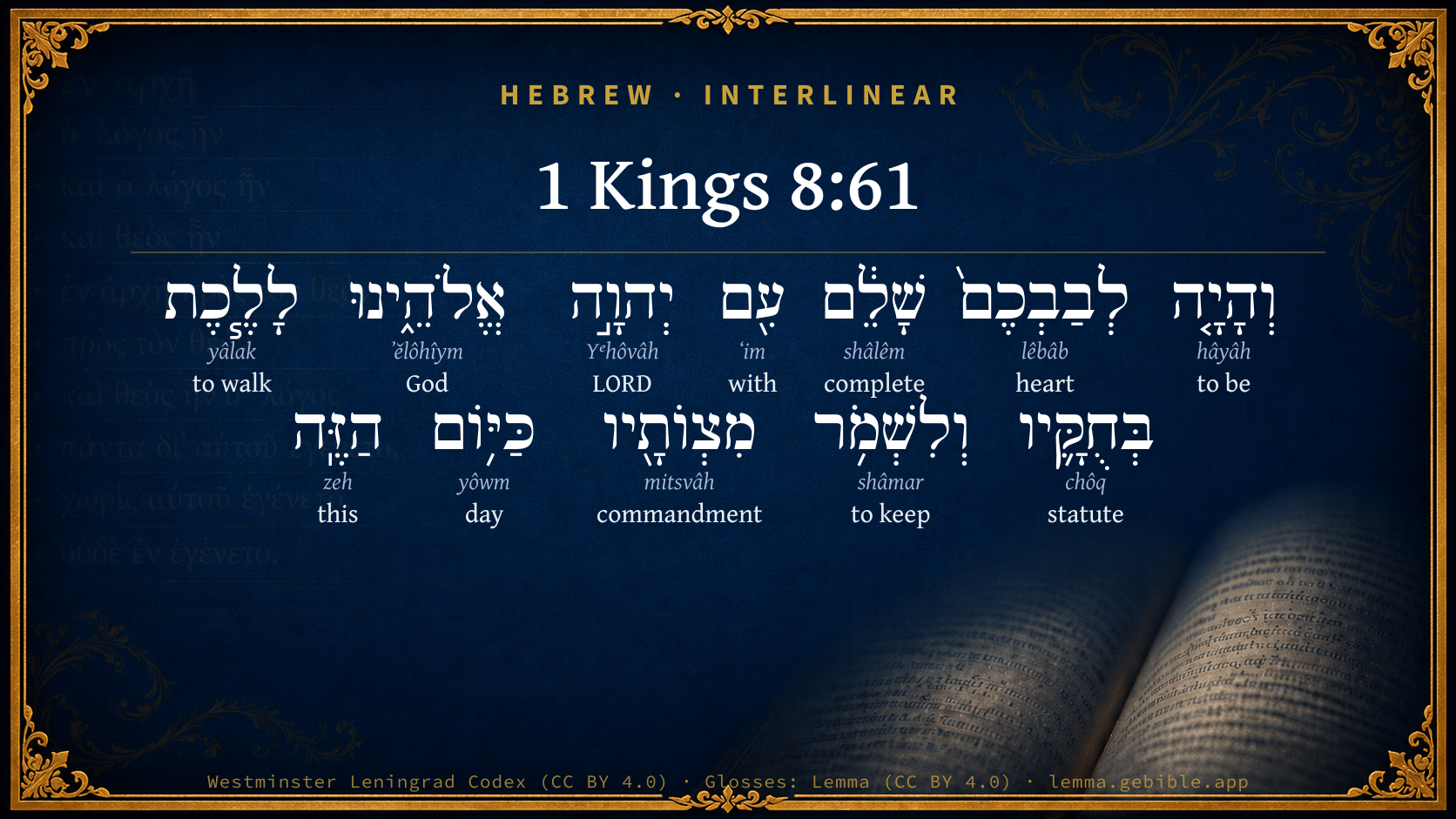
Hebrew (Westminster Leningrad Codex) 1 Kings 8:61 appears in the Hebrew Old Testament. The text above is from the Westminster Leningrad Codex. Each word links to its Strong’s number, a concise gloss, and parsing drawn from the Open Scriptures Hebrew Bible morphology. Click any word for its full Brown-Driver-Briggs (BDB) entry.
Download image
Cite this verse

1 Kings 8:61 (World English Bible). Public Domain. Lemma interlinear Bible study tool, https://lemma.gebible.app/v/1-kings/8/61.

Show BibTeX & RIS
BibTeX
RIS
English Translation
Let your heart therefore be perfect with Yahweh our God, to walk in his statutes, and to keep his commandments, as at this day.
World English Bible · Public Domain
Download a study sheet

One document with this verse’s original text, its word-by-word gloss line, the meaning frame, cross-references with their text, attributed commentary, and full source and license credits — printable, and it pastes into notes with its structure intact.

This verse Autodidact and up

Study sheet (.html) Plain text (.txt)

A passage Seminary Student

Up to 50 verses in one chapter. A passage sheet keeps up to 6 commentary sources and 12 cross-references per verse, in the order this page ranks them, and says so on the sheet whenever that leaves anything out. Ask for a single verse and you get the Autodidact verse sheet above.

Everything on this page stays free to read, with no account — the sheet is a download of what is already on screen, not access to it.

Want to remove ads? Support Godless Engineer
Compare translations 3

The same verse in 3 English versions, stacked beneath the original-language interlinear above. Click any original word for its lexicon entry.

Each is an independent rendering of the whole verse — the interlinear is not word-aligned to these translations.

Highlighted words mark where these versions differ — a whole-verse word diff, not a word-by-word alignment.

  • World English Bible Public Domain
    Let your heart therefore be perfect with Yahweh our God, to walk in his statutes, and to keep his commandments, as at this day.
  • King James Version Public Domain
    Let your heart therefore be perfect with the LORD our God, to walk in his statutes, and to keep his commandments, as at this day.
  • unfoldingWord Literal Text CC BY-SA 4.0
    And may your heart be complete with Yahweh our God, to walk in his statutes and to keep his commandments, as this day.”

unfoldingWord Literal Text — © unfoldingWord, licensed CC BY-SA 4.0. Word-aligned USFM3 via Door43 (git.door43.org/unfoldingWord/en_ult).

Versions to compare (up to 4)

3 of 4 selected

Show all 18 translations

Every available English version of this verse, each an independent rendering of the whole verse.

  • World English Bible Public Domain
    Let your heart therefore be perfect with Yahweh our God, to walk in his statutes, and to keep his commandments, as at this day.
  • Berean Standard Bible Public Domain
    So let your heart be fully devoted to the LORD our God, as it is this day, to walk in His statutes and to keep His commandments.”
  • Majority Standard Bible Public Domain
    So let your heart be fully devoted to the LORD our God, as it is this day, to walk in His statutes and to keep His commandments.”
  • King James Version Public Domain
    Let your heart therefore be perfect with the LORD our God, to walk in his statutes, and to keep his commandments, as at this day.
  • American Standard Version (1901) Public Domain
    Let your heart therefore be perfect with Jehovah our God, to walk in his statutes, and to keep his commandments, as at this day.
  • Revised Version (1885) Public Domain
    Let your heart therefore be perfect with the LORD our God, to walk in his statutes, and to keep his commandments, as at this day.
  • Geneva Bible (1599) Public Domain
    Let your heart therefore be perfit with the Lord our God to walke in his statutes, and to keepe his commandements, as this day.
  • Douay-Rheims (1899) Public Domain
    Let our hearts also be perfect with the Lord our God, that we may walk in his statutes, and keep his commandments, as at this day.
  • Young's Literal Translation Public Domain
    and your heart hath been perfect with Jehovah our God, to walk in His statutes, and to keep His commands, as `at' this day.'
  • Literal Standard Version CC BY-SA 4.0
    and your heart has been perfect with our God YHWH, to walk in His statutes, and to keep His commands, as [at] this day.”
  • Unlocked Literal Bible CC BY-SA 4.0
    Therefore let your heart be true to Yahweh our God, to walk in his statutes and keep his commandments, as on this day.”
  • unfoldingWord Literal Text CC BY-SA 4.0
    And may your heart be complete with Yahweh our God, to walk in his statutes and to keep his commandments, as this day.”
  • Darby Bible Public Domain
    and that your heart may be perfect with Jehovah our God, to walk in his statutes and to keep his commandments, as at this day.
  • World Messianic Bible Public Domain
    “Let your heart therefore be perfect with the LORD our God, to walk in his statutes, and to keep his commandments, as it is today.”
  • Webster's Bible Public Domain
    Let your heart therefore be perfect with the LORD our God, to walk in his statutes, and to keep his commandments, as at this day.
  • Free Bible Version CC BY-SA 4.0
    So make sure you are completely committed to the Lord our God just as you are today, and be careful to follow his statutes and to keep his commandments.”
  • Bible in Basic English Public Domain
    Then let your hearts be without sin before the Lord our God, walking in his laws and keeping his orders as at this day.
  • JPS Tanakh (1917) Public Domain
    Let your heart therefore be whole with the LORD our God, to walk in His statutes, and to keep His commandments, as at this day.'

Literal Standard Version (2020), Covenant Press — licensed CC BY-SA 4.0. Text via the HelloAO Bible API (eBible.org). Unlocked Literal Bible (unfoldingWord) — licensed CC BY-SA 4.0. Text via the HelloAO Bible API (eBible.org). unfoldingWord Literal Text — © unfoldingWord, licensed CC BY-SA 4.0. Word-aligned USFM3 via Door43 (git.door43.org/unfoldingWord/en_ult). Free Bible Version, Dr. Jonathan Gallagher — licensed CC BY-SA 4.0. Text via the HelloAO Bible API (eBible.org).

Word by word

More ways to search: Search by grammar → Find every occurrence → Compare this word →

Practice this passage: Drill this verse → Learn its vocabulary →

שָׁלֵ֔ם
shâlêm
H8003
“complete”
Adjective, Adjective, Masculine, Singular, Absolute
Part of Speech
Adjective
Type
Adjective
Gender
Masculine
Number
Singular
State
Absolute
Full BDB Definition

Origin: from H7999

TWOT: 2401d

complete, safe, peaceful, perfect, whole, full, at peace - complete - full, perfect - finished - safe, unharmed - peace (of covenant of peace, mind) - perfect, complete (of keeping covenant relation)
  1. וְהָיָ֤ה hâyâh H1961 “and · to be” Conjunction + Verb, Qal, Sequential Perfect, 3rd Person, Masculine, Singular
  2. לְבַבְכֶם֙ lêbâb H3824 “heart · your” Noun, Common, Masculine, Singular, Construct + Suffix, Personal, 2nd Person, Masculine, Plural
  3. עִ֖ם ʻim H5973 “with” Preposition
  4. יְהוָ֣ה Yᵉhôvâh H3068 “LORD” Noun, Proper
  5. אֱלֹהֵ֑ינוּ ʼĕlôhîym H430 “God(s) · our” Noun, Common, Masculine, Plural, Construct + Suffix, Personal, 1st Person, Common, Plural
  6. לָלֶ֧כֶת yâlak H3212 “to walk” Preposition + Verb, Qal, Infinitive Construct
  7. בְּחֻקָּ֛יו chôq H2706 “in/at · statutes · his” Preposition + Noun, Common, Masculine, Plural, Construct + Suffix, Personal, 3rd Person, Masculine, Singular
  8. וְלִשְׁמֹ֥ר shâmar H8104 “and · to keep” Conjunction + Preposition + Verb, Qal, Infinitive Construct
  9. מִצְוֺתָ֖יו mitsvâh H4687 “commandments · his” Noun, Common, Feminine, Plural, Construct + Suffix, Personal, 3rd Person, Masculine, Singular
  10. כַּיּ֥וֹם yôwm H3117 “like/as the · day” Preposition, Determined + Noun, Common, Masculine, Singular, Absolute
  11. הַזֶּֽה zeh H2088 “the · this” Particle, Definite Article + Pronoun, Demonstrative, Masculine, Singular

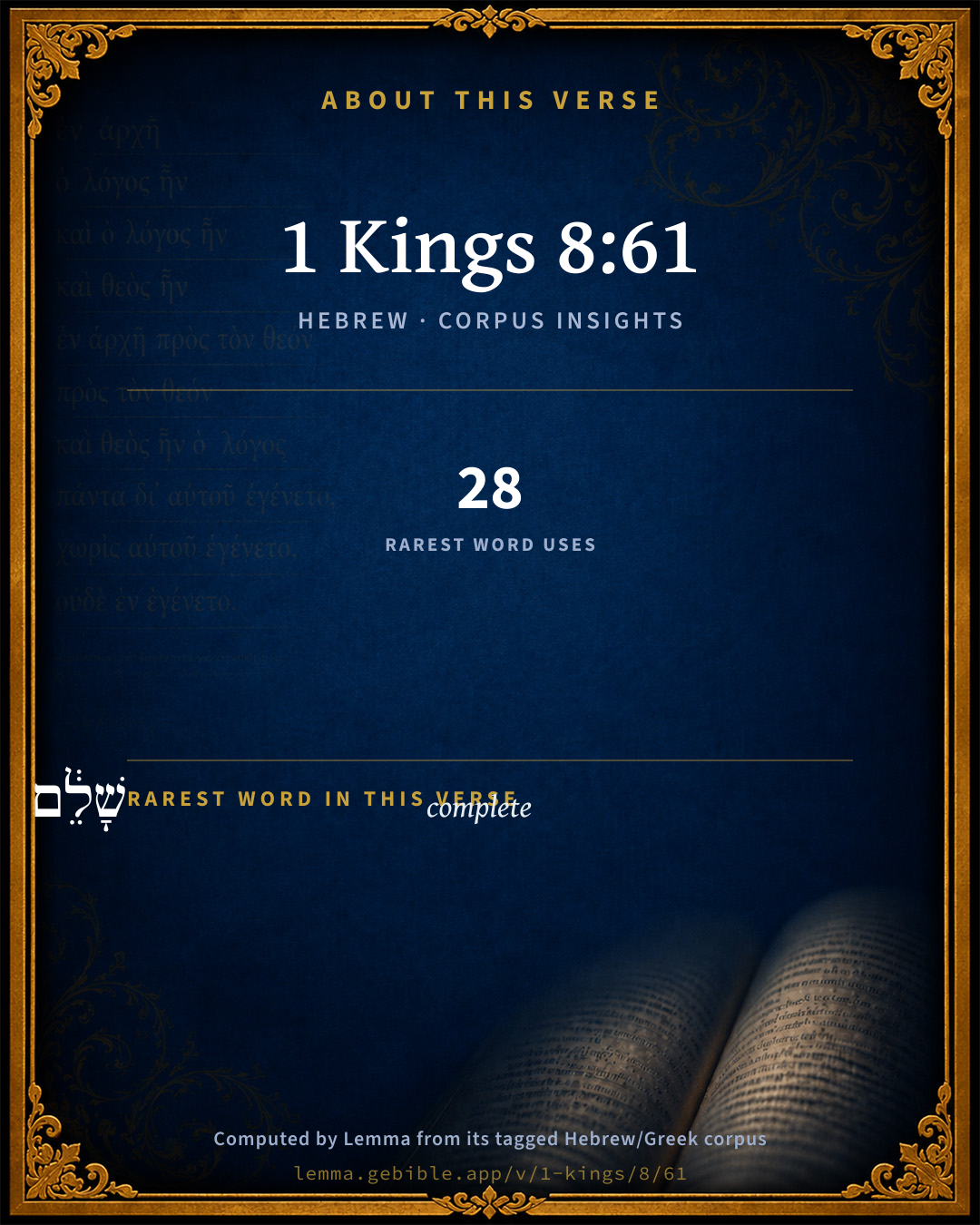
About this verse

These counts appear in no published source. They are computed here, from the morphology-tagged text and Lemma’s own curated glosses. What Lemma adds →

12
words
12
distinct lemmas
Historical
section

Shared distinctive vocabulary

שָׁלֵ֔ם complete H8003 occurs in 27 verses of the Hebrew Bible. Also found in:

Grammatical profile

  • 3 verbs
  • 6 nouns
  • 1 adjective
  • 1 pronoun
  • 1 preposition

Verb forms

  • וְהָיָ֤ה Qal · Sequential Perfect
  • לָלֶ֧כֶת Qal · Infinitive Construct
  • וְלִשְׁמֹ֥ר Qal · Infinitive Construct

Hebrew & Septuagint length

In English translation the verse runs 24 words from the Hebrew and 27 from the Septuagint (LXX English) — closely comparable.

A rough comparison of the two English renderings, which tokenize alike — not a word-level alignment.

Word counts can differ between the Hebrew and the Greek without any difference in meaning — e.g. the Hebrew direct-object marker אֵת has no separate Greek word, and Greek often adds the article ὁ.

Cross-references

12

Topical passages linked to 1 Kings 8:61 in the Treasury of Scripture Knowledge — connected by theme and wording, ordered by reader-vote popularity; previews shown in the World English Bible.

  • 1 Kings 11:4 For it happened, when Solomon was old, that his wives turned away his heart after other gods; and his heart was not perfect with Yahweh his God, as was the heart of David his father.
  • 2 Kings 20:3 Remember now, Yahweh, I beg you, how I have walked before you in truth and with a perfect heart, and have done that which is good in your sight. Hezekiah wept sore.
  • 1 Kings 15:14 But the high places were not taken away: nevertheless the heart of Asa was perfect with Yahweh all his days.
  • Deuteronomy 18:13 You shall be perfect with Yahweh your God.
  • 1 Kings 15:3 He walked in all the sins of his father, which he had done before him; and his heart was not perfect with Yahweh his God, as the heart of David his father.
  • 2 Corinthians 7:1 Having therefore these promises, beloved, let us cleanse ourselves from all defilement of flesh and spirit, perfecting holiness in the fear of God.
  • 1 Chronicles 28:9 You, Solomon my son, know the God of your father, and serve him with a perfect heart and with a willing mind; for Yahweh searches all hearts, and understands all the imaginations of the thoughts: if you seek him, he will be found of you; but if you forsake him, he will cast you off forever.
  • Job 1:8 Yahweh said to Satan, "Have you considered my servant, Job? For there is none like him in the earth, a blameless and an upright man, one who fears God, and turns away from evil."
  • Genesis 17:1 When Abram was ninety-nine years old, Yahweh appeared to Abram, and said to him, "I am God Almighty. Walk before me, and be blameless.
  • Job 1:1 There was a man in the land of Uz, whose name was Job. That man was blameless and upright, and one who feared God, and turned away from evil.
  • Psalms 37:37 Mark the perfect man, and see the upright, For there is a future for the man of peace.
  • Philippians 3:12–16 Not that I have already obtained, or am already made perfect; but I press on, if it is so that I may take hold of that for which also I was taken hold of by Christ Jesus.

Cross-references courtesy of OpenBible.info (CC BY 4.0).

Hebrew and Greek witnesses Masoretic Hebrew ↔ Greek Septuagint

The same verse in the two great witnesses to the Old Testament, shown verse-for-verse.

These are two independent witnesses, not word-aligned to each other, and the Septuagint is shown in lemma (dictionary) form.

Hebrew 1 Kings 8:61 Masoretic · Westminster Leningrad Codex

וְהָיָ֤ה לְבַבְכֶם֙ שָׁלֵ֔ם עִ֖ם יְהוָ֣ה אֱלֹהֵ֑ינוּ לָלֶ֧כֶת בְּחֻקָּ֛יו וְלִשְׁמֹ֥ר מִצְוֺתָ֖יו כַּיּ֥וֹם הַזֶּֽה

Let your heart therefore be perfect with Yahweh our God, to walk in his statutes, and to keep his commandments, as at this day.

World English Bible · Public Domain

Greek LXX 1 Kings 8:61 Septuagint · lemma form

καί εἰμί ὁ καρδία ἐγώ τέλειος πρός κύριος θεός ἐγώ καί ὁσίως πορεύομαι ἐν ὁ πρόσταγμα αὐτός καί φυλάσσω ἐντολή αὐτός ὡς ὁ ἡμέρα οὗτος

And let our hearts be perfect toward the Lord our God, to walk also holily in his ordinances, and to keep his commandments, as at this day.

LXX2012 (modern English Septuagint) · Public Domain

Hebrew: Westminster Leningrad Codex (CC BY 4.0). Greek: Septuagint (public domain); English from LXX2012 (modern English Septuagint) (Public Domain). How the Septuagint differs from the Hebrew →

Targum (Aramaic paraphrase)

1

The Targum is the ancient Jewish Aramaic paraphrase of the Hebrew Scriptures — an interpretive translation, not the Hebrew text itself. Onkelos (literal) and Pseudo-Jonathan (expansive) render the Torah, and Jonathan the Prophets. Coverage is partial: where no permissively-licensed English translation exists for a verse, only the Aramaic is shown. This is verse-level text, not a word-by-word alignment to the Hebrew.

  1. Targum Jonathan Prophets (Joshua–Malachi)
    וִיהֵי לִבְּכוֹן שְׁלִים בִּדְחַלְתָּא דַייָ אֱלָהָנָא לִמְהַךְ בִּקְיָמוֹהִי וּלְמִטַר פִּקוּדוֹהִי כְּיוֹמָא הָדֵין:

    (no public-domain English translation for this verse)

    Targum Jonathan — Aramaic: “Mikraot Gedolot” (public domain). English: “Sefaria Community Translation” (CC0 1.0 (public-domain dedication)); “London "Chaldee Paraphrase," 1871” (public domain). Text via Sefaria.

Commentary

Notes on 1 Kings 8:61 from classic Christian and Jewish commentators (each source and its license shown beneath its notes). The classic Christian expositions comment on the surrounding passage and are grouped to its opening verse, so a note may address several verses; the Jewish commentaries on the Tanakh (Rashi and others) are per-verse, so they appear only where the commentator wrote on this verse.

Lemma curates 59 commentaries, every one of them public domain or Creative Commons licensed, each selected and text-cleaned for this edition rather than reprinted as found. About our sources →

Trapp's Complete Commentary

John Trapp

1Ki 8:61 Let your heart therefore be perfect with the LORD our God, to walk in his statutes, and to keep his commandments, as at this day.

Ver. 61. As at this day.] Keep up your affections as much as may be, in this float wherein now you find them.

John Trapp, A Commentary or Exposition upon All the Books of the Old and New Testament (1647–1656) — public domain. Text from a community e-Sword module.

Joseph Benson's Commentary

1Ki 8:61. Let your heart therefore be perfect with the Lord your God — Be sincere and serious in your purposes of new obedience. Let it be universal, without dividing; upright, without dissembling; and constant, without declining. Thus having spoken to God for them, he here speaks from God to them; and those only would be the better for his prayers, that were made better by his preaching.

Joseph Benson's Commentary on the Old and New Testaments (1811–1818) — public domain. Text from a community e-Sword module.

Adam Clarke's Commentary

Verse 61. Let your heart therefore be perfect] Be sincere in your faith, be irreproachable in your conduct.

Adam Clarke's Commentary on the Bible (1810–1826) — public domain. Text from a community e-Sword/MySword module.

The Cambridge Bible for Schools and Colleges

gen. ed. J. J. S. Perowne

61. perfect] i.e. ‘Entirely surrendered’ (shâläm). So in Arabic islam = religion as entire submission; moslem, the religious man as entirely devoted.

The Cambridge Bible for Schools and Colleges (gen. ed. J. J. S. Perowne; Cambridge University Press, 1878–1918) — public domain. Text from a community e-Sword module.

John Gill's Exposition

The same day did the king hallow the middle of the court that was before the house of the Lord,.... The court of the priests that was before the holy place, adjoining to it, in which was the altar of burnt offering; this, or, however, the middle part of it, he sanctified for present use, to offer sacrifices on, for a reason hereafter given:

for there he offered burnt offerings and meat offerings, and the fat of the peace offerings; which was the reason why the middle of the great court was for this time set apart for this service.

John Gill's Exposition of the Whole Bible (1746–1763) — public domain (CC PDM 1.0). Text via the HelloAO Bible API.

Albert Barnes' Notes on the Bible

As at this day - i. e. “as ye are now doing, in coming with pious intentions to this festival.”

Albert Barnes' Notes on the Bible (1834–1885) — public domain. Text from a community e-Sword/MySword module.

Matthew Poole's English Annotations

Perfect, i.e. sincere and serious in your purposes of obedience; for sinless perfection he himself taught them was not to be expected here, Ecc 7:20.

Matthew Poole's English Annotations on the Holy Bible (1683–1685) — public domain. Text from a community e-Sword/MySword module.

The Pulpit Commentary

Let your heart therefore be perfect with the Lord our God An instructive commentary on these words is found in 1Ki_11:4, where it is said of this Solomon, "His heart was not perfect," etc. same words. Similarly, ib. vers. 3, 9 are a comment on the prayer of ver. 58. Having preached to others, he himself became a castaway, to walk in his statutes, and to keep his commandments, us at this day That day the nation proved its piety by the dedication of the house.

At the close of this prayer (omitted in Chronicles), according to 2Ch_7:1, "fire came down from heaven and consumed the burnt offering and the sacrifices, and the glory of the Lord filled the house," but Bahr rejects these words as an interpolation. He maintains, indeed, that the chronicler contradicts himself, for we can hardly think that the glory which we are told (1Ki_5:14) had already filled the house, left it and then returned. It is certainly suspicious, and a much stronger argument against the words in question, that no mention of the fire is made by our author, for, brief as this history is, it is difficult to believe that so signal an interposition could have remained unnoticed, if it really occurred.

HOMILIES BY J. WAITE Ver. 61.

A Royal Benediction.

The prayer of Solomon is followed by a benediction. "He stood and blessed all the congregation," etc. (vers. 54, 55). But though he assumed for the time the priestly function, his utterance was not cast into the usual form of priestly benediction. It was rather an ascription of praise to the God who had fulfilled His promises and given rest to His people, and an exhortation to them that they on their part should follow that path of life in which alone they could hope to realize the further fulfilment of those promises, and enjoy the heritage of blessing that was theirs. Lessons are suggested here that are of force and value for all time.

I THE RELATION BETWEEN TRUE PRAYER AND PERSONAL RIGHTEOUSNESS. Solomon felt that all the impassioned supplications that he had been pouring out before the Lord, and all the sympathetic enthusiasm of the people in these temple services, would be but a mockery unless he and they were prepared to walk with all fidelity in the way of God"s commandments. They would soon be leaving the sacred shrine of worship. They could not always be amid the ecstatic and rapturous associations of the temple. They must go back to the matter of fact, prosaic world, to their posts of honour and responsibility, to the privacy of their homes, to their haunts of busy life, to their paths of commerce and of labour. Let them worship there. Let them dwell with God there. Let them embody there, in all the forms of practical virtue, the spirit of devotion that has inspired them amid these hallowed scenes. The "statutes and commandments" of the Lord had reference in great part to the due observance of the ritual of temple worship, but they also claimed, as much then as now, to control the whole spirit and conduct of human life in all its aspects. The relation between prayer and conduct is of a twofold character. They act and react the one on the other. True prayer sheds a hallowing influence over the entire field of a man"s daffy activity. When his soul has been face to face with God, absorbed in Divine communion, the inspiration of holy thought and feeling of which he has been conscious will inevitably betray itself in the way in which he acts when he mingles with the things and the beings of earth. The glory of heaven that has shone upon him cannot fail to be reflected in the beauty of his character and deed. A prayerful spirit is an earnest, pure, upright, loving spirit, and such a spirit will govern the whole form and method and aim of a man"s life. Prayer solves difficulties, clears one"s vision of the path of duty, draws strength from Divine sources for all toil and suffering, raises the tone and level of moral action, fortifies the spirit for any emergency, fills the heart with the peaceful joy of a better world. On the other hand, the conduct of life necessarily affects for good or ill the spirit and efficacy of prayer. If it is needful to pray in order that we may live as Christians, it is equally needful that we should live as Christians in order rightly to pray. The importance of prayer as one chief function of spiritual life doubles the importance of all our actions, because our prayers are so much as our doings are. According as we stand towards the world, with all the social relationships and duties that belong to our place in it, so do we stand before the mercy seat. Think, for instance, how the beneficial effect of family prayer may be nullified by the prevailing spirit of family life. By the discord that may be allowed to reign in it, by its lack of the graces of mutual respect and loving self sacrifice, by the worldliness of its associations, the meanness of its ambitions, the frivolity of its pleasures, the vanity of its cherished societies how completely may the soul of domestic devotion be destroyed. Let aman be morally reckless in the intercourse and transactions of daily life, and all freedom, "boldness," gladness in prayer is at an end. Anything like loving, confiding converse with the "Father who seeth in secret" is impossible to him. If he cannot look without fear and shame in the face of his fellow man, how shall he dare to look in the face of God? The "heavens become as brass" above his head which no voice of prayer can penetrate. When Saul"s heart is thoroughly set in him to do evil it is vain for him to inquire of the Lord. "The Lord answers him no more, neither by Urim, nor by prophet, nor by dream." Let there be a Divine unity and harmony in our life. Let our conduct in all human relationships show us to be what, in our hours of devotion, we seem to ourselves to be. Let it be our ambition every day" to live more nearly as we pray.

II THE RELATION BETWEEN PRACTICAL VIRTUE AND THE STATE OF THE SECRET HEART. A man"s heart must be "perfect with the Lord" before he can walk acceptably in the path of His commandments. The old legal economy was not after all so superficial as it seemed to be. God"s commandment was "exceeding broad." Literal as the moral laws were, and formal as the ceremonial precepts, they touched at every point the life of the spirit within. "Moses describeth the righteousness which is of the law, That the man who doeth these things shall live by them", (Rom_10:5) but the righteousness was not in the mere doing. David, the noblest representative of the spirit of the law, well knew that as it is from the fountain of the evil heart that all transgression proceeds, so from the purified heart springs all practical righteousness. "Create in me a clean heart, O God," etc. (Psa_51:10) The glory of Christianity is that it not only recognizes this principle, but actually brings to bear on the heart the renewing, healing power. It cleanses the fountain of life within. The law could disclose the secret evil, convince of sin, rebuke, restrain, but it could not make men righteous. The gospel does. "Christ is the end of the law for righteousness," etc. (Rom_10:4) "What the law could not do," etc. (Rom_8:8, Rom_8:4) Keep your heart in habitual contact with the highest sources of spiritual inspiration in familiar converse with Him who is the fountain of truth and purity and love. Watch over its most secret thoughts and impulses. Guard its sensibilities from the contaminations of the world and the hardening influences of life. Seek to preserve the freshness of its Divine affections and the integrity of its allegiance to Christ, if you would walk as He did, "in loveliness of perfect deeds.

III THE BENEFICIAL INFLUENCE OF A SACRED MEMORY. "As it is this day." Solomon would have that day to dwell in their memories and hallow all their days. Times of special Divine manifestation and highest religious consciousness show us what we may be, what God would have us to be, what is the true level of our spirit"s life. W.

The Pulpit Commentary (1880–1919), ed. H.D.M. Spence-Jones & Joseph S. Exell — public domain. Text from a community e-Sword module.

John Wesley's Explanatory Notes

Perfect - Let your obedience be universal, without dividing; upright, without dissembling; and constant, without declining.

John Wesley, Explanatory Notes Upon the Whole Bible (1754–1765) — public domain. Text via the GEBible commentary corpus.

Keil & Delitzsch

C. F. Keil & F. Delitzsch

Let your heart be יי עם שׁלם, wholly, undividedly devoted to the Lord (cf. Kg1 11:4; Kg1 15:3, Kg1 15:14, etc.).

Keil & Delitzsch — Biblical Commentary on the Old Testament (1861–1891) — public domain (CC PDM 1.0). Text via the HelloAO Bible API. (Old Testament only.)

Scofield Reference Notes

C. I. Scofield

perfect

The word implies whole-heartedness for God, single-mindedness, sincerity -- not sinless perfection.

The Scofield Reference Bible (1917 edition), notes by C. I. Scofield — public domain. Text from a community e-Sword module.

Lesson kit

Teaching starters — assembled from the data on this page, not authored interpretation. Every prompt links to the verse data it draws on. Edit before teaching.

1 Kings, in the Historical, opens this verse with 12 words (12 distinct Hebrew lemmas). Its most distinctive word is shâlêm (“complete”). A historical commentator’s framing appears above. Read the whole chapter for the surrounding context.

Discussion questions

  1. What does “complete” (shâlêm) contribute to the verse as a whole?
  2. Genesis 15:16 shares the word «complete» with this verse. How do the two illuminate each other?
  3. The translations on this page render this verse differently — a whole-verse word diff, not a word-by-word alignment. What might account for the different wordings?
  4. The verb «וְהָיָ֤ה» is Qal Sequential Perfect. How does its form color the action?
  5. Reading how Trapp's Complete Commentary and Joseph Benson's Commentary read this verse, where do the two commentators agree and where do they part?

Things to notice

Reading settings

Reading text

Shown beneath each verse's original-language words.

Old Testament
Old Testament edition

Read the OT as the Masoretic Hebrew (MT) or the Greek Septuagint (LXX).

English shown for the Greek Septuagint (in the Hebrew ↔ Greek comparison).

Comparing translations? Open the Compare panel on any verse page to stack up to four side by side.