Nehemiah 11:23

Hebrew (Westminster Leningrad Codex) Nehemiah 11:23 appears in the Hebrew Old Testament. The text above is from the Westminster Leningrad Codex. Each word links to its Strong’s number, a concise gloss, and parsing drawn from the Open Scriptures Hebrew Bible morphology. Click any word for its full Brown-Driver-Briggs (BDB) entry.
Download image
Cite this verse

Nehemiah 11:23 (World English Bible). Public Domain. Lemma interlinear Bible study tool, https://lemma.gebible.app/v/nehemiah/11/23.

Show BibTeX & RIS
BibTeX
RIS
English Translation
For there was a commandment from the king concerning them, and a settled provision for the singers, as every day required.
World English Bible · Public Domain
Download a study sheet

One document with this verse’s original text, its word-by-word gloss line, the meaning frame, cross-references with their text, attributed commentary, and full source and license credits — printable, and it pastes into notes with its structure intact.

This verse Autodidact and up

Study sheet (.html) Plain text (.txt)

A passage Seminary Student

Up to 50 verses in one chapter. A passage sheet keeps up to 6 commentary sources and 12 cross-references per verse, in the order this page ranks them, and says so on the sheet whenever that leaves anything out. Ask for a single verse and you get the Autodidact verse sheet above.

Everything on this page stays free to read, with no account — the sheet is a download of what is already on screen, not access to it.

Want to remove ads? Support Godless Engineer
Compare translations 3

The same verse in 3 English versions, stacked beneath the original-language interlinear above. Click any original word for its lexicon entry.

Each is an independent rendering of the whole verse — the interlinear is not word-aligned to these translations.

Highlighted words mark where these versions differ — a whole-verse word diff, not a word-by-word alignment.

  • World English Bible Public Domain
    For there was a commandment from the king concerning them, and a settled provision for the singers, as every day required.
  • King James Version Public Domain
    For it was the king's commandment concerning them, that a certain portion should be for the singers, due for every day.
  • unfoldingWord Literal Text CC BY-SA 4.0
    For the commandment of the king was upon them, that support for the ones who sang was a daily matter in its day.

unfoldingWord Literal Text — © unfoldingWord, licensed CC BY-SA 4.0. Word-aligned USFM3 via Door43 (git.door43.org/unfoldingWord/en_ult).

Versions to compare (up to 4)

3 of 4 selected

Show all 18 translations

Every available English version of this verse, each an independent rendering of the whole verse.

  • World English Bible Public Domain
    For there was a commandment from the king concerning them, and a settled provision for the singers, as every day required.
  • Berean Standard Bible Public Domain
    For there was a command from the king concerning the singers, an ordinance regulating their daily activities.
  • Majority Standard Bible Public Domain
    For there was a command from the king concerning the singers, an ordinance regulating their daily activities.
  • King James Version Public Domain
    For it was the king's commandment concerning them, that a certain portion should be for the singers, due for every day.
  • American Standard Version (1901) Public Domain
    For there was a commandment from the king concerning them, and a settled provision for the singers, as every day required.
  • Revised Version (1885) Public Domain
    For there was a commandment from the king concerning them, and a settled provision for the singers, as every day required.
  • Geneva Bible (1599) Public Domain
    For it was the Kings commandement cocerning them, that faithfull prouision shoulde bee for the singers euery day.
  • Douay-Rheims (1899) Public Domain
    For the king's commandment was concerning them, and an order among the singing men day by day.
  • Young's Literal Translation Public Domain
    for the command of the king `is' upon them, and support `is' for the singers, a matter of a day in its day.
  • Literal Standard Version CC BY-SA 4.0
    for the command of the king [is] on them, and support [is] for the singers, a matter of a day in its day.
  • Unlocked Literal Bible CC BY-SA 4.0
    They were under orders from the king, and firm orders were given for the singers as every day required.
  • unfoldingWord Literal Text CC BY-SA 4.0
    For the commandment of the king was upon them, that support for the ones who sang was a daily matter in its day.
  • Darby Bible Public Domain
    For it was the king's commandment concerning them, and there was a settled portion for the singers, due for each day.
  • World Messianic Bible Public Domain
    For there was a commandment from the king concerning them, and a settled provision for the singers, as every day required.
  • Webster's Bible Public Domain
    For it was the king's commandment concerning them, that a certain portion should be for the singers, due for every day.
  • Free Bible Version CC BY-SA 4.0
    They had specific orders from the king who had instructed them to perform a daily service.
  • Bible in Basic English Public Domain
    For there was an order from the king about them and a regular amount for the music-makers, for their needs day by day.
  • JPS Tanakh (1917) Public Domain
    For there was a commandment from the king concerning them, and a sure ordinance concerning the singers, as every day required.

Literal Standard Version (2020), Covenant Press — licensed CC BY-SA 4.0. Text via the HelloAO Bible API (eBible.org). Unlocked Literal Bible (unfoldingWord) — licensed CC BY-SA 4.0. Text via the HelloAO Bible API (eBible.org). unfoldingWord Literal Text — © unfoldingWord, licensed CC BY-SA 4.0. Word-aligned USFM3 via Door43 (git.door43.org/unfoldingWord/en_ult). Free Bible Version, Dr. Jonathan Gallagher — licensed CC BY-SA 4.0. Text via the HelloAO Bible API (eBible.org).

Word by word

More ways to search: Search by grammar → Find every occurrence → Compare this word →

Practice this passage: Drill this verse → Learn its vocabulary →

וַאֲמָנָ֥ה
ʼămânâh
H548
“and · faith”
Conjunction + Noun, Common, Feminine, Singular, Absolute
Part of Speech
Conjunction + Noun
Type
Common
Gender
Feminine
Number
Singular
State
Absolute
Full BDB Definition

Origin: from H543

TWOT: 116h

faith, support, sure, certain - of a covenant - of financial support
  1. כִּֽי kîy H3588 “that” Conjunction
  2. מִצְוַ֥ת mitsvâh H4687 “commandment of” Noun, Common, Feminine, Singular, Construct
  3. הַמֶּ֖לֶךְ melek H4428 “the · king” Particle, Definite Article + Noun, Common, Masculine, Singular, Absolute
  4. עֲלֵיהֶ֑ם ʻal H5921 “upon · them” Preposition + Suffix, Personal, 3rd Person, Masculine, Plural
  5. עַל ʻal H5921 “upon” Preposition
  6. הַמְשֹׁרְרִ֖ים shîyr H7891 “the · singing” Particle, Definite Article + Verb, Polel, Participle Active, Masculine, Plural, Absolute
  7. דְּבַר dâbâr H1697 “word of” Noun, Common, Masculine, Singular, Construct
  8. י֥וֹם yôwm H3117 “day” Noun, Common, Masculine, Singular, Absolute
  9. בְּיוֹמֽוֹ yôwm H3117 “in/at · day · his” Preposition + Noun, Common, Masculine, Singular, Construct + Suffix, Personal, 3rd Person, Masculine, Singular

About this verse

These counts appear in no published source. They are computed here, from the morphology-tagged text and Lemma’s own curated glosses. What Lemma adds →

10
words
8
distinct lemmas
Historical
section

Notable vocabulary

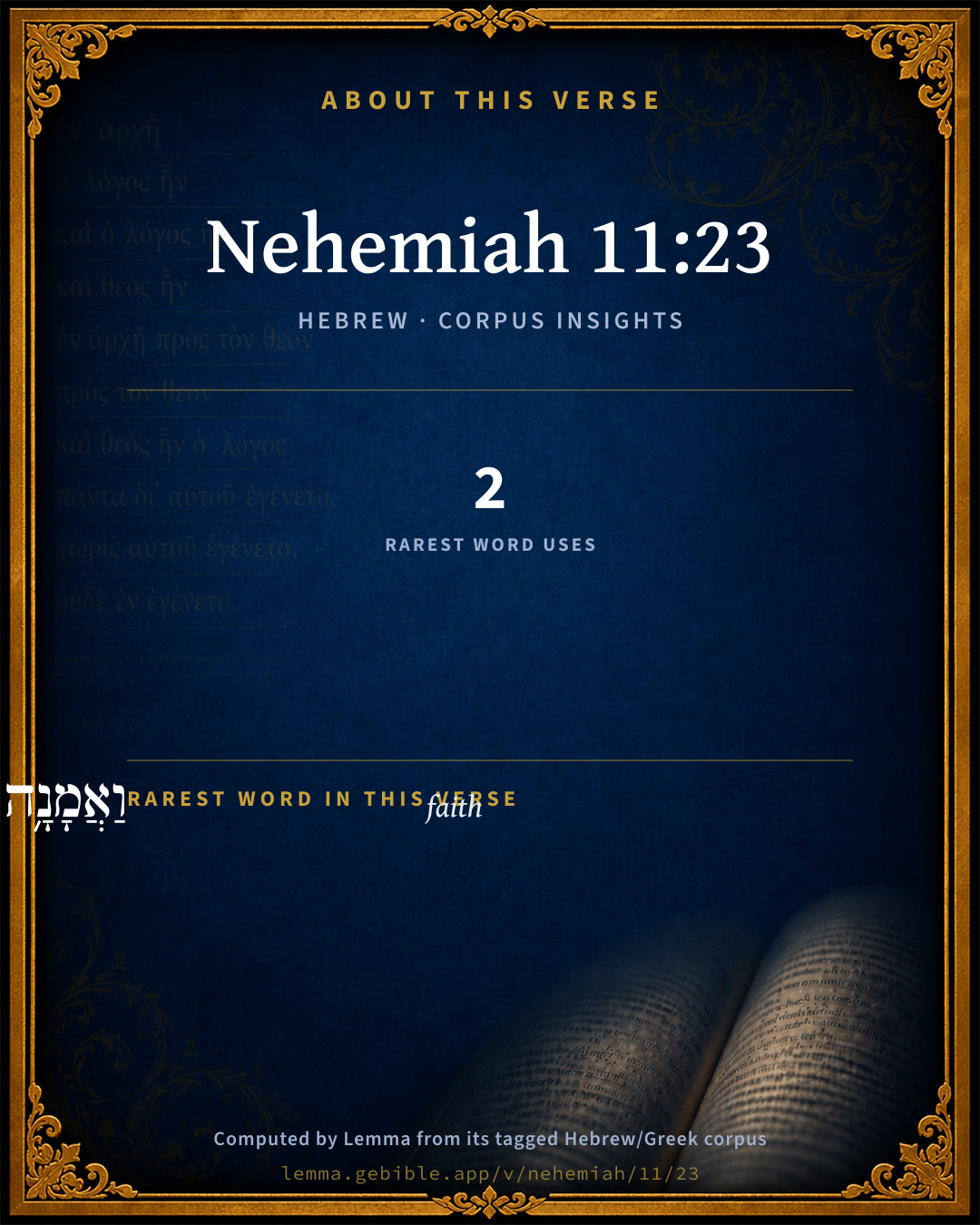
The rarest word here is וַאֲמָנָ֥ה faith H548 — appearing just 2 times in the whole Hebrew Bible.

Shared distinctive vocabulary

וַאֲמָנָ֥ה faith H548 occurs in 2 verses of the Hebrew Bible. Also found in:

Grammatical profile

  • 1 verb
  • 6 nouns
  • 2 prepositions
  • 1 conjunction

Verb forms

  • הַמְשֹׁרְרִ֖ים Polel · Participle Active

Repetition

Words recur within this verse — often emphatic in Hebrew:

  • עֲלֵיהֶ֑ם upon H5921 ×2
  • י֥וֹם day H3117 ×2

Cross-references

4

Topical passages linked to Nehemiah 11:23 in the Treasury of Scripture Knowledge — connected by theme and wording, ordered by reader-vote popularity; previews shown in the World English Bible.

  • 1 Chronicles 9:33 These are the singers, heads of fathers' [houses] of the Levites, [who lived] in the chambers [and were] free [from other service]; for they were employed in their work day and night.
  • Ezra 6:8–9 Moreover I make a decree what you shall do to these elders of the Jews for the building of this house of God: that of the king's goods, even of the tribute beyond the River, expenses be given with all diligence to these men, that they be not hindered.
  • Ezra 7:20–24 Whatever more shall be needful for the house of your God, which you shall have occasion to bestow, bestow it out of the king's treasure-house.
  • Nehemiah 12:47 All Israel in the days of Zerubbabel, and in the days of Nehemiah, gave the portions of the singers and the porters, as every day required: and they set apart [that which was] for the Levites; and the Levites set apart [that which was] for the sons of Aaron.

Cross-references courtesy of OpenBible.info (CC BY 4.0).

Hebrew and Greek witnesses Masoretic Hebrew ↔ Greek Septuagint

The same verse in the two great witnesses to the Old Testament, shown verse-for-verse.

These are two independent witnesses, not word-aligned to each other, and the Septuagint is shown in lemma (dictionary) form.

Hebrew Nehemiah 11:23 Masoretic · Westminster Leningrad Codex

כִּֽי מִצְוַ֥ת הַמֶּ֖לֶךְ עֲלֵיהֶ֑ם וַאֲמָנָ֥ה עַל הַמְשֹׁרְרִ֖ים דְּבַר י֥וֹם בְּיוֹמֽוֹ

For there was a commandment from the king concerning them, and a settled provision for the singers, as every day required.

World English Bible · Public Domain

Greek LXX Structure differs

The Septuagint has no separate book of Nehemiah. Its Greek text is the second half of Esdras B (2 Esdras), chapters 11–23; Ezra is the first half (1–10).

A verse-for-verse comparison isn’t shown here because the chapters and verses don’t line up. Switch to the LXX edition with the MT / LXX toggle above to read the Greek directly.

On this verse, The Cambridge Bible for Schools and Colleges discusses the Septuagint’s reading. Read the note in Commentary ↓

Hebrew: Westminster Leningrad Codex (CC BY 4.0). Greek: Septuagint (public domain); English from a public-domain English Septuagint. How the Septuagint differs from the Hebrew →

Commentary

Notes on Nehemiah 11:23 from classic Christian and Jewish commentators (each source and its license shown beneath its notes). The classic Christian expositions comment on the surrounding passage and are grouped to its opening verse, so a note may address several verses; the Jewish commentaries on the Tanakh (Rashi and others) are per-verse, so they appear only where the commentator wrote on this verse.

Lemma curates 59 commentaries, every one of them public domain or Creative Commons licensed, each selected and text-cleaned for this edition rather than reprinted as found. About our sources →

Trapp's Complete Commentary

John Trapp

Neh 11:23 For [it was] the king’s commandment concerning them, that a certain portion should be for the singers, due for every day.

Ver. 23. The king’s] viz. Of Persia, Ezr 6:8-9; Ezr 7:2; Ezr 7:24.

John Trapp, A Commentary or Exposition upon All the Books of the Old and New Testament (1647–1656) — public domain. Text from a community e-Sword module.

Joseph Benson's Commentary

Neh 11:23. It was the king’s commandment, &c. — That is, as it is generally thought, the commandment of the king of Persia, who, out of his great munificence, gave it for their better support, it being common in all countries to have a particular regard for those who sung hymns in praise of their gods. Houbigant renders the words, was at the king’s hand, in the next verse, was the king’s minister.

Joseph Benson's Commentary on the Old and New Testaments (1811–1818) — public domain. Text from a community e-Sword module.

Jamieson, Fausset & Brown

Robert Jamieson, A. R. Fausset & David Brown

it was the king's commandment--It was the will of the Persian monarch in issuing his edict that the temple service should be revived in all its religious fulness and solemnity. As this special provision for the singers is said to have been by the king's commandment, the order was probably given at the request or suggestion of Ezra or Nehemiah.

Jamieson, Fausset & Brown — Commentary Critical and Explanatory on the Whole Bible (1871) — public domain (CC PDM 1.0). Text via the HelloAO Bible API.

Adam Clarke's Commentary

Verse 23. It was the king's commandment] By the king some understand David, and others Artaxerxes. It is most probable that it was the latter; who wished that a provision should be made for these, a part of whose office was to offer up prayers also, as well as praises. For we know that Darius made an ample provision for the priests, that they might offer sacrifices of sweet savour unto the God of heaven; and pray for the life of the king and of his sons, Ezr 6:10. Some have thought that they had been Jewish singers employed in the service of the Persian king, to whom he had given a salary, and to whom he wished still to continue the same.

Adam Clarke's Commentary on the Bible (1810–1826) — public domain. Text from a community e-Sword/MySword module.

Ellicott's Commentary for English Readers

(23) The king’s commandment.—It seems that Artaxerxes had gone beyond the exemption of Ezr_7:24, and given them a daily allowance, which it was the business of Uzzi to see to.

A Bible Commentary for English Readers, edited by Charles John Ellicott (1878–1897) — public domain. Text from a community e-Sword module.

The Cambridge Bible for Schools and Colleges

gen. ed. J. J. S. Perowne

23. For it was] R.V. For there was.

the king’s commandment] R.V. a commandment from the king.

That this was the Persian king Artaxerxes is shown by the reference to ‘the king’ in Neh_11:24, and by the similar instances of favour to the Temple at Jerusalem on the part of Artaxerxes. Cf. Neh_2:8; Ezr_7:20-24.

concerning them] Who are spoken of? the singers, the Levites, or their officers and overseers?

The context seems in favour of the Levites. The name of Uzzi who was at once ‘overseer’ of the Levites and by descent of the family of Asaph, suggested the parenthetical statement, that there was a royal edict in favour of the Levitical community, and a special provision made for the singers.

that a certain portion should be for] R.V. and a settled provision for. Marg. ‘Or, a sure ordinance concerning’. The clause is not dependent on (as A.V.), but co-ordinate with its predecessor. The word rendered ‘settled provision’ (emanah) is that rendered ‘a sure covenant’ in Neh_9:38. An abstract word, it perhaps denotes the fixity of the arrangement on behalf of the singers rather than the nature of its provisions. ‘Sure ordinance’ is therefore to be preferred as a rendering; and this rendering presents a closer parallel to ‘commandment.’

due for every day] R.V. as every day required. Cf. Neh_12:47. Literally, ‘the thing of a day on its day,’ as LXX. λόγος ἑκάστης ἡμέρας ἐν τῇ ἡμέρᾳ αὐτοῦ. A common Hebrew phrase, e.g. Exo_5:13; Exo_5:19; Exo_16:4; Lev_23:37; 1Ki_8:59; 2Ki_25:30; 1Ch_16:37; 2Ch_8:14; 2Ch_31:16; Ezr_3:4; Jer_52:34; Dan_1:5.

The Cambridge Bible for Schools and Colleges (gen. ed. J. J. S. Perowne; Cambridge University Press, 1878–1918) — public domain. Text from a community e-Sword module.

Albert Barnes' Notes on the Bible

The goodwill of Artaxerxes toward the ministers employed in the temple service, had been previously shown by his exempting them from taxation of every kind Ezr 7:24. Now, it would seem, he had gone further and assigned to the singers an allowance from the royal revenue.

Albert Barnes' Notes on the Bible (1834–1885) — public domain. Text from a community e-Sword/MySword module.

Haydock's Catholic Bible Commentary

King’s. David’s, (chap. xii. 24,) or perhaps the Persian monarch, who had appointed a maintenance for the priests, &c., 1 Esdras vi., and vii. (Calmet) --- Order. Hebrew, "that a certain portion should be for the singers, due for every day." (Protestants)

George Leo Haydock (1774–1849), Haydock's Catholic Family Bible and Commentary, 1859 edition — public domain. Excludes Psalms (Douay-Rheims chapter numbering differs from Protestant) and Deuterocanonical books (Catholic canon only).

Matthew Poole's English Annotations

For; or, therefore; for the following words contain either a reason why they were set over that business, or a recompence for it, or a provision that they might diligently attend to it.

The king’s commandment; either,

1. David’s, who made this constitution. Or rather,

2. The kings of Persia, who is called simply the king in the next verse also; who took this care at the request and by the direction of Ezra or Nehemiah. Or this might be Nehemiah’s command, which is called the king’s command, because it was done by the king’s deputy, or a commissioner whom the king empowered to do what he saw fit for the house and service of God, commanding all the people to obey him therein; as he had formerly done to Ezra, Ezr 7:18,20,23.

Matthew Poole's English Annotations on the Holy Bible (1683–1685) — public domain. Text from a community e-Sword/MySword module.

Whedon's Commentary on the Bible

Daniel D. Whedon

23. The king’s commandment — The king here referred to is not David, who originally arranged and made provision for the Levites, (1 Chronicles 23-26,) but the Persian king, Artaxerxes, who gave commandment concerning them to Ezra. Compare his decree, Ezr_7:12-26.

A certain portion — אמנה, a firm, or sure agreement, a covenant. The English version gives the view of many interpreters, who understand that a stipulated allowance of food was granted to the singers. But the Hebrew may be thus literally rendered: and an agreement was upon the singers, a matter of day in its day. That is, the singers were bound by a settled agreement to perform a certain amount of service on each particular day. Each day had its own matter of service for these singers. Perhaps, however, the thought of allowance may also be included.

Daniel D. Whedon (gen. ed.), Commentary on the Old and New Testaments (1874–1909) — public domain. Text from a community e-Sword module.

The Pulpit Commentary

For it was the king"s commandment concerning them. Artaxerxes, it appears, had assigned a certain stipend from the royal revenue for the support of such Levites as were singers, and this stipend had to be paid to them day by day. It is suggested as the grounds for this special favour

1. That the Levites engaged in the choral service were regarded as those especially who prayed "for the life of the king and of his sons"; (Ezr_6:10) and,

2. That the singing Levites who returned from Babylon, being so few in number (128), had to be constantly on duty in the temple, and so needed a regular daily stipend. The nexus of this verse with the preceding one implies that the payment in question was an important part of the internal business of the house committed to Uzzi.

The Pulpit Commentary (1880–1919), ed. H.D.M. Spence-Jones & Joseph S. Exell — public domain. Text from a community e-Sword module.

Rashi

Rabbi Shlomo Yitzchaki (Rashi)

For the command of the king was upon them and [his] trust The king trusted them.

upon the singers to spend money from King Darius’s treasury.

for the daily requirements in order to perform the requirements of the Temple.

Rashi on the Tanakh — English translations: “The Judaica Press complete Tanach with Rashi, translated by A. J. Rosenberg” (CC BY 4.0); “Pentateuch with Rashi's commentary by M. Rosenbaum and A.M. Silbermann, 1929-1934” (public domain); “The Metsudah Tanach series, Lakewood, N.J” (CC BY 4.0); and “The Book of Joshua, Metsudah Publications, 1997” (CC BY 4.0). Text via Sefaria.

Lesson kit

Teaching starters — assembled from the data on this page, not authored interpretation. Every prompt links to the verse data it draws on. Edit before teaching.

Nehemiah, in the Historical, opens this verse with 10 words (8 distinct Hebrew lemmas). Its most distinctive word is ʼămânâh (“faith”). A historical commentator’s framing appears above. Read the whole chapter for the surrounding context.

Discussion questions

  1. How does “faith” (ʼămânâh) shape what this verse is saying?
  2. Nehemiah 9:38 shares the word «faith» with this verse. How do the two illuminate each other?
  3. “upon” occurs 2× in this one verse. What is the effect of the repetition?
  4. These translations render this verse differently. What is at stake in choosing one wording over another?
  5. The verb «הַמְשֹׁרְרִ֖ים» is Polel Participle Active. How does its form color the action?
  6. Reading how Trapp's Complete Commentary and Joseph Benson's Commentary read this verse, where do the two commentators agree and where do they part?

Things to notice

Reading settings

Reading text

Shown beneath each verse's original-language words.

Old Testament
Old Testament edition

Read the OT as the Masoretic Hebrew (MT) or the Greek Septuagint (LXX).

English shown for the Greek Septuagint (in the Hebrew ↔ Greek comparison).

Comparing translations? Open the Compare panel on any verse page to stack up to four side by side.