Deuteronomy 6:17

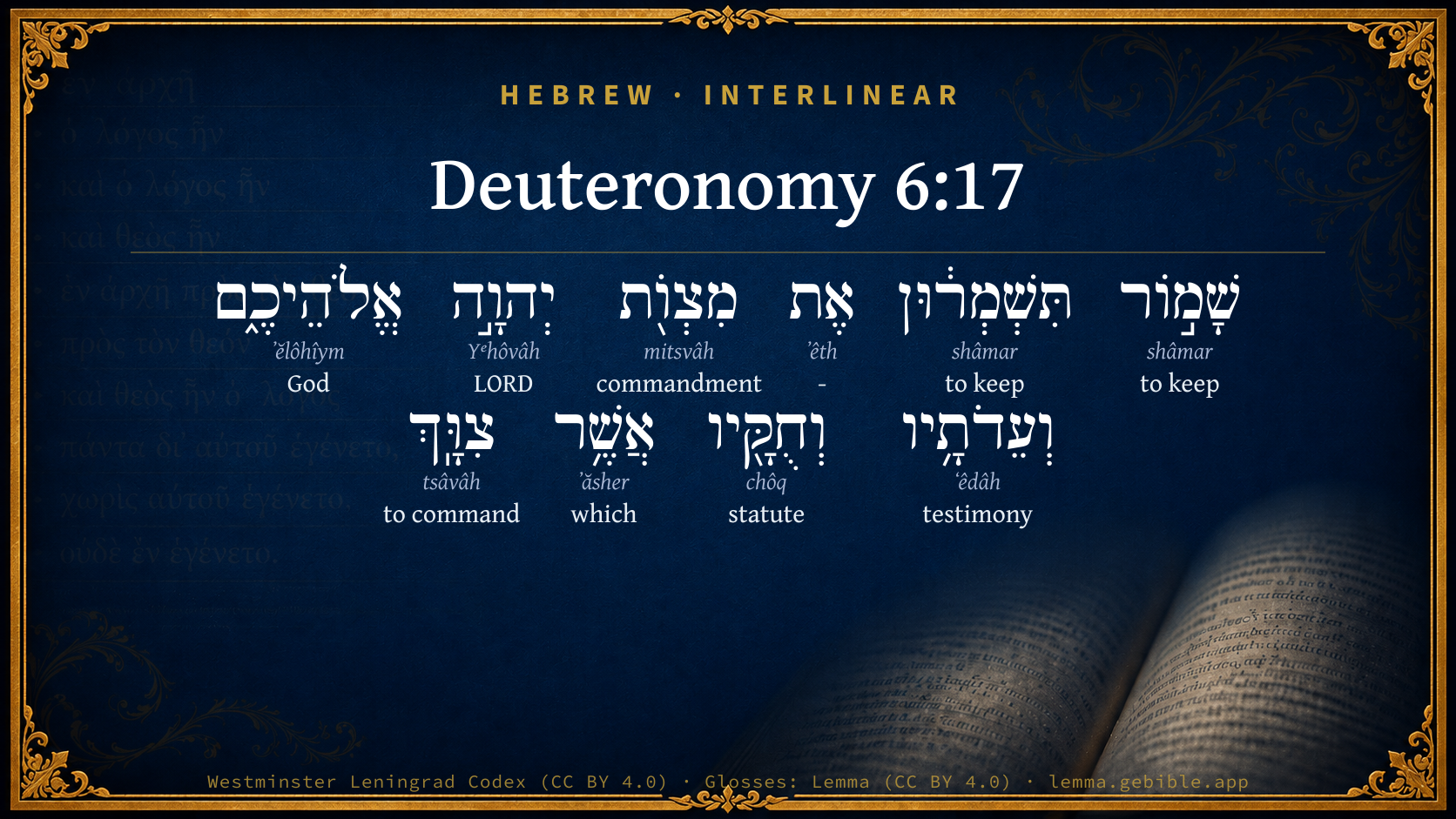
Hebrew (Westminster Leningrad Codex) Deuteronomy 6:17 appears in the Hebrew Old Testament. The text above is from the Westminster Leningrad Codex. Each word links to its Strong’s number, a concise gloss, and parsing drawn from the Open Scriptures Hebrew Bible morphology. Click any word for its full Brown-Driver-Briggs (BDB) entry.
Download image
Cite this verse

Deuteronomy 6:17 (World English Bible). Public Domain. Lemma interlinear Bible study tool, https://lemma.gebible.app/v/deuteronomy/6/17.

Show BibTeX & RIS
BibTeX
RIS
English Translation
You shall diligently keep the commandments of Yahweh your God, and his testimonies, and his statutes, which he has commanded you.
World English Bible · Public Domain
Download a study sheet

One document with this verse’s original text, its word-by-word gloss line, the meaning frame, cross-references with their text, attributed commentary, and full source and license credits — printable, and it pastes into notes with its structure intact.

This verse Autodidact and up

Study sheet (.html) Plain text (.txt)

A passage Seminary Student

Up to 50 verses in one chapter. A passage sheet keeps up to 6 commentary sources and 12 cross-references per verse, in the order this page ranks them, and says so on the sheet whenever that leaves anything out. Ask for a single verse and you get the Autodidact verse sheet above.

Everything on this page stays free to read, with no account — the sheet is a download of what is already on screen, not access to it.

Want to remove ads? Support Godless Engineer
Compare translations 3

The same verse in 3 English versions, stacked beneath the original-language interlinear above. Click any original word for its lexicon entry.

Each is an independent rendering of the whole verse — the interlinear is not word-aligned to these translations.

Highlighted words mark where these versions differ — a whole-verse word diff, not a word-by-word alignment.

  • World English Bible Public Domain
    You shall diligently keep the commandments of Yahweh your God, and his testimonies, and his statutes, which he has commanded you.
  • King James Version Public Domain
    Ye shall diligently keep the commandments of the LORD your God, and his testimonies, and his statutes, which he hath commanded thee.
  • unfoldingWord Literal Text CC BY-SA 4.0
    Keeping, you shall keep the commandments of Yahweh your God and his testimonies and his statutes that he has commanded you.

unfoldingWord Literal Text — © unfoldingWord, licensed CC BY-SA 4.0. Word-aligned USFM3 via Door43 (git.door43.org/unfoldingWord/en_ult).

Versions to compare (up to 4)

3 of 4 selected

Show all 18 translations

Every available English version of this verse, each an independent rendering of the whole verse.

  • World English Bible Public Domain
    You shall diligently keep the commandments of Yahweh your God, and his testimonies, and his statutes, which he has commanded you.
  • Berean Standard Bible Public Domain
    You are to diligently keep the commandments of the LORD your God and the testimonies and statutes He has given you.
  • Majority Standard Bible Public Domain
    You are to diligently keep the commandments of the LORD your God and the testimonies and statutes He has given you.
  • King James Version Public Domain
    Ye shall diligently keep the commandments of the LORD your God, and his testimonies, and his statutes, which he hath commanded thee.
  • American Standard Version (1901) Public Domain
    Ye shall diligently keep the commandments of Jehovah your God, and his testimonies, and his statutes, which he hath commanded thee.
  • Revised Version (1885) Public Domain
    Ye shall diligently keep the commandments of the LORD your God, and his testimonies, and his statutes, which he hath commanded thee.
  • Geneva Bible (1599) Public Domain
    But ye shall keepe diligently the commandements of the Lord your God, and his testimonies, and his ordinances which he hath commanded thee,
  • Douay-Rheims (1899) Public Domain
    Keep the precepts of the Lord thy God, and the testimonies and ceremonies which he hath commanded thee.
  • Young's Literal Translation Public Domain
    ye do diligently keep the commands of Jehovah your God, and His testimonies, and His statutes which He hath commanded thee,
  • Literal Standard Version CC BY-SA 4.0
    You diligently keep the commands of your God YHWH, and His testimonies and His statutes which He has commanded you,
  • Unlocked Literal Bible CC BY-SA 4.0
    You will diligently keep the commandments of Yahweh your God, his solemn commands, and his statutes, that he has commanded you.
  • unfoldingWord Literal Text CC BY-SA 4.0
    Keeping, you shall keep the commandments of Yahweh your God and his testimonies and his statutes that he has commanded you.
  • Darby Bible Public Domain
    Ye shall diligently keep the commandments of Jehovah your God, and his testimonies, and his statutes, which he hath commanded thee.
  • World Messianic Bible Public Domain
    You shall diligently keep the commandments of the LORD your God, and his testimonies, and his statutes, which he has commanded you.
  • Webster's Bible Public Domain
    Ye shall diligently keep the commandments of the LORD your God, and his testimonies, and his statutes, which he hath commanded thee.
  • Free Bible Version CC BY-SA 4.0
    You must be careful to keep the commandments of the Lord your God and the laws and rules he's given you.
  • Bible in Basic English Public Domain
    Keep with care the orders of the Lord your God, and his rules and his laws which he has given you;
  • JPS Tanakh (1917) Public Domain
    Ye shall diligently keep the commandments of the LORD your God, and His testimonies, and His statutes, which He hath commanded thee.

Literal Standard Version (2020), Covenant Press — licensed CC BY-SA 4.0. Text via the HelloAO Bible API (eBible.org). Unlocked Literal Bible (unfoldingWord) — licensed CC BY-SA 4.0. Text via the HelloAO Bible API (eBible.org). unfoldingWord Literal Text — © unfoldingWord, licensed CC BY-SA 4.0. Word-aligned USFM3 via Door43 (git.door43.org/unfoldingWord/en_ult). Free Bible Version, Dr. Jonathan Gallagher — licensed CC BY-SA 4.0. Text via the HelloAO Bible API (eBible.org).

Word by word

More ways to search: Search by grammar → Find every occurrence → Compare this word →

Practice this passage: Drill this verse → Learn its vocabulary →

וְעֵדֹתָ֥יו
ʻêdâh
H5713
“and · testimonies · his”
Conjunction + Noun, Common, Feminine, Plural, Construct + Suffix, Personal, 3rd Person, Masculine, Singular
Part of Speech
Conjunction + Noun
Type
Common
Gender
Feminine
Number
Plural
State
Construct
Full BDB Definition

Origin: from H5707 in its technical sense

TWOT: 1576c , 1576e

testimony, witness - always plural and always of laws as divine testimonies
  1. שָׁמ֣וֹר shâmar H8104 “to keep” Verb, Qal, Infinitive Absolute
  2. תִּשְׁמְר֔וּן shâmar H8104 “to keep” Verb, Qal, Imperfect, 2nd Person, Masculine, Plural + Suffix, n
  3. אֶת ʼêth H853 “-” Particle, Direct Object
  4. מִצְוֺ֖ת mitsvâh H4687 “commandments of” Noun, Common, Feminine, Plural, Construct
  5. יְהוָ֣ה Yᵉhôvâh H3068 “LORD” Noun, Proper
  6. אֱלֹהֵיכֶ֑ם ʼĕlôhîym H430 “God(s) · your” Noun, Common, Masculine, Plural, Construct + Suffix, Personal, 2nd Person, Masculine, Plural
  7. וְחֻקָּ֖יו chôq H2706 “and · statutes · his” Conjunction + Noun, Common, Masculine, Plural, Construct + Suffix, Personal, 3rd Person, Masculine, Singular
  8. אֲשֶׁ֥ר ʼăsher H834 “which” Particle, Relative
  9. צִוָּֽךְ tsâvâh H6680 “to command · you” Verb, Piel, Perfect, 3rd Person, Masculine, Singular + Suffix, Personal, 2nd Person, Feminine, Singular

About this verse

These counts appear in no published source. They are computed here, from the morphology-tagged text and Lemma’s own curated glosses. What Lemma adds →

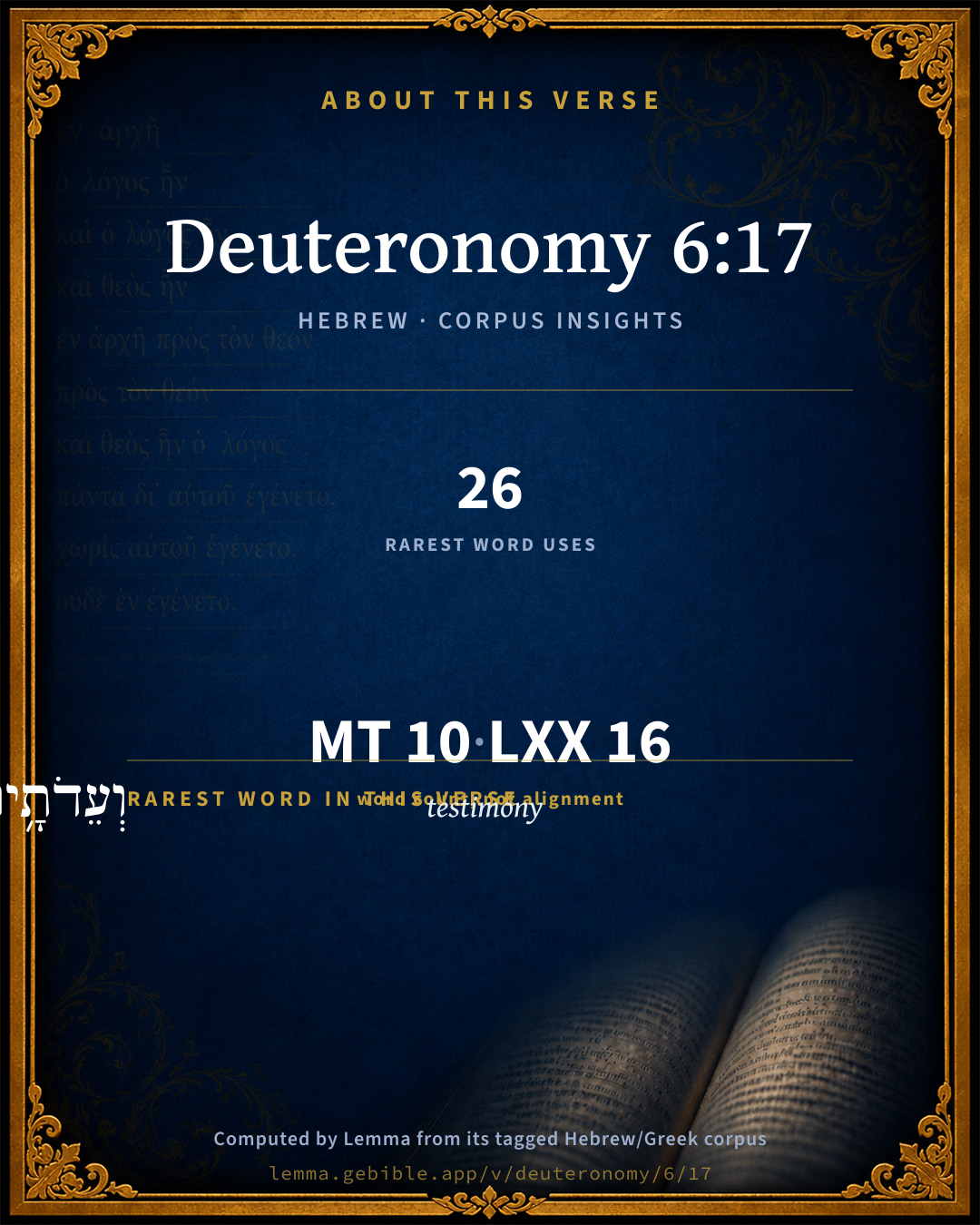
10
words
9
distinct lemmas
Pentateuch
section

Shared distinctive vocabulary

וְעֵדֹתָ֥יו testimony H5713 occurs in 25 verses of the Hebrew Bible. Also found in:

Grammatical profile

  • 3 verbs
  • 5 nouns
  • 2 particles

Verb forms

  • שָׁמ֣וֹר Qal · Infinitive Absolute
  • תִּשְׁמְר֔וּן Qal · Imperfect
  • צִוָּֽךְ Piel · Perfect

Repetition

A word recurs within this verse — often emphatic in Hebrew:

  • שָׁמ֣וֹר to keep H8104 ×2

Hebrew & Septuagint length

In English translation the verse runs 21 words from the Hebrew and 22 from the Septuagint (LXX English) — closely comparable.

A rough comparison of the two English renderings, which tokenize alike — not a word-level alignment.

Word counts can differ between the Hebrew and the Greek without any difference in meaning — e.g. the Hebrew direct-object marker אֵת has no separate Greek word, and Greek often adds the article ὁ.

In the original languages it is 10 Hebrew tokens and 16 Greek tokens — but the two are counted differently (Hebrew bundles its prefixes and suffixes into one token; the Greek is in lemma form), so that isn’t a like-for-like length.

Cross-references

10

Topical passages linked to Deuteronomy 6:17 in the Treasury of Scripture Knowledge — connected by theme and wording, ordered by reader-vote popularity; previews shown in the World English Bible.

  • Deuteronomy 11:22 For if you shall diligently keep all this commandment which I command you, to do it, to love Yahweh your God, to walk in all his ways, and to cleave to him;
  • Psalms 119:4 You have commanded your precepts, That we should fully obey them.
  • 1 Corinthians 15:58 Therefore, my beloved brothers, be steadfast, immovable, always abounding in the Lord's work, because you know that your labor is not in vain in the Lord.
  • 2 Peter 1:5–10 Yes, and for this very cause adding on your part all diligence, in your faith supply moral excellence; and in moral excellence, knowledge;
  • 2 Peter 3:14 Therefore, beloved, seeing that you look for these things, be diligent to be found in peace, without blemish and blameless in his sight.
  • Exodus 15:26 and he said, "If you will diligently listen to the voice of Yahweh your God, and will do that which is right in his eyes, and will pay attention to his commandments, and keep all his statutes, I will put none of the diseases on you, which I have put on the Egyptians; for I am Yahweh who heals you."
  • Titus 3:8 This saying is faithful, and concerning these things I desire that you affirm confidently, so that those who have believed God may be careful to maintain good works. These things are good and profitable to men;
  • Hebrews 6:11 We desire that each one of you may show the same diligence to the fullness of hope even to the end,
  • Deuteronomy 6:1–2 Now this is the commandment, the statutes, and the ordinances, which Yahweh your God commanded to teach you, that you might do them in the land where you go over to possess it;
  • Deuteronomy 11:13 It shall happen, if you shall listen diligently to my commandments which I command you this day, to love Yahweh your God, and to serve him with all your heart and with all your soul,

Cross-references courtesy of OpenBible.info (CC BY 4.0).

Hebrew and Greek witnesses Masoretic Hebrew ↔ Greek Septuagint

The same verse in the two great witnesses to the Old Testament, shown verse-for-verse.

These are two independent witnesses, not word-aligned to each other, and the Septuagint is shown in lemma (dictionary) form.

Hebrew Deuteronomy 6:17 Masoretic · Westminster Leningrad Codex

שָׁמ֣וֹר תִּשְׁמְר֔וּן אֶת מִצְוֺ֖ת יְהוָ֣ה אֱלֹהֵיכֶ֑ם וְעֵדֹתָ֥יו וְחֻקָּ֖יו אֲשֶׁ֥ר צִוָּֽךְ

You shall diligently keep the commandments of Yahweh your God, and his testimonies, and his statutes, which he has commanded you.

World English Bible · Public Domain

Greek LXX Deuteronomy 6:17 Septuagint · lemma form

φυλάσσω φυλάσσω ὁ ἐντολή κύριος ὁ θεός σύ ὁ μαρτύριον καί ὁ δικαίωμα ὅσος ἐντέλλομαι σύ

You shall by all means keep the commands of the Lord your God, the testimonies, and the ordinances, which he commanded you.

LXX2012 (modern English Septuagint) · Public Domain

Hebrew: Westminster Leningrad Codex (CC BY 4.0). Greek: Septuagint (public domain); English from LXX2012 (modern English Septuagint) (Public Domain). How the Septuagint differs from the Hebrew →

Targum (Aramaic paraphrase)

2

The Targum is the ancient Jewish Aramaic paraphrase of the Hebrew Scriptures — an interpretive translation, not the Hebrew text itself. Onkelos (literal) and Pseudo-Jonathan (expansive) render the Torah, and Jonathan the Prophets. Coverage is partial: where no permissively-licensed English translation exists for a verse, only the Aramaic is shown. This is verse-level text, not a word-by-word alignment to the Hebrew.

  1. Targum Onkelos Torah (Genesis–Deuteronomy)
    מִטַּר תִּטְרוּן יָת פִּקוּדַיָא דַיְיָ אֱלָהֲכוֹן וּסְהֶדְוָתֵהּ וּקְיָמוֹהִי דִי פַקְדָךְ

    (no public-domain English translation for this verse)

    Targum Onkelos — Aramaic: “Onkelos Genesis” (public domain); “Onkelos Exodus” (public domain); “Onkelos Leviticus” (public domain); “Onkelos Numbers” (public domain); “Onkelos Deuteronomy” (public domain). English: “Sefaria Community Translation” (CC0 1.0 (public-domain dedication)); “J.W. Etheridge. The Targums of Onkelos and Jonathan Ben Uzziel on the Pentateuch. London: Longmans, Green, 1862” (public domain). Text via Sefaria.

  2. Targum Pseudo-Jonathan Torah (Genesis–Deuteronomy)
    מִינְטוֹר תִּנְטְרוּן יַת פִּקּוּדַיָא דַיְיָ אֱלָהָכוֹן וּסְהִידְוָותֵיהּ וּקְיָימוֹי דְפַקֵּיד לְכוֹן

    keeping keep the commandments of the Lord your God, and His testimonies and statutes which He hath commanded you;

    Targum Pseudo-Jonathan — Aramaic: “Targum Jonathan on Genesis” (public domain); “Targum Jonathan on Exodus” (public domain); “Targum Jonathan on Leviticus” (public domain); “Targum Jonathan on Numbers” (public domain); “Targum Jonathan on Deuteronomy” (public domain). English: “The Targum of Jonathan ben Uzziel, trans. J. W. Etheridge, London, 1862” (public domain). Text via Sefaria.

Commentary

Notes on Deuteronomy 6:17 from classic Christian and Jewish commentators (each source and its license shown beneath its notes). The classic Christian expositions comment on the surrounding passage and are grouped to its opening verse, so a note may address several verses; the Jewish commentaries on the Tanakh (Rashi and others) are per-verse, so they appear only where the commentator wrote on this verse.

Lemma curates 59 commentaries, every one of them public domain or Creative Commons licensed, each selected and text-cleaned for this edition rather than reprinted as found. About our sources →

Matthew Henry's Commentary

Here, I. Moses charges them to keep God's commandments themselves: You shall diligently keep God's commandments, Deu 6:17-19. Note, It requires a great deal of care and pains to keep up religion in the power of it in our hearts and lives. Negligence will ruin us; but we cannot be saved without diligence. To induce them to this, he here shows them, 1. That this would be very acceptable to God: it is right and good in the sight of the Lord; and that is right and good indeed that is, so in God's sight. If we have any regard to the favour of our Creator as our felicity, and the law of our creation as our rule, we shall be religious. 2. That it would be very advantageous and profitable to themselves. It would secure to them the possession of the land of Canaan, prosperity there, and constant victory over those that stood in their way. In short, "Do well, and it shall be well with thee."

II. He charges them to instruct their children in the commands of God, not only that they might in their tender years intelligently and affectionately join in religious services, but that afterwards they might in their day keep up religion, and convey it to those that should come after them. Now,

1. Here is a proper question which it is supposed the children would ask (Deu 6:20): "What mean the testimonies and the statutes? What is the meaning of the feasts we observe, the sacrifices we offer, and the many peculiar customs we keep up?" Observe, (1.) All divine institutions have a certain meaning, and there is something great designed in them. (2.) It concerns us to know and understand the meaning of them, that we may perform a reasonable service and may not offer the blind for sacrifice. (3.) It is good for children betimes to enquire into the true intent and meaning of the religious observances they are trained up in. If any are thus inquisitive in divine things it is a good sign that they are concerned about them, and a good means of their attaining to a great acquaintance with them. Then shall we know if thus we follow on to know.

2. Here is a full answer put into the parents' mouths to be given to this good question. Parents and teachers must give instruction to those under their charge, though they do not ask it, nay, though they have an aversion to it; much more must they be ready to answer questions, and to give instruction when it is desired; for it may be hoped that those who ask it will be willing to receive it. Did the children ask the meaning of God's laws? Let them be told that they were to be observed, (1.) In a grateful remembrance of God's former favours to them, especially their deliverance out of Egypt, Deu 6:21-23. The children must be often told of the deplorable state their ancestors were in when they were bondmen in Egypt, the great salvation God wrought for them in fetching them out thence, and that God, in giving them these peculiar statutes, meant to perpetuate the memorial of that work of wonder, by which they were formed into a peculiar people. (2.) As the prescribed condition of his further favours (Deu 6:24): The Lord commanded us all these statutes for our good. Note, God commands us nothing but what is really for our good. It is our interest as well as our duty to be religious. [1.] It will be our life: That he might preserve us alive, which is a great favour, and more than we could expect, considering how often we have forfeited life itself. Godliness has the promise of the continuance and comfort of the life that now is as far as it is for God's glory. [2.] It will be our righteousness. Could we perfectly fulfil but that one command of loving God with all our heart, soul, and might, and could we say, "We have never done otherwise," this would be so our righteousness as to entitle us to the benefits of the covenant of innocency; had we continued in every thing that is written in the book of the law to do it, the law would have justified us. But this we cannot pretend to, therefore our sincere obedience shall be accepted through a Mediator to denominate us, as Noah was, righteous before God, Gen 7:1; Luk 1:6; and Jo1 3:7. The Chaldee reads it, There shall be a reward to us if we observe to do these commandments; for, without doubt, in keeping God's commandments there is great reward.

Matthew Henry's Commentary on the Whole Bible (1708–1710) — public domain (CC PDM 1.0). Text via the HelloAO Bible API.

Trapp's Complete Commentary

John Trapp

Deu 6:17 Ye shall diligently keep the commandments of the LORD your God, and his testimonies, and his statutes, which he hath commanded thee.

Ver. 17. Ye shall diligently keep.] So Psa 119:4. Howbeit the most that David could do towards it, was to wish well to it. {Deu 6:5}

John Trapp, A Commentary or Exposition upon All the Books of the Old and New Testament (1647–1656) — public domain. Text from a community e-Sword module.

Adam Clarke's Commentary

Verse 17. Ye shall diligently keep, &c.] On this and the following verse See Clarke on De 6:3.

Adam Clarke's Commentary on the Bible (1810–1826) — public domain. Text from a community e-Sword/MySword module.

John Gill's Exposition

You shall diligently keep the commandments of the Lord your God,.... Not only the ten commands, but all others:

and his testimonies, and his statutes, which he hath commanded thee; those of a judicial and ceremonial kind.

John Gill's Exposition of the Whole Bible (1746–1763) — public domain (CC PDM 1.0). Text via the HelloAO Bible API.

John Wesley's Explanatory Notes

Ye diligently keep - Negligence will ruin us: but we cannot be saved without diligence.

John Wesley, Explanatory Notes Upon the Whole Bible (1754–1765) — public domain. Text via the GEBible commentary corpus.

Keil & Delitzsch

C. F. Keil & F. Delitzsch

They were rather to observe all His commandments diligently, and do what was right and good in His eyes. The infinitive וגו להדף contains the further development of וגו ייטב למען: "so that He (Jehovah) thrust out all thine enemies before thee, as He hath spoken" (viz., Exo 23:27., Deu 34:11).

Keil & Delitzsch — Biblical Commentary on the Old Testament (1861–1891) — public domain (CC PDM 1.0). Text via the HelloAO Bible API. (Old Testament only.)

Lesson kit

Teaching starters — assembled from the data on this page, not authored interpretation. Every prompt links to the verse data it draws on. Edit before teaching.

Deuteronomy, in the Pentateuch, opens this verse with 10 words (9 distinct Hebrew lemmas). Its most distinctive word is ʻêdâh (“testimony”). A historical commentator’s framing appears above. Read the whole chapter for the surrounding context.

Discussion questions

  1. The word ʻêdâh carries the sense “testimony.” How does it shape the verse?
  2. How does Genesis 21:30, which shares the word «testimony», read alongside this verse?
  3. What does the repetition of “to keep” (2× in this one verse) do in this verse?
  4. These translations render this verse differently; the difference is in the English rendering, not the original. What questions does that raise?
  5. «שָׁמ֣וֹר» is a Qal Infinitive Absolute verb. How does that grammatical form shape the action described?
  6. Compare how Matthew Henry's Commentary and Trapp's Complete Commentary read this verse. Where do they agree or differ?

Things to notice

Reading settings

Reading text

Shown beneath each verse's original-language words.

Old Testament
Old Testament edition

Read the OT as the Masoretic Hebrew (MT) or the Greek Septuagint (LXX).

English shown for the Greek Septuagint (in the Hebrew ↔ Greek comparison).

Comparing translations? Open the Compare panel on any verse page to stack up to four side by side.