
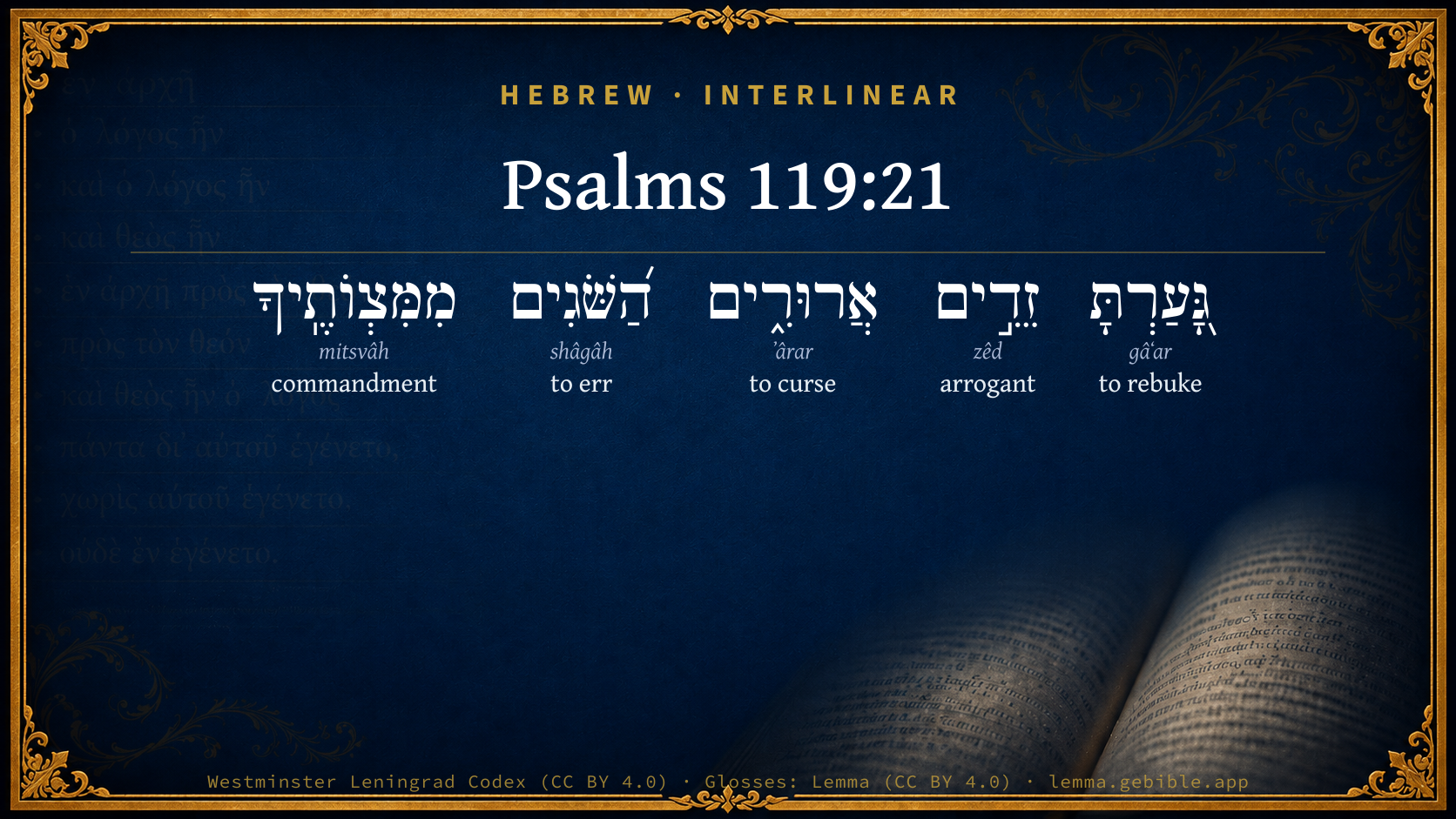
Psalms 119:21

Hebrew (Westminster Leningrad Codex) Psalms 119:21 appears in the Hebrew Old Testament. The text above is from the Westminster Leningrad Codex. Each word links to its Strong’s number, a concise gloss, and parsing drawn from the Open Scriptures Hebrew Bible morphology. Click any word for its full Brown-Driver-Briggs (BDB) entry.
Download image
Cite this verse

Psalms 119:21 (World English Bible). Public Domain. Lemma interlinear Bible study tool, https://lemma.gebible.app/v/psalms/119/21.

Show BibTeX & RIS
BibTeX
RIS
English Translation
You have rebuked the proud who are cursed, Who wander from your commandments.
World English Bible · Public Domain
Download a study sheet

One document with this verse’s original text, its word-by-word gloss line, the meaning frame, cross-references with their text, attributed commentary, and full source and license credits — printable, and it pastes into notes with its structure intact.

This verse Autodidact and up

Study sheet (.html) Plain text (.txt)

A passage Seminary Student

Up to 50 verses in one chapter. A passage sheet keeps up to 6 commentary sources and 12 cross-references per verse, in the order this page ranks them, and says so on the sheet whenever that leaves anything out. Ask for a single verse and you get the Autodidact verse sheet above.

Everything on this page stays free to read, with no account — the sheet is a download of what is already on screen, not access to it.

Want to remove ads? Support Godless Engineer
Compare translations 3

The same verse in 3 English versions, stacked beneath the original-language interlinear above. Click any original word for its lexicon entry.

Each is an independent rendering of the whole verse — the interlinear is not word-aligned to these translations.

Highlighted words mark where these versions differ — a whole-verse word diff, not a word-by-word alignment.

  • World English Bible Public Domain
    You have rebuked the proud who are cursed, Who wander from your commandments.
  • King James Version Public Domain
    Thou hast rebuked the proud that are cursed, which do err from thy commandments.
  • unfoldingWord Literal Text CC BY-SA 4.0
    You rebuke the proud, the cursed, those wandering from your commandments.

unfoldingWord Literal Text — © unfoldingWord, licensed CC BY-SA 4.0. Word-aligned USFM3 via Door43 (git.door43.org/unfoldingWord/en_ult).

Versions to compare (up to 4)

3 of 4 selected

Show all 17 translations

Every available English version of this verse, each an independent rendering of the whole verse.

  • World English Bible Public Domain
    You have rebuked the proud who are cursed, Who wander from your commandments.
  • Berean Standard Bible Public Domain
    You rebuke the arrogant—the cursed who stray from Your commandments.
  • Majority Standard Bible Public Domain
    You rebuke the arrogant—the cursed who stray from Your commandments.
  • King James Version Public Domain
    Thou hast rebuked the proud that are cursed, which do err from thy commandments.
  • American Standard Version (1901) Public Domain
    Thou hast rebuked the proud that are cursed, That do wander from thy commandments.
  • Revised Version (1885) Public Domain
    Thou hast rebuked the proud that are cursed, which do wander from thy commandments.
  • Geneva Bible (1599) Public Domain
    Thou hast destroied the proud: cursed are they that doe erre from thy commandements.
  • Young's Literal Translation Public Domain
    Thou hast rebuked the cursed proud, Who are erring from Thy commands.
  • Literal Standard Version CC BY-SA 4.0
    You have rebuked the cursed proud, || Who are erring from Your commands.
  • Unlocked Literal Bible CC BY-SA 4.0
    You rebuke the proud, who are cursed, who wander from your commandments.
  • unfoldingWord Literal Text CC BY-SA 4.0
    You rebuke the proud, the cursed, those wandering from your commandments.
  • Darby Bible Public Domain
    Thou hast rebuked the proud [that are] cursed, who wander from thy commandments.
  • World Messianic Bible Public Domain
    You have rebuked the proud who are cursed, who wander from your commandments.
  • Webster's Bible Public Domain
    Thou hast rebuked the proud that are cursed, who do err from thy commandments.
  • Free Bible Version CC BY-SA 4.0
    You reprimand those who are arrogant; those who don't follow your commandments are cursed.
  • Bible in Basic English Public Domain
    Your hand has been against the men of pride, a curse is on those who go wandering out of your way.
  • JPS Tanakh (1917) Public Domain
    Thou hast rebuked the proud that are cursed, that do err from Thy commandments.

Literal Standard Version (2020), Covenant Press — licensed CC BY-SA 4.0. Text via the HelloAO Bible API (eBible.org). Unlocked Literal Bible (unfoldingWord) — licensed CC BY-SA 4.0. Text via the HelloAO Bible API (eBible.org). unfoldingWord Literal Text — © unfoldingWord, licensed CC BY-SA 4.0. Word-aligned USFM3 via Door43 (git.door43.org/unfoldingWord/en_ult). Free Bible Version, Dr. Jonathan Gallagher — licensed CC BY-SA 4.0. Text via the HelloAO Bible API (eBible.org).

Word by word

More ways to search: Search by grammar → Find every occurrence → Compare this word →

Practice this passage: Drill this verse → Learn its vocabulary →

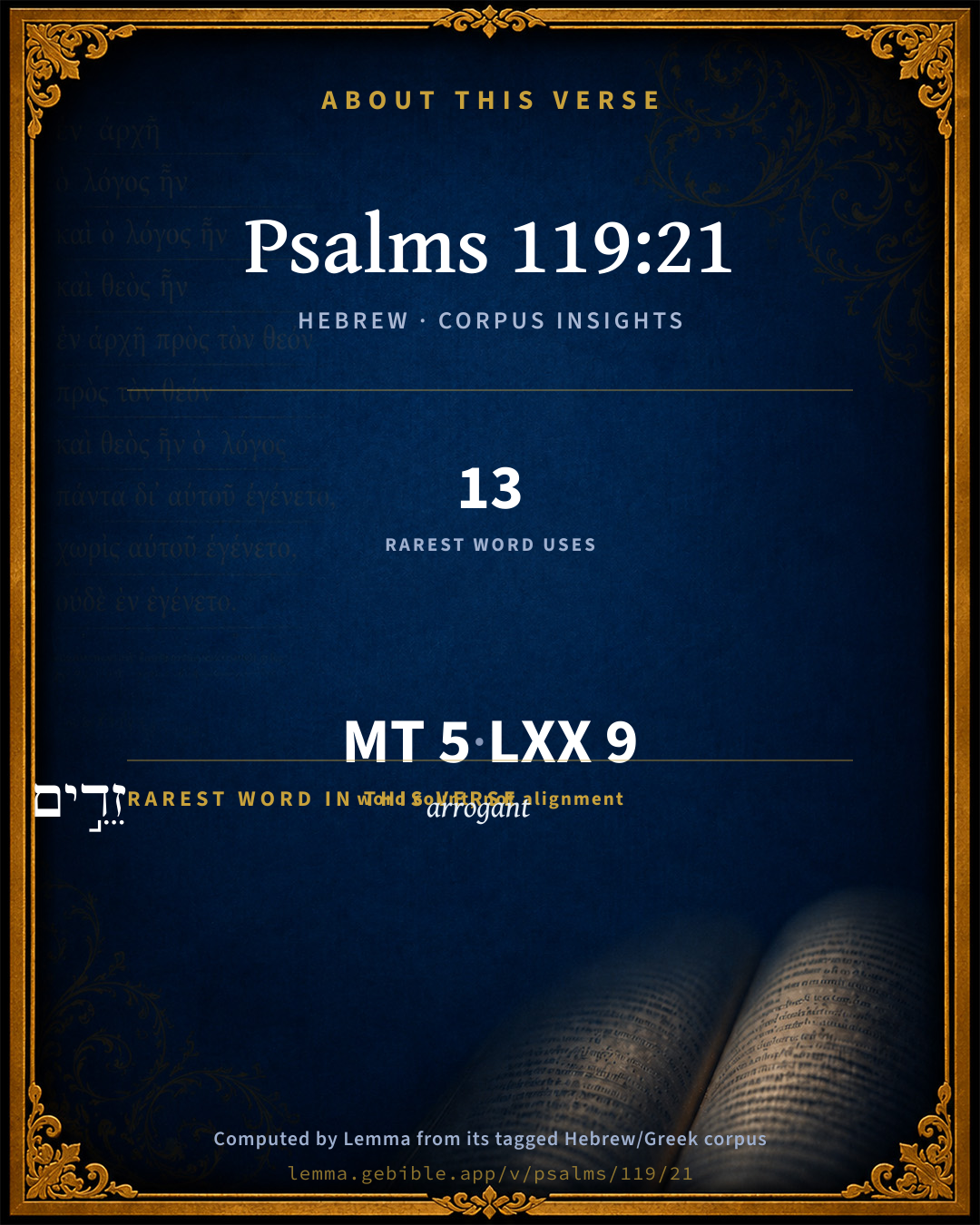
About this verse

These counts appear in no published source. They are computed here, from the morphology-tagged text and Lemma’s own curated glosses. What Lemma adds →

5
words
5
distinct lemmas
Wisdom
section

Notable vocabulary

The rarest word here is זֵדִ֣ים arrogant H2086 — appearing just 13 times in the whole Hebrew Bible.

Shared distinctive vocabulary

זֵדִ֣ים arrogant H2086 occurs in 13 verses of the Hebrew Bible. Also found in:

Grammatical profile

  • 3 verbs
  • 1 noun
  • 1 adjective

Verb forms

  • גָּ֭עַרְתָּ Qal · Perfect
  • אֲרוּרִ֑ים Qal · Participle Passive
  • הַ֝שֹּׁגִים Qal · Participle Active

Hebrew & Septuagint length

In English translation the verse runs 13 words from the Hebrew and 14 from the Septuagint (LXX English) — closely comparable.

A rough comparison of the two English renderings, which tokenize alike — not a word-level alignment.

Word counts can differ between the Hebrew and the Greek without any difference in meaning — e.g. the Hebrew direct-object marker אֵת has no separate Greek word, and Greek often adds the article ὁ.

In the original languages it is 5 Hebrew tokens and 9 Greek tokens — but the two are counted differently (Hebrew bundles its prefixes and suffixes into one token; the Greek is in lemma form), so that isn’t a like-for-like length.

Cross-references

29

Topical passages linked to Psalms 119:21 in the Treasury of Scripture Knowledge — connected by theme and wording, ordered by reader-vote popularity; previews shown in the World English Bible.

  • Psalms 119:10 With my whole heart, I have sought you. Don't let me wander from your commandments.
  • 1 Peter 5:5 Likewise, you younger ones, be subject to the elder. Yes, all of you gird yourselves with humility, to subject yourselves to one another; for "God resists the proud, but gives grace to the humble."
  • Psalms 119:118 You reject all those who stray from your statutes, For their deceit is in vain.
  • Luke 18:14 I tell you, this man went down to his house justified rather than the other; for everyone who exalts himself will be humbled, but he who humbles himself will be exalted."
  • Deuteronomy 28:15 But it shall come to pass, if you will not listen to the voice of Yahweh your God, to observe to do all his commandments and his statutes which I command you this day, that all these curses shall come on you, and overtake you.
  • Deuteronomy 30:19 I call heaven and earth to witness against you this day, that I have set before you life and death, the blessing and the curse: therefore choose life, that you may live, you and your seed;
  • Psalms 119:110 The wicked have laid a snare for me, Yet I haven't gone astray from your precepts.
  • Jeremiah 44:28–29 Those who escape the sword shall return out of the land of Egypt into the land of Judah, few in number; and all the remnant of Judah, who have gone into the land of Egypt to sojourn there, shall know whose word shall stand, mine, or theirs.
  • Malachi 4:1 "For, behold, the day comes, it burns as a furnace; and all the proud, and all who work wickedness, will be stubble; and the day that comes will burn them up," says Yahweh of Hosts, "that it shall leave them neither root nor branch.
  • Luke 14:11 For everyone who exalts himself will be humbled, and whoever humbles himself will be exalted."
  • Exodus 10:3 Moses and Aaron went in to Pharaoh, and said to him, "This is what Yahweh, the God of the Hebrews, says: 'How long will you refuse to humble yourself before me? Let my people go, that they may serve me.
  • Exodus 18:11 Now I know that Yahweh is greater than all gods because of the thing in which they dealt arrogantly against them."
  • Deuteronomy 27:15–26 Cursed be the man who makes an engraved or molten image, an abomination to Yahweh, the work of the hands of the craftsman, and sets it up in secret. All the people shall answer and say, Amen.
  • Nehemiah 9:16 But they and our fathers dealt proudly and hardened their neck, and didn't listen to your commandments,
  • Nehemiah 9:29 and testified against them, that you might bring them again to your law. Yet they dealt proudly, and didn't listen to your commandments, but sinned against your ordinances, (which if a man do, he shall live in them), and withdrew the shoulder, and hardened their neck, and would not hear.
  • Job 40:11–12 Pour forth the fury of your anger. Look on everyone who is proud, and bring him low.
  • Psalms 119:78 Let the proud be disappointed, for they have overthrown me wrongfully. I will meditate on your precepts.
  • Psalms 138:6 For though Yahweh is high, yet he looks after the lowly; But the proud, he knows from afar.
  • Isaiah 2:11–12 The lofty looks of man will be brought low, The haughtiness of men will be bowed down, And Yahweh alone will be exalted in that day.
  • Isaiah 10:12 Therefore it shall happen that, when the Lord has performed his whole work on Mount Zion and on Jerusalem, I will punish the fruit of the stout heart of the king of Assyria, and the glory of his high looks.
  • Isaiah 42:24 Who gave Jacob for a spoil, and Israel to the robbers? Didn't Yahweh? he against whom we have sinned, and in whose ways they would not walk, neither were they obedient to his law.
  • Isaiah 43:28 Therefore I will profane the princes of the sanctuary; and I will make Jacob a curse, and Israel a reviling.
  • Jeremiah 44:9–11 Have you forgotten the wickedness of your fathers, and the wickedness of the kings of Judah, and the wickedness of their wives, and your own wickedness, and the wickedness of your wives which they committed in the land of Judah, and in the streets of Jerusalem?
  • Jeremiah 44:16 As for the word that you have spoken to us in the name of Yahweh, we will not listen to you.
  • Ezekiel 28:2–10 Son of man, tell the prince of Tyre, Thus says the Lord Yahweh: Because your heart is lifted up, and you have said, I am a god, I sit in the seat of God, in the midst of the seas; yet you are man, and not God, though you did set your heart as the heart of God;-
  • Daniel 4:37 Now I, Nebuchadnezzar, praise and extol and honor the King of heaven; for all his works are truth, and his ways justice; and those who walk in pride he is able to abase.
  • Daniel 5:22–24 You his son, Belshazzar, have not humbled your heart, though you knew all this,
  • Galatians 3:13 Christ redeemed us from the curse of the law, having become a curse for us. For it is written, "Cursed is everyone who hangs on a tree,"
  • James 4:6 But he gives more grace. Therefore it says, "God resists the proud, but gives grace to the humble."

Cross-references courtesy of OpenBible.info (CC BY 4.0).

Hebrew and Greek witnesses Masoretic Hebrew ↔ Greek Septuagint

The same verse in the two great witnesses to the Old Testament, shown verse-for-verse.

You’re reading Greek Psalm 118 (Hebrew Psalm 119). The Septuagint counts the superscription, so verse numbers can differ from the Hebrew — chapter-level alignment, not verse-by-verse. Numbering follows Rahlfs.

These are two independent witnesses, not word-aligned to each other, and the Septuagint is shown in lemma (dictionary) form.

Hebrew Psalms 119:21 Masoretic · Westminster Leningrad Codex

גָּ֭עַרְתָּ זֵדִ֣ים אֲרוּרִ֑ים הַ֝שֹּׁגִים מִמִּצְוֺתֶֽיךָ

You have rebuked the proud who are cursed, Who wander from your commandments.

World English Bible · Public Domain

Greek LXX Greek Psalm 118:21 Septuagint · lemma form

ἐπιτιμάω ὑπερήφανος ἐπικατάρατος ὁ ἐκκλίνω ἀπό ὁ ἐντολή σύ

You have rebuked the proud: cursed are they that turn aside from your commandments.

LXX2012 (modern English Septuagint) · Public Domain

On this verse, Ellicott's Commentary for English Readers discusses the Septuagint’s reading. Read the note in Commentary ↓

Hebrew: Westminster Leningrad Codex (CC BY 4.0). Greek: Septuagint (public domain); English from LXX2012 (modern English Septuagint) (Public Domain). How the Septuagint differs from the Hebrew →

Commentary

Notes on Psalms 119:21 from classic Christian and Jewish commentators (each source and its license shown beneath its notes). The classic Christian expositions comment on the surrounding passage and are grouped to its opening verse, so a note may address several verses; the Jewish commentaries on the Tanakh (Rashi and others) are per-verse, so they appear only where the commentator wrote on this verse.

Lemma curates 59 commentaries, every one of them public domain or Creative Commons licensed, each selected and text-cleaned for this edition rather than reprinted as found. About our sources →

Trapp's Complete Commentary

John Trapp

Psa 119:21 Thou hast rebuked the proud [that are] cursed, which do err from thy commandments.

Ver. 21. Thou hast rebuked the proud, &c.] Thou chidest them, threatenest them, plaguest them, and so settest it on as no creature can take it off. And this is one reason why I love and observe thy laws, ne paria patiar, lest I should suffer in like sort; since men must do it or die for it.

John Trapp, A Commentary or Exposition upon All the Books of the Old and New Testament (1647–1656) — public domain. Text from a community e-Sword module.

Joseph Benson's Commentary

Psa 119:21. Thou hast rebuked — Or, dost rebuke, that is, reprove and punish, the proud — Obstinate and presumptuous sinners, who sin with a high hand; that are cursed — That are under the wrath and curse of God, and have his curse upon them in all that they do or possess, Deu 28:16-19. Which, do err — Hebrew, השׁגים, hashogim, wander, or stray, from thy commandments — Namely, knowingly, or wilfully, as proud sinners are wont to do.

Joseph Benson's Commentary on the Old and New Testaments (1811–1818) — public domain. Text from a community e-Sword module.

J. A. Alexander on Psalms

Joseph Addison Alexander

21. (Psa 119:21) Thou hast rebuked the proud, the accursed, those wandering from thy commandments. Compare Psa 9:5. Rebuked, not merely by word but by deed, i.e. punished.

Joseph Addison Alexander, The Psalms Translated and Explained (1850) — public domain. Text from a community e-Sword module.

Geneva Bible (1599)

Geneva Bible translators

In all ages thou hast plagued all such which maliciously and contemptuously depart from thy truth.

Geneva Bible (1599) marginal notes — public domain. Text via Bolls.life.

Matthew Henry's Commentary

Here is, 1. The wretched character of wicked people. The temper of their minds is bad. They are proud; they magnify themselves above others. And yet that is not all: they magnify themselves against God, and set up their wills in competition with and opposition to the will of God, as if their hearts, and tongues, and all, were their own. There is something of pride at the bottom of every wilful sin, and the tenour of their lives is no better: They do err from thy commandments, as Israel, that did always err in their hearts; they err in judgment, and embrace principles contrary to thy commandments, and then no wonder that they err in practice, and wilfully turn aside out of the good way. This is the effect of their pride; for they say, What is the Almighty, that we should serve him? As Pharaoh, Who is the Lord? 2. The wretched case of such. They are certainly cursed, for God resists the proud; and those that throw off the commands of the law lay themselves under its curse (Gal 3:10), and he that now beholds them afar off will shortly say to them, Go, you cursed. The proud sinners bless themselves; God curses them; and, though the most direful effects of this curse are reserved for the other world, yet they are often severely rebuked in this world: Providence crosses them, vexes them, and, wherein they dealt proudly, God shows himself above them; and these rebukes are earnests of worse. David took notice of the rebukes proud men were under, and it made him cleave the more closely to the word of God and pray the more earnestly that he might not err from God's commandments. Thus saints get good by God's judgments on sinners.

Matthew Henry's Commentary on the Whole Bible (1708–1710) — public domain (CC PDM 1.0). Text via the HelloAO Bible API.

Adam Clarke's Commentary

Verse 21. Thou hast rebuked the proud] This was done often in the case of David; and was true also in reference to the Babylonians, who held the Israelites in subjection, and whose kings were among the proudest of human beings. Instead of זדים zedim, the proud, some MSS. read זרים zarim, strangers, and one reads גוים goyim, the heathen; and so the Syriac.

Adam Clarke's Commentary on the Bible (1810–1826) — public domain. Text from a community e-Sword/MySword module.

John Calvin's Commentaries

21. Thou hast destroyed the proud. Others render it:, Thou hast rebuked the proud; a translation of which the Hebrew term גער, gaar, admits when the letter ב, beth, is joined with it in construction; but this being awaiting, it is better to render it destroy It makes, however, little difference to the main drift of the passage, there being no doubt that the intention of the prophet is, to inform us that God’s judgments instructed him to apply his mind to the study of the law; and certainly this is an exercise which we ought on no account to defer till God visit us with chastisement.. But when we behold him taking vengeance upon the wicked, and the despisers of his word, we must be stupid, indeed, if his rod do not teach us wisdom; and, doubtless, it is an instance of special kindness on God’s part, to spare us, and only to terrify us from afar, that he may bring us to himself without injuring or chastising us at all.

It is not without reason that he denominates all unbelievers proud, because it is true faith alone which humbles us, and all rebellion is the offspring of pride. From this we learn how profitable it is to consider carefully and attentively the judgments of God, by which he overthrows such haughtiness. When the weak in faith see the wicked rise in furious. opposition against God, arrogantly casting off all restraint, and holding all religion in derision with impunity, they begin to question whether there be a God who sits as judge in heaven. God may, for a time, wink at this: by-and-bye, we witness him setting forth some indication of his judgment, to convince us that he hath not in vain uttered threatening against the violators of his law; and we ought to bear in mind that all who depart from him are reprobate.

Let it be carefully observed that, by wandering from his commandments, is not meant all kinds of transgression indiscriminately, but that unbridled licentiousness which proceeds from impious contempt of God. It is, indeed, given as a general sentence, that

“every one is cursed who continueth not in all things which are written,” Deuteronomy 27:26

But as God in his paternal kindness, bears with those who fail through infirmity of the flesh, so here we must understand these judgments to be expressly executed upon the wicked and reprobate; and their end, as Isaiah declares, is,

“that the inhabitants of the earth may learn righteousness,” (Isaiah 26:9)

John Calvin's Commentaries (1540-1563) — public domain. Text from the Calvin Translation Society English edition (1840s-50s) via the Christian Classics Ethereal Library (ccel.org). Calvin's coverage is partial (roughly two-thirds of the Bible); uncommented books and verses are honest gaps, never fabricated. The 19th-century editor's footnotes and remarks are omitted so the notes are faithfully Calvin's own voice.

Ellicott's Commentary for English Readers

(21) LXX. and Vulg. divide the verse: “Thou hast rebuked the proud; cursed are they,” &c. This is preferable.

A Bible Commentary for English Readers, edited by Charles John Ellicott (1878–1897) — public domain. Text from a community e-Sword module.

The Cambridge Bible for Schools and Colleges

gen. ed. J. J. S. Perowne

21. The A.V. follows the Massoretic text; but the more obvious construction of the verse is that of the LXX, Syr., and Jer., followed by P.B.V. and R.V. marg. Thou rebukest the proud: cursed are they which do wander &c. God’s rebuke is that sentence of condemnation which carries its own execution with it (Psa_9:5). The perfect tense (hast rebuked) states a general truth and is best translated by the present, thou rebukest. The proud (Psa_119:51; Psa_119:69; Psa_119:78; Psa_119:85; Psa_119:122; cf. Mal_3:15; Mal_4:1) are those who sin wilfully and presumptuously (Psa_19:13; Deu_17:12-13), careless or apostate Israelites. See above, p. 702.

The Cambridge Bible for Schools and Colleges (gen. ed. J. J. S. Perowne; Cambridge University Press, 1878–1918) — public domain. Text from a community e-Sword module.

John Gill's Exposition

Princes also did sit and speak against me,.... The princes in the court of Saul, who suggested to him that David sought his hurt; the princes of his own court, Absalom, his own son, a prince of the blood, and Ahithophel, a counsellor of state: or the princes of the Gentiles, as Jarchi; so the princes of the Philistines spake against him in a very disdainful manner, "make this fellow return to his place again", Sa1 29:4. Such as these might speak against him, as they sat and rode in their chariots; when at their tables, conversing together; or at their council boards, forming schemes against him: the phrase denotes their constant practice, as Kimchi observes; see Psa 50:20; herein David was a type of Christ, whom the princes of this world conspired against, and whose life they took away, Psa 2:2;

but thy servant did meditate in thy statutes; what the princes did or said against him did not divert his mind, or take off his thoughts from the word of God, and the ordinances of it; he thought of them, he spoke and discoursed of them; he declared them, as the word (w) sometimes signifies, and so the Targum takes it here; he was not afraid nor ashamed to profess his regard unto them: as Daniel, when he knew that the presidents and princes had obtained a royal decree, and the writing was signed; yet went into his chamber, as at other times, and kneeled down and prayed to God, Dan 6:10.

(w) "disserit", Tigurine version, Vatablus, Musculus; "loquitur", Piscator, Gejerus.

John Gill's Exposition of the Whole Bible (1746–1763) — public domain (CC PDM 1.0). Text via the HelloAO Bible API.

Albert Barnes' Notes on the Bible

Thou hast rebuked the proud - Compare Psa 9:5. The meaning is, that God had done this not by word but by deed. The proud were everywhere rebuked by God, alike in his law, and in his providence. The connection seems to be this: the psalmist is meditating on the benefit or advantage of keeping the law of God; of a humble, pious life. His mind naturally adverts to what would be the opposite of this - or to this in contrast with an opposite course of life; and he says, therefore, that God had in every way, and at all times, manifested his displeasure against that class of people. Such a course, therefore, must be attended with misery; but the course which he proposed to pursue must be attended with happiness.

That are cursed - The accursed; those who are regarded and treated by God as accursed, or as objects of his disapprobation.

Which do err from thy commandments - Who depart from thy law. The sense is, “I propose and intend to keep thy law. As a motive to this, I look at the consequences which must follow from disobeying it. I see it everywhere in the divine treatment of those who do disregard that law. They are subject to the displeasure - the solemn rebuke - of God. So all must be who disregard his law; and it is my purpose not to be found among their number.”

Albert Barnes' Notes on the Bible (1834–1885) — public domain. Text from a community e-Sword/MySword module.

Matthew Poole's English Annotations

Hast rebuked, or dost rebuke, i.e. severely punish and destroy. And therefore I justly long for thy judgments, as for the love which I have to them, so for fear of those terrible judgments which thou sendest upon the despisers of them.

The proud; obstinate and presumptuous sinners, who sin with a high hand, and with contempt of God, and of his laws, and of his judgment; all which is the effect of pride.

That are cursed; that have the curse of God upon them, and upon all which they have or do; which is the depth of misery.

Do err; or, wander; knowingly, and wilfully, and maliciously, as proud sinners use to do.

Matthew Poole's English Annotations on the Holy Bible (1683–1685) — public domain. Text from a community e-Sword/MySword module.

The Treasury of David

Charles H. Spurgeon

Ver. 21. Thou hast rebuked the proud that are cursed. This is one of God's judgments: he is sure to deal out a terrible portion to men of lofty looks. God rebuked Pharaoh with sore plagues, and at the Red Sea "In the foundations of the world were discovered at thy rebuke, O Lord." In the person of the naughty Egyptian he taught all the proud that he will certainly abase them. Proud men are cursed men: nobody blesses them, and they soon become a burden to themselves. In itself, pride is a plague and torment. Even if no curse came from the law of God, there seems to be a law of nature that proud men should be unhappy men. This led David to abhor pride; he dreaded the rebuke of God and the curse of the law. The proud sinners of his day were his enemies, and he felt happy that God was in the quarrel as well as he.

Which do err from thy commandments. Only humble hearts are obedient, for they alone will yield to rule and government. Proud men's looks are high, too high to mark their own feet and keep the Lord's way. Pride lies at the root of all sin: if men were not arrogant they would not be disobedient.

God rebukes pride even when the multitudes pay homage to it, for he sees in it rebellion against his own majesty, and the seeds of yet further rebellions. It is the sum of sin. Men talk of an honest pride; but if they were candid they would see that it is of all sins the least honest, and the least becoming in a creature, and especially in a fallen creature: yet so little do proud men know their own true condition under the curse of God, that they set up to censure the godly, and express contempt for them, as may be seen in the next verse. They are themselves contemptible, and yet they are contemptuous towards their betters. We may well love the judgments of God when we see them so decisively levelled against the haughty upstarts who would fain lord it over righteous men; and we may well be of good under the rebukes of the ungodly since their power to hurt us is destroyed by the Lord himself. "The Lord rebuke thee" is answer enough for all the accusations of men or devils.

In the fifth of the former octave the Psalmist wrote, "I have declared all the judgments of thy mouth, "and here he continues in the same strain, giving a particular instance of the Lord's judgments against haughty rebels. In the next two portions the fifth verses deal with lying and vanity, and pride is one of the most common forms of those evils.

Ver. 21. Thou hast rebuked the proud that are cursed. If the proud escape here, as sometimes they do, hereafter they shall not; for, "the proud man is an abomination to the Lord"; Pr 16:5. God cannot endure him; Ps 101:5. And what of that? Tu perdes superbos, Thou shalt destroy the proud. The very heathens devised the proud giants struck with thunder from heaven. And if God spared not the angels, whom he placed in the highest heavens, but for their pride threw them down headlong to the nethermost hell, how much less shall he spare the proud dust and ashes of the sons of men, but shall cast them from the height of their earthly altitude to the bottom of that infernal dungeon! "Humility makes men angels; pride makes angels devils; "as that father said: I may well add, makes devils of men. Alazoneiav outiv ekfeugei dikhn, says the heathen poet, Menander; "Never soul escaped the revenge of pride, " never shall escape it. So sure as God is just, pride shall not go unpunished. I know now we are all ready to call for a bason, with Pilate, and to wash our hands from this foul sin. Honourable and beloved, this vice is a close one; it will cleave fast to you; yea, so close that ye can hardly discern it from a piece of yourselves: this is it that aggravates the danger of it. For, as Aquinas notes well, some sins are more dangerous propter vehementiam impugnationis, "for the fury of their assault"; as the sin of anger: others for their correspondence to nature; as the sins of lust: other, propter latentiam sui, "for their close skulking" in our bosom; as the sin of pride. Oh, let us look seriously into the corners of our false hearts, even with the lanthorn of God's law, and find out this subtle devil; and never give peace to our souls till we have dispossessed him. Down with your proud plumes, O ye glorious peacocks of the world: look upon your black legs, and your snake like head: be ashamed of your miserable infirmities: else, God will down with them and yourselves in a fearful vengeance. There is not the holiest of us but is this way faulty: oh, let us be humbled by our repentance, that we may not be brought down to everlasting confusion: let us be cast down upon our knees, that we may not be cast down upon our faces. For God will make good his own word, one way; "A man's pride shall bring him low." Joseph Hall, 1574-1656.

Ver. 21. Thou hast rebuked the proud. Let the histories of Cain, Pharaoh, Haman, Nebuchadnezzar, and Herod, exhibit the proud under the rebuke and curse of God. He abhors their persons and their offerings: he "knows them afar off": he "resisteth them": "he scattereth them in the imaginations of their hearts." Yet more especially hateful are they in his sight, when cloaking themselves under a spiritual garb, "which say, Stand by thyself, come not near to me: for I am holier than thou. These are a smoke in my nose, a fire that burneth all the day." David and Hezekiah are instructive beacons in the church, that God's people, whenever they give place to the workings of a proud heart, must not hope to escape his rebuke. "Thou wast a God that forgavest them, though thou tookest vengeance on their inventions:" Ps 99:8. Charles Bridges.

Ver. 21. Thou hast rebuked the proud. David addeth another reason whereby he is more enflamed to pray unto God and to address himself unto him to be taught in his word; to wit, when he seeth that he hath so, "rebuked the proud." For the chastisement and punishments which God layeth upon the faithless and rebellious should be a good instruction for us; as it is said that God hath executed judgment, and that the inhabitants of the land should learn his righteousness. It is not without cause that the prophet Isaiah also hath so said; for he signifieth unto us that God hath by divers and sundry means drawn us unto him, and that chiefly when he teacheth us to fear his majesty. For without it, alas, we shall soon become like unto brute beasts: if God lay the bridle on our necks, what license we will give unto ourselves experience very well teacheth us. Now God seeing that we are so easily brought to run at random, sendeth us examples, because he would bring us to walk in fear and carefully. John Calvin.

Ver. 21. The proud. This is a style commonly given to the wicked; because as it is our oldest evil, so is it the strongest and first that strives in our corrupt nature to carry men to transgress the bounds appointed by the Lord. From the time that pride entered into Adam's heart, that he would be higher than God had made him, he spared not to eat of the forbidden tree. And what else is the cause of all transgression, but that man's ignorant pride will have his will preferred to the will of God. William Cowper.

Ver. 21. The proud. Peter speaks of the proud, as if they did challenge God like champions, and provoke him like rebels, so that unless he did resist them, they would go about to deprive him of his rule, as Korah, Dathan, and Abiram undermined Moses. Nu 16:1-33.

For so the proud man saith, I will be like the highest, Isa 14:12-15, and, if he could, above the highest too. This is the creature that was taken out of the dust, Ge 2:7, and so soon as he was made, he opposed himself against that majesty which the angels adore, the thrones worship, the devils fear, and the heavens obey. How many sins are in this sinful world! and yet, as Solomon saith of the good wife, Pr 31:29, "Many daughters have done virtuously, but you surmount them all"; so may I say of pride, many sins have done wickedly, but you surmount them all; for the wrathful man, the prodigal man, the lascivious man, the surfeiting man, the slothful man, is rather an enemy to himself than to God; but the proud man sets himself against God, because he doth against his laws; he maketh himself equal with God, because he doth all without God, and craves no help of him; he exalteth himself above God, because he will have his own will though it be contrary to God's will. As the humble man saith, Not unto us, Lord, not unto us, but to thy name give the glory, Ps 115:1; so the proud man saith, Not unto Him, not unto Him, but unto us give the glory. Like unto Herod which took the name of God, and was honoured of all but the worms, and they showed that he was not a god, but a man, Ac 12:21. Therefore proud men may be called God's enemies, because as the covetous pull riches from men, so the proud pull honour from God. Beside, the proud man hath no cause to be proud, as other sinners have; the covetous for riches, the ambitious for honour, the voluptuous for pleasure, the envious for wrong, the slothful for ease; but the proud man hath no cause to be proud, but pride itself, which saith, like Pharaoh, "I will not obey, " Ex 5:2. Henry Smith, 1560-1591.

Ver. 21. Proud that are cursed. Proud men endure the curse of never having friends; not in prosperity, because they know nobody; not in adversity, because then nobody knows them. John Whitecross, in "Anecdotes illustrative of the Old Testament."

Ver. 21. This use of God's judgments upon others must we make to ourselves; first, that we may be brought to acknowledge our deserts, and so may fear; and, next, that we may so behold his justice upon the proud that we may have assurance of his mercy to the humble. This is hard to flesh and blood; for some can be brought to rejoice at the destruction of others, and cannot fear; and others, when they are made to fear, cannot receive comfort. But those which God hath joined together let us not separate: therefore let us make these uses of God's judgments. Richard Greenham.

Ver. 21.

1. The character of the proud.

2. God's dealings with them.

3. Our own relation to them.

Ver. 21.

1. The sin; "Err from the commandments."

(a) By neglect; or,

(b) By abuse of them.

2. Its origin pride: pride of reason, of heart, of life.

3. Its punishment.

(a) Rebuke.

(b) Condemnation. G.R.

Psalms 119:22*

Charles H. Spurgeon's The Treasury of David (1869–1885) — public domain. Psalms only. Text from a community e-Sword/MySword module.

The Pulpit Commentary

Thou hast rebuked the proud. It is difficult to connect this with the preceding. But perhaps the link may be found in the double sense of mishpatim, "judgments," which includes verbal sentences against sinners delivered in the Law, and also actual sentences upon them in deed and fact. These last are in the writer"s mind in the present verse such judgments as those upon Pharaoh, (Exo_14:23-31) Zerah, (2Ch_14:9-15) and Sennacherib. (2Ki_19:32-37) That are cursed. This clause is questioned, as metrically redundant. But Hebrew metrology is scarcely as yet an exact science. And the clause finds its justification in Deu_27:26. Which do err from thy commandments. Such error brings under a curse those who commit it. If it be a blessed thing to walk in God"s Law (ver. 1), it must be a cursed thing to transgress against it.

The Pulpit Commentary (1880–1919), ed. H.D.M. Spence-Jones & Joseph S. Exell — public domain. Text from a community e-Sword module.

John Wesley's Explanatory Notes

The proud - Obstinate and presumptuous sinners, who sin with an high hand. Err - Or, wander, knowingly or wilfully.

John Wesley, Explanatory Notes Upon the Whole Bible (1754–1765) — public domain. Text via the GEBible commentary corpus.

unfoldingWord translationNotes

Door43 World Missions Community

who are cursed

Possible meanings are that 1) God will curse them or 2) they deserve God's punishment. AT: "who deserve your punishment"

who wander from your commandments

The writer speaks of disobeying God's commandments as if they were a path that can be wandered off from. AT: "who go away from the path of your commandments" or "who disobey your commandments" (See: Metaphor)

Spare me from

"Keep me from" or "Rescue me from"

translationWords

rebuke

proud

curse

obey

covenant

humiliate

unfoldingWord translationNotes — © Distant Shores Media and the Door43 World Missions Community, licensed CC BY-SA 4.0. Source: git.door43.org/Door43/en_tn.

Lesson kit

Teaching starters — assembled from the data on this page, not authored interpretation. Every prompt links to the verse data it draws on. Edit before teaching.

Psalms, in the Wisdom, opens this verse with 5 words (5 distinct Hebrew lemmas). Its most distinctive word is zêd (“arrogant”). A historical commentator’s framing appears above. Read the whole chapter for the surrounding context.

Discussion questions

  1. How does “arrogant” (zêd) shape what this verse is saying?
  2. Psalms 19:13 shares the word «arrogant» with this verse. How do the two illuminate each other?
  3. The translations on this page render this verse differently — a whole-verse word diff, not a word-by-word alignment. What might account for the different wordings?
  4. The verb «גָּ֭עַרְתָּ» is Qal Perfect. How does its form color the action?
  5. Reading how Trapp's Complete Commentary and Joseph Benson's Commentary read this verse, where do the two commentators agree and where do they part?

Things to notice

Reading settings

Reading text

Shown beneath each verse's original-language words.

Old Testament
Old Testament edition

Read the OT as the Masoretic Hebrew (MT) or the Greek Septuagint (LXX).

English shown for the Greek Septuagint (in the Hebrew ↔ Greek comparison).

Comparing translations? Open the Compare panel on any verse page to stack up to four side by side.