
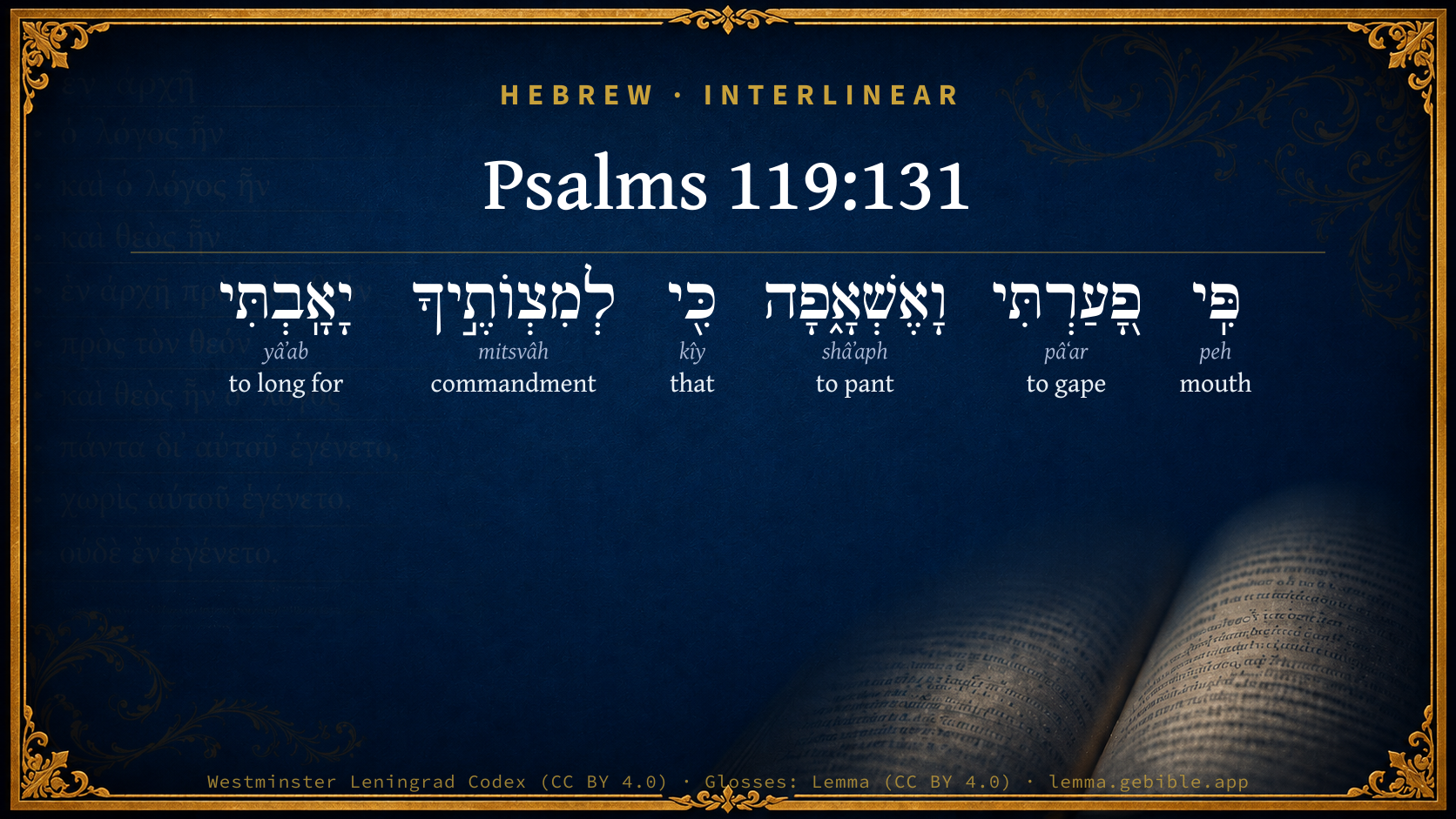
Psalms 119:131

Hebrew (Westminster Leningrad Codex) Psalms 119:131 appears in the Hebrew Old Testament. The text above is from the Westminster Leningrad Codex. Each word links to its Strong’s number, a concise gloss, and parsing drawn from the Open Scriptures Hebrew Bible morphology. Click any word for its full Brown-Driver-Briggs (BDB) entry.
Download image
Cite this verse

Psalms 119:131 (World English Bible). Public Domain. Lemma interlinear Bible study tool, https://lemma.gebible.app/v/psalms/119/131.

Show BibTeX & RIS
BibTeX
RIS
English Translation
I opened my mouth wide and panted, For I longed for your commandments.
World English Bible · Public Domain
Highlights
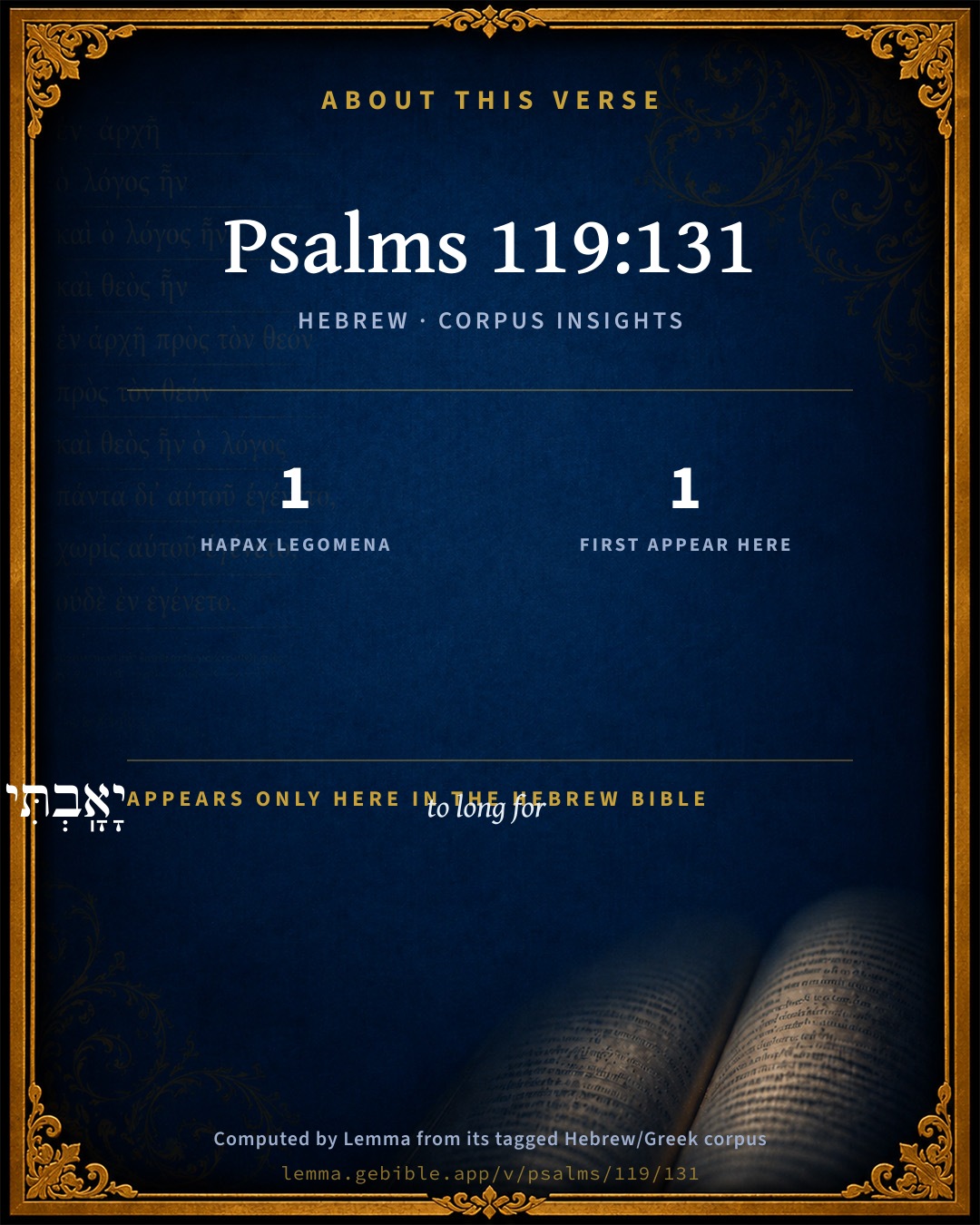
  • 1 hapax legomenon — only here in the Hebrew Bible
  • 1 first appearance in the Hebrew Bible
Full analysis ↓
Download a study sheet

One document with this verse’s original text, its word-by-word gloss line, the meaning frame, cross-references with their text, attributed commentary, and full source and license credits — printable, and it pastes into notes with its structure intact.

This verse Autodidact and up

Study sheet (.html) Plain text (.txt)

A passage Seminary Student

Up to 50 verses in one chapter. A passage sheet keeps up to 6 commentary sources and 12 cross-references per verse, in the order this page ranks them, and says so on the sheet whenever that leaves anything out. Ask for a single verse and you get the Autodidact verse sheet above.

Everything on this page stays free to read, with no account — the sheet is a download of what is already on screen, not access to it.

Want to remove ads? Support Godless Engineer
Compare translations 3

The same verse in 3 English versions, stacked beneath the original-language interlinear above. Click any original word for its lexicon entry.

Each is an independent rendering of the whole verse — the interlinear is not word-aligned to these translations.

Highlighted words mark where these versions differ — a whole-verse word diff, not a word-by-word alignment.

  • World English Bible Public Domain
    I opened my mouth wide and panted, For I longed for your commandments.
  • King James Version Public Domain
    I opened my mouth, and panted: for I longed for thy commandments.
  • unfoldingWord Literal Text CC BY-SA 4.0
    I open wide my mouth and I pant, for I long for your commandments.

unfoldingWord Literal Text — © unfoldingWord, licensed CC BY-SA 4.0. Word-aligned USFM3 via Door43 (git.door43.org/unfoldingWord/en_ult).

Versions to compare (up to 4)

3 of 4 selected

Show all 17 translations

Every available English version of this verse, each an independent rendering of the whole verse.

  • World English Bible Public Domain
    I opened my mouth wide and panted, For I longed for your commandments.
  • Berean Standard Bible Public Domain
    I open my mouth and pant, longing for Your commandments.
  • Majority Standard Bible Public Domain
    I open my mouth and pant, longing for Your commandments.
  • King James Version Public Domain
    I opened my mouth, and panted: for I longed for thy commandments.
  • American Standard Version (1901) Public Domain
    I opened wide my mouth, and panted; For I longed for thy commandments.
  • Revised Version (1885) Public Domain
    I opened wide my mouth, and panted; for I longed for thy commandments.
  • Geneva Bible (1599) Public Domain
    I opened my mouth and panted, because I loued thy commandements.
  • Young's Literal Translation Public Domain
    My mouth I have opened, yea, I pant, For, for Thy commands I have longed.
  • Literal Standard Version CC BY-SA 4.0
    I have opened my mouth, indeed, I pant, || For I have longed for Your commands.
  • Unlocked Literal Bible CC BY-SA 4.0
    I open my mouth and pant, for I long for your commandments.
  • unfoldingWord Literal Text CC BY-SA 4.0
    I open wide my mouth and I pant, for I long for your commandments.
  • Darby Bible Public Domain
    I opened my mouth wide and panted; for I longed for thy commandments.
  • World Messianic Bible Public Domain
    I opened my mouth wide and panted, for I longed for your commandments.
  • Webster's Bible Public Domain
    I opened my mouth, and panted: for I longed for thy commandments.
  • Free Bible Version CC BY-SA 4.0
    With keen desire I long for what you have to say.
  • Bible in Basic English Public Domain
    My mouth was open wide, waiting with great desire for your teachings.
  • JPS Tanakh (1917) Public Domain
    I opened wide my mouth, and panted; for I longed for Thy commandments.

Literal Standard Version (2020), Covenant Press — licensed CC BY-SA 4.0. Text via the HelloAO Bible API (eBible.org). Unlocked Literal Bible (unfoldingWord) — licensed CC BY-SA 4.0. Text via the HelloAO Bible API (eBible.org). unfoldingWord Literal Text — © unfoldingWord, licensed CC BY-SA 4.0. Word-aligned USFM3 via Door43 (git.door43.org/unfoldingWord/en_ult). Free Bible Version, Dr. Jonathan Gallagher — licensed CC BY-SA 4.0. Text via the HelloAO Bible API (eBible.org).

Word by word

More ways to search: Search by grammar → Find every occurrence → Compare this word →

Practice this passage: Drill this verse → Learn its vocabulary →

About this verse

These counts appear in no published source. They are computed here, from the morphology-tagged text and Lemma’s own curated glosses. What Lemma adds →

6
words
6
distinct lemmas
Wisdom
section

Notable vocabulary

1 hapax legomenon — a word that appears only here in the entire Hebrew Bible:

  • יָאָֽבְתִּי to long for H2968

First appearance in Scripture

This word makes its first canonical appearance in the Hebrew Bible here:

  • יָאָֽבְתִּי to long for H2968

Shared distinctive vocabulary

פָ֭עַרְתִּי to gape H6473 occurs in 4 verses of the Hebrew Bible. Also found in:

Grammatical profile

  • 3 verbs
  • 2 nouns
  • 1 conjunction

Verb forms

  • פָ֭עַרְתִּי Qal · Perfect
  • וָאֶשְׁאָ֑פָה Qal · Sequential Imperfect
  • יָאָֽבְתִּי Qal · Perfect

Hebrew & Septuagint length

In English translation the verse runs 13 words from the Hebrew and 14 from the Septuagint (LXX English) — closely comparable.

A rough comparison of the two English renderings, which tokenize alike — not a word-level alignment.

Word counts can differ between the Hebrew and the Greek without any difference in meaning — e.g. the Hebrew direct-object marker אֵת has no separate Greek word, and Greek often adds the article ὁ.

Cross-references

10

Topical passages linked to Psalms 119:131 in the Treasury of Scripture Knowledge — connected by theme and wording, ordered by reader-vote popularity; previews shown in the World English Bible.

  • Psalms 42:1 As the deer pants for the water brooks, So my soul pants after you, God.
  • Psalms 119:20 My soul is consumed with longing for your ordinances at all times.
  • 1 Peter 2:2 as newborn babes, long for the pure milk of the Word, that you may grow thereby,
  • Psalms 81:10 I am Yahweh, your God, Who brought you up out of the land of Egypt. Open your mouth wide, and I will fill it.
  • Isaiah 26:8–9 Yes, in the way of your judgments, Yahweh, have we waited for you; to your name, even to your memorial [name], is the desire of our soul.
  • Hebrews 12:14 Follow after peace with all men, and the sanctification without which no man will see the Lord,
  • Job 29:23 They waited for me as for the rain. Their mouths drank as with the spring rain.
  • Psalms 119:162 I rejoice at your word, As one who finds great spoil.
  • Psalms 119:174 I have longed for your salvation, Yahweh. Your law is my delight.
  • Psalms 119:40 Behold, I long for your precepts! Revive me in your righteousness.

Cross-references courtesy of OpenBible.info (CC BY 4.0).

Hebrew and Greek witnesses Masoretic Hebrew ↔ Greek Septuagint

The same verse in the two great witnesses to the Old Testament, shown verse-for-verse.

You’re reading Greek Psalm 118 (Hebrew Psalm 119). The Septuagint counts the superscription, so verse numbers can differ from the Hebrew — chapter-level alignment, not verse-by-verse. Numbering follows Rahlfs.

These are two independent witnesses, not word-aligned to each other, and the Septuagint is shown in lemma (dictionary) form.

Hebrew Psalms 119:131 Masoretic · Westminster Leningrad Codex

פִּֽי פָ֭עַרְתִּי וָאֶשְׁאָ֑פָה כִּ֖י לְמִצְוֺתֶ֣יךָ יָאָֽבְתִּי

I opened my mouth wide and panted, For I longed for your commandments.

World English Bible · Public Domain

Greek LXX Greek Psalm 118:131 Septuagint · lemma form

ὁ στόμα ἐγώ ἀναοἴγω καί ἕλκω πνεῦμα ὅτι ὁ ἐντολή σύ ἐπιποθέω

I opened my mouth, and drew breath: for I earnestly longed after your commandments.

LXX2012 (modern English Septuagint) · Public Domain

On this verse, Trapp's Complete Commentary discusses the Septuagint’s reading. Read the note in Commentary ↓

Hebrew: Westminster Leningrad Codex (CC BY 4.0). Greek: Septuagint (public domain); English from LXX2012 (modern English Septuagint) (Public Domain). How the Septuagint differs from the Hebrew →

Commentary

Notes on Psalms 119:131 from classic Christian and Jewish commentators (each source and its license shown beneath its notes). The classic Christian expositions comment on the surrounding passage and are grouped to its opening verse, so a note may address several verses; the Jewish commentaries on the Tanakh (Rashi and others) are per-verse, so they appear only where the commentator wrote on this verse.

Lemma curates 59 commentaries, every one of them public domain or Creative Commons licensed, each selected and text-cleaned for this edition rather than reprinted as found. About our sources →

Trapp's Complete Commentary

John Trapp

Psa 119:131 I opened my mouth, and panted: for I longed for thy commandments.

Ver. 131. I opened my mouth and panted] Heb. and sooped in the air, as one that laboureth for life. Oh the sighs and the groans that I incessantly breathed forth out of zeal to thy law! Oh the strong affections kindled on the hearth of my heart! for,

I longed for thy commandments] The Septuagint renders it by επιποθεω, which signifieth a most vehement desire, impatient of delays. As one that runneth himself out of breath. Sitio propter legem sicut dracones propter pluviam, Job 29:1-25

John Trapp, A Commentary or Exposition upon All the Books of the Old and New Testament (1647–1656) — public domain. Text from a community e-Sword module.

The Biblical Illustrator

Joseph S. Exell

Psa_119:131-133

I opened my mouth, and panted, for I longed for Thy commandments.

Holy longings

Here we have David desiring, praying, pleading, and setting forth very clearly what he pants after. May you and I have the same burning desires; and at the same time may we clearly know what we are panting for, so that we may the more intelligently pursue it, and thus go the nearer way to obtain it!

I. Longing ardently after holiness (verse 131).

1. The man of God longeth after the Lords commandments. Many religious people long after the promises, and they do well; but they must not forget to have an equal longing for the commandments.

2. The psalmist, having told us what he longed for, shows the strength of those desires; for he had been so eager in his pursuit of holiness that he had test his breath. Are you ready to faint? Underneath are the everlasting arms.

3. See how resolved he was. Even though you open your mouth and pant with weariness, yet keep your face set like a flint towards holiness, and let your case be that of one who is faint, yet pursuing.

4. Note that the follower after holiness seeks renewed strength. Why does he open his mouth and pant? Is it not to get more air, to fill his lungs again, to cool his blood, and to be ready to renew his running?

5. He was dissatisfied with his attainments. His opened mouth and panting heart betoken desires which are not as yet fulfilled.

6. Yet, let no tinge of discouragement mingle with your dissatisfaction: this man is hopeful of better things. He opens his mouth because he looks for something to fill it; he pants because he believes in water-brooks which will relieve his thirst.

II. Pleading fervently for the holiness he desired (verse 132).

1. He believes in Gods power to bless him, and hence he turns to Him, and cries, Look Thou upon me. Great sinners may be grateful for a look, for it is more than they deserve. Great saints may rejoice in a look; for it means much when the eye which looks is the eye of Omnipotent Love.

2. He appeals to mercy.

3. He pleads as one who loves God.

4. He employs the grand plea of use and wont.

5. He joyfully accepts Gods method. We kiss the rod, because the Father who uses it designs to kiss us. We assent to the processes of grace that we may enjoy the results of grace. It may so happen that if God sanctifies you, He may have to grind you very small: cheerfully yield yourself to the mill. If this is the way in which He deals with those that love His Name, do not desire any different treatment.

III. Enlarging intelligently upon the favour he seeks (verse 133).

1. Now, let us see how the psalmist puts it. His cry is for holiness, and he describes it as being ruled by the Word of God. Order my steps in Thy Word. The different sects have differing ideas of holiness, but the reality of holiness is only one. It is this--Order my steps in Thy Word.

2. He would have holiness in every step of his life.

3. He would have every step ordered. We can never attain to the right proportion of the virtues unless the Lord Himself arranges them in order for us, Do not tell me it is easy to be holy; you want not only the different graces, but all these in order due and measure fit. O Lord, help us! Order our steps.

4. He would have every step full of God: he would have each one ordered of the Lord. He would receive his strength, his motives, his guiding influences direct from the Lord.

5. He would be wholly delivered from the tyranny of sin. Let not any iniquity, etc. I fear that many professors have never understood this prayer. One man is a splendid man for a prayer-meeting, a fine man for a Bible-class; but at home he is a tyrant to his wife and children. Is not this a great evil under the sun? Another man is stern and honest, and he inveighs with all his might against every form of evil, but he is hard even to cruelty with all who are in his power. One is generous and fervent, but he likes a sly drop; another is good-natured and pleasant, but he puts it on in his bills at times, and his customers do not find the goods quite of the quality they pay for. Beware of pet sins. If you let a golden god rule you, you will perish as well as if you let a mud god rule you. Be this your constant cry--Let not any iniquity have dominion over me. (C. H. Spurgeon.)

The satisfying power of Divine things

These words may be considered as expressing the very earnest longing of the psalmist for greater acquaintance with God in spiritual things; and then, in saying, I opened my mouth, and panted, he merely asserts the vehemence of his desire. Or you may separate the clauses: you may regard the first as the utterance of a man utterly dissatisfied with the earth and earthly things, and the second as the expression of a consciousness that God, and God only, could meet the longings of his soul. I opened my mouth, and panted. Out of breath with chasing shadows, and hunting after baubles, I sit down exhausted, as far off as ever from the happiness which has been earnestly but fruitlessly sought. Whither, then, shall I turn? Thy commandments, O Lord, and these alone, can satisfy the desires of an immortal being like myself; and on these, therefore, henceforward shall my longings be turned. We shall regard the passage under this latter point of view.

I. The insufficiency of created things to supply the wants of the soul. Let the soul be set to the survey of any created good, and however enamoured of that good, its decision will be that its limits are discernible; and in making this decision its own capacities, unconsciously, it may be, but not the less surely, will enlarge so as to be greater than the good, and thus make hopeless the attempt at filling them therewith. The soul, in fact, grows with what it receives; and unless the horizon of a good be like the natural horizon, which recedes as fast as you approach, the soul will quickly pass the boundary line, and present again a void which craves to be filled. But this can be affirmed of no good save the Almighty Himself. God is that alone perfection of which I can see no end; with all others, the higher I ascend the more conscious am I that the horizon has a shore, however distant, and with the greater elasticity does my spirit spread itself, so as to embrace the expanse of wonders; but with God, the loftier my point of survey, the firmer my persuasion that the ocean is without a shore.

II. The power there is in Gods commandments of filling our capacity for enjoyment. We suppose that, had it been left with ourselves to draw the comparison, we should not have represented this man, who was exhausted by a fruitless search after happiness, as longing after the commandments of God. We should have been inclined to fix on the favour of God, or on the joys which He communicates to His people, rather than, with David in our text, on His commandments, as affording that material of satisfaction which is so vainly sought in any earthly good. But let the matter be carefully examined, and we shall find that it is strictly for the commandment that the wearied soul ought to long. The whole law of God is summed up in one commandment, the commandment of love; but in what does mans happiness lie, if not in obedience to this commandment? We deny the possibility of satisfaction of soul, so long as there is nothing of reunion with God. The human soul has been torn away from God, and all that restlessness which it manifests, until again linked into friendship, is an irrepressible evidence of the disruption. In its ceaseless but unavailing endeavours to find a resting-place in finite good, there is an ever-powerful testimony that it has fatally wandered from its home; its fruitless searchings after happiness in the creature are the melancholy evidences of alienation from the Creator. Indeed, fraught as the soul is with the consciousness of immortality--a consciousness which, however for awhile overborne by the tumult of passion, starts up frequently in every man, and forces itself on his attention, it is not possible that there should be aught but disquietude, so long as there is no sense of being at peace with the Almighty, And thus, even if you consider not the peculiar nature of Gods commandments, there would be enough in the fact that they are Gods commandments, and therefore to be obeyed, if we would not be everlastingly and unutterably wretched, to certify us that in Gods commandments must happiness be sought, and that therefore those commandments must be longed for by any one who has exhausted himself in a search after good. But we must go beyond this. We must give heed to the fact that the commandments are summed up in love. Think of a man who knew nothing of envy, who was altogether free from jealousy, nay, who had not only purged himself from these corroding passions, but who had so identified the interests of others with his own, that he felt what befell them as befalling himself; and this would be the man who would obey the command, Thou shalt love thy neighbour as thyself. And can you imagine a happier individual? Can you ever take the measure of his happiness? But the love of man is not all which the commandments require; they require love of God; and this makes them adequate to our every capacity; for it is certain, first of all, that ere I can love God I must know myself reconciled to God. In loving God we throw from us the burden which, if unmoved, must press us down everlastingly into the depths of wretchedness; and we take hold of immortality, as purchased for us and prepared, and reserved. We turn this earth, from a scene of jarring passions and petty rivalries, into one broad stage upon which to labour for the extension of the kingdom of Christ. We concentrate our affections on objects whose contemplation enlarges the soul, whilst their boundaries are unapproached by the mightiest expansion. If I love God I shall be continually travelling on His perfections, and continually discerning that I am as far off as ever from their limits. I shall be continually stretching the soul, that it may enclose what is Divine, and continually finding that what is Divine is too vast to be thus circumscribed. And therefore the command that I love God, oh l it is a command that I develop the immortality of the soul; that I employ my desires till they are as broad as my duration; that I prove myself too capacious for creation. Earth, and moon, and sun, and stars! He who made you all can alone occupy that spirit which, with this narrow framework of flesh as its centre, spreads its circumference wheresoever ye travel in your glorious wanderings. And if such be Gods commandments, we may well set these commandments in contrast with every good from which those who are yet strangers to God would gather their happiness; and I can no longer wonder that a man worn out by the pursuit of earthly things, so that he exclaimed, I opened my mouth, and punted, should turn to the law of the Most High as alone adequate to his capacities, and break into the utterance, I longed for Thy commandments, O Lord. (H. Melvill, B. D.)

The Biblical Illustrator, edited by Joseph S. Exell (c. 1880s–1900s) — public domain. Text from a community e-Sword module.

Joseph Benson's Commentary

Psa 119:131. I opened my mouth, and panted, &c. — I thirst after the truths and precepts of thy word, and pursue them eagerly, and, as it were, with open mouth, ready and greedy to receive them. “An eastern traveller, fatigued through toil and parched by heat, doth not with more vehement desire gasp for the cooling breeze, than the servant of God, in time of temptation and trouble, panteth after that spirit of refreshment and consolation which breathes in the Scriptures of truth.” — Horne.

Joseph Benson's Commentary on the Old and New Testaments (1811–1818) — public domain. Text from a community e-Sword module.

J. A. Alexander on Psalms

Joseph Addison Alexander

131. (Psa 119:131) My mouth I stretch and pant, because for thy commandments I long. The first verb usually means to gape or yawn, but these verbs are intransitive in English, and cannot be construed with the noun directly. For the meaning of the next verb, see above, on Psa 56:1-2; Psa 57:3. Both are figurative expressions of the idea conveyed directly by the third verb, which occurs nowhere else, but differs only in a single letter from the verb of the same meaning used in Psa 119:40; Psa 119:174, which also is peculiar to this psalm.

Joseph Addison Alexander, The Psalms Translated and Explained (1850) — public domain. Text from a community e-Sword module.

Geneva Bible (1599)

Geneva Bible translators

My zeal toward thy word was so great.

Geneva Bible (1599) marginal notes — public domain. Text via Bolls.life.

Matthew Henry's Commentary

Here is, 1. The desire David had towards the word of God: I longed for thy commandments. When he was under a forced absence from God's ordinances he longed to be restored to them again; when he enjoyed ordinances he greedily sucked in the word of God, as new-born babes desire the milk. When Christ is formed in the soul there are gracious longings, unaccountable to one that is a stranger to the work. 2. The degree of that desire appearing in the expressions of it: I opened my mouth and panted, as one overcome with hear, or almost stifled, pants for a mouthful of fresh air. Thus strong, thus earnest, should our desires be towards God and the remembrance of his name, Psa 42:1, Psa 42:2. Luk 12:50.

Matthew Henry's Commentary on the Whole Bible (1708–1710) — public domain (CC PDM 1.0). Text via the HelloAO Bible API.

Adam Clarke's Commentary

Verse 131. I opened my mouth, and panted] A metaphor taken from an animal exhausted in the chase. He runs, open-mouthed, to take in the cooling air; the heart beating high, and the muscular force nearly expended through fatigue. The psalmist sought for salvation, as he would run from a ferocious beast for his life. Nothing can show his earnestness in a stronger point of view.

Adam Clarke's Commentary on the Bible (1810–1826) — public domain. Text from a community e-Sword/MySword module.

John Calvin's Commentaries

131. I opened my mouth and panted. The allusion, according to some, is to an exhausted or thirsty traveler in hot countries, who gasps and pants for the cooling breeze, or the refreshing fountain. According to others this is a metaphor, taken from an exhausted animal in the chase, which runs open-mouthed, to take in the cooling air, the heart beating high, and the muscular force being nearly expended through fatigue. In either view the language is extremely expressive, showing how intensely the Psalmist longed for the refreshment and delight which an acquaintance with the word of God affords. And if the “opening of God’s words,” mentioned in the preceding verse, means the expounding of them, David here points out his eager desire to hear God’s word expounded.

John Calvin's Commentaries (1540-1563) — public domain. Text from the Calvin Translation Society English edition (1840s-50s) via the Christian Classics Ethereal Library (ccel.org). Calvin's coverage is partial (roughly two-thirds of the Bible); uncommented books and verses are honest gaps, never fabricated. The 19th-century editor's footnotes and remarks are omitted so the notes are faithfully Calvin's own voice.

Ellicott's Commentary for English Readers

(131) Comp. Job_29:23.

A Bible Commentary for English Readers, edited by Charles John Ellicott (1878–1897) — public domain. Text from a community e-Sword module.

The Cambridge Bible for Schools and Colleges

gen. ed. J. J. S. Perowne

131. I opened wide my mouth for the food of this illuminating informing instruction (Job_29:23; Psa_81:10), and panted in my eagerness to receive it.

The Cambridge Bible for Schools and Colleges (gen. ed. J. J. S. Perowne; Cambridge University Press, 1878–1918) — public domain. Text from a community e-Sword module.

John Gill's Exposition

Make thy face to shine upon thy servant,.... That is, lift up the light of thy countenance on me; favour me with thy gracious presence, and communion with thyself; manifest thyself unto me, and shed abroad thy love in my heart; cause the sun of righteousness to arise upon me, and commune with me, from above thy mercy seat; restore to me the joys of thy salvation, and let me have the comforts of thy good Spirit: this prayer is a part of the blessing of the high priest, Num 6:25;

and teach me thy statutes; the more communion a man has with God, the more desirous he is of learning and doing his will. This is a frequent petition; see Psa 119:124.

John Gill's Exposition of the Whole Bible (1746–1763) — public domain (CC PDM 1.0). Text via the HelloAO Bible API.

Albert Barnes' Notes on the Bible

I opened my mouth and panted - All this is the language of deep emotion. We breathe hard under the influence of such emotion; we open the mouth wide, and pant, as the ordinary passage for the air through the nostrils is not sufficient to meet the needs of the lungs in their increased action. The idea is, that his heart was full; that he had such an intense desire as to produce deep and rapid breathing; that he was like one who was exhausted, and who “panted” for breath. Compare the notes at Psa 42:1.

For I longed for thy commandments - The word here rendered “longed” occurs nowhere else. It means to desire earnestly. See the notes at Psa 119:20.

Albert Barnes' Notes on the Bible (1834–1885) — public domain. Text from a community e-Sword/MySword module.

Matthew Poole's English Annotations

I thirst after thy precepts, and pursue them eagerly, as it were with open mouth, ready and greedy to receive them. It is a metaphor from one that makes great haste after another, whereby he is forced to pant and to open his mouth for air to refresh himself.

Matthew Poole's English Annotations on the Holy Bible (1683–1685) — public domain. Text from a community e-Sword/MySword module.

The Treasury of David

Charles H. Spurgeon

Ver. 131. I opened my mouth, and panted. So animated was his desire that he looked into the animal world to find a picture of it. He was filled with an intense longing, and was not ashamed to describe it by a most expressive, natural, and yet singular symbol. Like a stag that has been hunted in the chase, and is hard pressed, and therefore pants for breath, so did the Psalmist pant for the entrance of God's word into his soul. Nothing else could content him. All that the world could yield him left him still panting with open mouth.

For I longed for thy commandments. Longed to know them, longed to obey them, longed to be conformed to their spirit, longed to teach them to others. He was a servant of God, and his industrious mind longed to receive orders; he was a learner in the school of grace, and his eager spirit longed to be taught of the Lord.

Ver. 131. I opened my mouth, and panted. By this manner of speech, David expresses, as Basil thinks, animi propensionem, that the inclination of his soul was after God's word. For, this opened mouth, Ambrose thinks, is os interioris hominis, the mouth of the inward man, which in effect is his heart; and the, speech notes vehementem animi intensionem, a vehement intension of his spirit, saith Euthymius. Yet shall it not be amiss to consider here how the mind of the godly earnestly affected moves the body also. The speech may be drawn from travellers, who being very desirous to attain to their proposed ends, enforce their strength thereunto; and finding a weakness in their body to answer their will, they pant and open their mouth, seeking refreshment from the air to renew their strength: or as Vatablus thinks, from men exceeding hungry and thirsty, who open their mouth as if they would draw in the whole air, and then pant and sigh within themselves when they find no full refreshment by it. So he expresses it: "My heart burns with so ardent a longing for thy commandments, that I am forced ever and anon to gasp by reason of my painful breathing."

However it be, it lets us see how the hearing, reading, or meditating of God's word wakened in David a most earnest affection to have the light, joy, grace, and comfort thereof communicated to his own heart. For in the godly, knowledge of good increaseth desires; and it cannot be expressed how vehemently their souls long to feel that power and comfort which they know is in the word; and how sore they are grieved and troubled when they find it not.

And happy were we, if we could meet the Lord with this like affection; that when he opens his mouth, we could also open our heart to hear, as David here doth. Christus aperit os, ut daret allis spiritum; David aperuil ut acciperet;offering his heart to receive the spirit of grace, when God openeth his mouth in his word to give it. For it is his promise to us all "Open thy mouth wide, and I will fill it." Let us turn it into a prayer, that the Lord, who opened the heart of Lydia, would open our heart to receive grace when he offers by his word to give it. William Cowper.

Ver. 131. I opened my mouth, and panted, etc, There are two ways in which these words may be understood. They may be considered as expressing the very earnest longing of the Psalmist for greater acquaintance with God in spiritual things; and then in saying, "I opened my mouth, and panted, "he merely asserts the vehemence of his desire. Or you may separate the clauses: you may regard the first as the utterance of a man utterly dissatisfied with the earth and earthly things, and the second as the expression of a consciousness that God, and God only, could meet the longings of his soul. "I opened my mouth, and panted. "Out of breath, with chasing shadows, and hunting after baubles, I sit down exhausted, as far off as ever from the happiness which has been earnestly but fruitlessly sought. Whither, then, shall I turn? Thy commandments, O Lord, and these alone, can satisfy the desires of an immortal being like myself; and on these, therefore, henceforward shall my longings be turned. Henry Melvill.

Ver. 131. I opened my mouth, and panted. A metaphor taken from men scorched and sweltered with heat, or from those that have run themselves out of breath in following the thing which they would overtake. The former metaphor expressed the vehemency of his love; the other the earnestness of his pursuit: he was like a man gasping for breath, and sucking in the cool air. Thomas Manton.

Ver. 131. I longed for thy commandments. This is a desire which God will satisfy. "Open thy mouth wide, and I will fill it": Ps 81:10. Thomas Manton.

Ver. 131. Panting for holiness. A rare hunger; the evidence of much grace, and the pledge of glory.

Psalms 119:132*

Charles H. Spurgeon's The Treasury of David (1869–1885) — public domain. Psalms only. Text from a community e-Sword/MySword module.

The Pulpit Commentary

I opened my mouth, and panted. (comp. Psa_38:10) The idea intended to be expressed is that of earnest and eager desire. For I longed for thy commandments (see vers. 20, 40).

The Pulpit Commentary (1880–1919), ed. H.D.M. Spence-Jones & Joseph S. Exell — public domain. Text from a community e-Sword module.

John Wesley's Explanatory Notes

Panted - I thirst after thy precepts, and pursue them eagerly.

John Wesley, Explanatory Notes Upon the Whole Bible (1754–1765) — public domain. Text via the GEBible commentary corpus.

unfoldingWord translationNotes

Door43 World Missions Community

I open my mouth and pant, for I long for your commandments

The writer speaks of his desire for Yahweh's commandments as if he were a dog panting for water. AT: "I earnestly long for your commandments" (See: Metaphor)

Turn to me

To turn towards someone means to pay attention to that person. AT: "Pay attention to me" (See: Symbolic Action)

love your name

Here the word "name" represents Yahweh himself. AT: "love you" (See: Metonymy)

translationWords

command

turn

mercy

love

name

unfoldingWord translationNotes — © Distant Shores Media and the Door43 World Missions Community, licensed CC BY-SA 4.0. Source: git.door43.org/Door43/en_tn.

Rashi

Rabbi Shlomo Yitzchaki (Rashi)

and panted Heb. ואשאפה, an expression of swallowing, as (Jer. 2:24): “snuffs up (שאפה) the wind.”

Rashi on the Tanakh — English translations: “The Judaica Press complete Tanach with Rashi, translated by A. J. Rosenberg” (CC BY 4.0); “Pentateuch with Rashi's commentary by M. Rosenbaum and A.M. Silbermann, 1929-1934” (public domain); “The Metsudah Tanach series, Lakewood, N.J” (CC BY 4.0); and “The Book of Joshua, Metsudah Publications, 1997” (CC BY 4.0). Text via Sefaria.

Lesson kit

Teaching starters — assembled from the data on this page, not authored interpretation. Every prompt links to the verse data it draws on. Edit before teaching.

Psalms, in the Wisdom, opens this verse with 6 words (6 distinct Hebrew lemmas). Its most distinctive word is yâʼab (“to long for”). A historical commentator’s framing appears above. Read the whole chapter for the surrounding context.

Discussion questions

  1. What does “to long for” (yâʼab) contribute to the verse as a whole?
  2. This verse holds 1 word here found nowhere else in the Hebrew Bible. What might the rare word draw attention to?
  3. The word “to long for” first appears here in Scripture. What is being introduced at this debut?
  4. Job 16:10 shares the word «to gape» with this verse. How do the two illuminate each other?
  5. These translations render this verse differently; the difference is in the English rendering, not the original. What questions does that raise?
  6. The verb «פָ֭עַרְתִּי» is Qal Perfect. How does its form color the action?
  7. Reading how Trapp's Complete Commentary and The Biblical Illustrator read this verse, where do the two commentators agree and where do they part?

Things to notice

  • 1 word in this verse appears nowhere else in the Hebrew Bible.
  • 1 word makes its first canonical appearance in Scripture here.
  • These translations choose different wording for 7 words in this verse.
  • 6 distinct Hebrew lemmas span 6 words in this verse.

Reading settings

Reading text

Shown beneath each verse's original-language words.

Old Testament
Old Testament edition

Read the OT as the Masoretic Hebrew (MT) or the Greek Septuagint (LXX).

English shown for the Greek Septuagint (in the Hebrew ↔ Greek comparison).

Comparing translations? Open the Compare panel on any verse page to stack up to four side by side.