
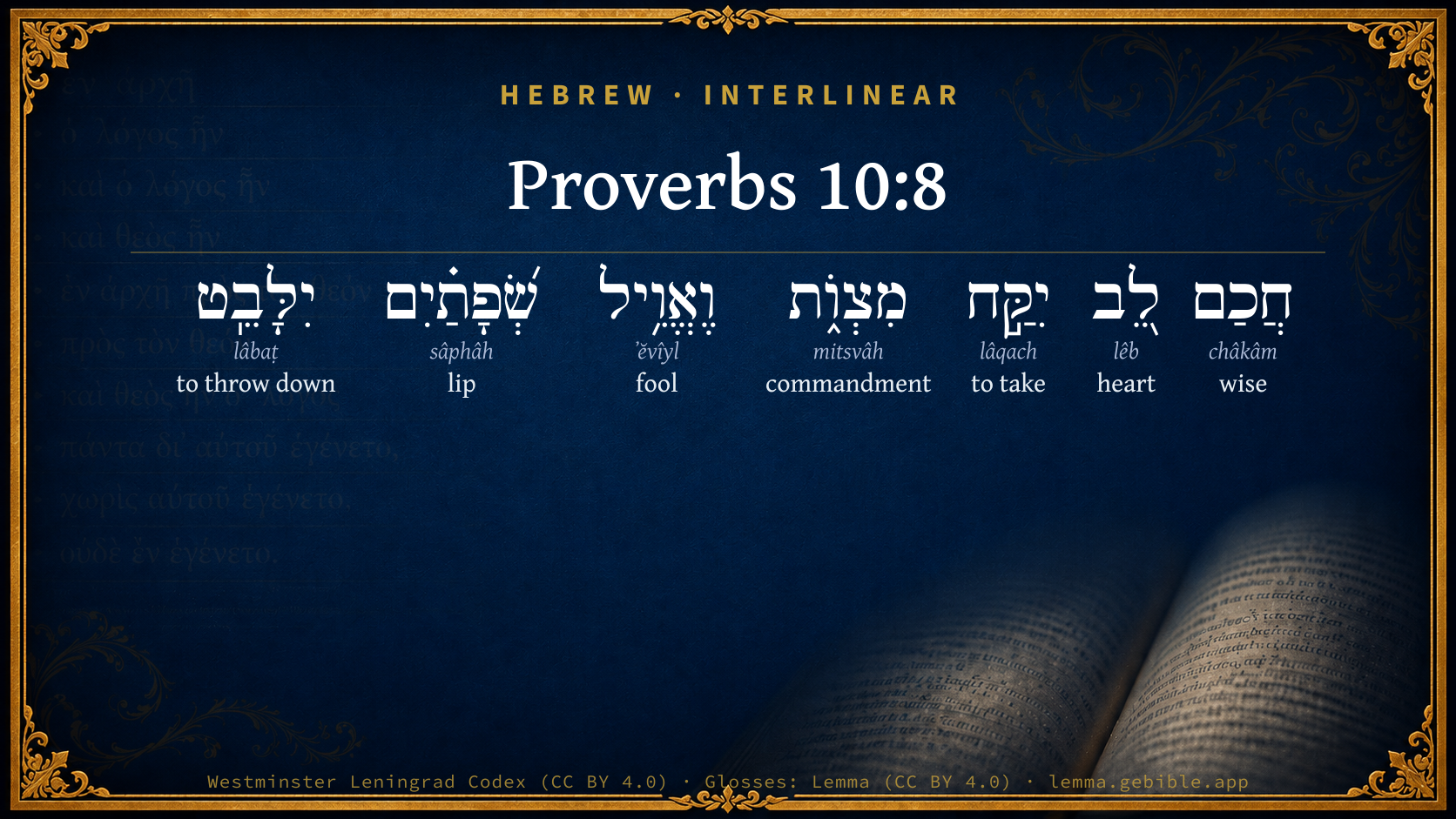
Proverbs 10:8

Hebrew (Westminster Leningrad Codex) Proverbs 10:8 appears in the Hebrew Old Testament. The text above is from the Westminster Leningrad Codex. Each word links to its Strong’s number, a concise gloss, and parsing drawn from the Open Scriptures Hebrew Bible morphology. Click any word for its full Brown-Driver-Briggs (BDB) entry.
Download image
Cite this verse

Proverbs 10:8 (World English Bible). Public Domain. Lemma interlinear Bible study tool, https://lemma.gebible.app/v/proverbs/10/8.

Show BibTeX & RIS
BibTeX
RIS
English Translation
The wise in heart accept commandments, But a chattering fool will fall.
World English Bible · Public Domain
Highlights Full analysis ↓
Download a study sheet

One document with this verse’s original text, its word-by-word gloss line, the meaning frame, cross-references with their text, attributed commentary, and full source and license credits — printable, and it pastes into notes with its structure intact.

This verse Autodidact and up

Study sheet (.html) Plain text (.txt)

A passage Seminary Student

Up to 50 verses in one chapter. A passage sheet keeps up to 6 commentary sources and 12 cross-references per verse, in the order this page ranks them, and says so on the sheet whenever that leaves anything out. Ask for a single verse and you get the Autodidact verse sheet above.

Everything on this page stays free to read, with no account — the sheet is a download of what is already on screen, not access to it.

Want to remove ads? Support Godless Engineer
Compare translations 3

The same verse in 3 English versions, stacked beneath the original-language interlinear above. Click any original word for its lexicon entry.

Each is an independent rendering of the whole verse — the interlinear is not word-aligned to these translations.

Highlighted words mark where these versions differ — a whole-verse word diff, not a word-by-word alignment.

  • World English Bible Public Domain
    The wise in heart accept commandments, But a chattering fool will fall.
  • King James Version Public Domain
    The wise in heart will receive commandments: but a prating fool shall fall.
  • unfoldingWord Literal Text CC BY-SA 4.0
    The one wise of heart receives commands, but the one stupid of lips will be thrown down.

unfoldingWord Literal Text — © unfoldingWord, licensed CC BY-SA 4.0. Word-aligned USFM3 via Door43 (git.door43.org/unfoldingWord/en_ult).

Versions to compare (up to 4)

3 of 4 selected

Show all 18 translations

Every available English version of this verse, each an independent rendering of the whole verse.

  • World English Bible Public Domain
    The wise in heart accept commandments, But a chattering fool will fall.
  • Berean Standard Bible Public Domain
    A wise heart will receive commandments, but foolish lips will come to ruin.
  • Majority Standard Bible Public Domain
    A wise heart will receive commandments, but foolish lips will come to ruin.
  • King James Version Public Domain
    The wise in heart will receive commandments: but a prating fool shall fall.
  • American Standard Version (1901) Public Domain
    The wise in heart will receive commandments; But a prating fool shall fall.
  • Revised Version (1885) Public Domain
    The wise in heart will receive commandments: but a prating fool shall fall.
  • Geneva Bible (1599) Public Domain
    The wise in heart will receiue commandements: but the foolish in talke shalbe beaten.
  • Douay-Rheims (1899) Public Domain
    The wise of heart receiveth precepts: a fool is beaten with lips.
  • Young's Literal Translation Public Domain
    The wise in heart accepteth commands, And a talkative fool kicketh.
  • Literal Standard Version CC BY-SA 4.0
    The wise in heart accepts commands, || And a talkative fool kicks.
  • Unlocked Literal Bible CC BY-SA 4.0
    Those who are sensible accept commands, but a talkative fool will come to ruin.
  • unfoldingWord Literal Text CC BY-SA 4.0
    The one wise of heart receives commands, but the one stupid of lips will be thrown down.
  • Darby Bible Public Domain
    The wise in heart receiveth commandments; but a prating fool shall fall.
  • World Messianic Bible Public Domain
    The wise in heart accept commandments, but a chattering fool will fall.
  • Webster's Bible Public Domain
    The wise in heart will receive commandments: but a prating fool shall fall.
  • Free Bible Version CC BY-SA 4.0
    Those who think wisely pay attention to instruction, but a stupid chatterbox ends up in disaster.
  • Bible in Basic English Public Domain
    The wise-hearted man will let himself be ruled, but the man whose talk is foolish will have a fall.
  • JPS Tanakh (1917) Public Domain
    The wise in heart will receive commandments; but a prating fool shall fall.

Literal Standard Version (2020), Covenant Press — licensed CC BY-SA 4.0. Text via the HelloAO Bible API (eBible.org). Unlocked Literal Bible (unfoldingWord) — licensed CC BY-SA 4.0. Text via the HelloAO Bible API (eBible.org). unfoldingWord Literal Text — © unfoldingWord, licensed CC BY-SA 4.0. Word-aligned USFM3 via Door43 (git.door43.org/unfoldingWord/en_ult). Free Bible Version, Dr. Jonathan Gallagher — licensed CC BY-SA 4.0. Text via the HelloAO Bible API (eBible.org).

Word by word

More ways to search: Search by grammar → Find every occurrence → Compare this word →

Practice this passage: Drill this verse → Learn its vocabulary →

About this verse

These counts appear in no published source. They are computed here, from the morphology-tagged text and Lemma’s own curated glosses. What Lemma adds →

7
words
7
distinct lemmas
Wisdom
section

Notable vocabulary

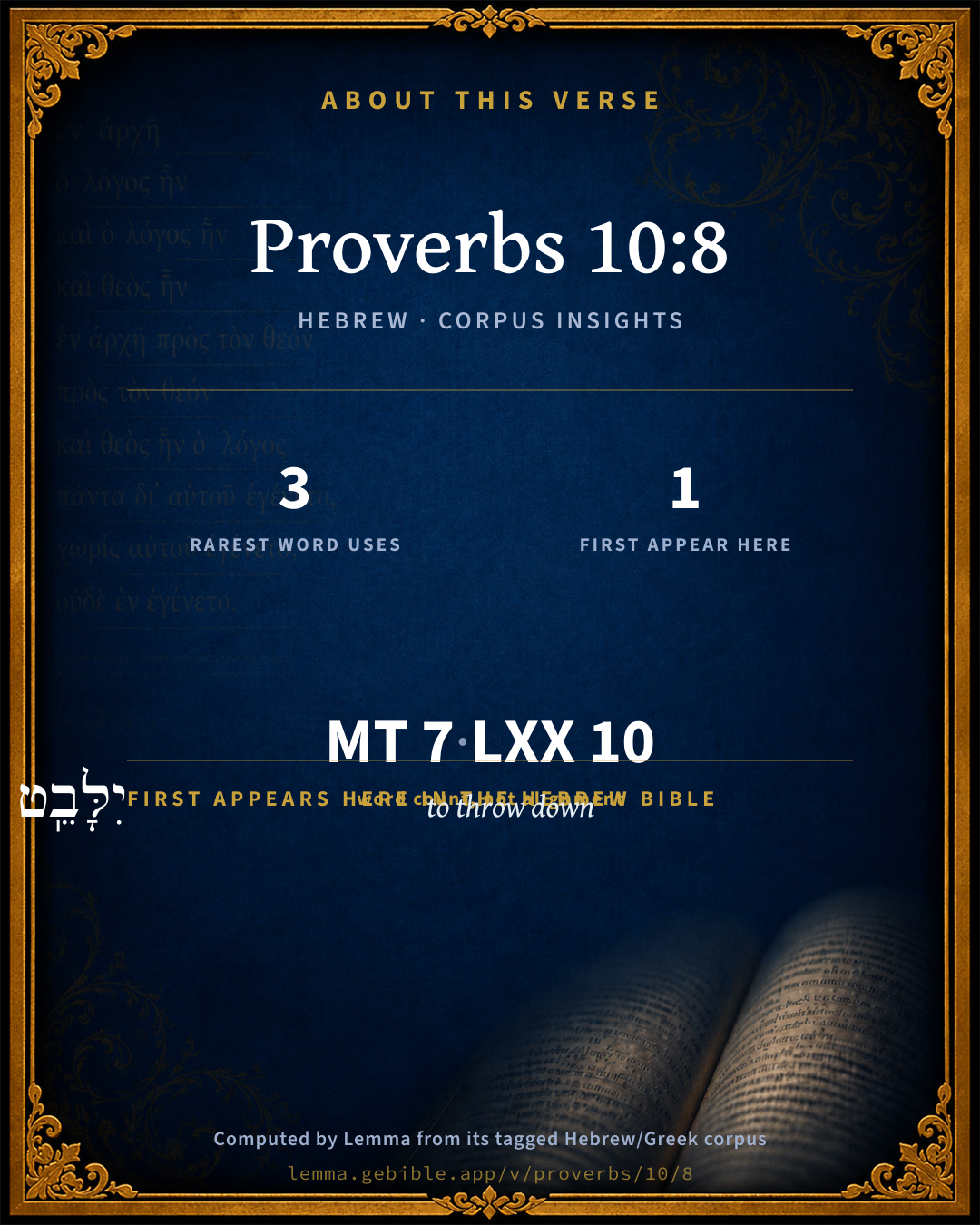
The rarest word here is יִלָּבֵֽט to throw down H3832 — appearing just 3 times in the whole Hebrew Bible.

First appearance in Scripture

This word makes its first canonical appearance in the Hebrew Bible here:

  • יִלָּבֵֽט to throw down H3832

Shared distinctive vocabulary

יִלָּבֵֽט to throw down H3832 occurs in 3 verses of the Hebrew Bible. Also found in:

Grammatical profile

  • 2 verbs
  • 3 nouns
  • 2 adjectives

Verb forms

  • יִקַּ֣ח Qal · Imperfect
  • יִלָּבֵֽט Niphal · Imperfect

Hebrew & Septuagint length

In English translation the verse runs 12 words from the Hebrew and 22 from the Septuagint (LXX English) — the Septuagint runs noticeably longer here. See the side-by-side →

A rough comparison of the two English renderings, which tokenize alike — not a word-level alignment.

Word counts can differ between the Hebrew and the Greek without any difference in meaning — e.g. the Hebrew direct-object marker אֵת has no separate Greek word, and Greek often adds the article ὁ.

In the original languages it is 7 Hebrew tokens and 10 Greek tokens — but the two are counted differently (Hebrew bundles its prefixes and suffixes into one token; the Greek is in lemma form), so that isn’t a like-for-like length.

Cross-references

13

Topical passages linked to Proverbs 10:8 in the Treasury of Scripture Knowledge — connected by theme and wording, ordered by reader-vote popularity; previews shown in the World English Bible.

  • Matthew 7:24–25 "Everyone therefore who hears these words of mine, and does them, I will liken him to a wise man, who built his house on a rock.
  • Proverbs 12:1 Whoever loves correction loves knowledge, But he who hates reproof is stupid.
  • James 3:13 Who is wise and understanding among you? Let him show by his good conduct that his deeds are done in gentleness of wisdom.
  • Psalms 119:34 Give me understanding, and I will keep your law. Yes, I will obey it with my whole heart.
  • Proverbs 9:9 Instruct a wise man, and he will be still wiser. Teach a righteous man, and he will increase in learning.
  • Proverbs 1:5 That the wise man may hear, and increase in learning; That the man of understanding may attain to sound counsel:
  • Proverbs 13:3 He who guards his mouth guards his soul. One who opens wide his lips comes to ruin.
  • Proverbs 18:6–7 A fool's lips come into strife, And his mouth invites beatings.
  • Ecclesiastes 10:12 The words of a wise man's mouth are gracious; but a fool is swallowed by his own lips.
  • Proverbs 10:10 One winking with the eye causes sorrow, But a chattering fool will fall.
  • Proverbs 12:13 An evil man is trapped by sinfulness of lips, But the righteous shall come out of trouble.
  • Proverbs 14:8 The wisdom of the prudent is to think about his way, But the folly of fools is deceit.
  • Proverbs 14:23 In all hard work there is profit, But the talk of the lips leads only to poverty.

Cross-references courtesy of OpenBible.info (CC BY 4.0).

Hebrew and Greek witnesses Masoretic Hebrew ↔ Greek Septuagint

The same verse in the two great witnesses to the Old Testament, shown verse-for-verse.

Here the Septuagint runs noticeably longer than the Hebrew — LXX2012 (modern English Septuagint) 22 words vs World English Bible 12. A rough length comparison of the two English translations, not a word-level alignment — read both below.

These are two independent witnesses, not word-aligned to each other, and the Septuagint is shown in lemma (dictionary) form.

Hebrew Proverbs 10:8 Masoretic · Westminster Leningrad Codex

חֲכַם לֵ֭ב יִקַּ֣ח מִצְוֺ֑ת וֶאֱוִ֥יל שְׂ֝פָתַ֗יִם יִלָּבֵֽט

The wise in heart accept commandments, But a chattering fool will fall.

World English Bible · Public Domain

Greek LXX Proverbs 10:8 Septuagint · lemma form

σοφός καρδία δέχομαι ἐντολή ὁ δέ ἄστεγος χεῖλος σκολιάζω ὑποσκελίζω

A wise man in heart will receive commandments; but he that is unguarded in his lips shall be overthrown in his perverseness.

LXX2012 (modern English Septuagint) · Public Domain

On this verse, Whedon's Commentary on the Bible discusses the Septuagint’s reading. Read the note in Commentary ↓

Hebrew: Westminster Leningrad Codex (CC BY 4.0). Greek: Septuagint (public domain); English from LXX2012 (modern English Septuagint) (Public Domain). How the Septuagint differs from the Hebrew →

Commentary

Notes on Proverbs 10:8 from classic Christian and Jewish commentators (each source and its license shown beneath its notes). The classic Christian expositions comment on the surrounding passage and are grouped to its opening verse, so a note may address several verses; the Jewish commentaries on the Tanakh (Rashi and others) are per-verse, so they appear only where the commentator wrote on this verse.

Lemma curates 59 commentaries, every one of them public domain or Creative Commons licensed, each selected and text-cleaned for this edition rather than reprinted as found. About our sources →

Trapp's Complete Commentary

John Trapp

Pro 10:8 The wise in heart will receive commandments: but a prating fool shall fall.

Ver. 8. The wise in heart shall receive commandment,] i.e., Submit to God’s holy word without replies and cavils. This is check to the brave gallants of our age, which exercise their ripe heads and fresh wits in wrestling with the truth of God, and take it for a glory to give it a foil. The Athenians encountered with Paul, and had argument for argument against him, that Christ was not the Saviour of the world, that he was not risen from the dead, &c. This shewed they were not wise in heart, though reckoned chief among the world’s wizards.

But a prating fool shall fall.] Or, Be beaten. Such a fool was Diotrephes, who prated or trifled {φλυαρει, 3Jn 1:10} against St John with malicious words, and might have been therefore surnamed Nugax, as Rodulphus, that succeeded Anselm in the see of Canterbury, was. {a}

{a} Godwin’s Catal.

John Trapp, A Commentary or Exposition upon All the Books of the Old and New Testament (1647–1656) — public domain. Text from a community e-Sword module.

The Biblical Illustrator

Joseph S. Exell

Pro_10:8

The wise in heart will receive commandments: but a prating fool shall fall.

The wise take advice, fools only give it

Here is one of the most valuable results of wisdom. It is not what it gives, but what it receives. It receives commandments. This receptiveness is a prime characteristic of the new heart. As the thirsty ground drinks in the rain, so the wise in heart long for, and live upon, Gods Word. This receptiveness is a most precious feature of character. Blessed are they that hunger, for they shall be filled. A prating fool shall fall. All his folly comes out. The fool, being empty, busies himself giving out instead of taking in, and he becomes still more empty. From him that hath not shall be taken. He is known, by the noise he makes, to be a tinkling cymbal. People would not have known that his head was so hollow if he had not been constantly ringing on it. To receive a lesson and put it in practice implies a measure of humility; whereas to lay down the law to others is grateful incense to a mans pride and self-importance. The Lord Himself pointed to the unsuspecting receptiveness of a little child, and said that this is the way to enter the kingdom. (W. Arnot, D D.)

A prating fool

A fool of lips; a lip-fool.

1. The self-conceited are generally superficial. There is much talk and little substance; words without sense; plenty of tongue, but a lack of wit. Light matter floats on the surface, and appears to all; what is solid and precious lies at the bottom. The foam is on the face of the waters; the pearl is below.

2. The reference may be to the bluster of insubordination; the loud protestations and boastings of his independence on the part of the man who resists authority and determines to be a law unto himself. (R. Wardlaw.)

The Biblical Illustrator, edited by Joseph S. Exell (c. 1880s–1900s) — public domain. Text from a community e-Sword module.

Joseph Benson's Commentary

Pro 10:8. The wise, &c., will receive commandments — Is ready to hear and obey the precepts of God and men. But a prating fool — One who is slow to hear, and swift to speak, who, instead of receiving good admonitions, cavils and disputes against them; Hebrew, אויל שׂפתים, a fool of lips, one who discovers the folly of his heart by his lips, and thereby exposes himself to the mischief here following; shall fall — Into mischief, or be punished.

Joseph Benson's Commentary on the Old and New Testaments (1811–1818) — public domain. Text from a community e-Sword module.

The Preacher's Complete Homiletical Commentary

Joseph S. Exell (gen. ed.)

MAIN HOMILETICS OF Pro_10:8

THE DOER AND THE TALKER

I. A definition of a wise man. He is one that “will receive commandments.” The reception of commandments implies a commander, and a willingness to obey his laws. The wise man is willing to obey good laws even at the expense of some self-sacrifice, because he has a strong conviction of the benefits that will arise from submission. The laws which govern a well-ordered State will not be irksome to a right-minded citizen. He feels that submission to them will bring only comfort to him. The yoke will bring ease, and he proves that he is a wise man by accepting it. The commandments here are the commandments of Jehovah. He only is a truly wise man who is willing to submit his will to the Divine will, to take upon himself the yoke of Him whose “yoke is easy” (Mat_11:30), who is the Lawgiver who “makes free indeed” (Joh_8:36). He obeys His commandments from the full conviction of the benefits and blessings which flow from keeping them. He knows that the obedience must come before the comfort, that Incarnate Wisdom has placed the commandment first, and then the reward “Ye are my friends, if ye do whatsoever I command you” (Joh_15:14). He can say, from past experience concerning the Divine commands, “In keeping of them there is great reward” (Psa_19:11), and the blessedness that he has tasted he knows to be but the earnest of what is to be in the future, and therefore he is willing to sacrifice present advantage and worldly ease to obedience to them. He is like the trader who has received a sample of a rich cargo from a distant land, and who is so convinced of the value of the whole from that which has come to hand, that he is willing to undergo any present privation in order to become its possessor. The Son of God likened such an one to “a wise man, which built his house upon a rock,” for it is evident that to “receive” commandments is here equivalent to “doing” them (Mat_7:24).

II. A distinguishing mark of a fool. He is a prater. He is one who is willing to talk, but not to act; willing to give out words, but not to receive instruction; and therefore he is one who can give out nothing by speech that is worth giving. Unless the earth receives good seed into its bosom, it cannot give out “seed to the sower and bread to the eater. Unless a man receives into his heart the good seed of the kingdom, he can never bring forth moral fruit” (Mat_13:23), and he can never do more than prate about spiritual truths. There are many words but no meat. There is only one Being in the universe who can be a giver without first being a receiver, and that is God. Outside of Him, all must receive of His fulness if they would be anything more than mere talkers on eternal realities. All such men are fools. “Where is the wise? Where is the scribe? Where is the disputer of this world? Hath not God made foolish the wisdom of this world?” (1Co_1:20.)

III. The end of such a mere talker. He shall fall.

1. In the estimation of those whom he pretends to instruct. No men are so prone to assume the office of instructors as men who are ignorant, but such men cannot long hold a place in the estimation of others.

2. He shall fall into deeper folly. Those who refuse to receive that Divine commandment which will make them truly wise, must sink lower and lower in sinful folly. The longer he refuses the offered wisdom, and refuses to put his neck under the yoke of God’s commandments, the heavier will grow the chains of sinful habit, and the more firmly will they be riveted.

3. He shall fall into righteous retribution. This will be proportionate to the opportunities he has had of receiving wisdom. “And thou, Capernaum, which art exalted unto heaven, shall be brought down to hell” (Mat_11:23).

OUTLINES AND SUGGESTIVE COMMENTS

A fool is in nothing sooner and better recognised than in his conversation.—Geier.

It is striking how often Solomon dwells upon sins of the tongue; no member is so hard to control; none more surely indicates the man.—Fausset.

The heart is the seat of true wisdom, and a teachable spirit is the best proof of its influence. For who that knows himself would not be thankful for further light. No sooner, therefore, do the commandments come down from heaven, than the well-instructed Christian receives them, like his father Abraham (Heb_11:8, Gen_22:1-3), with undisputing simplicity; welcomes the voice of his heavenly teacher (1Sa_3:10, Act_10:33, Psa_27:8; Psa_143:10), and when he knows that “it is the Lord, girds himself” with all the ardour of the disciple to be found at his feet (Joh_21:2-7). But look at the professor of religion destitute of this heart-seated wisdom. We find him a man of creeds and doctrines, not of prayer; asking curious questions rather than listening to plain truths; wanting to know events rather than duties; occupied with other men’s business to the neglect of his own (Luk_13:23-24; 1Ti_5:13).—Bridges.

It is one of the marks of true wisdom, and none of the least, that it is not self-sufficient and self-willed. This is the evident import of the former part of this verse. We might consider the disposition in reference both to God and to men—to the Supreme Ruler and Lord of the conscience,—and to existing human authorities. The “wise in heart will receive” God’s “commandments.” This, true wisdom will do implicitly. It will never presume on dictating to God, or on altering and amending His prescriptions; but, proceeding on the self-evident principle that the dictates of Divine Wisdom must in all cases be perfect, will bow in instant acquiescence. With regard also to earthly superiors, a humble submission to legitimate authority, both in the family and in the State, is the province of wisdom. There is a self-conceit that spurns at all such authority. It talks as if it would legislate for all nations. It would give commandments rather than receive them. It likes not being dictated to. It plumes itself on its skill in finding fault. There is no rule prescribed at which it does not carp, no proposal in which it does not see something not to its mind, no order in which it does not find something to which it cannot submit. This is folly, for, were this temper of mind prevalent, there would be an end to all subordination and control. The prating fool, or the fool of lips, may be understood in two ways. First, the self-conceited are generally superficial. There is much talk and little substance: words without sense: plenty of tongue, but a lack of wit. Light matter floats on the surface, and appears to all; what is solid and precious lies at the bottom. The foam is on the face of the waters; the pearl is below. Or, secondly, the reference may be to the bluster of insubordination; the loud protestations and boasting of his independence on the part of a man who resists authority, and determines to be “a law to himself.”—Wardlaw.

The word “commandments” (E. V.), might often be translated “laws.” One set of passages would just change words with another. The word translated “commandments” means primarily “something fixed.” It answers to the New Testament “law” (Rom_8:3), and is adapted to the reasonings of the apostles. “He of the wise heart” means the truly wise. He of the fool heart might seem good for the rest of the sentence. But a deep philosophy reminds the inspired man that men are not such fools as to believe in sin, as the pardoned Christian does in holiness. They know a great deal more than they either act or utter. A vast deal of the worldliness of men is a mere lip service, like that to the Almighty. And, knowing that the lost man is aware of his perdition, and has been told his folly, the proverb does not account him a fool in his deep sense, so much as superficially, and in the mad actings of his folly. In his heart he knows he is deceived. In his lips he is constantly deceiving himself. In his acts he keeps up a fictitious life.—Miller.

The Preacher's Complete Homiletical Commentary (gen. ed. Joseph S. Exell; Funk & Wagnalls, c. 1892) — public domain (pre-1929). A full-Bible homiletical/sermon-outline anthology covering 65 of 66 books (2 John is absent from the source module). Text from a community e-Sword module.

Geneva Bible (1599)

Geneva Bible translators

Hebrew, lips.

Geneva Bible (1599) marginal notes — public domain. Text via Bolls.life.

Matthew Henry's Commentary

Here is, 1. The honour and happiness of the obedient. They will receive commandments; they will take it as a privilege, and really an ease to them, to be under government, which saves them the labour of deliberating and choosing for themselves; and they will take it as a favour to be told their duty and admonished concerning it. And this is their wisdom; those are wise in heart who are tractable, and those who thus bend, thus stoop, shall stand and be established, shall prosper, being well advised. 2. The shame and ruin of the disobedient, that will not be governed, nor endure any yoke, that will not be taught, nor take any advice. They are fools, for they act against themselves and their own interest; they are commonly prating fools, fools of lips, full of talk, but full of nonsense, boasting of themselves, prating spitefully against those that admonish them (Jo3 1:10), and pretending to give counsel and law to others. Of all fools, none more troublesome than the prating fools, nor that more expose themselves; but they shall fall into sin, into hell, because they received not commandments. Those that are full of tongue seldom look well to their feet, and therefore stumble and fall.

Matthew Henry's Commentary on the Whole Bible (1708–1710) — public domain (CC PDM 1.0). Text via the HelloAO Bible API.

Jamieson, Fausset & Brown

Robert Jamieson, A. R. Fausset & David Brown

wise, &c.--(compare Pro 9:8-9, Pro 9:16), opposed to

prating fool--or, "fool of lips of wicked language."

fall--headlong, suddenly.

Jamieson, Fausset & Brown — Commentary Critical and Explanatory on the Whole Bible (1871) — public domain (CC PDM 1.0). Text via the HelloAO Bible API.

Adam Clarke's Commentary

Verse 8. A prating fool shall fall.] This clause is repeated in the tenth verse. The wise man will receive the commandment: but the shallow blabbing fool shall be cast down. See Pr 10:10.

Adam Clarke's Commentary on the Bible (1810–1826) — public domain. Text from a community e-Sword/MySword module.

Ellicott's Commentary for English Readers

(8) A prating fool (‘evîl). (See above, on Pro_1:7.)

A Bible Commentary for English Readers, edited by Charles John Ellicott (1878–1897) — public domain. Text from a community e-Sword module.

The Cambridge Bible for Schools and Colleges

gen. ed. J. J. S. Perowne

8. a prating fool] A happy rendering, lit. the foolish of lips.

shall fall] Or, shall be overthrown, or laid low. R.V. marg.

The Cambridge Bible for Schools and Colleges (gen. ed. J. J. S. Perowne; Cambridge University Press, 1878–1918) — public domain. Text from a community e-Sword module.

John Gill's Exposition

The wise in heart will receive commandments,.... Such who have true wisdom in the hidden part of the heart, of which the fear of the Lord is the beginning: these will not only, as good subjects, honour their king, and attend to his lawful commands; and, as dutiful children, regard those of their parents; and, as faithful servants, hearken to those of their masters; but, as such that fear the Lord, will receive and cheerfully obey the commandments of God and Christ;

but a prating fool shall fall; like Diotrephes, that prated against the Apostle John and other saints. Or, "a fool of lips" (b); whose folly is proclaimed and made known by his lips; who, out of the abundance of it in his heart, speaks and pours it out by his lips: such an one falls into sin and into mischief; he falls into disgrace in this world, and into hell in the next. The Targum is,

"the fool by his lips shall be taken;''

as in a snare.

(b) "stultus labiis", Montanus, &c.

John Gill's Exposition of the Whole Bible (1746–1763) — public domain (CC PDM 1.0). Text via the HelloAO Bible API.

Albert Barnes' Notes on the Bible

A prating ... fall - Better, as in the margin. Inward self-contained wisdom is contrasted with self-exposed folly.

Albert Barnes' Notes on the Bible (1834–1885) — public domain. Text from a community e-Sword/MySword module.

Haydock's Catholic Bible Commentary

Lips. He will not bear correction. (Menochius) --- But suffers the punishment of his own unguarded speeches; or rather the man who hath foolish lips, shall be beaten, ver. 13. (Calmet)

George Leo Haydock (1774–1849), Haydock's Catholic Family Bible and Commentary, 1859 edition — public domain. Excludes Psalms (Douay-Rheims chapter numbering differs from Protestant) and Deuterocanonical books (Catholic canon only).

Matthew Poole's English Annotations

Will receive commandments; is ready to hear and obey the counsels and precepts of God, and of men, by which means he shall stand fast and live.

A prating fool; one who is slow to hear and swift to speak, who, instead of receiving good admonitions, cavils and disputes against them. In the Hebrew he is called a fool of lips, either because he discovers the folly of his heart by his lips, and thereby exposeth himself to the mischief here following; or because he is without heart, as is said of Ephraim, Hos 7:11, or his heart is little worth, as is said here, Pro 10:20; or because he speaks rashly, without any consideration. Or it may be rendered, a fool by his lips, i.e. by his foolish and wicked speeches, contrary to the commands of God, by talking much and ill, when it is more comely and necessary for him to hear and receive instruction from others.

Shall fall, to wit, into mischief; or, be punished, as the word is used, Hos 4:14; or, be beaten, as below, Pro 10:10.

Matthew Poole's English Annotations on the Holy Bible (1683–1685) — public domain. Text from a community e-Sword/MySword module.

Whedon's Commentary on the Bible

Daniel D. Whedon

8. Commandments — Probably in the sense of instruction, advice, precept.

A prating fool — Foolish of lips; he who is foolish with his lips has more tongue than brains.

Shall fall — The Septuagint, “Shall be tripped up.” Stuart, “Shall rush headlong.” The antithesis lies chiefly in receiving, that is, accepting, advice, in the one case, and the implied non-acceptance of it in the other, which is expressed by its consequences, he shall be tripped up, or overthrown. The intimation is, that this will occur from his empty loquacity.

Daniel D. Whedon (gen. ed.), Commentary on the Old and New Testaments (1874–1909) — public domain. Text from a community e-Sword module.

The Pulpit Commentary

Will receive commandments. The wise in heart is not proud or conceited: he accepts the Divine Law with all its directions (observe the plural "commandments"), and is not above learning from others; at the same time, he makes no display of his wisdom. The fool of lips (ver. 10); one who is always exposing his folly. The literal antithesis is better shown by rendering "the solid in heart," and "the loose in lips." So Wordsworth. The Vulgate translates, "The fool is chastised by his lips;" i.e. the folly which he has uttered falls back upon him, and causes him to suffer punishment. The LXX renders the last clause, "He who is given to prating (astegov ceilesi ), walking tortuously, shall be tripped up.

Vers. 8-10. Folly and wisdom in manifold contrast.

I THE WISE MAN IS MORE READY TO RECEIVE THAN TO GIVE COUNSEL; THE FOOL, THE OPPOSITE.

II THE WISE MAN KNOWS THE VALUE OF RESERVE; THE FOOL WILL "STILL BE TALKING.

III THE WISE MAN IS THRIFTY, ECONOMICAL OF WORDS, A CAPITALIST OF THOUGHT; THE FOOL, A SPENDTHRIFT OF WORDS, A BANKRUPT OF THOUGHT.

IV THE WISE MAN RISES IN REPUTATION, IN POSITION; THE FOOL COMES SOONER OR LATER TO A "FALL.

V GUILELESSNESS IS SAFE, WHILE CRAFT AND CROOKED POLICY ARE CERTAIN, SOONER OR LATER, OF EXPOSURE. (Ver. 9) In that widest sense in which alone the saying is noble and true, "Honesty is the best policy." Cunning overreaches itself and gets into trouble; and the mere talker never ends well. Speech should only be prophetic of deed; otherwise, Many will say to me in that day, etc. J.

Vers. 8, 10, 11, 14, 18-21, 31, 32. The service of speech, etc.

"Man is a talking animal," we say. But if we are distinguished from the brute creation by the mere fact of speech, how truly are we divided from one another by the use we make of that human faculty! To what height of worthiness one man may rise, and what inestimable service he may render, but to what depth of wrong another man may fall, and what mischief he may work, by the use of his tongue!

I THE SERVICE OF SPEECH. "By our words" we may do great things, as our Master has told us, and as his apostle reminds us. (see Mat_12:37 Jam_3:9)

1. We may give deep and pure gratification. (ver. 32; and see Ecc_12:10) We may speak (or read) words which shall be

(1) charming, soothing, comforting, encouraging, even inspiring, in the ear of man; and also

(2) pleasing and satisfying to our Divine Master.

2. We may follow in the footsteps of the Divine. For "the mouth of the just bringeth forth wisdom" (ver. 31). We may utter in the ears, and may thus convey to the minds and hearts of men, the truths which are nothing less than the wisdom of God. Thus we may be speaking to others the very thoughts and making known the will of God. We ourselves may be, on our scale and in our sphere, like the Lord whom we serve and follow, "the Wisdom of God". (1Co_1:24, 1Co_1:30)

3. We may enrich the life of our fellow men. "The tongue of the just is as choice silver" (ver. 20). And surely fine thoughts, brilliant images, sound principles, sustaining truths, elevating conceptions of God, charitable ideas of men, these are more enlarging and enriching than many pounds of silver or many piles of gold.

4. We may nourish the soul. "The lips of the righteous feed many" (ver. 21). Their words are spiritual bread which "strengtheneth man"s heart," and makes him able to watch, to work, to battle, to endure. They are the wine which gives new life when he is ready to perish, (Pro_31:6) which restores him in the languor of doubt and difficulty, and fills his soul with hopefulness and energy.

5. We may thus contribute to the true and real life of men. Our mouth will be "a fountain of life" (ver. 11, Revised Version). Whithersoever the river of Divine wisdom, of Christian truth, runneth, there will be that spiritual upspringing which is the true life of man.

II THE MISCHIEF OF ITS ABUSE. The abuse of the power of speech, the talking which is idle and vain, is a great and sore evil.

1. It brings the speaker into contempt; he is thought and spoken of as "a prating fool" (vers. 8, 10), and he comes under the contempt of the wise.

2. It involves men in sin. "In the multitude of words," etc. (ver. 19). The man that is ever speaking with little forethought is sure to violate truth and righteousness before many hours have passed.

3. It works mischief of many kinds (vers. 14 and 18). It is sure to end in slander, in the robbery of reputation. The mouth of the foolish is "a present destruction" (Revised Version). The habit of bad speech, especially if it be that of falsehood, or lewdness, or profanity, is a "present destruction,

(1) in that it constitutes a real calamity; for in the sight of God there can be few things worse than such a pitiful abuse of the powers he has entrusted to us. It is also a "present destruction,

(2) in that it leads with a fatal swiftness to the deterioration and corruption of those in whose hearing it is uttered. C.

The Pulpit Commentary (1880–1919), ed. H.D.M. Spence-Jones & Joseph S. Exell — public domain. Text from a community e-Sword module.

John Wesley's Explanatory Notes

Who receive - Is ready to hear and obey the precepts of God and men. Fall - Into mischief.

John Wesley, Explanatory Notes Upon the Whole Bible (1754–1765) — public domain. Text via the GEBible commentary corpus.

Keil & Delitzsch

C. F. Keil & F. Delitzsch

There follows now a series of proverbs in which reference to sins of the mouth and their contrary prevails:

He that is wise in heart receives precepts;

But he that is of a foolish mouth comes to ruin.

A חכם־לב, wise-hearted, as one whose heart is חכם, Pro 23:15; in a word, a נבון, a person of understanding or judgment, Pro 16:21. Such an one does not make his own knowledge the ne plus ultra, nor does he make his own will the noli me tangere; but he takes commands, i.e., instructions directing or prohibiting, to which he willingly subordinates himself as the outflow of a higher knowledge and will, and by which he sets bounds and limits to himself. But a fool of the lips, i.e., a braggart blunderer, one pleasing himself with vain talk (Pro 14:23), falls prostrate, for he thinks that he knows all things better, and will take no pattern; but while he boasts himself from on high, suddenly all at once - for he offends against the fundamental principle of common life and of morality - he comes to lie low down on the ground. The Syr. and Targ. translate ילּבט by, he is caught (Bertheau, ensnared); Aquila, Vulgate, Luther, δαρήσεται, he is slain; Symmachus, βασανισθήσεται; but all without any support in the usage of the language known to us. Theodotion, φυρήσεται, he is confounded, is not tenable; Joseph Kimchi, who after David Kimchi, under Hos 4:14, appeals in support of this meaning (ישׁתבשׁ, similarly Parchon: יתבלבל) to the Arabic, seems to think on iltibâs, confusion. The demonstrable meanings of the verb לבט are the following: 1. To occasion trouble. Thus Mechilta, under Exo 17:14, לבטוהו, one has imposed upon him trouble; Sifri, under Num 11:1, נתלבטנו, we are tired, according to which Rashi: he fatigues himself, but which fits neither to the subj. nor to the contrast, which is to be supposed. The same may be said of the meaning of the Syr. lbt, to drive on, to press, which without doubt accords with the former meaning of the word in the language of the Midrash. 2. In Arab. labaṭ (R. lab, vid., Wnsche's Hos. p. 172), to throw any one down to the earth, so that he falls with his whole body his whole length; the passive נלבט, to be thus thrown down by another, or to throw oneself thus down, figuratively of one who falls hopelessly into evil and destruction (Fl.). The Arabic verb is also used of the springing run of the animal ridden on (to gallop), and of the being lame (to hop), according to which in the Lex. the explanations, he hurries, or he wavers hither and thither, are offered by Kimchi (Graec. Venet. πλανηθήσεται). But the former of these explanations, corruit (= in calamitatem ruit), placed much nearer by the Arabic, is confirmed by the lxx ὑποσκελισθήσεται, and by the Bershith rabba, c. 52, where לבט is used in the sense to be ruined (= נכשׁל). Hitzig changes the passive into the active: "he throws the offered לקח scornfully to the ground," but the contrast does not require this. The wanton, arrogant boasting lies already in the designation of the subj. אויל שׂפתים; and the sequel involves, as a consequence, the contrasted consequence of ready reception of the limitations and guidance of his own will by a higher.

Keil & Delitzsch — Biblical Commentary on the Old Testament (1861–1891) — public domain (CC PDM 1.0). Text via the HelloAO Bible API. (Old Testament only.)

Bridges on Proverbs

Charles Bridges

The heart is the seat of true wisdom, and a teachable spirit is the best proof of its influence. For who that knows himself would not be thankful for further light? No sooner, therefore, do the commandments come down from heaven, than the well-instructed Christian receives them, like his father Abraham (Heb 11:8 . Gen 22:1-3 ), with undisputing simplicity; welcomes the voice of his heavenly teacher (1Sa 3:10 . Act 10:33 . Psa 27:8 ; Psa 86:11 ; Psa 143:10 ); and, when he knows that "it is the LORD, girds himself" with all the ardour of the disciple to be found at his feet. (Joh 21:7 .)

But look at the professor of religion destitute of this heart-seated wisdom. We find him a man of creeds and doctrines, not of prayer; asking curious questions, rather than listening to plain truths (Joh 21:21-22 ); wanting to know events rather than duties; occupied with other men’s business, to the neglect of his own. (Luk 13:23-24 . 1Ti 5:13 .) In this vagrant spirit, with all his thoughts outward bound, he wanders from church to church, and from house to house, a prating fool upon religion; bold in his own conceit (3Jn 1:10 ), while his life and temper fearfully contradict his fluent tongue. Too blind to respect himself (Pro 18:2 ), too proud to listen to counsel (Pro 10:17 ; Pro 15:32 ), he will surely fall into disgrace, beaten with the rod of his own foolishness. (Pro 18:6-7 . Ecc 10:12 . 2Ki 14:8-14 .) Let me look at this picture as a beacon against the folly of my own heart. Young Christian! beware of a specious religion, without humility, consistency, love; because separated from close walking with God.

Charles Bridges, An Exposition of the Book of Proverbs (1846) — public domain. Text from a community e-Sword module.

Kretzmann's Popular Commentary

Paul E. Kretzmann

v. 8. The wise in heart will receive commandments, showing himself ready to be instructed and guided in the right way; but a prating fool, a person of foolish lips, shall fall, be overthrown, bring about his own ruin.

Paul E. Kretzmann, Popular Commentary of the Bible (1921–1924) — public domain. Text from a community e-Sword module.

unfoldingWord translationNotes

Door43 World Missions Community

come to ruin

"be destroyed" or "be made useless"

crooked

not straight; deformed; dishonest; deceitful

translationWords

command

fool

ruin

walk

integrity

unfoldingWord translationNotes — © Distant Shores Media and the Door43 World Missions Community, licensed CC BY-SA 4.0. Source: git.door43.org/Door43/en_tn.

Rashi

Rabbi Shlomo Yitzchaki (Rashi)

The wise-hearted takes commandments This alludes to our teacher, Moses, for all Israel were busy with the plunder of Egypt, and he was busy with the commandments, as is it said (Exod. 13:19): “And Moses took Joseph’s bones, etc.”

but he who talks foolishly will weary Heb. ילבט, an expression of weariness. It appears in Sifre, in the section commencing (Num. 11:1): “And the people were as complainers.” They said, “How much have we wearied (נתלבטנו) on the way!”

Rashi on the Tanakh — English translations: “The Judaica Press complete Tanach with Rashi, translated by A. J. Rosenberg” (CC BY 4.0); “Pentateuch with Rashi's commentary by M. Rosenbaum and A.M. Silbermann, 1929-1934” (public domain); “The Metsudah Tanach series, Lakewood, N.J” (CC BY 4.0); and “The Book of Joshua, Metsudah Publications, 1997” (CC BY 4.0). Text via Sefaria.

Lesson kit

Teaching starters — assembled from the data on this page, not authored interpretation. Every prompt links to the verse data it draws on. Edit before teaching.

Proverbs, in the Wisdom, opens this verse with 7 words (7 distinct Hebrew lemmas). Its most distinctive word is lâbaṭ (“to throw down”). The Greek Septuagint runs longer here. A historical commentator’s framing appears above. Read the whole chapter for the surrounding context.

Discussion questions

  1. How does “to throw down” (lâbaṭ) shape what this verse is saying?
  2. The word “to throw down” first appears here in Scripture. What is being introduced at this debut?
  3. Proverbs 10:10 shares the word «to throw down» with this verse. How do the two illuminate each other?
  4. Compared with the Hebrew, the Septuagint runs longer here. What questions does that raise?
  5. The translations on this page render this verse differently — a whole-verse word diff, not a word-by-word alignment. What might account for the different wordings?
  6. The verb «יִקַּ֣ח» is Qal Imperfect. How does its form color the action?
  7. Reading how Trapp's Complete Commentary and The Biblical Illustrator read this verse, where do the two commentators agree and where do they part?

Things to notice

Reading settings

Reading text

Shown beneath each verse's original-language words.

Old Testament
Old Testament edition

Read the OT as the Masoretic Hebrew (MT) or the Greek Septuagint (LXX).

English shown for the Greek Septuagint (in the Hebrew ↔ Greek comparison).

Comparing translations? Open the Compare panel on any verse page to stack up to four side by side.