
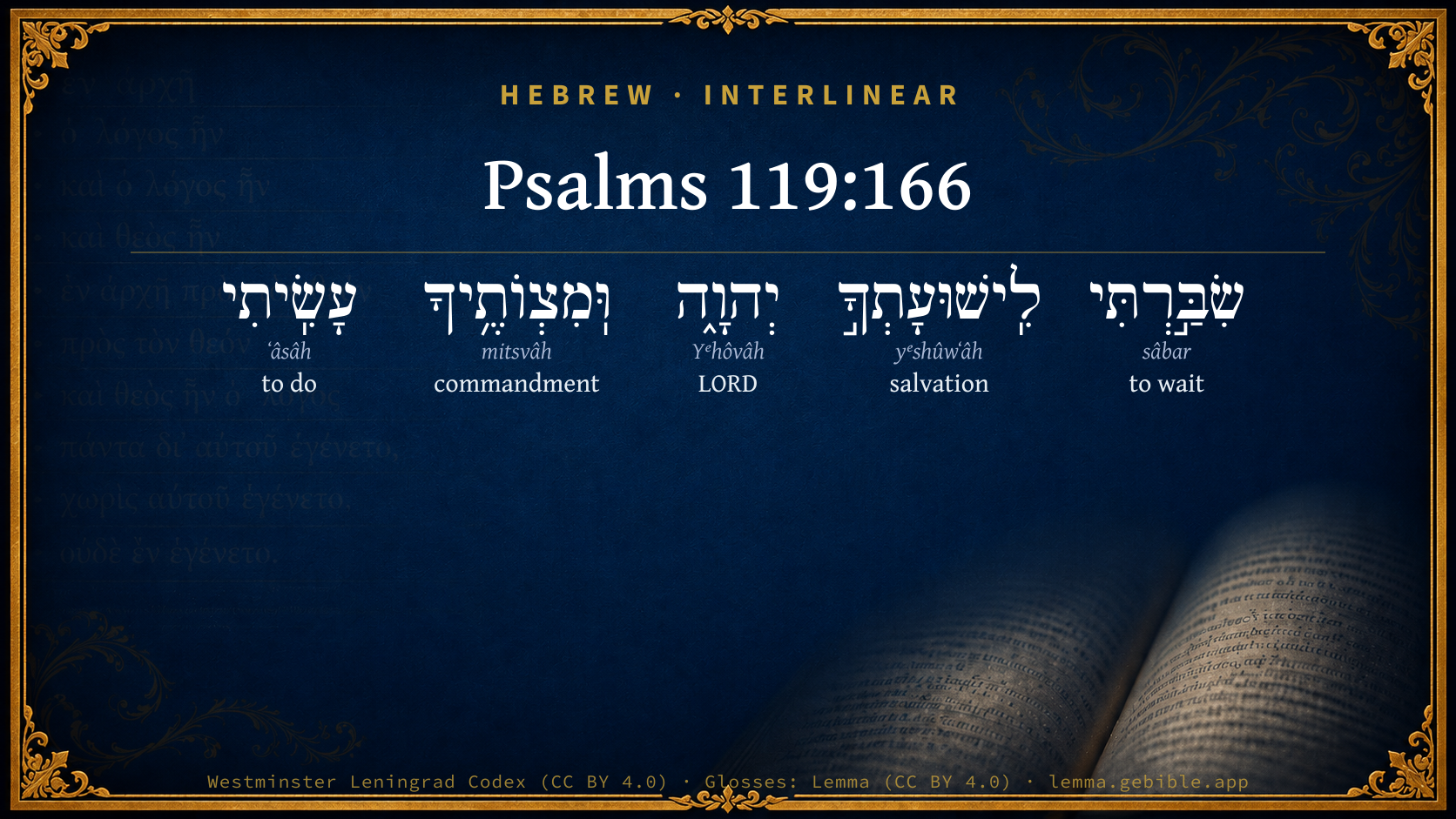
Psalms 119:166

Hebrew (Westminster Leningrad Codex) Psalms 119:166 appears in the Hebrew Old Testament. The text above is from the Westminster Leningrad Codex. Each word links to its Strong’s number, a concise gloss, and parsing drawn from the Open Scriptures Hebrew Bible morphology. Click any word for its full Brown-Driver-Briggs (BDB) entry.
Download image
Cite this verse

Psalms 119:166 (World English Bible). Public Domain. Lemma interlinear Bible study tool, https://lemma.gebible.app/v/psalms/119/166.

Show BibTeX & RIS
BibTeX
RIS
English Translation
I have hoped for your salvation, Yahweh. I have done your commandments.
World English Bible · Public Domain
Download a study sheet

One document with this verse’s original text, its word-by-word gloss line, the meaning frame, cross-references with their text, attributed commentary, and full source and license credits — printable, and it pastes into notes with its structure intact.

This verse Autodidact and up

Study sheet (.html) Plain text (.txt)

A passage Seminary Student

Up to 50 verses in one chapter. A passage sheet keeps up to 6 commentary sources and 12 cross-references per verse, in the order this page ranks them, and says so on the sheet whenever that leaves anything out. Ask for a single verse and you get the Autodidact verse sheet above.

Everything on this page stays free to read, with no account — the sheet is a download of what is already on screen, not access to it.

Want to remove ads? Support Godless Engineer
Compare translations 3

The same verse in 3 English versions, stacked beneath the original-language interlinear above. Click any original word for its lexicon entry.

Each is an independent rendering of the whole verse — the interlinear is not word-aligned to these translations.

Highlighted words mark where these versions differ — a whole-verse word diff, not a word-by-word alignment.

  • World English Bible Public Domain
    I have hoped for your salvation, Yahweh. I have done your commandments.
  • King James Version Public Domain
    LORD, I have hoped for thy salvation, and done thy commandments.
  • unfoldingWord Literal Text CC BY-SA 4.0
    I hope for your salvation, Yahweh, and I do your commandments.

unfoldingWord Literal Text — © unfoldingWord, licensed CC BY-SA 4.0. Word-aligned USFM3 via Door43 (git.door43.org/unfoldingWord/en_ult).

Versions to compare (up to 4)

3 of 4 selected

Show all 17 translations

Every available English version of this verse, each an independent rendering of the whole verse.

  • World English Bible Public Domain
    I have hoped for your salvation, Yahweh. I have done your commandments.
  • Berean Standard Bible Public Domain
    I wait for Your salvation, O LORD, and I carry out Your commandments.
  • Majority Standard Bible Public Domain
    I wait for Your salvation, O LORD, and I carry out Your commandments.
  • King James Version Public Domain
    LORD, I have hoped for thy salvation, and done thy commandments.
  • American Standard Version (1901) Public Domain
    I have hoped for thy salvation, O Jehovah, And have done thy commandments.
  • Revised Version (1885) Public Domain
    I have hoped for thy salvation, O LORD, and have done thy commandments.
  • Geneva Bible (1599) Public Domain
    Lord, I haue trusted in thy saluation, and haue done thy commandements.
  • Young's Literal Translation Public Domain
    I have waited for Thy salvation, O Jehovah, And Thy commands I have done.
  • Literal Standard Version CC BY-SA 4.0
    I have waited for Your salvation, O YHWH, || And I have done Your commands.
  • Unlocked Literal Bible CC BY-SA 4.0
    I hope for your salvation, Yahweh, and I obey your commandments.
  • unfoldingWord Literal Text CC BY-SA 4.0
    I hope for your salvation, Yahweh, and I do your commandments.
  • Darby Bible Public Domain
    I have hoped for thy salvation, O Jehovah, and have done thy commandments.
  • World Messianic Bible Public Domain
    I have hoped for your salvation, LORD. I have done your commandments.
  • Webster's Bible Public Domain
    LORD, I have hoped for thy salvation, and performed thy commandments.
  • Free Bible Version CC BY-SA 4.0
    Lord, I look forward to your salvation. I keep your commandments.
  • Bible in Basic English Public Domain
    Lord, my hope has been in your salvation; and I have kept your teachings.
  • JPS Tanakh (1917) Public Domain
    I have hoped for Thy salvation, O LORD, and have done Thy commandments.

Literal Standard Version (2020), Covenant Press — licensed CC BY-SA 4.0. Text via the HelloAO Bible API (eBible.org). Unlocked Literal Bible (unfoldingWord) — licensed CC BY-SA 4.0. Text via the HelloAO Bible API (eBible.org). unfoldingWord Literal Text — © unfoldingWord, licensed CC BY-SA 4.0. Word-aligned USFM3 via Door43 (git.door43.org/unfoldingWord/en_ult). Free Bible Version, Dr. Jonathan Gallagher — licensed CC BY-SA 4.0. Text via the HelloAO Bible API (eBible.org).

Word by word

More ways to search: Search by grammar → Find every occurrence → Compare this word →

Practice this passage: Drill this verse → Learn its vocabulary →

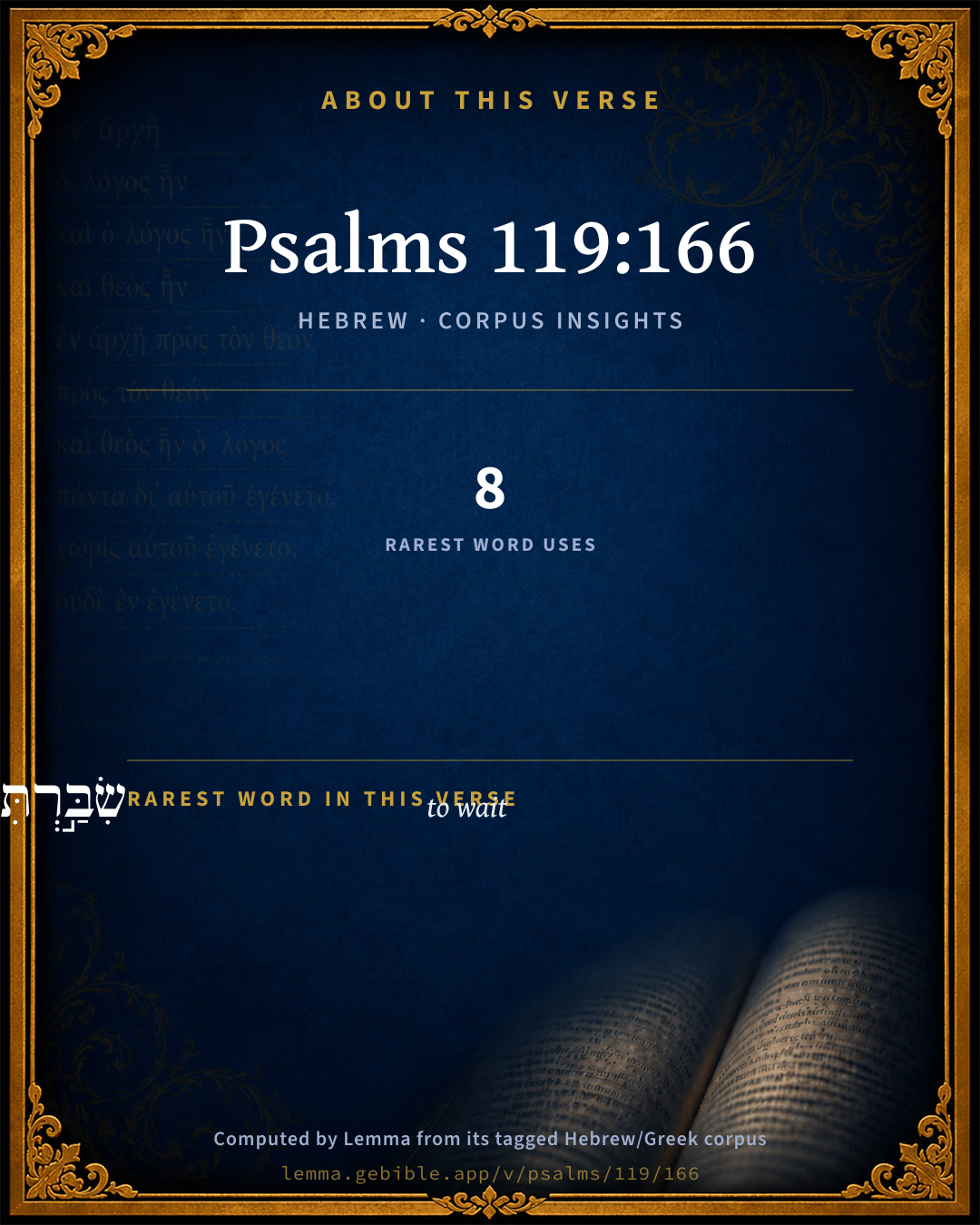
About this verse

These counts appear in no published source. They are computed here, from the morphology-tagged text and Lemma’s own curated glosses. What Lemma adds →

5
words
5
distinct lemmas
Wisdom
section

Notable vocabulary

The rarest word here is שִׂבַּ֣רְתִּי to wait H7663 — appearing just 8 times in the whole Hebrew Bible.

Shared distinctive vocabulary

שִׂבַּ֣רְתִּי to wait H7663 occurs in 8 verses of the Hebrew Bible. Also found in:

Grammatical profile

  • 2 verbs
  • 3 nouns

Verb forms

  • שִׂבַּ֣רְתִּי Piel · Perfect
  • עָשִֽׂיתִי Qal · Perfect

Hebrew & Septuagint length

In English translation the verse runs 12 words from the Hebrew and 12 from the Septuagint (LXX English) — the same length.

A rough comparison of the two English renderings, which tokenize alike — not a word-level alignment.

Word counts can differ between the Hebrew and the Greek without any difference in meaning — e.g. the Hebrew direct-object marker אֵת has no separate Greek word, and Greek often adds the article ὁ.

Cross-references

9

Topical passages linked to Psalms 119:166 in the Treasury of Scripture Knowledge — connected by theme and wording, ordered by reader-vote popularity; previews shown in the World English Bible.

  • Genesis 49:18 I have waited for your salvation, Yahweh.
  • Psalms 119:81 My soul faints for your salvation. I hope in your word.
  • Psalms 119:174 I have longed for your salvation, Yahweh. Your law is my delight.
  • Psalms 50:23 Whoever offers the sacrifice of thanksgiving glorifies me, And prepares his way so that I will show God's salvation to him."
  • Psalms 130:5–7 I wait for Yahweh. My soul waits. I hope in his word.
  • John 7:17 If anyone desires to do his will, he will know about the teaching, whether it is from God, or if I am speaking from myself.
  • 1 John 2:3–4 This is how we know that we know him: if we keep his commandments.
  • Psalms 4:5 Offer the sacrifices of righteousness. Put your trust in Yahweh.
  • Psalms 24:3–5 Who may ascend to Yahweh's hill? Who may stand in his holy place?

Cross-references courtesy of OpenBible.info (CC BY 4.0).

Hebrew and Greek witnesses Masoretic Hebrew ↔ Greek Septuagint

The same verse in the two great witnesses to the Old Testament, shown verse-for-verse.

You’re reading Greek Psalm 118 (Hebrew Psalm 119). The Septuagint counts the superscription, so verse numbers can differ from the Hebrew — chapter-level alignment, not verse-by-verse. Numbering follows Rahlfs.

These are two independent witnesses, not word-aligned to each other, and the Septuagint is shown in lemma (dictionary) form.

Hebrew Psalms 119:166 Masoretic · Westminster Leningrad Codex

שִׂבַּ֣רְתִּי לִֽישׁוּעָתְךָ֣ יְהוָ֑ה וּֽמִצְוֺתֶ֥יךָ עָשִֽׂיתִי

I have hoped for your salvation, Yahweh. I have done your commandments.

World English Bible · Public Domain

Greek LXX Greek Psalm 118:166 Septuagint · lemma form

προςδοκάω ὁ σωτήριον σύ κύριος καί ὁ ἐντολή σύ ἀγαπάω

I waited for your salvation, O Lord, and have loved your commandments.

LXX2012 (modern English Septuagint) · Public Domain

Hebrew: Westminster Leningrad Codex (CC BY 4.0). Greek: Septuagint (public domain); English from LXX2012 (modern English Septuagint) (Public Domain). How the Septuagint differs from the Hebrew →

Commentary

Notes on Psalms 119:166 from classic Christian and Jewish commentators (each source and its license shown beneath its notes). The classic Christian expositions comment on the surrounding passage and are grouped to its opening verse, so a note may address several verses; the Jewish commentaries on the Tanakh (Rashi and others) are per-verse, so they appear only where the commentator wrote on this verse.

Lemma curates 59 commentaries, every one of them public domain or Creative Commons licensed, each selected and text-cleaned for this edition rather than reprinted as found. About our sources →

Trapp's Complete Commentary

John Trapp

Psa 119:166 LORD, I have hoped for thy salvation, and done thy commandments.

Ver. 166. Lord, I have hoped for thy salvation] This saying he borrowed from good old Jacob, Gen 49:18

And done thy commandments] Done them as I could; done them to Divine acceptation through Christ; and hence I have hoped: 1Jn 3:3 "Every man that hath this hope in him purifieth himself, as God is pure."

John Trapp, A Commentary or Exposition upon All the Books of the Old and New Testament (1647–1656) — public domain. Text from a community e-Sword module.

The Biblical Illustrator

Joseph S. Exell

Psa_119:166-168

Lord, I have hoped for Thy salvation, and done Thy commandments.

A justifiable hope

There is a true hope and a false hope, a justifiable and an unjustifiable hope--the words direct us to the former.

I. Here is a hope that has a justifiable object. What is the object? Thy salvation. What does the real salvation of man involve?

1. Restoration to lost holiness. The soul was created in the image of God, that is, in moral perfection. That image it has lost, the restoration of that is salvation. The restoration of purity, love, spiritual freedom, loyalty.

2. The restoration of lost usefulness. The soul was made to be useful, to render by its true thoughts, pure sympathies, and wise counsels, service to other souls. But this usefulness it has lost. As a rule, men are injurious to each other. Salvation is the restoration of this usefulness. All souls ministering and inter-ministering to the good of one another. Now, is not this a justifiable object of hope? This is the hope which God has set before us in the Gospel.

II. Hero is a hope that has a justifiable reason. The reason here assigned for this hope is devotion to the right. A man who is loyally and livingly devoted to the right has undoubtedly a justifiable reason for hoping for salvation. It cannot be purchased, it cannot be given, it must grow out of the soul devoted to rectitude. (Homilist.)

The doing of Gods commandments

Set upon the practice of what you read. A student in physic doth not satisfy himself to read over a system or body of physic, but he falls upon practising physic. The life-blood of religion lies in the practical part. Christians should be walking Bibles. Xenophon said, Many read Lycurguss laws, but few observe them. The Word written is not only a rule of knowledge, but a rule of obedience; it is not only to mend our sight, but to mend our pace. David calls Gods Word a lamp unto his feet (verse 105). It was not only a light to his eyes to see by, but to his feet to walk by. By practice we trade with the talent of knowledge, and turn it to profit. This is a blessed reading of Scripture, when we fly from the sins which the Word forbids, and espouse the doctrines which the Word commands. Reading without practice will be but a torch to light men to hell. (T. Watson.)

The Biblical Illustrator, edited by Joseph S. Exell (c. 1880s–1900s) — public domain. Text from a community e-Sword module.

J. A. Alexander on Psalms

Joseph Addison Alexander

166. (Psa 119:166) I hope for thy salvation, 0 Jehovah, and thy commandments I do. I hope and have hoped, do and have done. In the mean time, while expecting thy salvation, I am careful to perform thy will.

Joseph Addison Alexander, The Psalms Translated and Explained (1850) — public domain. Text from a community e-Sword module.

Geneva Bible (1599)

Geneva Bible translators

He showeth that we must first have faith before we can work and please God.

Geneva Bible (1599) marginal notes — public domain. Text via Bolls.life.

Matthew Henry's Commentary

Here is the whole duty of man; for we are taught, 1. To keep our eye upon God's favour as our end: "Lord, I have hoped for thy salvation, not only temporal but eternal salvation. I have hoped for that as my happiness and laid up my treasure in it; I have hoped for it as thine, as a happiness of thy preparing, thy promising, and which consists in being with thee. Hope of this has raised me above the world, and borne me up under all my burdens in it." 2. To keep our eye upon God's word as our rule: I have done thy commandments, that is, I have made conscience of conforming myself to thy will in every thing. Observe here how God has joined these two together, and let no man put them asunder. We cannot, upon good grounds, hope for God's salvation, unless we set ourselves to do his commandments, Rev 22:14. But those that sincerely endeavour to do his commandments ought to keep up a good hope of the salvation; and that hope will both engage and enlarge the heart in doing the commandments. The more lively the hope is the more lively the obedience will be.

Matthew Henry's Commentary on the Whole Bible (1708–1710) — public domain (CC PDM 1.0). Text via the HelloAO Bible API.

Adam Clarke's Commentary

Verse 166. Lord, I have hoped] Thou hast promised deliverance, and I have expected it on the ground of that promise.

Adam Clarke's Commentary on the Bible (1810–1826) — public domain. Text from a community e-Sword/MySword module.

John Calvin's Commentaries

166 O Jehovah! I have waited for thy salvation. It is not without cause that the Prophet often repeats this sentence, which is in all men’s mouths, there being nothing easier than to ascribe to God the praise and office of saving, while yet there is hardly to be met with in the world a single example of steadfast hope, when men come to wrestle with temptations for any length of time. From the order of the words we learn, that if a man would keep himself in the fear of God, and the love of the law, it is necessary for him, above all things, “Primum,” Lat — “Devant toutes choses,” Fr.

John Calvin's Commentaries (1540-1563) — public domain. Text from the Calvin Translation Society English edition (1840s-50s) via the Christian Classics Ethereal Library (ccel.org). Calvin's coverage is partial (roughly two-thirds of the Bible); uncommented books and verses are honest gaps, never fabricated. The 19th-century editor's footnotes and remarks are omitted so the notes are faithfully Calvin's own voice.

John Gill's Exposition

My lips shall utter praise,.... Like water flowing from a fountain, as the word (m) signifies. The heart of a good man is like a fountain of water, abounding: with good things, and his mouth is a well of life; out of the abundance of grace and good things in his heart his mouth speaks, Joh 4:14; and particularly his heart is filled with praise and thankfulness for the many blessings of providence and grace enjoyed; his lips show it forth; it comes flowing from him freely and readily, without force and compulsion, largely and plentifully, constantly and continually, and with great vehemence and strength, as streams from a fountain;

when thou hast taught me thy statutes: which is what the psalmist often prays for in this psalm; and signifies he should be very thankful to God for, and should sincerely praise him, could he obtain this favour; see Psa 119:7.

(m) "profundent", Vatablus, Musculus; "ebullient", Piscator, Gejerus; "scaturiunt", Cocceius; "scaturient", Michaelis.

John Gill's Exposition of the Whole Bible (1746–1763) — public domain (CC PDM 1.0). Text via the HelloAO Bible API.

Albert Barnes' Notes on the Bible

Lord, I have hoped for thy salvation - As a prevailing habit or principle in my life. I have looked to thee for deliverance in the time of danger; I have looked to thee for salvation in the world to come.

And done thy commandments - That is, habitually. This is not, necessarily, a claim to absolute perfection.

Albert Barnes' Notes on the Bible (1834–1885) — public domain. Text from a community e-Sword/MySword module.

Matthew Poole's English Annotations

Thus performing the condition which thou hast required, I justly and confidently hope for thy mercy promised.

Matthew Poole's English Annotations on the Holy Bible (1683–1685) — public domain. Text from a community e-Sword/MySword module.

The Treasury of David

Charles H. Spurgeon

Ver. 166. Lord, I have hoped for thy salvation, and done thy commandments. Here we have salvation by grace, and the fruits thereof. All David's hope was fixed upon God, he looked to him alone for salvation; and then he endeavoured most earnestly to fulfil the commands of his law. Those who place least reliance upon good works are very frequently those who have tile most of them; that same divine teaching which delivers us from confidence in our own doings leads us to abound in every good work to the glory of God. In times of trouble there are two things to be done, the first is to hope in God, and the second is to do that which is right. The first without the second would be mere presumption: the second without the first mere formalism. It is well if in looking back we can claim to have acted in the way which is commanded of the Lord. If we have acted rightly towards God we are sure that lie will act kindly with us.

Ver. 166. LORD, I have hoped for thy salvation, etc. This is the true posture in which all the servants of God should desire to be found hoping in his mercy, and doing his commands. How easy were it to demonstrate the connection between the mental feeling here recognized, and the obedience with which it is here associated! It is the hope of salvation which is the great and pervading motive to holiness, and it is the consciousness of obedience to the will of God which strengthens our hope of interest in the divine mercy. John Morison.

Ver. 166. Lord, I have hoped for thy salvation. This saying he borrowed from good old Jacob. Ge 49:18. John Trapp.

Ver. 166. I have done thy commandments. Set upon the practice of what you read. A student in physics doth not satisfy himself to read over a system or body of physics, but he falls upon practising physics: the life blood of religion his in the practical part. Christians should be walking Bibles. Xenophon said, "Many read Lycurgus's laws, but few observe them." The word written is not only a rule of knowledge, but a rule of obedience; it is not only to mend our sight, but to mend our pace. David calls God's word "a lamp unto his feet" (Ps 119:105). It was not only a light to his eyes to see by, but to his feet to walk by. By practice we trade with the talent of knowledge, and turn it to profit. This is a blessed reading of Scripture, when we fly from the sins which the word forbids, and espouse the doctrines which the word commands. Reading without practice will be but a torch to light men to hell. Thomas Watson.

Ver. 166,167,168. He that casts the commands behind his back is very presumptuous in applying the promises to himself. That hope which is not accompanied with obedience will make a man ashamed. He that has learned the word of God knows that the law is not made void by faith, but established: Ro 3:31. Christ the church's Head and Prophet, in his sermon upon the mount shows the extent of the law, requiring purity in the heart and thoughts, as well as in the life and actions, and condemns them "who shall break the least of these commands and shall teach men so"; but "those that teach and do them, "he owns as great in his kingdom: Mt 5:19. The law spoken on Mount Sinai is established by the Legislator Christ in Mount Zion as a rule of righteousness. And they who are rightly instructed, "which walk according to this rule, "will have both heart and conversation ordered according to its direction, and "peace and mercy will be upon them, " and hereby they will show themselves to be indeed the Israel of God. Nathanael Vincent.

Ver. 166.

1. A hope which is not ashamed.

2. A life which is not ashamed.

3. A God of whom he is not ashamed.

Ver. 166. A good hope through grace.

1. Salvation is God's gift: "thy salvation."

2. Is apprehended by hope: "I have hoped."

3. Is accompanied by obedience: "and done thy commandments." Heb 6:9.

C.A.D.

Psalms 119:167*

Charles H. Spurgeon's The Treasury of David (1869–1885) — public domain. Psalms only. Text from a community e-Sword/MySword module.

The Pulpit Commentary

Lord, I have hoped for thy salvation (comp. vers. 81, 123). I have waited for thee, continually expecting thee to come to my aid, and save me from my enemies. And done thy commandments; kept them, i.e., as far as human frailty would allow.

The Pulpit Commentary (1880–1919), ed. H.D.M. Spence-Jones & Joseph S. Exell — public domain. Text from a community e-Sword module.

Lesson kit

Teaching starters — assembled from the data on this page, not authored interpretation. Every prompt links to the verse data it draws on. Edit before teaching.

Psalms, in the Wisdom, opens this verse with 5 words (5 distinct Hebrew lemmas). Its most distinctive word is sâbar (“to wait”). A historical commentator’s framing appears above. Read the whole chapter for the surrounding context.

Discussion questions

  1. How does “to wait” (sâbar) shape what this verse is saying?
  2. Ruth 1:13 shares the word «to wait» with this verse. How do the two illuminate each other?
  3. These translations render this verse differently. What is at stake in choosing one wording over another?
  4. The verb «שִׂבַּ֣רְתִּי» is Piel Perfect. How does its form color the action?
  5. Reading how Trapp's Complete Commentary and The Biblical Illustrator read this verse, where do the two commentators agree and where do they part?

Things to notice

Reading settings

Reading text

Shown beneath each verse's original-language words.

Old Testament
Old Testament edition

Read the OT as the Masoretic Hebrew (MT) or the Greek Septuagint (LXX).

English shown for the Greek Septuagint (in the Hebrew ↔ Greek comparison).

Comparing translations? Open the Compare panel on any verse page to stack up to four side by side.