
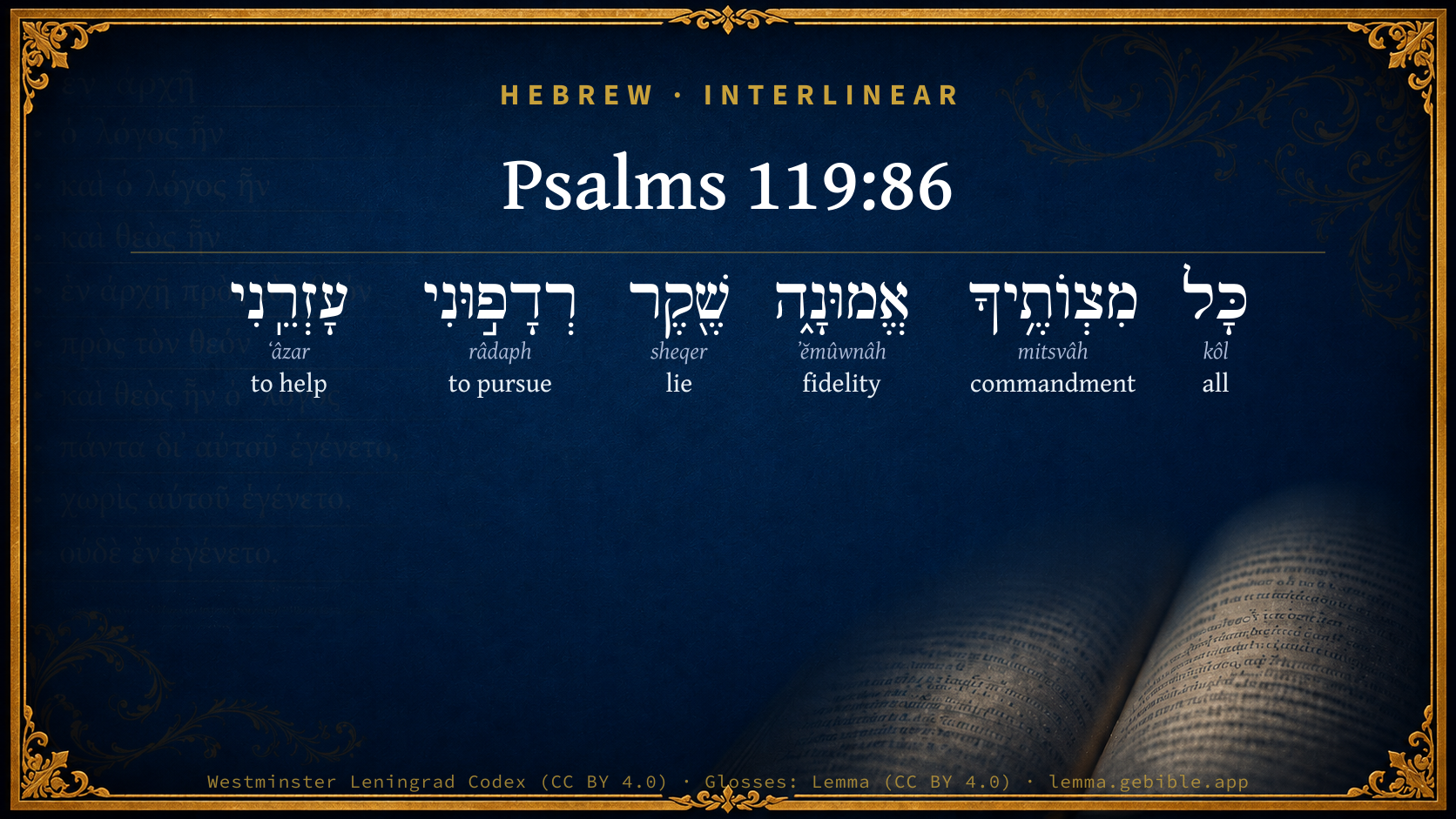
Psalms 119:86

Hebrew (Westminster Leningrad Codex) Psalms 119:86 appears in the Hebrew Old Testament. The text above is from the Westminster Leningrad Codex. Each word links to its Strong’s number, a concise gloss, and parsing drawn from the Open Scriptures Hebrew Bible morphology. Click any word for its full Brown-Driver-Briggs (BDB) entry.
Download image
Cite this verse

Psalms 119:86 (World English Bible). Public Domain. Lemma interlinear Bible study tool, https://lemma.gebible.app/v/psalms/119/86.

Show BibTeX & RIS
BibTeX
RIS
English Translation
All of your commandments are faithful. They persecute me wrongfully. Help me!
World English Bible · Public Domain
Download a study sheet

One document with this verse’s original text, its word-by-word gloss line, the meaning frame, cross-references with their text, attributed commentary, and full source and license credits — printable, and it pastes into notes with its structure intact.

This verse Autodidact and up

Study sheet (.html) Plain text (.txt)

A passage Seminary Student

Up to 50 verses in one chapter. A passage sheet keeps up to 6 commentary sources and 12 cross-references per verse, in the order this page ranks them, and says so on the sheet whenever that leaves anything out. Ask for a single verse and you get the Autodidact verse sheet above.

Everything on this page stays free to read, with no account — the sheet is a download of what is already on screen, not access to it.

Want to remove ads? Support Godless Engineer
Compare translations 3

The same verse in 3 English versions, stacked beneath the original-language interlinear above. Click any original word for its lexicon entry.

Each is an independent rendering of the whole verse — the interlinear is not word-aligned to these translations.

Highlighted words mark where these versions differ — a whole-verse word diff, not a word-by-word alignment.

  • World English Bible Public Domain
    All of your commandments are faithful. They persecute me wrongfully. Help me!
  • King James Version Public Domain
    All thy commandments are faithful: they persecute me wrongfully; help thou me.
  • unfoldingWord Literal Text CC BY-SA 4.0
    All of your commandments are truth. They pursue me deceit; help me!

unfoldingWord Literal Text — © unfoldingWord, licensed CC BY-SA 4.0. Word-aligned USFM3 via Door43 (git.door43.org/unfoldingWord/en_ult).

Versions to compare (up to 4)

3 of 4 selected

Show all 17 translations

Every available English version of this verse, each an independent rendering of the whole verse.

  • World English Bible Public Domain
    All of your commandments are faithful. They persecute me wrongfully. Help me!
  • Berean Standard Bible Public Domain
    All Your commandments are faithful; I am persecuted without cause—help me!
  • Majority Standard Bible Public Domain
    All Your commandments are faithful; I am persecuted without cause—help me!
  • King James Version Public Domain
    All thy commandments are faithful: they persecute me wrongfully; help thou me.
  • American Standard Version (1901) Public Domain
    All thy commandments are faithful: They persecute me wrongfully; help thou me.
  • Revised Version (1885) Public Domain
    All thy commandments are faithful: they persecute me wrongfully; help thou me.
  • Geneva Bible (1599) Public Domain
    All thy commandements are true: they persecute me falsely: helpe me.
  • Young's Literal Translation Public Domain
    All Thy commands `are' faithfulness, `With' falsehood they have pursued me, Help Thou me.
  • Literal Standard Version CC BY-SA 4.0
    All Your commands [are] faithfulness, || They have pursued me [with] falsehood, || Help me.
  • Unlocked Literal Bible CC BY-SA 4.0
    All your commandments are reliable; those people persecute me wrongfully; help me.
  • unfoldingWord Literal Text CC BY-SA 4.0
    All of your commandments are truth. They pursue me deceit; help me!
  • Darby Bible Public Domain
    All thy commandments are faithfulness. They persecute me wrongfully: help thou me.
  • World Messianic Bible Public Domain
    All of your commandments are faithful. They persecute me wrongfully. Help me!
  • Webster's Bible Public Domain
    All thy commandments are faithful: they persecute me wrongfully; help thou me.
  • Free Bible Version CC BY-SA 4.0
    All your commands are trustworthy. Help me against these people who persecute me with their lies!
  • Bible in Basic English Public Domain
    All your teachings are certain; they go after me with evil design; give me your help.
  • JPS Tanakh (1917) Public Domain
    All Thy commandments are faithful; they persecute me for nought; help Thou me.

Literal Standard Version (2020), Covenant Press — licensed CC BY-SA 4.0. Text via the HelloAO Bible API (eBible.org). Unlocked Literal Bible (unfoldingWord) — licensed CC BY-SA 4.0. Text via the HelloAO Bible API (eBible.org). unfoldingWord Literal Text — © unfoldingWord, licensed CC BY-SA 4.0. Word-aligned USFM3 via Door43 (git.door43.org/unfoldingWord/en_ult). Free Bible Version, Dr. Jonathan Gallagher — licensed CC BY-SA 4.0. Text via the HelloAO Bible API (eBible.org).

Word by word

More ways to search: Search by grammar → Find every occurrence → Compare this word →

Practice this passage: Drill this verse → Learn its vocabulary →

About this verse

These counts appear in no published source. They are computed here, from the morphology-tagged text and Lemma’s own curated glosses. What Lemma adds →

6
words
6
distinct lemmas
Wisdom
section

Shared distinctive vocabulary

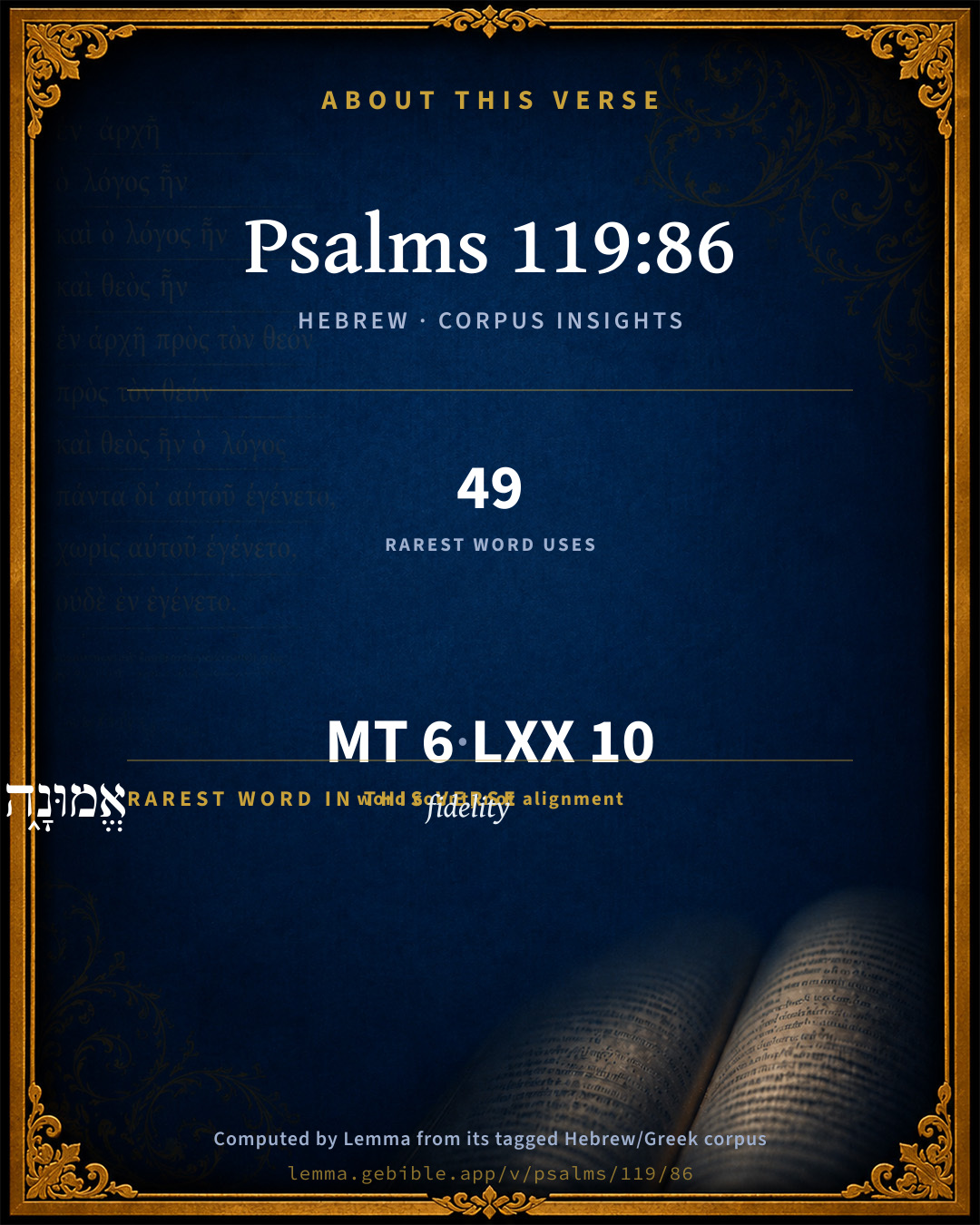
אֱמוּנָ֑ה fidelity H530 occurs in 49 verses of the Hebrew Bible. Also found in:

Grammatical profile

  • 2 verbs
  • 4 nouns

Verb forms

  • רְדָפ֣וּנִי Qal · Perfect
  • עָזְרֵֽנִי Qal · Imperative

Hebrew & Septuagint length

In English translation the verse runs 12 words from the Hebrew and 12 from the Septuagint (LXX English) — the same length.

A rough comparison of the two English renderings, which tokenize alike — not a word-level alignment.

Word counts can differ between the Hebrew and the Greek without any difference in meaning — e.g. the Hebrew direct-object marker אֵת has no separate Greek word, and Greek often adds the article ὁ.

In the original languages it is 6 Hebrew tokens and 10 Greek tokens — but the two are counted differently (Hebrew bundles its prefixes and suffixes into one token; the Greek is in lemma form), so that isn’t a like-for-like length.

Cross-references

17

Topical passages linked to Psalms 119:86 in the Treasury of Scripture Knowledge — connected by theme and wording, ordered by reader-vote popularity; previews shown in the World English Bible.

  • Psalms 35:19 Don't let those who are my enemies wrongfully rejoice over me; Neither let them wink with the eye who hate me without a cause.
  • Psalms 70:5 But I am poor and needy. Come to me quickly, God. You are my help and my deliverer. Yahweh, don't delay.
  • Psalms 35:7 For without cause they have hidden their net in a pit for me. Without cause they have dug a pit for my soul.
  • Psalms 109:26 Help me, Yahweh, my God. Save me according to your loving kindness;
  • Psalms 119:78 Let the proud be disappointed, for they have overthrown me wrongfully. I will meditate on your precepts.
  • Psalms 119:128 Therefore I consider all of your precepts to be right. I hate every false way.
  • Psalms 119:138 You have commanded your statutes in righteousness. They are fully trustworthy.
  • Psalms 119:151 You are near, Yahweh. All your commandments are truth.
  • Romans 7:12 Therefore the law indeed is holy, and the commandment holy, and righteous, and good.
  • Psalms 19:9 The fear of Yahweh is clean, enduring forever. Yahweh's ordinances are true, and righteous altogether.
  • Psalms 119:142 Your righteousness is an everlasting righteousness. Your law is truth.
  • Jeremiah 18:20 Shall evil be recompensed for good? for they have dug a pit for my soul. Remember how I stood before you to speak good for them, to turn away your wrath from them.
  • Psalms 7:1–5 Yahweh, my God, I take refuge in you. Save me from all those who pursue me, and deliver me,
  • Psalms 38:19 But my enemies are vigorous and many. Those who hate me without reason are numerous.
  • Psalms 59:3–4 For, behold, they lie in wait for my soul. The mighty gather themselves together against me, Not for my disobedience, nor for my sin, Yahweh.
  • Psalms 142:4–6 Look on my right, and see; For there is no one who is concerned for me. Refuge has fled from me. No one cares for my soul.
  • Psalms 143:9 Deliver me, Yahweh, from my enemies. I flee to you to hide me.

Cross-references courtesy of OpenBible.info (CC BY 4.0).

Hebrew and Greek witnesses Masoretic Hebrew ↔ Greek Septuagint

The same verse in the two great witnesses to the Old Testament, shown verse-for-verse.

You’re reading Greek Psalm 118 (Hebrew Psalm 119). The Septuagint counts the superscription, so verse numbers can differ from the Hebrew — chapter-level alignment, not verse-by-verse. Numbering follows Rahlfs.

These are two independent witnesses, not word-aligned to each other, and the Septuagint is shown in lemma (dictionary) form.

Hebrew Psalms 119:86 Masoretic · Westminster Leningrad Codex

כָּל מִצְוֺתֶ֥יךָ אֱמוּנָ֑ה שֶׁ֖קֶר רְדָפ֣וּנִי עָזְרֵֽנִי

All of your commandments are faithful. They persecute me wrongfully. Help me!

World English Bible · Public Domain

Greek LXX Greek Psalm 118:86 Septuagint · lemma form

πᾶς ὁ ἐντολή σύ ἀλήθεια ἀδίκως καταδιώκω ἐγώ βοηθέω ἐγώ

All your commandments are truth; they persecuted me unjustly; help you me.

LXX2012 (modern English Septuagint) · Public Domain

Hebrew: Westminster Leningrad Codex (CC BY 4.0). Greek: Septuagint (public domain); English from LXX2012 (modern English Septuagint) (Public Domain). How the Septuagint differs from the Hebrew →

Commentary

Notes on Psalms 119:86 from classic Christian and Jewish commentators (each source and its license shown beneath its notes). The classic Christian expositions comment on the surrounding passage and are grouped to its opening verse, so a note may address several verses; the Jewish commentaries on the Tanakh (Rashi and others) are per-verse, so they appear only where the commentator wrote on this verse.

Lemma curates 59 commentaries, every one of them public domain or Creative Commons licensed, each selected and text-cleaned for this edition rather than reprinted as found. About our sources →

Trapp's Complete Commentary

John Trapp

Psa 119:86 All thy commandments [are] faithful: they persecute me wrongfully; help thou me.

Ver. 86. All thy commandments are faithful] Heb. faithfulness, that is, they are true, sure, equal, infallible.

They persecute me wrongfully] For asserting thy truths, and adhering thereunto.

Help thou me] The more eagerly men molest us the more earnestly should we implore the Divine help.

John Trapp, A Commentary or Exposition upon All the Books of the Old and New Testament (1647–1656) — public domain. Text from a community e-Sword module.

J. A. Alexander on Psalms

Joseph Addison Alexander

86. (Psa 119:86) All thy commandments (are) faithfulness; falsely do they persecute me; help thou me. The promises annexed to God's commandments are infallible. Falsely, as in Psa 119:78, falsehood, i.e. in falsehood, without right or reason, or with (by means of) falsehood, as their instrument. The verb agrees with the remoter antecedent (persecutors) in Psa 119:84.

Joseph Addison Alexander, The Psalms Translated and Explained (1850) — public domain. Text from a community e-Sword module.

Geneva Bible (1599)

Geneva Bible translators

He assureth himself, that God will deliver his, and destroy such as unjustly persecute them.

Geneva Bible (1599) marginal notes — public domain. Text via Bolls.life.

John Calvin's Commentaries

86. All thy commandments are truth. In this verse he again confirms the statement, That, in whatever ways he was afflicted, his mind had not been distracted by various devices, because, trusting in the word of God, he never doubted of his assistance. In the first place, he tells us, that the consideration, by which he was armed for repelling all assaults, was this, That the faithful, under the conduct of God, engage in a prosperous warfare, the salvation which they hope for from his word being absolutely certain. For this reason he declares, that the commandments of God are true; by which encomium he teaches us, that those who rely upon the word of God are out of all danger; and he lays down this truth, that such a support may always sustain our courage. In the second place, he complains of the treachery of his enemies, as he declared before. Here the word שקר, sheker, is repeated, by which he means, that they had no regard to equity. From this consideration also he was led to entertain the hope of deliverance; for it is the peculiar office of God to succor the poor and afflicted who are wrongfully oppressed.

John Calvin's Commentaries (1540-1563) — public domain. Text from the Calvin Translation Society English edition (1840s-50s) via the Christian Classics Ethereal Library (ccel.org). Calvin's coverage is partial (roughly two-thirds of the Bible); uncommented books and verses are honest gaps, never fabricated. The 19th-century editor's footnotes and remarks are omitted so the notes are faithfully Calvin's own voice.

The Cambridge Bible for Schools and Colleges

gen. ed. J. J. S. Perowne

86. faithful] Lit. faithfulness (cp. Psa_119:75; Psa_119:138); they are an expression of the character of God, in strong contrast to the falsehood (cp. Psa_119:78) with which his persecutors assail him.

The Cambridge Bible for Schools and Colleges (gen. ed. J. J. S. Perowne; Cambridge University Press, 1878–1918) — public domain. Text from a community e-Sword module.

John Gill's Exposition

Thy faithfulness is unto all generations,.... Or "to generation and generation" (y); to his people in every age, fulfilling his word, supplying their wants, giving them new mercies every morning and every day; never leaving and forsaking them, according to his promise: his faithfulness never fails, it endures for ever, and is exceeding great and large indeed; see Lam 3:23;

thou hast established the earth, and it abideth: laid the foundation of it so firm and sure, that it cannot be removed: and though one generation has passed after another, the earth abides where it was, and will do for ever; and as firm and stable, and never failing, is the faithfulness of God, which this is designed to illustrate. So some supply it, "as thou hast established the earth", &c. (z); see Psa 24:2.

(y) "in generationem et generationem", Gejerus; "in aetatem et aetatem", Cocceius. (z) "Quemadmodum vel sicut fundasti", Gejerus.

John Gill's Exposition of the Whole Bible (1746–1763) — public domain (CC PDM 1.0). Text via the HelloAO Bible API.

Albert Barnes' Notes on the Bible

All thy commandments are faithful - Margin, “faithfulness.” The idea in the Hebrew is that they are worthy to be relied on. They are founded in truth, and they should secure our confidence.

They persecute me wrongfully ... - Hebrew, a “lie, “or “falsehood.” That is, There is a “lie” or “falsehood” at the foundation of their persecutions. Those persecutions are not based on any just views of what I am, or of the treatment which I ought to receive at the hand of my fellow-men. They charge on me tilings which are not true, and they act accordingly. See the notes at Psa 119:78.

Albert Barnes' Notes on the Bible (1834–1885) — public domain. Text from a community e-Sword/MySword module.

Matthew Poole's English Annotations

Are faithful; they are in themselves most just and true, and they require justice and faithfulness from men, promising many blessings to those that perform it, and severely forbid all fraud and falseness, threatening grievous punishments to those that use it; and such promises and threatenings are true, and shall certainly be executed.

Matthew Poole's English Annotations on the Holy Bible (1683–1685) — public domain. Text from a community e-Sword/MySword module.

The Treasury of David

Charles H. Spurgeon

Ver. 86. All thy commandments are faithful. He had no fault to find with God's law, even though he had fallen into sad trouble through obedience to it. Whatever the command might cost him it was worth it; he felt that God's way might be rough, but it was right; it might make him enemies, but still it was his best friend. He believed that in the end God's command would turn out to his own profit, and that he should be no loser by obeying it.

They persecute me wrongfully. The fault lay with his persecutors, and neither with his God nor with himself. He had done no injury to anyone, nor acted otherwise than according to truth and justice; therefore he confidently appeals to his God, and cries, "Help thou me." This is a golden prayer, as precious as it is short. The words are few, but the meaning is full. Help was needed that the persecuted one might avoid the snare, might bear up under reproach, and might act so prudently as to baffle his foes. God's help is our hope. Whoever may hurt us, it matters not so long as the Lord helps us; for if indeed the Lord help us, none can really hurt us. Many a time have these words been groaned out by troubled saints, for they are such as suit a thousand conditions of need, pain, distress, weakness, and sin. "Help, Lord, "will be a fitting prayer for youth and age, for labour and suffering, for life and death. No other help is sufficient, but God's help is all sufficient, and we cast ourselves upon it without fear.

Ver. 86. All thy commandments are faithful. David setteth down here three points. The one is that God is true; and after that he addeth a protestation of his good conduct and guidance, and of the malice of his adversaries: thirdly, he calleth upon God in his afflictions. Now as concerning the first, he showeth us that although Satan to shake us, and in the end utterly to carry us away, subtilly and cunningly goeth about to deceive us, we must, to the contrary, learn how to know his ambushes, and to keep us from out of them. So often then as we are grieved with adversity and affliction, where must we begin? See Satan how he pitches his nets and layeth his ambushes to induce and persuade us to come into them, what saith he? Dost thou not see thyself forsaken of thy God? Where are the promises whereunto thou didst trust? Now here thou seest thyself to be a wretched, forlorn creature. So then thou right well seest that God hath deceived thee, and that the promises whereunto thou trustedst appertain nothing at all unto thee. See here the subtlety of Satan. What is now to be done? We are to conclude with David and say, yet God is true and faithful. Let us, I say, keep in mind the truth of God as a shield to beat back whatsoever Satan is able to lay unto our charge. When he shall go about to cause us to deny our faith, when he shall lie about us to make us believe that God thinketh no more of us, or else that it is in vain for us to trust unto his promises; let us know the clean contrary and believe that it is very plain and sound truth which God saith unto us. Although Satan casteth at us never so many darts, although he have never so exceeding many devices against us, although now and then by violence, sometimes with subtlety and cunning, it seemeth in very deed to us that he should overcome us; nevertheless he shall never bring it to pass, for the truth of God shall be made sure and certain in our hearts. John Calvin.

Ver. 86. All thy commandments are faithful. The Hebrew is Faithfulness; that is to say, they are true, sure, equal, infallible. "They have persecuted me wrongfully:" no doubt for asserting God's truths and commands, and adhering thereto. John Trapp.

Ver. 86. They persecute me wrongfully. There is a stress on the word falsely (or wrongfully); for that is a true saying of a martyr saint, "The cause, not the pain, makes the martyr." Wherefore the apostle teaches us, "Let none of you suffer as a murderer or as a thief, or as an evil doer, or as a busybody in other men's matters. Yet if any man suffer as a Christian, let him not be ashamed; but let him glorify God on this behalf." Neale and Littledale.

Ver. 86. Help thou me. "God help me" is an excellent, comprehensive prayer; it is a pity it should ever be used lightly and as a byword. Matthew Henry.

Ver. 86 (last clause). A prayer for all occasions. See the many cases in which it is used in Scripture.

Psalms 119:87*

Charles H. Spurgeon's The Treasury of David (1869–1885) — public domain. Psalms only. Text from a community e-Sword/MySword module.

The Pulpit Commentary

All thy commandments are faithful; literally, are faithfulness. This is said in respect of the promises attached to them. They (i.e. my enemies) persecute me wrongfully; or, "with lies lyingly (comp. vers. 69, 78). Help thou me; i.e. help me against them, so that their "lies" may do me no harm.

The Pulpit Commentary (1880–1919), ed. H.D.M. Spence-Jones & Joseph S. Exell — public domain. Text from a community e-Sword module.

John Wesley's Explanatory Notes

Faithful - Just and true.

John Wesley, Explanatory Notes Upon the Whole Bible (1754–1765) — public domain. Text via the GEBible commentary corpus.

Rashi

Rabbi Shlomo Yitzchaki (Rashi)

All Your commandments are faithful A Moabite and not a Moabitess; but they pursue [me] to prohibit me [from entering the congregation of the Lord].

they pursued me in vain My enemies pursued me in vain.

Rashi on the Tanakh — English translations: “The Judaica Press complete Tanach with Rashi, translated by A. J. Rosenberg” (CC BY 4.0); “Pentateuch with Rashi's commentary by M. Rosenbaum and A.M. Silbermann, 1929-1934” (public domain); “The Metsudah Tanach series, Lakewood, N.J” (CC BY 4.0); and “The Book of Joshua, Metsudah Publications, 1997” (CC BY 4.0). Text via Sefaria.

Lesson kit

Teaching starters — assembled from the data on this page, not authored interpretation. Every prompt links to the verse data it draws on. Edit before teaching.

Psalms, in the Wisdom, opens this verse with 6 words (6 distinct Hebrew lemmas). Its most distinctive word is ʼĕmûwnâh (“fidelity”). A historical commentator’s framing appears above. Read the whole chapter for the surrounding context.

Discussion questions

  1. How does “fidelity” (ʼĕmûwnâh) shape what this verse is saying?
  2. How does Exodus 17:12, which shares the word «fidelity», read alongside this verse?
  3. These translations render this verse differently; the difference is in the English rendering, not the original. What questions does that raise?
  4. «רְדָפ֣וּנִי» is a Qal Perfect verb. How does that grammatical form shape the action described?
  5. Compare how Trapp's Complete Commentary and J. A. Alexander on Psalms read this verse. Where do they agree or differ?

Things to notice

Reading settings

Reading text

Shown beneath each verse's original-language words.

Old Testament
Old Testament edition

Read the OT as the Masoretic Hebrew (MT) or the Greek Septuagint (LXX).

English shown for the Greek Septuagint (in the Hebrew ↔ Greek comparison).

Comparing translations? Open the Compare panel on any verse page to stack up to four side by side.