
Deuteronomy 28:9

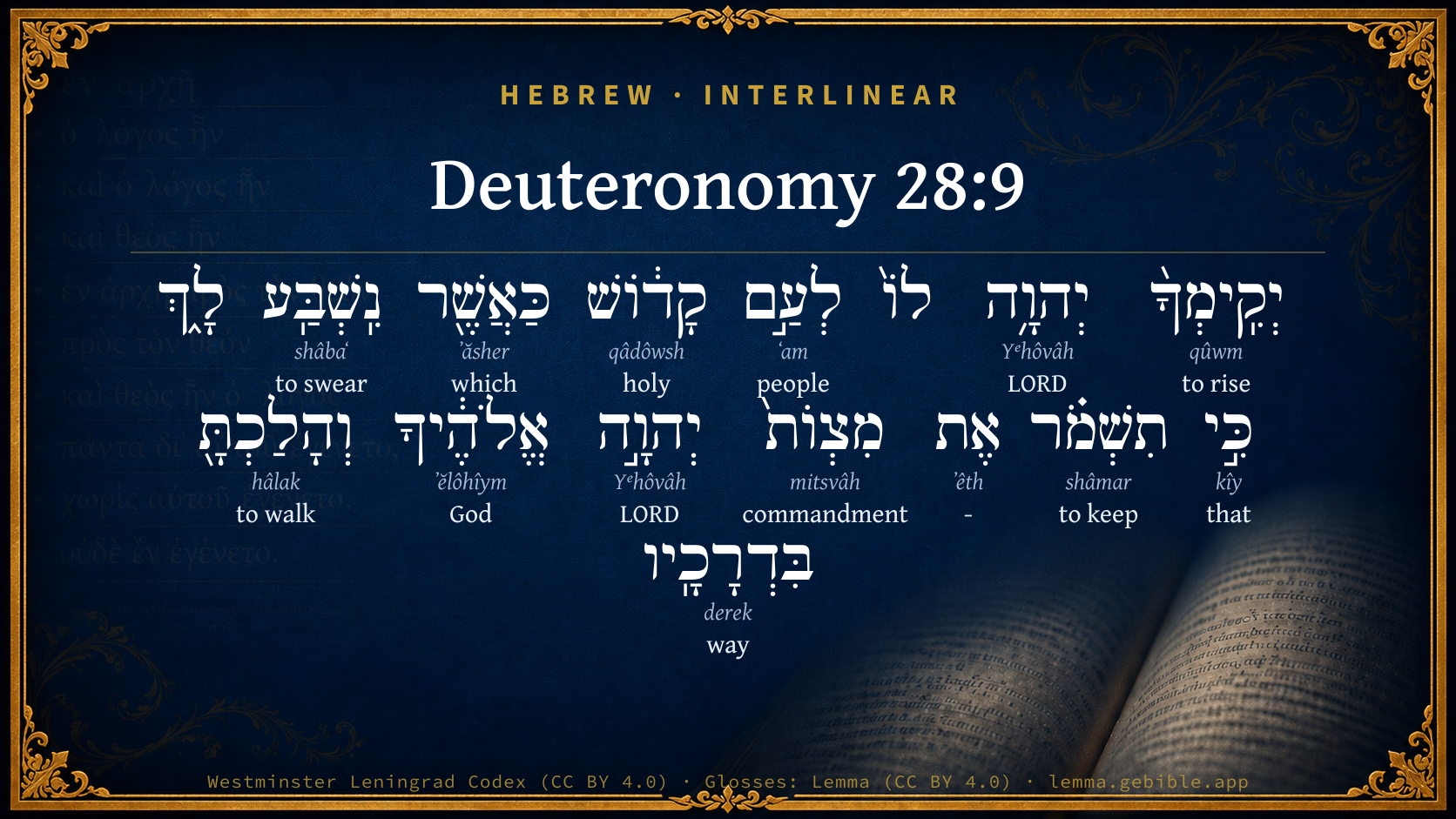
Hebrew (Westminster Leningrad Codex) Deuteronomy 28:9 appears in the Hebrew Old Testament. The text above is from the Westminster Leningrad Codex. Each word links to its Strong’s number, a concise gloss, and parsing drawn from the Open Scriptures Hebrew Bible morphology. Click any word for its full Brown-Driver-Briggs (BDB) entry.
Download image
Cite this verse

Deuteronomy 28:9 (World English Bible). Public Domain. Lemma interlinear Bible study tool, https://lemma.gebible.app/v/deuteronomy/28/9.

Show BibTeX & RIS
BibTeX
RIS
English Translation
Yahweh will establish you for a holy people to himself, as he has sworn to you; if you shall keep the commandments of Yahweh your God, and walk in his ways.
World English Bible · Public Domain
Download a study sheet

One document with this verse’s original text, its word-by-word gloss line, the meaning frame, cross-references with their text, attributed commentary, and full source and license credits — printable, and it pastes into notes with its structure intact.

This verse Autodidact and up

Study sheet (.html) Plain text (.txt)

A passage Seminary Student

Up to 50 verses in one chapter. A passage sheet keeps up to 6 commentary sources and 12 cross-references per verse, in the order this page ranks them, and says so on the sheet whenever that leaves anything out. Ask for a single verse and you get the Autodidact verse sheet above.

Everything on this page stays free to read, with no account — the sheet is a download of what is already on screen, not access to it.

Want to remove ads? Support Godless Engineer
Compare translations 3

The same verse in 3 English versions, stacked beneath the original-language interlinear above. Click any original word for its lexicon entry.

Each is an independent rendering of the whole verse — the interlinear is not word-aligned to these translations.

Highlighted words mark where these versions differ — a whole-verse word diff, not a word-by-word alignment.

  • World English Bible Public Domain
    Yahweh will establish you for a holy people to himself, as he has sworn to you; if you shall keep the commandments of Yahweh your God, and walk in his ways.
  • King James Version Public Domain
    The LORD shall establish thee an holy people unto himself, as he hath sworn unto thee, if thou shalt keep the commandments of the LORD thy God, and walk in his ways.
  • unfoldingWord Literal Text CC BY-SA 4.0
    Yahweh will establish you as his sanctified people, as he has sworn to you, if you keep the commandments of Yahweh your God and walk in his ways.

unfoldingWord Literal Text — © unfoldingWord, licensed CC BY-SA 4.0. Word-aligned USFM3 via Door43 (git.door43.org/unfoldingWord/en_ult).

Versions to compare (up to 4)

3 of 4 selected

Show all 18 translations

Every available English version of this verse, each an independent rendering of the whole verse.

  • World English Bible Public Domain
    Yahweh will establish you for a holy people to himself, as he has sworn to you; if you shall keep the commandments of Yahweh your God, and walk in his ways.
  • Berean Standard Bible Public Domain
    The LORD will establish you as His holy people, just as He has sworn to you, if you keep the commandments of the LORD your God and walk in His ways.
  • Majority Standard Bible Public Domain
    The LORD will establish you as His holy people, just as He has sworn to you, if you keep the commandments of the LORD your God and walk in His ways.
  • King James Version Public Domain
    The LORD shall establish thee an holy people unto himself, as he hath sworn unto thee, if thou shalt keep the commandments of the LORD thy God, and walk in his ways.
  • American Standard Version (1901) Public Domain
    Jehovah will establish thee for a holy people unto himself, as he hath sworn unto thee; if thou shalt keep the commandments of Jehovah thy God, and walk in his ways.
  • Revised Version (1885) Public Domain
    The LORD shall establish thee for an holy people unto himself, as he hath sworn unto thee; if thou shalt keep the commandments of the LORD thy God, and walk in his ways.
  • Geneva Bible (1599) Public Domain
    The Lord shall make thee an holy people vnto himself, as he hath sworne vnto thee, if thou shalt keepe the commandements of the Lord thy God, and walke in his wayes.
  • Douay-Rheims (1899) Public Domain
    The Lord will raise thee up to be a holy people to himself, as he swore to thee: if thou keep the commandments of the Lord thy God, and walk in his ways.
  • Young's Literal Translation Public Domain
    `Jehovah doth establish thee to Himself for a holy people, as He hath sworn to thee, when thou keepest the commands of Jehovah thy God, and hast walked in His ways;
  • Literal Standard Version CC BY-SA 4.0
    YHWH establishes you to Himself for a holy people, as He has sworn to you, when you keep the commands of your God YHWH and have walked in His ways;
  • Unlocked Literal Bible CC BY-SA 4.0
    Yahweh will establish you as a people that is set apart for himself, as he has sworn to you, if you keep the commandments of Yahweh your God, and walk in his ways.
  • unfoldingWord Literal Text CC BY-SA 4.0
    Yahweh will establish you as his sanctified people, as he has sworn to you, if you keep the commandments of Yahweh your God and walk in his ways.
  • Darby Bible Public Domain
    Jehovah will establish thee unto himself a holy people as he hath sworn unto thee, if thou keep the commandments of Jehovah thy God, and walk in his ways.
  • World Messianic Bible Public Domain
    The LORD will establish you for a holy people to himself, as he has sworn to you, if you shall keep the commandments of the LORD your God, and walk in his ways.
  • Webster's Bible Public Domain
    The LORD shall establish thee a holy people to himself, as he hath sworn to thee, if thou shalt keep the commandments of the LORD thy God, and walk in his ways.
  • Free Bible Version CC BY-SA 4.0
    The Lord will make you his holy people, just as he promised you, if you obey the Lord your God's commandments and follow his ways.
  • Bible in Basic English Public Domain
    The Lord will keep you as a people holy to himself, as he has said to you in his oath, if you keep the orders of the Lord your God and go on walking in his ways.
  • JPS Tanakh (1917) Public Domain
    The LORD will establish thee for a holy people unto Himself, as He hath sworn unto thee; if thou shalt keep the commandments of the LORD thy God, and walk in His ways.

Literal Standard Version (2020), Covenant Press — licensed CC BY-SA 4.0. Text via the HelloAO Bible API (eBible.org). Unlocked Literal Bible (unfoldingWord) — licensed CC BY-SA 4.0. Text via the HelloAO Bible API (eBible.org). unfoldingWord Literal Text — © unfoldingWord, licensed CC BY-SA 4.0. Word-aligned USFM3 via Door43 (git.door43.org/unfoldingWord/en_ult). Free Bible Version, Dr. Jonathan Gallagher — licensed CC BY-SA 4.0. Text via the HelloAO Bible API (eBible.org).

Word by word

More ways to search: Search by grammar → Find every occurrence → Compare this word →

Practice this passage: Drill this verse → Learn its vocabulary →

קָד֔וֹשׁ
qâdôwsh
H6918
“holy”
Adjective, Adjective, Masculine, Singular, Absolute
Part of Speech
Adjective
Type
Adjective
Gender
Masculine
Number
Singular
State
Absolute
Full BDB Definition

Origin: from H6942

TWOT: 1990b

sacred, holy, Holy One, saint, set apart
  1. יְקִֽימְךָ֨ qûwm H6965 “to rise · you” Verb, Hiphil, Imperfect, 3rd Person, Masculine, Singular + Suffix, Personal, 2nd Person, Masculine, Singular
  2. יְהוָ֥ה Yᵉhôvâh H3068 “LORD” Noun, Proper
  3. לְעַ֣ם ʻam H5971 “to/for · people” Preposition + Noun, Common, Masculine, Singular, Absolute
  4. כַּאֲשֶׁ֖ר ʼăsher H834 “like/as · which” Preposition + Particle, Relative
  5. נִֽשְׁבַּֽע shâbaʻ H7650 “to swear” Verb, Niphal, Perfect, 3rd Person, Masculine, Singular
  6. כִּ֣י kîy H3588 “that” Conjunction
  7. תִשְׁמֹ֗ר shâmar H8104 “to keep” Verb, Qal, Imperfect, 2nd Person, Masculine, Singular
  8. אֶת ʼêth H853 “-” Particle, Direct Object
  9. מִצְוֺת֙ mitsvâh H4687 “commandments of” Noun, Common, Feminine, Plural, Construct
  10. יְהוָ֣ה Yᵉhôvâh H3068 “LORD” Noun, Proper
  11. אֱלֹהֶ֔יךָ ʼĕlôhîym H430 “God(s) · your” Noun, Common, Masculine, Plural, Construct + Suffix, Personal, 2nd Person, Masculine, Singular
  12. וְהָלַכְתָּ֖ hâlak H1980 “and · to walk” Conjunction + Verb, Qal, Sequential Perfect, 2nd Person, Masculine, Singular
  13. בִּדְרָכָֽיו derek H1870 “in/at · ways · his” Preposition + Noun, Common, Both, Plural, Construct + Suffix, Personal, 3rd Person, Masculine, Singular

About this verse

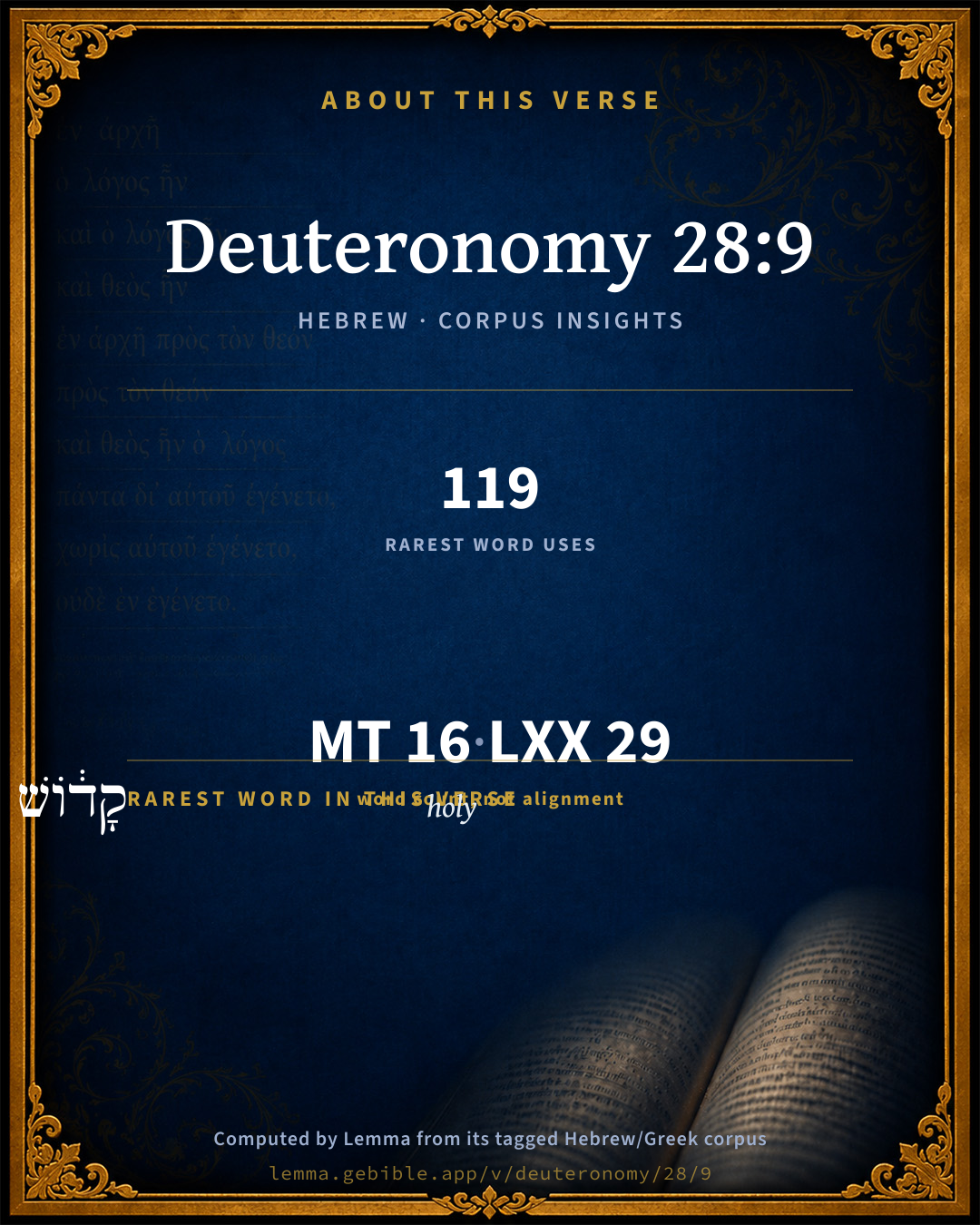
These counts appear in no published source. They are computed here, from the morphology-tagged text and Lemma’s own curated glosses. What Lemma adds →

16
words
13
distinct lemmas
Pentateuch
section

Grammatical profile

  • 4 verbs
  • 6 nouns
  • 1 adjective
  • 2 prepositions
  • 1 conjunction
  • 2 particles

Verb forms

  • יְקִֽימְךָ֨ Hiphil · Imperfect
  • נִֽשְׁבַּֽע Niphal · Perfect
  • תִשְׁמֹ֗ר Qal · Imperfect
  • וְהָלַכְתָּ֖ Qal · Sequential Perfect

Repetition

A word recurs within this verse — often emphatic in Hebrew:

  • יְהוָ֥ה LORD H3068 ×2

Hebrew & Septuagint length

In English translation the verse runs 31 words from the Hebrew and 33 from the Septuagint (LXX English) — closely comparable.

A rough comparison of the two English renderings, which tokenize alike — not a word-level alignment.

Word counts can differ between the Hebrew and the Greek without any difference in meaning — e.g. the Hebrew direct-object marker אֵת has no separate Greek word, and Greek often adds the article ὁ.

In the original languages it is 16 Hebrew tokens and 29 Greek tokens — but the two are counted differently (Hebrew bundles its prefixes and suffixes into one token; the Greek is in lemma form), so that isn’t a like-for-like length.

Cross-references

16

Topical passages linked to Deuteronomy 28:9 in the Treasury of Scripture Knowledge — connected by theme and wording, ordered by reader-vote popularity; previews shown in the World English Bible.

  • Exodus 19:5–6 Now therefore, if you will indeed obey my voice, and keep my covenant, then you shall be my own possession from among all peoples; for all the earth is mine;
  • Deuteronomy 7:6 For you are a holy people to Yahweh your God: Yahweh your God has chosen you to be a people for his own possession, above all peoples who are on the face of the earth.
  • Deuteronomy 26:18–19 and Yahweh has declared you this day to be a people for his own possession, as he has promised you, and that you should keep all his commandments;
  • Deuteronomy 13:17 There shall cleave nothing of the devoted thing to your hand; that Yahweh may turn from the fierceness of his anger, and show you mercy, and have compassion on you, and multiply you, as he has sworn to your fathers;
  • Titus 2:14 who gave himself for us, that he might redeem us from all iniquity, and purify for himself a people for his own possession, zealous for good works.
  • 1 Peter 2:9–11 But you are a chosen race, a royal priesthood, a holy nation, a people for God's own possession, that you may show forth the excellencies of him who called you out of darkness into his marvelous light:
  • Isaiah 62:12 They shall call them The holy people, The redeemed of Yahweh: and you shall be called Sought out, A city not forsaken.
  • 1 Peter 5:10 But may the God of all grace, who called you to his eternal glory by Christ Jesus, after you have suffered a little while, perfect, establish, strengthen, and settle you.
  • Deuteronomy 29:12–13 that you may enter into the covenant of Yahweh your God, and into his oath, which Yahweh your God makes with you this day;
  • Psalms 87:5 Yes, of Zion it will be said, "This one and that one was born in her;" The Most High himself will establish her.
  • Isaiah 1:26 I will restore your judges as at the first, And your counselors as at the beginning. Afterward you shall be called 'The city of righteousness, A faithful town.'
  • Deuteronomy 7:8 but because Yahweh loves you, and because he would keep the oath which he swore to your fathers, has Yahweh brought you out with a mighty hand, and redeemed you out of the house of bondage, from the hand of Pharaoh king of Egypt.
  • Jeremiah 11:5 that I may establish the oath which I swore to your fathers, to give them a land flowing with milk and honey, as at this day. Then answered I, and said, Amen, Yahweh.
  • 2 Thessalonians 3:3 But the Lord is faithful, who will establish you, and guard you from the evil one.
  • Hebrews 6:13–18 For when God made a promise to Abraham, since he could swear by none greater, he swore by himself,
  • Genesis 17:7 I will establish my covenant between me and you and your seed after you throughout their generations for an everlasting covenant, to be a God to you and to your seed after you.

Cross-references courtesy of OpenBible.info (CC BY 4.0).

Hebrew and Greek witnesses Masoretic Hebrew ↔ Greek Septuagint

The same verse in the two great witnesses to the Old Testament, shown verse-for-verse.

These are two independent witnesses, not word-aligned to each other, and the Septuagint is shown in lemma (dictionary) form.

Hebrew Deuteronomy 28:9 Masoretic · Westminster Leningrad Codex

יְקִֽימְךָ֨ יְהוָ֥ה לוֹ֙ לְעַ֣ם קָד֔וֹשׁ כַּאֲשֶׁ֖ר נִֽשְׁבַּֽע לָ֑ךְ כִּ֣י תִשְׁמֹ֗ר אֶת מִצְוֺת֙ יְהוָ֣ה אֱלֹהֶ֔יךָ וְהָלַכְתָּ֖ בִּדְרָכָֽיו

Yahweh will establish you for a holy people to himself, as he has sworn to you; if you shall keep the commandments of Yahweh your God, and walk in his ways.

World English Bible · Public Domain

Greek LXX Deuteronomy 28:9 Septuagint · lemma form

ἀναἵστημι σύ κύριος ὁ θεός σύ ἑαυτοῦ λαός ἅγιος ὅς τρόπος ὄμνυμι ὁ πατήρ σύ ἐάν εἰςἀκούω ὁ φωνή κύριος ὁ θεός σύ καί πορεύομαι ἐν ὁ ὁδός αὐτός

The Lord raise you up for himself a holy people, as he swore to your fathers; if you will hear the voice of the Lord your God, and walk in all his ways.

LXX2012 (modern English Septuagint) · Public Domain

On this verse, Ellicott's Commentary for English Readers discusses the Septuagint’s reading. Read the note in Commentary ↓

Hebrew: Westminster Leningrad Codex (CC BY 4.0). Greek: Septuagint (public domain); English from LXX2012 (modern English Septuagint) (Public Domain). How the Septuagint differs from the Hebrew →

Targum (Aramaic paraphrase)

2

The Targum is the ancient Jewish Aramaic paraphrase of the Hebrew Scriptures — an interpretive translation, not the Hebrew text itself. Onkelos (literal) and Pseudo-Jonathan (expansive) render the Torah, and Jonathan the Prophets. Coverage is partial: where no permissively-licensed English translation exists for a verse, only the Aramaic is shown. This is verse-level text, not a word-by-word alignment to the Hebrew.

  1. Targum Onkelos Torah (Genesis–Deuteronomy)
    יְקִימִנָךְ יְיָ לֵהּ לְעַם קַדִישׁ כְּמָא דִי קַיִים לָךְ אֲרֵי תִטַר יָת פִּקוּדַיָא דַיְיָ אֱלָהָךְ וּתְהַךְ בְּאָרְחָן דְתָקְנָן קֳדָמוֹהִי

    (no public-domain English translation for this verse)

    Targum Onkelos — Aramaic: “Onkelos Genesis” (public domain); “Onkelos Exodus” (public domain); “Onkelos Leviticus” (public domain); “Onkelos Numbers” (public domain); “Onkelos Deuteronomy” (public domain). English: “Sefaria Community Translation” (CC0 1.0 (public-domain dedication)); “J.W. Etheridge. The Targums of Onkelos and Jonathan Ben Uzziel on the Pentateuch. London: Longmans, Green, 1862” (public domain). Text via Sefaria.

  2. Targum Pseudo-Jonathan Torah (Genesis–Deuteronomy)
    יְקוּם יַתְכוֹן מֵימְרָא דַיְיָ קֳדָמוֹי לְעַם קַדִישׁ הֵיכְמָא דְמַלֵיל לְכוֹן אֲרוּם תִּנְטְרוּן יַת פִּיקוּדַיָא דַיְיָ אֱלָהָכוֹן וְתַהֲכוּן בְּאָרְחָן דְתַקְנָן קֳדָמוֹי

    The Word of the Lord will establish you to be a holy people before Him, as He hath said unto you, when you keep the commandments of the Lord your God, and walk in the ways that are right before Him.

    Targum Pseudo-Jonathan — Aramaic: “Targum Jonathan on Genesis” (public domain); “Targum Jonathan on Exodus” (public domain); “Targum Jonathan on Leviticus” (public domain); “Targum Jonathan on Numbers” (public domain); “Targum Jonathan on Deuteronomy” (public domain). English: “The Targum of Jonathan ben Uzziel, trans. J. W. Etheridge, London, 1862” (public domain). Text via Sefaria.

Commentary

Notes on Deuteronomy 28:9 from classic Christian and Jewish commentators (each source and its license shown beneath its notes). The classic Christian expositions comment on the surrounding passage and are grouped to its opening verse, so a note may address several verses; the Jewish commentaries on the Tanakh (Rashi and others) are per-verse, so they appear only where the commentator wrote on this verse.

Lemma curates 59 commentaries, every one of them public domain or Creative Commons licensed, each selected and text-cleaned for this edition rather than reprinted as found. About our sources →

Trapp's Complete Commentary

John Trapp

Deu 28:9 The LORD shall establish thee an holy people unto himself, as he hath sworn unto thee, if thou shalt keep the commandments of the LORD thy God, and walk in his ways.

Ver. 9. The Lord shall establish thee a holy people unto himself.] This is more and better than all the former: he shall "bless thee with all spiritual blessings, in heavenly things, in Christ Jesus." {Eph 1:3} He is rich, not that hath the world, but that can contemn it.

John Trapp, A Commentary or Exposition upon All the Books of the Old and New Testament (1647–1656) — public domain. Text from a community e-Sword module.

Joseph Benson's Commentary

Deu 28:9-10. Establish thee — Shall confirm his covenant with thee, by which he separated thee to himself as a holy and peculiar people. Called by the name of the Lord — That you are in truth his people and children: a most excellent and glorious people, under the peculiar care and countenance of the great God.

Joseph Benson's Commentary on the Old and New Testaments (1811–1818) — public domain. Text from a community e-Sword module.

Adam Clarke's Commentary

Verse 9. The Lord shall establish thee a holy people unto himself] This is the sum of all blessings, to be made holy, and be preserved in holiness.

If thou shalt keep, c.] Here is the solemn condition if they did not keep God's testimonies, taking them for the regulators of their lives, and according to their direction walking in his ways, under the influence and aids of his grace, then the curses, and not the blessings, must be their portion. See De 28:15, &c.

Adam Clarke's Commentary on the Bible (1810–1826) — public domain. Text from a community e-Sword/MySword module.

Ellicott's Commentary for English Readers

(9) The Lord shall establish thee an holy people—i.e., shall “maintain” thee in that position or shall “raise thee up” into it, and exalt thee to it, in its fullest sense. The word here employed has branched out into two lines of thought. In Jewish literature it has taken the sense of permanence and perpetuity. Through the LXX. translation it has given birth to the New Testament word for “resurrection.” (See Note on Deu_18:18, and comp. Act_3:26; 2Sa_7:12; 1Ch_17:11.)

A Bible Commentary for English Readers, edited by Charles John Ellicott (1878–1897) — public domain. Text from a community e-Sword module.

The Cambridge Bible for Schools and Colleges

gen. ed. J. J. S. Perowne

9. holy] See Deu_7:6, and note on Holiness, p. 108. Here (as the context shows) the meaning is not ethical, but = set apart for Himself, therefore inviolate; cp. Jer_2:3.

if thou shalt keep] Rather, for (ex hypothese) thou wilt be keeping. Cp. Dri.; Marti.: in case thou shalt. So there is no need to omit the clause with Steuern. and Staerk.

The Cambridge Bible for Schools and Colleges (gen. ed. J. J. S. Perowne; Cambridge University Press, 1878–1918) — public domain. Text from a community e-Sword module.

John Gill's Exposition

And all the people of the earth shall see that thou art called by the name of the Lord,.... Called his children, his people, his portion, and his inheritance; and that they are his, and he is theirs, by the care he takes of them, the provision he makes for them, and the protection they have from him:

and they shall be afraid of thee; as not only the Canaanites were, but all other nations; see Deu 11:25.

John Gill's Exposition of the Whole Bible (1746–1763) — public domain (CC PDM 1.0). Text via the HelloAO Bible API.

Matthew Poole's English Annotations

Shall establish thee an holy people unto himself, i.e. shall confirm and establish his covenant with thee, by which he separated thee to himself as a holy and peculiar people, and shall publicly own thee for such, as it follows, Deu 28:10.

Matthew Poole's English Annotations on the Holy Bible (1683–1685) — public domain. Text from a community e-Sword/MySword module.

The Pulpit Commentary

The Lord would establish them to be a people holy unto himself, in whose Blessed condition all would see that they were indeed his people, favored by him.

Established.

Probation, in the case of the faithful, ends in establishment. If Israel would keep the commandments, God would "perfect, stablish, strengthen, settle" them as "a holy people" to himself, and so confirm the promises made to the fathers. A like promise to the Church and to Christians. (Act_16:5; Rom_1:11; Col_2:7; Heb_13:9 1Pe_5:10; 2Pe_1:12) Establishment is:

1. Unto holiness.

2. A result of God naming his Name upon his people (ver. 12, Hebrew), i.e. dwelling with them, and revealing his attributes in saving, sanctifying, blessing, and exalting them.

3. The reward of fidelity.

4. A proof of God"s fidelity. God "hath sworn" to fulfill his word. J.O. (Heb_6:17, Heb_6:18; cf. 1Co_1:9; Php_1:6)

The Pulpit Commentary (1880–1919), ed. H.D.M. Spence-Jones & Joseph S. Exell — public domain. Text from a community e-Sword module.

John Wesley's Explanatory Notes

Establish thee - Shall confirm his covenant with thee, by which he separated thee to himself as an holy and peculiar people.

John Wesley, Explanatory Notes Upon the Whole Bible (1754–1765) — public domain. Text via the GEBible commentary corpus.

unfoldingWord translationNotes

Door43 World Missions Community

General Information:

Moses speaks to the Israelites as if they were one man, so the words "you" and "your" here are singular. (See: Forms of You)

Yahweh will establish you as a people that is set apart for himself

Yahweh choosing the people of Israel to belong to him in a special way is spoken of as if Yahweh put them in a place different from the place all other nations live in. AT: "Yahweh will make you a holy people that belongs to him" (See: Metaphor)

you are called by the name of Yahweh

Here the metonym "called by the name of Yahweh" means belonging to him. This can be stated in active form. AT: "Yahweh has called you his own" (See: Metonymy and Active or Passive)

translationWords

people group

set apart

oath

command

God

walk

earth

call

name

fear

unfoldingWord translationNotes — © Distant Shores Media and the Door43 World Missions Community, licensed CC BY-SA 4.0. Source: git.door43.org/Door43/en_tn.

Ramban (Nachmanides)

Rabbi Moshe ben Nachman (Ramban / Nachmanides)

THE ETERNAL WILL ESTABLISH THEE FOR A HOLY PEOPLE UNTO HIMSELF AS HE HATH SWORN UNTO THEE. He applies the term “oath” to the covenant which He made with them at Mount Sinai concerning all these things, for there it was said, And ye shall be unto Me a kingdom of priests, and a holy nation. Or it may be that the covenant He made with Abraham to be a G-d unto thee and to thy seed after thee includes this one.. Similarly he said, that He may establish thee this day unto Himself for a people, and that He may be unto thee a G-d, as He spoke unto thee, and as He swore unto thy fathers, to Abraham, to Isaac, and to Jacob, for the covenant was made for all of them.

Ramban (Nachmanides) on the Tanakh — English translation: “Commentary on the Torah by Ramban (Nachmanides). Translated and annotated by Charles B. Chavel. New York, Shilo Pub. House, 1971-1976” (CC BY 4.0). Text via Sefaria.

Lesson kit

Teaching starters — assembled from the data on this page, not authored interpretation. Every prompt links to the verse data it draws on. Edit before teaching.

Deuteronomy, in the Pentateuch, opens this verse with 16 words (13 distinct Hebrew lemmas). Its most distinctive word is qâdôwsh (“holy”). A historical commentator’s framing appears above. Read the whole chapter for the surrounding context.

Discussion questions

  1. The word qâdôwsh carries the sense “holy.” How does it shape the verse?
  2. Exodus 19:5–6 shares this passage’s theme. How do the two illuminate each other?
  3. “LORD” occurs 2× in this one verse. What is the effect of the repetition?
  4. The translations on this page render this verse differently — a whole-verse word diff, not a word-by-word alignment. What might account for the different wordings?
  5. The verb «יְקִֽימְךָ֨» is Hiphil Imperfect. How does its form color the action?
  6. Reading how Trapp's Complete Commentary and Joseph Benson's Commentary read this verse, where do the two commentators agree and where do they part?

Things to notice

Reading settings

Reading text

Shown beneath each verse's original-language words.

Old Testament
Old Testament edition

Read the OT as the Masoretic Hebrew (MT) or the Greek Septuagint (LXX).

English shown for the Greek Septuagint (in the Hebrew ↔ Greek comparison).

Comparing translations? Open the Compare panel on any verse page to stack up to four side by side.