

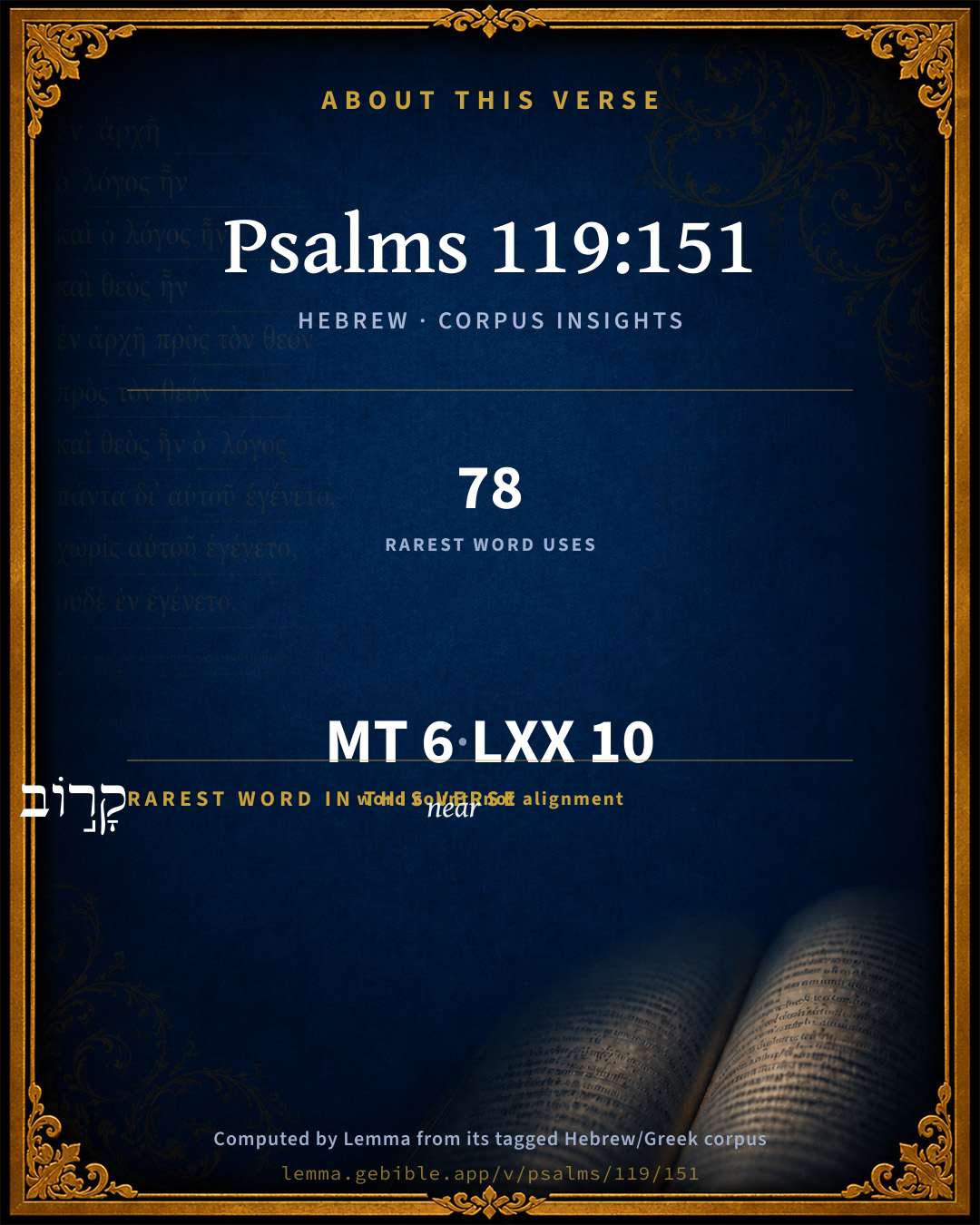
Psalms 119:151

Hebrew (Westminster Leningrad Codex) Psalms 119:151 appears in the Hebrew Old Testament. The text above is from the Westminster Leningrad Codex. Each word links to its Strong’s number, a concise gloss, and parsing drawn from the Open Scriptures Hebrew Bible morphology. Click any word for its full Brown-Driver-Briggs (BDB) entry.
Download image
Cite this verse

Psalms 119:151 (World English Bible). Public Domain. Lemma interlinear Bible study tool, https://lemma.gebible.app/v/psalms/119/151.

Show BibTeX & RIS
BibTeX
RIS
English Translation
You are near, Yahweh. All your commandments are truth.
World English Bible · Public Domain
Download a study sheet

One document with this verse’s original text, its word-by-word gloss line, the meaning frame, cross-references with their text, attributed commentary, and full source and license credits — printable, and it pastes into notes with its structure intact.

This verse Autodidact and up

Study sheet (.html) Plain text (.txt)

A passage Seminary Student

Up to 50 verses in one chapter. A passage sheet keeps up to 6 commentary sources and 12 cross-references per verse, in the order this page ranks them, and says so on the sheet whenever that leaves anything out. Ask for a single verse and you get the Autodidact verse sheet above.

Everything on this page stays free to read, with no account — the sheet is a download of what is already on screen, not access to it.

Want to remove ads? Support Godless Engineer
Compare translations 3

The same verse in 3 English versions, stacked beneath the original-language interlinear above. Click any original word for its lexicon entry.

Each is an independent rendering of the whole verse — the interlinear is not word-aligned to these translations.

Highlighted words mark where these versions differ — a whole-verse word diff, not a word-by-word alignment.

  • World English Bible Public Domain
    You are near, Yahweh. All your commandments are truth.
  • King James Version Public Domain
    Thou art near, O LORD; and all thy commandments are truth.
  • unfoldingWord Literal Text CC BY-SA 4.0
    Near you, Yahweh, and all your commandments truth.

unfoldingWord Literal Text — © unfoldingWord, licensed CC BY-SA 4.0. Word-aligned USFM3 via Door43 (git.door43.org/unfoldingWord/en_ult).

Versions to compare (up to 4)

3 of 4 selected

Show all 17 translations

Every available English version of this verse, each an independent rendering of the whole verse.

  • World English Bible Public Domain
    You are near, Yahweh. All your commandments are truth.
  • Berean Standard Bible Public Domain
    You are near, O LORD, and all Your commandments are true.
  • Majority Standard Bible Public Domain
    You are near, O LORD, and all Your commandments are true.
  • King James Version Public Domain
    Thou art near, O LORD; and all thy commandments are truth.
  • American Standard Version (1901) Public Domain
    Thou art nigh, O Jehovah; And all thy commandments are truth.
  • Revised Version (1885) Public Domain
    Thou art nigh, O LORD; and all thy commandments are truth.
  • Geneva Bible (1599) Public Domain
    Thou art neere, O Lord: for all thy commandements are true.
  • Young's Literal Translation Public Domain
    Near `art' Thou, O Jehovah, And all Thy commands `are' truth.
  • Literal Standard Version CC BY-SA 4.0
    You [are] near, O YHWH, || And all Your commands [are] truth.
  • Unlocked Literal Bible CC BY-SA 4.0
    You are near, Yahweh, and all your commandments are trustworthy.
  • unfoldingWord Literal Text CC BY-SA 4.0
    Near you, Yahweh, and all your commandments truth.
  • Darby Bible Public Domain
    Thou, Jehovah, art near, and all thy commandments are truth.
  • World Messianic Bible Public Domain
    You are near, LORD. All your commandments are truth.
  • Webster's Bible Public Domain
    Thou art near, O LORD; and all thy commandments are truth.
  • Free Bible Version CC BY-SA 4.0
    But you, Lord, are close beside me; all your commandments are true.
  • Bible in Basic English Public Domain
    You are near, O Lord; and all your teachings are true.
  • JPS Tanakh (1917) Public Domain
    Thou art nigh, O LORD; and all Thy commandments are truth.

Literal Standard Version (2020), Covenant Press — licensed CC BY-SA 4.0. Text via the HelloAO Bible API (eBible.org). Unlocked Literal Bible (unfoldingWord) — licensed CC BY-SA 4.0. Text via the HelloAO Bible API (eBible.org). unfoldingWord Literal Text — © unfoldingWord, licensed CC BY-SA 4.0. Word-aligned USFM3 via Door43 (git.door43.org/unfoldingWord/en_ult). Free Bible Version, Dr. Jonathan Gallagher — licensed CC BY-SA 4.0. Text via the HelloAO Bible API (eBible.org).

Word by word

More ways to search: Search by grammar → Find every occurrence → Compare this word →

Practice this passage: Drill this verse → Learn its vocabulary →

About this verse

These counts appear in no published source. They are computed here, from the morphology-tagged text and Lemma’s own curated glosses. What Lemma adds →

6
words
6
distinct lemmas
Wisdom
section

Grammatical profile

  • 4 nouns
  • 1 adjective
  • 1 pronoun

Hebrew & Septuagint length

In English translation the verse runs 9 words from the Hebrew and 11 from the Septuagint (LXX English) — closely comparable.

A rough comparison of the two English renderings, which tokenize alike — not a word-level alignment.

Word counts can differ between the Hebrew and the Greek without any difference in meaning — e.g. the Hebrew direct-object marker אֵת has no separate Greek word, and Greek often adds the article ὁ.

In the original languages it is 6 Hebrew tokens and 10 Greek tokens — but the two are counted differently (Hebrew bundles its prefixes and suffixes into one token; the Greek is in lemma form), so that isn’t a like-for-like length.

Cross-references

9

Topical passages linked to Psalms 119:151 in the Treasury of Scripture Knowledge — connected by theme and wording, ordered by reader-vote popularity; previews shown in the World English Bible.

  • Psalms 145:18 Yahweh is near to all those who call on him, To all who call on him in truth.
  • Psalms 119:142 Your righteousness is an everlasting righteousness. Your law is truth.
  • Psalms 34:18 Yahweh is near to those who have a broken heart, And saves those who have a crushed spirit.
  • Psalms 139:2 You know my sitting down and my rising up. You perceive my thoughts from afar.
  • Deuteronomy 4:7 For what great nation is there, that has a god so near to them, as Yahweh our God is whenever we call on him?
  • Psalms 46:1 God is our refuge and strength, A very present help in trouble.
  • Psalms 75:1 We give thanks to you, God, We give thanks, for your Name is near. Men tell about your wondrous works.
  • Psalms 119:138 You have commanded your statutes in righteousness. They are fully trustworthy.
  • Matthew 1:23 "Behold, the virgin shall be with child, And shall bring forth a son. They shall call his name Immanuel;" Which is, being interpreted, "God with us."

Cross-references courtesy of OpenBible.info (CC BY 4.0).

Hebrew and Greek witnesses Masoretic Hebrew ↔ Greek Septuagint

The same verse in the two great witnesses to the Old Testament, shown verse-for-verse.

You’re reading Greek Psalm 118 (Hebrew Psalm 119). The Septuagint counts the superscription, so verse numbers can differ from the Hebrew — chapter-level alignment, not verse-by-verse. Numbering follows Rahlfs.

These are two independent witnesses, not word-aligned to each other, and the Septuagint is shown in lemma (dictionary) form.

Hebrew Psalms 119:151 Masoretic · Westminster Leningrad Codex

קָר֣וֹב אַתָּ֣ה יְהוָ֑ה וְֽכָל מִצְוֺתֶ֥יךָ אֱמֶֽת

You are near, Yahweh. All your commandments are truth.

World English Bible · Public Domain

Greek LXX Greek Psalm 118:151 Septuagint · lemma form

ἐγγύς εἰμί σύ κύριος καί πᾶς ὁ ἐντολή σύ ἀλήθεια

You are near, O Lord; and all your ways are truth.

LXX2012 (modern English Septuagint) · Public Domain

Hebrew: Westminster Leningrad Codex (CC BY 4.0). Greek: Septuagint (public domain); English from LXX2012 (modern English Septuagint) (Public Domain). How the Septuagint differs from the Hebrew →

Commentary

Notes on Psalms 119:151 from classic Christian and Jewish commentators (each source and its license shown beneath its notes). The classic Christian expositions comment on the surrounding passage and are grouped to its opening verse, so a note may address several verses; the Jewish commentaries on the Tanakh (Rashi and others) are per-verse, so they appear only where the commentator wrote on this verse.

Lemma curates 59 commentaries, every one of them public domain or Creative Commons licensed, each selected and text-cleaned for this edition rather than reprinted as found. About our sources →

Trapp's Complete Commentary

John Trapp

Psa 119:151 Thou [art] near, O LORD; and all thy commandments [are] truth.

Ver. 151. Thou art near, O Lord] To counterwork and control the enemy; as also to safeguard and support thy people.

John Trapp, A Commentary or Exposition upon All the Books of the Old and New Testament (1647–1656) — public domain. Text from a community e-Sword module.

The Biblical Illustrator

Joseph S. Exell

Psa_119:151

Thou art near, O Lord.

The nearness of God

I. God is near us in the hour of human desertion. We are never in reality alone, never in reality deserted. On our right hand and on our left the Invisible walks.

II. God is near us in the hour of temptation. When an army goes forth to battle, a true leader goes forth with it. In the supreme moment of his destiny, whether of downfall or triumph, God always stands by a follower.

III. The nearness of god to us is seen in the various experiences of our life and growth. Now it is hard to analyze the sources and causes of growth. Ask the rose how it grows. Say to it, Whence came your sweetness and the royal colour of your leaves? and the rising volume of its fragrance is your only answer. It cannot say how much it owes to the sun, how much to the shower, how much to the cloud, nor whether day or night brought most of perfume and beauty to it. So it is with the soul. You ask some aged Christian whence came her purity, her patience, her calm reliance and that hope of hers,--and can she tell you? No! She only knows that she is as she is through the grace of God. You may grope in darkness or walk in light, but He unto whom the light and darkness are one is over with you. (W. H. H. Murray.)

The nearness of God

I. The momentous import of the solemn fact. I hear people speaking of loneliness, and saying how chill is life, how bitter is their lot! What an implied insult to a God who is ever so near!

II. A few of the consequences which this important fact involves.

1. Then God knows all about us.

2. He not only knows us, but sees much to abhor.

3. He can also appreciate the good. The presence of God, then, should excite two vast opposing influences. It is deterrent to the bad, it is a help to the good. (Homilist.)

Nearer, my God, to Thee

Even in view of our folly and our failure, we who love the Lord will still rejoice that God sees us. We cannot hide our secret sins from Him, and I do not think we wish to.

I. In what senses is God near to His people?

1. He draws near to them by virtue of the sacrifice of Christ.

2. Moreover, through the indwelling of the Spirit the Lord is near to us, not merely above us and about us, behind us and beneath us, compassing us about with songs of deliverance, but dwelling in the human heart.

II. To whom does God thus specially approach?

1. To the lowly.

2. To the prayerful.

3. To those who are in trouble.

4. To the broken-hearted.

III. What is the result of this Divine proximity?

1. Recognizing this, we shall feel strong. If the Lord is near, it matters little who else is near, friend or foe.

2. His presence should make us very watchful.

3. If we know that God is near, we shall begin to want Him to be nearer still. (T. Spurgeon.)

The Biblical Illustrator, edited by Joseph S. Exell (c. 1880s–1900s) — public domain. Text from a community e-Sword module.

Joseph Benson's Commentary

Psa 119:151-152. Thou art near, O Lord — Namely, to me. Thou art as ready and present to succour me, as they are to molest me. And all thy commandments are truth — Considered with the promises and threatenings which belong to them, and are always either expressed or implied. Concerning thy testimonies, I have known of old — By my own long experience, ever since I arrived at any knowledge in those matters; that thou hast founded them for ever — Thou hast established them upon everlasting foundations. They are as unalterable as the attributes of their great Author, and can never fail those who rely upon them, in time or in eternity.

Joseph Benson's Commentary on the Old and New Testaments (1811–1818) — public domain. Text from a community e-Sword module.

J. A. Alexander on Psalms

Joseph Addison Alexander

151. (Psa 119:151) Near (art) thou, Jehovah, and all thy commandments are truth. The lusus verborum may be said to be continued. As they are near to injure, thou art near to save, and all thy promises to those who do thy will are true, are truth itself.

Joseph Addison Alexander, The Psalms Translated and Explained (1850) — public domain. Text from a community e-Sword module.

Adam Clarke's Commentary

Verse 151. Thou art near] As they are near to destroy, so art thou near to save. When the enemy comes in as a flood, the Spirit of the Lord lifts up a standard against him.

Adam Clarke's Commentary on the Bible (1810–1826) — public domain. Text from a community e-Sword/MySword module.

John Calvin's Commentaries

151. Thou, O Jehovah! art near. He encourages himself from the consolatory consideration, that God, when he sees his own people sore pressed, comes forward, seasonably to afford them succor; even as Paul on this subject says,

“Be not over-careful, the Lord is at hand, let your moderation be known to all men ” (Philippians 4:5)

The concluding sentence of the verse is to this effect, That God never forsakes nor disappoints his people in their necessity, because he is true to his promises; and in them he assures us, that the welfare of his people will always be the object of his care. That therefore we may be fully persuaded that the hand of God is always ready to repulse the assaults of our enemies, let us retain a settled belief of the truth, that he does not in vain promise in his word to be the guardian of our welfare.

John Calvin's Commentaries (1540-1563) — public domain. Text from the Calvin Translation Society English edition (1840s-50s) via the Christian Classics Ethereal Library (ccel.org). Calvin's coverage is partial (roughly two-thirds of the Bible); uncommented books and verses are honest gaps, never fabricated. The 19th-century editor's footnotes and remarks are omitted so the notes are faithfully Calvin's own voice.

John Gill's Exposition

Salvation is far from the wicked,.... Christ, the author of salvation, is far from them: he was far from the unbelieving Jews, even though salvation was of them, and he, the Saviour, was among them; and he is far from all unconverted persons, as to knowledge of him, faith in him, or love to him; and from all those that seek for salvation elsewhere, let them make ever such pretences to religion: the word of salvation is far from them, as Kimchi; the Gospel of salvation, which they put away from them, as the Jews did in the times of Christ and the apostles; an experimental knowledge of salvation, a sense of need of it, and an application of it, are far from them; and the enjoyment of it in heaven, which, though nearer the saints than when they first believed, is far off from the wicked, and whose damnation is near: Aben Ezra interprets it,

"the days of salvation;''

for they seek not thy statutes; either to know them, or keep them: they seek not after God, to know him, his mind and will; the language of their hearts and actions is, "depart from us, we desire not the knowledge of thy ways"; no, not of life and salvation, and therefore it must be far from them, Job 21:14.

John Gill's Exposition of the Whole Bible (1746–1763) — public domain (CC PDM 1.0). Text via the HelloAO Bible API.

Albert Barnes' Notes on the Bible

Thou art near, O Lord - God was present with him; he was ready to hear his cry; he was at hand to save him. Compare Psa 145:18. The psalmist had the assurance, springing from deep feeling, and the conscious presence of God, which the people of God often have, that God is very near to them; that he is ready to hear them; that their prayers are answered; that they are in the presence of a heavenly Friend. Such are among the precious experiences of the life of a religious man.

And all thy commandments are truth - All that thou hast ordained; all that thou hast promised. The psalmist felt this. He was experiencing the truth of what God had assured him of. Not a doubt came into his mind - for God was near him. This conviction that God is “near” us - this manifestation of God to the soul as a present God - is one of the most certain assurances to our own minds of the truth of religion, and of our acceptance with him.

Albert Barnes' Notes on the Bible (1834–1885) — public domain. Text from a community e-Sword/MySword module.

Matthew Poole's English Annotations

Thou art near to me. Thou art as ready and present to succour me as they are to molest me.

Thy commandments; considered with the promises and threatenings, which are frequently annexed to them. Or, the promises, as this word seems to be used, Psa 111:7, and elsewhere in this Psalm. And God is said to command not only his precepts, or the observation thereof, but also his covenant, Psa 105:8; 111:9, which is a collection or body of the promises; and his loving-kindness, Psa 42:8, which is the fountain of the promises; and his blessing, Psa 133:3, which is the fruit of his promises; and deliverances, Psa 44:4, which are the things promised. And therefore it is not strange if he promises be sometimes called commandments.

Matthew Poole's English Annotations on the Holy Bible (1683–1685) — public domain. Text from a community e-Sword/MySword module.

The Treasury of David

Charles H. Spurgeon

Ver. 151. Thou art near, O Lord. Near as the enemy might be, God was nearer: this is one of the choicest comforts of the persecuted child of God. The Lord is near to hear our cries, and to speedily afford us succour. He is near to chase away our enemies, and to give us rest and peace.

And all thy commandments are truth. God neither commands a lie, nor lies in his commands. Virtue is truth in action, and this is what God commands. Sin is falsehood in action, and this is what God forbids. If all God's commands are truth, then the true man will be glad to keep near to them, and therein he will find the true God near him. This sentence will be the persecuted man's protection from tile false hearts that seek to do him mischief: God is near and God is true, therefore his people are safe. If at any time we fall into danger through keeping the commands of God we need not suppose that we have acted unwisely: we may, on the contrary, be quite sure that we are in the right way; for God's precepts are right and true. It is for this very reason that wicked men assail us: they hate the truth, and therefore hate those who do the truth. Their opposition may be our consolation; while God's presence upon our side is our glory and delight.

Ver. 151. Thou art near, O Lord. How sweetly and how often has this thought been brought home to some forsaken and forgotten one! "When my father and my mother forsake me, the Lord will take me up, "was the comfort of one in that deep affliction. And in the first out breaking of the heart, how sweetly has the conviction come, like some whisper of peace, "I am with thee!" And I have no doubt that many and many a time in those hours of solitary prayer, when before the dawning of the morning, and before the night watches, or the Psalmist arose at midnight to commune with God, when no voice broke on the stillness, and every sound was hushed save the beating of his own heart, then had David heard the whisper of God's Holy Spirit, "I am near, ""Fear not, I am with thee." Barton Bouchier.

Ver. 151. Thou art near, O Lord. This was once man's greatest blessing, and source of sweetest consolation. It was the fairest flower which grew in Paradise; but sin withered it, the flower faded, it drooped, it died. Ge 3:8 4:16. It must be so once more; the flower must once again bloom, again it must revive; even upon earth must it blossom, or in heaven it will never put forth its fragrance.

Thou art near. Even in thy works of "creation", in the sun in his glory, in the moon in her softness, gleaming in the firmament, I see thee. In the balm of this fragrant air, in the light of this cheerful day, in the redolence of these shrubs around me, whose flowery tops, as they drink in the soft and gentle shower as it falls, seem to breathe forth a fresh perfume in gratitude to him who sends it. In the melody of these birds which fill the air with their Songs, thou, O Lord, art near. I perceive thee not with my bodily eyes, although by these I discern thy workmanship, and with the eye of the mind behold thee in thy works, a present God.

Thou art near. Even in the book of thy providence, dark and mysterious though it be, I see thee. There do I read thy wisdom, as developed in thy world, thy church, thy saints, thy servant before thee; the wisdom that guides, the wisdom that guards, the wisdom that bestows, the wisdom that encourages, the wisdom that corrects, that kills and makes alive. There do I read thy power, thy justice, thy faithfulness, thy holiness, thy love.

But it is in thy Son, thy beloved Son, that I most clearly and distinctly see thee as near. If in creation, if in providence, thou art near, in him thou art very near. O Lord. Near as a sin forgiving God. Ro 8:1. Near as a promise-keeping God. 2Co 1:20. Near as a prayer hearing God. Joh 16:20; Ps 145:18. Near as a covenant keeping God. Heb 8:10. Near as a gracious, tender Father. Joh 20:17.

Thou art near, O Lord. O that I might live in the constant sense of thy nearness to me! How often, far too often, alas, do I seem quite to forget it!

Art thou near? Then may I realizingly remember, that by the blood of thy dear Son, and by that alone, have I been brought nigh (Eph 4:13); that it required nothing less than the stoop of Deity, and the sufferings and death of Iris perfect humanity, to remove those hindrances which interposed between a holy God and an unholy creature. Oh, to walk before thee with a grateful spirit, and with a broken, contrite heart!

Art thou near? Then may I walk as before thee, as seeing thee, in holy fear, in filial love, in simple faith, in child like confidence. Ge 17:1. When sin would tempt and solicit indulgence, when the world presents some new allurement, when Satan would take advantage of constitution, society, circumstances, oh, that I may ever remember "Thou art near."

If my dearest comforts droop and die, if friends are cool, if the bonds once the firmest, the closest, the tenderest, are torn asunder and dissevered, yet may I still remember, "Thou art near, O Lord, "and not afar off. And when the solemn moment shall come, when heart and flesh shall fail, when all earthly things are seen with a dying eye, when I hear thee say, "Thou must die, and not live, "then, oh then may I remember, with all the composedness of faith, and all the liveliness of hope, and all the ardour of love, "Thou art near, O Lord." James Harington Evans, 1785-1849.

Ver. 151. All thy commandments are truth. His meaning is, Albeit, O Lord, the evil will of wicked men follows me because I follow thee; yet I know thy commandments are true, and that it is not possible that thou canst desert or fail thy servants who stand to the maintenance of thy word. Then, ye see, David's comfort in trouble was not in any presumptuous conceit of his own wisdom or strength, but in the truth of God's promises, which he was persuaded could not fail him. And here also he makes a secret opposition between the word of the Lord and the word of his enemies. Sometimes men command, but without reason; sometimes they threaten, but without effect. Herod's commanding, Rabshakeh's railing, Jezebel's proud boasting against Elijah, may prove this. But as to the Lord our God he is alway better than his word, and his servants shall find more in his performance hereafter than now they can perceive in his promise: like as his enemies should find more weight in his judgments than now they can apprehend in his threatenings. William Cowper.

Ver. 151 (last clause). The commandments of the Lord are true in principle; they lead to true living, if carried out; they truly reward the obedient; they never lead to falsehood, nor cause to be deluded.

Psalms 119:152*

Charles H. Spurgeon's The Treasury of David (1869–1885) — public domain. Psalms only. Text from a community e-Sword/MySword module.

The Pulpit Commentary

Thou art near, O Lord. If "they draw nigh," still more near art thou, ready to succor and defend and save. (comp. Psa_145:18) And all thy commandments are truth (comp. ver. 142, "Thy Law is the truth;" and see the comment on that passage).

The Pulpit Commentary (1880–1919), ed. H.D.M. Spence-Jones & Joseph S. Exell — public domain. Text from a community e-Sword module.

unfoldingWord translationNotes

Door43 World Missions Community

all your commandments are trustworthy

"I can trust your commandments"

covenant decrees

Other possible meanings are "testimonies" or "laws." See how you translated this in Psalms 78:5

set them in place

The psalmist speaks of Yahweh's commands as if they were posts set in the ground. AT: "given them for people to obey" (See: Metaphor)

translationWords

command

trust

covenant

decree

eternity

unfoldingWord translationNotes — © Distant Shores Media and the Door43 World Missions Community, licensed CC BY-SA 4.0. Source: git.door43.org/Door43/en_tn.

Rashi

Rabbi Shlomo Yitzchaki (Rashi)

You are near to these faraway people, who distance themselves from Your Torah, if they repent of their way.

Rashi on the Tanakh — English translations: “The Judaica Press complete Tanach with Rashi, translated by A. J. Rosenberg” (CC BY 4.0); “Pentateuch with Rashi's commentary by M. Rosenbaum and A.M. Silbermann, 1929-1934” (public domain); “The Metsudah Tanach series, Lakewood, N.J” (CC BY 4.0); and “The Book of Joshua, Metsudah Publications, 1997” (CC BY 4.0). Text via Sefaria.

Lesson kit

Teaching starters — assembled from the data on this page, not authored interpretation. Every prompt links to the verse data it draws on. Edit before teaching.

Psalms, in the Wisdom, opens this verse with 6 words (6 distinct Hebrew lemmas). Its most distinctive word is qârôwb (“near”). A historical commentator’s framing appears above. Read the whole chapter for the surrounding context.

Discussion questions

  1. What does “near” (qârôwb) contribute to the verse as a whole?
  2. Psalms 145:18 shares this passage’s theme. How do the two illuminate each other?
  3. The translations on this page render this verse differently — a whole-verse word diff, not a word-by-word alignment. What might account for the different wordings?
  4. Reading how Trapp's Complete Commentary and The Biblical Illustrator read this verse, where do the two commentators agree and where do they part?

Things to notice

Reading settings

Reading text

Shown beneath each verse's original-language words.

Old Testament
Old Testament edition

Read the OT as the Masoretic Hebrew (MT) or the Greek Septuagint (LXX).

English shown for the Greek Septuagint (in the Hebrew ↔ Greek comparison).

Comparing translations? Open the Compare panel on any verse page to stack up to four side by side.